

Middle East and Africa Dry Stack Boat Storage Market Size & Forecast:
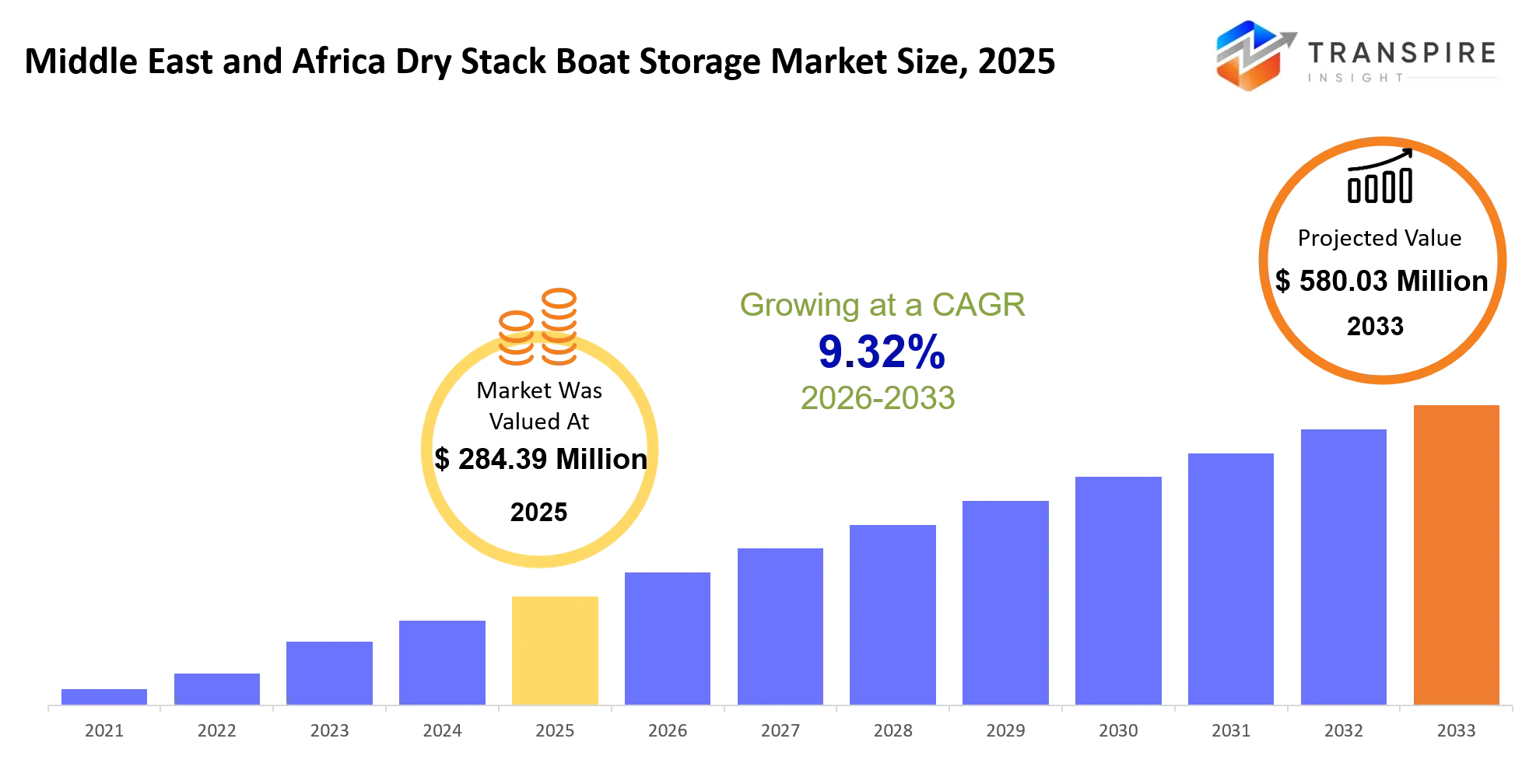
- Middle East and Africa Dry Stack Boat Storage Market Size 2025: USD 284.39 Million
- Middle East and Africa Dry Stack Boat Storage Market Size 2033: USD 580.03 Million
- Middle East and Africa Dry Stack Boat Storage Market CAGR: 9.32%
- Middle East and Africa Dry Stack Boat Storage Market Segments: By Storage Type (Indoor Dry Stack Storage, Outdoor Dry Stack Storage, Covered Storage, Uncovered Storage, Automated Storage Systems, Others); By Boat Type (Powerboats, Sailboats, Fishing Boats, Personal Watercraft, Yachts, Others); By Facility Type (Marinas, Boat Clubs, Private Storage Facilities, Yacht Clubs, Others); By End User (Recreational Boaters, Commercial Operators, Rental Service Providers, Tourism Companies, Others)
To learn more about this report,  Download Free Sample Report
Middle East and Africa Dry Stack Boat Storage Market Summary
The Middle East and Africa Dry Stack Boat Storage Market was valued at USD 284.39 Million in 2025. It is forecast to reach USD 580.03 Million by 2033. That is a CAGR of 9.32% over the period.
The Middle East and Africa Dry Stack Boat Storage Market seems to play a kinda practical role in fixing one of boating’s most stubborn headaches, the lack of waterfront space for storing vessels. In simple terms, dry stack facilities keep boats inside multi level rack systems on land. They protect vessels from water exposure, which cuts down on maintenance, and lets marinas fit more boats without pushing to expand their shoreline. So the whole model turns out pretty useful for coastal tourism hot spots, yacht focused destinations, and marina projects where space is already tight.
Over the last five years, the market has moved away from the more traditional dockside storage mindset, and leaned more toward high density rack storage that’s paired with automated boat handling equipment. One big reason for this change has been the fast growth of marina and waterfront tourism developments across the Gulf area, especially the UAE and Saudi Arabia. As governments keep putting strong investments into marine leisure infrastructure, marina operators are looking for storage options that help them maximize berth utilization, while also improving land efficiency. This is also creating new revenue opportunities for marina operators, boosting vessel turnover rates, and making it easier to see wider adoption of premium storage services throughout the region.
Key Market Insights
- Saudi Arabia kind of dominates the regional market, with about 31% of the revenue share in 2024 , and that is backed by these large-scale marina projects.
- Saudi Arabia also stays the fastest-growing country market through 2030, mostly because Red Sea tourism keeps building momentum , plus the coastal infrastructure expansion never really slows down.
- In terms of product type, custom rack storage feels like it takes the lead with nearly 75% market share. This mainly shows operator preference for squeezing in more storage capacity, while still keeping vessel access easier.
- Enclosed rack systems end up as the second biggest segment too, since luxury boat owners want better protection, especially under harsh coastal conditions.
- Custom rack storage is also the fastest-growing segment through 2033. That’s due to how flexible it is across recreational boats and, broader than that, yachts.
- For end-use applications, marine and marina-based applications account for the largest share. Operators try to make better use of waterfront space, and improve storage turnover rates, so it fits how they operate day to day.
- Luxury yacht and superyacht storage services are starting to show up as a high-growth application across Gulf marina destinations.
- Private boat owners remain the leading end-user group as well , largely because maintenance costs are lower and vessel protection is better.
- Commercial marina operators are the fastest-growing end-user segment, since new waterfront projects continue to come online across the Gulf region.
- Major players such as Safe Harbor Marinas, Suntex Marinas, IGY Marinas, D-Marin, MarineMax, and Brunswick Corporation are putting money into digital booking systems, marina expansion, and those premium customer experiences people actually remember.
What are the Key Drivers, Restraints, and Opportunities in the Middle East and Africa Dry Stack Boat Storage Market?
The strongest growth driver comes from large-scale coastal tourism and marina development programs across Gulf countries. In Saudi Arabia and the UAE, government backed projects have helped speed up investment in marine leisure infrastructure, which in turn creates pressure on marina operators to push vessel capacity up while not exactly securing more waterfront land. Dry stack systems kinda solve this by increasing storage density and at the same time reducing vessel maintenance exposure. As more marinas adopt these high-capacity storage formats, operators end up generating more revenue per square meter of developed waterfront space, so project economics look better, and it becomes easier to justify more deployment.
The biggest barrier though is that dry stack infrastructure is capital intensive. Facilities need specialized rack systems, lifting equipment, reinforced structures, and proper waterfront integration. These investments often go beyond what smaller marina operators can realistically fund. The problem is structural, because waterfront construction, permitting requirements, and specialized engineering know-how can’t be scaled quickly, even if demand jumps. Because of that, several potential projects stay on hold, and that slows market penetration while shrinking near term revenue opportunities.
A major opportunity sits in integrating dry stack storage inside next generation luxury marina developments. Gulf countries are increasingly positioning themselves as international yachting destinations. New projects linked to tourism corridors and waterfront real estate growth are opening doors for automated storage solutions, digital reservation platforms, and premium concierge services.
What Has the Impact of Artificial Intelligence Been on the Middle East and Africa Dry Stack Boat Storage Market?
Artificial intelligence is slowly, kind of transforming dry stack boat storage work by making facility efficiency better , using the equipment more effectively, and improving how customers are handled. More and more marina operators are turning to AI assisted scheduling systems that try to coordinate boat retrieval routines, launch sequencing, and storage allocation all at once. In practice, these tools can reduce those annoying waiting times during busy periods, and they also tend to raise crane utilization rates.
Then there are machine learning tools that are quietly helping with predictive maintenance. They examine sensor readings from lifts, cranes, and other handling gear, so operators can spot wear cycles earlier than the equipment would normally “say” something. That approach lowers unexpected downtime, helps extend equipment lifespan, and generally boosts facility readiness. A few more advanced marina management platforms also lean on predictive analytics to forecast storage occupancy, seasonal demand shifts, and berth utilization direction. This kind of visibility can let operators tune pricing and staffing levels with less guesswork.
At the same time, digital ecosystems are showing up more often in higher end marina networks, which makes online booking easier, strengthens customer engagement, and supports an operational workflow that is more organized. Some early rollouts already showed measurable improvements in booking speed and customer convenience.
Still, adoption is not fully smooth. AI uptake stays limited by integration costs and fragmented data environments. A lot of facilities still run on legacy infrastructure with minimal sensor connectivity, so it becomes hard to gather the sort of clean operational data advanced predictive models really need. Smaller operators also struggle with the business case, because if vessel volumes stay modest it is harder to justify spending on sophisticated digital platforms, even if the long term benefits could be real.
Key Market Trends
- Since 2021, Gulf waterfront developments have basically sped up the uptake of high-capacity rack storage, to squeeze more use out of the limited marina land , you know.
- In 2024, rack storage alone passed 75% share, and that’s a sign of a broader move toward flexible multi-vessel accommodation, not just single-asset thinking.
- Marina operators are also starting to bundle storage, maintenance and concierge type services together , which helps them keep recurring revenue steady over time.
- Digital marina platforms meanwhile are getting adopted faster, and a number of operators even say around 20% of bookings are finished online.
- On top of that, luxury yacht tourism keeps expanding, so demand rises for protected storage solutions across the more premium Gulf destinations.
- Since 2023, developers have leaned into integrated marina communities instead of building standalone storage infrastructure , as if the whole place should work like one system.
- Regional operators have been growing mostly through partnerships and management contracts , rather than relying only on greenfield development.
- And sustainability concerns are increasingly shaping marina design, pushing for more efficient land use and less waterfront congestion, which is kinda the goal anyway.
- Superyacht-focused marina investments also picked up during 2024 and 2025, as berth shortages became more obvious.
- Overall competitive differentiation has shifted away from storage capacity alone. Now it’s more about customer experience, automation, and digital engagement, like the experience matters just as much as where the yacht sits.
Middle East and Africa Dry Stack Boat Storage Market Segmentation
By Storage Type
The storage type segment kind of reflects the various solutions that get used to shelter boats, make better use of marina space, and overall push operational efficiency a bit more. Indoor Dry Stack Storage has a big role , because the enclosed setups protect against weather exposure, sunlight, dust, and general environmental wear. A lot of boat owners lean toward this option too, not just for convenience, but mainly to cut down on maintenance and keep the vessel in better shape over longer stretches. With that strong protection plus space utilization that actually works well, adoption stays pretty steady in many coastal destinations.
Outdoor Dry Stack Storage still matters where local climate , and facility layouts, fit open-air storage operations. Covered Storage adds another protection layer, while keeping access simpler and keeping operating costs lower than fully enclosed facilities. Uncovered Storage is still there for users who are more cost-sensitive, since it tends to work for practical storage needs over shorter periods. Automated Storage Systems keep catching attention , because automated handling helps speed up retrieval, cuts down on labor needs, and expands storage capacity in a measurable way. Then you also have “others” like specialized storage formats that get designed to fit unusual facility requirements, specific boat dimensions, and local operating conditions that can be pretty different from place to place.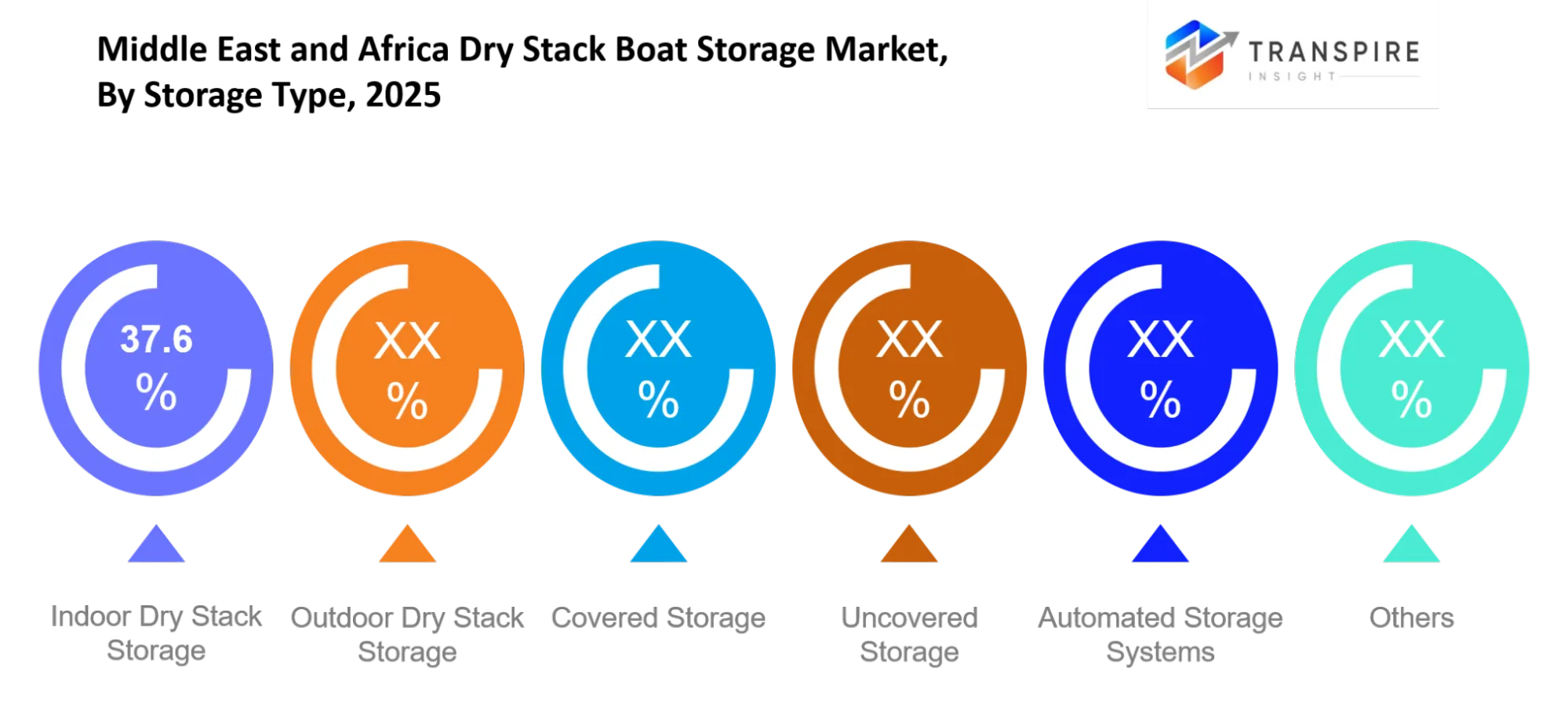
To learn more about this report, Download Free Sample Report
By Boat Type
The boat type segment kind of underscores the range of vessels that plug into dry stack storage services in both recreational and commercial settings. Powerboats take up a big portion, mostly because they’re used often, the handling feels straightforward, and ownership is climbing, so demand stays pretty regular. A lot of storage sites are set up to handle powerboats effectively, while still offering quick launch, and fast retrieval, which sort of keeps people coming back. Steady use habits tend to keep occupancy rates fairly stable across the year.
Sailboats stay noticeable in regions with long standing sailing communities and marine leisure activities. Fishing Boats drive more storage pull from recreational angling, plus small scale commercial runs. Personal Watercraft keep gaining traction as well, since their compact size makes rack system storage and maneuvering more efficient. Yachts typically need the higher end kind of storage approach, one that protects the asset and also makes maintenance scheduling easier. Others covers specialty vessels that don’t quite fit the standard boxes, so they often need customized storage arrangements, based on how they operate and their physical traits.
By Facility Type
The facility type segment shows, in a kind of practical way, how different organizations provide storage services to help with boating activities and daily waterfront operations. Marinas take up a major share, mostly because an integrated setup—like storage, maintenance, launching, and all the customer services tied together—makes things easier for boat owners. They also have strong waterfront access, plus established infrastructure , so dry stack storage systems get adopted more widely. On top of that, marina operators end up with better land utilization and, in general, more storage capacity.
Boat Clubs add to the market momentum by offering shared access to vessels along with storage services for their members. Private Storage Facilities are more about dedicated storage operations, and they often attract customers who want flexible storage arrangements. Yacht Clubs help drive demand too, through higher end services, organized marine activities, and access to specialized facilities. Then there are the “Others” category which can cover mixed-use waterfront developments, and specialized marine facilities that bring storage services into a broader offering , kind of as a supporting function instead of a standalone thing.
By End User
The end user segment points out the groups that lean on dry stack storage to boost vessel protection, improve day to day efficiency, and handle waterfront space more smoothly. Recreational Boaters, for instance, take up a large portion because convenient storage, less maintenance touchpoints, and fast entry to the water still matter a lot when you own a boat. Regular boating routines help keep demand steadier for secure and easy to reach storage setups. Storage providers are also pushing out more options to match shifting customer expectations, even when those expectations change pretty quick.
Commercial Operators use these facilities to manage fleets efficiently, and to stay operationally ready year around. Rental Service Providers depend on well organized storage systems, so they can rotate vessels often and keep customers in good supply. Tourism Companies tap into storage infrastructure to support marine leisure activities, waterfront moments, and services that are aimed at visitors. Others covers specialized operators that need protected storage in a way that fits their business model, vessel category, and operating needs.
What are the Key Use Cases Driving the Middle East and Africa Dry Stack Boat Storage Market?
The biggest use case stays recreational boat storage for private boat owners, and marina members. These people kinda depend on dry stack facilities to keep their vessels safe from long water exposure, lower the hassle of upkeep, and get quicker launch, and retrieval services. This particular thing creates the most demand since it hits the space limitations that show up in high traffic marina environments, pretty directly.
Right next to that, adjacent applications are also taking off with yacht clubs, marina operators and even commercial waterfront developments. Those groups use dry stack systems to help with vessel turnover, make the waterfront land use more efficient, and support bigger customer volumes without having to extend dock infrastructure more and more.
More new opportunities are showing up too, especially in luxury tourism destinations and in integrated waterfront real estate projects. Fresh marine leisure developments in Gulf countries are starting to fold in automated storage systems along with premium yacht services, and smart marina technologies , as part of wider tourism and hospitality strategies.
|
Report Metrics |
Details |
|
Market size value in 2025 |
USD 284.39 Million |
|
Market size value in 2026 |
USD 310.88 Million |
|
Revenue forecast in 2033 |
USD 580.03 Million |
|
Growth rate |
CAGR of9.32% from 2026 to 2033 |
|
Base year |
2025 |
|
Historical data |
2021 - 2024 |
|
Forecast period |
2026 - 2033 |
|
Report coverage |
Revenue forecast, competitive landscape, growth factors, and trends |
|
Regional scope |
Middle East and Africa (Saudi Arabia, United Arab Emirates, South Africa, Rest of Middle East and Africa) |
|
Key company profiled |
Safe Harbor Marinas, Suntex Marinas, IGY Marinas, Oasis Marinas, Marina Holdings, D-Marin, Porto Montenegro, Premier Marinas, MDL Marinas, Brunswick Corporation, MarineMax, Freedom Boat Club, Westrec Marinas, Gulf Craft Marinas, Camper & Nicholsons Marinas |
|
Customization scope |
Free report customization (country, regional & segment scope). Avail customized purchase options to meet your exact research needs. |
|
Report Segmentation |
By Storage Type (Indoor Dry Stack Storage, Outdoor Dry Stack Storage, Covered Storage, Uncovered Storage, Automated Storage Systems, Others); By Boat Type (Powerboats, Sailboats, Fishing Boats, Personal Watercraft, Yachts, Others); By Facility Type (Marinas, Boat Clubs, Private Storage Facilities, Yacht Clubs, Others); By End User (Recreational Boaters, Commercial Operators, Rental Service Providers, Tourism Companies, Others) |
Which Regions are Driving the Middle East and Africa Dry Stack Boat Storage Market Growth?
The Gulf Cooperation Council region, helmed by Saudi Arabia and the UAE, basically shows up as the dominant regional market. Strong government spending on tourism infrastructure, marina developments , and coastal economic diversification programs keeps backing the whole growth motion. Big waterfront projects also keep creating the right conditions for high-density storage solutions, in a kind of practical way. And there’s this broad little ecosystem of marina operators, yacht service providers , and tourism developers that sort of reinforces regional leadership, all together.
South Africa then turns out to be the second most meaningful market contributor. But unlike the Gulf region, the momentum here is more rooted in an already in place recreational boating culture, plus a mature marina network. Not so much in huge government-led tourism pushes. Ongoing private investment and steady marina operations generate dependable demand for vessel storage services. That steadiness ends up giving an important revenue base for the regional market participants.
Saudi Arabia is also showing up as the fastest-moving national market in the region. Lately, investments tied to Red Sea tourism, marina infrastructure, and coastal destination development have reshaped market expectations. New waterfront projects, in turn, need scalable storage solutions that can handle expanding recreational fleets. For investors and new entrants, this means there are real opportunities to set up capacity before marina utilization rates reach maturity, or at least before they fully level out.
Who are the Key Players in the Middle East and Africa Dry Stack Boat Storage Market and How Do They Compete?
Competition is still fairly fragmented, in the sense that international marina operators are in the mix with regional marina developers and, also, specialized storage providers. The players try to stand out by things like how widely they cover different geographies, what kind of premium service they provide, their marina management savoir-faire, and those technology-enabled customer moments. In practice, service quality and how well the marina integrates overall have become more decisive than simply having extra storage capacity.
D-Marin seems to be pushing hard on premium marina experiences , plus digital transformation. They’ve grown their Gulf presence, and at the same time they are putting money into customer engagement platforms and into digitizing day to day operations. The whole angle is to blend marina services, hospitality, and technology so customer retention actually sticks.
IGY Marinas focuses on luxury yacht destinations and marina management arrangements. Its role in managing the Wynn Al Marjan Island Marina helps reinforce its Middle East footprint, and it also brings exposure to higher value yacht traffic. They separate themselves with superyacht operations know-how and destination management.
Safe Harbor Marinas, Suntex Marinas, and MarineMax are leaning on their bigger marina networks, operational scale, and service integration strength. On the other side, Brunswick Corporation brings broad marine industry experience, plus complementary product offerings that can help with marina infrastructure and vessel services support.
Company List
- Safe Harbor Marinas
- Suntex Marinas
- IGY Marinas
- Oasis Marinas
- Marina Holdings
- D-Marin
- Porto Montenegro
- Premier Marinas
- MDL Marinas
- Brunswick Corporation
- MarineMax
- Freedom Boat Club
- Westrec Marinas
- Gulf Craft Marinas
- Camper & Nicholsons Marinas
Recent Development News
In July 2025, IGY Marinas announced its appointment as marina operator for Wynn Al Marjan Island Marina in Ras Al Khaimah, UAE. The agreement expands IGY's Middle East presence and supports the development of a major luxury yachting destination.https://www.igymarinas.com
In April 2025, D-Marin launched operations at the J1 Beach anchorage destination in Dubai through a partnership with MEREX Investment. The initiative expands marina service offerings and strengthens premium boating infrastructure within the Gulf leisure market.https://www.d-marin.com
In March 2025, D-Marin formed an alliance with Azimut|Benetti Group to develop an integrated marina network and expand nautical tourism infrastructure. The partnership strengthens marina connectivity and enhances long-term marina capacity development.https://www.d-marin.com
What Strategic Insights Define the Future of the Middle East and Africa Dry Stack Boat Storage Market?
The market is kind of structurally moving toward integrated marina ecosystems, where storage vessels servicing digital customer management and waterfront leisure offerings basically work as one unified platform, sort of connected. The main thing driving it is the bigger economic weight of marine tourism and premium waterfront developments across Gulf economies.xe
One hidden risk is that the market can end up more concentrated around just a small handful of large scale tourism and marina projects. So if there are delays in the flagship waterfront developments or if tourism investment priorities shift, that could make temporary demand imbalances for storage infrastructure providers, and then everyone feels it.
There is also a pretty interesting emerging opportunity in smart marina platforms that merge automated storage management, predictive maintenance and digital customer engagement together. Early adopters are already showing improvements in booking efficiency and operational visibility, you can see it in how things run day to day.
For investors and operators, the best approach seems to be aligning storage infrastructure with the broader marina and tourism developments, instead of chasing standalone facilities. Integrated service models should capture more customer lifetime value and end up generating stronger long term returns than just expanding capacity, by itself.
Middle East and Africa Dry Stack Boat Storage Market Report Segmentation
By Storage Type
- Indoor Dry Stack Storage
- Outdoor Dry Stack Storage
- Covered Storage
- Uncovered Storage
- Automated Storage Systems
- Others
By Boat Type
- Powerboats
- Sailboats
- Fishing Boats
- Personal Watercraft
- Yachts
- Others
By Facility Type
- Marinas
- Boat Clubs
- Private Storage Facilities
- Yacht Clubs
- Others
By End User
- Recreational Boaters
- Commercial Operators
- Rental Service Providers
- Tourism Companies
- Others
Frequently Asked Questions
Find quick answers to common questions.
The Expected Middle East and Africa Dry Stack Boat Storage Market size for the market will be USD 580.03 Million in 2033.
Key Segments for the Middle East and Africa Dry Stack Boat Storage Market are By Storage Type (Indoor Dry Stack Storage, Outdoor Dry Stack Storage, Covered Storage, Uncovered Storage, Automated Storage Systems, Others); By Boat Type (Powerboats, Sailboats, Fishing Boats, Personal Watercraft, Yachts, Others); By Facility Type (Marinas, Boat Clubs, Private Storage Facilities, Yacht Clubs, Others); By End User (Recreational Boaters, Commercial Operators, Rental Service Providers, Tourism Companies, Others).
Major Middle East and Africa Dry Stack Boat Storage Market Players are Safe Harbor Marinas, Suntex Marinas, IGY Marinas, Oasis Marinas, Marina Holdings, D-Marin, Porto Montenegro, Premier Marinas, MDL Marinas, Brunswick Corporation, MarineMax, Freedom Boat Club, Westrec Marinas, Gulf Craft Marinas, Camper & Nicholsons Marinas.
The Current Middle East and Africa Dry Stack Boat Storage Market size is USD 284.39 Million in 2025.
The Middle East and Africa Dry Stack Boat Storage Market CAGR is 9.32% from 2026 to 2033.
- Safe Harbor Marinas
- Suntex Marinas
- IGY Marinas
- Oasis Marinas
- Marina Holdings
- D-Marin
- Porto Montenegro
- Premier Marinas
- MDL Marinas
- Brunswick Corporation
- MarineMax
- Freedom Boat Club
- Westrec Marinas
- Gulf Craft Marinas
- Camper & Nicholsons Marinas
About the Authors

Mayur Shinde
I am Mayur Shinde, a Senior Research Analyst at Transpire Insight, specializing in the Automotive & Transportation and Information & Communication Technology (ICT) Industry. My work focuses on analyzing emerging market trends, technological advancements, competitive landscapes, and industry developments to deliver accurate, data-driven insights. I am passionate about transforming complex market information into clear, actionable content that helps businesses, professionals, and decision-makers stay informed and make confident strategic decisions.

Chakradhar Khansole
Chakradhar serves as the Research Director at Transpire Insight, bringing over 8 years of experience in technology, innovation, and strategic market intelligence. He specializes in transforming complex market data into actionable business insights that enable organizations to make informed, growth-oriented decisions. Recognized for his strategic vision and analytical expertise, Chakradhar leads high-impact research initiatives, delivering comprehensive market assessments, competitive intelligence, and forward-looking industry analysis.
Recently Published Reports
-
Apr 2026
ATV & UTV Market
ATV & UTV Market Size, Share & Analysis Report By Type (ATV, and UTV), By Variants (Less Than 400 CC, 400 CC To 800 CC, and More Than 800 CC), and Geography (North America, Europe, Asia-Pacific, Middle East and Africa, South and Central America), 2021 - 2031
-
Apr 2026
Automotive Central Gateway Module Market
Automotive Central Gateway Module Market Size, Share & Analysis Report By Type (Ethernet Central Gateway Module, CAN Central Gateway Module, LIN Central Gateway Module, and FlexRay), By Application (Powertrain Control, Body Control, Infotainment System, Advanced Driver Assistance Systems (ADAS), and Others), By End User (Passenger Vehicles, and Commercial Vehicles), and Geography (North America, Europe, Asia-Pacific, Middle East and Africa, South and Central America), 2021 - 2031
-
Apr 2026
Automotive Engine Oil Filter Market
Automotive Engine Oil Filter Market Size, Share & Analysis Report By Filter Type (Fuel Filter, Engine Oil Filter, Hydraulic Oil Filter, and Others), By Filter Media (Cellulose, Synthetic, and Micro), By Sales Channel (OEMs, and Aftermarket), By Vehicle Type (Passenger Cars, Light Commercial Vehicles, Heavy Duty Trucks, Buses and Coaches, and Off-road Vehicles), and Geography (North America, Europe, Asia-Pacific, Middle East and Africa, South and Central America), 2021 - 2031
-
Apr 2026
Automotive Parts Aluminium Die Casting Market
Automotive Parts Aluminium Die Casting Market Size, Share & Analysis Report By Production Process (Pressure Die Casting, Vacuum Die Casting, Squeeze Die Casting, Gravity Die Casting), By Application (Body Parts, Engine Parts, Transmission Parts, Battery And Related Components, Other Application Types), and Geography (North America, Europe, Asia-Pacific, Middle East and Africa, South and Central America), 2021 - 2031
Our Clients



