Europe Outboard Engines Market Size & Forecast:
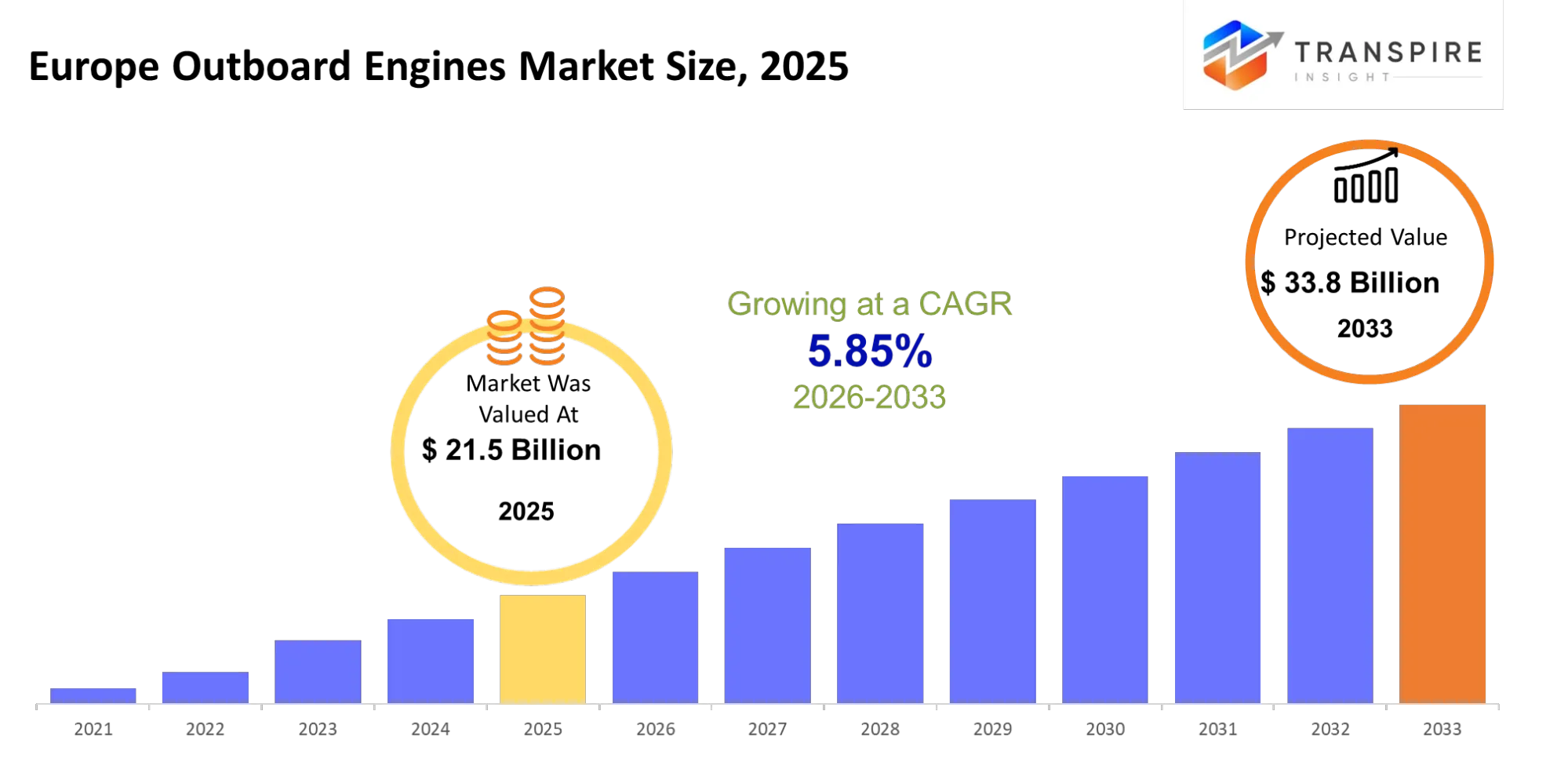
- Europe Outboard Engines Market Size 2025: USD 21.5 Billion
- Europe Outboard Engines Market Size 2033: USD 33.8 Billion
- Europe Outboard Engines Market CAGR: 5.85%
- Europe Outboard Engines Market Segments: By Type (Two-Stroke Engines, Four-Stroke Engines, Electric Outboards, Others); By Application (Recreational Boating, Commercial Boats, Fishing Boats, Water Sports, Others); By End-User (Individual Users, Commercial Operators, Fishing Industry, Rental Services, Others); By Power (Low HP, Mid HP, High HP, Others)
To learn more about this report,  Download Free Sample Report
Europe Outboard Engines Market Summary
The Europe Outboard Engines Market was valued at USD 21.5 Billion in 2025. It is forecast to reach USD 33.8 Billion by 2033. That is a CAGR of 5.85% over the period.
European countries use outboard engines to operate their small to mid-sized boats which serve multiple purposes including coastal fishing leisure boating and patrol and rescue missions. The system provides adaptable engine power which workers may install on external boat parts because this arrangement simplifies engine upkeep while enabling operators to install new or upgraded systems without complete vessel restoration.
The market has developed toward electric power and environmentally friendly solutions because governmental agencies have implemented stricter environmental regulations which control marine engine emissions. Strict European Union emissions regulations have forced manufacturers to speed up their electric and hybrid outboard development work, which serves as the main driving force behind this industry development. The regulations create buying patterns for customers, especially for commercial organizations and municipalities which need to meet their environmental conservation goals.
The market experiences expansion because of both replacement cycles and fresh capital dedicated to developing environmentally friendly vehicle fleets. Buyers are expanding their capacity while installing new systems that will help them achieve regulatory compliance and decrease their future operational expenses, which in turn creates new revenue streams for high-value products that use advanced technology.
Key Market Insights
- Northern Europe dominates the Europe Outboard Engines Market, accounting for over 35% market share in 2024 due to strong marine tourism and boating infrastructure.
- The fastest-growing region in Southern Europe maintains its growth until 2030 because of rising recreational boating demand and coastal economic development projects.
- The 30-150 HP mid-range engine segment delivers multiple operational benefits which result in more than 40% market share for its entire range of applications.
- The offshore marine industry and high-performance maritime operations prefer high-power engines which exceed 150 HP as their second-most popular engine category.
- The electric outboard engine market will experience rapid growth until 2030 because of emission standards and ongoing research and development activities.
- The recreational boating market holds a 55% share in 2024 because European coastal areas experience high levels of leisure marine activity.
- The highest demand for commercial applications occurs in patrol and fishing vessels because fleets require modern vessels which meet new regulations.
- Individual consumers and leisure boat owners lead the Europe Outboard Engines Market with over 50% share because their disposable income and tourism activities continue to grow.
- The fastest-growing market segment includes government and commercial fleet operators who choose low-emission engines to meet regulatory requirements and enhance their operational capabilities.
- Advanced technologies which include IoT-based engine monitoring systems and fuel optimization systems create business advantages while enabling companies to set higher prices.
What are the Key Drivers, Restraints, and Opportunities in the Europe Outboard Engines Market?
Driver:
The primary force which drives the Europe Outboard Engines Market forward operates through the EU Stage V emission regulations which establish strict marine engine pollution standards. The new policy requirements force manufacturers and fleet operators to upgrade their old two-stroke engines through the adoption of cleaner four-stroke and electric engine technologies. The combination of regulatory enforcement and non-compliance penalties serves as the main trigger which affects commercial operators and public sector fleets. The market has experienced a decline in product replacement periods because customers now select engines which deliver high value and reduce emissions. The transition results in higher average selling prices while technology upgrades generate revenue growth for the company.
Restraint:
The structure of electric and hybrid outboard engines faces obstacles because their electric systems require high initial investment costs to become operational. The current energy density limitations and infrastructure deficiencies in coastal areas create battery system and charging infrastructure restrictions which result in limited operational capacity. The cost difference between small-scale operators and recreational users who are sensitive to prices prevents them from adopting the product. The legacy internal combustion engine system maintains control over a significant portion of installed equipment which results in slower progress toward new technology development that generates revenue for the company.
Opportunity:
The development of electric marina infrastructure throughout Northern and Western Europe presents a significant business opportunity. Norway and the Netherlands are establishing shore-side charging systems which have been specifically designed to support marine operations. The system allows for the effective use of electric outboards in both short-distance and inland waterway work activities. The advancement of infrastructure development allows manufacturers to focus on developing rental fleets and tourism business and urban mobility initiatives.
What Has the Impact of Artificial Intelligence Been on the Europe Outboard Engines Market?
European fleets are starting to use AI and advanced digital systems for new methods of operating and maintaining outboard engines. The building of engine systems now requires manufacturers to supply their products with sensor networks and onboard control units which will perform automated engine diagnostics and fuel injection timing control and emissions monitoring throughout the engine's operation. The systems operate through cloud platforms which enable operators to check their compliance with EU emission standards without needing to perform physical inspections. The system enables fleet managers to use AI-powered dashboards for tracking engine performance and calculating fuel usage based on specific routes and monitoring environmental compliance across different ships.
Machine learning models are increasingly applied for predictive maintenance by analyzing vibration patterns temperature shifts and fuel burn anomalies. The system enables operators to detect component wear before it leads to failure which results in a 15 to 25 percent decrease of unplanned downtime during controlled deployments. AI enables performance optimization through its ability to control throttle and load conditions according to the various operating environments which results in up to 10 percent fuel efficiency gains for boats operating in different marine environments.
The adoption of this technology faces obstacles because ocean areas experience connectivity problems and the costs of system integration remain expensive. Smaller operators face challenges because they do not possess the digital systems which allow them to operate these technologies at full capacity.
Key Market Trends
- The European Union implemented Stage V emission regulations in 2021 which required commercial operators to replace their old two-stroke engines with engines that meet emissions standards through four-stroke and electric engine technology.
- The period from 2020 to 2024 saw a substantial increase in electric outboard engine launches by Torqeedo and Yamaha which marked a transition to zero-emission propulsion technologies.
- Boat owners now prefer mid-range engines that come with digital controls because they want engines that require less maintenance and allow them to check performance in real time.
- Northern Europe continued to expand its power base after 2022 because of government-supported marine electrification initiatives and its users who accepted shore charging technology early.
- The supply chain crises of 2021 to 2022 pushed manufacturers to start using local sources for their parts which decreased their Asian supply chain dependence while their delivery processes improved by 2024.
- Fleet operators started to use predictive maintenance systems which helped them decrease unexpected engine breakdowns while AI diagnostics and sensor systems increased their vessel operational time.
- After 2022, Mercury Marine and Honda developed their competitive approaches through hybrid prototype development and strategic partnerships which enabled them to speed up their innovative development process.
- The recovery of coastal tourism after 2021 led to new investments in rental and leisure fleets which drove operators to replace their engines with models that provide better fuel efficiency and meet legal requirements.
- From 2024 onwards, manufacturers have installed IoT-based telemetry systems which enable real-time tracking of emissions and compliance documentation for multiple vessels operating in European regulated water areas.
Europe Outboard Engines Market Segmentation
By Type:
The European waters of 2024 show four-stroke engines as the most installed engine type which exceeds 60 percent of all installations. The company achieves strong market position because its products meet EU Stage V requirements while producing lower noise levels and higher fuel efficiency than existing systems. The market for electric outboards continues to grow because they represent a smaller market segment, which develops into the fastest growing segment, while two-stroke engines experience market decline-through environmental regulations and regulatory restrictions.
The adoption of four-stroke engines has increased because recreational users and light commercial operators need to replace their existing equipment which offers higher cost efficiency and dependable performance. Electric outboards gain traction in inland waterways and short-distance coastal operations where charging access is improving. Two-stroke engines face structural decline as bans expand across protected marine zones, limiting new sales.
Northern European countries will pursue hybrid development paths which lead to complete electric systems. Manufacturers will increase their research and development spending to develop battery integration solutions and create lightweight materials. Investors and original equipment manufacturers will invest in electric platforms which can expand because they believe costs will decrease over time.
By Application:
Recreational boating leads with over half of total demand, supported by strong leisure activity and tourism-driven vessel ownership across coastal regions. The commercial boating industry together with fishing vessels maintains constant market share, while water sports activities develop into premium leisure markets. The distribution of demand shows seasonal usage patterns together with the availability of marine infrastructure in different regions.
Recreational demand growth is tied to post-2021 tourism recovery and rising interest in private boating experiences. Commercial operators focus on engine upgrades to meet emission rules and reduce fuel expenses. Water sports segments benefit from higher disposable income and demand for high-performance engines with advanced throttle control. Future trends suggest that recreational boating will maintain its leading position through the development of smart technologies and electric driving systems. The commercial fleet sector will implement low-emission technologies because increasing compliance requirements will force them to do so. Product developers will need to create customized solutions that address different application needs while maintaining their environmental impact and cost-effectiveness.
By End-User:
The individual users segment represents the largest portion of engine demand which exceeds 50 percent because recreational boat ownership is widespread. The fishing industry together with commercial operators represents stable market segments while rental services experience increased growth in tourist regions. The distribution of end-users shows how both private individuals and organizations use their products.
Personal buyers search for products that require minimal effort to operate and need slight upkeep while they work together with digital systems. Commercial operators invest in durable and compliant systems to meet regulatory standards and reduce operating costs. Rental service providers expand fleets with standardized engines that support quick maintenance and high utilization rates.
Tourism ecosystems will drive future expansion through rental and shared-use business models. Commercial fleets will continue upgrading toward cleaner propulsion systems. Manufacturers will increasingly segment offerings based on user profiles, focusing on customization and service-based revenue streams.
By Power:
The market shows dominance of mid-range engines which operate between 30 and 150 horsepower as they fulfill both recreational and light commercial needs. High horsepower engines follow, driven by offshore and performance-oriented usage. Low horsepower engines sustain their importance for use in small boats and inland waterways.
The mid-range segment develops through three factors which include balanced performance and fuel efficiency and affordable pricing which enables its use across multiple vessel types. The high-power engines gain from premium boating and water sports markets which require both speed and durability. The market for low-power engines shows consistent growth in areas which enforce noise and emission standards that prohibit the use of larger engines.
The future shows that electric technologies will experience significant growth in both low and mid horsepower categories. The industry will adopt hybrid systems in high horsepower segments to achieve emission standards while preserving operational efficiency. Product developers will focus on modular designs that allow scalability across power categories while maintaining compliance and efficiency.
What are the Key Use Cases Driving the Europe Outboard Engines Market?
Recreational boating remains the core use case which produces the highest demand throughout coastal Europe. Private boat owners and leisure operators rely on outboard engines because these engines provide easy installation and require less maintenance while allowing engine upgrades. The tourism industry in Italy and France and Croatia creates ongoing engine replacement needs which particularly affect mid-range power categories.
Commercial patrol vessels and small-scale fishing operations are expanding their usage of adjacent applications. Government agencies use modern engines to achieve emission standards while keeping their operations fully functional. Fishing operators choose fuel-efficient models to reduce their operating expenses while rental service providers establish standardized fleets which help them maximize vehicle usage during high-demand tourism periods.
The new use cases of electric-powered urban water mobility and eco-tourism fleets operate their services in protected inland waterways. Short-distance ferry services and guided nature tours increasingly adopt low-noise, zero-emission engines as regulations tighten and infrastructure improves.
| Report Metrics | Details |
| Market size value in 2025 | USD 21.5 Billion |
| Market size value in 2026 | USD 22.7 Billion |
| Revenue forecast in 2033 | USD 33.8 Billion |
| Growth rate | CAGR of 5.85% from 2026 to 2033 |
| Base year | 2025 |
| Historical data | 2021 - 2024 |
| Forecast period | 2026 - 2033 |
| Report coverage | Revenue forecast, competitive landscape, growth factors, and trends |
| Regional scope | Europe (Germany, United Kingdom, France, Italy, Spain, Rest of Europe) |
| Key company profiled | Yamaha, Mercury Marine, Suzuki, Honda, Tohatsu, Evinrude, Volvo Penta, BRP, Parsun, Selva Marine, Hidea, Johnson Outdoors, Lehr, Torqeedo, OXE Marine |
| Customization scope | Free report customization (country, regional & segment scope). Avail customized purchase options to meet your exact research needs. |
| Report Segmentation | By Type (Two-Stroke Engines, Four-Stroke Engines, Electric Outboards, Others); By Application (Recreational Boating, Commercial Boats, Fishing Boats, Water Sports, Others); By End-User (Individual Users, Commercial Operators, Fishing Industry, Rental Services, Others); By Power (Low HP, Mid HP, High HP, Others) |
Which Regions are Driving the Europe Outboard Engines Market Growth?
The northern European region maintains its number one status because it enforces environmental rules and operates advanced marine facilities. The nations of Norway, Sweden, and Denmark create low-emission zones which drive their operators to develop cleaner propulsion technologies. The combination of extensive marina networks together with electrified ports and government financial support enables quick adoption of electric and hybrid outboard motors. The high purchasing power of recreational users and institutional fleets creates ongoing demand for advanced engine technology which drives premium products.
Western Europe provides stable market development during which Germany, France, and the Netherlands maintain equal demand throughout their recreational and business activities. The marine manufacturing sector in this area receives better industrial support together with gradual policy implementation compared to the intense regulatory environment which exists in northern regions. Boat ownership remains well established, and operators continue to invest in engine upgrades to improve efficiency and meet evolving standards. This region generates predictable revenue because its established financing systems and distribution channels create stable business conditions.
Southern Europe has become the fastest-growing area because tourism has revived and coastal economies have developed since 2022. The countries of Italy, Spain, and Greece have increased their marina infrastructure and small vessel fleet investment to meet seasonal demands. The enforcement of regulations has become stricter which pushes organizations to implement modern engines but without the urgent requirements that Northern Europe imposes. The market growth enables new businesses to establish themselves by focusing on rental fleets and mid-range engine markets which will expand until 2033.
Who are the Key Players in the Europe Outboard Engines Market and How Do They Compete?
European competition shows moderate consolidation because major engine manufacturers from different countries compete against each other while new electric companies enter specific market areas. The existing companies maintain their market positions through their dealer networks and service networks and their small engine efficiency improvements, while the new companies focus on their electric power systems and their digital technology developments. The main competitive advantage between companies now depends on technology because both emissions standards and battery capacity and onboard diagnostic systems have become essential to their operations. Advanced systems require organizations to establish geographic locations because Northern and Western European countries use their regulatory systems and their infrastructure networks to establish advanced technologies.
Yamaha Motor and Mercury Marine continue to anchor the conventional segment but are actively repositioning through electrification and hybrid development.Through its partnership with Torqeedo Yamaha expands its electric product line to all European dealers thus building a competitive edge through its dual product system.Yamaha products distribute through Torqeedo, which enables Yamaha to establish an electric product line that European dealers can use. Mercury distinguishes itself by offering high-performance engines together with SmartCraft digital systems that deliver real-time vessel information and forecasting maintenance functions. Honda Motor develops four-stroke engines that provide fuel efficiency and low emissions to ensure reliability for both general users and government vehicle fleets.
Torqeedo operates with a technology-first approach, specializing in fully electric propulsion and modular battery systems tailored for inland and nearshore applications. Suzuki Motor Corporation establishes its presence in Southern Europe through its distribution expansion of compact and fuel-efficient products, which meet growing demand in the leisure market. Each company creates competitive advantages by developing their products according to upcoming regulations and specific local usage needs, instead of choosing to compete through pricing strategies.
Company List
- Yamaha
- Mercury Marine
- Suzuki
- Honda
- Tohatsu
- Evinrude
- Volvo Penta
- BRP
- Parsun
- Selva Marine
- Hidea
- Johnson Outdoors
- Lehr
- Torqeedo
- OXE Marine
Recent Development News
“In November 2025, Torqeedo launched new Cruise 3.0 and 6.0 electric outboard models along with advanced Deep Blue system components at METSTRADE in Amsterdam. The launch introduced a standardized 48-volt architecture and enhanced connectivity, strengthening digital integration in marine propulsion systems. https://www.torqeedo.com
“In January 2025, Yamaha Motor announced the distribution of Torqeedo electric outboards across its European dealer network following its acquisition of Torqeedo. This strategic integration combined conventional and electric propulsion portfolios, reinforcing Yamaha’s position in the transition toward carbon-neutral marine solutions. https://www.torqeedo.com
What Strategic Insights Define the Future of the Europe Outboard Engines Market?
The Europe Outboard Engines Market is moving toward electrified and digitally integrated propulsion systems according to its current projection for the next five to seven years because fleet operators implement stricter emission standards while they become aware of total cost of ownership. Manufacturers who develop scalable products through their ability to combine battery efficiency with lightweight design and smart diagnostics will gain competitive advantages over their industry rivals who depend on independent engine solutions.
The actual danger which exists as a hidden threat stems from the need for raw materials which essential for battery production. The dependence on lithium and rare earth elements will create supply problems that result in higher production costs for lithium while generating delays in the transition to electric power systems which will reduce immediate profits despite existing governmental backing.
Western Europe will benefit from an emerging opportunity which involves creating standardized charging corridors that operate through its inland and coastal waterways. This infrastructure development will create new demand from shared mobility services and tourism transportation fleets.
Market participants should choose modular electric architectures which provide incremental upgrade capabilities because this approach enables faster technology adoption while decreasing initial financial obstacles for end users.
Europe Outboard Engines Market Report Segmentation
By Type
- Two-Stroke Engines
- Four-Stroke Engines
- Electric Outboards
- Others
By Application
- Recreational Boating
- Commercial Boats
- Fishing Boats
- Water Sports
- Others
By End-User
- Individual Users
- Commercial Operators
- Fishing Industry
- Rental Services
- Others
By Power
- Low HP
- Mid HP
- High HP
- Others
Frequently Asked Questions
Find quick answers to common questions.
The Europe Outboard Engines Market size is USD 33.8 Billion in 2033.
Key segments for the Europe Outboard Engines Market are By Type (Two-Stroke Engines, Four-Stroke Engines, Electric Outboards, Others); By Application (Recreational Boating, Commercial Boats, Fishing Boats, Water Sports, Others); By End-User (Individual Users, Commercial Operators, Fishing Industry, Rental Services, Others); By Power (Low HP, Mid HP, High HP, Others).
Major Europe Outboard Engines Market players are Yamaha, Mercury Marine, Suzuki, Honda, Tohatsu, Evinrude, Volvo Penta, BRP, Parsun, Selva Marine, Hidea, Johnson Outdoors, Lehr, Torqeedo, OXE Marine.
The Europe Outboard Engines Market size is USD 21.5 Billion in 2025.
The Europe Outboard Engines Market CAGR is 5.85% from 2026 to 2033.
- Yamaha
- Mercury Marine
- Suzuki
- Honda
- Tohatsu
- Evinrude
- Volvo Penta
- BRP
- Parsun
- Selva Marine
- Hidea
- Johnson Outdoors
- Lehr
- Torqeedo
- OXE Marine
Recently Published Reports
-
Apr 2026
ATV & UTV Market
ATV & UTV Market Size, Share & Analysis Report By Type (ATV, and UTV), By Variants (Less Than 400 CC, 400 CC To 800 CC, and More Than 800 CC), and Geography (North America, Europe, Asia-Pacific, Middle East and Africa, South and Central America), 2021 - 2031
-
Apr 2026
Automotive Central Gateway Module Market
Automotive Central Gateway Module Market Size, Share & Analysis Report By Type (Ethernet Central Gateway Module, CAN Central Gateway Module, LIN Central Gateway Module, and FlexRay), By Application (Powertrain Control, Body Control, Infotainment System, Advanced Driver Assistance Systems (ADAS), and Others), By End User (Passenger Vehicles, and Commercial Vehicles), and Geography (North America, Europe, Asia-Pacific, Middle East and Africa, South and Central America), 2021 - 2031
-
Apr 2026
Automotive Engine Oil Filter Market
Automotive Engine Oil Filter Market Size, Share & Analysis Report By Filter Type (Fuel Filter, Engine Oil Filter, Hydraulic Oil Filter, and Others), By Filter Media (Cellulose, Synthetic, and Micro), By Sales Channel (OEMs, and Aftermarket), By Vehicle Type (Passenger Cars, Light Commercial Vehicles, Heavy Duty Trucks, Buses and Coaches, and Off-road Vehicles), and Geography (North America, Europe, Asia-Pacific, Middle East and Africa, South and Central America), 2021 - 2031
-
Apr 2026
Automotive Parts Aluminium Die Casting Market
Automotive Parts Aluminium Die Casting Market Size, Share & Analysis Report By Production Process (Pressure Die Casting, Vacuum Die Casting, Squeeze Die Casting, Gravity Die Casting), By Application (Body Parts, Engine Parts, Transmission Parts, Battery And Related Components, Other Application Types), and Geography (North America, Europe, Asia-Pacific, Middle East and Africa, South and Central America), 2021 - 2031
Our Clients