

Europe Ultra-wideband Market Size & Forecast:
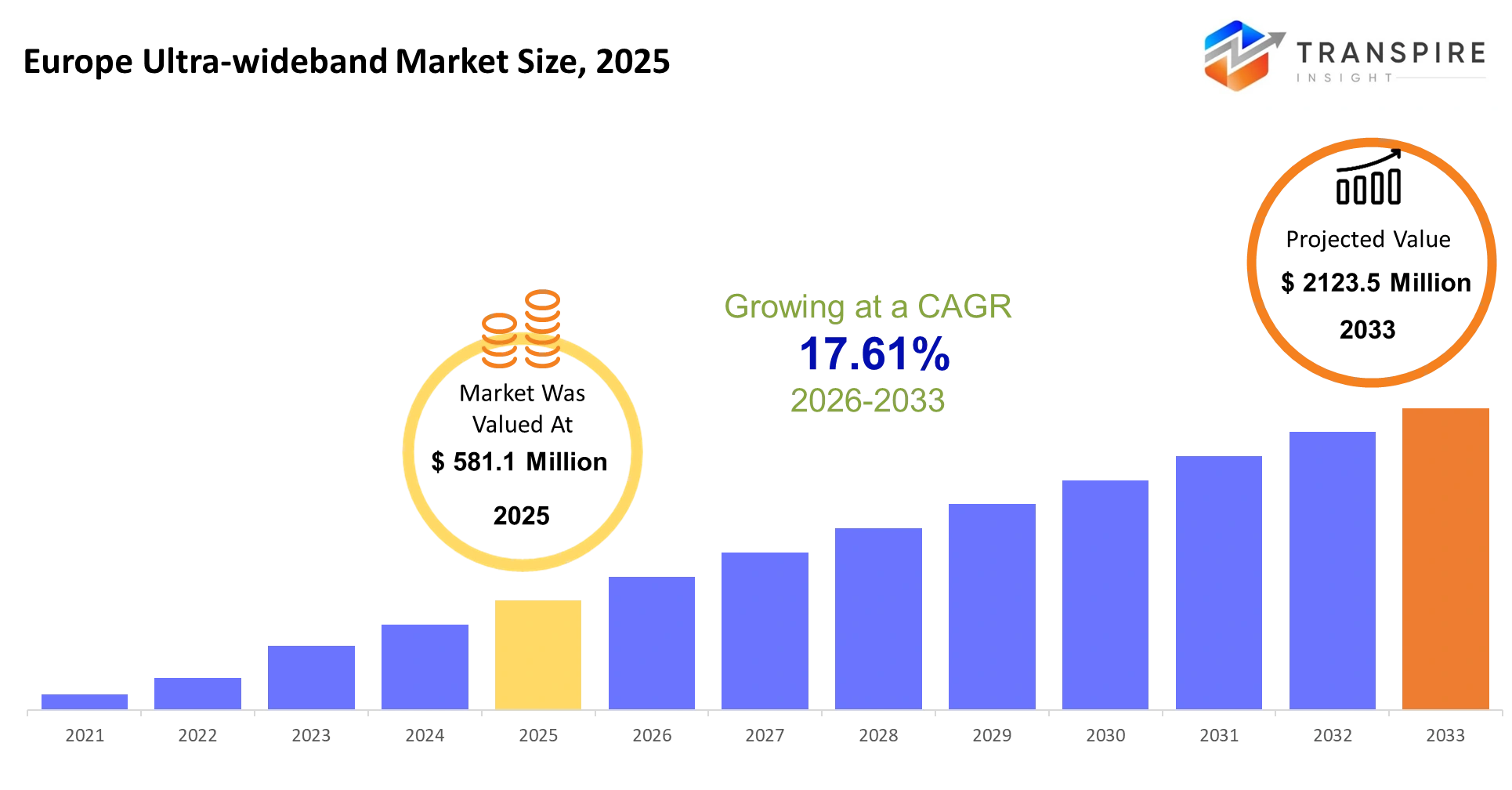
- Europe Ultra-wideband Market Size 2025: USD 581.1 Million
- Europe Ultra-wideband Market Size 2033: USD 2123.5 Million
- Europe Ultra-wideband Market CAGR: 17.61%
- Europe Ultra-wideband Market Segments: By Type (Short-range UWB, Long-range UWB, High-frequency UWB, Low-power UWB, Precision UWB, Others); By Application (RTLS, Consumer Electronics, Automotive, Healthcare, Industrial, Others); By End-User (Electronics, Automotive, Healthcare, Industrial, Enterprises, Others); By Component (Chips, Sensors, Antennas, Software, Modules, Others)
To learn more about this report,  Download Free Sample Report
Europe Ultra-wideband Market Summary:
The Europe Ultra-wideband Market size is estimated at USD 581.1 Million in 2025 and is anticipated to reach USD 2123.5 Million by 2033, growing at a CAGR of 17.61% from 2026 to 2033.
The Europe ultra-wideband market will attract more interest throughout the wireless communication industry because next-generation digital infrastructure requires precise connectivity solutions. The market will develop through two main trends which include indoor positioning requirements and secure access system requirements and device intelligence requirements in both consumer and business settings. Users will require fast communication between smart home devices which can withstand interference because they need to track their location and control their home systems.The development of chip technology will enable manufacturers to create smaller ultra-wideband systems which use less power but still maintain operational performance and compatibility with smartphones and wearables and automotive products. The European regulatory framework will promote interoperability standards which will enable public infrastructure and industrial applications to use those standards more effectively. The automotive industry will use ultra-wideband technology to create advanced keyless entry systems and in-cabin sensing systems which meet safety requirements and provide users with convenient access.Companies will expand their enterprise operations into logistics and manufacturing sectors to use asset tracking and spatial awareness technology for operational efficiency improvements. Ultra-wideband technology has become more attractive because it enables organizations to protect sensitive data through its precise data tracking capacity which requires minimal signal transmission.
What Has the Impact of Artificial Intelligence Been on the Europe Ultra-wideband Market?
Artificial intelligence is rapidly transforming the European ultra-wideband market through its ability to enhance data analysis and data interpretation and data implementation across interconnected networks.
Artificial intelligence will boost productivity by enabling organizations to implement intelligent automation through machine learning throughout their manufacturing and deployment processes. The European ultra-wideband market will see manufacturers implementing artificial intelligence-based systems for their chip design process, testing procedures, and quality assurance methods to decrease manufacturing expenses while upholding strict accuracy requirements. AI will enhance supply chain operations by improving inventory oversight and delivery processes through its capacity to forecast demand changes while decreasing operational interruptions. The newly developed systems will enable businesses to create products faster and expand their operations more easily.
AI will drive businesses to enhance their competitive advantage through its capacity to create custom user interfaces and flexible network design systems. The organizations that implement machine learning and predictive intelligence will gain exclusive market access as the European ultra-wideband market develops through their ability to produce safer and more efficient and responsive ultra-wideband technologies.
Key Market Trends & Insights:
- Germany maintains its lead over the European ultra-wideband market which reaches 28% market share in 2025 because of its strong automotive and industrial IoT technology growth.
- France will maintain its position as the fastest-growing area until 2030 because of rising smart infrastructure expenditure and digital transformation projects.
- The hardware segment controls almost 60% market share because customers demand UWB-enabled chipsets and embedded modules.
- The software platforms market holds the second-largest market share because it provides analytics tools and device synchronization features and real-time positioning abilities.
- The services segment experiences the fastest growth which continues to expand until 2030 because of rising demand for integration services and maintenance work and customization solutions.
- Real-time location systems control the market with their 35% share because they receive common usage in manufacturing and logistics and smart retail environments.
- Automotive applications show the fastest growth because of people adopting keyless entry systems and in-cabin sensing technologies.
- The consumer electronics segment controls about 40% of the market because smartphones and wearables and smart home ecosystems drive its growth.
- The industrial and manufacturing sectors experience rapid growth because they use UWB technology to enhance their asset tracking and operational efficiency.
- The company expands its regional presence and invests in R&D to increase market share while its AI integration technology developments create competitive advantages.
Europe Ultra-wideband Market Segmentation
By Type:
The system covers three main areas of operation which include Short-range UWB, Long-range UWB,High-frequency UWB, Low-power UWB and Precision UWB and additional unspecified technologies. Short-range UWB will support indoor positioning with high accuracy in compact environments such as smart homes and offices. Long-range UWB will extend its coverage capabilities to track industrial assets and monitor facility operations. High-frequency variants will enable faster data exchange, while low-power options will decrease energy use in portable devices. Precision UWB will gain importance in applications requiring centimeter-level accuracy, including advanced navigation and automation systems.
By Application:
RTLS provides essential support for asset tracking and workflow optimization which remains crucial in logistics and manufacturing operations. Consumer electronics will integrate UWB for seamless device connectivity and spatial awareness. Automotive adoption will grow through secure access and sensing features. Healthcare and industrial applications will benefit from improved tracking, safety monitoring, and operational visibility across controlled environments.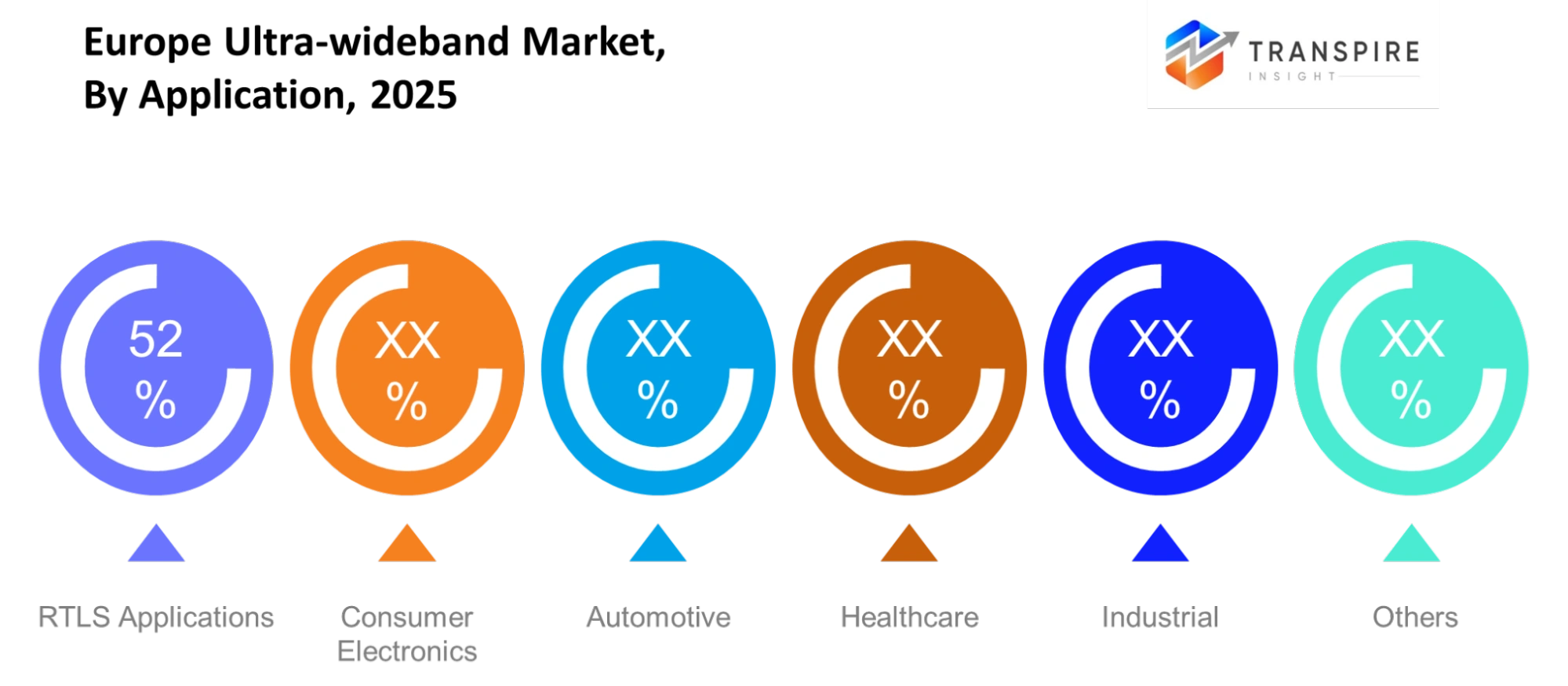
To learn more about this report, Download Free Sample Report
By End-User:
The Electronics sector will drive technology adoption through its need for accurate location tracking which comes from smartphones and wearables and other connected devices. The Automotive sector will use UWB technology to improve vehicle safety features and accessibility systems. Healthcare providers will use it for patient and equipment tracking. Industrial users and enterprises will apply the technology to improve efficiency, reduce losses, and strengthen process control in large-scale operations.
By Component:
Chips will serve as the essential building blocks for UWB systems because they enable both signal processing and communication capabilities. The system will achieve precise signal transmission and reception through the use of sensors and antennas. The software system will handle three main functions which include data interpretation, positioning algorithms, and system integration. The deployment process will become more efficient because modules package various components into complete solutions which businesses can implement immediately.
What are the Main Challenges for the Europe Ultra-wideband Market Growth?
The european ultra-wideband market faces ongoing technical and operational difficulties which block its ability to deliver stable results in complicated environmental situations. The system experiences reliability problems because of three factors which include signal interference and the system's restricted range in areas with heavy infrastructure and its calibration difficulties. The European ultra-wideband market systems will experience dual challenges because they need to connect with current wireless systems which will result in slower growth and more complex system rollout.
The European ultra-wideband market will face manufacturing and commercialization obstacles which will create challenges for mass adoption because of high production costs and complicated product design. The need for advanced chip fabrication and precision engineering will require companies to make major capital investments whereas European regulatory frameworks will extend the time needed for product approval. The market will face restrictions which will lead to extended product development times that make it hard for smaller companies to compete in the market.
UWB system deployment and management face adoption difficulties because organizations lack necessary infrastructure and skilled professionals. Funding limitations will prevent multiple industries from replacing their outdated systems which will restrict their ability to implement new technology. The european ultra-wideband market will face delayed growth in emerging markets because people lack knowledge about the technology and the region lacks digital infrastructure.
The market faces competitive pressure from alternative technologies which include Bluetooth Low Energy and Wi-Fi-based positioning systems which will create challenges for market pricing and demand for technological advancement. The European ultra-wideband market must dedicate ongoing resources for market differentiation because its companies must navigate both regulatory changes and technological developments.
Regional Insights
Germany will lead adoption because of its strong automotive manufacturing base and its industrial automation capabilities and its early use of advanced connectivity technologies. France will show steady expansion supported by smart infrastructure programs and public sector digitization. The United Kingdom will focus on consumer electronics and enterprise applications, while Italian and Spanish markets will gradually expand through industrial modernization projects.
Northern Europe demonstrates better readiness because it invests heavily in IoT ecosystems and connected technologies. Western Europe will keep a substantial market portion because of its existing infrastructure and research facilities. The manufacturing and logistics sectors of Eastern Europe will experience slow development as digital transformation strategies become more widespread and cost barriers decrease.
Recent Development News
In April 2026, Apple Inc. expanded UWB ecosystem integration. The company advanced its Home Key platform through broader compatibility using Ultra Wideband, Bluetooth, and NFC, supporting secure access systems across devices and partners. https://appleinsider.com
In April 2026, STMicroelectronics launched the ST64UWB chip family. The new ultra-wideband solution supports next-generation IEEE 802.15.4ab standards, enabling advanced automotive, industrial, and smart device applications with improved range and accuracy. https://www.eletimes.ai
|
Report Metrics |
Details |
|
Market size value in 2025 |
USD 581.1 Million |
|
Market size value in 2026 |
USD 682.2 Million |
|
Revenue forecast in 2033 |
USD 2123.5 Million |
|
Growth rate |
CAGR of 17.61% from 2026 to 2033 |
|
Base year |
2025 |
|
Historical data |
2021 - 2024 |
|
Forecast period |
2026 - 2033 |
|
Report coverage |
Revenue forecast, competitive landscape, growth factors, and trends |
|
Regional scope |
Europe (Germany, United Kingdom, France, Italy, Spain, Rest of Europe) |
|
Key company profiled |
Apple, Samsung, NXP, Qorvo, Decawave, Qualcomm, Sony, Huawei, Bosch, Infineon, STMicroelectronics, Texas Instruments, Zebra Technologies, HID Global, Sewio |
|
Customization scope |
Free report customization (country, regional & segment scope). Avail customized purchase options to meet your exact research needs. |
|
Report Segmentation |
By Type (Short-range UWB, Long-range UWB, High-frequency UWB, Low-power UWB, Precision UWB, Others); By Application (RTLS, Consumer Electronics, Automotive, Healthcare, Industrial, Others); By End-User (Electronics, Automotive, Healthcare, Industrial, Enterprises, Others); By Component (Chips, Sensors, Antennas, Software, Modules, Others) |
How Can New Companies Establish a Strong Foothold in the Europe Ultra-wideband Market?
New companies that enter the Europe ultra-wideband market should establish themselves through their focus on high-value specialized applications which need both precise performance and dependable operation. Businesses will direct their efforts toward specific markets which include healthcare asset tracking and smart manufacturing and secure access systems. The organization creates distinctive value through custom solutions that resolve industry challenges about real-time visibility and safety compliance and operational efficiency.
European companies will depend on their innovation strategies as the main method to gain market traction in the ultra-wideband sector. Startups that develop advanced chip technology and energy-efficient communication systems and artificial intelligence location tracking solutions will achieve competitive advantages in their industry. The company Sewio proved through its real-time location systems that industrial workflows can achieve transformation while Ubisense and other new companies work to develop precise tracking systems for manufacturing operations.
Companies will use strategic partnerships to facilitate their entry into the Europe ultra-wideband market. Businesses should work together with automotive manufacturers and IoT platform providers and infrastructure developers to achieve faster deployment of their products and create better ecosystem connections. New companies that align with industry trends and create solutions that can scale and provide measurable business results will establish credibility which helps them win long-term market growth opportunities.
Key Europe Ultra-wideband Market Company Insights
Established semiconductor and technology companies will maintain their market dominance because they continue to develop advanced chipsets and integrated solutions. The research will concentrate on three specific goals which are to improve accuracy and decrease power usage and develop better system interoperability.
New market entrants will disrupt current industry players because they will provide affordable yet specialized products which meet specific needs in industrial tracking and healthcare monitoring. The company will achieve its unique market position through ongoing research and development activities which will establish its brand presence in different regions through partnerships with ecosystem stakeholders. The organization will gain a competitive edge when it can quickly develop innovative solutions that can grow with its operations while meeting current industry standards.
Company List
- Apple
- Samsung
- NXP
- Qorvo
- Decawave
- Qualcomm
- Sony
- Huawei
- Bosch
- Infineon
- STMicroelectronics
- Texas Instruments
- Zebra Technologies
- HID Global
- Sewio
What are the Key Use-Cases Driving the Growth of the Europe Ultra-wideband Market?
The Europe ultra-wideband market is growing because real-time location systems (RTLS) become more popular in logistics, manufacturing and healthcare settings. Companies utilize ultra-wideband technology for asset tracking and efficiency monitoring and operational loss management. Healthcare systems improve equipment tracking and patient monitoring to boost response times and resource allocation, thereby increasing system adoption.
The Europe ultra-wideband market in automotive applications receives support from secure keyless entry systems and in-cabin sensing applications. Automakers use ultra-wideband technology to stop relay attacks and protect user safety and create custom driver experiences. This use-case is becoming a standard feature in premium and mid-range vehicles, strengthening long-term market demand.
The europe ultra-wideband market experiences another major growth opportunity through consumer electronics which include smartphones and wearables that provide users with spatial awareness and device interaction capabilities. User engagement increases through features that enable users to locate devices precisely and control smart home devices. The applications create possibilities for expanding device ecosystems through their connection with various devices.
Ultra-wideband technology enables enterprise and industrial sectors to achieve automation and improve worker safety and track inventory assets. The europe ultra-wideband market will expand through these use-cases because businesses focus on boosting efficiency through digital transformation.
Europe Ultra-wideband Market Report Segmentation
By Type
- Short-range UWB
- Long-range UWB
- High-frequency UWB
- Low-power UWB
- Precision UWB
- Others
By Application
- RTLS
- Consumer Electronics
- Automotive
- Healthcare
- Industrial
- Others
By End-User
- Electronics
- Automotive
- Healthcare
- Industrial
- Enterprises
- Others
By Component
- Chips
- Sensors
- Antennas
- Software
- Modules
- Others
Frequently Asked Questions
Find quick answers to common questions.
The Approximate Europe Ultra-wideband Market size for the Market will be USD 2123.5 Million in 2033.
Key Segments for the Europe Ultra-wideband Market are By Type (Short-range UWB, Long-range UWB, High-frequency UWB, Low-power UWB, Precision UWB, Others); By Application (RTLS, Consumer Electronics, Automotive, Healthcare, Industrial, Others); By End-User (Electronics, Automotive, Healthcare, Industrial, Enterprises, Others); By Component (Chips, Sensors, Antennas, Software, Modules, Others).
Major Europe Ultra-wideband Market Players are Apple, Samsung, NXP, Qorvo, Decawave, Qualcomm, Sony, Huawei, Bosch, Infineon, STMicroelectronics, Texas Instruments, Zebra Technologies, HID Global, Sewio.
The Current Europe Ultra-wideband Market size is USD 581.1 Million in 2025.
The Europe Ultra-wideband Market CAGR is 17.61%.
- Apple
- Samsung
- NXP
- Qorvo
- Decawave
- Qualcomm
- Sony
- Huawei
- Bosch
- Infineon
- STMicroelectronics
- Texas Instruments
- Zebra Technologies
- HID Global
- Sewio
Recently Published Reports
-
Apr 2026
Fiber Optic Faceplates Market
Fiber Optic Faceplates Market Size, Share & Analysis Report By Type (< 300 mm2, 300-350 mm2, and > 350 mm2, By Application (Night Vision, Holographic Imaging, Medical, and Others), and Geography (North America, Europe, Asia-Pacific, Middle East and Africa, South and Central America), 2021 - 2031
-
Apr 2026
High Temperature Superconductors Market
High Temperature Superconductors Market Size, Share & Analysis Report By Type (1G HTS, and 2G HTS), By Application (Power Cable, Fault Current Limiter, and Transformer), and Geography (North America, Europe, Asia-Pacific, Middle East and Africa, South and Central America), 2021 - 2031
-
Apr 2026
Industrial Plugs and Socket Market
Industrial Plugs and Socket Market Size, Share & Analysis Report By Type (Industrial Plugs, Industrial Sockets), By Current (Up to 32 A, 32 to 125 A, Above 125 A), By Protection (Dustproof and Splash Proof, Waterproof, Explosion Proof), By End User (Heavy Industries, Oil and Gas, Chemicals and Pharmaceuticals, Power Generation, Others), and Geography (North America, Europe, Asia-Pacific, Middle East and Africa, South and Central America), 2021 - 2031
-
Apr 2026
InGaAs Avalanche Photodiodes Market
InGaAs Avalanche Photodiodes Market Size, Share & Analysis Report By Type (1100 - 1700 nm, and 1000 - 1600 nm), By Application (Missile Warning System, Muzzle Flash Detection, Wafer Defect Inspection, Laser Rangefinders, and Others), and Geography (North America, Europe, Asia-Pacific, Middle East and Africa, South and Central America), 2021 - 2031