

Germany Robot End Effector Market Summary
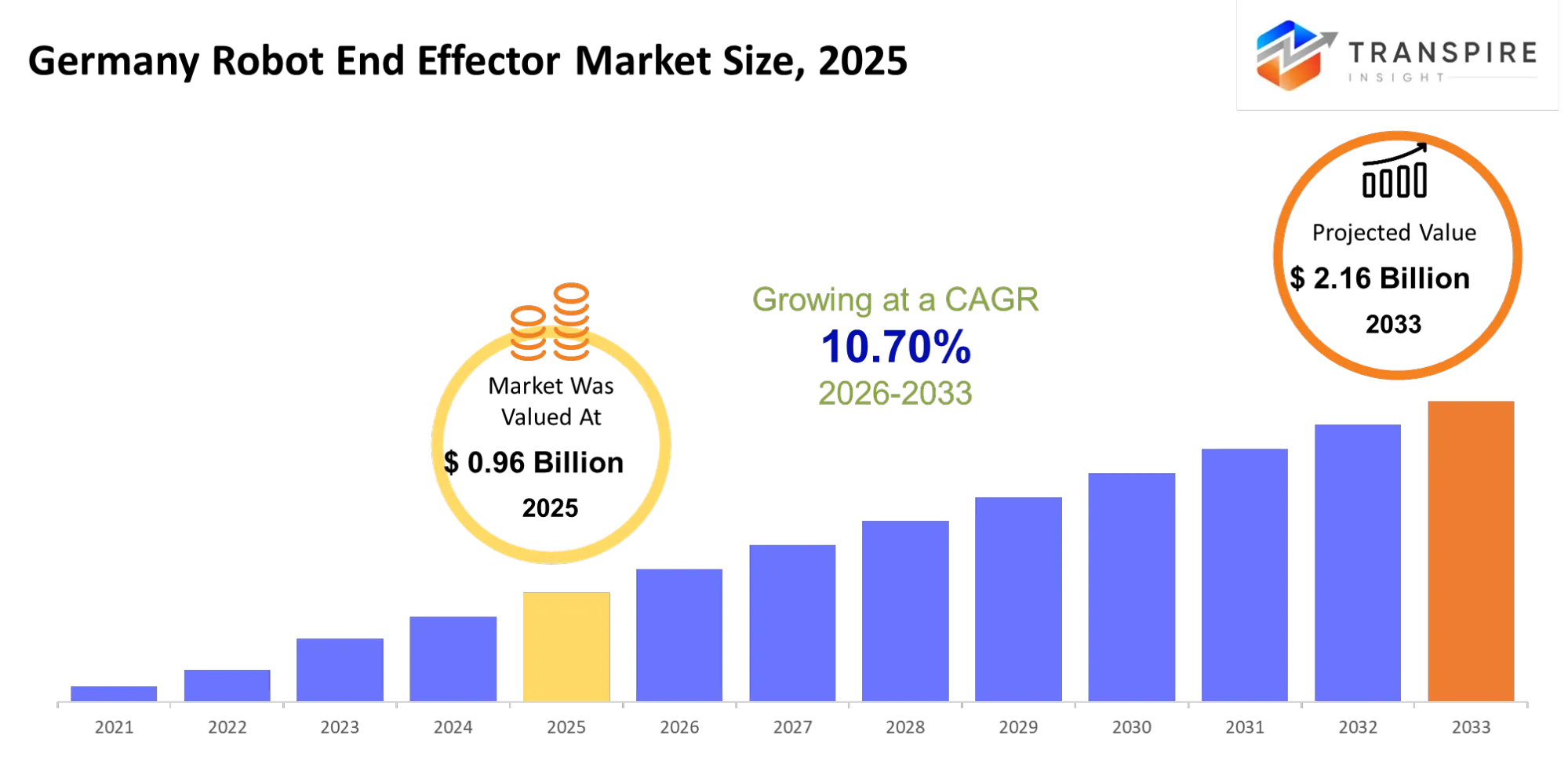
As per Transpire Insight Analysis the Germany Robot End Effector Market size is estimated at USD 0.96 Billion in 2025 and is anticipated to reach USD 2.16 Billion by 2033, growing at a CAGR of 10.70% from 2026 to 2033.
The Germany Robot End Effector Market plays a pretty critical role in industrial automation, by helping robots grab, weld, assemble, examine, dispense, and move materials with high precision across production and logistics activities. End effectors sort of turn robotic arms into application-specific tools, so factories can boost their production accuracy , lower the need for manual touches, and keep product quality steady and predictable. Over the last five years, things have noticeably shifted away from plain pneumatic grippers toward more intelligent electric end effectors, often with built-in sensors, and even AI-enabled features that fit well with flexible manufacturing setups . During the COVID-19 period, supply chain disruptions also helped push investment in automation forward, because manufacturers wanted stronger production resilience and less reliance on human labor . Meanwhile, as automotive, electronics, and logistics companies roll out smart factory initiatives, demand seems to be moving toward modular tooling that can be reconfigured faster, almost like “plug and adjust” equipment. This shift is driving higher spending on advanced robotic solutions, which in turn supports recurring revenue streams from equipment upgrades, software integration, and aftermarket services too.
Germany Robot End Effector Market Size & Forecast:
- Germany Robot End Effector Market Size 2025: USD 0.96 Billion
- Expected Market Value 2033: USD 2.16 Billion
- Forecast CAGR: 10.70%
- Key Profile: Schunk, Zimmer Group, Festo, SMC Corporation, OnRobot, DESTACO, ATI Industrial Automation, Piab, Robotiq, ABB, KUKA, FANUC, Yaskawa Electric, Emerson, Zimmer Austria
Key Market Insights
- Southern Germany sort of dominates the Germany Robot End Effector Market, grabbing around 44% of the market share in 2025, and thats mostly backed by dense automotive plus industrial manufacturing clusters.
- Eastern Germany is also expected to show the quickest momentum from 2026–2033, mainly because of fresh semiconductor funding, factory modernization efforts, and industrial automation initiatives.
- Grippers are still the most prominent product segment, holding close to 34% market share, and vacuum end effectors come in second as packaging and logistics automation keep expanding.
- Electric end effectors, meanwhile, are supposed to be the fastest growing product category through 2033, and this is backed by Industry 4.0 rollouts and tighter precision based assembly needs, which kind of forces smarter tooling.
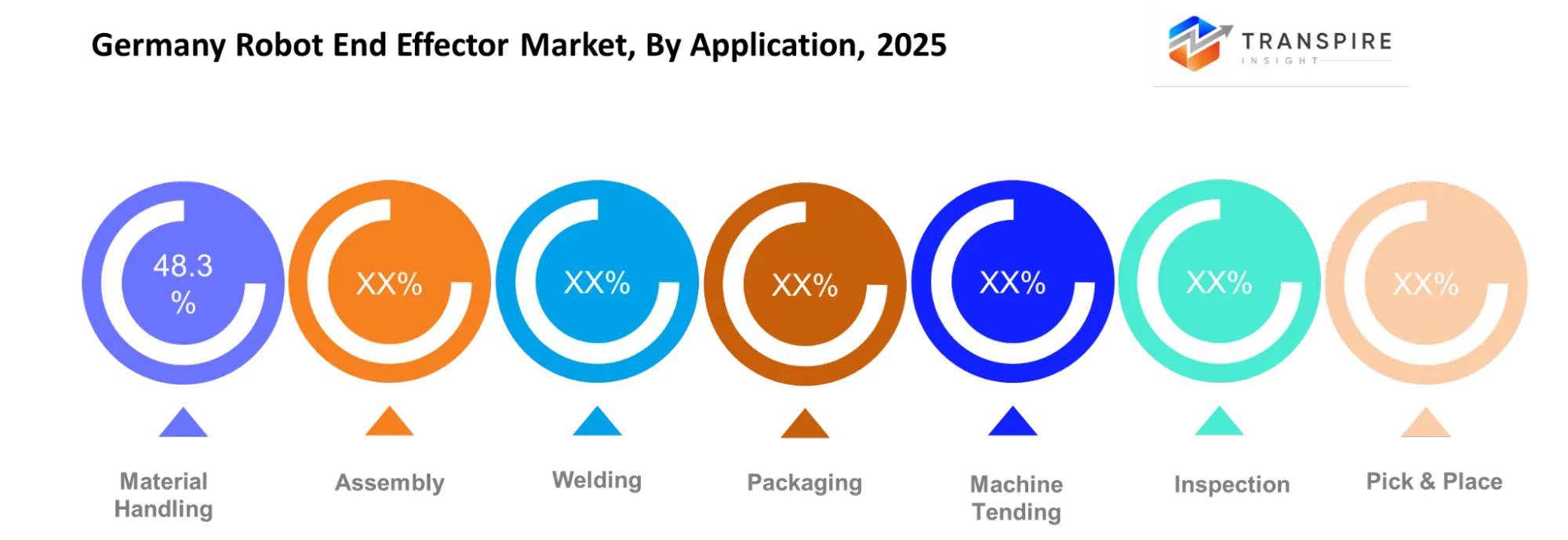
- For applications, material handling brings in close to 30% of revenue, while inspection and quality assurance shows the strongest uptake, especially along electronics manufacturing lines.
- On the end user side, automotive is still the largest segment with an estimated 38% share , but logistics is where the expansion really moves quicker , since warehouse automation keeps accelerating at a steady pace.
- Companies such as Schunk, Zimmer Group, Festo, ABB, KUKA, and FANUC keep investing in more intelligent grasping methods, plus digital monitoring setups and collaborative robot compatibility too.
- Also, strategic partnerships between robotics makers and automation software vendors help speed up deployments, improve predictive maintenance, and increase production flexibility across German plants, pretty consistently.
- On the tech level, AI enabled force sensing, vision led gripping, and modular tooling can reduce production downtime by as much as 20% , and this clearly supports day to day operational efficiency.
- All in all, the Germany Robot End Effector Market looks solid, driven by industrial spending, strong manufacturing horsepower, and continuous technology upgrades, which then supports the long term market outlook, the overall industry size, and a sustained growth direction.
What are the Key Drivers, Restraints, and Opportunities in the Germany Robot End Effector Market?
Germany is basically the strongest driver behind market expansion, since it’s moving toward automated, digitally connected manufacturing, all tied to the Industry 4.0 initiatives, you know. In practice automotive manufacturers, electronics producers, and industrial equipment suppliers keep moving away from single dedicated production lines, and instead they’re adopting flexible robotic cells that can manage multiple product variants. Because of that, the demand keeps rising for intelligent end effectors that come with force sensors, vision systems, and quick-change tooling, which helps them stay useful when product needs keep shifting. And as production flexibility becomes a kind of competitive edge, manufacturers invest in robotic add-ons that cut down changeover time, strengthen quality, and also lower operating expenses, which then directly supports equipment sales, plus integration revenues.
That said, the biggest structural problem is still the high implementation cost. For advanced end effectors to really pay off, they need compatible robots, control software, vision systems, and solid engineering know-how first, otherwise nothing runs smoothly. Smaller and medium sized manufacturers are often the ones who hold back on automation, because integration expenses, employee training, and production downtime during installation create real financial strain. Because of those obstacles adoption doesn’t spread as fast outside the largest industrial sites, and that also caps the near term revenue outlook in several manufacturing segments.
Still, there’s a major opening in collaborative robotics and this intelligent electric gripping technology angle. German companies increasingly deploy collaborative robots for small batch production, electronics assembly, laboratory automation, and medical device manufacturing too. Then AI assisted vision systems, together with adaptive gripping, lets robots handle mixed items without needing a lot of reprogramming, and that makes whole workflows feel more seamless, frankly.
What Has the Impact of Artificial Intelligence Been on the Germany Robot End Effector Market?
Artificial intelligence has, i mean improved a lot the performance of robotic end effectors across Germany's advanced manufacturing sector. Machine vision algorithms now help recognize object orientation, surface conditions, and dimensional deviations in real time, so robotic grippers can tune gripping force automatically, no more constant manual programming. AI powered control systems also refine assembly, welding, inspection, and packaging tasks by constantly reading production data and adapting robotic motions to shifting operating conditions. In practice these functions cut down product defects, make output steadier, and raise equipment utilization across automotive electronics and logistics sites.
Machine learning also backs predictive maintenance: it watches vibration, motor current, temperature, and even gripping performance. Manufacturers can spot component wear early, before a breakdown happens, which reduces unexpected stoppage time and stretches equipment life, all while lowering maintenance costs. AI assisted production scheduling further boosts robot utilization by balancing workloads across automated production cells, in a sort of quiet but continuous way.
Still, even with these benefits, broad AI adoption seems held back by integration complexity plus the implementation costs. A lot of production lines already run with older industrial equipment that needs heavy software tailoring and engineering help before AI enabled robotic tooling can work properly. Also, weak interoperability between legacy automation systems and modern intelligent end effectors keeps slowing deployment, especially for small and medium sized manufacturers.
Key Market Trends
- In 2025 automotive manufacturers made up nearly 38% of robotic end effector deployments, and KUKA, ABB, plus FANUC kept pushing intelligent welding and assembly offerings aimed at electric vehicle production.
- Electric end effectors actually took over more than 42% of the new installations in 2025, basically swapping out pneumatic options as manufacturers wanted better precision, less energy use, and more digital connectivity, kind of a clean upgrade path not just a tweak.
- From 2022 to 2025, collaborative robot deployments rose above 25%, which is where the appetite for force sensitive grippers and adaptive tooling really gathered steam, with Schunk, OnRobot, and Zimmer Group showing up more often in these programs.
- Also, AI enabled vision systems cut inspection defects by as much as 30% in more advanced production lines, so a lot of teams leaned into smart sensing alongside robotic end effectors for ongoing quality assurance, and not only after something went wrong.
- Quick change tool changers, since around 2021, shortened production changeover time by roughly 40%, which helps flexible manufacturing playbooks, especially when you have high mix and low volume workloads that can’t stay still.
- After 2022 warehouse automation projects grew a lot, and that growth boosted use of vacuum end effectors along with mobile robotic solutions for parcel handling and e commerce fulfillment work, because throughput matters.
- Between 2023 and 2025, German manufacturers increased Industry 4.0 spending by more than 20%, speeding up the coupling of sensor equipped end effectors with digital manufacturing platforms, plus predictive maintenance systems that try to catch problems early, before downtime.
- Finally, battery manufacturing and semiconductor investments turned into major automation drivers after 2023, creating stronger pull for precision gripping systems that can handle delicate high value components without damaging them, even when the tolerances are tight.
Germany Robot End Effector Market Segmentation
By Product Type
Grippers really end up taking the biggest share, because automotive, electronics, and logistics facilities need dependable handling for parts that come in varying shapes and weights, so yeah it matters. Vacuum end effectors also stay strong, especially in packaging, food processing, and warehouse automation , where cartons, glass panels, and flat materials need quicker , damage-free moves. Welding guns still count a lot in automotive body manufacturing, and tool changers kind of support production lines that have to switch tasks with minimal downtime and not too much fuss.
Force/torque sensors keep getting more important since manufacturers are moving toward precision assembly and collaborative robotics which really demand controlled interaction with the product, not just basic touching. Dispensing end effectors are used for adhesive application , sealing, and coating tasks across automotive and electronics production. Magnetic grippers work efficiently for steel components in metal fabrication, while the “others” section includes custom gripping tools, made for particular industrial procedures and high-value manufacturing uses.
By Robot Type
Articulated robots kinda lead the segment on the whole, because complex manufacturing workflows need a bunch of degrees of freedom for welding, assembly, and moving materials around. Collaborative robots keep widening their footprint, especially among small to medium manufacturers, since the programming path is pretty straightforward and safe human interaction lowers deployment barriers. SCARA robots still show up a lot for high speed assembly, precision insertion, and electronics manufacturing, where accuracy and repeatability really matter.
Cartesian robots back the linear movement use cases like dispensing, and machine tending. Delta robots, meanwhile, push exceptional speed for packaging and pick and place tasks. Mobile robots are getting more common in warehouses and inside production facilities, where automated transportation helps the internal logistics run smoother. The “others” bucket covers specialized robotic platforms for inspection, lab automation, and customized industrial uses, pretty much anything that does not fit the mainstream boxes.
By Application
Material handling is probably the largest application area, mostly because manufacturing facilities depend on robotic systems to move raw materials, finished goods, and even production components pretty efficiently, almost like nonstop. Assembly also keeps growing , since manufacturers try to automate those repetitive operations that need steady accuracy and strong throughput. Welding is still a big deal inside automotive production, where robotic precision really boosts joint quality and speeds up output.
Packaging has been growing steadily too, driven by warehouse automation and consumer goods production, and machine tending helps cut down idle time by automatically loading and unloading industrial equipment. Inspection benefits from advanced vision systems, plus sensor-equipped end effectors that make product quality more reliable. Pick-and-place keeps expanding in electronics and food processing, while the others category kind of bundles polishing, painting, testing, and customized industrial automation work, which is handled depending on the line.
By End User
Automotive is still the big end-user because vehicle production basically counts on robotic assembly, welding, painting, and component moving, pretty relentlessly. Electronics makers are also still putting money into precision robotic tooling, so they can back semiconductor output, printed circuit board assembly, and those tiny component transfers that need a steady hand. Food and beverage businesses are gradually shifting toward automating packaging, plus palletizing routines , to boost output and keep hygiene right where it belongs.
Pharmaceutical producers use robotic end effectors for lab automation, sterile wrapping, and careful product movement. Metal fabrication sites rely on custom grippers and welding setups , aiming at better manufacturing efficiency. Meanwhile logistics companies are extending warehouse automation to cope with surging e-commerce volumes. Aerospace manufacturers need very high-precision robotic systems for tricky assembly tasks, and the others group covers plastics, chemicals, consumer goods, and research laboratories.
By Actuation
Pneumatic actuation still holds a pretty strong spot, mainly because compressed-air systems give reliable gripping results with operating costs that stay competitive. Electric actuation is growing fast now, since many manufacturers are putting more weight on exact force regulation, better energy efficiency, and digital connectivity in Industry 4.0 kind of production setups. Hydraulic systems stay a good fit for heavy-duty industrial work where you need big gripping force, plus solid, dependable running performance.
Servo-based actuation fits those more advanced robotic uses, where correct positioning and smoother motion help with output quality, and also keep processes steady. Hybrid systems kind of mix more than one actuation method to juggle speed, adaptability, and load handling in tougher manufacturing conditions. The “others” category is for specialized actuation technologies , that were designed for tailored industrial workflows, research use cases, and newer automation needs that are still emerging.
What are the Key Use Cases Driving the Germany Robot End Effector Market?
Material handling is still basically the biggest use case through Germany’s industrial space, specially in automotive production, metal fabrication, and all those warehouse workflows. Robotic grippers, welding instruments, and sensor-equipped end effectors help push throughput up, while keeping pretty high accuracy for repeatable operations. In practice, car makers lean on advanced robotic tooling for body fitting, component moving, and welding tasks, so it turns into a steady stream of investment into automation technologies.
Packaging and electronics manufacturing are becoming strong secondary arenas too. Electronics firms need precise end effectors for semiconductor handling, printed circuit board assembly, and tiny parts positioning, while logistics teams use vacuum grippers plus mobile robotic setups for parcel sorting and warehouse automation. Even pharmaceutical facilities are adopting robotic tooling for sterile packaging and lab routines, where strict quality control is nonnegotiable.
Fresh opportunities keep showing up in battery production, collaborative robotics, and AI-assisted inspection systems. Germany’s growing electric vehicle supply chain is driving demand for careful cell handling and precision assembly tooling. Vision-guided robotic systems that support quality inspection, plus adaptive gripping situations, are likely to see wider deployment during the forecast period.
|
Report Metrics |
Details |
|
Market size value in 2025 |
USD 0.96 Billion |
|
Market size value in 2026 |
USD 1.06 Billion |
|
Revenue forecast in 2033 |
USD 2.16 Billion |
|
Growth rate |
CAGR of 10.70% from 2026 to 2033 |
|
Base year |
2025 |
|
Historical data |
2021 - 2024 |
|
Forecast period |
2026 - 2033 |
|
Report coverage |
Revenue forecast, competitive landscape, growth factors, and trends |
|
Regional scope |
Germany |
|
Key company profiled |
Schunk, Zimmer Group, Festo, SMC Corporation, OnRobot, DESTACO, ATI Industrial Automation, Piab, Robotiq, ABB, KUKA, FANUC, Yaskawa Electric, Emerson, Zimmer Austria |
|
Customization scope |
Free report customization (country, regional & segment scope). Avail customized purchase options to meet your exact research needs. |
|
Report Segmentation |
By Product Type (Grippers, Vacuum End Effectors, Welding Guns, Tool Changers, Force/Torque Sensors, Dispensing End Effectors, Magnetic Grippers, Others); By Robot Type (Articulated Robots, Collaborative Robots, SCARA Robots, Cartesian Robots, Delta Robots, Mobile Robots, Others); By Application (Material Handling, Assembly, Welding, Packaging, Machine Tending, Inspection, Pick & Place, Others); By End User (Automotive, Electronics, Food & Beverage, Pharmaceuticals, Metal Fabrication, Logistics, Aerospace, Others); By Actuation (Pneumatic, Electric, Hydraulic, Servo-Based, Hybrid Systems, Others) |
Which Regions are Driving the Germany Robot End Effector Market Growth?
Southern Germany is kind of leading the market , not that anyone is surprised, because Bavaria and Baden-Württemberg still have this dense cluster of automotive makers, industrial machinery firms, and automation technology providers. And well, strong spending from vehicle producers plus advanced manufacturing companies helps a broad rollout of robotic systems across production sites , all of it feels pretty continuous. The area also gets support from mature supplier networks, hands on engineering know how, and many research collaborations that speed up new ideas in industrial automation. So the ecosystem basically keeps funding high performance robotic tooling and smarter manufacturing technologies, you know, the whole package.
Western Germany stays a major contributor too, mainly due to its mixed industrial landscape, like chemicals, logistics, machinery, and consumer goods manufacturing. But compared with Southern Germany, the growth here seems to ride on consistent modernization undertakings, rather than mostly depending on automotive production only. Big logistics hubs and export oriented sectors keep putting money into automation, aiming to raise productivity and tighten supply chain efficiency. With stable industrial output and long term investment schedules, robotic end effector suppliers can expect more steady revenue chances.
Eastern Germany is projected to grow the quickest by 2033 because there is more semiconductor money, battery manufacturing projects, and industrial development pushes happening at the same time. New plants for electronics and electric mobility components are increasing the demand for precision robotic systems . On top of that, both public and private funds for manufacturing infrastructure have made the region more attractive for automation providers. This momentum then creates good conditions for newcomers , tech specialists, and long term investors who want to build early and stay in.
Who are the Key Players in the Germany Robot End Effector Market and How Do They Compete?
In the Germany Robot End Effector Market, competition looks kinda moderately fragmented, sort of split between big global robotics players and smaller specialized end effector makers. A lot of the fighting is on technology capability , customization, high precision engineering and integration services too. At the same time industrial buyers are pushing for modular and “smart” tooling that can bend and change with flexible production setups, so many manufacturers feel pushed to bet on innovation rather than just price , ok.
Schunk stands out with advanced gripping systems, intelligent toolholders and solid know how across automation parts. They lean into sensor integrated end effectors, which help improve flexibility in automotive and electronics production. Zimmer Group is more into tailored handling solutions and modular gripper designs, so manufacturers can reconfigure automation equipment when production requirements shift. Their continuous investment into digital monitoring and smart factory related tech also keeps their position stronger.
Festo competes using pneumatic as well as electric automation approaches, which are meant to back energy efficient production. ABB mixes robotic platforms with vision systems and AI enabled software, creating more fully integrated automation offerings. KUKA benefits from long term links with German automotive firms and builds application oriented robotic tools for complicated industrial work. FANUC keeps emphasis on reliability, fast cycle performance and wide industrial compatibility, plus long term customer stickiness supported by service and support networks that are pretty extensive.
Across the whole market, partnerships, software integration, and intelligent sensing tech are still pretty core strategies for winning an edge, and staying there, even when the environment gets crowded.
Company List
- Schunk
- Zimmer Group
- Festo
- SMC Corporation
- OnRobot
- DESTACO
- ATI Industrial Automation
- Piab
- Robotiq
- ABB
- KUKA
- FANUC
- Yaskawa Electric
- Emerson
- Zimmer Austria
Recent Development News
In April 2026, ABB Robotics launched the PoWa™ collaborative robot family for high-speed industrial automation. The new cobots support higher payloads, faster operation, and seamless integration with OmniCore™ controls, strengthening flexible automation and expanding opportunities for advanced robotic end effectors across German manufacturing.https://www.abb.com
In March 2026, SCHUNK and the German Aerospace Center (DLR) entered a strategic cooperation to accelerate technology transfer for humanoid robot hands. The collaboration advances modular five-finger gripping technology for industrial automation, creating new opportunities for intelligent end effectors in manufacturing and logistics.https://www.dlr.de
In March 2026, ABB Robotics announced a partnership with NVIDIA to integrate physical AI capabilities into RobotStudio® using NVIDIA Omniverse technologies. The collaboration improves virtual robot training, accelerates deployment, and enables more accurate AI-driven robotic manipulation for industrial applications.https://www.abb.com
What Strategic Insights Define the Future of the Germany Robot End Effector Market?
Germany’s Robot End Effector Market is moving, kind of fast, toward intelligent software-defined automation where AI machine vision, and sensor-enabled tooling turn into the norm across automotive, electronics, logistics and battery manufacturing. The basic push behind it, is the shift away from fixed production lines and into flexible manufacturing systems that can juggle multiple product variants with very little hands-on work. In the next five to seven years, most manufacturers will likely focus on modular end effectors that let teams swap tools quickly, enable predictive maintenance and plug in smoothly with digital factory platforms.
There’s also a less obvious risk, the rising reliance on advanced electronic components and high precision sensors, which are often sourced via global supply chains. If semiconductors get delayed or if critical material availability tightens up, equipment delivery timelines can slip and production costs may climb. At the same time, humanoid robotics, plus AI-based adaptive gripping, is showing up as an interesting opportunity as industrial operators look for automation in complicated handling jobs that traditional robotic tooling just can’t manage efficiently. Firms that put money into interoperable software, smarter gripping methods, and partnerships with robotics integrators should end up in a stronger spot to benefit from long term growth and to further separate themselves within Germany’s advanced manufacturing ecosystem.
Germany Robot End Effector Market Report Segmentation
By Product Type
• Grippers
• Vacuum End Effectors
• Welding Guns
• Tool Changers
• Force/Torque Sensors
• Dispensing End Effectors
• Magnetic Grippers
• Others
By Robot Type
• Articulated Robots
• Collaborative Robots
• SCARA Robots
• Cartesian Robots
• Delta Robots
• Mobile Robots
• Others
By Application
• Material Handling
• Assembly
• Welding
• Packaging
• Machine Tending
• Inspection
• Pick & Place
• Others
By End User
• Automotive
• Electronics
• Food & Beverage
• Pharmaceuticals
• Metal Fabrication
• Logistics
• Aerospace
• Others
By Actuation
• Pneumatic
• Electric
• Hydraulic
• Servo-Based
• Hybrid Systems
• Others
Frequently Asked Questions
Find quick answers to common questions.
The expected Germany Robot End Effector Market size for the market will be USD 2.16 Billion in 2033.
Key segments for the Germany Robot End Effector Market are By Product Type (Grippers, Vacuum End Effectors, Welding Guns, Tool Changers, Force/Torque Sensors, Dispensing End Effectors, Magnetic Grippers, Others); By Robot Type (Articulated Robots, Collaborative Robots, SCARA Robots, Cartesian Robots, Delta Robots, Mobile Robots, Others); By Application (Material Handling, Assembly, Welding, Packaging, Machine Tending, Inspection, Pick & Place, Others); By End User (Automotive, Electronics, Food & Beverage, Pharmaceuticals, Metal Fabrication, Logistics, Aerospace, Others); By Actuation (Pneumatic, Electric, Hydraulic, Servo-Based, Hybrid Systems, Others)
Major Germany Robot End Effector Market players are Schunk, Zimmer Group, Festo, SMC Corporation, OnRobot, DESTACO, ATI Industrial Automation, Piab, Robotiq, ABB, KUKA, FANUC, Yaskawa Electric, Emerson, Zimmer Austria.
The Germany Robot End Effector Market size is USD 0.96 Billion in 2025.
The Germany Robot End Effector Market CAGR is 10.70% from 2026 to 2033.
- Schunk
- Zimmer Group
- Festo
- SMC Corporation
- OnRobot
- DESTACO
- ATI Industrial Automation
- Piab
- Robotiq
- ABB
- KUKA
- FANUC
- Yaskawa Electric
- Emerson
- Zimmer Austria
About the Authors

Avinash Kumar
I’m Avinash Kumar, a Senior Research Analyst at Transpire Insight, with expertise in the Electronics and Semiconductor and Energy & Power industry. My work focuses on analyzing emerging technologies, market trends, industry developments, and innovation across these sectors. I specialize in transforming complex technical and market insights into clear, research-backed content that helps professionals, businesses, and decision-makers stay informed. Through continuous industry research and data-driven analysis, I strive to deliver accurate, reliable, and practical perspectives on the latest advancements shaping the semiconductor and energy landscape.

Chakradhar Khansole
Chakradhar serves as the Research Director at Transpire Insight, bringing over 8 years of experience in technology, innovation, and strategic market intelligence. He specializes in transforming complex market data into actionable business insights that enable organizations to make informed, growth-oriented decisions. Recognized for his strategic vision and analytical expertise, Chakradhar leads high-impact research initiatives, delivering comprehensive market assessments, competitive intelligence, and forward-looking industry analysis.
Recently Published Reports
-
Apr 2026
Fiber Optic Faceplates Market
Fiber Optic Faceplates Market Size, Share & Analysis Report By Type (< 300 mm2, 300-350 mm2, and > 350 mm2, By Application (Night Vision, Holographic Imaging, Medical, and Others), and Geography (North America, Europe, Asia-Pacific, Middle East and Africa, South and Central America), 2021 - 2031
-
Apr 2026
High Temperature Superconductors Market
High Temperature Superconductors Market Size, Share & Analysis Report By Type (1G HTS, and 2G HTS), By Application (Power Cable, Fault Current Limiter, and Transformer), and Geography (North America, Europe, Asia-Pacific, Middle East and Africa, South and Central America), 2021 - 2031
-
Apr 2026
Industrial Plugs and Socket Market
Industrial Plugs and Socket Market Size, Share & Analysis Report By Type (Industrial Plugs, Industrial Sockets), By Current (Up to 32 A, 32 to 125 A, Above 125 A), By Protection (Dustproof and Splash Proof, Waterproof, Explosion Proof), By End User (Heavy Industries, Oil and Gas, Chemicals and Pharmaceuticals, Power Generation, Others), and Geography (North America, Europe, Asia-Pacific, Middle East and Africa, South and Central America), 2021 - 2031
-
Apr 2026
InGaAs Avalanche Photodiodes Market
InGaAs Avalanche Photodiodes Market Size, Share & Analysis Report By Type (1100 - 1700 nm, and 1000 - 1600 nm), By Application (Missile Warning System, Muzzle Flash Detection, Wafer Defect Inspection, Laser Rangefinders, and Others), and Geography (North America, Europe, Asia-Pacific, Middle East and Africa, South and Central America), 2021 - 2031