

Germany Molasses Market Size & Forecast:
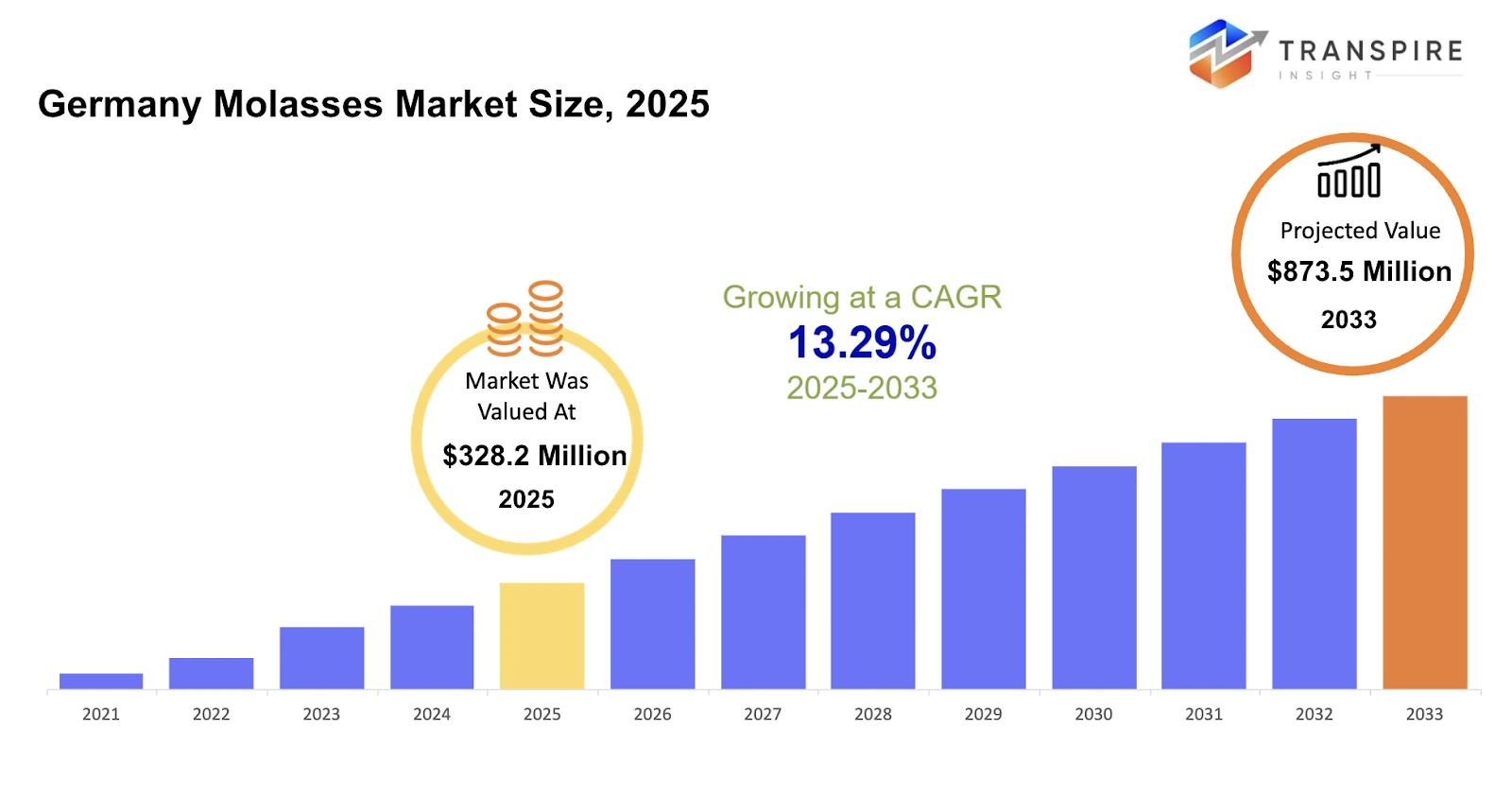
- Germany Molasses Market Size 2025: 328.2 USD Million
- Germany Molasses Market Size 2033: 873.5 USD Million
- Germany Molasses Market CAGR: 13.29%
- Germany Molasses Market Segments: By Product (True Molasses, Blackstrap), By Source (Sugarcane, Sugar Beet, Other), By Application (Food & Beverages, Biofuel (Ethanol, Acetone, etc.), Animal Feed, Other)
To learn more about this report,  Download Free Sample Report
Germany Molasses Market Summary:
The Germany Molasses Market size was estimated at 328.2 USD Million in 2025 and is anticipated to reach 873.5 USD Million by 2033, growing at a CAGR of 13.29% from 2026 to 2033. The Germany molasses market for food processing and industrial by-products will establish a dependable supply chain which depends on sugar refining and its subsequent applications. The market will reflect consistent demand from food manufacturers, animal nutrition producers, and fermentation-based industries. Processing facilities will maintain production practices which comply with quality standards and traceability rules and sustainability checks. The industry will establish molasses application methods based on consumer preferences for cleaner product labels and controlled material sourcing. The distribution patterns and long-term contracts in domestic and international trade will continue to evolve according to regulatory requirements for food-grade materials and industrial safety standards.
Key Market Trends & Insights:
- The livestock farming industry in Germany has experienced growth which creates a need for affordable energy sources that feed producers require to produce their feed mixtures. The sugar content of molasses together with its nutritional properties enables it to enhance feed efficiency. Feed manufacturers therefore continue using molasses as a cost-effective ingredient, supporting steady commercial activity connected with the Germany Molasses Market.
- The fermentation industry uses molasses because its natural sugar content enables microbial growth during production processes. The fermentation industry sees increased adoption of molasses from ethanol plants and yeast producers and biotechnology facilities. The processing industries in Germany experience increasing demand for renewable raw materials which creates stable supply chains.
- The growth of sustainable and circular production methods has reached a new milestone because people in Germany now recognize environmental sustainability as their main way to maximize agricultural waste. The by-product of sugar production molasses meets sustainability requirements because all its production waste goes through commercially viable industrial processing.
- The combination of food ingredients processing companies and animal feed production firms and fermentation businesses establishes circular resource management practices which maintain molasses as a valuable resource for both agricultural and industrial uses throughout its lifespan. The sugar beet processing industry operates as a major economic sector which supports Germany's position as one of Europe's top sugar beet processing countries. The sugar extraction process generates molasses as a secondary product which creates a constant supply of this material to domestic markets. The Germany Molasses Market depends on two factors which operate together to create stable raw material supply.
- The demand for specialty food products and baking applications has grown because more people are now showing interest in those fields. The food industry and artisanal baking businesses use molasses because of its ability to provide deep flavor and color improvement and natural sweetness. The baking industry uses molasses in its traditional recipes and specialty products to achieve both texture and flavor balance. The increasing demand for natural food products in Germany enables niche culinary markets to expand their customer base.
Germany Molasses Market Segmentation
By Product:
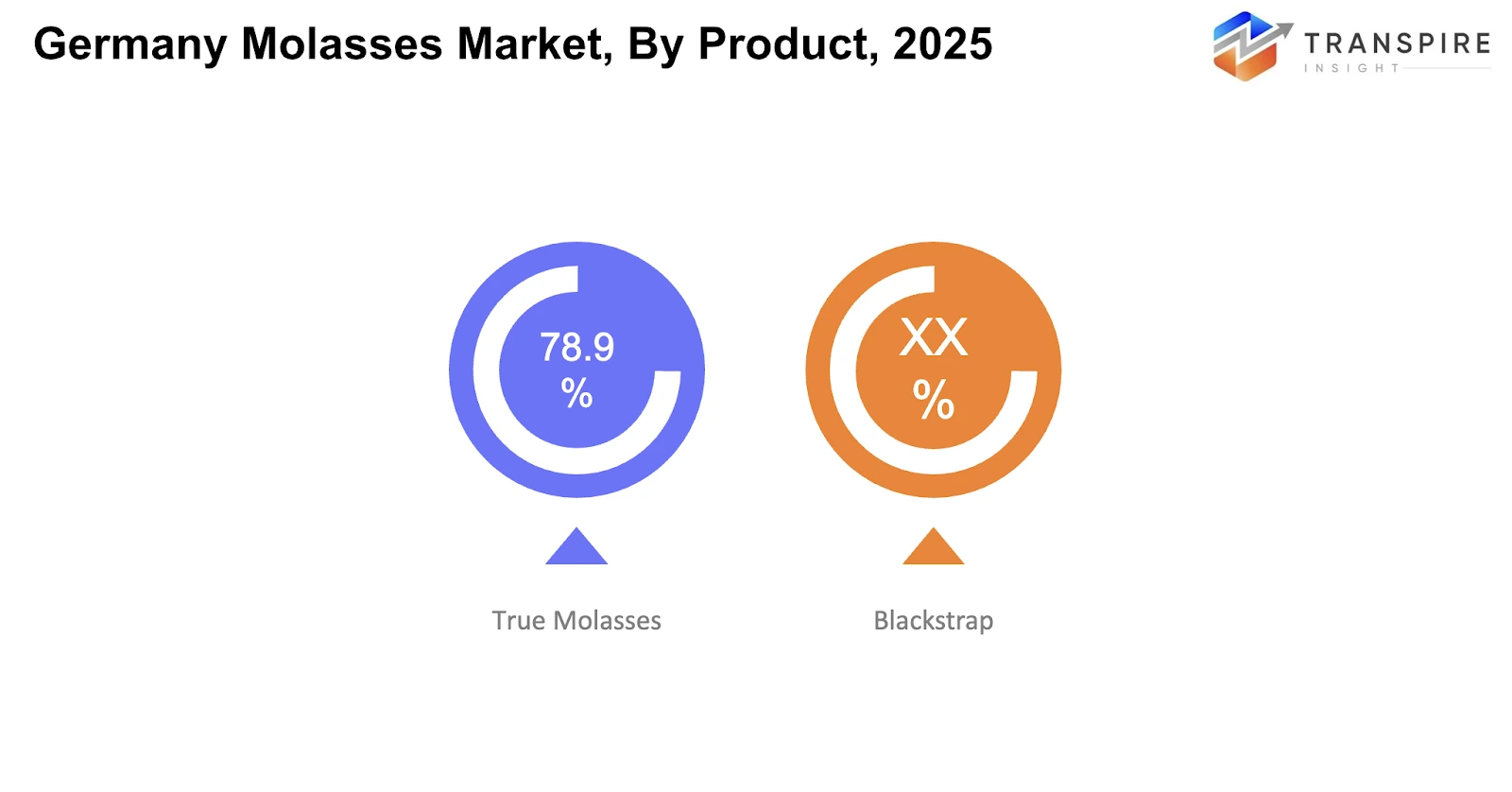
- Molasses: The German molasses market shows constant demand for true molasses because its sugar content and flavoring qualities maintain a stable balance. Food processors use true molasses for making bakery products and syrup and traditional recipes. The product provides industrial kitchens and small food manufacturers with dependable texture and managed sweetness for their operations.
- Blackstrap: Blackstrap molasses shows stronger growth driven by higher mineral concentration and lower sugar levels. Health-focused food producers and animal nutrition suppliers value blackstrap for its calcium, iron and magnesium content. Biofuel producers use blackstrap because it provides better fermentation efficiency for their ethanol processing needs.
To learn more about this report, Download Free Sample Report
By Source:
- Sugarcane: The market receives sugarcane-based molasses through importation from foreign countries. Food and beverage manufacturers prefer sugarcane origin because it provides deeper flavor and produces darker color. Ethanol producers use this factor because they need to know how their fermentation process will proceed. The supply system depends on two factors which are trade movements and the worldwide sugarcane harvest conditions.
- Sugar Beet: The domestic market receives its primary supply of sugar beet molasses because the country has developed extensive beet processing facilities. The local supply enables businesses to maintain their expenses while ensuring they have enough materials. Animal feed producers widely use beet molasses because it improves taste and provides essential energy for animals. Regional production cycles use beet-based molasses as a vital component for biofuel production.
- Other: The two sources include special molasses which comes from blending different types of molasses with specialized molasses that originates from other agricultural products. Usage remains limited but growing among niche food producers and research-driven bio-industrial users. The development of new fermentation processes together with environmentally friendly feed solutions will result in gradual implementation throughout specific uses.
By Application:
- Food and beverage: Food and beverage consumption focuses on bakery products and confectionery items and sauce-based products and traditional sweeteners. The flavor of food products receives enhanced depth while maintaining their moisture content through the use of molasses which also improves their visual appearance. The need for clean-label products drives manufacturers to implement controlled production methods which enable them to track product origins throughout their supply chains.
- Biofuel: Biofuel production creates a major demand market which requires both ethanol and industrial solvents. The use of molasses in production processes functions as an economical fermentation material. The government promotes renewable energy and waste conversion technologies which boost the long-term usage of industrial bio-processing systems.
- Animal Feed: The application of animal feed remains constant because it serves the nutritional requirements of livestock. The feed contains molasses which enhances its flavor while decreasing dust particles and providing instant energy. The dairy and cattle feed industry depends on stable product quality and large product supply to achieve their operational efficiency.
- Other: The applications of the product extend to three areas which include pharmaceuticals and yeast production and agricultural inputs. The volume of these applications remains small yet they continue to show consistent demand. The combination of research work and specialized production methods drives specific molasses use which helps to create new market opportunities without affecting overall production levels.
Country Insights
The German molasses market experiences consistent demand because molasses serves three functions in livestock feed and fermentation production and food processing. The main source of molasses in Germany comes from sugar beet processing which serves as a vital component of German agricultural production. The supply of sugar depends on current sugar production levels while feed manufacturers and fermentation industries maintain their regular demand.
The companies work to enhance their processing capabilities and storage systems for maintaining the quality of their molasses products. The Germany molasses market operates under stable demand conditions because feed producers have established long-term supply relationships with their partners. The Germany molasses market will experience growth because livestock nutrition and fermentation production create increased demand. The energy-rich feed ingredient molasses enhances feed palatability for cattle and other livestock species. The industrial demand increases through the expansion of yeast production and organic acid manufacturing and ethanol fermentation processes.
Sugar processors continue their funding of better extraction methods which they use during their sugar beet processing operations. The process achieves higher productivity which results in greater molasses production and provides continuous feedstock to both feed producers and industrial customers. Fermentation manufacturers maintain regular procurement of molasses due to availability and cost advantages. The collaboration between sugar processors and fermentation producers creates a stable growth pattern for the German molasses market.
Recent Development News
Recent developments show that changes in the sugar sector strongly influence the Germany molasses Market. In 2025, the German sugar industry association projected that refined sugar production could decline by about 4.9 percent during the 2025–2026 season, reaching around 4.40 million metric tonnes. The main reason behind the decline comes from reduced sugar beet planting by farmers, with cultivated area dropping to about 350,100 hectares after a year-on-year decrease of roughly 9.3 percent. (Source:https://www.chinimandi.com/germany-industry-association-sees-4-9-fall-in-sugar-output-this-season/)
Another important development connected to the Germany molasses Market relates to overall market pressure in the European sugar sector. In 2025, a major German sugar producer reported a sharp decline in financial performance as sugar prices dropped across the European Union. (Source:https://www.reuters.com/sustainability/climate-energy/suedzucker-posts-heavy-q2-earnings-fall-82-weak-sugar-market-2025-10-09/)
|
Report Attribute |
Details |
|
Revenue forecast in 2033 |
USD 873.5 million |
|
Growth rate |
CAGR of 13.29% from 2026 to 2033 |
|
Actual data |
2021 - 2025 |
|
Forecast data |
2026 - 2033 |
|
Quantitative units |
Revenue in USD million and CAGR from 2026 to 2033 |
|
Report coverage |
Revenue forecast, company ranking, competitive landscape, growth factors, and trends |
|
Segments covered |
Product, source, application |
|
Country scope |
Germany |
|
Key companies profiled |
Südzucker AG, Nordzucker AG, Pfeifer & Langen GmbH & Co. KG, Cosun Beet Company, Tereos, AGRANA Beteiligungs-AG, Cargill Incorporated, Archer Daniels Midland Company, ED&F Man Holdings Limited, Louis Dreyfus Company, BayWa AG, Bunge Limited, K+S Aktiengesellschaft, Raffinerie Tirlemontoise, Zuckerfabrik Anklam GmbH |
|
Customization scope |
Free report customization (equivalent up to 8 analysts working days) with purchase. Addition or alteration to country, regional & segment scope. |
|
ReportSegmentation |
By Product (True Molasses, Blackstrap), By Source (Sugarcane, Sugar Beet, Other), By Application (Food & Beverages, Biofuel (Ethanol, Acetone, etc.), Animal Feed, Other) |
Key Germany molasses market Insights
The market requires reliable supply volume patterns and contract-based sourcing methods for its ongoing operations. Quality testing at processing units will remain a priority to meet application-specific needs. Buyers will prefer suppliers who provide traceability and compliance assistance. Usage patterns across Germany will remain tied to food safety regulations and feed regulations and industrial input standards.
Company List
- Südzucker AG
- Nordzucker AG
- Pfeifer & Langen GmbH & Co. KG
- Cosun Beet Company
- Tereos
- AGRANA Beteiligungs-AG
- Cargill Incorporated
- Archer Daniels Midland Company
- ED&F Man Holdings Limited
- Louis Dreyfus Company
- BayWa AG
- Bunge Limited, K+S Aktiengesellschaft
- Raffinerie Tirlemontoise
- Zuckerfabrik Anklam GmbH
By Product
- True Molasses
- Blackstrap
By Source
- Sugarcane
- Sugar Beet
- Other
By Application
- Food & Beverages
- Biofuel (Ethanol, Acetone, etc.)
- Animal Feed
- Other
Frequently Asked Questions
Find quick answers to common questions.
The approximate Germany Health And Wellness Foods Market size for the market will be USD 873.5 million.
Key segments for the Germany Molasses Market are By Product (True Molasses, Blackstrap), By Source (Sugarcane, Sugar Beet, Other), By Application (Food & Beverages, Biofuel (Ethanol, Acetone, etc.), Animal Feed, Other).
Major Germany Molasses Market players are Südzucker AG, Nordzucker AG, Pfeifer & Langen GmbH & Co. KG, Cosun Beet Company, Tereos, AGRANA Beteiligungs-AG, Cargill Incorporated, Archer Daniels Midland Company, ED&F Man Holdings Limited, Louis Dreyfus Company, BayWa AG, Bunge Limited, K+S Aktiengesellschaft, Raffinerie Tirlemontoise, Zuckerfabrik Anklam GmbH.
The Germany Molasses Market size is USD 328.2 million in 2025.
The Germany Molasses Market CAGR is 13.29%
- Südzucker AG
- Nordzucker AG
- Pfeifer & Langen GmbH & Co. KG
- Cosun Beet Company
- Tereos
- AGRANA Beteiligungs-AG
- Cargill Incorporated
- Archer Daniels Midland Company
- ED&F Man Holdings Limited
- Louis Dreyfus Company
- BayWa AG
- Bunge Limited, K+S Aktiengesellschaft
- Raffinerie Tirlemontoise
- Zuckerfabrik Anklam GmbH
Recently Published Reports
-
Dec 2024
Baby Infant Formula Market
Baby Infant Formula Market Size, Share & Analysis Report By ype (Infant Milk, Follow On Milk, Specialty Baby Milk, Growing-Up Milk), By Ingredient (Carbohydrate, Fat, Protein, Minerals, Vitamins, and Others), By Product Form (Powder, Liquid, and Ready-to-feed), By Distribution Channels (Supermarket/Hypermarket, Specialty Store, Pharmacies, Online Retail, and Others), and Geography (North America, Europe, Asia-Pacific, Middle East and Africa, South and Central America), 2021 - 2031
-
Jan 2025
Edible Insects for Animal Feed Market
Edible Insects for Animal Feed Market Size, Share & Analysis Report By Type (Insect Powder, Insect Meal, Insect Bar, Insect Paste, Insect Oil, and Others), By Insect Type (Beetles, Cricket, Caterpillar, Hymenoptera, Orthoptera, Tree Bugs, and Others), By Application (Livestock, Pet Food, and Aquaculture), By Livestock Type (Poultry, Swine, and Others), and Geography (North America, Europe, Asia-Pacific, Middle East and Africa, South and Central America), 2021 - 2031
-
Jan 2025
Food Industry Disinfection and Bacterial Control Market
Food Industry Disinfection and Bacterial Control Market Size, Share & Analysis Report By Type (Chemical Disinfectants, Physical Disinfectants, and Biocides and Antimicrobials), By Application (Food Processing Equipment Surface Disinfection, Food Preparation Areas Surface Disinfection, Storage Areas Surface Disinfection, Anti-microbial Coatings Food Preservation, and Preservative Solutions Food Preservation), By End User (Meat and Poultry Processing, Dairy Processing, Seafood Processing, Bakery and Confectionery, Restaurants and Commercial Kitchens, and Food Service Providers), By Sales Channel (Online, Offline), and Geography (North America, Europe, Asia-Pacific, Middle East and Africa, South and Central America), 2021 - 2031
-
Jan 2025
Freeze Dried Food Market
Freeze Dried Food Market Size, Share & Analysis Report By Product Type (Fruits, Vegetables, Freeze-Dried Dairy Products, Freeze-Dried Meat and Seafood, Freeze-Dried Pet Food, and Prepared Meal), By Nature (Organic, and Conventional), By Form (Powdered, Granules, and Diced), By End Use (Breakfast Cereals, Dairy Products, Bakery & Confectionery, Nutritional Bars & Supplements, Powdered Beverages, Snacks, and Retail (Household)), and Geography (North America, Europe, Asia-Pacific, Middle East and Africa, South and Central America), 2021 - 2031