
Germany Medical Technologies Market Summary
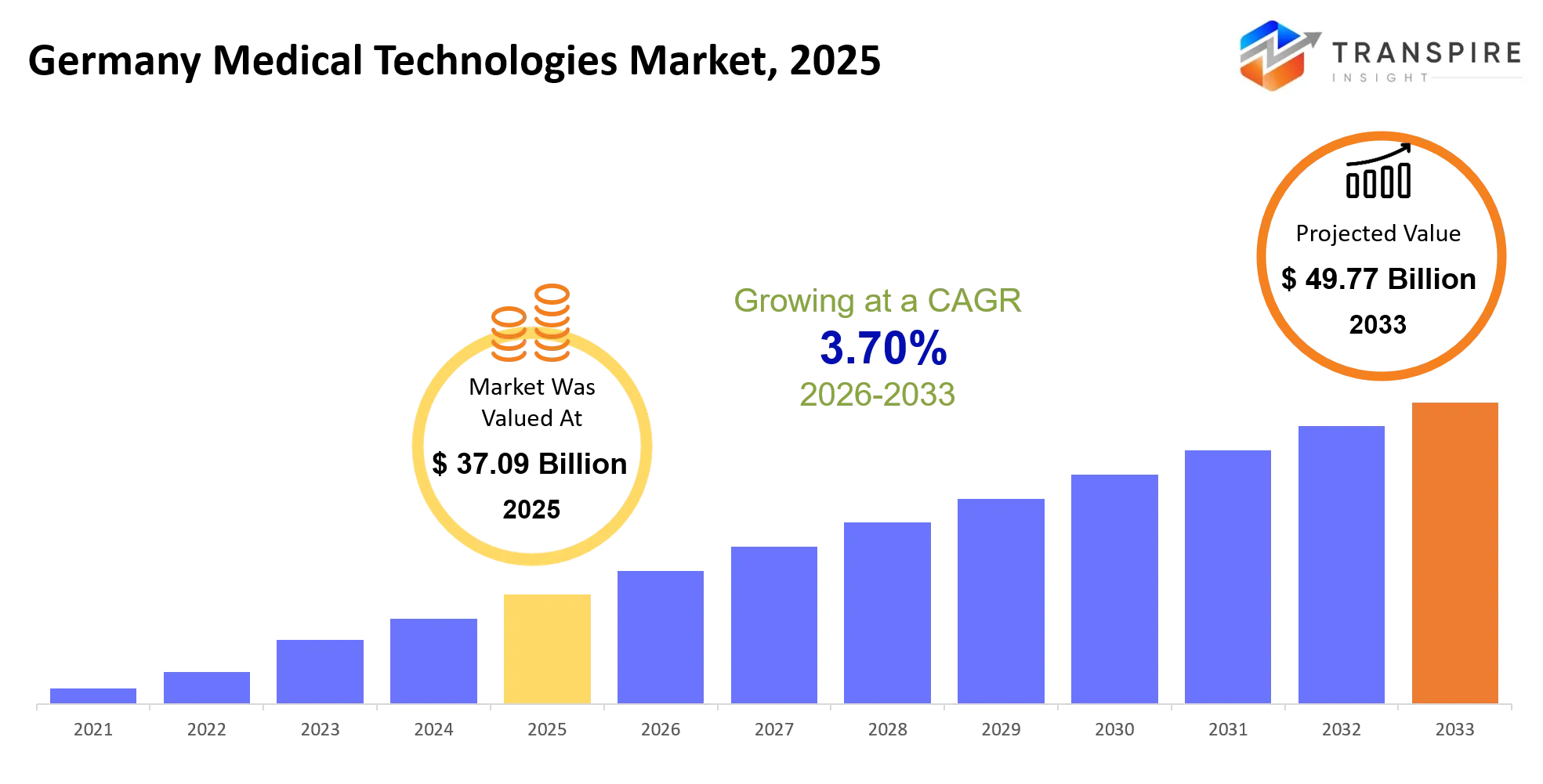
As per Transpire Insight Analysis The Germany Medical Technologies Market size is estimated at USD 37.09 Billion in 2025 and is anticipated to reach USD 49.77 Billion by 2033, growing at a CAGR of 3.70%from 2026 to 2033.
The Germany medical technologies market kind of supports hospitals , laboratories, and other healthcare providers by bringing more advanced equipment and solutions, that boost diagnosis, make treatment accuracy feel a bit sharper, support patient tracking ,and generally help day to day clinical work run a little more smoothly.In reality, these technologies assist healthcare systems with dealing with tougher illnesses, reducing treatment delays, and lifting outcomes, mainly by using more precision oriented medical procedures in a more controlled way.
Over the last three to five years, the market has been leaning toward digital healthcare integration a bit more, where artificial intelligence, connected devices, and automated diagnostic platforms have become pretty central, in everyday medical routines. Also, the implementation of the EU Medical Device Regulation (MDR) and supply chain disruptions during the COVID-19 period kinda pushed manufacturers to focus harder on regulatory compliance, local production, and building sturdier healthcare technology networks. Growth is reinforced by hospital modernization programs, an aging population that really needs advanced care solutions,and ongoing investments in minimally invasive procedures. Put together, these factors are making healthcare providers more willing to adopt higher value technologies; they often claim it improves both operational efficiency and clinical decision making.
Germany Medical Technologies Market Size & Forecast:
- Germany Medical Technologies Market Size 2025: USD 37.09 Billion
- Expected Market Value 2033: 805.3 Million
- Forecast CAGR: 3.70%
- Key Profile: Siemens Healthineers, B. Braun, Drägerwerk, Fresenius Medical Care, Carl Zeiss Meditec, Philips Healthcare, GE HealthCare, Medtronic, Abbott Laboratories, Boston Scientific, Stryker Corporation, Roche Diagnostics, BD, Olympus Corporation, Johnson & Johnson MedTech
Key Market Insights
- Southern Germany seems to lead the adoption rate, with big medical innovation hubs in Bavaria and Baden-Württemberg, backing advanced healthcare technologies.
- It’s kinda obvious that AI-based diagnostics are picking up steam after 2025, since hospitals start folding in automation tools for quicker clinical decision making, and smoother workflows in general.
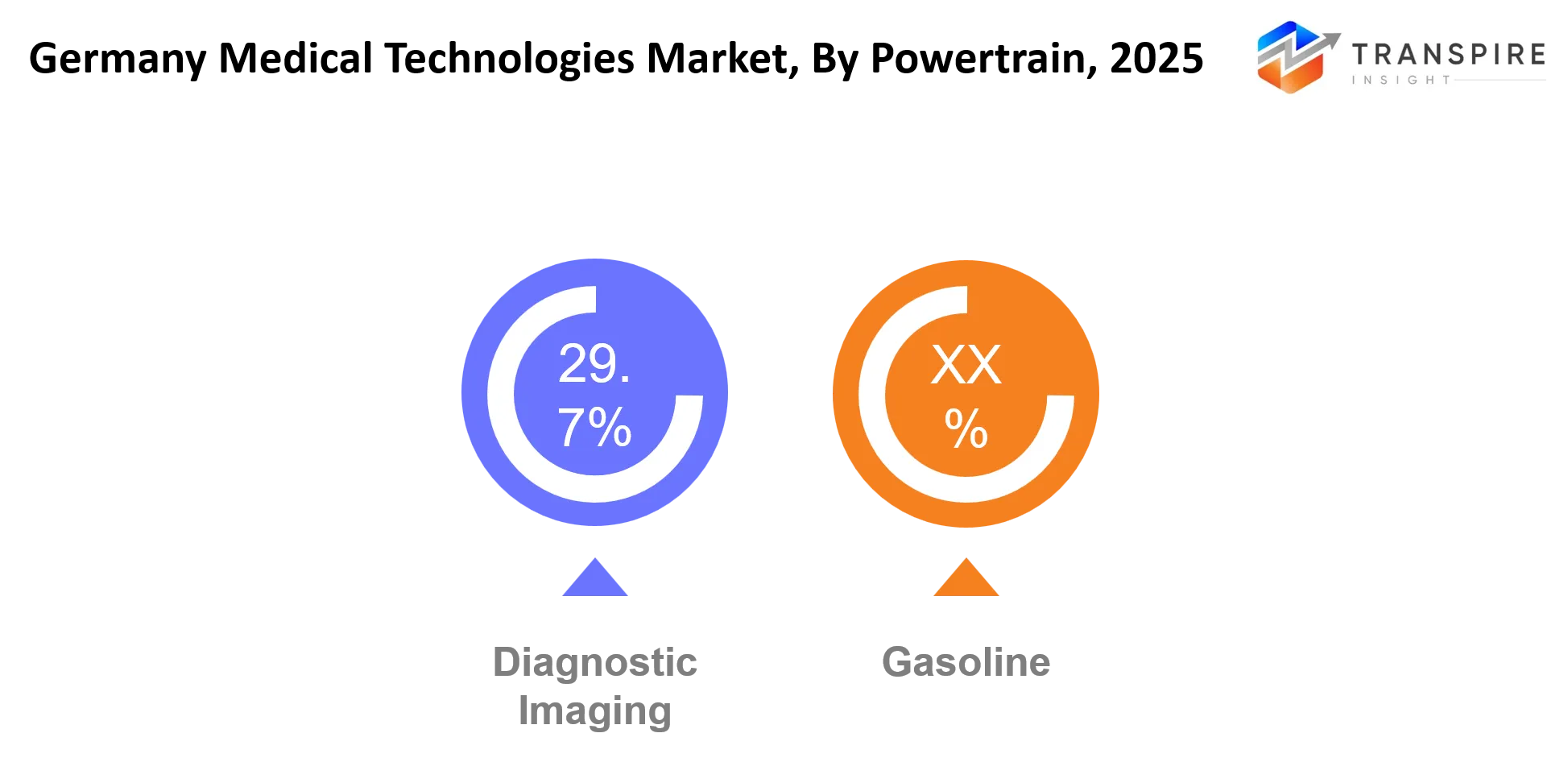
- Diagnostic imaging still keeps a notable market share, largely because MRI, CT, and AI enhanced imaging platforms are seeing higher utilization across the board.
- Meanwhile digital health solutions are showing the fastest growth, as German healthcare providers roll out connected patient monitoring and remote care services, more and more.
- Hospitals sit as the largest end-user segment, they’re pushed along by modernization programs ,plus steady investments in newer and advanced medical equipment.
- Home healthcare adoption is also accelerating ,mostly due to aging demographics, and the growing demand for remote monitoring paired with more personalized treatment solutions.
- Siemens Healthineers and GE HealthCare keep strengthening their market positions with AI-enabled imaging platforms and broader integrated healthcare ecosystems.
- B. Braun and Fresenius Medical Care, are expanding through specialized therapies, hospital partnerships, and patient centric medical solutions, which customers tend to notice quickly.
- After 2024, medical device manufacturers are increasingly placing emphasis on MDR compliance, cybersecurity, and sustainable production strategies.
- Looking ahead, robotic surgery and smart implant technologies are emerging opportunities, tied closely to precision medicine investments, through 2030.
What are the Key Drivers, Restraints, and Opportunities in The Germany Medical Technologies Market?
Germany’s medical technologies market is, mostly, pulled by healthcare digitization, an aging population with needs that keep growing, and government backed modernization of medical infrastructure. In practice, hospitals and healthcare providers are spending more on advanced imaging systems, AI supported diagnostics, and connected monitoring devices. The idea is to boost treatment efficiency and—at the same time— take some of the operational pressure off staff. Also, the stricter European Medical Device Regulation requirements have been kind of pushing manufacturers toward solutions with better quality and stronger documentation, so demand is shifting to certified and more technologically advanced products.
One big restraint though is the heavy compliance burden tied to MDR requirements. On top of that, the approval processes for innovative medical devices can be pretty lengthy. Smaller manufacturers often get hit harder by the costs for clinical evaluations, documentation, and regulatory validation, which can delay launches and, in some cases, limit how fast they even enter the market. As a result, innovation cycles might slow down and adoption speed for emerging technologies may drop.
Still, there’s a real opportunity in AI powered healthcare platforms, digital therapeutics, and remote patient monitoring solutions. Germany’s ongoing investment in healthcare digitalization and electronic health records creates a favorable environment for technology providers. Firms building secure AI diagnostic systems, connected medical devices, and personalized healthcare solutions can do well through partnerships with hospitals, research institutions, and healthcare networks, even if the path there requires patience and solid integration work.
What Has the Impact of Artificial Intelligence Been on The Germany Medical Technologies Market?
Artificial intelligence is kinda reshaping Germany’s medical technologies sector, by boosting diagnostic accuracy, speeding up workflow automation, and giving clinical decision support a more grounded feel. AI powered imaging platforms are assisting radiologists in interpreting MRI , CT and X-ray scans more quickly while also spotting subtle patterns that could allow earlier disease detection. Firms like Siemens Healthineers and Philips Healthcare are moving toward AI algorithms inside imaging and monitoring solutions, with the goal of raising hospital efficiency, and making day to day operations a bit smoother.
Machine learning models are likewise backing predictive healthcare use cases by looking at patient data, flagging likely health risks, and helping refine treatment planning. AI based laboratory systems improve testing routines too, automating sample analysis and cutting down on a lot of manual intervention . In general these tools help healthcare providers improve operational throughput, reduce diagnostic timelines, and better manage resources.
That said, AI adoption still has limitations, mainly because implementation costs can be high, data privacy requirements are strict, and there are persistent challenges integrating brand new systems with older hospital infrastructure . In addition, limited access to standardized healthcare datasets can lower algorithm performance when they’re moved across different clinical environments. Future momentum, in other words, depends on continued investment in data security , interoperability, and regulatory approval.
Key Market Trends
- In 2025 , German hospitals started using more AI-supported imaging systems, partly to speed up diagnosis and also to make clinical decisions more precise, you know.
- From 2024 onward, the MDR compliance rules kind of pushed manufacturers to shift their approach, toward tougher certification processes and clearer product validation steps.
- Siemens Healthineers then moved further into AI enabled imaging, to help automate diagnostics across all kinds of healthcare facilities.
- Meanwhile digital health platforms picked up pace too, especially as Germany accelerated the buildout of electronic healthcare infrastructure.
- Robotic-assisted surgery adoption also went up, because hospitals put more money into precision procedures, and more minimally invasive treatment tech.
- After 2025 , home monitoring solutions expanded as healthcare providers had to deal with aging population issues, not just in one region but generally.
- Medical technology companies kept growing partnerships with research institutions, aiming to fast-track AI and personalized medicine innovation.
- And since supply chains were disrupted, manufacturers leaned into regional production strength, plus they diversified suppliers, a bit more than before.
- Smart implants, and also wearable healthcare devices, gained more attention due to improvements in connected patient monitoring.
- Finally, healthcare providers placed more emphasis on cybersecurity features because connected medical devices became more common, and that basically changed the priorities.
Germany Medical Technologies Market Segmentation
By Product Type
Diagnostic imaging will stay a major product category because hospitals, and diagnostic centers keep using MRI, CT, ultrasound, and X-ray systems, for accurate identification of disease. Surgical devices back minimally invasive procedures, advanced operations, and really precise treatments across hospitals, and also in specialty care facilities. Patient monitoring systems let healthcare professionals track vital signs, and handle critical conditions especially in intensive care units, and emergency departments. In-vitro diagnostics help with laboratory testing, screening for disease, and choosing personalized treatment decisions by using advanced testing technologies.
Orthopedic devices handle joint replacement, bone injuries, and mobility-related conditions using implants along with surgical equipment. Cardiovascular devices support heart care through monitoring systems, stents, and intervention tools. Respiratory devices assist patients with breathing disorders, and dental equipment along with ophthalmic devices cover specialized treatment needs. Other medical products include supporting instruments, and equipment that are used across many different healthcare applications.
By Technology
Digital health technologies are going to help healthcare delivery, mostly because of electronic records, telemedicine platforms and those connected patient management systems, you know. Also AI based technologies really help with faster diagnosis, plus medical image analysis, and clinical decisions, thanks to more advanced data processing. Robotic surgery makes procedures more precise, it kind of supports minimally invasive treatments, in hospitals as well as in specialized surgical centers. Then wearable devices do continuous health tracking, with sensors monitoring patient conditions outside the usual healthcare setting.
3D printing technology supports customized implants, and also surgical planning model things, and patient specific medical solutions. Smart implants, they can include advanced monitoring features and better treatment outcomes, through connected capabilities. Laser technology supports precision procedures, for example in ophthalmology and surgery, while nanotechnology enables more targeted medical applications. Imaging technology keeps improving diagnostic accuracy, through advanced scanning, visualization methods, and similar upgrades.
By Application
Cardiology applications will keep getting strong adoption, because there’s this ongoing need for cardiovascular monitoring systems, diagnostic tools, and those minimally invasive treatment devices. Oncology applications, on the other hand, really lean on advanced imaging equipment, diagnostic solutions, plus treatment technologies, to back up cancer detection and overall management. Neurology applications depend on imaging platforms, monitoring devices, and surgical technologies , for handling neurological disorder care. Orthopedics uses implants, surgical gear, and rehabilitation technologies to support care for bones and joints.
General surgery applications tend to benefit from advanced surgical instruments and robotic-assisted systems, which help improve procedural outcomes. Gynecology and urology applications make use of specialized diagnostic and treatment devices for focused healthcare procedures. Emergency care leans on quick diagnostic systems and patient monitoring equipment, while rehabilitation uses assistive technologies and recovery solutions. Other applications usually cover specialty treatments that require advanced medical equipment and support systems, not just one single kind of tool.
By End User
Hospitals are basically a huge end-user group, since they keep using diagnostic gear, surgical systems, monitoring tools ,and a lot of advanced treatment technologies all the time. Clinics may move toward compact medical devices and digital health solutions ,so they can improve outpatient services in a smoother way. Ambulatory surgical centers will likely bring in more technology because of minimally invasive procedures and faster surgical workflows, maybe less hassle overall. Diagnostic labs rely on automated testing setups and advanced diagnostic equipment, in order to get accurate results sooner and with more consistency.
Home healthcare is gaining weight too, especially with remote monitoring devices and connected healthcare solutions that help manage patients for the long run. Research institutes and academic institutions also use modern technologies for medical innovation, clinical studies, and training programs, almost like continuous learning labs. Specialty centers plus rehabilitation centers tend to apply very specific devices for targeted treatments, recovery programs, and specialized care services. Other end users include healthcare facilities that need particular medical equipment solutions ,depending on their case mix and internal preferences.
By Distribution Channel
Direct sales still stay a key distribution way , since manufacturers provide advanced medical equipment straight to hospitals and healthcare organizations. Medical distributors kind of broaden the reach by linking manufacturers with clinics, labs, and even smaller healthcare facilities. As digital purchasing systems keep getting better , online sales channels will grow for certain medical products as well as healthcare accessories. When it comes to hospital procurement, the main focus is choosing equipment by looking at performance, regulatory approval , service support, plus cost efficiency.
Government procurement backs healthcare infrastructure development, and also modernization initiatives across public healthcare facilities. Group purchasing organizations assist providers in lowering costs using collective purchasing agreements, which is really a kind of centralized buying approach. OEM supply networks support tailor made manufacturing partnerships between technology providers and medical device companies. Retail medical stores and third party suppliers distribute healthcare products to smaller providers and end users, and then the remaining channels handle specialized product requirements.
What are the Key Use Cases Driving The Germany Medical Technologies Market?
The main use case that’s pushing Germany’s medical technologies market is like advanced diagnostic and therapeutic support, spread across hospitals, specialty clinics, and outpatient care facilities. It looks like demand is getting higher for precision diagnosis, minimally invasive procedures and faster patient handling . Because of that, more providers are leaning into imaging systems, surgical technologies, and diagnostic devices.
Also, new applications are showing up in chronic disease management ,and in home based healthcare especially within the part of the population that is aging in Germany. Digital monitoring devices, connected medical equipment , and remote care solutions are picking up momentum among healthcare providers who are searching for cost efficient treatment models. Not always, but a lot of the time they want something that feels more continuous.
For newer or emerging use cases, you see AI assisted diagnostics, robotic assisted surgery, and personalized medicine platforms. These are being carried forward by Germany’s digital health initiatives , by regulatory approvals for innovative medical devices, and by stronger cooperation between technology companies, research institutes and healthcare organizations.
|
Report Metrics |
Details |
|
Market size value in 2025 |
USD 37.09 Billion |
|
Market size value in 2026 |
USD 38.46 Billion |
|
Revenue forecast in 2033 |
USD 49.77 Billion |
|
Growth rate |
CAGR of 3.70%from 2026 to 2033 |
|
Base year |
2025 |
|
Historical data |
2021 - 2024 |
|
Forecast period |
2026 - 2033 |
|
Report coverage |
Revenue forecast, competitive landscape, growth factors, and trends |
|
Regional scope |
Germany |
|
Key company profiled |
Siemens Healthineers, B. Braun, Drägerwerk, Fresenius Medical Care, Carl Zeiss Meditec, Philips Healthcare, GE HealthCare, Medtronic, Abbott Laboratories, Boston Scientific, Stryker Corporation, Roche Diagnostics, BD, Olympus Corporation, Johnson & Johnson MedTech |
|
Customization scope |
Free report customization (country, regional & segment scope). Avail customized purchase options to meet your exact research needs. |
|
Report Segmentation |
By Product Type (Diagnostic Imaging, Surgical Devices, Patient Monitoring Systems, In-Vitro Diagnostics, Orthopedic Devices, Cardiovascular Devices, Respiratory Devices, Dental Equipment, Ophthalmic Devices, Others); By Technology (Digital Health, AI-Based Technologies, Robotic Surgery, Wearables, 3D Printing, Smart Implants, Laser Technology, Nanotechnology, Imaging Technology, Others); By Application (Cardiology, Oncology, Neurology, Orthopedics, General Surgery, Gynecology, Urology, Emergency Care, Rehabilitation, Others); By End User (Hospitals, Clinics, Ambulatory Surgical Centers, Diagnostic Laboratories, Home Healthcare, Research Institutes, Academic Institutions, Specialty Centers, Rehabilitation Centers, Others); By Distribution Channel (Direct Sales, Medical Distributors, Online Sales, Hospital Procurement, Government Procurement, Group Purchasing Organizations, OEM Supply, Retail Medical Stores, Third-Party Suppliers, Others) |
Which Regions are Driving The Germany Medical Technologies Market Growth?
In Southern Germany, the adoption of medical technologies leads the way, kind of, because the healthcare ecosystem there is quite strong—especially in Bavaria and Baden-Württemberg. You can see it in the advanced university hospitals, medical research institutions, and yes, the large density of technology manufacturers in the same area. Besides that, the industrial know-how is solid, there is clear investment in healthcare innovation, and the constant cooperation between hospitals and device developers keeps regional demand moving, even when things get slower.
Western Germany also matters a lot, driven by its established healthcare infrastructure and markets that are more economically resilient across North Rhine-Westphalia and Hesse. And, in a way, it works a bit different from the research powered model you often see in the south. Here you have bigger hospital networks, relatively consistent healthcare spending, and more steady uptake of medical devices, both in public systems and private healthcare providers. This kind of rhythm makes the region dependable for many technology companies.
Northern Germany on the other hand, is turning into the fastest-growing region, mostly thanks to rising investments in digital healthcare infrastructure, plus ongoing modernization of medical facilities. Telemedicine platforms are being adopted more and more, and connected devices along with AI based healthcare solutions are showing up regularly. Between 2026 and 2033, this regional push is expected to bring in investors who want scalable digital medical solutions, as well as next-generation healthcare delivery models, which sounds like a mouthful but thats basically it.
Who are the Key Players in The Germany Medical Technologies Market and How Do They Compete?
Germany’s medical technologies market kind of shows a balance between big global players and smaller, specialized innovators, they compete via technological progress, clinical dependability, regulatory compliance, plus integrated healthcare solutions. The established manufacturers tend to keep solid leverage because of long-standing hospital connections, whereas digital health firms and focused device developers are getting more pushy with AI integration and more tailored, personalized solutions.
Siemens Healthineers shows up with advanced imaging systems, laboratory diagnostics, and AI-assisted clinical routines. Their edge is mostly about blending hardware platforms with a kind of digital healthcare ecosystem that helps hospitals gain operational efficiency , not just “faster” but smoother. B. Braun concentrates on specialized medical devices, infusion therapy, and surgical solutions. It differentiates itself with careful precision engineering and also with very strong relationships to healthcare providers.
Drägerwerk builds its advantage around critical care technologies, like anesthesia systems and patient monitoring gear, all designed for intensive healthcare environments. Fresenius Medical Care holds a specialized position through kidney care products and connected dialysis services, and it keeps expanding using global treatment networks. Carl Zeiss Meditec competes through high-precision ophthalmic tools and microsurgical technologies, with innovation in surgical visualization , and diagnostic platforms too.
Company List
- Siemens Healthineers
- B. Braun
- Drägerwerk
- Fresenius Medical Care
- Carl Zeiss Meditec
- Philips Healthcare
- GE HealthCare
- Medtronic
- Abbott Laboratories
- Boston Scientific
- Stryker Corporation
- Roche Diagnostics
- BD
- Olympus Corporation
- Johnson & Johnson MedTech
Recent Development News
In January 2026, Siemens Healthineers launched the MAGNETOM Flow platform, a new generation MRI technology designed to improve imaging efficiency and clinical workflow performance. The innovation strengthens Siemens Healthineers’ position in advanced diagnostic imaging by reducing operational complexity for healthcare providers.https://www.siemens-healthineers.com/ (Siemens Healthineers)
In February 2025, Roche Diagnostics launched the cobas Mass Spec solution in selected markets, expanding its clinical diagnostics portfolio with automated mass spectrometry capabilities. The technology supports laboratories seeking improved testing efficiency and precision in complex diagnostic workflows.https://diagnostics.roche.com/ (Roche Diagnostics)
What Strategic Insights Define the Future of The Germany Medical Technologies Market?
Germany’s medical technologies market is kinda moving toward more integrated, digitally-linked care systems, pushed mainly by AI adoption, hospital automation, and this need for personalized treatment routes that fit the person. In the next five to seven years, growth will probably hinge more and more on tools that blend medical devices with software intelligence and live patient information, which is not just a nice thing but a real requirement. But there is also a sort of shadow risk, because regulatory complexity is rising under the European medical device rules frameworks, and that could slow product approvals, and then also add compliance expenses, especially for smaller innovators who don’t have as much runway. Still, there’s a real opening too: AI-enhanced diagnostic platforms and remote monitoring offerings, supported by Germany’s digital health push and the growing needs of an aging population.
So, market players should really focus on partnerships between device manufacturers, software firms, and healthcare providers, so innovation can move faster while they stay regulatory-ready, and keep clinical worth intact.
Germany Medical Technologies Market Report Segmentation
By Product Type
• Diagnostic Imaging
• Surgical Devices
• Patient Monitoring Systems
• In-Vitro Diagnostics
• Orthopedic Devices
• Cardiovascular Devices
• Respiratory Devices
• Dental Equipment
• Ophthalmic Devices
• Others
By Technology
• Digital Health
• AI-Based Technologies
• Robotic Surgery
• Wearables
• 3D Printing
• Smart Implants
• Laser Technology
• Nanotechnology
• Imaging Technology
• Others
By Application
• Cardiology
• Oncology
• Neurology
• Orthopedics
• General Surgery
• Gynecology
• Urology
• Emergency Care
• Rehabilitation
• Others
By End User
• Hospitals
• Clinics
• Ambulatory Surgical Centers
• Diagnostic Laboratories
• Home Healthcare
• Research Institutes
• Academic Institutions
• Specialty Centers
• Rehabilitation Centers
• Others
By Distribution Channel
• Direct Sales
• Medical Distributors
• Online Sales
• Hospital Procurement
• Government Procurement
• Group Purchasing Organizations
• OEM Supply
• Retail Medical Stores
• Third-Party Suppliers
• Others
Frequently Asked Questions
Find quick answers to common questions.
The expected Germany Medical Technologies Market size for the market will be USD 49.77 Billion in 2033.
Key segments for The Germany Medical Technologies Market are By Product Type (Diagnostic Imaging, Surgical Devices, Patient Monitoring Systems, In-Vitro Diagnostics, Orthopedic Devices, Cardiovascular Devices, Respiratory Devices, Dental Equipment, Ophthalmic Devices, Others); By Technology (Digital Health, AI-Based Technologies, Robotic Surgery, Wearables, 3D Printing, Smart Implants, Laser Technology, Nanotechnology, Imaging Technology, Others); By Application (Cardiology, Oncology, Neurology, Orthopedics, General Surgery, Gynecology, Urology, Emergency Care, Rehabilitation, Others); By End User (Hospitals, Clinics, Ambulatory Surgical Centers, Diagnostic Laboratories, Home Healthcare, Research Institutes, Academic Institutions, Specialty Centers, Rehabilitation Centers, Others); By Distribution Channel (Direct Sales, Medical Distributors, Online Sales, Hospital Procurement, Government Procurement, Group Purchasing Organizations, OEM Supply, Retail Medical Stores, Third-Party Suppliers, Others)
Major Germany Medical Technologies Market players are Siemens Healthineers, B. Braun, Drägerwerk, Fresenius Medical Care, Carl Zeiss Meditec, Philips Healthcare, GE HealthCare, Medtronic, Abbott Laboratories, Boston Scientific, Stryker Corporation, Roche Diagnostics, BD, Olympus Corporation, Johnson & Johnson MedTech
The Germany Medical Technologies Market size is USD 37.09 Billion in 2025.
The Germany Medical Technologies Market CAGR is 3.70% from 2026 to 2033.
Company List
- Siemens Healthineers
- B. Braun
- Drägerwerk
- Fresenius Medical Care
- Carl Zeiss Meditec
- Philips Healthcare
- GE HealthCare
- Medtronic
- Abbott Laboratories
- Boston Scientific
- Stryker Corporation
- Roche Diagnostics
- BD
- Olympus Corporation
- Johnson & Johnson MedTech
About the Authors

Pankaj Ghogare Patil
I am Pankaj Ghogare Patil, a Senior Research Analyst at Transpire Insight, specializing in the Pharmaceutical, Chemicals & Materials, Healthcare IT, and Biotechnology industry. My expertise lies in conducting comprehensive market research, analyzing industry trends, evaluating competitive landscapes, and translating complex data into actionable insights. At Transpire Insight, I closely follow emerging technologies, regulatory developments, and market innovations to create accurate, well-researched, and informative content that helps businesses and professionals make informed decisions. I am committed to producing credible, evidence-based articles that reflect industry best practices while making technical topics accessible and valuable for a broad audience.

Chakradhar Khansole
Chakradhar serves as the Research Director at Transpire Insight, bringing over 8 years of experience in technology, innovation, and strategic market intelligence. He specializes in transforming complex market data into actionable business insights that enable organizations to make informed, growth-oriented decisions. Recognized for his strategic vision and analytical expertise, Chakradhar leads high-impact research initiatives, delivering comprehensive market assessments, competitive intelligence, and forward-looking industry analysis.
Recently Published Reports
-
Apr 2026
AI in Diabetic Retinopathy Market
AI in Diabetic Retinopathy Market Size, Share & Analysis Report By Type (Screening AI Systems, Diagnostic AI Systems, and Predictive AI Models), By Application Segment (Hospitals, Ophthalmology Clinics, Diagnostic Centers, and Research and Development), and Geography (North America, Europe, Asia-Pacific, Middle East and Africa, South and Central America), 2021 - 2031
-
Apr 2026
Psychometric Tests Market
Psychometric Tests Market Size, Share & Analysis Report By Type (Personality Tests, Ability/Aptitude Tests, Skill/Knowledge Tests, and Others), By Application (Talent Acquisition and Talent Management), and Geography (North America, Europe, Asia-Pacific, Middle East and Africa, South and Central America), 2021 – 2031
-
Apr 2026
Rare Biological Sample Collection Market
Rare Biological Sample Collection Market Size, Share & Analysis Report By Type (Isolation Kits & Reagent, Blood Collection Tubes, and Others), By Application (Oncology, Transcriptomics, Pharmacogenomics, and Others), and Geography (North America, Europe, Asia-Pacific, Middle East and Africa, South and Central America), 2021 – 2031
-
Jul 2026
Diabetic Retinopathy Market
Diabetic Retinopathy Market Size, Share & Analysis Report By Type (Proliferative Diabetic Retinopathy, and Diabetic Macular Edema (DME)), By Treatment Type (Anti VEGF Drug, Steroid Implants, Laser Surgeries, and Vitrectomy), and Geography (North America, Europe, Asia-Pacific, Middle East and Africa, South and Central America), 2021 – 2031
Our Clients







