
Germany Form In Place Gasket (FIPG) Market Summary
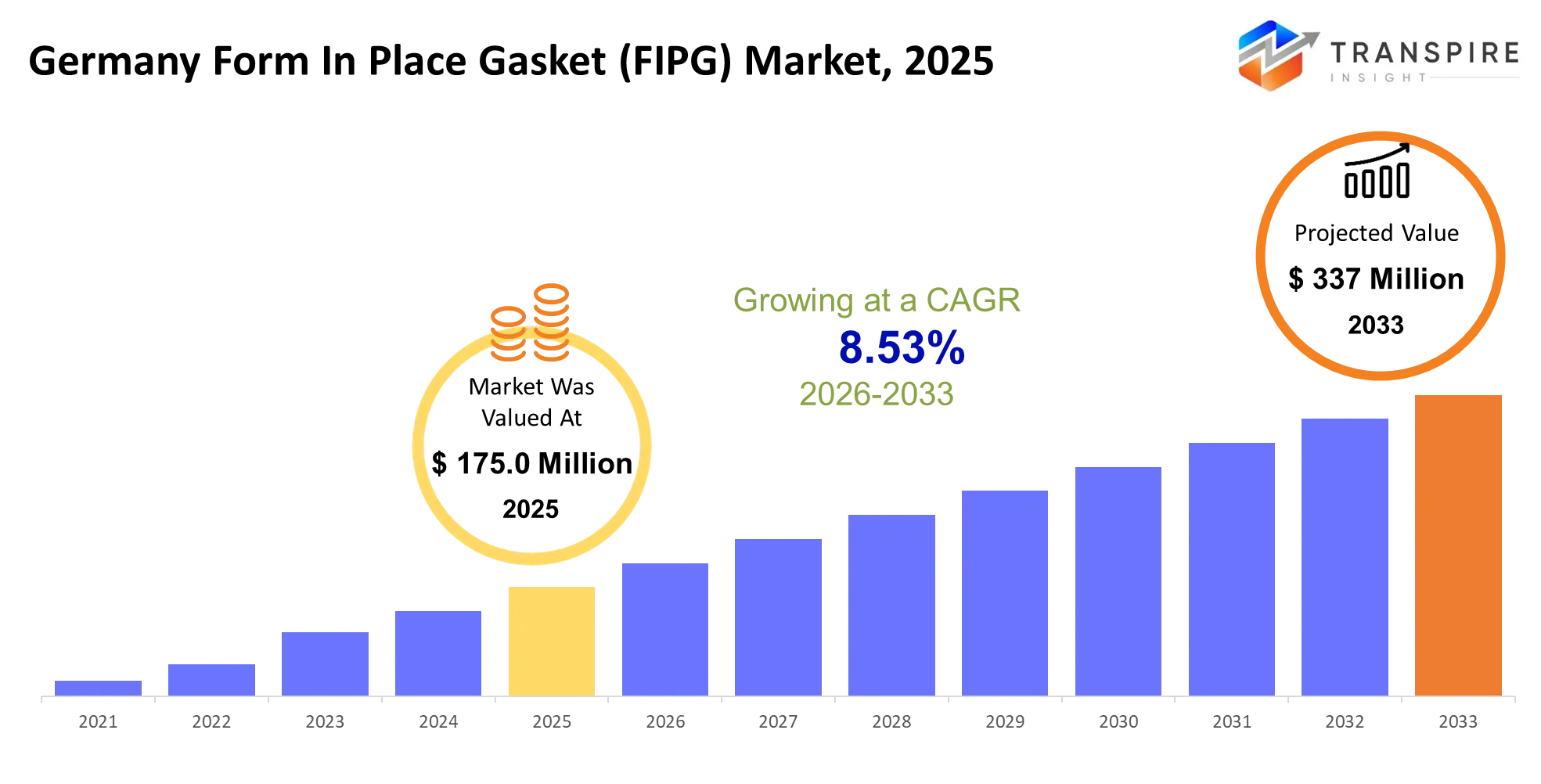
As per Transpire Insight Analysis the Germany Form In Place Gasket (FIPG) Market size is estimated at USD 175.0 Million in 2025 and is anticipated to reach USD 337 Million by 2033, growing at a CAGR of 8.53% from 2026 to 2033.
Form In Place Gasket (FIPG) materials do matter a lot in German manufacturing , they sort of create those durable liquid- applied seals that keep automotive parts, electronics, industrial equipment and battery systems safe from moisture , dust, chemicals and vibration. People usually compare them with conventional pre cut gaskets, but FIPG solutions really boost design freedom, and at the same time they fit automated production lines better. That also helps with stricter sealing tolerances, which is kind of a big deal.
Over the past five years Germany has seen a real shift, especially toward electric vehicle production , plus much more highly automated assembly. In that kind of environment precision dispensing technologies become basically non optional. Also, after the COVID-19 pandemic, supply chain problems made many manufacturers look for local production and then choose more dependable sealing materials for those mission critical uses.
Because of these changes, there has been stronger investment in advanced silicone and polyurethane gasket technologies, which allows manufacturers to speed up production, lower warranty related issues, and make components last longer. So as industrial automation and electrification continue to expand , FIPG solutions are turning into a strategic value driver across Germany’s advanced manufacturing ecosystem.
Germany Form In Place Gasket (FIPG) Market Size & Forecast:
- Germany Form In Place Gasket (FIPG) Market Size 2025: USD 175.0 Million
- Expected Market Value 2033: USD 337 Million
- Forecast CAGR: 8.53%
- Leading region in 2025:Southern Germany
- Fastest Growing region:Eastern Germany
- Key Profile: Henkel, Dow, 3M, H.B. Fuller, Parker Hannifin, Sika, Wacker Chemie, Shin-Etsu Chemical, Permabond, Momentive Performance Materials, DELO Industrial Adhesives, Panacol, Master Bond, Chemence, Dymax
Key Market Insights
- In Southern Germany, the Germany Form In Place Gasket (FIPG) Market kind of dominates, hitting roughly 42% market share in 2025, and a lot of that comes from Bavaria together with Baden-Württemberg automotive manufacturing clusters.
- Eastern Germany looks set to become the quickest growing regional market through 2033, mostly because of semiconductor investments, EV battery manufacturing, and those industrial modernization pushes.
- When it comes to materials, silicone based FIPG products lead the whole product segment with something like 48% market share, since they bring strong thermal resistance and play nicely with EV powertrain applications.
- Polyurethane FIPG solutions are sitting as the second-largest segment, while hybrid polymer formulations are expected to expand the quickest during 2026 to 2033 .
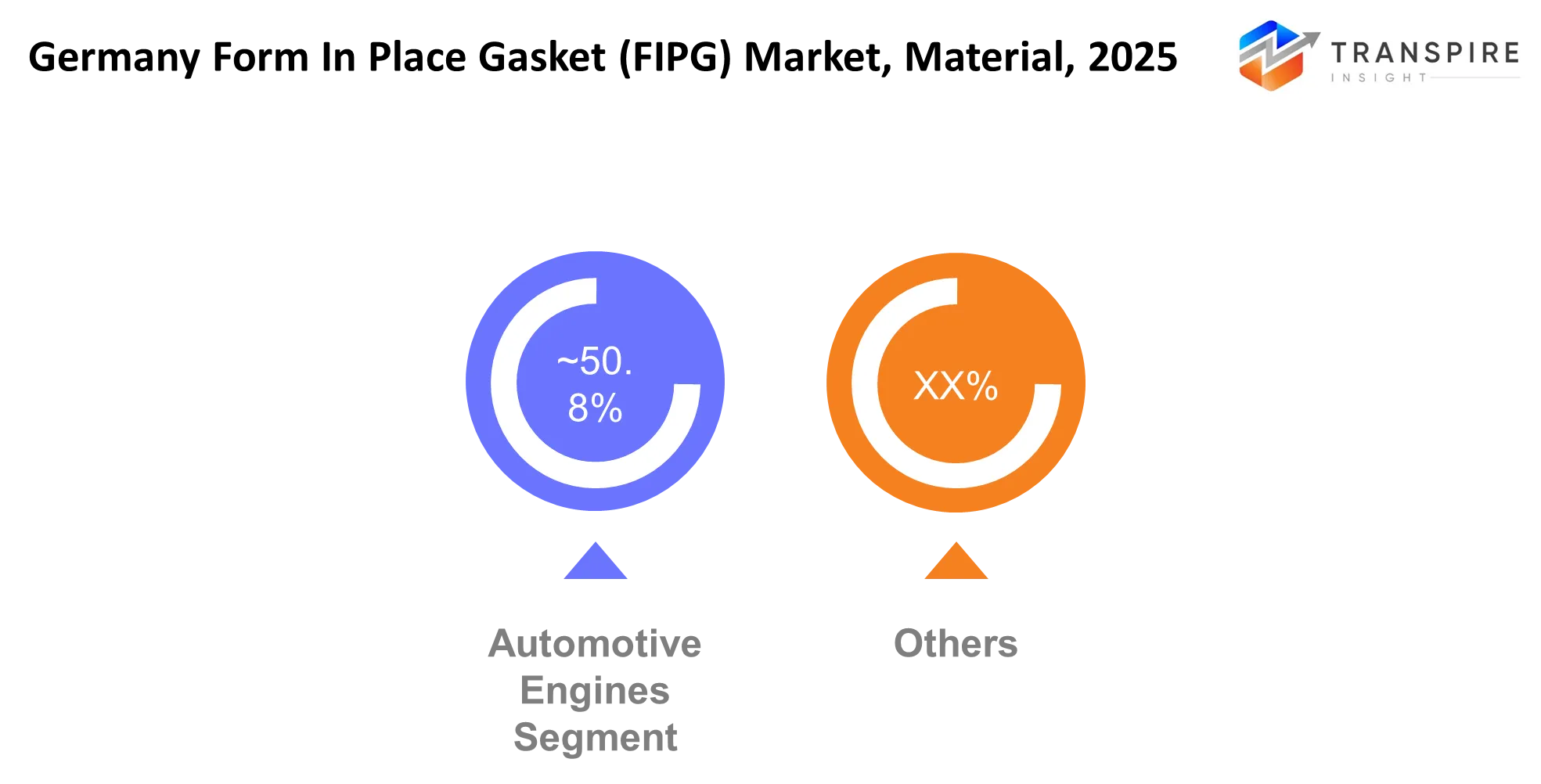
- For applications, automotive manufacturing is still the big driver around 55% of revenue share, whereas battery packs, power electronics, and electronic control units are the areas seeing the fastest growth.
- Passenger vehicle OEMs remain the largest end user group, though EV battery manufacturers and electronics producers are growing faster across the forecast.
- Key companies such as Henkel, Dow, 3M, H.B. Fuller, Sika, and Wacker Chemie are still putting money into low VOC formulations, automated dispensing compatibility, and customized sealing solutions.
- The strategic expansion theme is leaning toward AI-enabled dispensing systems, cooperative partnerships with automotive OEMs, building regional manufacturing capacity, plus advanced material innovations that improve sealing performance and production efficiency.
- Also, sustainability regulations that rolled in after 2021 helped speed up the shift toward solvent free and recyclable sealing materials, which in turn strengthens the industry’s long term competitiveness, really.
What are the Key Drivers, Restraints, and Opportunities in the Germany Form In Place Gasket (FIPG) Market?
The most forceful growth catalyst is Germany’s quick shift toward electric mobility and Industry 4.0 style manufacturing. Battery pack components, power electronics, and lightweight aluminum housings all need dependable sealing approaches that standard die-cut gaskets can’t always deliver in a stable way. So automotive makers have been putting more money into automated FIPG dispensing systems, this helps with production velocity , it simplifies the assembly workflow, and it improves sealing accuracy. In turn, this shift creates clearer revenue paths for suppliers of advanced silicone, polyurethane, and hybrid gasket materials.
A big structural hurdle is the expensive qualification process that comes with FIPG use. Manufacturers need to purchase high-precision dispensing gear, manage robotic integration, run process validation, and handle operator training before they can actually start running production. On top of that, plenty of industrial customers demand very long durability checks under thermal cycling and chemical exposure. That keeps pushing qualification dates out ,sometimes by quite a bit. Because of this, adoption tends to slow down among smaller to mid-sized manufacturers and commercial revenues arrive later than planned.
One major future opportunity is Germany’s growing ecosystem for semiconductor production, battery cell manufacturing, and power electronics. With government-supported funding for local chip fabrication and battery output, the need increases for sealing materials that can safeguard sensitive electronics assemblies. Vendors who build thermally conductive, low-outgassing, and automation-ready FIPG formulations can land lasting contracts with electronics firms while also moving into higher-margin industrial automation applications.
What Has the Impact of Artificial Intelligence Been on the Germany Form In Place Gasket (FIPG) Market?
Artificial intelligence is reshaping Germany Form In Place Gasket industry, kind of, by making dispensing more exact, production steadier and also helping with predictive maintenance across automated manufacturing sites. With AI vision systems working in the background, bead geometry can be checked all the time, plus dispensing width, and even material uniformity during production . So instead of discovering defects at the end, manufacturers can flag problems before final assembly. At the same time machine learning models read equipment vibration, dispensing pressure, nozzle aging, and a bunch of process settings to estimate when maintenance will be needed, which cuts down sudden stoppages and raises overall output.
Digital twins and process analytics also nudge dispensing routes, curing conditions, and material usage, so sealing consistency goes up while waste and day to day operating costs go down. More and more, companies link AI with robotics, and industrial IoT platforms for stronger production traceability and to meet tight automotive quality rules. Predictive analytics even helps tune the process by spotting the operating patterns that improve seal lifetime under thermal cycling plus vibration exposure. In the end this tends to improve equipment utilization, reduce scrap , and lift first time yield.
Still, AI rollout is not easy, because integration costs can be high , and legacy production setups do not always play nicely. Also the training part is tricky: reliable predictive models need high-quality manufacturing datasets, but those are often limited. Smaller manufacturers, especially, may need a longer runway before any measurable productivity improvement shows up.
Key Market Trends
- Since 2021, EV battery manufacturers kinda moved away from the old die-cut gaskets and more and more relied on automated FIPG sealing setups, to boost assembly precision ,and make the components more dependable overall.
- Henkel, Sika, and Dow also expanded their low-VOC and solvent free sealing offerings between 2022 and 2025, mostly to match the newer, stricter European manufacturing rules.
- In Germany, robotic dispensing installations were added in more automotive plants, this helped keep the bead consistency steadier while also cutting down sealing material use by something like 10–20%.
- After 2022, many manufacturers leaned toward hybrid silicone formulations, which supports better thermal endurance and a longer service life for battery modules, and even the electronic control units too.
- After the pandemic caused supply disruptions, the whole Industry 4.0 integration kinda sped up, so producers could digitize their dispensing tasks and improve production resilience, kind of a double win.
- Investment in battery production in Eastern Germany then created fresh demand for thermally conductive sealing materials, aimed at high-voltage electrical systems.
- Starting around 2023, AI driven visual inspection systems became pretty common, raising defect detection rates and reducing how much manual quality inspection was required.
- Meanwhile, OEMs tightened long-term supplier relationships with Wacker Chemie, H.B. Fuller, 3M, and Momentive Performance Materials, to keep specialty material supply more stable.
- Manufacturers also increasingly worked on recyclable packaging and lower emission production approaches, which lines up with European industrial sustainability expectations.
- Between 2023 and 2025, multi material sealing technologies got broader commercial traction , so lighter product designs became feasible while still holding strong mechanical and environmental sealing performance.
Germany Form In Place Gasket (FIPG) Market Segmentation
By Material
Silicone FIPG takes the biggest share, mostly because it shows great resistance to high temperatures, moisture, and chemicals. So this material stays usable for hard core automotive and electronics production, even when conditions are not kind. Polyurethane FIPG instead tends to give strong adhesion plus a kind of elastic behavior for industrial assemblies that face vibration and mechanical stress, day after day. Acrylic FIPG works best when you need fast curing and dependable bonding in lighter industrial equipment, where timing matters a lot. Epoxy FIPG gives a strong mechanical backbone and solid, long term durability for parts that must deal with harsh operating circumstances.
Rubber-Based FIPG is still a practical option for regular sealing needs, especially when cost and flexibility are the main points. Hybrid Sealants sort of mix advantages from different chemistries, so you get balanced overall performance for complicated manufacturing settings and modern component designs. Then there are other materials too, they fit niche applications that call for specialized sealing, thermal endurance, or chemical compatibility, across multiple manufacturing sectors. In the end material selection will keep depending on operating temperature, production approach, and how the seal holds up over the long run.
By Application
Automotive Engines are kind of the top use case, because engine assemblies need reliable sealing against oil , coolant , pressure , and all sorts of contaminants for really long duty cycles. Electronic Enclosures keep growing too, since manufacturers want sensitive circuits protected from moisture, dust and general environmental exposure. Industrial Equipment leans on durable sealing as well, mostly to keep the whole machine dependable and to cut down how often maintenance shows up. Battery Packs are also a big growth slice now, especially as electric vehicle production ramps up across Germany.
Pumps & Compressors call for dependable sealing approaches, mainly so fluid leakage stays in check and efficiency doesn’t drop in industrial plants. Medical Devices rely on precision sealing materials, supporting product reliability and also those strict manufacturing standards. Other areas involve automation systems, electrical equipment , consumer products, plus specialized machinery where a more compact build and durable seals help day-to-day performance. In the end every application asks for material traits that fit the real operating conditions and the actual production needs.
By End User
Automotive still stays the biggest end-user, since vehicle manufacturers keep asking for advanced sealing solutions for engines, transmissions, battery systems, and electronic components, basically the stuff that has to hold up while everything heats up. Electronics production is also getting stronger, with more manufacturing volumes of sensors control units, and communication gear, which then pushes the need for compact sealing solutions that do not take much space. In Industrial Manufacturing, the adoption stays steady, driven by automated production systems, processing equipment, and precision machinery. Aerospace, meanwhile, calls for lightweight but tough sealing materials, and they have to keep working well in harsh operating environments.
In Healthcare manufacturing, advanced sealing solutions show up in diagnostic equipment, lab instruments, and medical devices, all of which need dependable protection against contamination. Energy & Utilities uses sealing materials in electrical equipment, renewable energy systems, and power infrastructure, where a long service life is not optional. Other end users include defense, construction equipment, and consumer appliance manufacturers, they tend to value reliable sealing along with efficient production processes, not just one of those things.
By Dispensing Method
Automated Dispensing seems to lead the market because automated production lines demand accurate material placement, steady bead dimensions, and better manufacturing efficiency. Robotic Dispensing keeps getting more acceptance as manufacturers tune their precision, while cutting down on material waste in high volume production facilities. Manual Dispensing still works pretty well for repair tasks, smaller production runs, prototype development, and customized manufacturing efforts. CNC Dispensing is a good fit for complex component designs that need controlled motion, along with repeatable dispensing accuracy.
Besides that, other dispensing methods show up in specialized production environments, usually where the equipment setup is different or where there are tailored manufacturing needs. Picking the right approach depends on production volume, product complexity, available labor, and how much you can invest up front. At the same time, advanced dispensing technologies keep improving consistency, helping meet higher quality standards across industrial manufacturing operations.
By Cure Type
Room temperature cure still stays in wide use, mainly because it doesn’t need extra heating equipment and it helps keep production efficient across many manufacturing industries, which is sort of the point for most lines. Heat cure gives better mechanical strength and more durable behavior for parts that run in hot conditions, plus they endure steady mechanical stress for longer periods. UV cure supports very fast processing for items that want shorter manufacturing cycles and also need tight curing control, so the timing stays predictable. Moisture cure works nicely in situations where ambient moisture triggers the sealing material once assembly starts.
There are also other curing technologies that fit specialized manufacturing routines, especially when the material performance demands are a bit unusual or strict. Choosing the cure is usually about production speed, the component design, the operating environment, and the sealing characteristics that are expected. Manufacturing facilities keep moving toward curing approaches that juggle productivity , product quality, and long-term dependability while still aligning with industry performance requirements and standards.
What are the Key Use Cases Driving the Germany Form In Place Gasket (FIPG) Market?
Automotive manufacturing is still the biggest use case, because engine assemblies, transmission systems, and even electric vehicle battery housings need durable seals that stop oil, coolant, dust, and moisture from leaking. On top of that automated production lines, often do better with precise dispensing, it helps assembly quality and it can cut down material waste, pretty noticeably.
Electronics manufacturing is also catching more attention, since electronic enclosures, sensors, control modules, and industrial automation gear call for dependable protection against harsh environments. And in industrial manufacturing plants, they regularly rely on advanced sealing materials for pumps, compressors, and processing equipment, to boost operational dependability and stretch out maintenance intervals.
More emerging use cases show up too, like battery energy storage systems and advanced medical equipment, where space is limited, so sealing performance has to be really precise. Hydrogen energy infrastructure plus next generation power electronics look like promising territory, especially as Germany keeps pushing clean energy investment and expands advanced manufacturing capabilities during the forecast period.
|
Report Metrics |
Details |
|
Market size value in 2025 |
USD 175.0 Million |
|
Market size value in 2026 |
USD 190.0 Million |
|
Revenue forecast in 2033 |
USD 337 Million |
|
Growth rate |
CAGR of 8.53% from 2026 to 2033 |
|
Base year |
2025 |
|
Historical data |
2021 - 2024 |
|
Forecast period |
2026 - 2033 |
|
Report coverage |
Revenue forecast, competitive landscape, growth factors, and trends |
|
Regional scope |
Germany |
|
Key company profiled |
Henkel, Dow, 3M, H.B. Fuller, Parker Hannifin, Sika, Wacker Chemie, Shin-Etsu Chemical, Permabond, Momentive Performance Materials, DELO Industrial Adhesives, Panacol, Master Bond, Chemence, Dymax |
|
Customization scope |
Free report customization (country, regional & segment scope). Avail customized purchase options to meet your exact research needs. |
|
Report Segmentation |
By Material (Silicone FIPG, Polyurethane FIPG, Acrylic FIPG, Epoxy FIPG, Rubber-Based FIPG, Hybrid Sealants, Others); By Application (Automotive Engines, Electronic Enclosures, Industrial Equipment, Battery Packs, Pumps & Compressors, Medical Devices, Others); By End User (Automotive, Electronics, Industrial Manufacturing, Aerospace, Healthcare, Energy & Utilities, Others); By Dispensing Method (Automated Dispensing, Robotic Dispensing, Manual Dispensing, CNC Dispensing, Others); By Cure Type (Room Temperature Cure, Heat Cure, UV Cure, Moisture Cure, Others) |
Which Regions are Driving the Germany Form In Place Gasket (FIPG) Market Growth?
Southern Germany kind of takes the largest share of the market, mostly driven by Bavaria , and Baden-Württemberg. There, automotive manufacturing, industrial automation, plus precision engineering build up a strong customer base for advanced sealing materials. The area also kind of has favorable industrial policies, wide research collaborations , and dense supplier networks which connect material producers to vehicle manufacturers and equipment builders. Big automotive OEMs and Tier 1 suppliers keep investing in electric vehicle production , so the demand for high-performance liquid gasket technologies keeps rising. With a mature manufacturing ecosystem, a skilled workforce , and advanced production facilities, Southern Germany manages to hold onto long-term leadership in both innovation and commercial demand.
Western Germany brings in steady revenue, more from a diversified industrial base rather than leaning only on automotive manufacturing. North Rhine-Westphalia, Rhineland-Palatinate, and Hesse back chemical production, industrial machinery, and electronics manufacturing. Those sectors need dependable sealing technologies for many applications. The region gains from continuous industrial investment, solid logistics infrastructure , and a stable push for automation technologies that keep purchasing activity going. Because the industrial mix is balanced, it stays resilient when any single manufacturing segment swings, and it also helps sustain ongoing demand for advanced gasket materials.
Eastern Germany is expected to show the fastest growth during the forecast period. This is because semiconductor fabrication, battery cell production, and advanced electronics manufacturing keep expanding, like almost continuously.
Who are the Key Players in the Germany Form In Place Gasket (FIPG) Market and How Do They Compete?
Competition is still somewhat consolidated, but the global specialty chemical and adhesive firms take a large slice of revenue. Meanwhile, regional specialists compete with things like tailored formulations and a lot of technical support, so it’s not purely one size fits all. In practice, technology performance comes first—plus compatibility with automated dispensing equipment , material durability, and the engineering support side of it matter more than price by itself. At the same time, manufacturers keep putting money into greener chemistries, quicker curing methods, and products built for electric vehicle batteries, electronics, and industrial automation.
Henkel, for example, differentiates its offerings via LOCTITE and TEROSON sealing technologies. These are meant to fit cleanly into automated automotive production lines while still stressing low-emission formulations. Wacker Chemie leans on silicone chemistry knowledge and its domestic manufacturing footprint to provide customized materials for tough industrial and electronics needs. Dow is also centered on advanced silicone technologies, aiming at thermal stability and long service life, so their products stay aligned with electric vehicle battery systems and power electronics.
Sika tries to solidify its position by blending adhesive , sealing, and construction materials know-how, then working closely with automotive manufacturers on lighter vehicle designs. 3M instead leans into materials science innovation , offering engineered sealing products that boost manufacturing efficiency and long-term reliability in industrial settings. Overall, the companies keep expanding through collaborative product development, local technical help, sustainability-oriented material innovation, and investments geared toward automated dispensing compatibility, all of which help their competitive stance stay stronger over time.
Company List
• Dow
• 3M
• H.B. Fuller
• Parker Hannifin
• Sika
• Wacker Chemie
• Shin-Etsu Chemical
• Permabond
• Momentive Performance Materials
• DELO Industrial Adhesives
• Panacol
• Master Bond
• Chemence
• Dymax
Recent Development News
In May 2026, Henkel launched the TEROSON EP 52 Series structural adhesive. The product combines structural bonding with vibration damping for automated automotive production, supporting next-generation vehicle manufacturing.https://www.henkel.in/press-media/press-releases-and-kits/2026-05-12-new-henkel-automotive-adhesive-one-product-twice-the-power-2154280 (Henkel).
In January 2026, Henkel announced the acquisition of ATP Adhesive Systems. The acquisition expands Henkel's adhesive portfolio beyond liquid technologies and strengthens solutions for automotive, electronics, and industrial markets.https://www.henkel.com
What Strategic Insights Define the Future of the Germany Form In Place Gasket (FIPG) Market?
The market will be moving, more and more, toward high performance sealing materials that are made for electric mobility, semiconductor production, and these fully automated manufacturing settings, you know. If you look at the main structural push behind it, it’s basically the move to integrate advanced dispensing systems with digital manufacturing platforms ,and that combo helps with better precision, less waste and higher production efficiency.
There is also a risk that is a bit less visible, not everyone notices right away. It comes from relying on specialty silicone and polymer raw materials. So if there are supply disruptions or even just pricing volatility, manufacturers could see their margins shrink , even when demand stays solid.
At the same time there’s an opportunity showing up more clearly. Think of thermally conductive sealing materials for battery energy storage units and for next generation power electronics. This seems especially relevant in Eastern Germany, where bigger industrial investments keep rolling in.
Companies that start early with AI enabled dispensing technologies, plus localized technical support, and specialized formulations tailored to electrification use cases will likely end up with an advantage. They can secure long term contracts faster and protect their market position over the next five to seven years.
Germany Form In Place Gasket (FIPG) Market Report Segmentation
By Material
• Silicone FIPG
• Polyurethane FIPG
• Acrylic FIPG
• Epoxy FIPG
• Rubber-Based FIPG
• Hybrid Sealants
• Others
By Application
• Automotive Engines
• Electronic Enclosures
• Industrial Equipment
• Battery Packs
• Pumps & Compressors
• Medical Devices
• Others
By End User
• Automotive
• Electronics
• Industrial Manufacturing
• Aerospace
• Healthcare
• Energy & Utilities
• Others
By Dispensing Method
• Automated Dispensing
• Robotic Dispensing
• Manual Dispensing
• CNC Dispensing
• Others
By Cure Type
• Room Temperature Cure
• Heat Cure
• UV Cure
• Moisture Cure
• Others
Frequently Asked Questions
Find quick answers to common questions.
The expected Germany Form In Place Gasket (FIPG) Market size for the market will be USD 337 Million in 2033.
Key segments for the Germany Form In Place Gasket (FIPG) Market are By Material (Silicone FIPG, Polyurethane FIPG, Acrylic FIPG, Epoxy FIPG, Rubber-Based FIPG, Hybrid Sealants, Others); By Application (Automotive Engines, Electronic Enclosures, Industrial Equipment, Battery Packs, Pumps & Compressors, Medical Devices, Others); By End User (Automotive, Electronics, Industrial Manufacturing, Aerospace, Healthcare, Energy & Utilities, Others); By Dispensing Method (Automated Dispensing, Robotic Dispensing, Manual Dispensing, CNC Dispensing, Others); By Cure Type (Room Temperature Cure, Heat Cure, UV Cure, Moisture Cure, Others)
Major Germany Form In Place Gasket (FIPG) Market players are Henkel, Dow, 3M, H.B. Fuller, Parker Hannifin, Sika, Wacker Chemie, Shin-Etsu Chemical, Permabond, Momentive Performance Materials, DELO Industrial Adhesives, Panacol, Master Bond, Chemence, Dymax
The Germany Form In Place Gasket (FIPG) Market size is USD 175.0 Million in 2025.
The Germany Form In Place Gasket (FIPG) Market CAGR is 8.53% from 2026 to 2033.
Dow
• 3M
• H.B. Fuller
• Parker Hannifin
• Sika
• Wacker Chemie
• Shin-Etsu Chemical
• Permabond
• Momentive Performance Materials
• DELO Industrial Adhesives
• Panacol
• Master Bond
• Chemence
• Dymax
About the Authors

Pankaj Ghogare Patil
I am Pankaj Ghogare Patil, a Senior Research Analyst at Transpire Insight, specializing in the Pharmaceutical, Chemicals & Materials, Healthcare IT, and Biotechnology industry. My expertise lies in conducting comprehensive market research, analyzing industry trends, evaluating competitive landscapes, and translating complex data into actionable insights. At Transpire Insight, I closely follow emerging technologies, regulatory developments, and market innovations to create accurate, well-researched, and informative content that helps businesses and professionals make informed decisions. I am committed to producing credible, evidence-based articles that reflect industry best practices while making technical topics accessible and valuable for a broad audience.

Chakradhar Khansole
Chakradhar serves as the Research Director at Transpire Insight, bringing over 8 years of experience in technology, innovation, and strategic market intelligence. He specializes in transforming complex market data into actionable business insights that enable organizations to make informed, growth-oriented decisions. Recognized for his strategic vision and analytical expertise, Chakradhar leads high-impact research initiatives, delivering comprehensive market assessments, competitive intelligence, and forward-looking industry analysis.
Recently Published Reports
-
May 2026
Healthcare Polymer Packaging Market
Healthcare Polymer Packaging Market Size, Share & Analysis Report By Packaging Type (Syringes, IV Bottles and Pouches, Clamshells, Blisters, Bottles & Jars, Containers, Tubes, IV Parental Packaging, Others), By Type (Regulated, Non-regulated), By Polymer Type (LDPE (Low-Density Polyethylene), HDPE (High-Density Polyethylene), Homo-polymer (Homo), Random Copolymer (Random), Block Copolymer (Block), PET, Polystyrene, Polyvinyl Chloride, Polyamide/EVOH, Others), and Geography (North America, Europe, Asia-Pacific, Middle East and Africa, South and Central America), 2021 - 2031
-
Apr 2026
Hydrophilic Tape (Waterstop) Market
Hydrophilic Tape (Waterstop) Market Size, Share & Analysis Report By Type (Bentonite-Based Hydrophilic Tape, Rubber-Based Hydrophilic Tape), By Application (Residential Buildings, Commercial Buildings, Infrastructure Projects), and Geography (North America, Europe, Asia-Pacific, Middle East and Africa, South and Central America), 2021 - 2031
-
Apr 2026
Metalens Market
Metalens Market Size, Share & Analysis Report By Type (Visible Light Metalens, and Infrared Metalens), By Application (Consumer Electronics, Automotive Electronics, Industrial, Medical, and Others), and Geography (North America, Europe, Asia-Pacific, Middle East and Africa, South and Central America), 2021 - 2031
-
Apr 2026
PBT Resin Market
PBT Resin Market Size, Share & Analysis Report By Type (Reinforced PBT Resin, Unreinforced PBT Resin), By Processing Method (Injection Molding, Extrusion, Blow Molding, Others), By End-User (Automotive, Electrical & Electronics, Consumer Appliances, Industrial Machinery, Medical Devices, Packaging, Others), and Geography (North America, Europe, Asia-Pacific, Middle East and Africa, South and Central America), 2021 - 2031