
Germany Incident And Emergency Management Market Summary
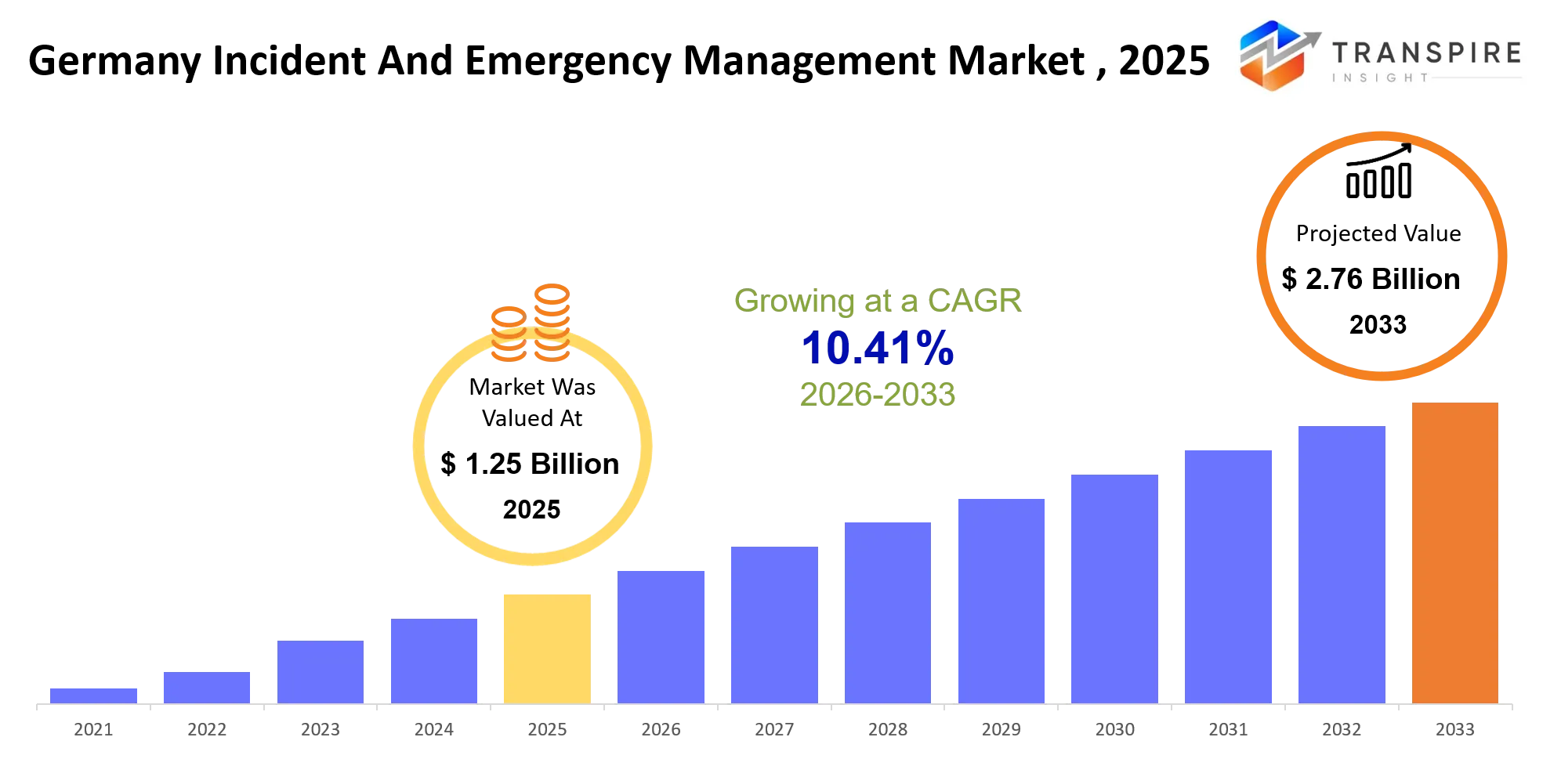
As per Transpire Insight Analysis theGermany Incident And Emergency Management Market size is estimated at USD 1.25 Billion in 2025 and is anticipated to reach USD 2.76 Billion by 2033, growing at a CAGR of 10.41% from 2026 to 2033.
The Germany Incident And Emergency Management Market kind of helps organizations dig up inefficiencies that are kinda hidden inside day to day business processes, by looking at digital event logs coming from ERP, CRM, and supply chain platforms. In practice, companies in manufacturing, automotive, banking, healthcare, and logistics use these solutions to spot bottlenecks , cut down operational costs , improve compliance, and speed up digital transformation efforts. Over the past five years, the whole market seems to move away from only standalone process discovery tools toward AI powered process intelligence platforms. These new platforms offer continuous monitoring , plus automated optimization suggestions, not just one time analysis. Then COVID-19 hit , and the ripple effects— especially the supply chain instability afterward— made German enterprises push harder for real time visibility into those tangled operational workflows, which in turn accelerated software adoption. Lately, as organizations link process mining with robotic process automation, cloud infrastructure, and enterprise analytics, implementation is expanding beyond the operational teams and into executive level decision making. That shift, in a way, is creating stronger software licensing , subscription, and consulting revenues across Germany’s digital enterprise ecosystem.
Germany Incident And Emergency Management Market Size & Forecast:
- Germany Incident And Emergency Management Market Size 2025: USD 1.25 Billion
- Expected Market Value 2033: USD 2.76 Billion
- Forecast CAGR: 10.41%
- Leading region in 2025:Southern Germany
- Fastest Growing region:Eastern Germany
- Key Profile: Everbridge, Motorola Solutions, Hexagon AB, Honeywell, Siemens, IBM, Atos, NEC Corporation, Esri, Veoci, Crisis24, Rave Mobile Safety, AlertMedia, BlackBerry, Intergraph
Key Market Insights
- Regional Leadership: Southern Germany sort of dominates, with about 38% market share in 2025, backed up by automotive manufacturing clusters and newer Industry 4.0 investments that keep getting pushed forward.
- Fastest-Growing Region: Eastern Germany is expected to see the quickest expansion through 2033, mostly because of digital modernization initiatives plus a steady rise in enterprise software spending.
- Leading Segment: Cloud based process mining platforms make up roughly 58% of the market in 2025, helped along by flexible scaling of deployment and the fact that they need less infrastructure.
- Second-Largest & Fastest Segment: Still, on-premise solutions are holding real weight for regulated industries. At the same time AI powered process intelligence platforms are projected to post the strongest growth, through 2033.
- Application Insights: Manufacturing brings in around 35% of total market revenue while banking and financial services is one of the faster-moving application areas, driven by compliance automation and related workflow tightening.
- End-User Analysis: Large enterprises produce more than 70% of market revenue. Meanwhile SMEs are the fastest-growing customer group because SaaS pricing lowers deployment costs, and well, that matters.
- Competitive Landscape: IBM, Siemens, Honeywell, Motorola Solutions, NEC Corporation, and Hexagon AB keep expanding their offerings by folding in AI, leaning into cloud native platforms, forming strategic partnerships,and boosting industrial analytics skills.
- Technology Trend: Over 60% of new enterprise deployments include AI driven process recommendations, which helps teams optimize workflows sooner and maintain continuous operational monitoring.
- Enterprise Strategy: Providers are increasingly blending process mining with robotic process automation and business intelligence suites ,so they can offer end-to-end operational visibility that is actually usable in day to day operations.
What are the Key Drivers, Restraints, and Opportunities in theGermany Incident And Emergency Management Market?
Germany’s rapidly accelerated Industry 4.0 push , along with enterprise digital transformation programs is still one of the steadiest catalysts for market growth. More and more manufacturers, auto suppliers , financial institutions, and logistics providers want real, end-to-end visibility into everyday business operations, so they can cut out workflow friction and also keep compliance tighter. As SAP S/4HANA migration efforts have become widespread, businesses are ending up with enormous volumes of procedural process data, and they are then turning to process mining platforms to make sense of it. In practice, this reduces process cycle duration, lowers operating costs, boosts audit readiness, and in turn motivates broader company-wide software rollout. That also maps neatly to recurring subscription value , plus ongoing consulting revenues.
Still, the biggest structural hurdle is the sheer complexity of connecting cloud-based process mining software with older enterprise environments. A lot of German companies run ERP, MES , and proprietary production platforms that are decades old. Those systems often produce event logs that are fragmented , inconsistent, or just missing important details. Cleaning, standardizing, and governing those datasets is not a simple task, it takes specialized know-how and it also stretches timelines. As a result, the integration effort slows down adoption across the enterprise, raises the overall budget , and stops many mid-sized organizations from reaching fast ROI gains.
The next phase of expansion is where process mining starts to pair with generative AI , predictive analytics, and hyperautomation layers. German enterprises are investing more and more in “intelligent automation” that can spot process drift and then suggest corrective measures, basically without needing someone to manually intervene every time.
What Has the Impact of Artificial Intelligence Been on theGermany Incident And Emergency Management Market?
Artificial intelligence has kinda changed the Germany Incident And Emergency Management Market by taking the older “process discovery” idea and pushing it toward smarter, more adaptive operational optimization. Nowadays platforms tend to automatically gather enterprise event logs from ERP , CRM , manufacturing execution systems, and supply chain tools, then they run machine learning models to spot friction points, foresee process drifts, and suggest workflow tweaks. With AI-supported analytics, teams can sort of automate compliance surveillance, dig up underlying reasons for operational bottlenecks, and rank improvement efforts using less manual wrangling of the data.
At the same time, predictive models are more and more forecasting production delays, maintenance needs, inventory gaps, and also process execution risks before they actually start to disrupt day-to-day operations. Manufacturers often see better equipment uptime, logistics providers cut down delivery slippage through predictive process orchestration, and financial institutions can reinforce regulatory adherence by continuously watching transactional sequences. Together, these abilities usually lead to higher operational throughput, reduced overhead costs, more sensible resource usage, and faster business decisions without so many back-and-forth reviews.
Still, AI rollouts don’t come without hurdles. Bringing machine learning components into older enterprise environments takes real money , plus time for data preparation, governance, and interoperability between systems. On top of that, many companies deal with inconsistent event data quality, and that in turn weakens prediction reliability, also making automated optimization suggestions less useful in practice. Fixing these integration and data-quality issues is still key if the industry wants to capture the full commercial payoff from AI-enhanced process intelligence platforms.
Key Market Trends
- Since 2021, cloud-native deployments have gone up a lot, as enterprises focus on scalable software implementation, and try to reduce the cost of infrastructure management , kinda in one swoop.
- AI-powered process intelligence also moved away from small pilot deployments, it is now mainstream in many companies , with top vendors embedding predictive analytics right into their core platforms.
- In Germany, manufacturers are merging process mining with SAP S/4HANA migration projects, so they can tune production workflows , and push better operational transparency overall.
- Meanwhile, financial institutions grew compliance-centric process analytics by more than 30% since 2022, which helps with audit readiness and makes regulatory reporting feel more efficient, less painful.
- Vendors such as IBM, Siemens, and Honeywell keep upping their investments in AI integration, workflow automation, and strategic partnerships, so they can stand out in enterprise software offerings.
- Big enterprises are progressively linking process mining with robotic process automation, and then they get continuous workflow optimization rather than just periodic process reviews, or so it seems.
- Manufacturing organizations are also pairing digital twins with process intelligence, aiming to improve production scheduling, asset utilization, and overall operational resilience .
- And SaaS subscription models keep replacing perpetual software licensing, so SMEs can adopt enterprise-grade process intelligence with less upfront cost, instead of a big upfront commitment.
- ESG reporting requirements have nudged many organizations to examine operational workflows more comprehensively, which supports measurable efficiency, and sustainability improvements that can actually be shown.
- Cross-functional adoption has spread beyond IT departments, with finance, procurement, operations, and compliance teams using process intelligence for strategic decision making, not only technical analysis.
Germany Incident And Emergency Management Market Segmentation
By Component
Software is basically the base of adoption in the sense that organizations rely on focused platforms to capture, analyze, and then keep improving business processes across the enterprise systems. Hardware backs the whole data processing and storage side of things, while services cover consulting, implementation, tailoring, and ongoing technical support too, and that all together helps the deployment work out better. Communication systems link several enterprise applications , so operational data can move between departments with less friction. Command center solutions take care of centralized monitoring too, and they help the people making decisions react fast when process deviations start showing up.
Analytics platforms then turn huge piles of operational data into business-relevant insights using dashboards, reports, and predictive modeling. Other pieces also matter, like integration tools, workflow connectors, security modules , and visualization applications, all of which boost operational visibility. When investment stays balanced across software, services, and analytics, the results of implementation keep getting better. And broader integration of the components will support long term enterprise process optimization across many industries, not just one.
By Deployment
Cloud based deployment tends to get more adoption simply because the infrastructure is scalable, the subscription pricing feels manageable, and the setup is faster, so organizations of various sizes can clear the tech hurdles. On premise deployment still matters a lot in sectors that handle extremely confidential operational data, plus places where teams need direct control over their own infrastructure. Hybrid deployment kinda blends cloud flexibility with local data management, which helps companies strike a steadier balance between speed performance, security, and regulatory compliance. Mobile based deployment, in the other hand, supports getting operational insights while you’re away, via smartphones and tablets.
Edge deployment takes the workloads and processes them nearer to the operational environments. That typically cuts latency, and makes quicker analytical decisions possible. Meanwhile other deployment approaches deal with more specific enterprise requirements, usually by using customized infrastructure models. Deployment strategies keep shifting over time based on industry regulations, digital maturity and operational complexity. In general, more flexible deployment options will broaden software accessibility across manufacturing, banking, healthcare, and logistics organizations.
By Application
Disaster Recovery helps keep business continuity going by noticing operational disruptions, getting recovery plans better, and cutting down that process downtime after sudden events, even when things get messy. Emergency Response enhances coordination by giving operational visibility across several business functions when it matters most. Public Safety organizations look at how workflows actually run, so they can fine tune resource allocation and make response turn around faster. Fire Management applications assist with incident coordination, plus planning and operational reporting, across emergency management operations.
Healthcare Emergency Management supports patient movement, better resource utilization, and more reliable emergency service coordination, mostly via process visibility. Industrial Incident Management enables manufacturing sites to review operational failures, reinforce workplace safety, and also limit production interruptions. Other applications cover regulatory reporting, infrastructure monitoring, and enterprise risk management activities, too. As application diversity keeps expanding it tends to open up wider commercial opportunities across both public and private sectors.
By End User
Government Agencies see major adoption, largely because administrative efficiency, compliance monitoring ,and service delivery gains stay key national priorities. Healthcare Organizations tend to look at how work actually flows, so they can fine-tune patient services, raise scheduling efficiency, and keep regulatory compliance steady. Industrial Enterprises usually focus on production operations, procurement, maintenance, and even supply-chain performance by using continuous process monitoring—like a kind of ongoing “watching” mode. Utilities on the other hand strengthen infrastructure management, they do this by spotting operational slowdowns, and then adjusting maintenance planning.
Transportation organizations improve logistics coordination, warehouse operations ,and fleet management through process visibility. Defense Organizations strengthen operational planning, resource management, and mission support thanks to more advanced analytical capabilities. Other end users also show up in education, financial institutions, telecommunications, and retail organizations. Overall, broad industry participation will keep supporting technology expansion throughout Germany, even as needs shift over time.
By Enterprise Size
Large Enterprises account for the highest adoption , because the extensive operational complexity kind of forces a need for stronger business value via process optimization and automation work. Medium Enterprises keep on expanding investments too, since subscription based platforms reduce rollout costs and make access better to enterprise software capabilities. Small Enterprises increasingly choose cloud solutions, aiming for improved operational efficiency without the big infrastructure spend. Other organizations, like nonprofit institutions, or specialized service providers also bring in analytical platforms, but they tune usage to their operational needs and realities.
Enterprise size also nudges the deployment strategy, shapes investment priorities, and affects implementation timelines across industries. Larger organizations usually stitch together multiple business systems so they can reach full operational visibility , while medium and small groups often start with focused business processes and then expand usage later. Technology providers continue introducing flexible pricing models which in turn support wider adoption. Overall enterprise wide digital transformation initiatives will keep driving long term implementation across organizations of every size, even when conditions change.
What are the Key Use Cases Driving theGermany Incident And Emergency Management Market?
Manufacturing is probably the biggest part of software adoption, because production facilities keep looking at how things really run, to cut cycle times, lift quality and generally make better use of resources. Process intelligence kind of feeds production planning, procurement, inventory management, and even supply chain coordination, and that ends up showing measurable efficiency improvements across the whole factory operation.
In banking and healthcare, software rollout keeps going too, mostly tied to regulatory compliance, audit preparation, and workflow optimization. Government agencies are not far behind, they are also tightening administrative processes by spotting where delays happen in public service delivery, and improving operational transparency using data-driven process analysis, so the logic sounds cleaner, for everyone involved.
Newer use cases are also appearing, like AI-supported decision intelligence plus sustainability reporting across industrial operations. Digital twin integration, predictive business process optimization, and automated compliance monitoring will likely open more commercial opportunities as enterprise digital transformation programs continue to mature, even if nobody says it the same way each quarter.
|
Report Metrics |
Details |
|
Market size value in 2025 |
USD 1.25 Billion |
|
Market size value in 2026 |
USD 1.38 Billion |
|
Revenue forecast in 2033 |
USD 2.76 Billion |
|
Growth rate |
CAGR of 10.41% from 2026 to 2033 |
|
Base year |
2025 |
|
Historical data |
2021 - 2024 |
|
Forecast period |
2026 - 2033 |
|
Report coverage |
Revenue forecast, competitive landscape, growth factors, and trends |
|
Regional scope |
Germany |
|
Key company profiled |
Everbridge, Motorola Solutions, Hexagon AB, Honeywell, Siemens, IBM, Atos, NEC Corporation, Esri, Veoci, Crisis24, Rave Mobile Safety, AlertMedia, BlackBerry, Intergraph |
|
Customization scope |
Free report customization (country, regional & segment scope). Avail customized purchase options to meet your exact research needs. |
|
Report Segmentation |
By Component (Software, Hardware, Services, Communication Systems, Command Center Solutions, Analytics Platforms, Others); By Deployment (Cloud-Based, On-Premise, Hybrid, Mobile-Based, Edge Deployment, Others); By Application (Disaster Recovery, Emergency Response, Public Safety, Fire Management, Healthcare Emergency Management, Industrial Incident Management, Others); By End User (Government Agencies, Healthcare Organizations, Industrial Enterprises, Utilities, Transportation, Defense Organizations, Others); By Enterprise Size (Large Enterprises, Medium Enterprises, Small Enterprises, Others) |
Which Regions are Driving theGermany Incident And Emergency Management Market Growth?
In Southern Germany , it kinda holds the biggest chunk of the market because Bavaria and Baden-Württemberg sort of team up a very solid industrial backbone with more advanced public safety infrastructure , plus a wide set of digital transformation initiatives. State governments keep pushing money into resilient emergency communication platforms, and at the same time manufacturing companies, utilities, and transport operators are adopting integrated incident management systems. This is meant to strengthen day to day operational continuity, even when things go wrong. Also the area has major technology companies, research institutions, and systems integrators around, which helps speed up solution rollouts. Overall this more mature ecosystem , enables constant software upgrades, strong implementation partners, and long-term enterprise spending, so the region stays in the leading position.
Western Germany comes in as the second-largest contributor, even if the pace feels a bit different than in the south. North Rhine-Westphalia, Hesse, and Rhineland-Palatinate gain from a mix of economic activity, tight transportation corridors, and big clusters of government bodies and corporate headquarters. Stable regulatory roll-out, steady funding for critical infrastructure protection, and already established business continuity programs create a more predictable demand for emergency management platforms. Financial services groups, healthcare organizations, and logistics providers are still modernizing how they handle crises. So that makes the region a pretty dependable producer of recurring market revenue.
Eastern Germany is expected to show the fastest growth all the way through 2033, as digital infrastructure initiatives and industrial modernization move ahead across Saxony, Brandenburg, and Thuringia.
Who are the Key Players in theGermany Incident And Emergency Management Market and How Do They Compete?
Competition is still pretty moderately consolidated, if you think about it, because big global technology firms are right there next to the more specialized emergency management software suppliers. On the ground, the real differentiators are tech innovation, AI-enabled situational awareness, cloud deployment readiness, cybersecurity controls, and how well everything plugs into the existing enterprise systems. The established providers keep pushing customer relationships forward using longer term service contracts, whereas the specialized software vendors tend to win on speed, with faster implementation, and especially with cloud platforms that are highly configurable.
Everbridge, though, keeps its portfolio distinct by leaning into AI-enabled Critical Event Management, plus mass notification and public warning features. Those elements come together so the operational resilience angle feels like it is on one cohesive platform, not scattered around. Also, the company is expanding its Munich office , which is helping with customer engagement across Germany and the broader DACH area. At the same time it improves local implementation, and support capacity there.
Motorola Solutions stays centered on mission-critical communications, command center software, and emergency response technologies with AI assistance. It’s also investing consistently in agentic AI, and using strategic acquisitions to widen the scope of automated incident handling. The outcome is that emergency response organizations can get better operational efficiency, without as much manual friction.
Siemens leans on strong ties in Germany’s industrial and infrastructure segments, by connecting emergency management with building automation, industrial monitoring, and digital infrastructure. IBM differentiates in a different lane, emphasizing hybrid cloud architecture, AI analytics, and enterprise resilience offerings, which help large organizations operate through complex operational environments, more calmly overall.
Company List
- Everbridge
• Motorola Solutions
• Hexagon AB
• Honeywell
• Siemens
• IBM
• Atos
• NEC Corporation
• Esri
• Veoci
• Crisis24
• Rave Mobile Safety
• AlertMedia
• BlackBerry
• Intergraph
Recent Development News
In June 2026, Everbridge announced the opening of a new office in Munich, Germany. The expansion strengthens customer support across the DACH region and reinforces investment in European critical event management operations.https://www.everbridge.com
In April 2026, Motorola Solutions completed the acquisition of HyperYou, Inc. and expanded AI-powered Assist Agents for emergency communications. The acquisition strengthens command center automation and improves emergency call handling through conversational AI technologies.https://www.motorolasolutions.com/newsroom/press-releases/hyper-acquisition-and-new-agentic-assist-agents.html (Motorola Solutions)
What Strategic Insights Define the Future of the Germany Incident And Emergency Management Market?
The market is drifting toward more integrated resilience platforms, that kinda blend artificial intelligence with geospatial intelligence, add a cloud-native architecture, and then pull in real-time communications into one unified operational workspace. In the end, enterprise digital transformation, tighter operational resilience obligations, and the continued rise of cybersecurity risks will keep pushing this shift forward during the next five to seven years.
There is also a not-so-obvious snag, basically a growing reliance on just a handful of enterprise software providers, and that can quietly raise integration expenses while also shrinking deployment freedom for public agencies and mid-sized organizations. Still, there’s an emerging opening too, like AI-enabled predictive incident management, paired with digital twins for industrial sites and critical infrastructure, especially where modernization is accelerating in Eastern Germany.
Market players should, in a practical sense, put resources into interoperable platforms with open APIs, serious security controls, and localized implementation services that make it easier to connect with what already exists in enterprise environments, plus public safety systems—without missing the changing regulatory requirements.
Germany Incident And Emergency Management Market Report Segmentation
By Component
• Software
• Hardware
• Services
• Communication Systems
• Command Center Solutions
• Analytics Platforms
• Others
By Deployment
• Cloud-Based
• On-Premise
• Hybrid
• Mobile-Based
• Edge Deployment
• Others
By Application
• Disaster Recovery
• Emergency Response
• Public Safety
• Fire Management
• Healthcare Emergency Management
• Industrial Incident Management
• Others
By End User
• Government Agencies
• Healthcare Organizations
• Industrial Enterprises
• Utilities
• Transportation
• Defense Organizations
• Others
By Enterprise Size
• Large Enterprises
• Medium Enterprises
• Small Enterprises
• Others
Frequently Asked Questions
Find quick answers to common questions.
The expected Germany Incident And Emergency Management Market size for the market will be USD 2.76 Billion in 2033.
Key segments for the Germany Incident And Emergency Management Market are By Component (Software, Hardware, Services, Communication Systems, Command Center Solutions, Analytics Platforms, Others); By Deployment (Cloud-Based, On-Premise, Hybrid, Mobile-Based, Edge Deployment, Others); By Application (Disaster Recovery, Emergency Response, Public Safety, Fire Management, Healthcare Emergency Management, Industrial Incident Management, Others); By End User (Government Agencies, Healthcare Organizations, Industrial Enterprises, Utilities, Transportation, Defense Organizations, Others); By Enterprise Size (Large Enterprises, Medium Enterprises, Small Enterprises, Others)
Major Germany Incident And Emergency Management Market players are Everbridge, Motorola Solutions, Hexagon AB, Honeywell, Siemens, IBM, Atos, NEC Corporation, Esri, Veoci, Crisis24, Rave Mobile Safety, AlertMedia, BlackBerry, Intergraph
The Germany Incident And Emergency Management Market size is USD 1.25 Billion in 2025.
The Germany Incident And Emergency Management Market CAGR is 10.41% from 2026 to 2033.
- Everbridge
• Motorola Solutions
• Hexagon AB
• Honeywell
• Siemens
• IBM
• Atos
• NEC Corporation
• Esri
• Veoci
• Crisis24
• Rave Mobile Safety
• AlertMedia
• BlackBerry
• Intergraph
About the Authors

Mayur Shinde
I am Mayur Shinde, a Senior Research Analyst at Transpire Insight, specializing in the Automotive & Transportation and Information & Communication Technology (ICT) Industry. My work focuses on analyzing emerging market trends, technological advancements, competitive landscapes, and industry developments to deliver accurate, data-driven insights. I am passionate about transforming complex market information into clear, actionable content that helps businesses, professionals, and decision-makers stay informed and make confident strategic decisions.

Chakradhar Khansole
Chakradhar serves as the Research Director at Transpire Insight, bringing over 8 years of experience in technology, innovation, and strategic market intelligence. He specializes in transforming complex market data into actionable business insights that enable organizations to make informed, growth-oriented decisions. Recognized for his strategic vision and analytical expertise, Chakradhar leads high-impact research initiatives, delivering comprehensive market assessments, competitive intelligence, and forward-looking industry analysis.
Recently Published Reports
-
Apr 2026
3D Optical Profiler Market
3D Optical Profiler Market Size, Share & Analysis Report By Type (Desktop 3D Optical Profiler, and Portable 3D Optical Profiler), By Technology (Confocal Technology, and White Light Interference), By End-Use Industry (Manufacturing, Research Institutions, Automotive, Aerospace and Defense, Medical Devices, and Other), and Geography (North America, Europe, Asia-Pacific, Middle East and Africa, South and Central America), 2021 - 2031
-
Apr 2026
Depth Sensor Market
Depth Sensor Market Size, Share & Analysis Report By Type (Infrared Depth Sensors, Time-of-Flight (ToF) Sensors, Stereo Vision Sensors, Structured Light Sensors, Ultrasonic Depth Sensors), By Application (Automotive, Robotics, Gaming, Consumer Electronics, Industrial Automation, Healthcare, Security & Surveillance, Others), By End Users (Automotive Manufacturers, Consumer Electronics Companies, Healthcare Providers, Industrial Companies, Security Agencies, Gaming Companies, Robotics Companies, Others), and Geography (North America, Europe, Asia-Pacific, Middle East and Africa, South and Central America), 2021 – 2031
-
Apr 2026
Digital Manufacturing Market
Digital Manufacturing Market Size, Share & Analysis Report By Component (Hardware, Software, and Services), By Technology (Robotics, 3D Printing, Internet of Things (IoT), and Others), By Application (Automotive and Transportation, Aerospace and Defense, Consumer Electronics, Industrial Machinery, and Others), By Process Type (Computer-Based Designing, Computer-Based Simulation, Computer 3D Visualization, Analytics, and Others), and Geography (North America, Europe, Asia-Pacific, Middle East and Africa, South and Central America), 2021 – 2031
-
Apr 2026
Digital Visa Services Market
Digital Visa Services Market Size, Share & Analysis Report By Type (Individual Travelers, Group Travelers), By Application (Tourism, Business Travel, Others), and Geography (North America, Europe, Asia-Pacific, Middle East and Africa, South and Central America), 2021 – 2031