

Software Defined Networking Market Summary:
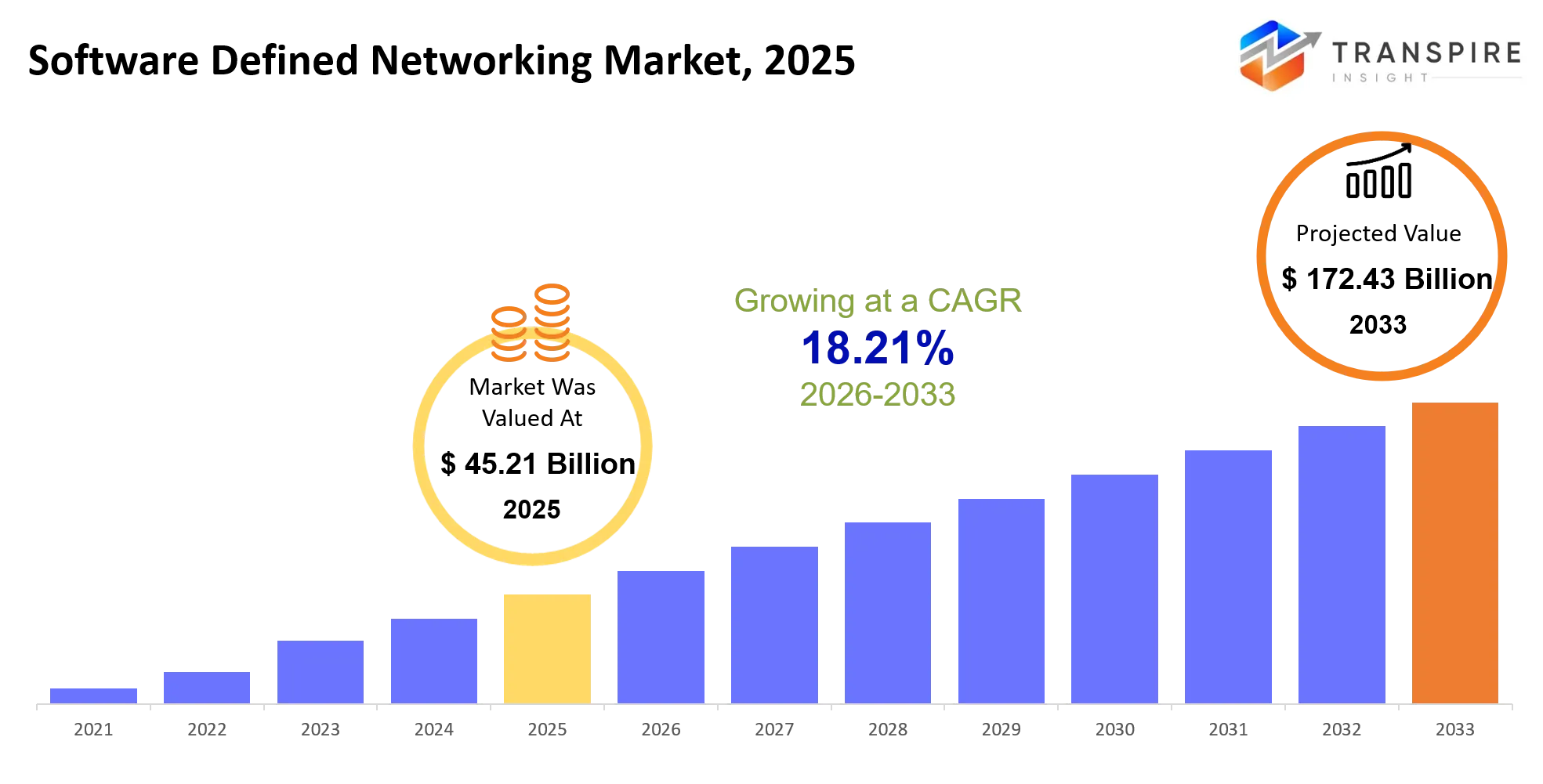
As per Transpire Insight Analysis, the Software Defined Networking Market size is estimated at USD 45.21 billion in 2025 and is anticipated to reach USD 172.43 billion by 2033, growing at a CAGR of 18.21 % from 2026 to 2033.
The software-defined networking market is changing the way networks are managed. Instead of setting up each device individually, it is now about managing everything from one central place. SDN tools help companies, telecom companies and data centres handle traffic, set up connections automatically and link areas with less need for people to do things manually. In the past three to five years, using more cloud services, mixing different types of systems and having work done in many places has changed how companies build their networks. SD-WAN is now a way to handle connections between offices and the cloud. A big change is the move to networks that are led by software. These networks can bring together equipment, virtual parts and cloud services from the same control system. The growth of AI tasks is another reason for this change. Moving a lot of data quickly needs networks that can react fast to changes, in how much data's moving. As companies add cloud services, remote locations and programs that need a lot of data, it is harder to manage networks the old way. This is making more companies use networks that can be programmed to route things automatically, give a picture of everything, and follow rules to control what happens.
Software Defined Networking Market Size & Forecast:
- Market Size 2025: USD 45.21 Billion
- Expected Market Value (2033): USD 172.43 Billion
- Forecast CAGR (2026–2033): 18.21%
- Leading Region in 2025: North America
- Fastest Growing Region: Asia Pacific
- Key Company Profiles: Cisco, VMware/Broadcom, HPE, Huawei, Juniper Networks, Nokia, Arista Networks, Dell Technologies, IBM, NEC Corporation, Ericsson, Huawei Technologies, Versa Networks, Ciena, Extreme Networks
Key Market Insights:
The market is shifting towards software-driven network management due to the demand for more flexibility in cloud, branch, data centre, and edge networks. SD-WAN technology is crucial due to the increasing need for dynamic connectivity and network automation.
- SD-WAN has a market share of 34.80%, showing the high adoption rate as enterprises are connecting their branch offices, cloud applications and users via a centrally managed network infrastructure.
- SD-WAN will grow at a CAGR of 18.30%, making it the fastest-growing segment as businesses are opting to replace their inflexible WAN architecture with flexible software-defined connectivity.
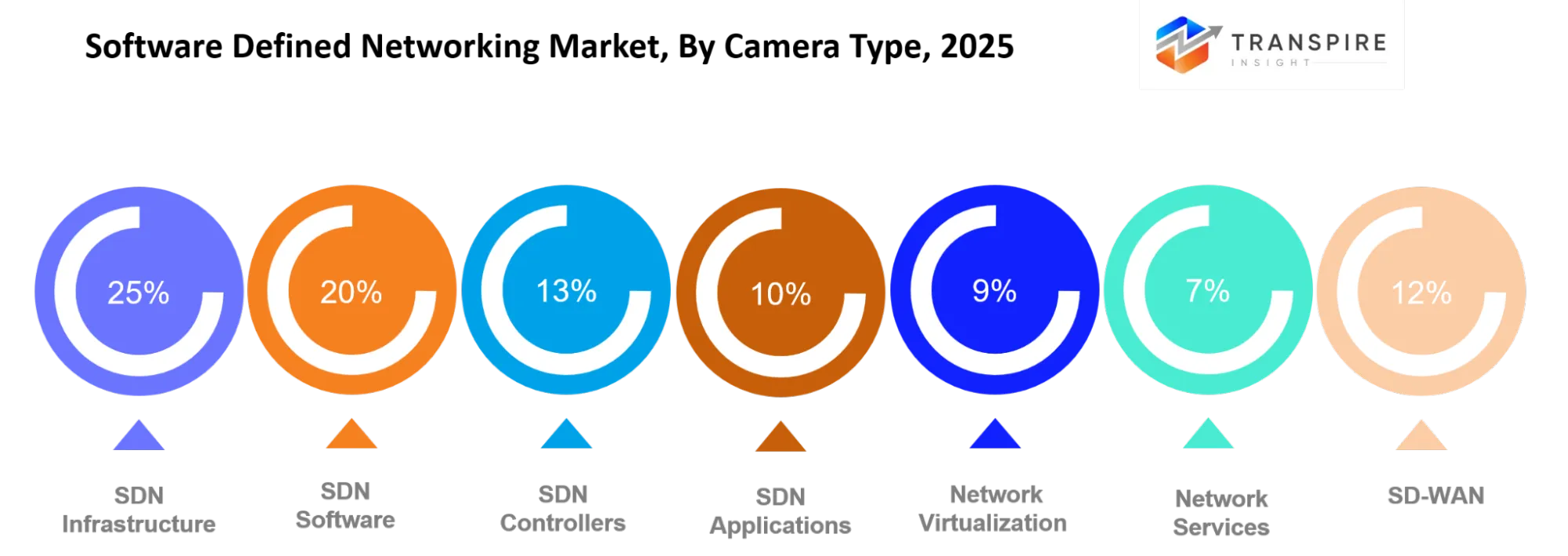
- SDN Infrastructure constitutes 25.00% of the market, showing the ongoing investments in the infrastructure that is needed to provide a programmable and centrally manageable network environment.
- The SDN Software represents 20.00% of the market, showing the move in the networking industry from hardware-centric networking to software platforms, subscription, orchestration, and policy-based network management.
- The SDN Controllers holds 13.00% of the market, offering centralised visibility and policy management for physical, virtual, and cloud-based network resources.
- Cisco is adding value to its networking portfolio through better SD-WAN and AI-ready infrastructure.
What are the Key Drivers, Restraints, and Opportunities in the Software Defined Networking Market?
Drivers
Growth will be fueled by the fact that managing more distributed networks will become a necessity without growing manual administration at the same speed. Workloads in cloud, branch office networks, hybrid clouds and bandwidth-intensive apps make management a more valuable aspect, while SD-WAN provides organisations with a means to choose their path based on the needs of the application and network conditions. This change can result in an increase in the amount of software adopted, services sold and subscriptions for vendors. The biggest driver behind this change is moving enterprise workloads out of their data centres.
Restraints
The limitation is the difficulty in implementation. The current network may have equipment from different vendors and older protocols and management mechanisms, thus making integration and upgrades difficult and costly.
Opportunities
The opportunity is the combination of SDN with AI-driven operations, edge computing and secure access architecture. It will be possible to save on operational costs while delivering valuable solutions. The growth of cloud infrastructure, 5G networks and digital services presents another opportunity in the Asia Pacific region.
What Has the Impact of Artificial Intelligence Been on the Software Defined Networking Market?
Artificial intelligence is changing the way software-defined networking works through helping network platforms shift from static rules to adaptive ones. Artificial intelligence and machine learning technologies can evaluate telemetry, traffic behavior and network performance in order to identify anomalies, congestion and suggest routing and automation. In the case of SD-WAN deployment, this technology can optimise routing based on application and latency performance rather than static configuration alone. Monitoring with AI can speed up troubleshooting through correlating events in branch offices, data centres, clouds and connected devices. Predictive analytics is very useful for identifying problems affecting network performance before they affect user experience significantly. Configuration, anomaly identification and policy generation can help network engineers with repetitive tasks and consistency. Network vendors are beginning to combine AI with observability and centralized management, which turns network data into actionable one. There are some challenges to implementing AI in existing networks. An AI-powered platform may require extra software, data structures and workforce. Misleading recommendations or lack of telemetry data can be another problem. Legacy device integration remains challenging as well.
Instance
In May 2026, HPE launched new self-driving networks with the use of agentic AI via HPE Mist and HPE Aruba Central. The system has the ability to identify, analyse, and solve network problems on its own, thus demonstrating how AI is making software-defined networks more autonomous and manageable.
Key Market Trends:
The market is shifting from centralised configuration to more automated, intelligent, and secure network management. The most pronounced one among these trends is the convergence of SDN with SD-WAN, cloud infrastructure, AI, observability, and security.
- From centralised configuration to complete automation of all phases of the life cycle of process management, SDN has advanced.
- With the increasing adoption of cloud computing, the need has also emerged for SDN to move out of data centres and align with on-premises, private cloud, public cloud, and edge computing.
- With the increasing distribution of networks, observability has become a priority area for vendors and has resulted in the correlation of telemetry with infrastructure and performance of applications.
- The emergence of AI workloads has affected the design of networks, making them demand higher bandwidth and reduced latency and encouraging vendors to deploy programmable fabrics and automated traffic management.
- The integration of security with SDN is becoming increasingly important, especially at branch locations and the edge of the WAN, where there is a desire to use fewer appliances and have unified policy enforcement.
Software Defined Networking Market Segmentation
By Component
SDN Infrastructure constitutes 25.00% of the market, SDN Software constitutes 20.00%, SDN Controllers constitute 13.00%, SDN Applications constitute 10.00%, Network Virtualisation constitutes 9.00%, Network Services constitute 7.00%, SD-WAN constitutes 12.00%, and Other Components constitute 4.00%. Both infrastructure and software continue to be significant since they form the building blocks of programmable control, whereas controllers and applications ensure the translation of network policies into actions. The provided market information also reveals SD-WAN as the largest sub-segment at 34.80% and the fastest-growing segment at 18.30% CAGR, which shows significant commercial success of software-based WAN management.
By Deployment
cloud and hybrid models are becoming more important as organisations spread their applications over cloud, private cloud and on-premises settings. Public Cloud allows scaling. Private Cloud and On-Premises setups stay useful when a company needs control over the company's data, the company's security or the company's own infrastructure. Hybrid deployment offers a way for companies that cannot move the company's networking tasks to the cloud at once. Edge and Multi‑Cloud setups should also get focus because applications are more often running in many different places and need the same rules everywhere.
By Organisation Size
Large Enterprises are still consumers, as Large Enterprises have sophisticated networking that covers offices, data centres, cloud and numerous business units. SMEs grow through managed services, cloud-based control and easy deployment that may reduce the necessity of an in-house networking team. Service Providers play a role due to programmable infrastructure that allows Service Providers to manage the network estate and provide special connectivity services. Government, Education, Healthcare and Data Centres provide opportunities where secure connectivity, centralised management and consistent performance are important. Future adoption depends on an easy deployment and subscription-based approach that eliminates entry barriers.
By End User
Telecom is an application scenario because telecoms have large distributed networks and require centralised control over traffic and services. BFSI depends on connectivity, reliable operation and controlled access between branches, applications and data centres. IT & Cloud depend on scalability and automation. Healthcare and Retail depend on connectivity for many sites. Manufacturing uses software-defined networking for connecting production sites, enterprise systems and industrial infrastructure. Government and Education will find value in policy management for facilities that are widely dispersed. In the future, the way to go is towards SDN because of the increasing convergence of networking with digital operations.
By Network Type
Data Centre Networks are receiving investments due to AI and cloud workloads increasing east-west traffic and demanding programmable traffic management. Enterprise Networks and Wide Area Networks continue to be robust as enterprises require policies for their various offices, campuses and remote locations. Campus and Wireless Networks are evolving towards network management and access control. Industrial Networks require connectivity for operational environments. Cloud Networks are gaining importance as applications are being moved around between infrastructures. Future growth lies in platforms that can integrate different types of networks through visibility, automation and policies.
By Technology
OpenFlow formed the foundation of programmable network control, whereas Network Functions Virtualisation and Network Virtualisation are technologies that helped in the shift away from hardware-based functions. SD-WAN is currently a real-world technology that can be used by enterprises for dynamic management of wide-area connectivity, while SD-LAN assists in managing the campus environment. Intent-Based Networking is an extension of automation that allows translation of intentions into network policies and validation of outcomes. Programmable Networks is the wider platform for automation of applications, APIs, and workflows.
What are the Key Use Cases Driving the Software Defined Networking Market?
use case where programmable WAN control is used by organisations for routing application traffic over available paths and connectivity to branches is SD-WAN. This use case is very relevant to those organisations that have multiple distributed locations and cloud-based workloads. The use of SDN in data centres and clouds is growing for automation of provisioning, connectivity of workloads, traffic engineering, and policy enforcement. In the same way, telecommunication operators are using programmable networks for managing their complex networks and delivering differentiated services. Some examples of emerging use cases are AI-ready network fabric, zero-trust branch networking, edge connectivity, and automated network assurance.
|
Report Metrics |
Details |
|
Market size value in 2025 |
USD 45.21 Billion |
|
Market size value in 2026 |
USD 53.45 Billion |
|
Revenue forecast in 2033 |
USD 172.43 Billion |
|
Growth rate |
CAGR of 18.21% from 2026 to 2033 |
|
Base year |
2025 |
|
Historical data |
2021 - 2024 |
|
Forecast period |
2026 - 2033 |
|
Report coverage |
Revenue forecast, competitive landscape, growth factors, and trends |
|
Regional scope |
United States; Canada; Mexico; United Kingdom; Germany; France; Italy; Spain; Denmark; Sweden; Norway; China; Japan; India; Australia; South Korea; Thailand; Brazil; Argentina; South Africa; Saudi Arabia; United Arab Emirates |
|
Key company profiled |
Cisco, VMware/Broadcom, HPE, Huawei, Juniper Networks, Nokia, Arista Networks, Dell Technologies, IBM, NEC Corporation, Ericsson, Huawei Technologies, Versa Networks, Ciena, Extreme Networks |
|
Customization scope |
Free report customization (country, regional & segment scope). Avail customized purchase options to meet your exact research needs. |
|
Report Segmentation |
Component (SDN Infrastructure, SDN Software, SDN Controllers, SDN Applications, Network Virtualization, Network Services, SD-WAN); Deployment (Cloud, On-Premise, Hybrid, Private Cloud, Public Cloud, Edge, Multi-Cloud); Organization Size (Large Enterprises, SMEs, Service Providers, Government, Education, Healthcare, Data Centers); End User (Telecommunications, BFSI, IT & Cloud, Healthcare, Retail, Manufacturing, Government, Education); Network Type (Data Center Networks, Enterprise Networks, Wide Area Networks, Campus Networks, Wireless Networks, Industrial Networks, Cloud Networks); Technology (OpenFlow, Network Functions Virtualization, Network Virtualization, SD-WAN, SD-LAN, Intent-Based Networking, Programmable Networks) |
Which Regions are Driving the Software-Defined Networking Market Growth?
North America
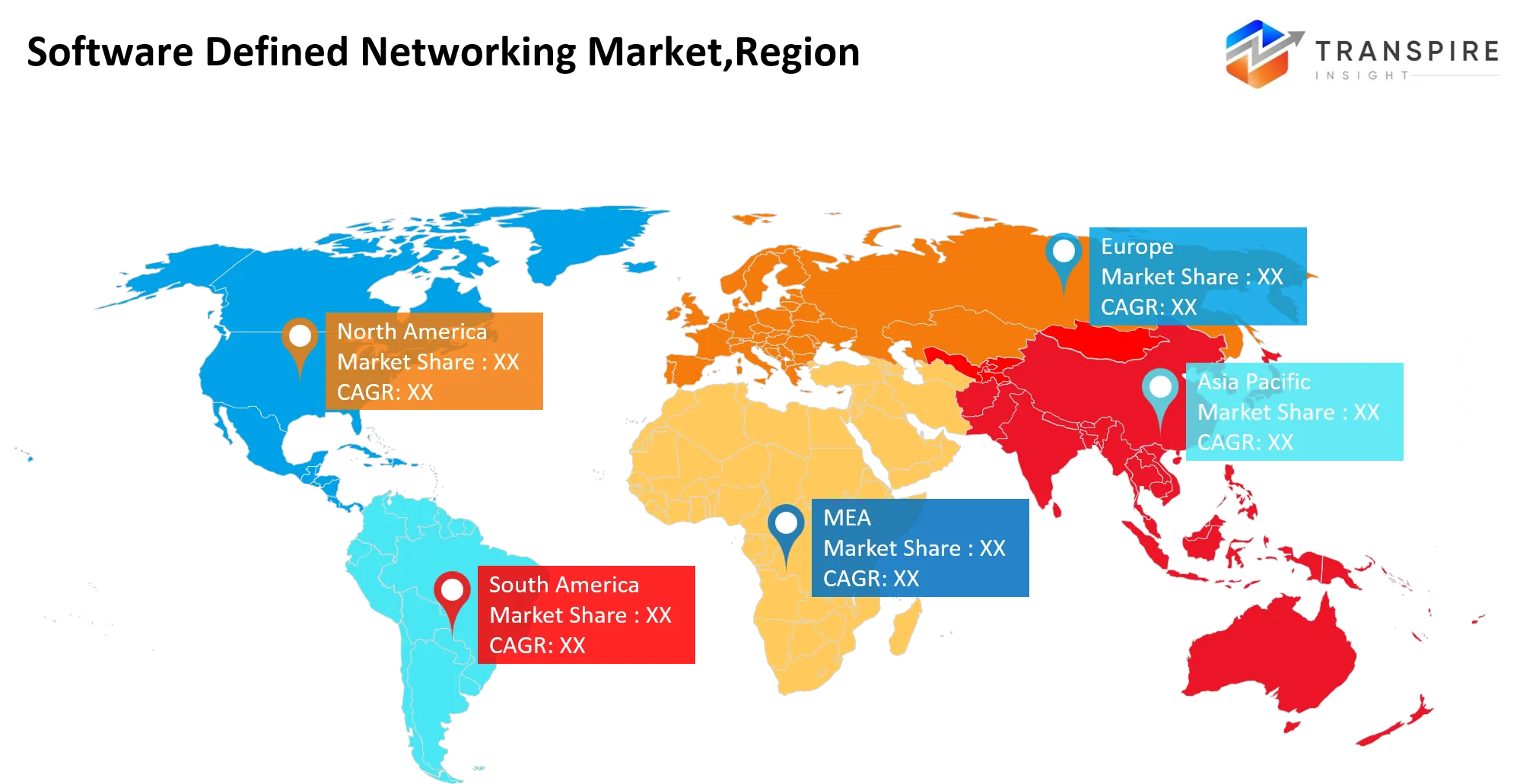
North America is the leading region in the software-defined networking market, accounting for 39.10%. It has a strong position in the market due to its mature cloud ecosystem, large enterprise networks, hyperscale data centre investments and early adoption of software-defined infrastructure. In addition, the region has a good base of networking technology providers, which helps in product development, integration and enterprise deployments. Continuous investments in AI-ready data centres and automation of network operations will continue to drive demand for programmable networking solutions.
In September 2026, AT&T pointed out the emerging significance of technologies such as SD-WAN, SASE, cloud connectivity, and hybrid networking in facilitating AI-based enterprise networks. This is indicative of the rising requirement for software-defined and programmable networks in North America.
https://about.att.com/blogs/2026/enterprise-networks-ai-era.html
Europe
Europe accounts for 28.00% of the software-defined networking market, making it the second largest after North America. It has an established and strong customer base. Demand is driven by enterprise modernisation, cloud adoption, data centre investments and efficient management of distributed infrastructure. Moreover, European organisations emphasise security, resiliency and a controlled data environment, driving investments in centralised network management. Its stable enterprise and telecom ecosystem will help in sustaining adoption of software-defined networks.
In February 2026, Deutsche Telekom, Orange, Telefónica, TIM, and Vodafone introduced an approach towards a federated Edge Continuum across Europe where the applications can be run from one operator’s edge network to another operator's edge network. It indicates the trend of automation and programmability in Europe.
https://www.vodafone.com/news/newsroom/technology/pan-european-federated-edge-continuum
Asia-Pacific
The Asia-Pacific region constitutes 23.00% of the worldwide software-defined networking market and is the most rapidly growing regional market with a CAGR of 14.20%. Growth is driven by adoption of cloud computing, 5G technologies, digitisation of services and increased investments in data centre operations in leading economies. The strong presence of enterprises and telecom companies in the region will provide scope for implementation of SDN technology in the wide area network, cloud and network infrastructure segments.
In March 2026, Singtel and Ericsson came up with a partnership in developing a programmable AI-powered digital platform from 5G Advanced. Network automation and programmability form part of this initiative.
Who are the Key Players in the Software-Defined Networking Market and how do they compete?
The competition in the Software-Defined Networking industry is being more affected by the range of the platform, level of automation, integration with security features and management of cloud and AI workloads. The platform by Cisco is a comprehensive one that links SD-WANs, campus networks, data centre management, and security. The recent upgrade of Cisco Catalyst SD-WAN includes resilience, visibility, and management simplicity. The company Arista Networks is adopting a cloud network platform strategy powered by the capabilities of a software-driven network and AI. Its acquisition of the VeloCloud SD-WAN portfolio gives it a stronger position in branch and WAN environments.HPE Juniper stands out with AI-assisted networking and SD-WAN features to boost visibility, anomaly detection and automated troubleshooting. Broadcom, via VMware, is focusing on an open private-cloud ecosystem and collaboration across multiple infrastructure layers in order to help its customers achieve flexible networking in private-cloud environments. Nokia and others that focus on telecommunication needs compete more strongly in service provider networking, while software-only vendors cater to particular automation and orchestration needs. The direction of competition is thus shifting from single SDN products to platforms with connectivity, security, observability, automation and cloud management.
Software-Defined Networking Market companies
- Cisco
- VMware/Broadcom
- HPE
- Huawei
- Juniper Networks
- Nokia
- Arista Networks
- Dell Technologies
- IBM
- NEC Corporation
- Ericsson
- Huawei Technologies
- Versa Networks
- Ciena
- Extreme Networks
Recent Development News
In November 2025, Broadcom launched an extended open ecosystem for VMware Cloud Foundation. The company launched an Open Networking Initiative and collaborations with firms like Cisco, Intel, OVHcloud, SNUC, and Supermicro. The move is beneficial for creating flexible private cloud infrastructure and for creating more chances for open networking technologies to be used in various infrastructures.
In July 2026, Arista Networks announced AI-Driven Edge Threat Management for VeloCloud SD-WAN. The new feature is a combination of zero-trust security and SD-WAN connectivity at the branch edge and includes firewalling, threat prevention, segmentation, filtering, and AI-powered policy insights. This shows that the market is moving towards integrating networking and security functionalities into one software-defined platform.
https://www.arista.com/en/company/news/press-release/24357-pr-20260721
What Strategic Insights Define the Future of the Software Defined Networking Market?
The future of the worldwide software-defined networking market lies with smart, security-conscious, and automated network management over simple centralized network configuration. SD-WAN, cloud networking, edge infrastructure, and AI-ready data centers will be increasingly integrated, necessitating platforms capable of managing network traffic, security, and application performance within a single platform layer. The hidden downside is complexity – companies run the risk of acquiring redundant controllers, security measures, and cloud orchestration, thus failing to deliver on the cost-saving promise that SDN provides. An even worse downside is the risk of faulty automation when there's a lack of comprehensive telemetry and ineffective policies. The most promising new use case scenario for SDN in the future is going to be AI-driven network assurance – platforms will be able to recognise abnormalities, forecast problems in performance and execute remediation actions based on recommendations or even autonomously. Thus, vendors must focus on APIs, vendor agnosticism, security features, and explainable automation in order to provide higher value to their customers.
Component
- SDN Infrastructure
- SDN Software
- SDN Controllers
- SDN Applications
- Network Virtualization
- Network Services
- SD-WAN
Deployment
- Cloud
- On-Premise
- Hybrid
- Private Cloud
- Public Cloud
- Edge
- Multi-Cloud
Organization Size
- Large Enterprises
- SMEs
- Service Providers
- Government
- Education
- Healthcare
- Data Centers
End User
- Telecommunications
- BFSI
- IT & Cloud
- Healthcare
- Retail
- Manufacturing
- Government
- Education
Network Type
- Data Center Networks
- Enterprise Networks
- Wide Area Networks
- Campus Networks
- Wireless Networks
- Industrial Networks
- Cloud Networks
Technology
- OpenFlow
- Network Functions Virtualisation
- Network Virtualization
- SD-WAN
- SD-LAN
- Intent-Based Networking
- Programmable Networks
Frequently Asked Questions
Find quick answers to common questions.
The software-defined networking market size was valued at USD 45.21 Billion in 2025 and is poised to reach USD 172.43 billion by 2033, expanding at an 18.21% CAGR
Key segments for the software defined networking market are Component (SDN Infrastructure, SDN Software, SDN Controllers, SDN Applications, Network Virtualization, Network Services, SD-WAN); Deployment (Cloud, On-Premise, Hybrid, Private Cloud, Public Cloud, Edge, Multi-Cloud); Organization Size (Large Enterprises, SMEs, Service Providers, Government, Education, Healthcare, Data Centers); End User (Telecommunications, BFSI, IT & Cloud, Healthcare, Retail, Manufacturing, Government, Education); Network Type (Data Center Networks, Enterprise Networks, Wide Area Networks, Campus Networks, Wireless Networks, Industrial Networks, Cloud Networks); Technology (OpenFlow, Network Functions Virtualization, Network Virtualization, SD-WAN, SD-LAN, Intent-Based Networking, Programmable Networks)
Growth is primarily driven by increasing network automation needs, expanding 5G networks, growing data center spending, adopting SD-WAN, and the requirement of flexible, secure, and efficient network infrastructure.
The market is led by major manufacturers including Cisco, VMware/Broadcom, HPE, Huawei, Juniper Networks, Nokia, Arista Networks, Dell Technologies, IBM, NEC Corporation, Ericsson, Huawei Technologies, Versa Networks, Ciena, Extreme Networks
The North American region dominates the software-defined networking market with a market share of 39.10%, thanks to the availability of advanced IT infrastructure, the quick uptake of cloud services, investments made in data centres, and the presence of top-tier tech firms in the region.
Market opportunities in the software-defined networking market involve the increasing use of cloud networking, the increasing build-up of 5G networks, the increasing demand for network automation, the increasing use of SD-WAN, and the demand for safe and scalable networking. Market opportunities also come out of the hybrid cloud environment, edge computing, and digital transformation.
About the Authors

Mayur Shinde
I am Mayur Shinde, a Senior Research Analyst at Transpire Insight, specializing in the Automotive & Transportation and Information & Communication Technology (ICT) Industry. My work focuses on analyzing emerging market trends, technological advancements, competitive landscapes, and industry developments to deliver accurate, data-driven insights. I am passionate about transforming complex market information into clear, actionable content that helps businesses, professionals, and decision-makers stay informed and make confident strategic decisions.

Chakradhar Khansole
Chakradhar serves as the Research Director at Transpire Insight, bringing over 8 years of experience in technology, innovation, and strategic market intelligence. He specializes in transforming complex market data into actionable business insights that enable organizations to make informed, growth-oriented decisions. Recognized for his strategic vision and analytical expertise, Chakradhar leads high-impact research initiatives, delivering comprehensive market assessments, competitive intelligence, and forward-looking industry analysis.
Recently Published Reports
-
Apr 2026
3D Optical Profiler Market
3D Optical Profiler Market Size, Share & Analysis Report By Type (Desktop 3D Optical Profiler, and Portable 3D Optical Profiler), By Technology (Confocal Technology, and White Light Interference), By End-Use Industry (Manufacturing, Research Institutions, Automotive, Aerospace and Defense, Medical Devices, and Other), and Geography (North America, Europe, Asia-Pacific, Middle East and Africa, South and Central America), 2021 - 2031
-
Apr 2026
Depth Sensor Market
Depth Sensor Market Size, Share & Analysis Report By Type (Infrared Depth Sensors, Time-of-Flight (ToF) Sensors, Stereo Vision Sensors, Structured Light Sensors, Ultrasonic Depth Sensors), By Application (Automotive, Robotics, Gaming, Consumer Electronics, Industrial Automation, Healthcare, Security & Surveillance, Others), By End Users (Automotive Manufacturers, Consumer Electronics Companies, Healthcare Providers, Industrial Companies, Security Agencies, Gaming Companies, Robotics Companies, Others), and Geography (North America, Europe, Asia-Pacific, Middle East and Africa, South and Central America), 2021 – 2031
-
Apr 2026
Digital Manufacturing Market
Digital Manufacturing Market Size, Share & Analysis Report By Component (Hardware, Software, and Services), By Technology (Robotics, 3D Printing, Internet of Things (IoT), and Others), By Application (Automotive and Transportation, Aerospace and Defense, Consumer Electronics, Industrial Machinery, and Others), By Process Type (Computer-Based Designing, Computer-Based Simulation, Computer 3D Visualization, Analytics, and Others), and Geography (North America, Europe, Asia-Pacific, Middle East and Africa, South and Central America), 2021 – 2031
-
Apr 2026
Digital Visa Services Market
Digital Visa Services Market Size, Share & Analysis Report By Type (Individual Travelers, Group Travelers), By Application (Tourism, Business Travel, Others), and Geography (North America, Europe, Asia-Pacific, Middle East and Africa, South and Central America), 2021 – 2031