
Automotive Parts Market Summary:
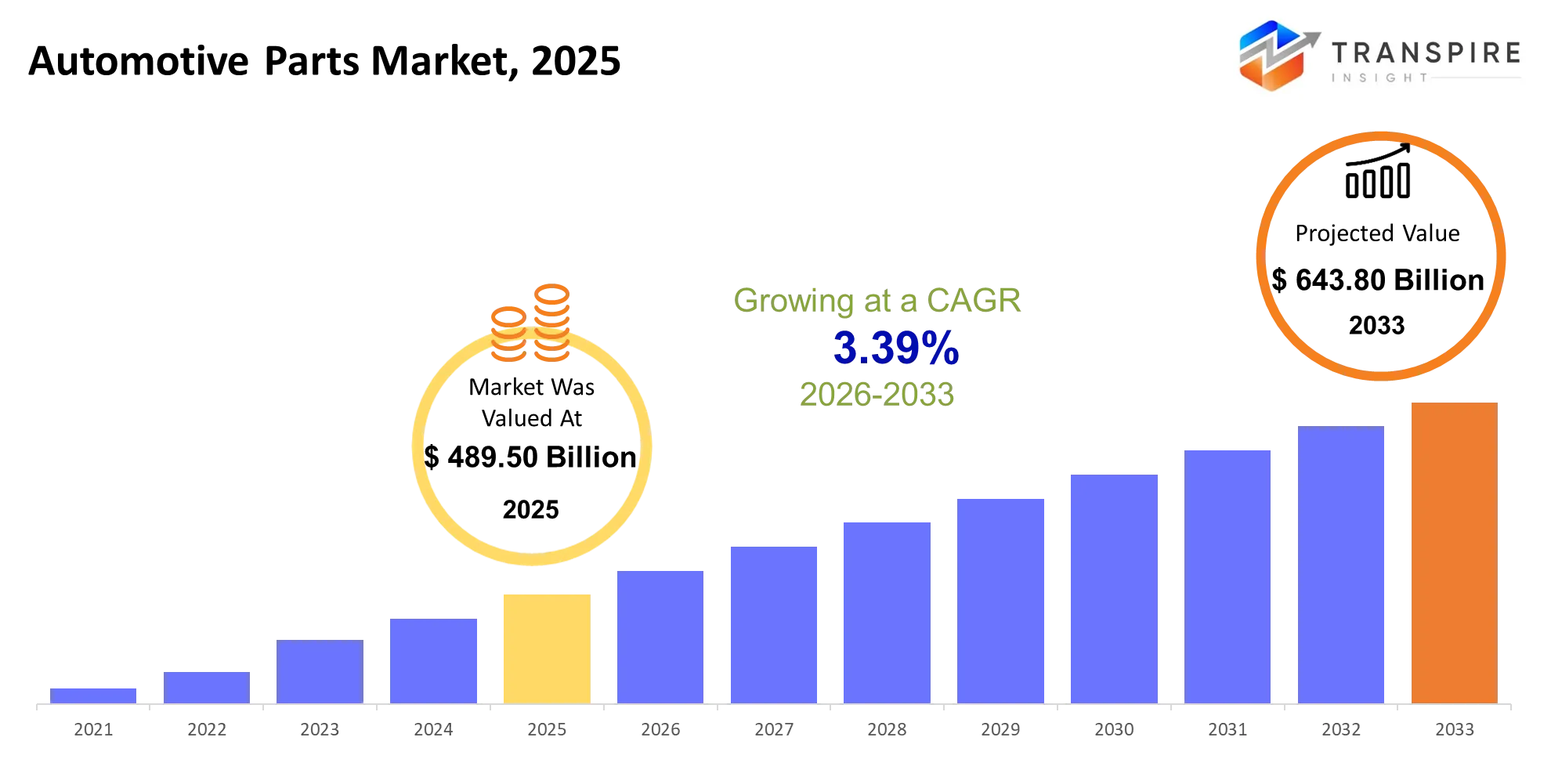
As per the Transpire Insight, The Automotive Parts Market size is estimated at USD 489.50 billion in 2025 and is anticipated to reach USD 643.80 billion by 2033, growing at a CAGR of 3.39% from 2026 to 2033.
The automotive parts market includes the parts used in the construction, upgrading, repairing, and maintaining of automobiles. They include powertrain and braking components, sensors, battery packs, body panels and software-enabled electronics. Within this market, while the recent past has been characterised by a transition from mechanical replacement cycles to electrified, electronically controlled and data-enabled vehicle parts, the most recent years have shown a shift to a new structure of a software-defined and electrified vehicle.
The key structural change is to a new configuration of higher-value parts such as power electronics, sensors, thermal-management units and diagnostic components, which have emerged as a result of a convergence of tighter emissions standards and higher investments in battery electric vehicles (BEVs). This convergence, driven by the shift to EVs, is forcing suppliers to revisit their capacity plans given the unpredictable demand for EVs, with the most recent years characterised by the coexistence of a migration to BEVs with a proliferation of EV models and price points.
Automotive Parts Market Size & Forecast:
- Market Size 2025: USD 489.50 Billion
- Expected Market Value (2033): USD 643.80 Billion
- Forecast CAGR (2026–2033): 3.39%
- Leading Region in 2025: Asia Pacific
- Fastest Growing Region: Middle East & Africa
- Key Company Profiles: Bosch, Denso, Magna International, Continental, ZF Friedrichshafen, Valeo, Aisin, Aptiv, Lear, BorgWarner, Hyundai Mobis, Forvia, Adient, Tenneco, Yazaki.
Key Automotive Parts Market Insights:
The market is shifting from volume-driven component supply toward intelligent, electrified and software-connected systems, increasing the value of electronics, sensing and integrated modules. Supplier competitiveness increasingly depends on localization, AI-enabled development, rapid validation, and the ability to combine hardware with software and lifecycle services.
- Powertrain applications account for 29.60%, while Bosch is advancing high-voltage electronics as electrification redirects investment from engines to integrated energy systems.
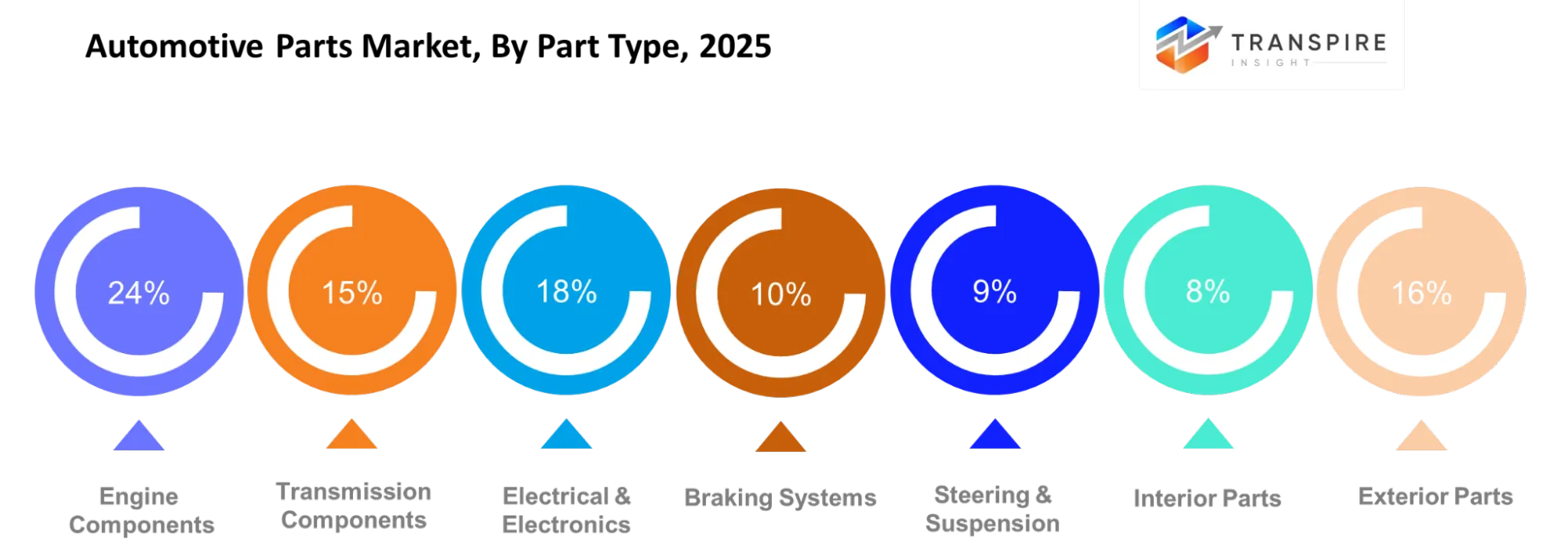
- Engine components hold 24.00%, but Denso’s thermal-management innovation supports hybrids as buyers retain efficient combustion vehicles longer.
- Electrical and electronics represent 18.00%; Continental’s 200-million radar-sensor milestone reflects rising ADAS content per vehicle.
- Transmission components contribute 15.00%, while Aisin is adapting drivetrain expertise for hybrid and electrified propulsion architectures.
- EV components are growing at 12.40% CAGR; Aptiv’s high-voltage cabling systems address demand for lighter, efficient vehicle electrical architecture.
- Braking systems comprise 10.00%, and ZF is extending perception and safety capability as automated driving raises brake-by-wire relevance.
- Tires and wheels represent 9.00%; Continental’s sensor-led tyre technologies support fleet preferences for predictive maintenance.
- Steering and suspension account for 9.00%, with Magna integrating chassis and ADAS functions for safer, software-enabled driving.
- Interior parts hold 8.00%, while Forvia and Adient respond to demand for sustainable materials and configurable cabin experiences.
What are the Key Drivers, Restraints, and Opportunities in the Automotive Parts Market?
Driver:
Vehicle electrification, rising electronic content, and the need to keep ageing vehicle fleets operational are increasing the value captured per repair and per vehicle produced. The shift was triggered by emissions regulations, OEM electrification roadmaps, and fleet pressure to reduce downtime. Battery connectors, inverters, thermal systems, ADAS sensors, and control modules carry greater technical value than many conventional mechanical parts. At the same time, connected diagnostics identify likely failures earlier, helping workshops and distributors plan inventory and convert maintenance into scheduled parts sales. Predictive maintenance can reduce maintenance costs by up to 20–30%, creating a financial rationale for fleets to adopt sensor-enabled replacement strategies.
Restraint:
Suppliers are struggling with hefty retooling costs, volatile raw material and energy prices, and uncertain EV volumes. This is because legacy suppliers need to fund the investments in new electrical and software expertise while simultaneously keeping internal combustion platforms going. Meanwhile, lower than expected EV demand in Europe has caused suppliers to delay, trim, or cancel component and battery investments in the region in order to preserve cash.
Opportunity:
The strongest opportunity is the convergence of physical parts with digital services. Suppliers can use embedded sensors, remote diagnostics, predictive maintenance, digital twins, and AI-assisted inspection to create recurring service value alongside hardware sales. ZF’s 2026 aftermarket approach, for example, connects vehicle diagnostic data with automated parts identification, availability checks, and ordering, showing how component suppliers can capture value beyond the initial sale. Regional localisation of EV and electronic-component supply chains also creates investment opportunities in Asia and North America.
What Has the Impact of Artificial Intelligence Been on the Automotive Parts Market?
The use of AI is transforming the manufacturing of automotive parts to move from reactive quality inspection to one of prediction and adaptive control. Suppliers are using machine-learning models to perform automated optical inspection, anomaly detection, root-cause analysis, production scheduling, and robot assembly to ensure defects don't escalate into batch-level quality issues. Bosch has built a large language model to analyse data from plant equipment, such as robots, to detect anomalies, and an automated system to optimise the equipment.
It has also built the Shopfloor Agent, an agentic AI to enable optimised troubleshooting of breakdowns, reducing downtime. In a handful of components such as chassis, predictive models can analyse behaviour, road conditions, equipment condition and results of physical tests to support engineers in designing, simulating and choosing maintenance strategies before a piece of hardware fails. For example, ZF's AI Road Sense system, launched in 2026, predicts road conditions and driver behaviour to further enhance adaptive chassis control. The key challenge for AI is having clean data, working equipment, system validation, cybersecurity controls, and trained personnel; false positives may require a human to examine.
In August 2026, Tata Consultancy Services partnered with Porsche AG to establish an AI Mobility Centre of Excellence aimed at industrializing artificial intelligence across manufacturing, engineering, and shopfloor operations.
Key Automotive Parts Market Trends:
The market is moving from volume-led mechanical supply toward higher-value electrified, electronic, and software-linked component ecosystems. Suppliers that combine hardware, diagnostic data, and service support are gaining a stronger position in both OEM and aftermarket channels.
- ICE-focused suppliers are diversifying into high-voltage connectors, inverters, thermal modules, and battery-safety parts.
- Vehicle repairs are becoming electronics-intensive as ADAS sensors, cameras, radar units, and control modules proliferate.
- Connected diagnostics are changing replacement behaviour from breakdown-driven purchases to planned maintenance interventions.
- AI-based demand forecasting is reducing stock-outs while lowering excess inventory across distributor networks.
- EV battery, thermal-management, and power-electronics servicing is creating new technician, tooling, and certification demand.
- Suppliers are localising production to reduce freight exposure, tariff risk, and semiconductor-related disruption.
- Remanufactured parts are gaining relevance as fleets seek lower lifecycle costs and circular-economy compliance.
- Online parts retail is improving fitment accuracy through vehicle-identification tools, AI recommendations, and faster fulfilment.
- Independent repairers are seeking broader access to diagnostic software and vehicle data as cars become software-defined.
Automotive Parts Market Segmentation
Part Type:
Engine components hold the largest stated share at 24.00%, supported by the large installed base of ICE and hybrid vehicles requiring filters, pistons, fuel-injection systems, gaskets, and cooling components. Transmission components account for 15.00%, but their growth logic is changing as conventional multi-speed systems face gradual substitution by simplified EV drivetrains. Electrical and electronics represent 18.00% and are positioned for stronger value expansion because vehicles increasingly require sensors, ECUs, wiring, radar, cameras, and connectivity modules. Braking systems and tyres and wheels each account for 10.00% and 9.00%, respectively, supported by wear-and-replacement demand, while steering and suspension account for 9.00%. Interior parts at 8.00% and exterior parts at 7.00% benefit from comfort upgrades, collision repair, and design differentiation.
Vehicle Type:
Passenger cars remain the primary volume base, while light and heavy commercial vehicles generate stronger aftermarket intensity because of high mileage, fleet utilisation, and preventive maintenance requirements. Two-wheelers support frequent, cost-sensitive replacement demand, whereas luxury vehicles require premium electronics, performance components, and certified parts. Electric vehicles and hybrids are reshaping supplier portfolios, with EV components projected to expand at a 12.40% CAGR, driven by batteries, power electronics, thermal management, and specialised electric drivetrains.
Sales Channel:
OEM supply remains essential for new-vehicle production, warranty replacement, and factory-fitted components, while the aftermarket benefits from a growing installed vehicle base. Online retail is gaining traction through digital catalogues, automated fitment verification, transparent pricing, and faster fulfilment. Authorized dealers retain an advantage for software-linked, calibrated, and safety-critical components. Independent dealers and distributors remain important for regional reach, while direct sales increasingly support large fleet operators requiring predictable supply, technical support, and negotiated procurement.
Material:
Steel remains fundamental to structural, chassis, and drivetrain applications because of its strength, established processing infrastructure, and cost efficiency. Aluminium is gaining importance where manufacturers pursue weight reduction without compromising structural performance. Plastics and composites are expanding across interiors, body systems, and lightweight modules, while carbon fibre remains concentrated in premium and performance applications. Copper benefits from electrification because higher electrical content increases wiring and conductivity requirements. Rubber and glass continue to support recurring replacement demand across tyres, seals, hoses, glazing, and safety-related applications.
Propulsion:
ICE vehicles remain the installed-base anchor, sustaining demand for engines, transmissions, exhaust systems, filters, lubrication components, and conventional maintenance parts. Hybrid and plug-in hybrid platforms create a transitional component mix by combining combustion hardware with electric motors, batteries, inverters, and advanced thermal systems. Battery electric vehicles are increasing demand for high-voltage components, battery-management systems, power electronics, and thermal management. Hydrogen fuel-cell vehicles create specialised requirements for stacks and storage systems, while CNG and LPG platforms continue supporting region-specific powertrain and fuel-system applications.
Application:
Powertrain Components lead at 29.60%, reflecting their substantial role across conventional and transitional propulsion platforms. However, the application mix is broadening as chassis systems incorporate electronically controlled braking, steering, and suspension technologies. Body applications increasingly integrate lightweight structures and embedded sensing, while Electrical Systems gain content from connectivity and vehicle computing. Interior and Exterior applications are becoming more intelligent through displays, lighting, cameras, and human-machine interfaces. Safety Systems and Infotainment further increase electronic content, creating opportunities for integrated, software-enabled component suppliers.
What are the Key Use Cases Driving the Automotive Parts Market?
Powertrain-related core uses commonly include supply to the powertrain and chassis areas, where replacement, preventive maintenance, safety, and uptime needs in passenger and commercial fleets create parts requirements. Powertrain components, represented at 29.60%, clearly indicate the importance of engines, transaxles, and thermal systems, just as electrification changes the technical makeup.
New applications include ADAS, connected diagnostics, electrified brakes and steering, battery thermal management, electronically controlled interior components, and the shift from replacement to systems with diagnostics, calibration, software, and training.
Emerging uses include predictive aftermarket work, remotely evaluating failures, and AI supporting the inspection process, with ZF's 2026 workflow incorporating diagnostic information to quickly identify and order the necessary parts.
|
Report Metrics |
Details |
|
Market size value in 2025 |
USD 489.50 Billion |
|
Market size value in 2026 |
USD 509.80 Billion |
|
Revenue forecast in 2033 |
USD 643.80 Billion |
|
Growth rate |
CAGR of 3.39% from 2026 to 2033 |
|
Base year |
2025 |
|
Historical data |
2021 - 2024 |
|
Forecast period |
2026 - 2033 |
|
Report coverage |
Revenue forecast, competitive landscape, growth factors, and trends |
|
Regional scope |
United States; Canada; Mexico; United Kingdom; Germany; France; Italy; Spain; Denmark; Sweden; Norway; China; Japan; India; Australia; South Korea; Thailand; Brazil; Argentina; South Africa; Saudi Arabia; United Arab Emirates |
|
Key companies profiled |
Bosch, Denso, Magna International, Continental, ZF Friedrichshafen, Valeo, Aisin, Aptiv, Lear, BorgWarner, Hyundai Mobis, Forvia, Adient, Tenneco, Yazaki. |
|
Customization scope |
Free report customization (country, regional & segment scope). Available customized purchase options to meet your exact research needs. |
|
Report Segmentation |
Part Type (Engine Components, Transmission Components, Electrical & Electronics, Braking Systems, Steering & Suspension, Interior Parts, Exterior Parts, Tires & Wheels); Vehicle Type (Passenger Cars, Light Commercial Vehicles, Heavy Commercial Vehicles, Two-Wheelers, Electric Vehicles, Hybrid Vehicles, Luxury Vehicles); Sales Channel (OEM, Aftermarket, Online Retail, Independent Dealers, Authorized Dealers, Distributors, Direct Sales); Material (Steel, Aluminum, Plastic, Rubber, Copper, Composites, Carbon Fiber, Glass); Propulsion (ICE, Hybrid, Battery Electric, Plug-In Hybrid, Hydrogen Fuel Cell, CNG, LPG); Application (Powertrain, Chassis, Body, Electrical Systems, Interior, Exterior, Safety Systems, Infotainment). |
Which Regions are Driving the Automotive Parts Market Growth?
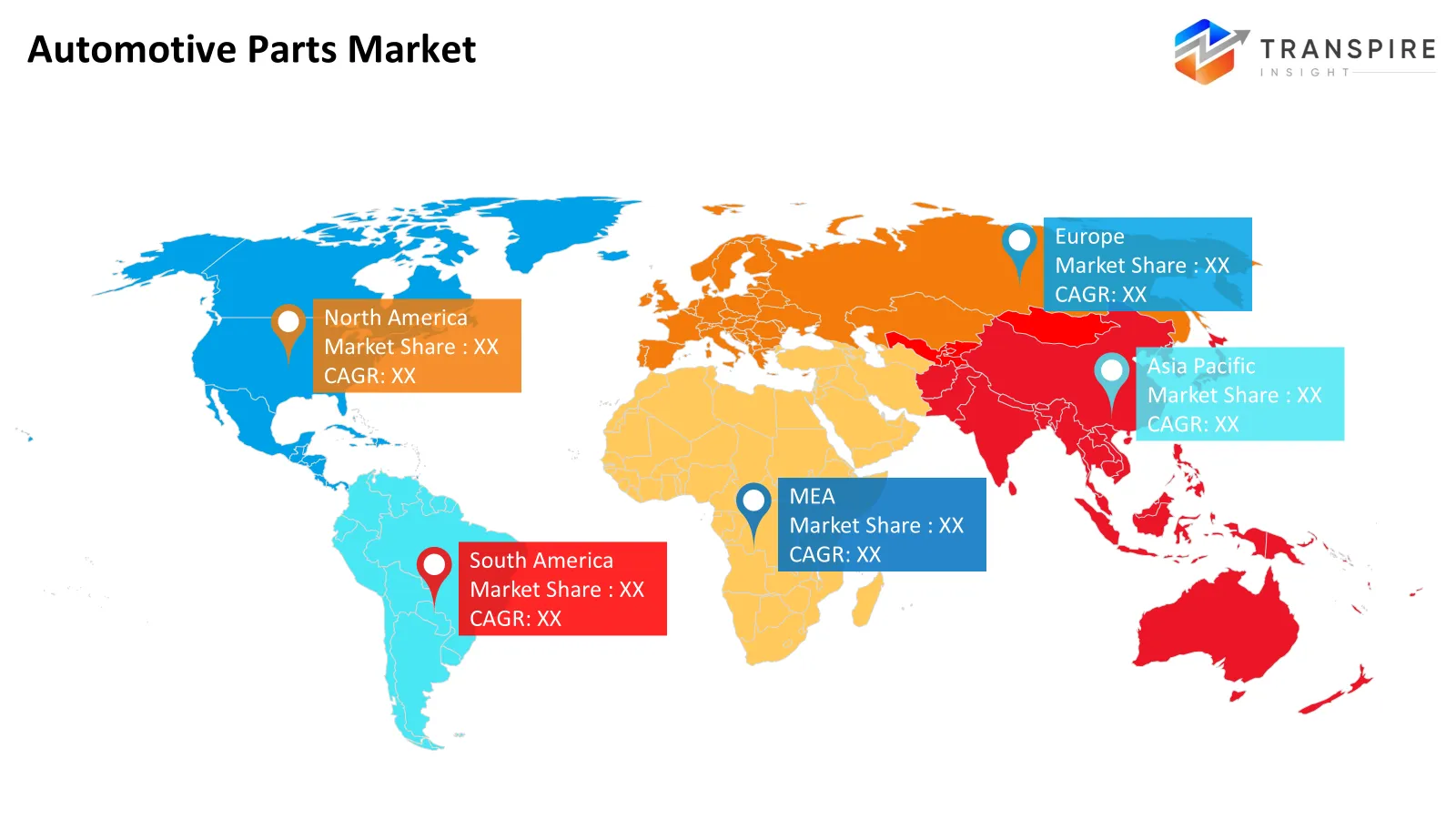
Asia Pacific commands 45.80% of the automotive parts market globally, driven by Chinese manufacturing of vehicles, batteries, motors, and electronics. China, Japan, South Korea, India, and ASEAN regions have extensive OEM, Tier-1, material, and semiconductor supplier ecosystems. Local sourcing of components is encouraged by policy incentives including China's New Energy Vehicle and India's production-linked incentive guidelines. Growing ownership of vehicles and affordable EV manufacturing are converting this manufacturing base into long-term demand for OEM and aftermarket components.
In July 2026, Samvardhana Motherson International Ltd. completed the acquisition of an 81% stake in Japan-based Yutaka Giken Co. This provided Motherson with management control over Honda’s long-standing precision component and powertrain supplier base to scale its electric mobility capabilities.
https://www.motherson.com/media/group-updates
Europe accounts for 24.00% of the total in second position, but with a different policy. The volume-led production approach will be replaced with a focus on engineering for premium vehicles, new safety systems, high emissions conformity, and a significant replacement demand from ageing fleets. Euro 7, electrification requirements, and battery traceability requirements will fuel demand for cost-effective powertrains, lightweight structures, sensors, and circular parts systems. Requirements for Digital Battery Passports will be a clear winner for those who can prove the origin, carbon footprint, and recyclability of batteries.
In September 2026, Panasonic Energy published its verified data dashboard as part of the Battery Alliance's 2026 Operational Trials, simulating a full end-to-end tracing mechanism for a 456-kilogram Tesla Model 3 NCA battery pack.
https://eu.mouser.com/en/newsroom/publicrelations-euro-7-standards-2026final/
The Middle East and Africa is the fastest-growing regional market with an expected CAGR of 7.10% from the current market share of 3.20%. Growth is primarily driven by infrastructure, urban logistics, fleet renewal, and rising vehicle importation. Unlike the manufacturing depth of Asia Pacific or the compliance-oriented demand in Europe, this region's opportunities include high-temperature performance, commercial-vehicle servicing, and distributor-owned aftermarket availability. Much like other regions, investment in local assembly, EV (electric vehicle) charging corridors, and regional spare-parts hubs will support supply resilience and enable mass adoption. North America comprises 22.00% of the market share and Latin America 5.00%, adding to aftermarket demand, further ensuring the region's demand is targeted at replacements.
In September 2026, Jameel Motors launched the Farizon V7E electric cargo van in the United Arab Emirates. This commercial vehicle expansion directly supports urban logistics networks and provides logistics fleets with local emission-compliant transport to fulfil regional sustainability mandates.
Who are the Key Players in the Automotive Parts Market, and how do they compete?
The competitive battle is no longer on the component scale, but rather on the delivery of electrification, vehicle software, sensing, and on-site manufacturing. Bosch, Denso, Continental, ZF Friedrichshafen, Valeo, Aisin, Aptiv, Magna International, Borg Warner, and Hyundai Mobis are competing in power electronics, Advanced Driver Assistance Systems (ADAS), thermal management, chassis, and high-voltage architecture. Bosch focuses on a gradual localised implementation of automated driving in China; Continental combines radar with cloud-connected software; Aptiv has differentiated itself with integrated electrical distribution and high-voltage cabling and growth in safety software; Magna employs modular vehicle architectures and collaborations on automated-driving computing; and ZF creates next-generation mobility through integrated chassis, brake, and perception.
Valeo relies on imaging radar, lighting, domain controllers, and over-the-air capability; Denso and Aisin use ties with Japanese Original Equipment Manufacturers (OEMs) and engineering expertise in thermal and hybrid-drive systems; Lear, Adient, and Forvia offer interior and cockpit electronics and sustainable cabin materials; Yazaki is significant with wiring harnesses; and Tenneco remains strong in emissions control and ride performance. Borg Warner continues to build and diversify through e-motors, inverters, and battery-related solutions.
Key Players are:
- Bosch
- Denso
- Magna International
- Continental
- ZF Friedrichshafen
- Valeo
- Aisin
- Aptiv
- Lear
- BorgWarner
- Hyundai Mobis
- Forvia
- Adient
- Tenneco
- Yazaki
Recent Development News
- In October 2026, J.K. Fenner entered into a strategic relationship with Yamada Manufacturing to strengthen the development and manufacturing of advanced automotive components. The collaboration is expected to combine Japanese component technology with J.K. Fenner’s manufacturing capabilities for domestic and markets. https://auto.economictimes.indiatimes.com/news/auto-components/jk-fenner-japans-yamada-manufacturing-enter-strategic-relationship-for-auto-components/134623726
- In September 2026, Highway Roop Precision Technologies Ltd, backed by the Carlyle Group, acquired Chamundi Die Cast Pvt. Ltd. This strategic action expands Highway Roop's operating footprint into complex precision manufacturing, accelerating the parts manufacturer's diversification strategy ahead of its projected initial public offering. https://www.livemint.com/companies/news/highway-roop-chamundi-die-cast-acquisition-carlyle-group-11790666681405.html
- In July 2026, Standard Motor Products formed a 50/50 joint venture with Techstrong Holdings to establish an automotive sensor manufacturing company in Thailand. The partnership is expected to expand sensor production capabilities while strengthening supply-chain diversification and delivery capacity. https://www.prnewswire.com/news-releases/smp-forms-joint-venture-with-techstrong-to-expand-sensor-manufacturing-capabilities-302818388.html
What Strategic Insights Define the Future of the Automotive Parts Market?
The industry is also moving toward integrated vehicle platforms, where suppliers offer end-to-end solutions, including hardware, embedded software, diagnostics, and lifecycle support. A key area of risk here is stranded capital: suppliers will invest significantly in EV capacity alone as regional demand and OEM launch schedules are still patchy. Until electrified volumes rise strongly, this could leave cash flow at risk to ICE revenues. A new opportunity is traceable circularity: Digital Battery Passports will increase demand for data systems that can quantify material origin, battery condition and lifespan, carbon footprint, second-use potential, and repairs. To mitigate short-term cash flow risk, suppliers should retain the flexibility to manufacture ICE, hybrid, and EVs, and emphasise software-enabled products, data-based collaboration with OEMs and fleets, off-the-shelf architecture, and monetised predictive maintenance rather than on-time delivery of component sales.
Key Segmentations are:
Part Type
- Engine Components
- Transmission Components
- Electrical & Electronics
- Braking Systems
- Steering & Suspension
- Interior Parts
- Exterior Parts
- Tires & Wheels
Vehicle Type
- Passenger Cars
- Light Commercial Vehicles
- Heavy Commercial Vehicles
- Two-Wheelers
- Electric Vehicles
- Hybrid Vehicles
- Luxury Vehicles
Sales Channel
- OEM
- Aftermarket
- Online Retail
- Independent Dealers
- Authorized Dealers
- Distributors
- Direct Sales
Material
- Steel
- Aluminium
- Plastic
- Rubber
- Copper
- Composites
- Carbon Fibre
- Glass
Propulsion
- ICE
- Hybrid
- Battery Electric
- Plug-In Hybrid
- Hydrogen Fuel Cell
- CNG
- LPG
Application
- Powertrain
- Chassis
- Body
- Electrical Systems
- Interior
- Exterior
- Safety Systems
- Infotainment
By Regional Analysis
North America
- US
- Canada
- Mexico
Europe
- Germany
- UK
- France
- Italy
- Spain
- Russia
- Rest of Europe
Asia Pacific
- China
- Japan
- India
- South Korea
- Australia
- Rest of Asia Pacific
South America
- Brazil
- Argentina
- Rest of South America
Middle East & Africa
- UAE
- Saudi Arabia
- Qatar
- South Africa
- Rest of the Middle East & Africa
Frequently Asked Questions
Find quick answers to common questions.
The automotive parts market size was valued at USD 489.50 billion in 2025 and is poised to reach USD 643.80 billion by 2033, expanding at a 3.39% CAGR.
Key segments for the automotive parts market are Part Type (Engine Components, Transmission Components, Electrical & Electronics, Braking Systems, Steering & Suspension, Interior Parts, Exterior Parts, Tires & Wheels); Vehicle Type (Passenger Cars, Light Commercial Vehicles, Heavy Commercial Vehicles, Two-Wheelers, Electric Vehicles, Hybrid Vehicles, Luxury Vehicles); Sales Channel (OEM, Aftermarket, Online Retail, Independent Dealers, Authorized Dealers, Distributors, Direct Sales); Material (Steel, Aluminum, Plastic, Rubber, Copper, Composites, Carbon Fiber, Glass); Propulsion (ICE, Hybrid, Battery Electric, Plug-In Hybrid, Hydrogen Fuel Cell, CNG, LPG); Application (Powertrain, Chassis, Body, Electrical Systems, Interior, Exterior, Safety Systems, Infotainment).
Growth is primarily driven by vehicle electrification, ADAS adoption, connected and software-defined vehicles, replacement demand from ageing vehicle fleets, AI-enabled manufacturing, and localisation of automotive supply chains.
The automotive parts market is led by major manufacturers, including Bosch, Denso, Magna International, Continental, ZF Friedrichshafen, Valeo, Aisin, Aptiv, Lear, BorgWarner, Hyundai Mobis, Forvia, Adient, Tenneco, and Yazaki.
Asia Pacific holds 45.80% of the automotive parts market, supported by large-scale vehicle production, dense supplier networks, EV manufacturing, localised sourcing, expanding automotive infrastructure, and strong component manufacturing capabilities.
Commercial opportunities include EV components, AI-enabled manufacturing, connected diagnostics, predictive aftermarket services, ADAS systems, lightweight materials, and localised production of high-value electronic components.
- Bosch
- Denso
- Magna International
- Continental
- ZF Friedrichshafen
- Valeo
- Aisin
- Aptiv
- Lear
- BorgWarner
- Hyundai Mobis
- Forvia
- Adient
- Tenneco
- Yazaki
About the Authors

Mayur Shinde
I am Mayur Shinde, a Senior Research Analyst at Transpire Insight, specializing in the Automotive & Transportation and Information & Communication Technology (ICT) Industry. My work focuses on analyzing emerging market trends, technological advancements, competitive landscapes, and industry developments to deliver accurate, data-driven insights. I am passionate about transforming complex market information into clear, actionable content that helps businesses, professionals, and decision-makers stay informed and make confident strategic decisions.

Chakradhar Khansole
Chakradhar serves as the Research Director at Transpire Insight, bringing over 8 years of experience in technology, innovation, and strategic market intelligence. He specializes in transforming complex market data into actionable business insights that enable organizations to make informed, growth-oriented decisions. Recognized for his strategic vision and analytical expertise, Chakradhar leads high-impact research initiatives, delivering comprehensive market assessments, competitive intelligence, and forward-looking industry analysis.
Recently Published Reports
-
Apr 2026
ATV & UTV Market
ATV & UTV Market Size, Share & Analysis Report By Type (ATV, and UTV), By Variants (Less Than 400 CC, 400 CC To 800 CC, and More Than 800 CC), and Geography (North America, Europe, Asia-Pacific, Middle East and Africa, South and Central America), 2021 - 2031
-
Apr 2026
Automotive Central Gateway Module Market
Automotive Central Gateway Module Market Size, Share & Analysis Report By Type (Ethernet Central Gateway Module, CAN Central Gateway Module, LIN Central Gateway Module, and FlexRay), By Application (Powertrain Control, Body Control, Infotainment System, Advanced Driver Assistance Systems (ADAS), and Others), By End User (Passenger Vehicles, and Commercial Vehicles), and Geography (North America, Europe, Asia-Pacific, Middle East and Africa, South and Central America), 2021 - 2031
-
Apr 2026
Automotive Engine Oil Filter Market
Automotive Engine Oil Filter Market Size, Share & Analysis Report By Filter Type (Fuel Filter, Engine Oil Filter, Hydraulic Oil Filter, and Others), By Filter Media (Cellulose, Synthetic, and Micro), By Sales Channel (OEMs, and Aftermarket), By Vehicle Type (Passenger Cars, Light Commercial Vehicles, Heavy Duty Trucks, Buses and Coaches, and Off-road Vehicles), and Geography (North America, Europe, Asia-Pacific, Middle East and Africa, South and Central America), 2021 - 2031
-
Apr 2026
Automotive Parts Aluminium Die Casting Market
Automotive Parts Aluminium Die Casting Market Size, Share & Analysis Report By Production Process (Pressure Die Casting, Vacuum Die Casting, Squeeze Die Casting, Gravity Die Casting), By Application (Body Parts, Engine Parts, Transmission Parts, Battery And Related Components, Other Application Types), and Geography (North America, Europe, Asia-Pacific, Middle East and Africa, South and Central America), 2021 - 2031
Our Clients