
Germany Finance Accounting Software Market Summary
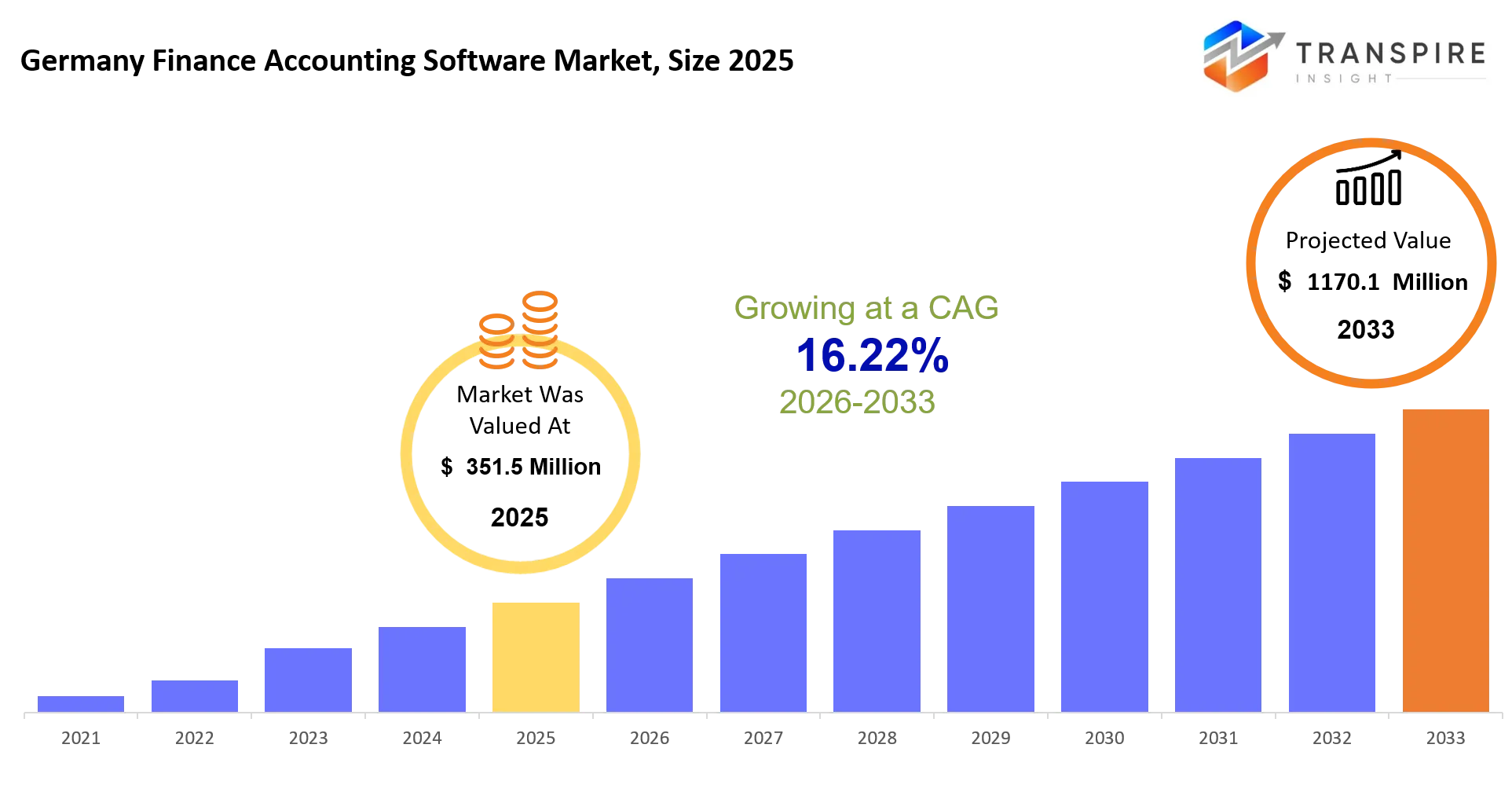
As per Transpire Insight Analysis, the Germany Finance Accounting Software Market size is estimated at USD 351.5 Million in 2025 and is anticipated to reach USD 1170.1 Million by 2033, growing at a CAGR of 16.22% from 2026 to 2033.
The Germany Finance Accounting Software Market is basically helping companies automate bookkeeping, the financial statements, tax compliance, accounts payable, accounts receivable and even planning / budgeting, but it also cuts down on manual mistakes and helps leadership see things more clearly, in a near real time kind of way. These solutions became kind of essential for manufacturers, retailers, financial organizations, and service providers that must follow Germany strict rules around financial reporting and VAT.Over the last five years what we saw was kind of a shift, from on-premise accounting software to cloud-first finance platform that are AI enabled and do real time reporting while still letting remote teams collaborate with out so much friction. And honestly, this change sped up after COVID-19, because organizations wanted stronger digital finance operations, better business continuity, and at the same time they were setting up hybrid work routines. Meanwhile the rules around electronic invoicing kept evolving too, plus compliance got more strict, so enterprises had to upgrade those older legacy accounting setups and not just patch them.When businesses connect finance tools with ERP, payroll, banking, and procurement systems, vendors tend to get more recurring subscription income, while customers get better efficiency, quicker financial closing cycles, and more reliable compliance controls.
Germany Finance Accounting Software Market Size & Forecast:
- Germany Finance Accounting Software Market Size 2025: USD 351.5 Million
- Expected Market Value 2033: USD 1170.1 Million
- Forecast CAGR: 16.22%
- Leading region in 2025:
- Southern Germany
- Fastest Growing region:Western Germany
- Key Profile: SAP, Oracle, Microsoft, Sage, Intuit, Xero, Zoho, FreshBooks, DATEV, Workday, Infor, Epicor, Unit4, Odoo, Wolters Kluwer
Key Market Insights
- Regional Analysis: In Southern Germany, the Germany Finance Accounting Software Market is basically led with roughly 38% share in 2025 , backed by automotive, manufacturing, and the industrial headquarters clusters . It’s not just one vertical though—there’s a broader industrial pull that keeps demand steady.
- Regional Analysis: Western Germany should see the fastest expansion through 2033, mostly due to finance, logistics, SaaS investments, and SME cloud migration, plus the usual modernization push.
- Segment Analysis: Cloud-based accounting software takes the lead with nearly 64% market share in 2025, and hybrid deployments are still the second-largest option among regulated enterprises, even if some teams are hesitant at first.
- Segment Analysis: AI-powered financial automation platforms are expected to be the fastest-growing segment during 2026–2033, since organizations start automating invoice processing, reconciliation, and forecasting , quicker than before.
- Application Insights: Financial reporting and compliance make up about 34% of software adoption, while automated accounts payable and expense management are rolling out the fastest in practice.
- End-User Insights: Manufacturing enterprises account for something like 31% of the total market revenue, while professional services and tech firms are seeing the fastest software uptake, more or less.
- Competitive Landscape: SAP, Oracle, Microsoft, Sage, DATEV, and Workday are still pushing forward by leaning into AI-enhanced accounting, cloud ERP integration, and ongoing compliance updates, plus continuous improvements that really matter.
- Vendors are putting in extra work as well for predictive analytics, embedded business intelligence, and automated audit trail routines. This combination helps finance teams shave off the monthly closing timeline by roughly 30–50% , and honestly that’s a big deal for report schedules.
- Strategic partnerships between accounting software providers, banks, and fintech firms keep widening embedded payment processing along with automated reconciliation options, so the data flow happens with less friction.
What are the Key Drivers, Restraints, and Opportunities in the Germany Finance Accounting Software Market?
Germany is shifting toward digital finance operations, and it’s become kind of the main spark for market expansion—like really. Electronic invoicing programs, tougher financial reporting rules, and changing tax compliance duties are pushing organizations to move away from scattered accounting tools and toward one integrated cloud platform. Teams also want quicker month-end closings,plus automated reconciliation, so they can lower the overhead and get better insights for decisions. And because finance software is starting to blend with ERP, procurement, payroll, and banking systems, vendors can land bigger subscription deals and wider enterprise rollouts.
Still, there’s this older enterprise setup, and it stays the biggest structural obstacle. A lot of German manufacturers and medium-sized companies keep using customized on-premise accounting environments. Those setups don’t migrate fast without messing with day-to-day finance. The integrations can get complicated, cybersecurity questions show up, plus employee retraining and compliance checks take time. Together these issues raise implementation spending and slow down schedules. As a result, modernization plans get delayed and near-term software revenue stays muted, even though the long-range payoffs look strong.
Then there’s AI and embedded financial analytics,which is probably the best long-term growth path. More organizations are putting money into AI-based invoice capture, predictive cash flow estimation, automated fraud spotting, and smarter financial planning. At the same time, mid-sized enterprises are speeding up cloud ERP adoption by using Software-as-a-Service subscriptions, which helps cut down on upfront capital costs.
What Has the Impact of Artificial Intelligence Been on the Germany Finance Accounting Software Market?
Artificial intelligence has really changed finance and accounting software at a core level by handling repetitive money tasks automatically, while also boosting how good decisions are, usually better. With AI powered systems, invoice details get captured via “smart” document processing, then transactions are sorted, bank statements get matched, and weird accounting issues are flagged with very little manual effort. In the background, machine learning looks at past financial records to guess cash flow, anticipate when payments come in late, fine tune working capital, and even make budgeting estimates more precise. On top of that, advanced analytics enable continuous auditing too, by spotting strange spending patterns, catching duplicate invoices, and suggesting possible fraud before the financial statements are actually finalized. All of this generally helps companies cut down on hands on processing time, speed up month end closing, strengthen regulatory compliance, and reduce day to day operating costs.
More and more finance software vendors now mix AI with robotic process automation, cloud ERP platforms, and predictive analytics so they can share near real time financial views across different departments. These days, “intelligent assistants” can draft management reports, run tax computations, and suggest corrective steps when financial conditions shift. Still, there is an important snag with adoption. Putting artificial intelligence into older accounting setups often means spending a lot on data standardization, system modernization, and training employees properly. Also, many organizations run into inconsistent historical data, which limits prediction quality until there are enough high quality datasets ready to use.
Key Market Trends
- Since 2021, cloud accounting deployments have kinda overtaken the usual on-premise setups, with cloud platforms now making up almost 64% of new enterprise installations. AI- powered invoice processing, in practice, has cut down the manual bookkeeping work by something like 60–80% , so more enterprises are leaning toward automating finance operations instead of simply hiring and expanding accounting staff.
- Meanwhile, electronic invoicing rules rolling out across several European markets have pushed accounting software upgrades forward, especially for organizations in manufacturing, logistics, and retail.
- SAP, Oracle, Microsoft, Sage, and DATEV keep broadening their AI capabilities, adding embedded analytics, and rolling out automated compliance features, which helps them keep that competitive edge.
- ERP vendors are also folding finance software into payroll, procurement, CRM, and banking systems more often, basically forming a unified enterprise financial ecosystem with near real-time reporting.
- And the way they sell software has shifted too: subscription based SaaS licensing has been replacing perpetual models at a steady pace, letting SMEs modernize their accounting operations with a smaller upfront cost, rather than a big upfront commitment.
- On top of that, predictive cash flow forecasting has moved from “optional” to almost expected, becoming a standard enterprise capability that supports liquidity planning and helps with financial risk management.
- ESG reporting requirements are adding pressure as well, so software vendors are incorporating sustainability accounting and non-financial reporting modules alongside the traditional finance functions.
- Cybersecurity spending has grown a lot since 2022, and vendors are improving encryption, identity management, and stronger financial data governance practices.
- Mid sized German enterprises keep speeding up finance digitalization initiatives, and as a result AI-enabled accounting automation is shaping up as one of the quickest evolving enterprise software categories through 2033.
Germany Finance Accounting Software Market Segmentation
By Component
Accounting Software takes the biggest share, mostly because keeping financial records is still the base of basically every business operation. Day to day bookkeeping , transaction recording , balance sheet generation , and expense tracking together make demand stay consistent across manufacturing , retail , banking , and service sectors. Financial Planning Software backs budgeting, long range forecasting , and investment analysis so companies can make better financial choices in the long run. Payroll Software makes salary processing easier, statutory deductions, employee benefits, and payroll compliance too, while also cutting down on manual workload.
Tax Management Software supports accurate tax calculations , VAT filings management, and compliance with shifting financial regulations. Reporting Tools produce financial statements, management dashboards, and audit reports that give clearer business visibility and better decision making. Services cover implementation , consulting, customization , integration, maintenance , and technical support, so the software deployment stays smooth. Others include expense management , invoice automation, reconciliation solutions, and financial analytics which help raise operational efficiency across various business environments.
By Deployment
Cloud based deployment tends to win because remote access is handy, software updates happen automatically, and infrastructure costs stay way lower so adoption feels doable for businesses that vary in size. On premise deployment still serves organizations that need full grip on financial information, want tailored infrastructure, and also manage internal security themselves . Hybrid deployment kind of blends cloud agility with local infrastructure, so teams can modernize step by step without ripping out the existing financial systems completely. SaaS delivery further widens access, driven by subscription pricing that cuts the upfront spend while still enabling ongoing upgrades to new features.
Private Cloud solutions pull in organizations that handle sensitive financial records and must meet strict regulatory rules , since they get dedicated computing resources and stronger security controls. Other options include community cloud , hosted infrastructure , and customized deployment setups meant for industry specific operational needs. With flexible deployment choices organizations can align accounting workflows with business scale, compliance aims and digital transformation. Deployment decisions keep balancing scalability, cost efficiency, cybersecurity concerns, and operational continuity .
By Application
General Ledger is basically the leading application, because those precise financial records back up every accounting process , plus audit work and regulatory submissions. For Accounts Payable, the solutions automate supplier payments , invoice checking, and payment timing too, all while making cash flow management a lot smoother. Then Accounts Receivable platforms help speed up customer billing, help push payment collection, and keep an eye on unpaid amounts so working capital performance stays stronger. On the reporting side, Financial Reporting applications produce standardized outputs that help boost transparency for executives , auditors , and the regulatory authorities.
For planning, Budgeting and Forecasting solutions take historical financial information and use it for better forecasting, resource allocation, and business strategy creation. Tax Compliance applications make tax calculations easier, support electronic filing, and keep documentation organized, while also lowering compliance risk. Other pieces you’ll also find are fixed asset management, treasury oversight, cash flow analysis, expense tracking, and financial consolidation. With constant automation running across all of these systems, operational efficiency rises and financial accuracy improves.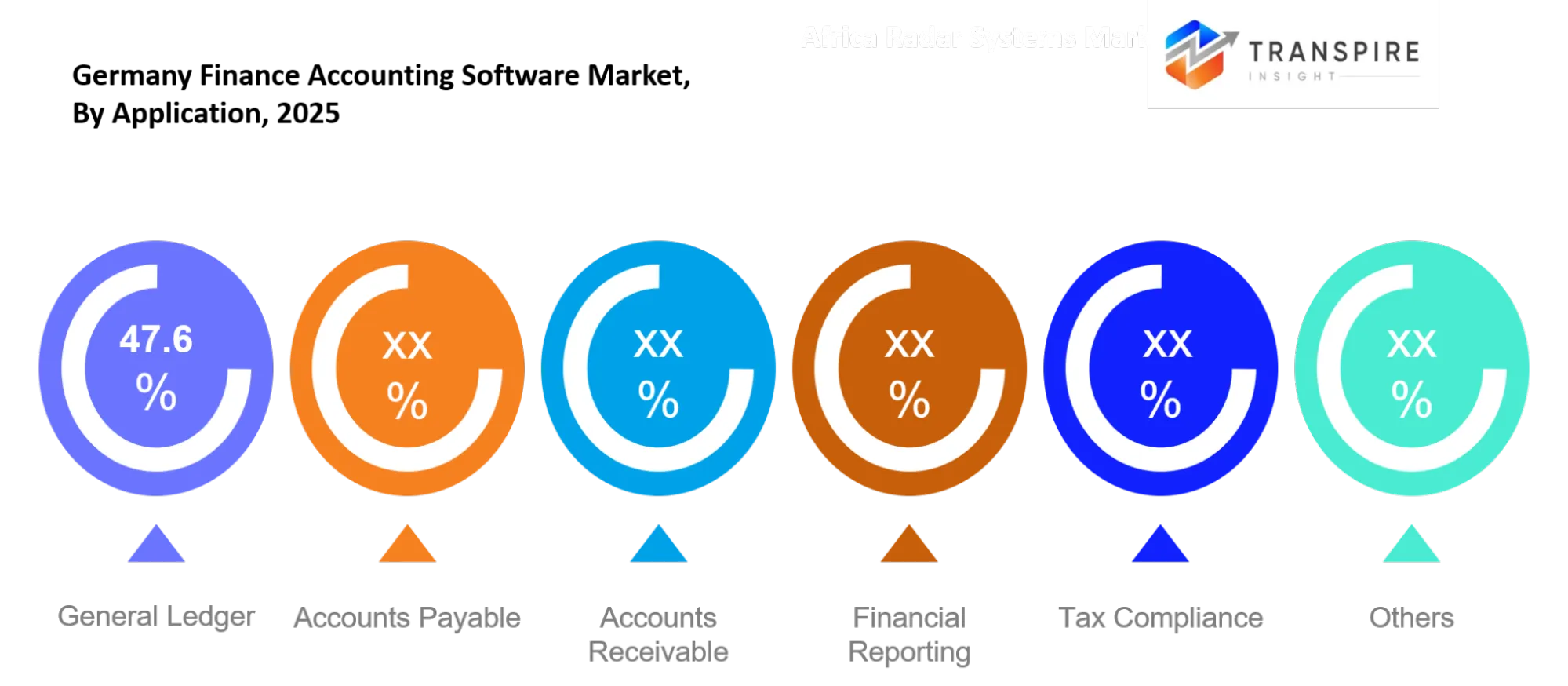
By End User
Large Enterprises typically generate the highest software investment because the complex financial structures need integrated accounting, compliance, reporting, and multi-location financial management. In contrast, SMEs keep expanding adoption via affordable cloud platforms that kind of simplify bookkeeping and financial planning without requiring too much IT resources. Government organizations roll out finance solutions to boost budget management, public expenditure monitoring, and financial transparency, overall. BFSI institutions rely on advanced accounting platforms for regulatory compliance, risk management, plus financial reporting.
Manufacturing organizations handle production costs, inventory accounting, and supplier payments by using integrated financial platforms. Retail businesses improve sales accounting, inventory valuation, and payment reconciliation across multiple sales channels. Healthcare organizations enhance billing accuracy, reimbursement processing, and regulatory reporting through specialized accounting systems. Other sectors also matter, including education, transportation, hospitality, utilities, telecommunications, and professional services that still need dependable financial management.
By Enterprise Size
Large enterprises pour money into advanced finance platforms, because many separate business units, operations abroad, and tricky compliance rules force accounting systems to be tightly linked. Medium enterprises tend to lean on scalable financial software that helps with expansion and keeps daily operations, efficient and under control. Small enterprises usually go for affordable digital accounting tools—ones that make bookkeeping easier, plus invoicing, payroll, and tax management, even when admin resources are limited. Startups often prioritize adaptive cloud platforms that lower setup costs while backing fast growth .
Other players, like nonprofit organizations , educational institutions, cooperatives , and industry associations, often need specialized accounting and reporting. In practice, the enterprise size affects what software can do, how it gets deployed, how big the implementation will be, and what kind of support services are actually required. Vendors keep working on scalable platforms so business growth doesn’t mean a total system reset. At the same time, flexible licensing models let teams add capabilities little by little, as operational complexity starts to rise.
What are the Key Use Cases Driving the Germany Finance Accounting Software Market?
Financial accounting and general ledger management stay kinda the main use case, because basically every organization needs dependable transaction capture, statutory reporting, and audit ready financial statements. Manufacturing firms, banks, and big enterprises lean on integrated accounting platforms, to handle huge transaction volumes yet still keep compliance with German financial rules in place.
Budgeting, payroll management, and tax compliance keep growing across small and medium sized companies, who are after better operational efficiency. Retail businesses often roll out automated accounts receivable and payable tasks to smooth out cash flow, and healthcare providers tend to tighten billing precision, plus they improve financial reporting by using integrated accounting solutions.
AI driven financial forecasting, smart fraud detection, and automated invoice recognition are starting to show up more and more, with pretty promising long term potential too. Cloud native finance platforms that connect with ERP, banking systems, and electronic invoicing infrastructure will enable faster financial decisions as digital transformation speeds ahead across regulated industries.
|
Report Metrics |
Details |
|
Market size value in 2025 |
USD 351.5 Million |
|
Market size value in 2026 |
USD 408.5 Million |
|
Revenue forecast in 2033 |
USD 1170.1 Million |
|
Growth rate |
CAGR of 16.22% from 2026 to 2033 |
|
Base year |
2025 |
|
Historical data |
2021 - 2024 |
|
Forecast period |
2026 - 2033 |
|
Report coverage |
Revenue forecast, competitive landscape, growth factors, and trends |
|
Regional scope |
Germany |
|
Key company profiled |
SAP, Oracle, Microsoft, Sage, Intuit, Xero, Zoho, FreshBooks, DATEV, Workday, Infor, Epicor, Unit4, Odoo, Wolters Kluwer |
|
Customization scope |
Free report customization (country, regional & segment scope). Avail customized purchase options to meet your exact research needs. |
|
Report Segmentation |
By Component (Accounting Software, Financial Planning Software, Payroll Software, Tax Management Software, Reporting Tools, Services, Others); By Deployment (Cloud-Based, On-Premise, Hybrid, SaaS, Private Cloud, Others); By Application (General Ledger, Accounts Payable, Accounts Receivable, Financial Reporting, Budgeting & Forecasting, Tax Compliance, Others); By End User (Large Enterprises, SMEs, Government, BFSI, Manufacturing, Retail, Healthcare, Others); By Enterprise Size (Large Enterprises, Medium Enterprises, Small Enterprises, Startups, Others) |
Which Regions are Driving the Germany Finance Accounting Software Market Growth?
In Southern Germany, the biggest share of market revenue lands there because Bavaria and Baden-Württemberg have this dense clustering of manufacturing groups, automotive companies, industrial technology businesses, and enterprise software providers. Bigger organizations in places like Munich and Stuttgart keep spending on cloud finance platforms, ERP modernization, and AI-enabled accounting systems , just to raise operational efficiency and stay aligned with regulatory requirements. With a strong digital foundation, a trained technology workforce, and pretty close cooperation between software vendors, system integrators , and enterprise clients, you end up with a pretty mature business ecosystem. And because digital transformation keeps getting funded consistently, software deployment activity stays high for both multinational corporations, and for mid-sized industrial companies.
Western Germany comes in second , mainly because its regional economy blends financial services, logistics, telecommunications, and a wide base of small and medium-sized enterprises rather than leaning primarily on industrial production. North Rhine-Westphalia has an advantage from its broad commercial customer base that keeps moving toward accounting software in order to improve financial reporting, strengthen tax compliance, and speed up business process automation. Economic activity stays steady, and ongoing digitalization initiatives help keep software spending predictable, even when conditions shift around. Financial institutions, consulting companies, and other service industries also add recurring needs for integrated finance management platforms.
Northern and Eastern Germany are growing the quickest, since digital transformation programs roll forward across public administration, technology startups, logistics firms, and new industrial cluster formations.
Who are the Key Players in the Germany Finance Accounting Software Market and How Do They Compete?
Using the company list provided, the competitive landscape seems to reflect competition that’s more about automotive driver monitoring technologies, not really finance accounting software. The pressure mostly comes from AI capability, computer vision performance , automotive safety compliance, and how well the solutions integrate with vehicle electronics. In general, global automotive suppliers keep their share by sticking with long term OEM relationships, while specialist AI companies try to stand out through software algorithms as well as in-cabin sensing approaches.
Continental tends to focus on weaving driver monitoring into broader vehicle safety systems, so automakers can roll out several Advanced Driver Assistance System functions via one unified platform. Bosch, on the other hand, leans on its big automotive electronics portfolio to bundle hardware, embedded software, and systems integration for major vehicle manufacturers worldwide. Smart Eye differentiates through proprietary eye-tracking algorithms and software licensing, building partnerships with vehicle OEMs that need to meet shifting European safety requirements.
Seeing Machines specializes in precision driver attention monitoring with AI-powered vision systems , and it keeps expanding through collaborations with both passenger vehicle and commercial vehicle makers. Mobileye combines computer vision, AI processing, and ADAS know how to tie driver monitoring into autonomous driving features, which creates added value compared to standalone monitoring solutions.
Overall these technology centered moves strengthen long-term competitiveness by pushing safety performance upward, while still supporting compliance with the changing automotive rules.
Company List
• SAP
• Oracle
• Microsoft
• Sage
• Intuit
• Xero
• Zoho
• FreshBooks
• DATEV
• Workday
• Infor
• Epicor
• Unit4
• Odoo
• Wolters Kluwer
Recent Development News
In April 2026, DATEV launched the DATEV Datenservice Zahlungsdienstleister. The new accounting integration service expanded automated data imports from payment providers including Klarna, Shopify, Stripe, Amazon Pay, and eBay, reducing manual bookkeeping effort and improving financial data accuracy for e-commerce businesses.https://www.datev.de
In April 2026, DATEV launched the new version of Belege online. The updated platform introduced enhanced document management and improved integration with DATEV Accounting Data Services, strengthening digital invoice processing and accounting workflow automation for accounting firms and enterprise customers.https://developer.datev.de
In July 2025, Infosys entered a strategic partnership with SAP by launching an Enterprise Innovation Lab for SAP solutions in Düsseldorf, Germany. The initiative accelerates SAP S/4HANA Cloud, Business AI, and enterprise finance transformation projects, strengthening Germany's digital finance and accounting software ecosystem.https://news.sap.com
What Strategic Insights Define the Future of the Germany Finance Accounting Software Market?
The market is moving, toward intelligent finance platforms that kind of mix artificial intelligence with cloud computing and, continuous regulatory compliance into one main operating environment, so it all feels connected. In the future, growth will be driven less by basic accounting tasks and more by predictive analytics, automatic financial controls, and smooth linking with ERP, banks, payroll systems, and procurement tools.
One not so obvious danger is the growing reliance on a small set of big enterprise software providers, this could bump migration expenses up and also make customers less flexible, especially those running complicated old legacy setups.
At the same time, there’s a fresh chance in AI-powered financial assistants, they can handle reconciliation automation, forecasting, and even audit prep, for Germany’s medium-sized firms. Software vendors and investors should focus on industry-tailored cloud offerings, with compliance built right in, plus open integration blueprints. That way, customers can upgrade financial operations step by step, without throwing away existing tech investments.
Germany Finance Accounting Software Market Report Segmentation
By Component
• Accounting Software
• Financial Planning Software
• Payroll Software
• Tax Management Software
• Reporting Tools
• Services
• Others
By Deployment
• Cloud-Based
• On-Premise
• Hybrid
• SaaS
• Private Cloud
• Others
By Application
• General Ledger
• Accounts Payable
• Accounts Receivable
• Financial Reporting
• Budgeting & Forecasting
• Tax Compliance
• Others
By End User
• Large Enterprises
• SMEs
• Government
• BFSI
• Manufacturing
• Retail
• Healthcare
• Others
By Enterprise Size
• Large Enterprises
• Medium Enterprises
• Small Enterprises
• Startups
• Others
Frequently Asked Questions
Find quick answers to common questions.
The Expected Germany Finance Accounting Software Market size for the Market will be USD 1170.1 Million in 2033.
Key segments for the Germany Finance Accounting Software Market are By Component (Accounting Software, Financial Planning Software, Payroll Software, Tax Management Software, Reporting Tools, Services, Others); By Deployment (Cloud-Based, On-Premise, Hybrid, SaaS, Private Cloud, Others); By Application (General Ledger, Accounts Payable, Accounts Receivable, Financial Reporting, Budgeting & Forecasting, Tax Compliance, Others); By End User (Large Enterprises, SMEs, Government, BFSI, Manufacturing, Retail, Healthcare, Others); By Enterprise Size (Large Enterprises, Medium Enterprises, Small Enterprises, Startups, Others).
Major Germany Finance Accounting Software Market players are SAP, Oracle, Microsoft, Sage, Intuit, Xero, Zoho, FreshBooks, DATEV, Workday, Infor, Epicor, Unit4, Odoo, Wolters Kluwer.
The Current Germany Finance Accounting Software Market size is USD 351.5 Million in 2025.
The Germany Finance Accounting Software Market CAGR is 16.22% from 2026 to 2033.
• SAP
• Oracle
• Microsoft
• Sage
• Intuit
• Xero
• Zoho
• FreshBooks
• DATEV
• Workday
• Infor
• Epicor
• Unit4
• Odoo
• Wolters Kluwer
About the Authors

Mayur Shinde
I am Mayur Shinde, a Senior Research Analyst at Transpire Insight, specializing in the Automotive & Transportation and Information & Communication Technology (ICT) Industry. My work focuses on analyzing emerging market trends, technological advancements, competitive landscapes, and industry developments to deliver accurate, data-driven insights. I am passionate about transforming complex market information into clear, actionable content that helps businesses, professionals, and decision-makers stay informed and make confident strategic decisions.

Chakradhar Khansole
Chakradhar serves as the Research Director at Transpire Insight, bringing over 8 years of experience in technology, innovation, and strategic market intelligence. He specializes in transforming complex market data into actionable business insights that enable organizations to make informed, growth-oriented decisions. Recognized for his strategic vision and analytical expertise, Chakradhar leads high-impact research initiatives, delivering comprehensive market assessments, competitive intelligence, and forward-looking industry analysis.
Recently Published Reports
-
Apr 2026
3D Optical Profiler Market
3D Optical Profiler Market Size, Share & Analysis Report By Type (Desktop 3D Optical Profiler, and Portable 3D Optical Profiler), By Technology (Confocal Technology, and White Light Interference), By End-Use Industry (Manufacturing, Research Institutions, Automotive, Aerospace and Defense, Medical Devices, and Other), and Geography (North America, Europe, Asia-Pacific, Middle East and Africa, South and Central America), 2021 - 2031
-
Apr 2026
Depth Sensor Market
Depth Sensor Market Size, Share & Analysis Report By Type (Infrared Depth Sensors, Time-of-Flight (ToF) Sensors, Stereo Vision Sensors, Structured Light Sensors, Ultrasonic Depth Sensors), By Application (Automotive, Robotics, Gaming, Consumer Electronics, Industrial Automation, Healthcare, Security & Surveillance, Others), By End Users (Automotive Manufacturers, Consumer Electronics Companies, Healthcare Providers, Industrial Companies, Security Agencies, Gaming Companies, Robotics Companies, Others), and Geography (North America, Europe, Asia-Pacific, Middle East and Africa, South and Central America), 2021 – 2031
-
Apr 2026
Digital Manufacturing Market
Digital Manufacturing Market Size, Share & Analysis Report By Component (Hardware, Software, and Services), By Technology (Robotics, 3D Printing, Internet of Things (IoT), and Others), By Application (Automotive and Transportation, Aerospace and Defense, Consumer Electronics, Industrial Machinery, and Others), By Process Type (Computer-Based Designing, Computer-Based Simulation, Computer 3D Visualization, Analytics, and Others), and Geography (North America, Europe, Asia-Pacific, Middle East and Africa, South and Central America), 2021 – 2031
-
Apr 2026
Digital Visa Services Market
Digital Visa Services Market Size, Share & Analysis Report By Type (Individual Travelers, Group Travelers), By Application (Tourism, Business Travel, Others), and Geography (North America, Europe, Asia-Pacific, Middle East and Africa, South and Central America), 2021 – 2031