
Germany Computer Vision in Healthcare Market Summary
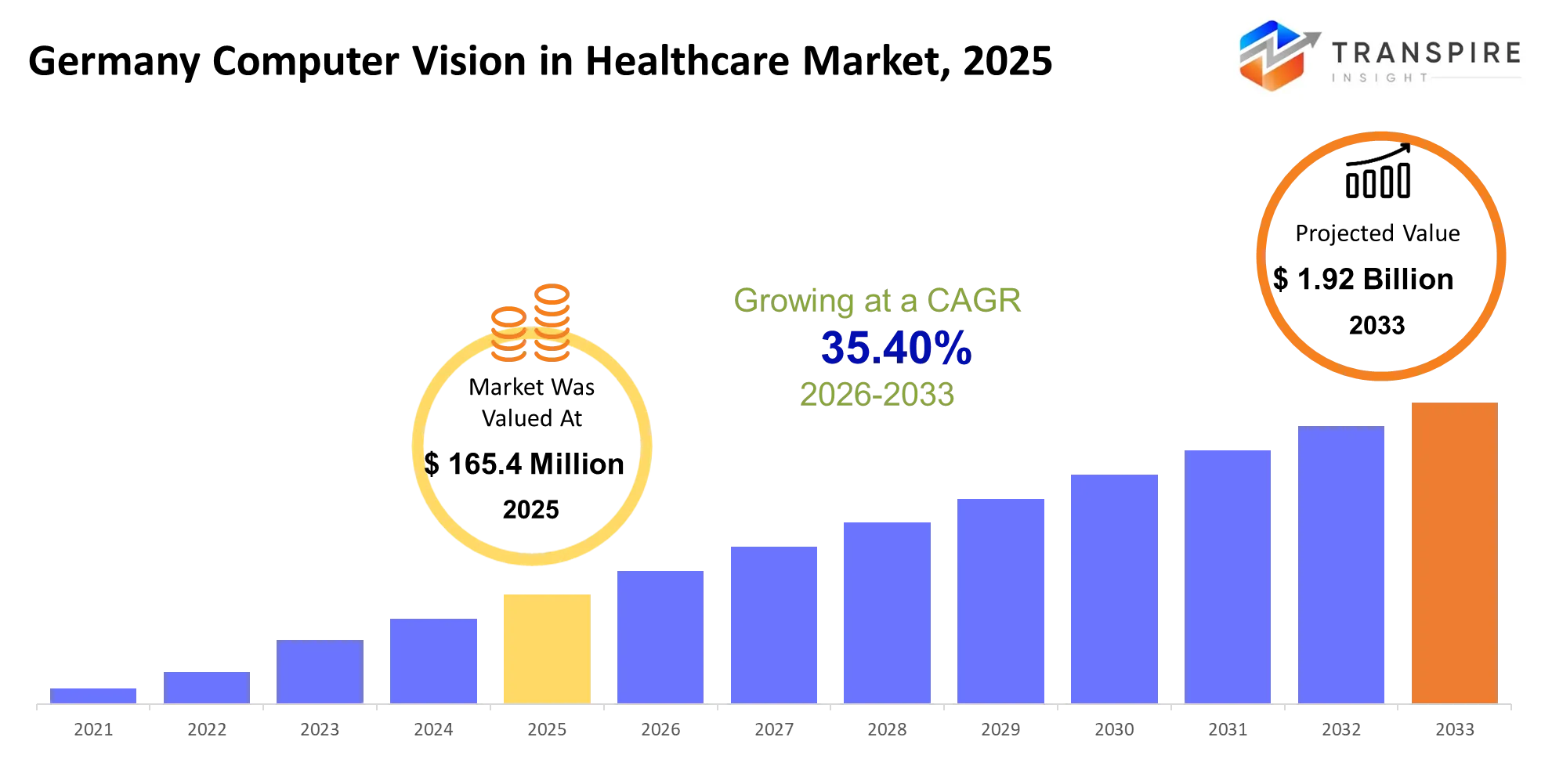
As per Transpire Insight Analysis The Germany Computer Vision in Healthcare Market size is estimated at USD 165.4 Million in 2025 and is anticipated to reach USD 1.92 Billion by 2033, growing at a CAGR of 35.40% from 2026 to 2033.
The Germany Computer Vision in Healthcare Market supports hospitals, diagnostic centers, and research facilities in a way that helps medical staff look at medical images, notice issues, automate day to day clinical processes, and boost diagnostic precision. In practice these systems assist radiologists, surgeons, and clinicians when they are dealing with huge volumes of imaging data, while at the same time cutting down the manual load. Over the last 3–5 years, many healthcare providers have moved away from the older imaging workflows towards AI-assisted diagnostics and cloud connected platforms , mainly because of digital health programs and better computing power. Germany’s rollout of healthcare digitalization policies, plus the investments in electronic health records, has made the take-up of advanced imaging solutions faster. And then the COVID-19 pandemic made remote diagnostics, and automated image checks even more important, because teams needed analysis that did not rely as much on physical presence. Right now the growing linking of AI algorithms with imaging devices is raising clinical productivity , helping enable quicker diagnosis, and opening fresh revenue paths for technology providers.
Germany Computer Vision in Healthcare Market Size & Forecast:
- Germany Computer Vision in Healthcare Market Size 2025: USD 165.4 Million
- Expected Market Value 2033: 1.92 Billion
- Forecast CAGR: 35.40%
- Leading region in 2025: Western Germany
- Fastest Growing region: Southern Germany
- Key Profile: Siemens Healthineers, GE HealthCare, Philips Healthcare, NVIDIA, Microsoft, IBM, Intel Corporation, Google Health, Aidoc, Viz.ai, Qure.ai, Canon Medical Systems, Fujifilm Holdings, Zebra Medical Vision, Arterys
Key Market Insights
- In Germany, the Computer Vision in Healthcare market sort of took off faster after 2020, because hospitals were putting more money into AI diagnostic imaging platforms and some automation tools. By 2025, AI-assisted radiology solutions were getting a lot more attention, mainly as clinicians wanted faster picture analysis, and better diagnostic accuracy as well, not just speed.
- Western Germany was clearly leading adoption in 2025, mostly tied to stronger healthcare infrastructure, research hubs and higher levels of technology investment. Then Southern Germany showed up as the fastest-growing area through 2033, kind of driven by biotechnology clusters plus medical technology innovation places, where new ideas keep moving quickly.
- In 2025, software solutions still held a big market share, kind of like people stayed comfortable with them, because healthcare organizations leaned toward AI algorithms and image analytics platforms. Meanwhile , the AI platforms were the fastest-growing component segment, mostly since they slot in with imaging systems, cloud services, and clinical decision support tools, and yeah this counts in day to day operations.
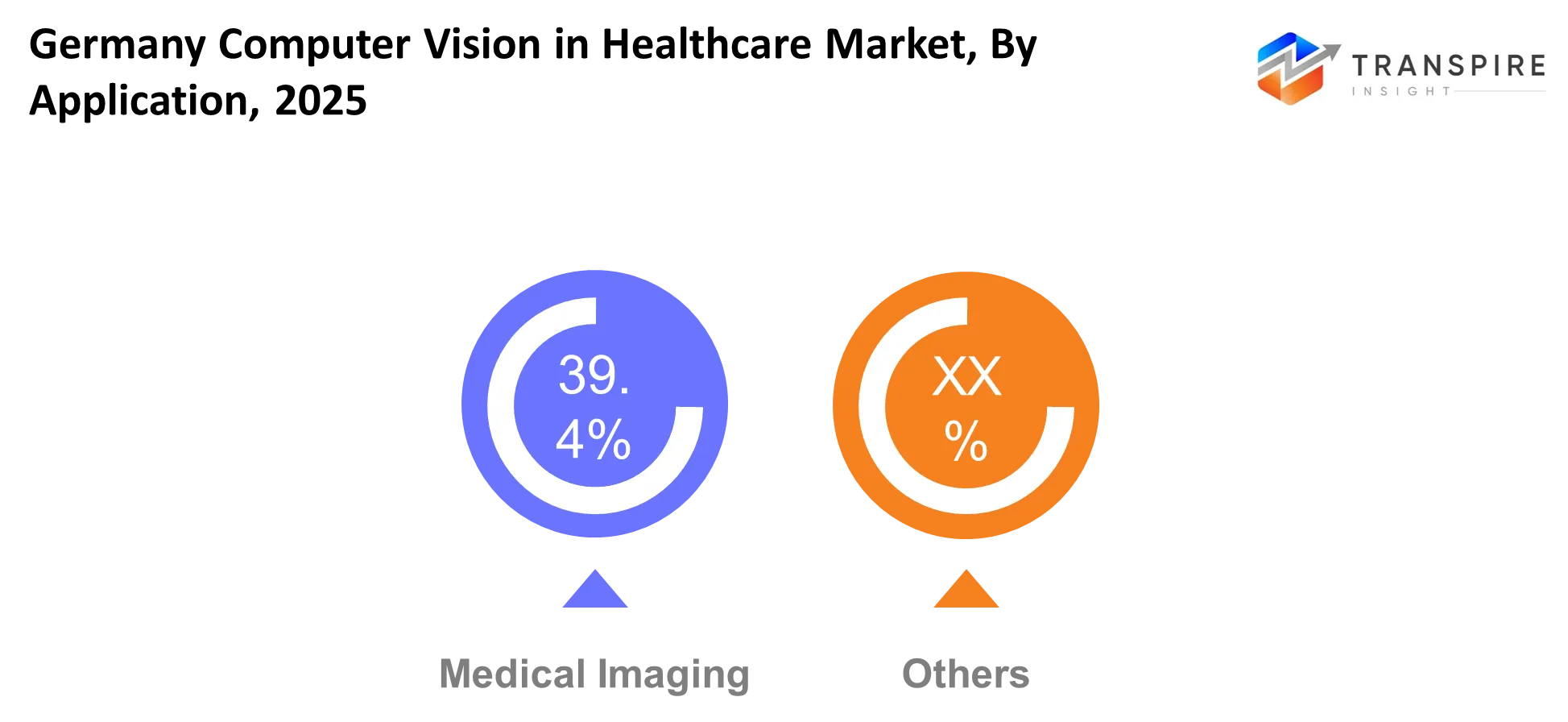
- From an application point of view, medical imaging stayed on top, with wide adoption across radiology, oncology, and cardiovascular diagnostics, especially in German hospitals. Pathology analysis was also picking up pretty quickly, as digital slide scanning and AI-based tissue analysis became more accepted over time, even if adoption has been a bit uneven.
- Hospitals remained the main end-user segment in 2025, largely because budgets went toward automated diagnostics and for better coordination of clinical workflows.
- At the same time, companies like Siemens Healthineers, GE HealthCare, NVIDIA, and Philips pushed forward AI healthcare partnerships too, to strengthen their market positioning and improve their reach.
What are the Key Drivers, Restraints, and Opportunities in The Germany Computer Vision in Healthcare Market?
The main force behind the Germany Computer Vision in Healthcare Market is that healthcare delivery is shifting toward AI-supported ways, a bit like everyone is quietly moving. German hospitals and diagnostic organizations are starting to use computer vision tools so they can lessen diagnostic workload, boost imaging accuracy, and handle those growing patient numbers. At the same time, government-backed healthcare digitalization efforts, plus investments in connected medical infrastructure, push providers to bring in AI-enabled imaging platforms more quickly. And when providers do that, there’s a clear set of revenue openings for technology firms, especially those that deliver advanced analytics, automated diagnosis, and workflow optimization approaches.
Still, one big hindrance is how complicated it is to connect computer vision tech with the existing hospital IT stack. A lot of healthcare systems run on older, legacy infrastructure, which causes compatibility friction, higher implementation costs, and longer rollout periods. On top of that, strict data privacy duties under European healthcare regulations add extra compliance steps, so smaller providers often slow down, even when they’re interested.
The next real growth angle comes from AI-driven precision medicine, plus more personalized healthcare applications. Newer machine learning models are getting better at cancer detection, pathology interpretation, and treatment planning in ways that are hard to ignore. Firms like Siemens Healthineers and NVIDIA are putting money into healthcare AI platforms that combine imaging data with predictive analytics. Also, the continued expansion of cloud-based healthcare infrastructure should make it easier to scale this across hospitals, and research institutions too.
What Has the Impact of Artificial Intelligence Been on The Germany Computer Vision in the Healthcare Market?
Artificial intelligence has, somehow, changed computer vision tasks in healthcare by making medical image interpretation more effective, and also by speeding up workflow automation, plus offering clinical decision guidance. In practice AI algorithms help radiologists notice weirdness or abnormalities in X-rays, CT scans ,and MRI images. This seems to enable faster diagnosis, and yeah it also cuts down reporting delays. There are newer platforms from companies like Aidoc and Viz.ai that can do automated detection of critical issues ,and they also push urgent cases to the top for clinicians.
On another front, machine learning models boost predictive strength. They do that by looking through old imaging records ,to spot disease patterns, measure likely treatment responses, and estimate patient risk. Healthcare teams tend to gain operational efficiency, shorter diagnostic cycles, and better use of staff and equipment. At the same time AI-enabled pathology tools, plus ophthalmology solutions, help specialists examine huge collections of images with more steady results, and less variation.
Still, AI adoption is not effortless. There are obstacles such as high integration costs, regulatory validation requirements, and not enough access to diverse clinical training datasets. Even when models look good, accuracy across different patient populations is a main sticking point before broader deployment can happen.
Key Market Trends
- Since 2021, German hospitals started using AI imaging tools more, partly because diagnostic workloads kept climbing, and clinicians wanted better clinical efficiency too, you know.
- After 2022, cloud based healthcare platforms also grew fast, since providers needed something scalable for medical image storage, and the analysis side of it.
- In 2025, AI driven radiology systems got more momentum, helped along by partnerships that popped up between hospitals, tech firms, and research organizations.
- Siemens Healthineers then pushed further with AI enabled imaging solutions, aimed at strengthening automated diagnostics across European healthcare markets.
- After 2023, there was also a stronger regulatory emphasis on healthcare data security, and it clearly nudged adoption toward compliant AI platforms.
- Digital pathology took off after 2020 as labs gradually swapped manual slide review for automated image processing.
- NVIDIA meanwhile increased its healthcare AI efforts, backing accelerated computing platforms for medical imaging use cases.
- At the same time, diagnostic centers leaned more toward automated analysis tools, to speed up turnaround times and keep operational costs down, which is pretty important.
- Hybrid cloud plus edge AI models started to get attention too, because providers were trying to balance performance, security, and data privacy all together.
- And finally, there were more strategic collaborations between technology companies and hospitals, mostly to validate these AI solutions inside real clinical environments, not just in demos.
Germany Computer Vision in Healthcare Market Segmentation
By Component:
Hardware is, kinda like, the bedrock of computer vision systems, that are used in healthcare in Germany. Medical cameras, imaging sensors, scanning devices, edge computing gear and specialized processors all help with precise image capturing and in-the-moment analysis. Updates to imaging hardware in hospitals and diagnostic centers are likely to keep coming, especially since healthcare providers are starting to lean into advanced AI based solutions. Edge devices also help with quicker processing, because they lower the reliance on centralized systems, in particular for urgent care and critical attention use cases.
Meanwhile, software solutions, analytics platforms, and AI platforms should be among the biggest growth areas. Healthcare orgs are pushing more automation for image interpretation, plus clinical decision support. Deep learning software makes it possible to analyze medical scans more rapidly, pathology images too, and even patient monitoring data. Cloud solutions, support services, and maintenance platforms will assist organizations to handle system performance, security needs, and overall long-term efficiency. Also, other pieces such as integration tools, and workflow applications will smooth out wider rollouts across varied healthcare spaces.
By Technology:
Deep learning technology kind of sits right in the middle of computer vision applications, because it makes automated analysis of complex medical images actually possible. In healthcare settings providers often rely on deep neural networks for spotting tumors, recognizing irregularities, and boosting diagnostic accuracy. Machine learning models keep supporting predictive analysis too, they do this by learning from big clinical datasets, sometimes the results are more stable than manual reviews. Also, image recognition along with pattern recognition helps clinicians interpret medical images with more speed and consistent reasoning, rather than rushing through every frame.
Meanwhile, 3D vision, object detection, and video analytics are pushing the use cases farther than the old traditional imaging pipeline. For example surgical navigation systems apply three-dimensional visualization to improve precision during medical procedures. Optical character recognition also supports healthcare documentation automation, by pulling structured information out of medical records. Facial recognition and other vision-driven systems will likely have selective roles in patient identification and healthcare security. All of this tends to reinforce workflow automation while still improving operational accuracy.
By Application:
Medical imaging still leads, even if it’s sort of obvious , because radiology, oncology, and cardiovascular diagnostics are used everywhere. Computer vision tools help clinicians sort through MRI, CT, ultrasound and X-ray images, bit by bit. Disease diagnosis use cases will probably grow even more, once AI algorithms get better at spotting different issues—like cancer, plus various neurological disorders. Surgical navigation systems, meanwhile, aim to make procedural planning more reliable and keep the accuracy level steadier.
On the other hand, patient monitoring, clinical workflow automation, and pathology analysis are getting more traction across healthcare sites in Germany. AI driven systems can help observe patient status, take over routine checks, and in turn lower the administrative busywork. Drug discovery will also get a boost from image based research analysis, and from identifying potential therapies more quickly. In areas like ophthalmology and dermatology, computer vision is likely to keep being adopted for early detection and for more individualized care routines.
By Deployment:
Cloud-based deployment setups are getting more adoption as healthcare orgs look for scalable infrastructure for storing and processing huge numbers of medical imaging records. Public cloud and private cloud options, will back secure data stewardship while still aligning with healthcare compliance duties, like it actually matters. Hybrid deployment patterns bring flexibility too, mixing cloud abilities with what the hospital already has running. SaaS platforms help smaller healthcare providers use advanced computer vision capabilities without having to do major infrastructure spending.
Meanwhile, on-premise systems are still pretty crucial in healthcare because some orgs need strict control over sensitive patient data. Edge AI deployment, lets decisions happen quicker by handling images closer to the place of care. Enterprise systems and web-based platforms will also help with integration between hospitals, diagnostic centers, and research facilities. And then, other deployment directions aim at better accessibility plus day to day operational reliability.
By End User:
Hospitals are likely the biggest end-user segment, mostly because they deal with huge imaging volumes and they also have the financial room for further investment in more advanced healthcare technologies. Big medical centers are already moving toward computer vision based solutions for radiology automation, “hands-on” surgical support, and continuous patient tracking. Diagnostic centers, too, should expand usage as the need keeps growing for quicker and more precise image interpretation. Overall healthcare providers will aim to leverage these tools to make day to day workflow smoother and to cut down on diagnostic delays, pretty reliably.
Research institutes, plus pharmaceutical and biotechnology companies, will lean more and more on computer vision platforms for medical research, drug discovery, and clinical studies. Academic institutions can help by backing AI in healthcare research programs and by forming technology partnerships. Specialty clinics will take on more specialized, targeted options for ophthalmology, dermatology, and other focused treatment areas. Meanwhile government healthcare bodies will slowly roll out computer vision tools to enhance public services and improve how resources are managed. Beyond that, other users will still matter, through smaller niche applications and by joining emerging healthcare technology initiatives.
What are the Key Use Cases Driving The Germany Computer Vision in the Healthcare Market?
Medical imaging still ends up being the main use case pushing computer vision adoption in Germany. Hospitals and diagnostic centers actually lean on AI based image analysis for radiology tasks , think MRI, CT, and X ray interpretations, because these tools help clinicians deal with the constantly growing imaging amounts, better the diagnostic uniformity, and shorten the time it takes to finish reports.
Also, the scope keeps expanding. You now see pathology work, and surgical navigation, moving through research institutes, specialty clinics, and larger hospital networks where workflows are more or less tightly connected. AI assisted pathology platforms tend to speed up tissue assessment, meanwhile navigation systems support surgical design and more exact maneuvers during tricky procedures.
Some newer directions are also coming into view, like AI powered drug discovery and personalized medicine experiments. Pharmaceutical businesses and biotech groups are looking at computer vision models for reading biological images and speeding up research momentum. On top of that, remote patient monitoring and automated clinical workflow systems seem promising too, as healthcare providers push connected care concepts towards 2033.
|
Report Metrics |
Details |
|
Market size value in 2025 |
USD 165.4 Million |
|
Market size value in 2026 |
USD 230.1 Million |
|
Revenue forecast in 2033 |
USD 1.92 Billion |
|
Growth rate |
CAGR of 35.40% from 2026 to 2033 |
|
Base year |
2025 |
|
Historical data |
2021 - 2024 |
|
Forecast period |
2026 - 2033 |
|
Report coverage |
Revenue forecast, competitive landscape, growth factors, and trends |
|
Regional scope |
Germany |
|
Key company profiled |
Siemens Healthineers, GE HealthCare, Philips Healthcare, NVIDIA, Microsoft, IBM, Intel Corporation, Google Health, Aidoc, Viz.ai, Qure.ai, Canon Medical Systems, Fujifilm Holdings, Zebra Medical Vision, Arterys |
|
Customization scope |
Free report customization (country, regional & segment scope). Avail customized purchase options to meet your exact research needs. |
|
Report Segmentation |
By Component (Hardware, Software, Services, AI Platforms, Imaging Systems, Edge Devices, Cloud Solutions, Analytics Platforms, Support & Maintenance, Others); By Technology (Deep Learning, Machine Learning, Image Recognition, Pattern Recognition, 3D Vision, Object Detection, Facial Recognition, OCR, Video Analytics, Others); By Application (Medical Imaging, Disease Diagnosis, Surgical Navigation, Patient Monitoring, Clinical Workflow Automation, Drug Discovery, Pathology Analysis, Ophthalmology, Dermatology, Others); By Deployment (Cloud-Based, On-Premise, Hybrid, Private Cloud, Public Cloud, SaaS, Edge AI, Enterprise Systems, Web-Based, Others); By End User (Hospitals, Diagnostic Centers, Research Institutes, Pharmaceutical Companies, Biotechnology Companies, Academic Institutes, Specialty Clinics, Healthcare Providers, Government Healthcare, Others) |
Which Regions are Driving The Germany Computer Vision in Healthcare Market Growth?
Western Germany kind of leads the adoption of computer vision in healthcare solutions , mostly because the medical technology ecosystem is really strong there, plus hospitals are already quite advanced and the research institutions are clustered pretty tightly. In practice, cities like Munich, Düsseldorf and Frankfurt help it along, with healthcare networks, technology companies, and university cooperation that keeps moving things forward. Also, the region usually gets more healthcare funding, and there is a solid kind of connection between hospitals and medical technology providers, so moving from pilot to rollout is less messy.
Southern Germany contributes in a steady way too, mainly via its biotechnology and engineering strengths, with support from companies, research centers, and specialized healthcare facilities. But, in a slightly different manner than Western Germany, Southern Germany leans on industrial know how, precision engineering, and a substantial medical device manufacturing base. Because hospitals and technology firms keep investing continuously, the demand becomes pretty stable for AI imaging and diagnostic platforms, which is important when teams need consistent datasets and long term deployments.
Eastern Germany shows up as the fastest growing region, as healthcare providers modernize infrastructure and adopt digital solutions more aggressively. New investments around healthcare digitalization, AI research programs, and connected medical systems are opening up fresh opportunities for computer vision adoption. So the growth there should pull in more interest, encouraging technology companies and investors to look for partnerships involving regional hospitals, research institutes, and government healthcare programs across 2026–2033.
Who are the Key Players in The Germany Computer Vision in Healthcare Market and How Do They Compete?
The Germany Computer Vision in Healthcare Market looks like a bit of a blend of well known medical technology firms and smaller specialized AI providers, all trying to edge each other out using tech capabilities, clinical accuracy, integration assistance and healthcare partnerships, you know. Bigger healthcare technology groups tend to protect their place in the market with advanced imaging ecosystems, while AI centric companies show up with more focused solutions, say diagnostics plus workflow automation kind of thing.
Siemens Healthineers plays it by offering integrated imaging systems and AI powered healthcare platforms, tying diagnostic devices into everyday clinical workflows without too much friction. GE HealthCare leans hard on advanced imaging technologies along with digital tools, mostly aimed at improving hospital efficiency and operational flow. Philips Healthcare differentiates with connected care platforms and AI assisted diagnostic features made for hospital networks, not just single departments.
On the AI side, companies like Aidoc and Viz.ai compete via narrower clinical use cases, including automatic disease detection, and urgent care workflow routing. NVIDIA meanwhile supports the whole effort by supplying accelerated computing infrastructure so healthcare organizations can actually run and deploy advanced AI models at scale. Overall competitive advantage, it seems, is shifting toward proven clinical results, regulatory adherence, and real partnerships with healthcare providers.
Company List
- Siemens Healthineers
- GE HealthCare
- Philips Healthcare
- NVIDIA
- Microsoft
- IBM
- Intel Corporation
- Google Health
- Aidoc
- Viz.ai
- Qure.ai
- Canon Medical Systems
- Fujifilm Holdings
- Zebra Medical Vision
- Arterys
Recent Development News
- In February 2026, Siemens Healthineers launched new AI-powered imaging workflow enhancements for its medical imaging portfolio. The development improved automation capabilities in radiology operations and strengthened AI integration across diagnostic workflows. https://www.siemens-healthineers.com/ (Siemens Healthineers)
- In January 2026, GE HealthCare expanded its AI-enabled healthcare technology portfolio through enhanced imaging solutions designed to support clinical decision-making. The initiative strengthened automated diagnostics capabilities for hospitals and imaging centers. https://www.gehealthcare.com/ (GE HealthCare)
- In April 2025, NVIDIA introduced healthcare AI computing advancements through its medical AI ecosystem initiatives. The technology supported faster development and deployment of healthcare AI applications by improving computational performance for imaging models. https://www.nvidia.com/en-us/industries/healthcare/ (NVIDIA Healthcare)
What Strategic Insights Define the Future of The Germany Computer Vision in the Healthcare Market?
The Germany Computer Vision in Healthcare Market is kinda moving toward integrated, AI-driven healthcare ecosystems, where imaging platforms, clinical data, and automated decision support systems all kind of work together at once. That shift seems to be pushed by healthcare providers wanting better operational efficiency, speedier diagnosis, and also better patient outcomes. There is however a quieter risk that market power could clump around a limited set of technology providers, and then healthcare orgs may become overly dependent on certain platforms, plus smaller organizations might struggle with integration, like some parts wont align. On top of that, AI regulations are still evolving, and that may end up slowing down or delaying deployment timelines for advanced clinical use cases.
The most promising opportunity, honestly, shows up in AI-powered precision medicine, and especially through partnerships involving hospitals, biotechnology firms, and research institutions. Market players should focus on interoperable AI platforms, strong regulatory compliance, and long-term healthcare collaborations, because that is how they can actually capture the longer runway of growth. Businesses that can pair solid clinical validation with scalable deployment models will likely stand out more clearly and strengthen their competitive position by 2033.
Germany Computer Vision in Healthcare Market Report Segmentation
By Component
- Hardware
- Software
- Services
- AI Platforms
- Imaging Systems
- Edge Devices
- Cloud Solutions
- Analytics Platforms
- Support & Maintenance
- Others
By Technology
- Deep Learning
- Machine Learning
- Image Recognition
- Pattern Recognition
- 3D Vision
- Object Detection
- Facial Recognition
- OCR
- Video Analytics
- Others
By Application
- Medical Imaging
- Disease Diagnosis
- Surgical Navigation
- Patient Monitoring
- Clinical Workflow Automation
- Drug Discovery
- Pathology Analysis
- Ophthalmology
- Dermatology
- Others
By Deployment
- Cloud-Based
- On-Premise
- Hybrid
- Private Cloud
- Public Cloud
- SaaS
- Edge AI
- Enterprise Systems
- Web-Based
- Others
By End User
- Hospitals
- Diagnostic Centers
- Research Institutes
- Pharmaceutical Companies
- Biotechnology Companies
- Academic Institutes
- Specialty Clinics
- Healthcare Providers
- Government Healthcare
- Others
Frequently Asked Questions
Find quick answers to common questions.
The expected Germany Computer Vision in Healthcare Market size for the market will be USD 1.92 Billion in 2033.
Key segments for The Germany Computer Vision in Healthcare Market are By Component (Hardware, Software, Services, AI Platforms, Imaging Systems, Edge Devices, Cloud Solutions, Analytics Platforms, Support & Maintenance, Others); By Technology (Deep Learning, Machine Learning, Image Recognition, Pattern Recognition, 3D Vision, Object Detection, Facial Recognition, OCR, Video Analytics, Others); By Application (Medical Imaging, Disease Diagnosis, Surgical Navigation, Patient Monitoring, Clinical Workflow Automation, Drug Discovery, Pathology Analysis, Ophthalmology, Dermatology, Others); By Deployment (Cloud-Based, On-Premise, Hybrid, Private Cloud, Public Cloud, SaaS, Edge AI, Enterprise Systems, Web-Based, Others); By End User (Hospitals, Diagnostic Centers, Research Institutes, Pharmaceutical Companies, Biotechnology Companies, Academic Institutes, Specialty Clinics, Healthcare Providers, Government Healthcare, Others).
Major Germany Computer Vision in Healthcare Market players are Siemens Healthineers, GE HealthCare, Philips Healthcare, NVIDIA, Microsoft, IBM, Intel Corporation, Google Health, Aidoc, Viz.ai, Qure.ai, Canon Medical Systems, Fujifilm Holdings, Zebra Medical Vision, Arterys.
The Germany Computer Vision in Healthcare Market size is USD 165.4 Million in 2025.
The Germany Computer Vision in Healthcare Market CAGR is 35.40% from 2026 to 2033.
- Siemens Healthineers
- GE HealthCare
- Philips Healthcare
- NVIDIA
- Microsoft
- IBM
- Intel Corporation
- Google Health
- Aidoc
- Viz.ai
- Qure.ai
- Canon Medical Systems
- Fujifilm Holdings
- Zebra Medical Vision
- Arterys
About the Authors

Pankaj Ghogare Patil
I am Pankaj Ghogare Patil, a Senior Research Analyst at Transpire Insight, specializing in the Pharmaceutical, Chemicals & Materials, Healthcare IT, and Biotechnology industry. My expertise lies in conducting comprehensive market research, analyzing industry trends, evaluating competitive landscapes, and translating complex data into actionable insights. At Transpire Insight, I closely follow emerging technologies, regulatory developments, and market innovations to create accurate, well-researched, and informative content that helps businesses and professionals make informed decisions. I am committed to producing credible, evidence-based articles that reflect industry best practices while making technical topics accessible and valuable for a broad audience.

Chakradhar Khansole
Chakradhar serves as the Research Director at Transpire Insight, bringing over 8 years of experience in technology, innovation, and strategic market intelligence. He specializes in transforming complex market data into actionable business insights that enable organizations to make informed, growth-oriented decisions. Recognized for his strategic vision and analytical expertise, Chakradhar leads high-impact research initiatives, delivering comprehensive market assessments, competitive intelligence, and forward-looking industry analysis.
Recently Published Reports
-
Apr 2026
AI in Diabetic Retinopathy Market
AI in Diabetic Retinopathy Market Size, Share & Analysis Report By Type (Screening AI Systems, Diagnostic AI Systems, and Predictive AI Models), By Application Segment (Hospitals, Ophthalmology Clinics, Diagnostic Centers, and Research and Development), and Geography (North America, Europe, Asia-Pacific, Middle East and Africa, South and Central America), 2021 - 2031
-
Apr 2026
Psychometric Tests Market
Psychometric Tests Market Size, Share & Analysis Report By Type (Personality Tests, Ability/Aptitude Tests, Skill/Knowledge Tests, and Others), By Application (Talent Acquisition and Talent Management), and Geography (North America, Europe, Asia-Pacific, Middle East and Africa, South and Central America), 2021 – 2031
-
Apr 2026
Rare Biological Sample Collection Market
Rare Biological Sample Collection Market Size, Share & Analysis Report By Type (Isolation Kits & Reagent, Blood Collection Tubes, and Others), By Application (Oncology, Transcriptomics, Pharmacogenomics, and Others), and Geography (North America, Europe, Asia-Pacific, Middle East and Africa, South and Central America), 2021 – 2031
-
Jul 2026
Diabetic Retinopathy Market
Diabetic Retinopathy Market Size, Share & Analysis Report By Type (Proliferative Diabetic Retinopathy, and Diabetic Macular Edema (DME)), By Treatment Type (Anti VEGF Drug, Steroid Implants, Laser Surgeries, and Vitrectomy), and Geography (North America, Europe, Asia-Pacific, Middle East and Africa, South and Central America), 2021 – 2031
Our Clients







