
Germany Carotid Artery Stents Market Summary
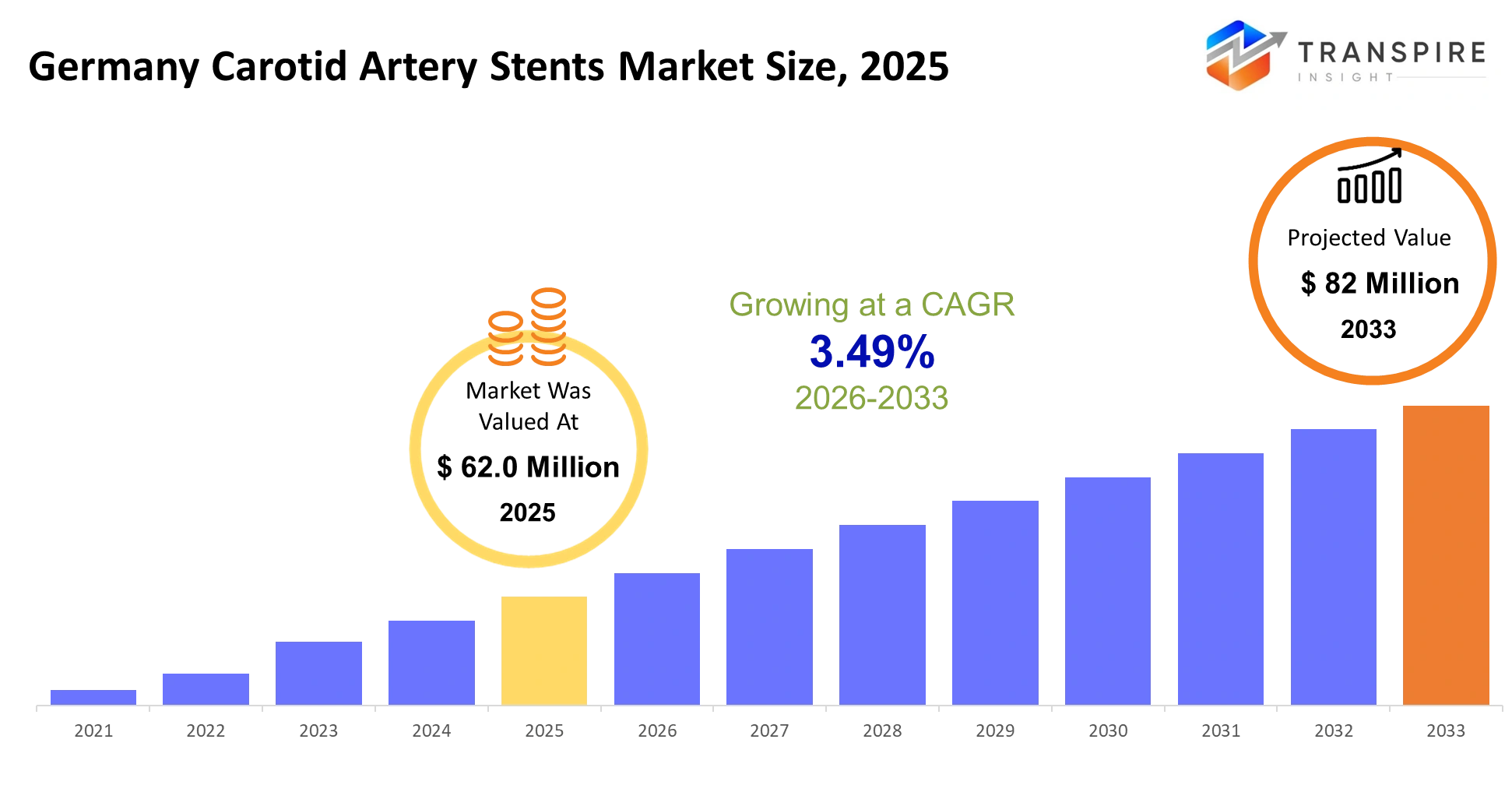
As per Transpire Insight Analysis, the Germany Carotid Artery Stents Market size is estimated at USD 62.0 Million in 2025 and is anticipated to reach USD 82 Million by 2033, growing at a CAGR of 3.49%from 2026 to 2033.
In Germany, the Carotid Artery Stents Market has become kind of a big deal for stopping ischemic strokes, because it supports a minimally invasive approach for patients who have carotid artery narrowing but can’t really use conventional surgery. In real hospital practice, vascular specialists and interventional teams are using carotid artery stents more often to bring back the blood flow while also cutting down recovery time and shortening stays in hospital. In the last about five years, the market has moved toward newer, next generation stent platforms, these come with better embolic protection systems and improved imaging guidance , so the whole workflow feels more controlled. This shift is also being backed by wider acceptance of endovascular procedures across Germany, and yes that includes more routine adoption in many regions.
The COVID-19 period did something similar but opposite at different moments, first it slowed elective vascular interventions and left treatment backlogs , later when care normalized, those volumes bounced up faster than expected. Meanwhile Germany’s aging population keeps pushing the demand upward, and stroke prevention programs keep expanding too. On top of that, more hybrid operating rooms are available , which makes these procedures easier to schedule and perform. As clinicians continue using evidence based endovascular techniques for high risk patients , hospitals tend to invest in advanced vascular devices. That helps sustain market revenues, and it also nudges continued product innovation among the leading manufacturers in the space.
Germany Carotid Artery Stents Market Size & Forecast:
- Germany Carotid Artery Stents Market Size 2025: USD 62.0 Million
- Expected Market Value 2033: USD 82 Million
- Forecast CAGR: 3.49%
- Leading region in 2025:Southern Germany
- Fastest Growing region:Eastern Germany
- Key Profile: Abbott Laboratories, Boston Scientific, Medtronic, Terumo Corporation, Cardinal Health, Cook Medical, InspireMD, BIOTRONIK, B. Braun, Merit Medical Systems, Cordis, Stryker, BD, W. L. Gore & Associates, MicroPort Scientific.
Key Market Insights
- In Southern Germany, the Germany Carotid Artery Stents Market is pretty much leading, with something like 38% share in 2025, and that is bolstered by advanced cardiac and vascular hospitals , plus higher procedure volumes overall.
- Eastern Germany looks set to grow the quickest through 2033, largely because vascular care infrastructure is getting modernized, and access to interventional specialists is being widened , step by step.
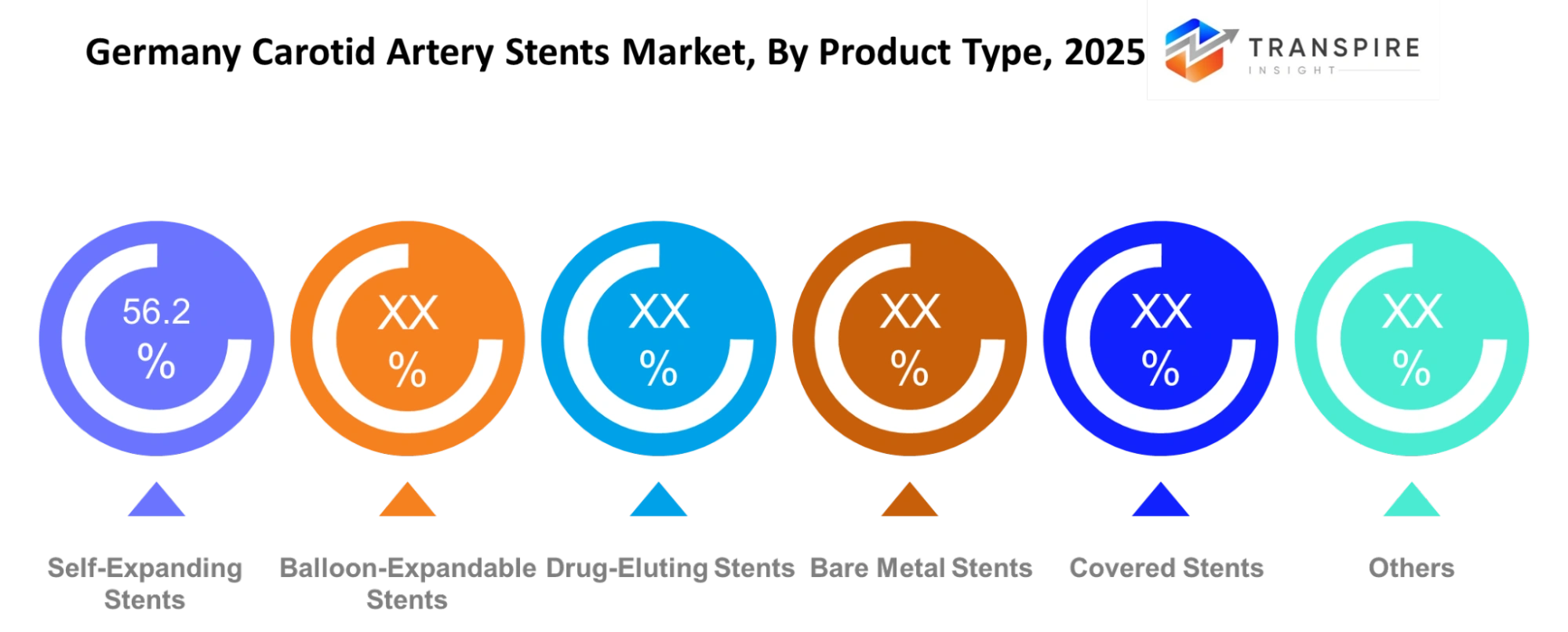
- Self-expanding carotid artery stents are still the main product slice, around 64% market share in 2025, since they offer stronger flexibility and better vessel conformity , in practice.
- Embolic protection devices sit in second place for now, yet the next generation dual-layer mesh stents are expected to post the fastest momentum during the forecast window.
- On the clinical side, stroke prevention procedures take up nearly 72% of total applications, while managing high surgical risk patients is showing up as the quickest-growing clinical use case.
- When it comes to who buys and uses these systems, hospitals stay out front, with roughly 78% market share, and specialized cardiovascular clinics are also ramping up their procedural capabilities across Germany.
- Abbott Laboratories, Boston Scientific, Medtronic, Terumo Corporation, and BIOTRONIK are continuing to reinforce their position by ongoing product innovation, plus clinical evidence work that keeps stacking up.
- Manufacturers are increasingly teaming up with German cardiovascular centers , to test advanced stent platforms, which helps physician adoption and builds procedural confidence.
- More recently, AI-assisted imaging and intravascular visualization, along with upgraded embolic protection technologies have improved procedural precision , lowering complications and encouraging broader clinical usage.
What are the Key Drivers, Restraints, and Opportunities in the Germany Carotid Artery Stents Market?
The main driving force behind the Germany Carotid Artery Stents Market is the ongoing move toward less invasive stroke prevention which is backed by newer clinical evidence, along with improvements in endovascular technology. In practice, better stent designs, enhanced embolic protection systems, and higher resolution imaging tools have pushed physician comfort upward when treating patients who are seen as high risk for carotid endarterectomy. Also Germany’s aging population, plus the rising prevalence of carotid artery disease, keeps lifting procedural counts, so hospitals are more willing to widen their vascular intervention programs and put money into advanced neurovascular equipment—at least that’s what many operators report.
Still, the biggest brake is the very strict patient selection rules set by European clinical guidance and reimbursement frameworks. Carotid artery stenting is generally suggested only for carefully screened patient cohorts, so broad, everyday use stays limited. On top of that, the procedures depend on highly trained interventional doctors and sophisticated imaging infrastructure, which becomes a kind of structural hurdle that cannot be fixed fast. As a result, smaller hospitals often see fewer procedures, and that quietly constrains overall revenue growth.
A real chance shows up when advanced imaging, AI based procedural planning, and next generation dual-layer stent technologies are woven into vascular intervention programs. Some German hospitals are building hybrid operating rooms, and upgrading digital angiography systems, and that combo makes it easier to take on more complicated endovascular work. If clinical research keeps proving better longer term patient outcomes, treatment eligibility could broaden, and adoption among vascular specialists may accelerate over the next few years.
What Has the Impact of Artificial Intelligence Been on the Germany Carotid Artery Stents Market?
Artificial intelligence and newer digital technologies are kind of reshaping carotid artery interventions, mainly by changing how physicians do procedural planning, interpret imaging, and make clinical choices. AI driven software helps doctors automatically spot plaque morphology on CT angiography and magnetic resonance imaging, so patient selection before carotid artery stenting becomes more accurate. At the same time, machine learning algorithms give support for a three-dimensional vascular reconstruction, which makes it easier to fine tune stent sizing and placement, while also lowering procedural variability. During the interventions, more advanced image guidance systems can improve navigation accuracy, and that can shorten procedure times too. In the end, this contributes to reduced radiation exposure and a smoother workflow efficiency.
Hospitals are now increasingly pairing AI enabled imaging platforms with electronic health records, to help forecast procedural risks, approximate stroke probability, and track outcomes after the procedure. Predictive analytics, in addition, support healthcare providers in finding who might need tighter follow-up. That improves long term treatment management and also helps optimize resource utilization. Overall these solutions seem to raise procedural precision, strengthen patient safety, and deliver more consistent clinical outcomes across vascular centers.
Still, AI adoption is not completely straightforward. It is slowed down by high implementation costs, the tricky integration with the existing hospital information systems, and the requirement for big datasets that are clinically validated. On top of that, imaging protocols vary across facilities, and these differences can influence how well the algorithm performs. This, in turn, can slow the wider rollout across Germany’s vascular care network.
Key Market Trends
- Since 2021, German hospitals have been expanding hybrid operating rooms here and there, which in turn, improves access to advanced carotid artery interventions and somehow supports higher procedural efficiency.
- Dual layer mesh stent technologies, have been getting real clinical uptake since 2022, and they tend to deliver better plaque coverage while also reducing embolic complications during the more complex procedures.
- AI assisted vascular imaging is now more and more built into treatment planning, helping with lesion assessment accuracy , and supporting physician decision making in specialized centers.
- Abbott Laboratories, Medtronic, Boston Scientific, BIOTRONIK, and Terumo Corporation have also pushed broader product innovation and physician training initiatives. The goal, is to strengthen competitive positioning, in a pretty straightforward way.
- Embolic protection devices are now basically standard practice across most carotid artery stenting procedures, improving procedural safety and boosting interventional specialists confidence.
- Clinical guideline updates have encouraged more selective patient stratification. This has been linked to better long term procedural outcomes, while still reinforcing evidence based treatment decisions.
- Hospitals have increased investments in digital angiography and intravascular imaging technologies since 2023, which enables more procedural precision and often shorter intervention times.
- Academic medical centers keep participating in multicenter vascular research , accelerating the evaluation of advanced stent technologies, and helping broader clinical adoption take shape.
- Finally, integrated digital workflow platforms have improved procedural documentation, patient monitoring, and multidisciplinary collaboration across Germany’s vascular care ecosystem, overall.
Germany Carotid Artery Stents Market Segmentation
By Product Type
Self-Expanding Stents take the biggest share since their flexible designs kind of adapt to changing vessel anatomy, and they keep steady support after the moment they’re placed. Balloon-Expandable Stents , meanwhile, are favored when you want accurate deployment, especially if a specific lesion location has to be matched very precisely. Drug-Eluting Stents keep getting interest because they reduce tissue growth near the treated zone. Bare Metal Stents still make sense in some clinical settings where well-known treatment protocols are already established , or where simpler scaffolding is enough. Covered Stents help with tougher vascular conditions, where extra shielding is needed for better containment, and Others covers specialized devices built for rarer anatomical requirements.
Product development keeps pushing forward, making devices more pliable, easier to visualize during imaging, and sturdier for long-term durability across basically every product group. Delivery systems are getting better too, so procedures feel simpler and experienced vascular centers can move through treatment more quickly. Clinical preference usually depends on lesion features, patient status, and the physician’s own evaluation, not on just one “best” strategy. Ongoing innovation should help broaden product availability, and it should improve procedural outcomes across healthcare facilities throughout Germany.
By Material
Nitinol is still the preferred choice because shape memory, and flexibility tend to help with dependable expansion inside carotid arteries. Stainless Steel keeps showing up in certain procedures, mainly when mechanical strength and that proven performance really matter more. Cobalt Chromium gives a kind of middle ground, between higher strength and thinner strut design, and that can help with better blood flow after implantation. Polymer-Coated materials also help, with more advanced device performance through improved surface features, while Other categories cover specialized material combinations made for specific clinical needs.
Material selection really changes how flexible things feel, how durable the device stays, how well it can be seen on imaging, and how it performs over the long haul clinically. Manufacturers keep working on material engineering , to lower complications and improve how reliable the procedure is. Research is mostly trying to balance mechanical support with patient safety, across different treatment scenarios. And I guess advanced material technology will keep being an important driver for future product development too.
By Application
Carotid Artery Stenosis is probably the largest use case, because when the carotid vessel gets narrowed there is a real stroke risk , and that usually means timely action is needed. Stroke Prevention stays tightly linked with this segment, since getting blood flow back helps reduce later neurological trouble. Revascularization Procedures support people who need a minimally invasive return of healthy circulation, typically via an endovascular approach. Peripheral Vascular Disease and Others show up too, where similar vascular technologies offer real treatment advantages.
Clinical take up keeps growing, mainly as imaging precision improves, and as procedural skill gets better across specialized hospitals . Earlier recognition helps physicians suggest intervention before complications become serious. Stronger long‑term clinical proof also boosts confidence in minimally invasive vascular treatment. Healthcare providers keep folding these procedures into broader cardiovascular care plans, step by step.
By End User
Hospitals account for the largest share, because advanced imaging equipment, multidisciplinary teams, and emergency care together help manage complex vascular procedures. Cardiac Centers do a substantial number of interventions, run mostly by experienced cardiovascular specialists, and they rely on dedicated catheterization laboratories. Specialty Clinics are still expanding outpatient vascular services for selected patient groups, especially where follow-up care is needed. Ambulatory Surgical Centers slowly increase their involvement in places where the infrastructure fits minimally invasive procedures, while Others covers healthcare institutions that have specialized vascular treatment capabilities.
Healthcare providers keep investing in imaging technology, hybrid operating rooms , and physician training programs. Better coordination between vascular specialists and neurologists leads to tighter treatment planning, and often improved patient outcomes. Expanding specialized treatment centers also boosts procedural availability across different regions. Continued investment should strengthen overall service quality, and it will improve access to advanced vascular care.
By Distribution Channel
Direct Sales are still important because manufacturers keep close relationships with major hospitals , and they also give technical support when a product is being adopted and implemented. Medical Device Distributors also help a lot, since they expand market reach by supplying healthcare facilities across several regions, and they lean on established logistics networks that are already in place. Hospital Procurement usually runs purchasing through organized tender processes , where they stress product quality, clinical effectiveness and cost efficiency, not just the price. Others, well there are alternative procurement arrangements too , like options that fit smaller healthcare providers and specialized treatment centers.
When distribution is efficient, product availability stays high , and that helps ensure vascular procedures keep running without interruptions across the facilities. Manufacturers keep working on supply chain dependability through inventory planning, plus regional partnerships. Procurement decisions now, more and more look at clinical evidence, product support, and long-term service quality alongside pricing. Stable distribution networks will remain key, for making sure access to advanced carotid artery stent technologies stays consistent.
What are the Key Use Cases Driving the Germany Carotid Artery Stents Market?
Treatment of carotid artery stenosis is still the most common reason people act quickly, because restoring blood flow in time helps lower the odds of ischemic stroke. Many big hospitals,plus cardiac centers handle most of these procedures, and they’re supported by advanced imaging equipment, seasoned vascular specialists, and fairly established clinical pathways especially for higher-risk patients
Beyond that, other use cases keep widening too, especially revascularization procedures for people who really can’t undergo standard surgery, and also stroke prevention programs aimed at older adults. In Germany, specialty clinics and dedicated cardiovascular units are doing more follow ups, plus minimally invasive interventions, as the referral web keeps getting better, across regions
Then you have the newer stuff that is starting to appear, like AI-assisted procedural planning, plus image-guided vascular interventions that help with better device selection and more precise placement. Over the forecast period, wider use of hybrid operating rooms, and next generation embolic protection technologies should also make it easier to treat difficult vascular cases more often.
|
Report Metrics |
Details |
|
Market size value in 2025 |
USD 62.0 Million |
|
Market size value in 2026 |
USD 64.5 Million |
|
Revenue forecast in 2033 |
USD 82 Million |
|
Growth rate |
CAGR of 3.49%from 2026 to 2033 |
|
Base year |
2025 |
|
Historical data |
2021 - 2024 |
|
Forecast period |
2026 - 2033 |
|
Report coverage |
Revenue forecast, competitive landscape, growth factors, and trends |
|
Regional scope |
Germany |
|
Key company profiled |
Abbott Laboratories, Boston Scientific, Medtronic, Terumo Corporation, Cardinal Health, Cook Medical, InspireMD, BIOTRONIK, B. Braun, Merit Medical Systems, Cordis, Stryker, BD, W. L. Gore & Associates, MicroPort Scientific. |
|
Customization scope |
Free report customization (country, regional & segment scope). Avail customized purchase options to meet your exact research needs. |
|
Report Segmentation |
By Product Type (Self-Expanding Stents, Balloon-Expandable Stents, Drug-Eluting Stents, Bare Metal Stents, Covered Stents, Others); By Material (Nitinol, Stainless Steel, Cobalt Chromium, Polymer-Coated, Others); By Application (Carotid Artery Stenosis, Stroke Prevention, Revascularization Procedures, Peripheral Vascular Disease, Others); By End User (Hospitals, Cardiac Centers, Specialty Clinics, Ambulatory Surgical Centers, Others); By Distribution Channel (Direct Sales, Medical Device Distributors, Hospital Procurement, Others). |
Which Regions are Driving the Germany Carotid Artery Stents Market Growth?
Southern Germany basically takes the biggest chunk of the market, because Bavaria and Baden-Württemberg have some of the country’s most advanced heart and vessel hospitals, plus university medical centers. There’s solid healthcare funding too, and the uptake of minimally invasive vascular procedures is pretty high, while experienced interventional specialists are easy to access which keeps procedure volumes fairly steady. On top of that, the region is supported by a tight research institution network that cooperates with medical device makers on clinical studies, and also helps with physician training . So in practice, clinical know-how, modern facilities, and ongoing tech adoption kind of lock in the long term regional lead.
Western Germany stays a steady contributor, but its growth doesn’t really mirror the southern area in the same way. North Rhine-Westphalia and Hesse have big urban populations, reimbursement structures that are already well established, and a broad availability of specialized vascular centers, more like service-based expansion rather than research-driven. Old hospital procurement programs and consistent spending on diagnostic imaging also make demand for carotid artery stents more predictable. And there is good collaboration between hospitals, insurers, and cardiovascular specialists, so procedural activity stays reliable across the whole region.
Eastern Germany is expected to show the quickest growth all the way toward 2033 as healthcare modernization programs keep improving access to advanced vascular care. More recently, investments in hospital infrastructure , digital imaging platforms, and hybrid operating rooms have raised the ability to carry out complicated endovascular procedures. In addition, improved referral pathways for stroke prevention, along with more trained vascular specialists, are pushing procedure numbers upward in parts that used to be underserved.
Who are the Key Players in the Germany Carotid Artery Stents Market and How Do They Compete?
Competition still looks moderately consolidated, mostly because only a limited set of multinational medical device companies really have the clinical evidence, the regulatory clearances and the manufacturing know how needed for carotid artery stent technologies. Innovation in tech, real world clinical results, how well physicians are trained, and product dependability, those things continue to matter most, not price by itself. Even now, companies keep putting money into better stent architecture, embolic protection systems, and digital imaging compatibility, basically to boost physician confidence and improve the whole procedural outcome.
Abbott Laboratories tends to stand out with carotid stents combined with embolic protection systems that help enable precise placement and reliable debris capture during the intervention. Medtronic leans into integrated vascular technologies and has widened carotid treatment options via commercial agreements, plus more advanced embolic protection solutions that make the procedures feel more streamlined. Boston Scientific meanwhile pushes its strength through ongoing investment in minimally invasive vascular technology and physician education programs, which in turn encourages broader clinical adoption.
InspireMD sets itself apart with MicroNet mesh technology, meant to reduce plaque prolapse and embolic complications, backed by solid clinical evidence and newer regulatory approvals. BIOTRONIK draws on European engineering experience and close hospital collaboration to support product development and physician training, while Terumo Corporation expands its vascular offering through catheter based intervention technologies and an increasing number of partnerships with cardiovascular treatment centers.
Company List
- Abbott Laboratories
- Boston Scientific
- Medtronic
- Terumo Corporation
- Cardinal Health
- Cook Medical
- InspireMD
- BIOTRONIK
- B. Braun
- Merit Medical Systems
- Cordis
- Stryker
- BD
- W. L. Gore & Associates
- MicroPort Scientific
Recent Development News
In June 2025, InspireMD received U.S. FDA Premarket Approval (PMA) for the CGuard Prime Carotid Stent System. The approval expanded commercial availability of the next-generation carotid stent platform and strengthened competition in advanced stroke prevention technologies.
Source: https://inspiremd.com
In January 2025, Medtronic entered an exclusive distribution agreement with Contego Medical. The agreement expanded Medtronic's carotid artery disease portfolio through commercialization of the Neuroguard IEP System, supporting broader access to integrated embolic protection technology.
Source: https://news.medtronic.com
In June 2026, InspireMD enrolled the first patient in the CGUARDIANS III pivotal study for the SwitchGuard Neuro Protection System. The clinical milestone supports development of next-generation neuroprotection technology for transcarotid artery revascularization procedures and broadens future treatment options.
Source: https://rss.globenewswire.com
What Strategic Insights Define the Future of the Germany Carotid Artery Stents Market?
The market seems to be drifting toward very specialized endovascular stroke prevention, backed by imaging upgrades, embolic defense technologies, and really solid, evidence based ways of picking patients. Hospitals are now expected to lean into integrated vascular systems that link advanced stents, digital imaging, and AI assisted procedural planning, which is why the demand for premium technology is getting stronger, and standard devices are sort of getting left behind. One less visible worry is how innovation is getting concentrated among a small set of manufacturers, this could push pricing pressure up and also reduce supply flexibility, especially if there are production hiccups or regulatory interruptions.
An interesting upside is AI supported procedural planning along with next generation mesh stent technologies, these can sharpen treatment precision while also widening who can qualify for minimally invasive intervention. Companies should keep building partnerships with university hospitals, put real money into physician training, and then create long term clinical data that supports reimbursement choices and also helps them stand out in an increasingly evidence driven healthcare environment.
Germany Carotid Artery Stents Market Report Segmentation
By Product Type
• Self-Expanding Stents
• Balloon-Expandable Stents
• Drug-Eluting Stents
• Bare Metal Stents
• Covered Stents
• Others
By Material
• Nitinol
• Stainless Steel
• Cobalt Chromium
• Polymer-Coated
• Others
By Application
• Carotid Artery Stenosis
• Stroke Prevention
• Revascularization Procedures
• Peripheral Vascular Disease
• Others
By End User
• Hospitals
• Cardiac Centers
• Specialty Clinics
• Ambulatory Surgical Centers
• Others
By Distribution Channel
• Direct Sales
• Medical Device Distributors
• Hospital Procurement
• Others
Frequently Asked Questions
Find quick answers to common questions.
The expected Germany Carotid Artery Stents Market size for the market will be USD 82 Million in 2033.
Key segments for the Germany Carotid Artery Stents Market are By Product Type (Self-Expanding Stents, Balloon-Expandable Stents, Drug-Eluting Stents, Bare Metal Stents, Covered Stents, Others); By Material (Nitinol, Stainless Steel, Cobalt Chromium, Polymer-Coated, Others); By Application (Carotid Artery Stenosis, Stroke Prevention, Revascularization Procedures, Peripheral Vascular Disease, Others); By End User (Hospitals, Cardiac Centers, Specialty Clinics, Ambulatory Surgical Centers, Others); By Distribution Channel (Direct Sales, Medical Device Distributors, Hospital Procurement, Others).
Major Germany Carotid Artery Stents Market players are Abbott Laboratories, Boston Scientific, Medtronic, Terumo Corporation, Cardinal Health, Cook Medical, InspireMD, BIOTRONIK, B. Braun, Merit Medical Systems, Cordis, Stryker, BD, W. L. Gore & Associates, MicroPort Scientific.
The Germany Carotid Artery Stents Market size is USD 62.0 Million in 2025.
The Germany Carotid Artery Stents Market CAGR is 3.49% from 2026 to 2033.
- Abbott Laboratories
- Boston Scientific
- Medtronic
- Terumo Corporation
- Cardinal Health
- Cook Medical
- InspireMD
- BIOTRONIK
- B. Braun
- Merit Medical Systems
- Cordis
- Stryker
- BD
- W. L. Gore & Associates
- MicroPort Scientific
About the Authors

Pankaj Ghogare Patil
I am Pankaj Ghogare Patil, a Senior Research Analyst at Transpire Insight, specializing in the Pharmaceutical, Chemicals & Materials, Healthcare IT, and Biotechnology industry. My expertise lies in conducting comprehensive market research, analyzing industry trends, evaluating competitive landscapes, and translating complex data into actionable insights. At Transpire Insight, I closely follow emerging technologies, regulatory developments, and market innovations to create accurate, well-researched, and informative content that helps businesses and professionals make informed decisions. I am committed to producing credible, evidence-based articles that reflect industry best practices while making technical topics accessible and valuable for a broad audience.

Chakradhar Khansole
Chakradhar serves as the Research Director at Transpire Insight, bringing over 8 years of experience in technology, innovation, and strategic market intelligence. He specializes in transforming complex market data into actionable business insights that enable organizations to make informed, growth-oriented decisions. Recognized for his strategic vision and analytical expertise, Chakradhar leads high-impact research initiatives, delivering comprehensive market assessments, competitive intelligence, and forward-looking industry analysis.
Recently Published Reports
-
Apr 2026
AI in Diabetic Retinopathy Market
AI in Diabetic Retinopathy Market Size, Share & Analysis Report By Type (Screening AI Systems, Diagnostic AI Systems, and Predictive AI Models), By Application Segment (Hospitals, Ophthalmology Clinics, Diagnostic Centers, and Research and Development), and Geography (North America, Europe, Asia-Pacific, Middle East and Africa, South and Central America), 2021 - 2031
-
Apr 2026
Psychometric Tests Market
Psychometric Tests Market Size, Share & Analysis Report By Type (Personality Tests, Ability/Aptitude Tests, Skill/Knowledge Tests, and Others), By Application (Talent Acquisition and Talent Management), and Geography (North America, Europe, Asia-Pacific, Middle East and Africa, South and Central America), 2021 – 2031
-
Apr 2026
Rare Biological Sample Collection Market
Rare Biological Sample Collection Market Size, Share & Analysis Report By Type (Isolation Kits & Reagent, Blood Collection Tubes, and Others), By Application (Oncology, Transcriptomics, Pharmacogenomics, and Others), and Geography (North America, Europe, Asia-Pacific, Middle East and Africa, South and Central America), 2021 – 2031
-
Jul 2026
Diabetic Retinopathy Market
Diabetic Retinopathy Market Size, Share & Analysis Report By Type (Proliferative Diabetic Retinopathy, and Diabetic Macular Edema (DME)), By Treatment Type (Anti VEGF Drug, Steroid Implants, Laser Surgeries, and Vitrectomy), and Geography (North America, Europe, Asia-Pacific, Middle East and Africa, South and Central America), 2021 – 2031
Our Clients







