

Functional Food Ingredient Market Summary:
According to Transpire Insights, a detailed research report on the market reflects that the probiotics application segment dominates the Global Functional Food Ingredient Market, accounting for approximately 31% of the total share worldwide. DSM-Firmenich leads the market with approximately USD 13.9 billion in annual revenue and an estimated 10–14% global market share, making it the leading contributor to global market development, innovation, advanced functional food ingredient production, expanding manufacturing capabilities, and growth dynamics.
Market Snapshot
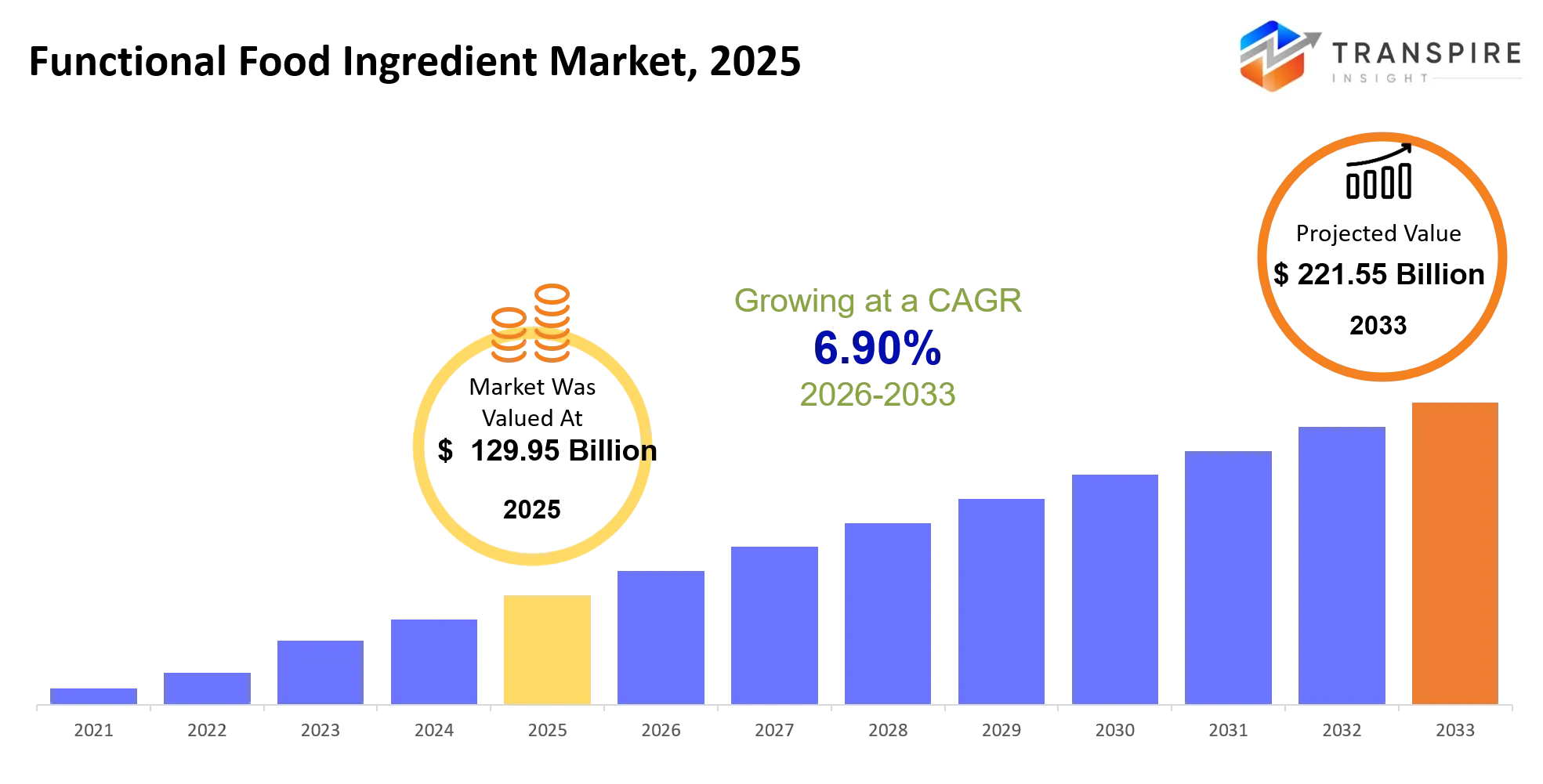
- Market Value (2025): USD 129.95 Billion.
- Expected Market Value (2026): USD 138.91 Billion.
- Estimated Market Value (2033): USD 221.55 Billion.
- Forecast CAGR (2026–2033): 6.90%
- Leading Region in 2025: North America
- Second-largest Region: Asia Pacific
- Fastest Growing Region: Europe
Introduction
Functional food ingredients refer to the use of unique ingredients that have been added to food and beverages to provide some form of health or physiological benefits apart from the basic nutritional values. Examples of such ingredients include probiotics, prebiotics, dietary fibers, plant proteins, vitamins, minerals, omega-3 fatty acids, antioxidants, and other bioactive ingredients that contribute towards good digestion, immunity, heart health, and nutrition. The Functional Food Ingredient Market is expected to grow on account of the rising production of food products that have preventive nutritional attributes, clean label requirements, personalization of well-being, and healthy living. The major applications include functional foods & beverages, nutraceuticals, dietary supplements, sports nutrition, infant nutrition, dairy products, bakery products, and functional beverages.
For instance:-
- North America: Growing consumer demands for functional drinks, probiotics, dietary fibers, and sports nutrition ingredients are encouraging innovation, reformulation of products, clinical trials and validation, and high-end ingredients.
- Europe: Health claim rules along with clean-label preference is motivating investments towards natural, evidence-based, clinically tested and transparent functional food ingredients.
Key Market Highlights: -
- By Ingredient, the Vitamins dominated the market and holds nearly 28.2% share in 2025 and is projected to grow at a substantial CAGR during the forecast period.
- Europe is anticipated to hold nearly 34% share of the Functional Food Ingredient Market over the predicted timeframe.
- Asia Pacific is anticipated to hold roughly30% share of the Functional Food Ingredient Market over the predicted timeframe.
- North America is expected to grow at a rapid CAGR in the Functional Food Ingredient Market by holding around33% of the share during the forecast period.
- By Source, the Plant-based dominated the market and holds close to 28% share in 2025 and is projected to grow at a substantial CAGR during the forecast period.
- By Function, the Multinational Corporations dominated the market and holds about 69.90% share in 2025 and is projected to grow at a substantial CAGR during the forecast period.
- The food processing schemes in India are enhancing infrastructure, value addition processing, cold chain facilities, microenterprise creation, and innovative food manufacturing, setting good conditions for functional food ingredients.
How is Technology Driving Growth in the Functional Food Ingredient Market?
These factors are contributing significantly to the growth of the Functional Food Ingredient market through advances in ingredient stability, bioavailability, extraction, and formulation efficiency. Micro-encapsulation and controlled delivery systems ensure that probiotics, vitamins, omega-3s, and other bioactive substances are protected throughout manufacturing and distribution. Precision fermentation offers a means of producing specialized proteins and enzymes, and artificial intelligence (AI)-enabled formulations make sure ingredients work well together. Enhanced extraction techniques produce more pure botanical-based ingredients, and high pressure processing technology aids in the preservation of heat sensitive nutrients.
|
Report Metrics |
Details |
|
Market size value in 2025 |
USD 129.95 Billion |
|
Market size value in 2026 |
USD 138.91 Billion |
|
Revenue forecast in 2033 |
USD 221.55 Billion |
|
Growth rate |
CAGR of 5.76%from 2026 to 2033 |
|
Base year |
2025 |
|
Historical data |
2021 - 2024 |
|
Forecast period |
2026 - 2033 |
|
Report coverage |
Revenue forecast, competitive landscape, growth factors, and trends |
|
Regional scope |
United States; Canada; Mexico; United Kingdom; Germany; France; Italy; Spain; Denmark; Sweden; Norway; China; Japan; India; Australia; South Korea; Thailand; Brazil; Argentina; South Africa; Saudi Arabia; United Arab Emirates |
|
Key company profiled |
Cargill, ADM, Kerry Group, DSM-Firmenich, Ingredion, Tate & Lyle, Chr. Hansen, Givaudan, BASF, DuPont, Roquette, Glanbia, Lonza, IFF, Arla Foods Ingredients |
|
Customization scope |
Free report customization (country, regional & segment scope). Avail customized purchase options to meet your exact research needs. |
|
Report Segmentation |
By Ingredient (Probiotics, Prebiotics, Vitamins, Minerals, Proteins, Omega Fatty Acids, Fibers, Others); By Source (Plant-based, Animal-based, Microbial, Synthetic, Marine, Fermented, Organic, Others); By Function (Digestive Health, Immune Health, Heart Health, Bone Health, Weight Management, Energy, Cognitive Health, Others); By Application (Food, Beverages, Dietary Supplements, Infant Nutrition, Sports Nutrition, Clinical Nutrition, Animal Nutrition, Others); By Form (Powder, Liquid, Granules, Capsules, Tablets, Gel, Emulsion, Others); By Product Type (Functional Dairy, Functional Bakery, Functional Beverages, Functional Snacks, Functional Cereals, Functional Confectionery, Functional Meat, Others); By End User (Food Manufacturers, Beverage Manufacturers, Nutraceutical Companies, Pharmaceutical Companies, Sports Nutrition Companies, Infant Nutrition Companies, Retailers, Others) |
Market Drivers
Factors fueling growth in the Functional Food Ingredient Market include the rising consumer preference for preventive nutrition, aging well, and wellness-based food options. Rising concern among consumers about their health due to their lifestyles is fueling the demand for health benefits such as improved digestive health, immunity, cardiovascular and metabolic health from functional food ingredients. The increasing number of aged people is also contributing to a growing demand for nutritious and specialized functional foods. In addition, clean label, natural, and plant-based trends are also impacting the choice of ingredients used in products.
For instance:-
Asia-Pacific: Fast consumer adoption rate, functional food tradition, probiotics intake and growth of wellness markets are stimulating innovation in beverages, dairy, supplements, and fortified foods with functional food ingredients.
Latin America: Increasing consumer demands for energy, physical performance, mental well-being, vitamins, proteins, antioxidants, and ingredient transparency are presenting opportunities in formulation of functional foods.
Restrain
High manufacturing cost, high research & development expenditure, and stringent requirement for health claim substantiation could be some of the factors that could hinder the Functional Food Ingredients market. High cost of developing new technologies and regulatory compliance adds to the development cost of these products as well as delays their commercialization process. Variations in regional regulations could add another barrier in the market. In addition to all this, consumers’ focus on added sugar, salt, artificial and heavily processed foods may impact their purchase decisions.
|
Driver |
Relative Impact on Growth (%) |
Geographic Relevance |
Impact Timeline |
Demand Strength |
Growth Mechanism |
Key Beneficiaries |
Major Constraint |
|
Driver 1: Rising Consumer Demand for Gut Health and Immunity Ingredients |
28% |
North America, Europe, Asia Pacific |
Short-term |
High |
Expands probiotic, prebiotic, fiber, and postbiotic adoption |
Ingredient manufacturers, food brands, nutraceutical companies |
Clinical substantiation and formulation stability challenges |
|
Driver 2: Growing Demand for Clean-Label and Plant-Based Functional Ingredients |
22% |
Europe, North America, Asia Pacific |
Medium-term |
High |
Accelerates natural, minimally processed, plant-derived ingredient incorporation |
Plant ingredient suppliers, food manufacturers, formulation specialists |
Higher costs and inconsistent raw-material availability |
|
Driver 3: Expansion of Functional Foods for Personalized and Preventive Nutrition |
19% |
North America, Europe, Asia Pacific |
Long-term |
High |
Enables targeted formulations addressing individual nutritional requirements |
Functional food producers, nutrition platforms, ingredient developers |
Limited consumer data and personalized formulation complexity |
|
Driver 4: Advancements in Fermentation and Bio-Based Ingredient Technologies |
17% |
Europe, North America, Asia Pacific |
Long-term |
Medium |
Improves scalable production of proteins, enzymes, cultures, and specialty ingredients |
Fermentation companies, ingredient innovators, technology providers |
Scale-up costs and regulatory approval requirements |
|
Driver 5: Regulatory Support for Scientifically Substantiated Functional Ingredients |
14% |
Europe, North America |
Medium-term |
Medium |
Encourages evidence-backed ingredients and compliant health-positioned products |
Ingredient manufacturers, food companies, regulatory consultants |
Stringent evidence and health-claim compliance requirements |
Analysis of Prices and Consumer Behaviour
Functional Food Ingredient Market consists of high-quality and standardized functional ingredients (accounting for 68% of the entire market; mainly because of the demands coming from dietary supplement, functional food, and nutraceutical industries). A functional ingredient of high purity and standardization is expected to cost 35% higher than other products since such ingredients are processed using high technologies, quality-controlled production, and standardized functional potency. 45% of the total units of functional food ingredients sold are sold in the powdered form. Such sales volumes can be explained by the flexibility of powder forms as well as their longer shelf life. Nutraceuticals and functional food industries account for around 70% of demands from these industries. Consumer purchasing behavior indicates that 55% of consumers give preference to those products which demonstrate higher functional potency and purity along with standardized formulation. Another 33% of consumers choose to buy their products through bulk buying or long-term contracts because of the desire to lower procurement costs and ensure continuous supply for their customers located in various parts of the world.
|
Company |
Est. Revenue Share Range |
Key Offerings |
Strategic Positioning |
Geographic Strength |
Technology Focus |
|
DSM-Firmenich AG |
4–7% |
Vitamins, minerals, carotenoids, probiotics, enzymes |
Science-led nutrition portfolio diversification |
Europe, North America, Asia Pacific |
Microbiome science, fermentation, nutritional bioscience |
|
Kerry Group plc |
3–5% |
Proteins, soluble fiber, enzymes, nutritional lipids |
Integrated nutrition and formulation solutions |
Europe, North America, Asia Pacific |
Enzyme technology, nutrition science, formulation platforms |
|
Archer Daniels Midland Company (ADM) |
3–5% |
Prebiotics, probiotics, postbiotics, fibers, botanicals |
Broad functional nutrition and formulation ecosystem |
North America, Europe, Asia Pacific |
Microbiome science, clinical validation, ingredient systems |
|
Ingredion Incorporated |
2–4% |
Dietary fibers, specialty starches, plant proteins, sweeteners |
Texture and nutrition-focused ingredient innovation |
North America, Latin America, Asia Pacific |
Specialty carbohydrates, fiber technology, formulation science |
|
Tate & Lyle PLC |
2–4% |
Prebiotic fibers, soluble fiber, polydextrose, sweetening systems |
Fiber-led health and sugar-reduction specialization |
Europe, North America, Asia Pacific |
Precision prebiotics, fiber science, carbohydrate technology |
|
Cargill Incorporated |
2–4% |
Plant proteins, fibers, omega-3s, phytosterols, postbiotics |
Vertically integrated nutrition ingredient supply |
North America, Europe, Latin America |
Protein processing, fiber systems, ingredient analytics |
|
Glanbia plc |
1.5–3% |
Whey proteins, milk proteins, sports nutrition ingredients |
Premium protein and specialized nutrition leadership |
North America, Europe, Asia Pacific |
Protein fractionation, nutritional formulation, bioactive research |
|
Corbion N.V. |
1–2.5% |
Functional blends, omega-3 algae, fortification, preservation |
Fermentation-driven specialty ingredient differentiation |
Europe, North America, Latin America |
Fermentation, algae biotechnology, natural preservation |
|
International Flavors & Fragrances Inc. (IFF) |
1–2.5% |
Probiotics, cultures, enzymes, fibers, specialty ingredients |
Bioscience-led functional ingredient innovation |
North America, Europe, Asia Pacific |
Biotechnology, fermentation, enzymes, microbial cultures |
|
Kemin Industries Inc. |
1–2% |
Botanical extracts, antioxidants, functional systems, specialty nutrients |
Specialty health ingredient and botanical differentiation |
North America, Europe, Asia Pacific |
Botanical science, bioactive extraction, formulation technology |
Who are the Key Players in the Functional Food Ingredient Market and how do they compete?
The competitiveness of companies within the international Functional Food Ingredient Market is determined by the companies specializing in technology innovations, solutions oriented to food and nutrition applications, and distribution network development on the international level. Competing not only in terms of prices but also on the basis of highly effective ingredients, cutting-edge technologies of production, scientifically backed formulations, and supply solutions, this kind of competition approach implies constant product development, and allows for achieving higher functionality, formulation efficiency, optimization of resources and scalability of operations.
Using innovative functional ingredients, advanced formulation solutions, and specialized nutritional technologies, Deere & Company improves its market position. Using the development of high-performance functional food ingredients for nutritional, wellness, food, beverage and dietary supplement applications, CNH Industrial distinguishes itself from other companies. AGCO Corporation builds its market position on the basis of integrated solutions in functional food ingredients, nutritional formulations, advanced processing and ingredient innovations, helping food producers to improve their formulation efficiency.
Top Companies in the Functional Food Ingredient Market
- Cargill
- ADM
- Kerry Group
- DSM-Firmenich
- Ingredion
- Tate & Lyle
- Chr. Hansen
- Givaudan
- BASF
- DuPont
- Roquette
- Glanbia
- Lonza
- IFF
- Arla Foods Ingredients
|
Investment Factor |
Why It Matters to Investors |
Opportunity |
Investment Implication |
|
Gut Health & Microbiome Nutrition |
Strong consumer focus supports sustained demand for specialized ingredients |
Probiotics, prebiotics, postbiotics, synbiotics |
Invest in clinically supported microbiome ingredient platforms |
|
Clean-Label & Plant-Based Ingredients |
Reformulation toward natural ingredients creates premium product opportunities |
Plant proteins, botanical extracts, natural fibers, functional lipids |
Prioritize scalable, clean-label ingredient manufacturing |
|
Precision Fermentation & Biotechnology |
Advanced production improves ingredient functionality and formulation flexibility |
Fermentation-derived proteins, enzymes, cultures, bioactives |
Build technology partnerships and differentiated production capabilities |
|
Functional Fiber & Metabolic Health |
Digestive, satiety, and metabolic wellness expand application opportunities |
Soluble fibers, resistant starches, specialty oligosaccharides |
Target high-value ingredients with evidence-backed functionality |
|
Asia Pacific Expansion |
Urbanization and evolving nutrition preferences broaden regional consumption |
Functional beverages, fortified foods, specialized nutrition |
Establish localized manufacturing and distribution partnerships |
|
Science-Backed Premium Ingredients |
Clinical validation strengthens differentiation and supports premium positioning |
Clinically substantiated probiotics, bioactives, nutritional compounds |
Allocate capital toward R&D, clinical evidence, and regulatory expertise |
Airport Quick Service Restaurant (QSR) Market Segmentation
The Functional Food Ingredient Market share is divided into seven categories: By Ingredient, By Source, By Function, By Application, By Form, By Product Type, By End User
The Vitamins dominated the market, accounting for nearly 28.2% in 2025 and is expected to rise at a significant CAGR during the forecast period.
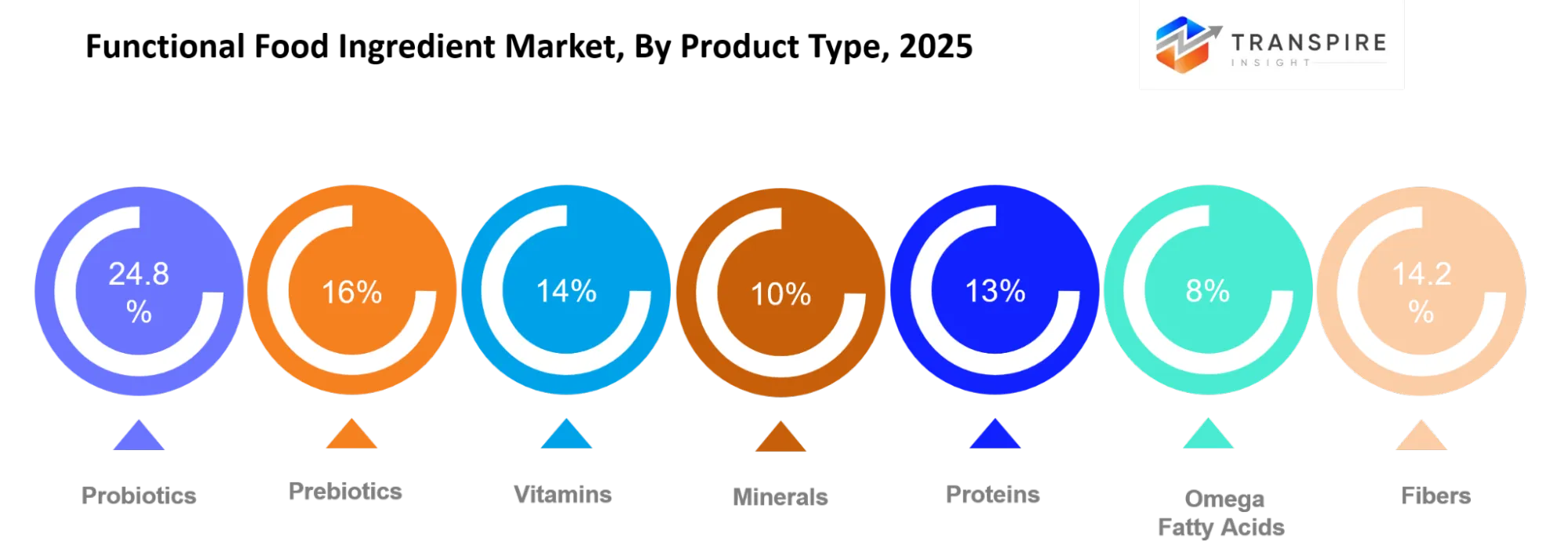
The Functional Food Ingredient Market is by ingredient into probiotics, prebiotics, vitamins, minerals, proteins, omega fatty acids, fibers, others. Among these, the Vitamins dominated the market, accounting for nearly 28.2% in 2025 and expected to increase at a significant CAGR during the forecast period. Vitamins held the highest market share of almost 28.2% in 2025 due to their high usage in fortified food products, drinks, dietary supplements, and nutritional formulations.
The Plant-based dominated the market, accounting for close to 28% in 2025, and is expected to rise at a significant CAGR during the forecast period
The Functional Food Ingredient Market is segmented by source into plant-based, animal-based, microbial, synthetic, marine, fermented, organic, others. Among these, the Plant-based dominated the market, accounting for close to 28% in 2025 and expected to increase at a significant CAGR during the forecast period. Plant-based ingredients held the largest market share of approximately 28% in 2025 due to the increasing requirement for clean label, sustainable, and natural functional ingredients.
The Digestive Health dominated the market, accounting for about 34% in 2025 and is expected to rise at a significant CAGR during the forecast period.
The Functional Food Ingredient Marketby function into digestive health, immune health, heart health, bone health, weight management, energy, cognitive health, others. Among these, theMultinational Corporations dominated the market, accounting for about 69.90% in 2025 and expected to increase at a significant CAGR during the forecast period. Digestive health ingredients held the largest market share of around 34% in 2025 due to the increasing intake of probiotics, prebiotics, and dietary fibers across the globe.
Regional Segment Analysis of the Functional Food Ingredient Market
- Europe (Germany, France, U.K., Italy, Spain, Rest of Europe)
- North America (U.S., Canada, Mexico)
- Asia-Pacific (China, Japan, India, Rest of APAC)
- South America (Brazil and the Rest of South America)
- The Middle East and Africa (UAE, South Africa, Rest of MEA)
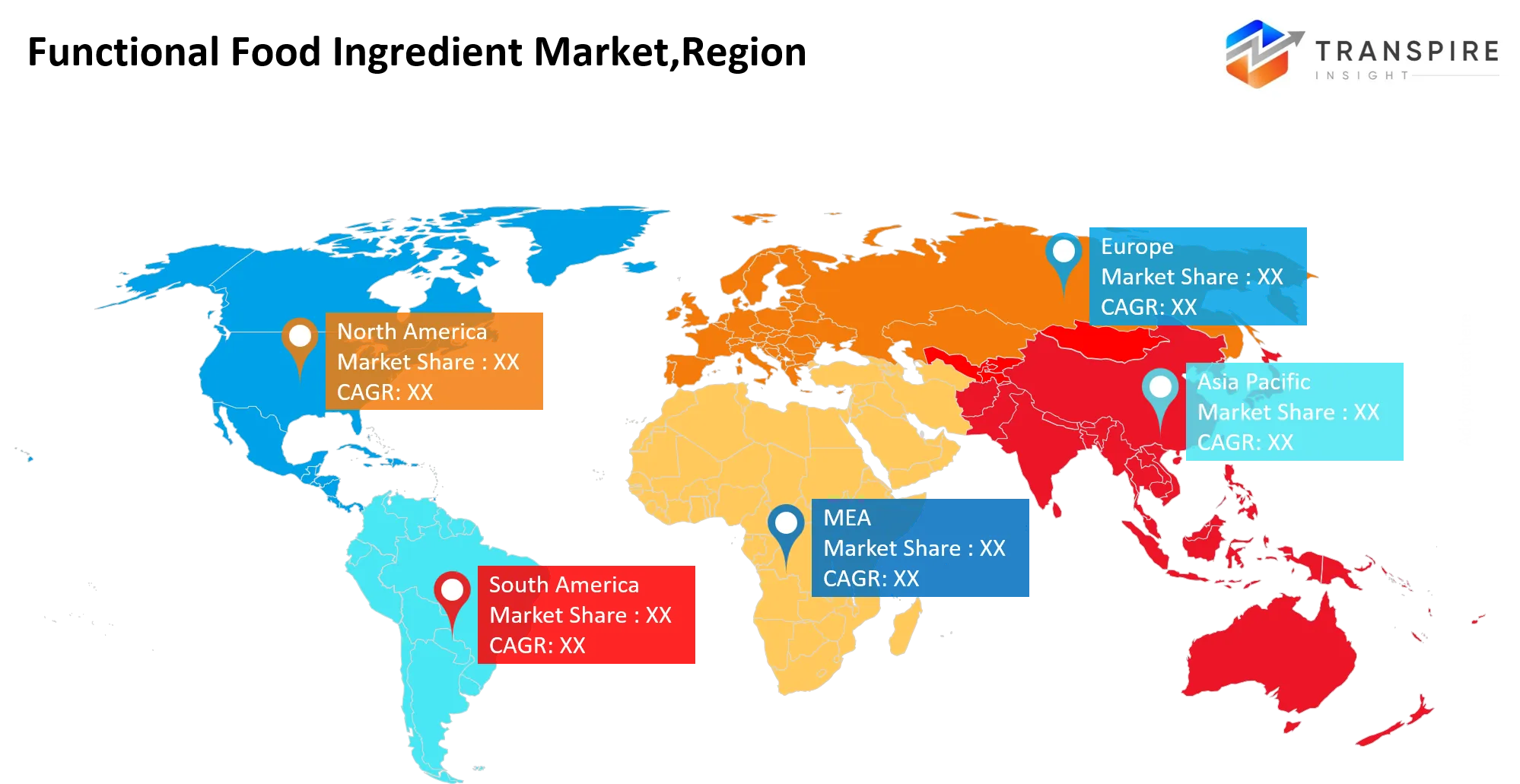
North America is expected to grow at a rapid CAGR in the Functional Food Ingredient Market, holding around 33% of the share during the forecast period.
North America is expected to hold the dominant market share in the Functional Food Ingredient Market due to the high consumer demand for preventive nutrition, digestive health, immunity, and healthy aging solutions. North America has advanced food processing facilities, active research & development activities, presence of functional food ingredient companies, as well as high adoption of functional drinks, dietary supplements, fortified foods, and sports nutrition products.
Asia Pacific is the high-growth region in the Functional Food Ingredient Market during the period, holding roughly 30% share.
The Asia Pacific region is estimated to evolve as one of the high-growth regions for the Functional Food Ingredient Market on the back of rising health consciousness, expansion of middle class population, urbanization, and rising demand for healthy and convenient food products. Rising consumption of functional beverages, fortified foods, probiotics, plant-based ingredients, and dietary supplements is boosting market prospects in the region. Growth in food processing industry, investments in biotechnology and ingredient innovation, changing consumer preferences, and improvements in the distribution network are further driving market growth in Asia Pacific.
Europe is the fastest-growing region in the Functional Food Ingredient Market during the period, holding nearly 28% share.
Europe is estimated to remain a fast-growing region for the Functional Food Ingredient Market due to high consumer preference towards clean label, natural, plant-based, and science-backed nutritional products. The region’s strong demand for probiotics, dietary fibers, vitamins, minerals, and functional beverages is driving product innovation. The region’s strong infrastructure for food processing, presence of major ingredient companies, stringent quality requirements, preventive nutrition awareness, and ongoing research on bioactive ingredients are further boosting market growth in Europe.
Strategies for Market Growth in Non-Leading Regions:
Developments of the non-leading areas by means of efficient and effective methods of production and processing of functional food ingredients will be of great benefit to small and medium sized food and ingredient processors. Efficient production and processing of locally-sourced plant based proteins, dietary fibers, probiotics, prebiotics, vitamins, minerals, and botanicals will ensure reduction in import dependence and improve production efficiency. Strategic alliances between the regional farmers, ingredient manufacturers, food & beverages companies, nutraceuticals producers and distributors will enhance market penetration and availability of functional food ingredients. Technical training on formulation, processing, quality control and standardization of the functional food ingredients will also be essential to improve knowledge on functional ingredients. Besides, flexibility in funding, long-term supply and contract manufacturing will make the functional food ingredients more affordable and hence encourage their usage. Collaborative programs among the government, agricultural, biotechnological and food processing industries along with e-commerce sales will increase the accessibility of the functional food ingredients.
Future Market Trends for the Functional Food Ingredient Market: -
Nutrition Personalization & Precision: AI and nutrigenomics are allowing targeted functional nutrition, thus offering chances to formulate personalized ingredients and foods.
Next Generation Probiotics, Prebiotics, Synbiotics, Plant Proteins, Botanicals, & Adaptogens: Strain-specific probiotics, prebiotics, synbiotics, plant-based proteins, botanicals, and adaptogens are finding acceptance in functional foods and beverages.
Advanced Delivery Systems & Functional Beverages: Advanced delivery systems such as microencapsulation and nanoencapsulation along with functional beverages create more demand for electrolytes, antioxidants, vitamins, and botanical ingredients.
Recent Development
In January–March 2026: Expansion in GOFOS capacity by Galam was achieved, while FrieslandCampina Ingredients increased capacity at Borculo for whey protein isolates and milk fat globule membranes.
In April–May 2026: Kerry Group started an expansion of its biotechnology facility in Ireland, while Vidya opened its probiotic manufacturing facility in Florida and FrieslandCampina invested €90 million for whey protein production.
Market Segment
This study forecasts revenue at global, regional and country levels from 2020 to 2033. Transpire Insights has segmented the Functional Food Ingredient Market based on the below-mentioned segments:
Functional Food Ingredient Market, By Ingredient
- Probiotics
- Prebiotics
- Vitamins
- Minerals
- Proteins
- Omega Fatty Acids
- Fibers
- Others
Functional Food Ingredient Market, By Source
- Plant-based
- Animal-based
- Microbial
- Synthetic
- Marine
- Fermented
- Organic
- Others
Functional Food Ingredient Market, By Function
- Digestive Health
- Immune Health
- Heart Health
- Bone Health
- Weight Management
- Energy
- Cognitive Health
- Others
Functional Food Ingredient Market, By Application
- Food
- Beverages
- Dietary Supplements
- Infant Nutrition
- Sports Nutrition
- Clinical Nutrition
- Animal Nutrition
- Others
Functional Food Ingredient Market, By Form
- Powder
- Liquid
- Granules
- Capsules
- Tablets
- Gel
- Emulsion
- Others
Functional Food Ingredient Market, By Product Type
- Functional Dairy
- Functional Bakery
- Functional Beverages
- Functional Snacks
- Functional Cereals
- Functional Confectionery
- Functional Meat
- Others
Functional Food Ingredient Market, By End User
- Food Manufacturers
- Beverage Manufacturers
- Nutraceutical Companies
- Pharmaceutical Companies
- Sports Nutrition Companies
- Infant Nutrition Companies
- Retailers
- Others
Functional Food Ingredient Market, By Regional Analysis
North America
- US
- Canada
- Mexico
Europe
- Germany
- UK
- France
- Italy
- Spain
- Russia
- Rest of Europe
Asia Pacific
- China
- Japan
- India
- South Korea
- Australia
- Rest of Asia Pacific
South America
- Brazil
- Argentina
- Rest of South America
Middle East & Africa
- UAE
- Saudi Arabia
- Qatar
- South Africa
- Rest of the Middle East & Africa
Frequently Asked Questions
Find quick answers to common questions.
Rising preventive nutrition awareness, clean-label preferences, healthy aging, microbiome solutions, and demand for functional beverages are accelerating ingredient adoption globally.
Probiotics, prebiotics, dietary fibers, plant proteins, vitamins, minerals, omega-3 fatty acids, botanicals, and bioactive compounds are gaining significant attention.
Microencapsulation, precision fermentation, advanced extraction, stabilization, and AI-assisted formulation are improving ingredient bioavailability, stability, functionality, and application performance.
North America remains a major market, while Asia Pacific offers substantial growth opportunities through rising health awareness, urbanization, and expanding food industries
High production costs, stringent regulatory requirements, clinical substantiation, complex supply chains, and consumer scrutiny of formulations remain significant industry challenges.
- Cargill
- ADM
- Kerry Group
- DSM-Firmenich
- Ingredion
- Tate & Lyle
- Chr. Hansen
- Givaudan
- BASF
- DuPont
- Roquette
- Glanbia
- Lonza
- IFF
- Arla Foods Ingredients
About the Authors

Chetan Dhatrak
I’m Chetan Dhatrak, a Senior Research Analyst at Transpire Insight, specializing in the Consumer Goods, Foods and Beverages industry. I focus on analyzing market trends, consumer behavior, competitive landscapes, and industry developments to deliver accurate, data-driven insights. My research at Transpire Insight is built on credible sources and in-depth analysis, helping businesses and readers better understand market dynamics, emerging opportunities, and evolving consumer preferences. I’m committed to creating reliable, well-researched content that supports informed decision-making and reflects the latest developments in the consumer goods and food & beverage sectors.

Chakradhar Khansole
Chakradhar serves as the Research Director at Transpire Insight, bringing over 8 years of experience in technology, innovation, and strategic market intelligence. He specializes in transforming complex market data into actionable business insights that enable organizations to make informed, growth-oriented decisions. Recognized for his strategic vision and analytical expertise, Chakradhar leads high-impact research initiatives, delivering comprehensive market assessments, competitive intelligence, and forward-looking industry analysis.
Recently Published Reports
-
Apr 2026
Baby Infant Formula Market
Baby Infant Formula Market Size, Share & Analysis Report By ype (Infant Milk, Follow On Milk, Specialty Baby Milk, Growing-Up Milk), By Ingredient (Carbohydrate, Fat, Protein, Minerals, Vitamins, and Others), By Product Form (Powder, Liquid, and Ready-to-feed), By Distribution Channels (Supermarket/Hypermarket, Specialty Store, Pharmacies, Online Retail, and Others), and Geography (North America, Europe, Asia-Pacific, Middle East and Africa, South and Central America), 2021 - 2031
-
Apr 2026
Edible Insects for Animal Feed Market
Edible Insects for Animal Feed Market Size, Share & Analysis Report By Type (Insect Powder, Insect Meal, Insect Bar, Insect Paste, Insect Oil, and Others), By Insect Type (Beetles, Cricket, Caterpillar, Hymenoptera, Orthoptera, Tree Bugs, and Others), By Application (Livestock, Pet Food, and Aquaculture), By Livestock Type (Poultry, Swine, and Others), and Geography (North America, Europe, Asia-Pacific, Middle East and Africa, South and Central America), 2021 - 2031
-
Apr 2026
Food Industry Disinfection and Bacterial Control Market
Food Industry Disinfection and Bacterial Control Market Size, Share & Analysis Report By Type (Chemical Disinfectants, Physical Disinfectants, and Biocides and Antimicrobials), By Application (Food Processing Equipment Surface Disinfection, Food Preparation Areas Surface Disinfection, Storage Areas Surface Disinfection, Anti-microbial Coatings Food Preservation, and Preservative Solutions Food Preservation), By End User (Meat and Poultry Processing, Dairy Processing, Seafood Processing, Bakery and Confectionery, Restaurants and Commercial Kitchens, and Food Service Providers), By Sales Channel (Online, Offline), and Geography (North America, Europe, Asia-Pacific, Middle East and Africa, South and Central America), 2021 - 2031
-
May 2026
Freeze Dried Food Market
Freeze Dried Food Market Size, Share & Analysis Report By Product Type (Fruits, Vegetables, Freeze-Dried Dairy Products, Freeze-Dried Meat and Seafood, Freeze-Dried Pet Food, and Prepared Meal), By Nature (Organic, and Conventional), By Form (Powdered, Granules, and Diced), By End Use (Breakfast Cereals, Dairy Products, Bakery & Confectionery, Nutritional Bars & Supplements, Powdered Beverages, Snacks, and Retail (Household)), and Geography (North America, Europe, Asia-Pacific, Middle East and Africa, South and Central America), 2021 - 2031