

Middle East and Africa Probiotics in Animal Feed Market Summary
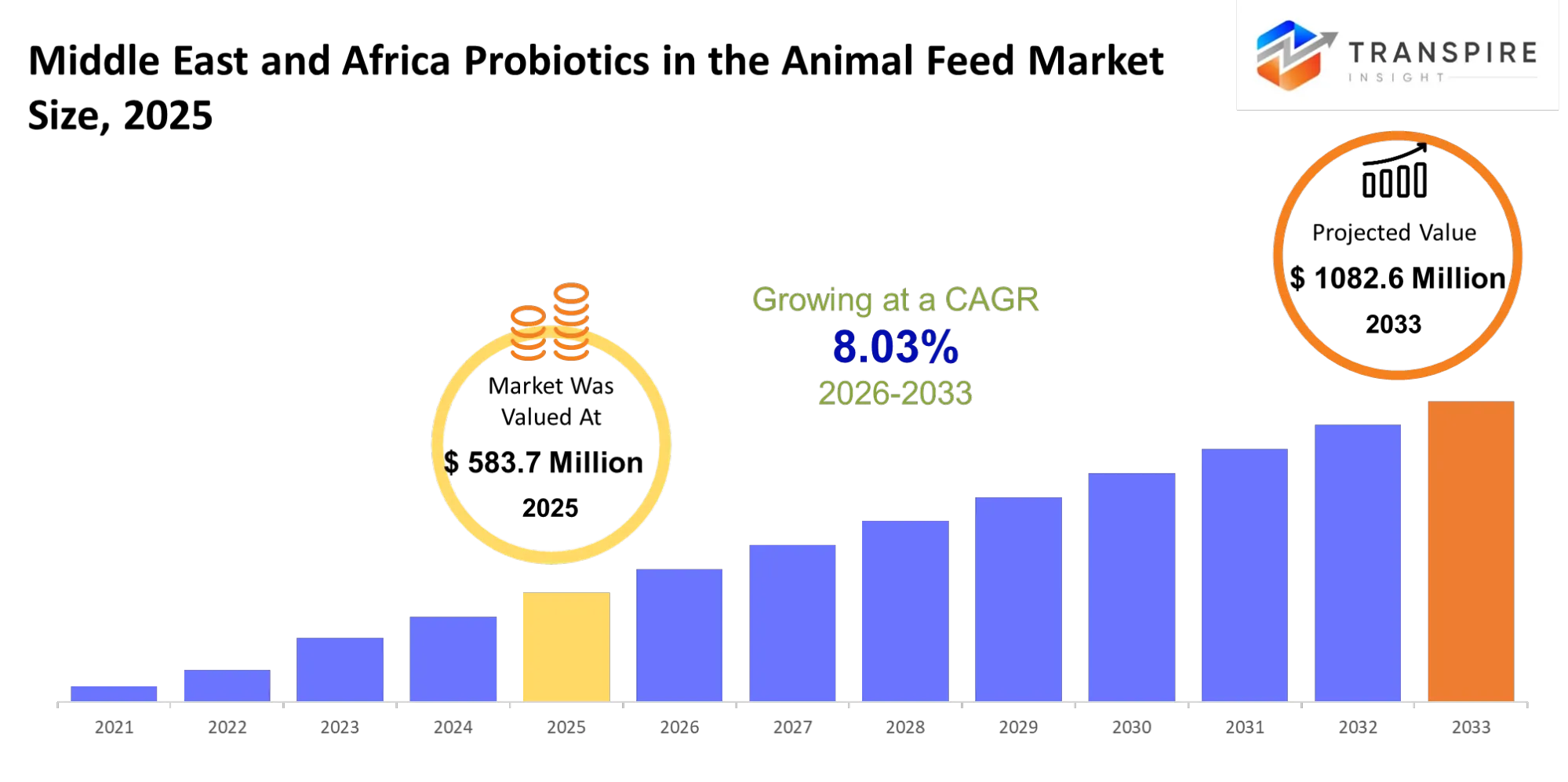
As per Transpire Insight Analysis the Middle East and Africa Probiotics in Animal Feed Market size is estimated at USD 583.7 Million in 2025 and is anticipated to reach USD 1082.6 Million by 2033, growing at a CAGR of 8.03% from 2026 to 2033.
In the Middle East and Africa Probiotics in Animal Feed market, these probiotic products kinda play a key role in improving livestock gut health, while also helping with feed conversion efficiency and building sturdier disease resistance. At the same time, they lower reliance on antibiotic growth promoters, a change that many producers are watching closely.Feed manufacturers plus commercial livestock producers are more often choosing probiotic formulations, not only to push productivity but also to help keep the herd stable and aligned with changing food safety rules. Over the last five years, you can see a kind of structural movement toward antibiotic free animal nutrition , mainly because regulations around antimicrobials tightened, and export quality expectations got stricter too.
Then, COVID-19 came along and with it, global disruptions in feed ingredient supply , plus uneven availability. That situation nudged producers toward more biologically efficient feed additives, so animals keep performing well even when input costs get shaky. As poultry, aquaculture, and dairy segments modernize across the Middle East and Africa, probiotic supplementation supports producers in reducing vet spend, improving how well feed is used, and raising production consistency. The economic outcomes are measurable, which is likely why companies are moving faster into broader, commercial adoption, driving steady recurring demand for higher quality feed recipes and backing long term market revenue growth.
Middle East and Africa Probiotics in Animal Feed Market Size & Forecast:
- Middle East and Africa Probiotics in Animal Feed Market Size 2025: USD 583.7 Million
- Expected Market Value 2033: USD 1082.6 Million
- Forecast CAGR: 8.03%
- Leading region in 2025:
- Fastest Growing region:
- Key Profile: DSM-Firmenich, Chr. Hansen, Evonik, ADM, Cargill, Novonesis, Kemin Industries, Lallemand, Alltech, BioChek, Novus International, Biomin, Phileo by Lesaffre, Adisseo, Elanco
Key Market Insights
- The Middle East and Africa Probiotics in Animal Feed market is projected to hit around USD 1,082.6 million by 2033 , while continued investment in advanced feed nutrition keeps pushing demand.
- In 2025, the Middle East leads the regional landscape with an estimated 58% market share , and that s mostly tied to commercial poultry as well as dairy industries that do not slow down.
- Africa is expected to see the quickest rise through 2033, largely because poultry production is expanding and feed manufacturing capacity is getting built out, bit by bit, in more places.
- Lactobacillus probiotics hold close to 31% of the market share, staying the main microorganism group thanks to well documented digestive health advantages.
- Bacillus probiotics sit as the second largest segment due to stronger heat stability during feed processing , which producers really care about.
- Multi strain probiotics are forecast to grow the fastest from 2026 to 2033, as manufacturers try to cover wider microbial functionality rather than just one mechanism.
- When it comes to application , poultry feed is still the biggest share at roughly 42% of regional demand, largely supported by intensive broiler production.
- Aquaculture feed is emerging as the fastest-growing use case , and that momentum comes from higher investments in sustainable fish farming across African economies.
- For end users, commercial livestock producers remain the largest group, contributing about 65% of revenue , while integrated feed mills keep expanding at a rapid pace.
- Key players such as DSM-Firmenich, Novonesis, Cargill, ADM, Evonik, and Alltech are working on competitiveness through strain upgrades, regional collaborations, manufacturing expansion, and precision nutrition technologies , which is kind of becoming the standard playbook.
What are the Key Drivers, Restraints, and Opportunities in the Middle East and Africa Probiotics in Animal Feed Market?
One of the major factors driving the market, is the shift away from routine antibiotic growth promoters in commercial livestock production, and honestly it feels like that’s the part everyone keeps coming back to. As regulatory restrictions tighten around antimicrobial use, and export markets also start insisting on safer animal products, feed manufacturers have been pushed to blend probiotic formulations into normal feed programs. Poultry integrators and dairy producers are increasingly coming to see that improved gut microbiota supports better feed conversion, reduced mortality, and steadier overall production results. Those day to day operational improvements then translate into farm profitability, and they also create recurring income for probiotic suppliers via long term feed contracts.
Still the main challenge remains the elevated cost and the technical hassle tied to probiotic formulation, stabilization and distribution. Keeping the microorganisms alive and active through manufacturing, storage, and shipping means specialized production methods and tightly managed logistics, which are still not widely available in several African countries. A lot of small scale livestock producers, when it comes down to it, tend to choose cheaper feed additives, even if the biological effect is lower, and that structural reality naturally slows adoption. In fragmented agricultural markets this can reduce momentum further, and as a result revenue growth gets held back.
A noticeable opportunity is widening probiotic usage in fast growing aquaculture sectors and in integrated poultry industries across countries like Egypt, Saudi Arabia, South Africa and Nigeria. When investments move toward modern feed mills, precision livestock farming, and functional nutrition, it sets up pretty favorable conditions for advanced microbial feed additives.
What Has the Impact of Artificial Intelligence Been on the Middle East and Africa Probiotics in Animal Feed Market?
Artificial intelligence is messing with how probiotics get made and how livestock are fed, mostly by tweaking microbial strain choice, feed design, and overall production output. Basically, machine learning models look at genomic information, fermentation results, and also animal health logs, so they can pick probiotic strains that stay stable longer, and still deliver stronger digestive performance. At the same time, manufacturers are leaning more on automation for fermentation control, using AI monitoring that fine tunes temperature, pH, nutrient concentration and microbial growth all the way through production. With these automated workflows, you get better batch uniformity, fewer manufacturing setbacks, and higher productivity.
On commercial livestock farms, predictive analytics are used with feed intake, animal weight, local environmental factors, and health signals to adjust probiotic supplementation timing. AI driven precision nutrition tools are helping producers push for better feed conversion, cut down mortality, and reduce spending on veterinary interventions, while keeping production levels fairly steady. There’s also digital monitoring, which can spot early disease patterns, so producers can act before a health problem drags down herd output.
Still, AI take up is not completely smooth, because the costs to implement are high, the digital infrastructure stays fragmented, and farm level data is often thin or hard to access across many Middle Eastern and African markets. A lot of small and mid size producers continue with manual management, and that makes predictive models less accurate and much less scalable. Even so, as digital livestock management becomes more common, AI should end up playing a bigger part in fine tuning probiotic performance and improving commercial feed efficiency.
Key Market Trends
- Since 2020, antibiotic reduction policies sort of sped up, the idea of putting probiotics more often into commercial poultry and dairy feed formulas across different livestock sectors and regions.
- Multi-strain probiotic products started getting better take up in the market after they showed more efficient feed conversion and steadier animal health, compared with the older single strain approach.
- A lot of feed manufacturers gradually leaned toward heat-stable Bacillus probiotic types , mainly so they would survive pelletizing temperatures and keep the final batch more uniform in quality.
- In poultry, integrators also widened long-term probiotic supply agreements because production efficiency turned into a big operational focus after those pandemic related disruptions.
- Bigger firms like DSM-Firmenich, Novonesis, ADM, Cargill, and Alltech increased their regional technical help, and they rolled out more localized product portfolios.
- Precision livestock farming tools kept getting tied in with probiotic feeding guidance, using digital systems for animal performance monitoring , which made the recommendations feel more targeted.
- In aquaculture, producers began using functional feed additives more frequently to boost disease resistance while also dialing down antibiotic dependence.
- Some local feed manufacturers then tightened partnerships with international biotech companies, to get access to advanced microbial strains and the production know how that comes with them.
- Research moved toward formulations that are species specific, for poultry, dairy cattle, aquaculture, and even small ruminants , so the biological effects would end up stronger.
- And in general, investment in regional feed manufacturing facilities went up, after supply chain disruptions reminded everyone how crucial localized production capability can be.
Middle East and Africa Probiotics in Animal Feed Market Segmentation
By Livestock
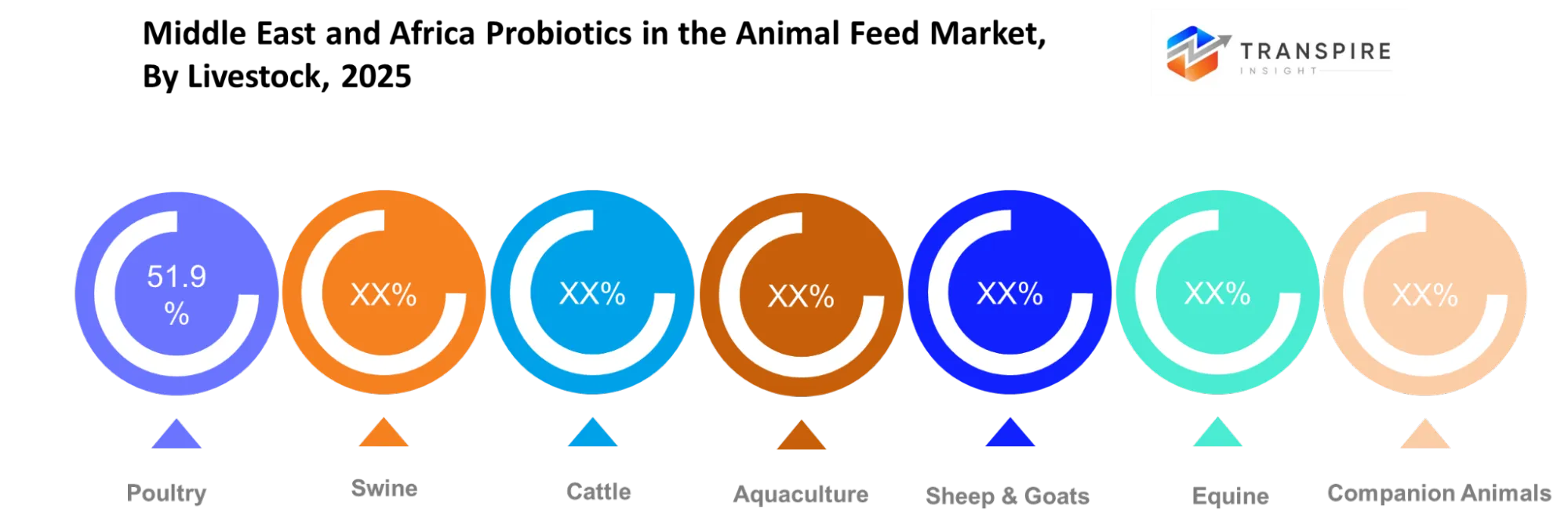
Poultry kind of sits as the biggest livestock portion, because commercial broiler and layer production really leans on consistent feed quality , and also on efficient nutrient uptake. Swine production meanwhile leans into probiotic add-ons , to help keep digestive balance steady, boost feed conversion, and lower health related losses in the production chain. Cattle farming puts probiotics to work for rumen efficiency, better milk output, and additional weight gain, all while keeping the animals in solid condition. Aquaculture keeps growing its probiotic use too, mainly to improve water quality, strengthen digestive performance, and raise survival odds for fish and shrimp operations.
For Sheep and Goats , probiotic feeding helps them use nutrients more effectively and helps growth move in the right direction, even when the farming setup differs. With Equine nutrition, people pick certain probiotic products to support digestive steadiness during transportation, training, and when feed schedules start changing. Companion Animals also get probiotic supplements, for digestive wellness plus immune support, typically via more specialized nutritional products. Other cases include camel farming , rabbit production, and smaller niche livestock sectors where functional feed solutions keep earning real commercial interest and value.
By Microorganism Type
Lactobacillus still stays the main microorganism, mostly due to strong digestive backing and a more stable gut microflora that helps overall animal results in many livestock groups, it really matters. Bifidobacterium plays a role in intestinal balance and in nutrient uptake, especially for young animals, since they need proper microbial maturation. Bacillus keeps solid commercial value too, because heat resistant strains handle feed processing and storage steps really well. Enterococcus backs up digestive well being, and also supports a steadier microbial profile when everything is running at commercial scale.
Streptococcus strains are used for selected nutritional goals, where digestion efficiency and feed utilization are still the key objectives. Yeast probiotics can improve fiber breakdown, especially in ruminants, while also keeping rumen activity stable. Multi strain probiotics take several beneficial microorganisms and mix them together, so livestock species can get wider digestive plus immune advantages. Others include newer microbial strains designed for specialized nutritional needs, as well as better production outcomes in the field.
By Form
Growth Promotion matters a lot for commercial use, mainly because better nutrient use really helps with faster weight gain, and it also supports stronger production efficiency. Gut Health stays as another big use case though, since balanced intestinal microflora helps digestion go smoothly and it boosts nutrient absorption too. Immunity Enhancement is also common, because it backs healthier livestock by reinforcing natural defense mechanisms against everyday production stressors, challenges and such. Feed Efficiency then comes in to reduce feed waste, while also lifting conversion rates and improving overall production economics.
Disease Prevention helps lower digestive problems and supports healthier production cycles, but without depending on antibiotic growth promoters all the time. Stress Management is there to help animals keep performance steady during transportation, vaccination, climate swings and production shifts. Reproductive Health supports breeding outcomes, mostly via improved nutritional balance and the general animal condition. Other options include specialty nutritional programs meant for species related production aims, and those can be tailored around specific objectives.
By Application
Feed Manufacturers are kinda like the biggest end user group, since commercial feed production somehow folds probiotics into full nutrient recipes, across several livestock sectors. Livestock Farms adopt probiotic solutions so they can boost production efficiency, animal well-being , and keep long-term profits on the upswing. Veterinary Clinics often suggest probiotic supplementation, as part of preventive animal care plans and also for recovery routines. Aquaculture Farms keep pushing probiotic usage forward, to help fish stay healthier, use feed more effectively, and achieve steadier production results.
Poultry Farms rely on probiotic supplementation to keep the flock thriving, while also improving feed conversion across the whole growth cycle. Dairy Farms use probiotics to support rumen function, increase milk yield, and generally strengthen herd performance. Research Institutes test new microbial strains , plus different application techniques and formulation methods, all to improve real-world commercial performance. Others are breeding centers, integrated livestock companies, and specialty nutrition providers that develop more targeted probiotic solutions for specific needs.
By End User
Commercial poultry production stays the main use case, basically because probiotic feed supplementation helps with feed conversion, flock health, and that production consistency which everybody wants. Most big feed manufacturers, along with integrated poultry producers, lean on microbial nutrition to keep things steady while they reduce routine antibiotic usage, and also to meet export quality requirements, at the same time.
Aquaculture operations and dairy producers keep pushing probiotic applications too, aiming for better digestive performance , improved water quality, and more efficient nutrient utilization. Even veterinary clinics often suggest probiotic supplementation during recovery programs and as part of preventive health management, so digestive disorders go down and overall livestock performance gets a lift, sort of gradually but reliably.
Newer use cases are starting to show up as well, like customized multi-strain formulations for precision livestock nutrition, and also species-specific microbial products for camel farming and more specialty animal production. Research institutes plus biotechnology companies are still working on advanced probiotic strains, in order to back climate-resilient livestock management and higher production efficiency across regional farming systems, which sounds simple but is pretty complex in practice.
What are the Key Use Cases Driving the Middle East and Africa Probiotics in the Animal Feed Market?
Commercial poultry production stays as the top use case, because probiotic feed supplementation really tends to improve feed conversion, flock wellness, and production steadiness in practical settings. Big feed manufacturers and integrated poultry producers keep leaning on microbial nutrition too, to hold up performance while also dialing back routine antibiotic usage , and to stay aligned with export quality requirements.
In parallel , aquaculture farms and dairy producers keep widening probiotic applications, aiming at better digestive function, improved water quality and stronger nutrient utilization. Veterinary clinics too, often suggest probiotic supplementation during recovery cycles and as part of preventive health routines, this helps lower the chance of digestive disorders, and can lift overall livestock performance , overall.
Newer use cases are starting to show up as well, like tailored multi-strain blend approaches for precision livestock nutrition, plus species-adapted microbial products for camel farming, and for some specialty animal production. Research institutes and biotechnology companies continue work on advanced probiotic strains, that are meant to back climate-resilient livestock management, and push higher production efficiency across regional farming systems too.
|
Report Metrics |
Details |
|
Market size value in 2025 |
USD 583.7 Million |
|
Market size value in 2026 |
USD 630.6 Million |
|
Revenue forecast in 2033 |
USD 1082.6 Million |
|
Growth rate |
CAGR of 8.03% from 2026 to 2033 |
|
Base year |
2025 |
|
Historical data |
2021 - 2024 |
|
Forecast period |
2026 - 2033 |
|
Report coverage |
Revenue forecast, competitive landscape, growth factors, and trends |
|
Regional scope |
Middle East and Africa (Saudi Arabia, United Arab Emirates, South Africa, Rest of Middle East and Africa) |
|
Key company profiled |
DSM-Firmenich, Chr. Hansen, Evonik, ADM, Cargill, Novonesis, Kemin Industries, Lallemand, Alltech, BioChek, Novus International, Biomin, Phileo by Lesaffre, Adisseo, Elanco |
|
Customization scope |
Free report customization (country, regional & segment scope). Avail customized purchase options to meet your exact research needs. |
|
Report Segmentation |
By Livestock (Poultry, Swine, Cattle, Aquaculture, Sheep & Goats, Equine, Companion Animals, Others); By Microorganism Type (Lactobacillus, Bifidobacterium, Bacillus, Enterococcus, Streptococcus, Yeast Probiotics, Multi-Strain Probiotics, Others); By Form (Dry Probiotics, Liquid Probiotics, Powder, Granules, Pellets, Feed Premixes, Water-Soluble Products, Others); By Application (Growth Promotion, Gut Health, Immunity Enhancement, Feed Efficiency, Disease Prevention, Stress Management, Reproductive Health, Others); By End User (Feed Manufacturers, Livestock Farms, Veterinary Clinics, Aquaculture Farms, Poultry Farms, Dairy Farms, Research Institutes, Others) |
Which Regions are Driving the Middle East and Africa Probiotics in Animal Feed Market Growth?
The Middle East sort of takes the lead as the biggest regional market, partly because commercial poultry, dairy, and integrated livestock operations have been adopting advanced feed nutrition a bit faster than nearby markets. In places like Saudi Arabia and the United Arab Emirates , livestock productivity keeps being pushed forward via food security programs, modern feed manufacturing facilities, and firm food safety standards. These measures also make it easier for alternatives to antibiotic growth promoters to get traction. And then there is the import side of things, with strong port and logistics infrastructure , plus long-running partnerships between global feed additive suppliers and regional distributors, so probiotic products can stay available in a reliable way. Ongoing funding for intensive animal farming and veterinary services helps keep the whole ecosystem stable, which in turn supports long-term market leadership.
South Africa is still second, even if its growth looks less like the Middle East model. The local picture is more mature: a fully developed commercial livestock sector, established feed mills, and regulatory enforcement that’s been applied consistently. So the momentum is more about stability , rather than fast expansion. Big poultry and cattle producers continue putting resources into nutritional efficiency, mainly to control feed expenses and improve production results when market conditions keep shifting. Research groups, feed manufacturers, and animal health companies also collaborate in a way that strengthens product validation. That collaboration, overall , supports steady probiotic adoption across mainstream commercial farms.
The Rest of Africa is expected to move the fastest through the forecast window, since poultry, aquaculture, and dairy continue to expand across multiple countries, including Nigeria, Kenya, Egypt, and Ethiopia.
Who are the Key Players in the Middle East and Africa Probiotics in Animal Feed Market and How Do They Compete?
Competition still looks kind of moderately consolidated because big global biotechnology and animal nutrition companies, basically hold a large share of the premium probiotic range. At the same time regional distributors try to open market access through local alliances, so it does not feel fully locked up. Product results, microbial strain know how, scientific validation, and hands on technical support are the main competitive points, not price only. The players keep spending on research, improving production efficiency, and providing more localized customer service to keep long term ties with feed manufacturers and livestock producers.
DSM-Firmenich leans hard into science driven nutritional offerings that are backed by a lot of research and tailored feed initiatives for different livestock types. Novonesis sets itself apart with a combined enzyme plus probiotic system, so clients can push feed efficiency using a wider biological toolkit. Evonik highlights precision animal nutrition by linking probiotic solutions with amino acid expertise, which then helps optimize livestock output and, overall production economics.
Cargill grows visibility by using its huge global feed manufacturing web, and also technical guidance that supports commercial livestock operators. ADM plugs probiotic offerings directly into complete feeds and premix solutions, which helps customers obtain full nutritional programs through well established distribution routes. Kemin Industries stays competitive via focused microbial formulas, ongoing product novelty, and regional collaborations that enhance customer backing and application know-how across Middle Eastern and African livestock markets.
Company List
- DSM-Firmenich
- Chr. Hansen
- Evonik
- ADM
- Cargill
- Novonesis
- Kemin Industries
- Lallemand
- Alltech
- BioChek
- Novus International
- Biomin
- Phileo by Lesaffre
- Adisseo
- Elanco
Recent Development News
In February 2026, DSM-Firmenich announced an agreement to divest its Animal Nutrition & Health business to CVC Capital Partners. The transaction strengthens the company's strategic focus while reshaping the competitive landscape for animal nutrition solutions.http://www.dsm-firmenich.com
In June 2025, Novonesis completed the acquisition of DSM-Firmenich's share of the Feed Enzyme Alliance. The completed transaction brings research, production, sales, and distribution together, expanding the company's integrated animal biosolutions portfolio.http://www.novonesis.com
In February 2025, Novonesis announced the acquisition of DSM-Firmenich's share of the Feed Enzyme Alliance for EUR 1.5 billion. The acquisition broadens animal nutrition capabilities by combining enzymes and probiotics under one commercial platform.http://www.novonesis.com
What Strategic Insights Define the Future of the Middle East and Africa Probiotics in the Animal Feed Market?
The market is slowly moving toward precision biological nutrition, supported by tighter antimicrobial stewardship, commercial livestock modernization, and more reliance on data-led feeding approaches. Future growth maybe depend less on just adding more animals and more on boosting production effectiveness, improving feed conversion, and strengthening animal health with scientifically confirmed microbial solutions. A quieter danger is the limited availability of specialized microbial production capacity, which can end up making supply tight, and raising prices if demand picks up quicker than manufacturing can be scaled, or expanded.
At the same time, customized multi-strain probiotics, tuned for regional livestock conditions and even aquaculture operations, are a real chance that still feels underused across much of Africa. Firms that want to enter this space should first lean into regional manufacturing partnerships, put effort into technical advisory services for commercial producers, and build locally adapted probiotic blends, backed by field performance evidence ,so they can lock in long-lasting competitive edge over the next few years.
Middle East and Africa Probiotics in Animal Feed Market Report Segmentation
By Livestock
- Poultry
- Swine
- Cattle
- Aquaculture
- Sheep & Goats
- Equine
- Companion Animals
- Others
By Microorganism Type
- Lactobacillus
- Bifidobacterium
- Bacillus
- Enterococcus
- Streptococcus
- Yeast Probiotics
- Multi-Strain Probiotics
- Others
By Form
- Dry Probiotics
- Liquid Probiotics
- Powder
- Granules
- Pellets
- Feed Premixes
- Water-Soluble Products
- Others
By Application
- Growth Promotion
- Gut Health
- Immunity Enhancement
- Feed Efficiency
- Disease Prevention
- Stress Management
- Reproductive Health
- Others
By End User
- Feed Manufacturers
- Livestock Farms
- Veterinary Clinics
- Aquaculture Farms
- Poultry Farms
- Dairy Farms
- Research Institutes
- Others
Frequently Asked Questions
Find quick answers to common questions.
The expected Middle East and Africa Probiotics in Animal Feed Market size for the market will be USD 1082.6 Million in 2033.
Key segments for the Middle East and Africa Probiotics in Animal Feed Market are By Livestock (Poultry, Swine, Cattle, Aquaculture, Sheep & Goats, Equine, Companion Animals, Others); By Microorganism Type (Lactobacillus, Bifidobacterium, Bacillus, Enterococcus, Streptococcus, Yeast Probiotics, Multi-Strain Probiotics, Others); By Form (Dry Probiotics, Liquid Probiotics, Powder, Granules, Pellets, Feed Premixes, Water-Soluble Products, Others); By Application (Growth Promotion, Gut Health, Immunity Enhancement, Feed Efficiency, Disease Prevention, Stress Management, Reproductive Health, Others); By End User (Feed Manufacturers, Livestock Farms, Veterinary Clinics, Aquaculture Farms, Poultry Farms, Dairy Farms, Research Institutes, Others).
Major Middle East and Africa Probiotics in Animal Feed Market players are DSM-Firmenich, Chr. Hansen, Evonik, ADM, Cargill, Novonesis, Kemin Industries, Lallemand, Alltech, BioChek, Novus International, Biomin, Phileo by Lesaffre, Adisseo, Elanco.
The Middle East and Africa Probiotics in Animal Feed Market size is USD 583.7 Million in 2025.
The Middle East and Africa Probiotics in Animal Feed Market CAGR is 8.03% from 2026 to 2033.
- DSM-Firmenich
- Chr. Hansen
- Evonik
- ADM
- Cargill
- Novonesis
- Kemin Industries
- Lallemand
- Alltech
- BioChek
- Novus International
- Biomin
- Phileo by Lesaffre
- Adisseo
- Elanco
About the Authors

Chetan Dhatrak
I’m Chetan Dhatrak, a Senior Research Analyst at Transpire Insight, specializing in the Consumer Goods, Foods and Beverages industry. I focus on analyzing market trends, consumer behavior, competitive landscapes, and industry developments to deliver accurate, data-driven insights. My research at Transpire Insight is built on credible sources and in-depth analysis, helping businesses and readers better understand market dynamics, emerging opportunities, and evolving consumer preferences. I’m committed to creating reliable, well-researched content that supports informed decision-making and reflects the latest developments in the consumer goods and food & beverage sectors.

Chakradhar Khansole
Chakradhar serves as the Research Director at Transpire Insight, bringing over 8 years of experience in technology, innovation, and strategic market intelligence. He specializes in transforming complex market data into actionable business insights that enable organizations to make informed, growth-oriented decisions. Recognized for his strategic vision and analytical expertise, Chakradhar leads high-impact research initiatives, delivering comprehensive market assessments, competitive intelligence, and forward-looking industry analysis.
Recently Published Reports
-
Apr 2026
Baby Infant Formula Market
Baby Infant Formula Market Size, Share & Analysis Report By ype (Infant Milk, Follow On Milk, Specialty Baby Milk, Growing-Up Milk), By Ingredient (Carbohydrate, Fat, Protein, Minerals, Vitamins, and Others), By Product Form (Powder, Liquid, and Ready-to-feed), By Distribution Channels (Supermarket/Hypermarket, Specialty Store, Pharmacies, Online Retail, and Others), and Geography (North America, Europe, Asia-Pacific, Middle East and Africa, South and Central America), 2021 - 2031
-
Apr 2026
Edible Insects for Animal Feed Market
Edible Insects for Animal Feed Market Size, Share & Analysis Report By Type (Insect Powder, Insect Meal, Insect Bar, Insect Paste, Insect Oil, and Others), By Insect Type (Beetles, Cricket, Caterpillar, Hymenoptera, Orthoptera, Tree Bugs, and Others), By Application (Livestock, Pet Food, and Aquaculture), By Livestock Type (Poultry, Swine, and Others), and Geography (North America, Europe, Asia-Pacific, Middle East and Africa, South and Central America), 2021 - 2031
-
Apr 2026
Food Industry Disinfection and Bacterial Control Market
Food Industry Disinfection and Bacterial Control Market Size, Share & Analysis Report By Type (Chemical Disinfectants, Physical Disinfectants, and Biocides and Antimicrobials), By Application (Food Processing Equipment Surface Disinfection, Food Preparation Areas Surface Disinfection, Storage Areas Surface Disinfection, Anti-microbial Coatings Food Preservation, and Preservative Solutions Food Preservation), By End User (Meat and Poultry Processing, Dairy Processing, Seafood Processing, Bakery and Confectionery, Restaurants and Commercial Kitchens, and Food Service Providers), By Sales Channel (Online, Offline), and Geography (North America, Europe, Asia-Pacific, Middle East and Africa, South and Central America), 2021 - 2031
-
May 2026
Freeze Dried Food Market
Freeze Dried Food Market Size, Share & Analysis Report By Product Type (Fruits, Vegetables, Freeze-Dried Dairy Products, Freeze-Dried Meat and Seafood, Freeze-Dried Pet Food, and Prepared Meal), By Nature (Organic, and Conventional), By Form (Powdered, Granules, and Diced), By End Use (Breakfast Cereals, Dairy Products, Bakery & Confectionery, Nutritional Bars & Supplements, Powdered Beverages, Snacks, and Retail (Household)), and Geography (North America, Europe, Asia-Pacific, Middle East and Africa, South and Central America), 2021 - 2031