

Fruits and Vegetables Ingredients Market Summary:
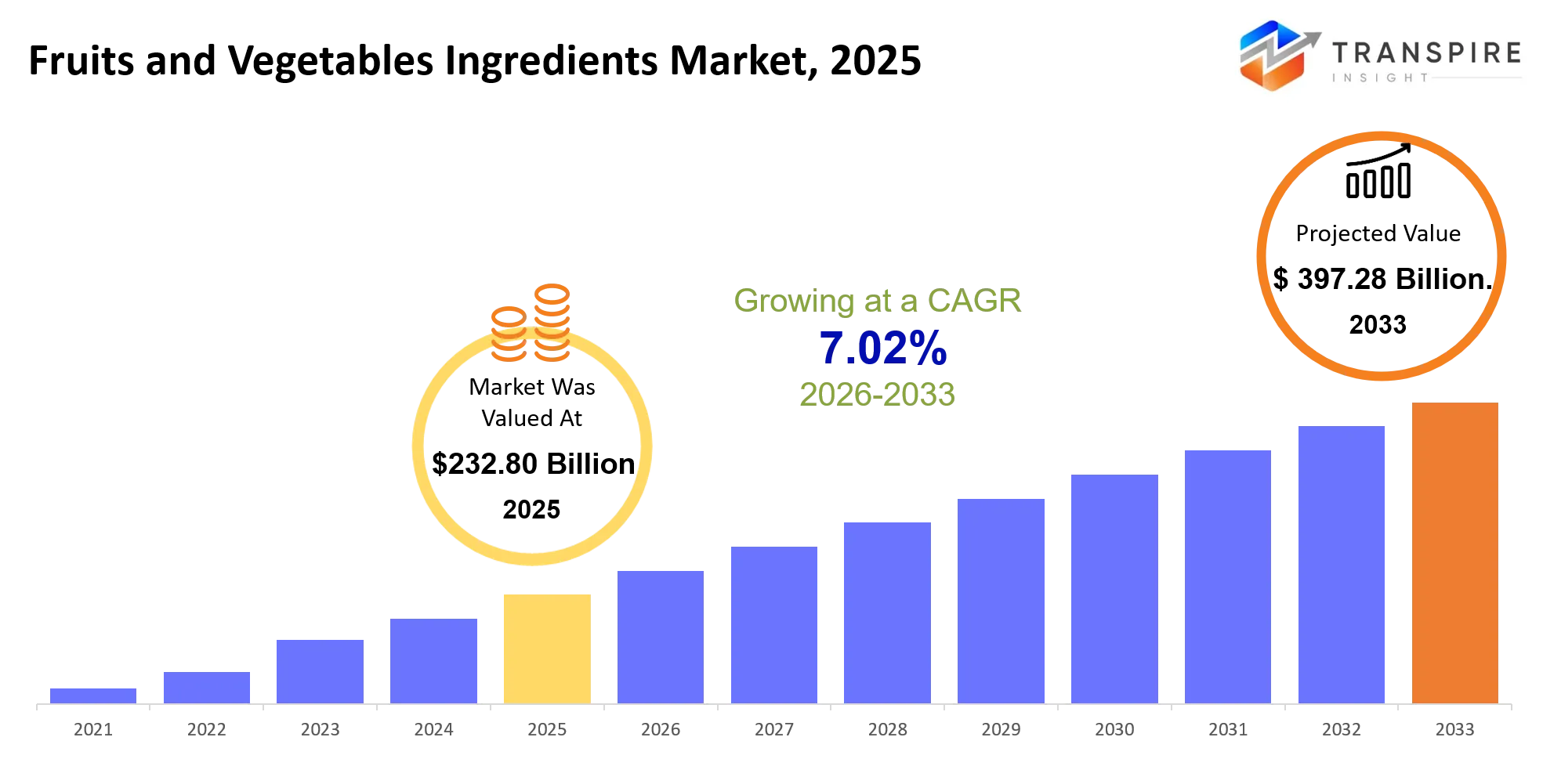
As per Transpire Insight Analysis, the Fruits and Vegetables Ingredients Market size is estimated at USD 232.80 billion in 2025 and is anticipated to reach USD 397.28 billion by 2033, growing at a CAGR of 7.02% from 2026 to 2033.
The fruits and vegetables ingredients market provides processed fruit and vegetable components. These components are used in beverages, dairy products, bakery items, confectionery, sauces, snacks and ready meals. Manufacturers depend on preparations, powders, purees and concentrates. They use these ingredients to keep flavour, colour and texture stable. This helps improve production consistency and reduces reliance on produce that changes with the seasons. In the past three to five years, the industry has focused more on clean-label formulations. There is also a focus on convenient ingredient formats. Companies want to use raw materials more efficiently. Drying, concentration and processing technologies have helped ingredient suppliers. These technologies create products with a longer shelf life. They also give consistent product characteristics.At the same time, food preferences are changing. The number of packaged beverages and convenient foods is growing. This has encouraged manufacturers to look into fruit-based formulations. These changes are helping the market grow. Food companies are looking for ways to improve product quality. They want to make processing simpler. They also want to meet consumer interest, in ingredients that're easy to recognise.
Fruits and Vegetables Ingredients Market Size & Forecast:
- Market Size 2025: USD 232.80 Billion
- Expected Market Value (2033): USD 397.28 Billion
- Forecast CAGR (2026–2033): 7.02%
- Leading Region in 2025: Europe
- Fastest Growing Region: Asia Pacific
- Key Company Profiles: Olam Food Ingredients, Ingredion, Kerry Group, Döhler, ADM, IFF, Tate & Lyle, Sensient Technologies, Symrise, AGRANA, SVZ, Conagra Brands, SunOpta, TreeHouse Foods, Naturex
Key Market Insights
The market is moving towards Product development, formulation flexibility, ingredient consistency, shelf life and more efficient use of fruits and vegetables.
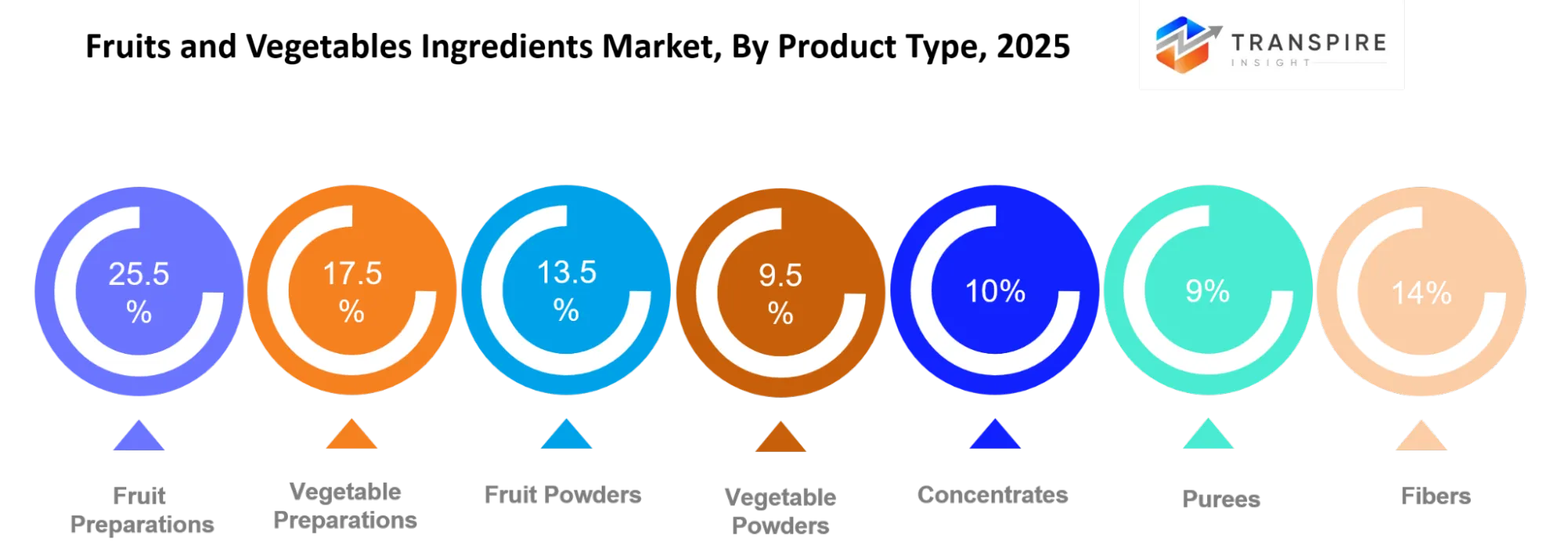
- Preparations based on fruits represent 25.5% of the market and prove their suitability for application as ingredients for yoghurts, bakery fillings and desserts as well as other food processing uses.
- Preparations based on vegetables represent 17.5% of the market and satisfy manufacturers in terms of the need for vegetables,
- Powders made from vegetables make up 9.5% of the market and offer a great opportunity for seasonings and instant foods with a reduced amount of moisture.
- Purees hold 9.0% of the market because of their creamy nature and the inclusion of fruits or vegetables that makes them ideal for use in baby foods, drinks, dairy foods, and sauces.
- Fibres represent 7.0% of the market, which presents a chance for food formulators who want to use textures and fruit or vegetable ingredients in certain formulas.
- Extracts constitute 7.0% of the market, providing concentrated flavours and formulating possibilities in specialised foods and beverages.
What are the Key Drivers, Restraints, and Opportunities in the Fruits and Vegetables Ingredients Market?
Drivers
The increasing number of frozen food products, the continuous need for ingredient solutions that can provide consistent performance throughout the year, fruit preparations, concentrates and purees guarantee that food companies will be able to keep their product specifications even under the effects of seasonality on their supplies of fresh fruits. Innovations in drying, freezing and concentrating fruit ingredients lead to an increase in the choice of ingredients for food companies. New formulations in beverages, dairy products and convenience foods call for quick and versatile ingredient solutions.
Restraints
Variability of raw materials is always a problem. Weather changes, crop diseases, location-specific harvesting seasons and even input fluctuations in agriculture may affect fruit quality, ingredient costs and procurement budgets. Energy demands, cold chains and food safety are another set of problems that can negatively affect margins of suppliers of perishable fruits and small-scale processors.
Opportunities
There are opportunities for fruit powders, upcycled concentrated ingredients, and customized products for specific uses. Improved methods of drying and extraction may allow the processors to extract maximum value from each harvest, even processing co-products. Tracing, reduction in energy during processing, and better local sourcing could resolve any issues with supply. Expansion of packaged foods and modern foodservice in Asia Pacific will lead to the need for shelf-stable ingredients. Providing consistent sourcing, application knowledge, and flexible specifications will ensure that companies secure long-term contracts and create higher-value-added products.
|
Driver |
Relative Impact on Growth (%) |
Geographic Relevance |
Impact Timeline |
Demand Strength |
Growth Mechanism (5–10 words) |
Key Beneficiaries (5–10 words) |
Major Constraint (5–10 words) |
|
Rising demand for natural and clean-label ingredients |
28% |
North America, Europe |
Short-term (≤2 years) |
High |
Replaces synthetic additives with recognizable fruit-based ingredients |
Fruit ingredient processors, beverage brands, clean-label food manufacturers |
Higher costs for natural ingredients and consistent quality |
|
Expanding demand for convenient and functional foods |
24% |
Asia-Pacific, North America |
Medium-term (2–4 years) |
High |
Supports ready-to-eat meals, snacks, beverages, and nutrition products |
Food manufacturers, snack producers, functional beverage companies |
Taste, texture, and shelf-life challenges in formulations |
|
Increasing adoption of fruit and vegetable powders, concentrates, and purees |
19% |
Asia-Pacific, Europe |
Short-term (≤2 years) |
High |
Enables convenient storage, transport, dosage, and product formulation |
Ingredient suppliers, bakery companies, beverage processors, foodservice operators |
Processing costs and nutrient losses during dehydration |
|
Advancements in processing and preservation technologies |
16% |
North America, Europe, Asia-Pacific |
Long-term (≥4 years) |
Medium |
Improves nutrient retention, extraction efficiency, and ingredient stability |
Processing equipment vendors, ingredient producers, food technology companies |
High capital investment and technology integration costs |
|
Sustainability initiatives and food waste valorization |
13% |
Europe, North America, Asia-Pacific |
Long-term (≥4 years) |
Medium |
Converts surplus produce and by-products into valuable ingredients |
Agricultural processors, circular economy ventures, sustainable food brands |
Variable raw material availability and food safety requirements |
|
Total |
100% |
market |
— |
— |
— |
— |
— |
What Has the Impact of Artificial Intelligence Been on the Fruits and Vegetables Ingredients Market?
Artificial intelligence has created the possibility for optimising material selection, efficiency and quality control within the fruits and vegetable ingredients industry. Food processors could employ computer vision technologies to inspect the products for visible defects, analyse colour changes and sort the incoming products. When used in combination with relevant production data, machine learning algorithms could assist manufacturers to recognise conditions that result in the desired flavour, texture, moisture and output. The technology could assist in the planning of harvesting and raw materials acquisition and managing of inventories. With access to data on past demand, suppliers and weather-related data, manufacturers may predict shortages and adapt their purchasing schedules in time to avoid production disruptions. Monitoring of drying and concentration processes would allow managers to recognise inefficient use of energy resources and process irregularities. there exist barriers to adoption of such systems. Equipment integration and acquisition of sufficient amounts of training data would be quite expensive, while smaller food processors would lack the necessary technical skills for maintenance. Thus, AI would prove to be most effective when it is combined with traditional practices of food safety and production.
Instance
In June 2025,Systemex Automation unveiled the AI-enabled EZ-CELL Sort-Mate, an innovation that utilizes artificial intelligence, robotics, and computer vision to grade and sort fruits and vegetables. The innovation increases accuracy and efficiency of the sorting process while minimizing food waste.
Key Market Trends:
The industry is shifting toward ingredient solutions which are more convenient, consistent in terms of quality and flexible in formulation.
- Food manufacturers are shifting from conventional fruit pieces to specific preparations that allow achieving a certain texture, balanced flavour release and better integration in automated filling equipment.
- Freezing and dehydration techniques are giving birth to new opportunities related to fruit ingredients which are much lighter to transport and store in comparison to fresh fruits.
- Clean-label product development is pushing for higher fruit colours, flavours, and sweeteners’ content, which correspond with necessary formulations and performances.
- The producers are getting more interested in evaluating how to make something valuable out of processing leftovers in the form of extracts, fibres, and so forth.
- Food manufacturers are paying closer attention to their suppliers due to changing weather conditions and more unpredictable harvests in terms of quality and amount of raw materials available.
- Automation and digital quality control are becoming more important for food processors to decrease manual selection procedures, to discover problems at an early stage and to keep product consistency from batch to batch.
Fruits and Vegetables Ingredients Market Segmentation
By Ingredient Type
Fruit preparations have the largest share of 25.5% in the supplied market breakup owing to their application in yoghurts, bakery fillings, candies, desserts, and other formulated foods. Vegetable preparations constitute 17.5%, whereas fruit powders constitute 13.5% and are advantageous owing to their applicability in dry mixes and convenience formulations. Concentrates comprise 11.0%, vegetable powders constitute 9.5%, and purees are 9.0%. Fibers and extracts each form 7.0%. Fruit powders are seen as the fastest-growing product segment with an anticipated CAGR of 8.4%.
By Fruit Type
In the market are berries, citrus, tropical, apples, grapes, stone fruit, melons and other specialities. Berries are very versatile for premium beverages, dairy products, desserts and confectionery because of their flavour and colour. Citrus fruits lend themselves to juices, drinks, sauces and flavour formulations while tropical products are suitable for smoothies, fruit preparations and niche beverages. Apples and grapes are also adaptable for concentrates, purees and processed foods. Stone fruit and melons offer another range of seasonal flavours and differentiated product ideas. Future opportunities will be partly limited by availability of raw material, processing qualities and the ability of manufacturers to achieve consistency of sensory quality.
By Vegetable Type
The range comprises vegetables such as tomato, carrot, pea, potato, onion, spinach, pumpkin and others. Tomato is essential for sauces, soups, condiments and prepared foods; onion and potato are used in a variety of savoury food applications. Carrot, pea, spinach and pumpkin can be utilised in various powdered, puréed, soups and selected nutritional formulas. Processes are implemented by suppliers to modify moisture level, texture and strength of taste to fulfil end-customers' needs. With an increase of application of meal and dry-mix products, vegetables which can offer consistent quality and ease of storage will become more relevant.
By Form
The market also consists of all raw and processed forms of fresh, frozen, dried, powdered, liquid, puree, concentrate, and other forms. Frozen ingredients increase the shelf life of seasonal ingredients, while dried and powdered ingredients keep the product while reducing the water activity. Liquid ingredients and concentrates find use in beverage formulation and dosing. Purees give a smooth texture and are used in dairy products, infant food, sauces, and desserts. Fresh ingredients find use in the least processed forms, but their handling requires greater care.
By Application
The market supplies beverage, bakery and confectionery, dairy, sauces & dressings, infant food, snack & ready meals. Fruit concentrates, purees and powders are a key component in a range of flavour and formulation solutions for drinks. Fruit preparations and pieces are added to fillings, toppings and desserts in bakery and confectionery; fruit ingredients feature in snacks, frozen desserts, dairy and frozen desserts; vegetable preparations and concentrates flavour sauces and dressings; attention to ingredient quality and safety and convenience are key to infant foods, and on-the-go snack and ready-meal formats will be affected by product innovation.
By End User
Suppliers of fruit- and vegetable-derived ingredients are able to supply customers such as: food manufacturers, beverage manufacturers, dairy manufacturers, bakeries, foodservice operators, retailers, nutraceuticals and other users. Large food manufacturers need assured, consistent quantities and specifications from several production sites. Beverage manufacturers need consistency in flavours and solubility, as well as compatibility with their systems. Dairy manufacturers need to consider texture, stability, and interaction with other ingredients. Bakeries and foodservice operators need ingredients that will ease preparation and reduce processing time. Suppliers who can offer consigned deliveries, technical assistance and flexible order sizes can satisfy the requirements of a wide range of customers.
What are the Key Use Cases Driving the Fruits and Vegetables Ingredients Market?
The uses of fruits have been diverse in the area of yoghurt, fillings for baked goods, desserts, and confectionery items. The category is critical in aiding manufacturers in maintaining the taste, mouth-feel and consistent levels of fruit components in industrial production of food products. Some new areas of application include fruit concentrate or fruit puree in fruit juices, smoothies, dairy drinks, and vegetables in sauces, dressings, soups and prepared foods. These help manufacturers keep consistencies in their products. Another area where fruits could be useful would be in powder form for use in beverages, snacks and nutritious foods.
|
Report Metrics |
Details |
|
Market size value in 2025 |
USD 232.80 Billion |
|
Market size value in 2026 |
USD247.15 Billion |
|
Revenue forecast in 2033 |
USD 397.28 Billion |
|
Growth rate |
CAGR of 7.02% from 2026 to 2033 |
|
Base year |
2025 |
|
Historical data |
2021 - 2024 |
|
Forecast period |
2026 - 2033 |
|
Report coverage |
Revenue forecast, competitive landscape, growth factors, and trends |
|
Regional scope |
United States; Canada; Mexico; United Kingdom; Germany; France; Italy; Spain; Denmark; Sweden; Norway; China; Japan; India; Australia; South Korea; Thailand; Brazil; Argentina; South Africa; Saudi Arabia; United Arab Emirates |
|
Key company profiled |
Olam Food Ingredients, Ingredion, Kerry Group, Döhler, ADM, IFF, Tate & Lyle, Sensient Technologies, Symrise, AGRANA, SVZ, Conagra Brands, SunOpta, TreeHouse Foods, Naturex |
|
Customization scope |
Free report customization (country, regional & segment scope). Avail customized purchase options to meet your exact research needs. |
|
Report Segmentation |
Ingredient Type (Fruit Preparations, Vegetable Preparations, Fruit Powders, Vegetable Powders, Concentrates, Purees, Fibers, Extracts)Fruit Type (Berries, Citrus Fruits, Tropical Fruits, Apples, Grapes, Stone Fruits, Melons, Others)Vegetable Type (Tomatoes, Carrots, Peas, Potatoes, Onions, Spinach, Pumpkin, Others)Form (Fresh, Frozen, Dried, Powdered, Liquid, Puree, Concentrated, Others)Application (Beverages, Bakery, Dairy, Confectionery, Sauces & Dressings, Infant Food, Snacks, Ready Meals)End User (Food Manufacturers, Beverage Companies, Dairy Producers, Bakeries, Foodservice, Retailers, Nutraceutical Companies, Others) |
Which Regions are Driving the Fruits and Vegetables Ingredients Market Growth?
North America
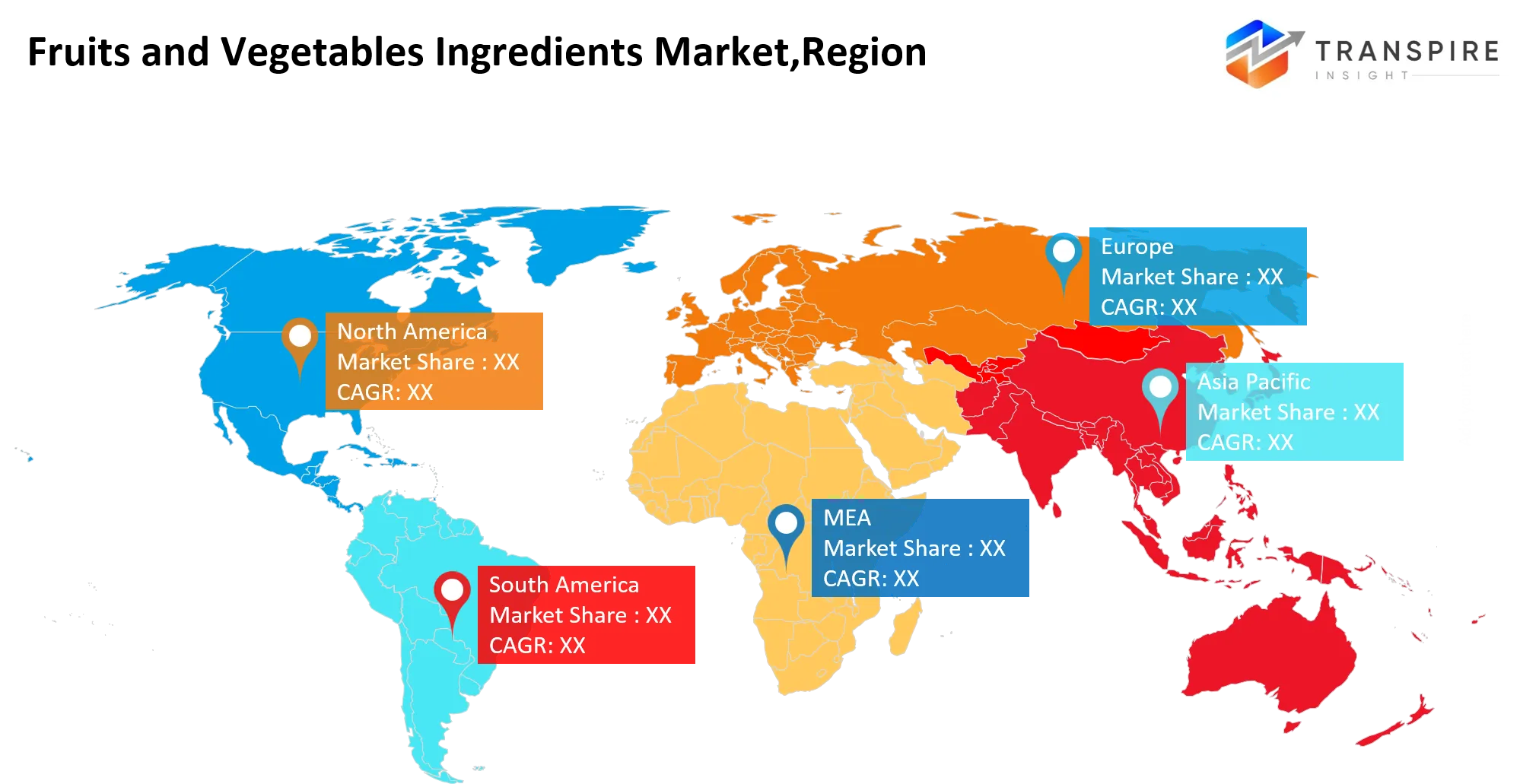
North America holds a market share of 27.4%, making it the second-largest region based on the provided figures. North America's well-established packaged food industry, large beverage industry and organised food service system contribute to the application of standardised fruit and vegetable ingredients. There is a need for a reliable supply of fruits and vegetables for sauces, snacks, dairy products, ready meals and beverage formulations. This represents a different route of growth compared to the established food processing and distribution system in Europe.
In October 2025, the Nafoods Group has made green investments for the upgrading of processing and reducing the losses incurred after harvest.
Europe
Europe leads in terms of regional market share with 30.5% of the provided market estimates, based on its well-established food processing industry and demand for processed fruit and vegetable ingredients. Europe has a well-established ecosystem of ingredient manufacturers, food laboratories and established distribution networks. Its bakery, dairy, beverage and convenience food industries have diverse applications for preparations, purees and concentrates. This represents a continuous route for growth in product development in terms of ingredient transparency, processing quality and formulation.
In June 2026, Suntory Beverage & Food GB&I made an investment in a state-of-the-art blackcurrant processing plant in the UK to ensure fruit processing and the supply chain for Ribena drinks.
Asia Pacific
Asia Pacific constitutes 25.2% of the market and is considered the fastest-growing segment, with a CAGR of 8.2 %. The growing food consumption, rising beverage packaging, and investments made in food manufacturing can create further scope for suppliers of ingredients. The demand for convenience and availability of processed ingredients might push manufacturers to increase their product range. This growth can be of much use to regional processors who improve their processes of storage and processing of products.
March 2025 -,Mother Dairy has made plans to invest in new processing units of fruits and vegetables in the states of Gujarat and Andhra Pradesh.
Who are the Key Players in the Fruits and Vegetables Ingredients Marketand how do they compete?
Competition in the fruits and vegetables ingredients market depends on the quality of the products, production facilities, source of the raw materials, application know-how and ability of the company to serve customers across multiple regions. Each firm provides a range of products including different types of preparations, purees, concentrates, powders and mixes. The competitive positioning of each supplier depends on the product mix, raw material supply, manufacturing capacities and ability to fulfill customer demands. Döhler has an unique product mix including fruits and vegetables ingredients that includes purees, concentrates, fruit pieces and mixes. Application development know-how and consistent processing allows Döhler to attract food and beverages manufacturers who need particular ingredients for particular recipes. AGRANA Fruit is specialized in fruit preparations and customized solutions for the dairy, bakery and other food industry players who need ingredients with particular properties like consistency, taste and reliable supply. SVZ supplies fruit and vegetable ingredients including purees and concentrates due to its sourcing and processing know-how. Rettenmaier & Söhne offers a wide variety of ingredients for different processing requirements. Competitive opportunities arise from specialized fruit powders, upcycled extracts and customized mixes.
Fruits and Vegetables Ingredients Market companies
- Olam Food Ingredients
- Ingredion
- Kerry Group
- Döhler
- ADM
- IFF
- Tate & Lyle
- Sensient Technologies
- Symrise
- AGRANA
- SVZ
- Conagra Brands
- SunOpta
- TreeHouse Foods
- Naturex
|
Company |
Est. Revenue Share Range |
Key Offerings |
Strategic Positioning |
Geographic Strength |
Technology Focus |
|
ADM |
Estimated 2–4% |
Fruit concentrates, vegetable powders, fruit extracts |
Integrated sourcing and diversified ingredient solutions |
North America, Europe, Asia Pacific |
Advanced extraction and processing optimization |
|
Olam Food Ingredients (ofi) |
Estimated 2–4% |
Dehydrated vegetables, fruit ingredients, vegetable powders |
Agricultural sourcing scale and specialized processing |
Asia Pacific, North America, Europe |
Dehydration and traceable ingredient sourcing |
|
Kerry Group |
Estimated 1–3% |
Fruit extracts, vegetable ingredients, natural flavor systems |
Application-led innovation and integrated taste solutions |
Europe, North America, Asia Pacific |
Flavor modulation and sensory optimization |
|
Döhler Group |
Estimated 2–4% |
Fruit purees, concentrates, fruit preparations |
Integrated natural ingredients and beverage solutions |
Europe, Asia Pacific, North America |
Aseptic processing and concentration technologies |
|
AGRANA Group |
Estimated 2–4% |
Fruit preparations, juice concentrates, fruit purees |
Large-scale fruit processing and customized manufacturing |
Europe, North America, Asia Pacific |
Fruit processing and customized formulation |
|
Ingredion |
Estimated 1–3% |
Fruit ingredients, vegetable fibers, plant-derived functional ingredients |
Functional ingredients and clean-label formulation expertise |
North America, Latin America, Asia Pacific |
Fiber functionality and texture optimization |
|
Cargill |
Estimated 1–3% |
Fruit ingredients, vegetable ingredients, fruit preparations |
sourcing and integrated ingredient supply |
North America, Europe, Asia Pacific |
Processing efficiency and formulation optimization |
|
Sensient Technologies |
Estimated 0.5–2% |
Natural fruit colors, vegetable colors, botanical extracts |
Specialty differentiation through natural colors and extracts |
North America, Europe, Asia Pacific |
Natural color extraction and pigment stabilization |
|
SVZ International |
Estimated 0.5–2% |
Fruit purees, vegetable purees, puree concentrates, NFC juices |
Specialized fruit and vegetable processing solutions |
Europe, North America, Asia Pacific |
Aseptic processing and puree concentration |
|
SunOpta |
Estimated 0.5–2% |
Fruit ingredients, fruit purees, concentrates, organic fruit ingredients |
Specialized fruit processing and organic ingredient supply |
North America, Europe, Asia Pacific |
Aseptic processing and ingredient preservation |
Recent Development News
In May 2026, Fresh Del Monte launched its Fruit Stories range of fruit preparations. The product range contains fruit and actual fruit pieces and was intended for baking, desserts and quick meal applications. The introduction shows an emphasis on convenient and ready-to-use fruit products for consumers and food applications.
In August 2025, MONIN India launched PURE, a range without added sugar which consists of fruit and plant-based extracts. The product range includes Mint, Red Fruits, Green Apple and Peach Apricot flavours for mocktails, iced teas, smoothies and desserts. The introduction shows product development for flavour ingredients and formulation without added sugar.
What Strategic Insights Define the Future of the Fruits and Vegetables Ingredients Market?
The future of the fruits and vegetables ingredients market will depend on the efficiency with which the suppliers will be able to integrate agricultural sourcing with processing and product development. Currently, fruit preparations have the largest market share in the estimated numbers. Fruit powders could be seen as an area of growth because of the convenience of their storage, transportation and formulations. Still, fluctuations in crop yields, raw materials prices and processing costs might squeeze the margin despite the growing volume of sales. Hence, it would be unwise for suppliers to become dependent on a limited number of crops and raw materials providers. One of the promising areas is the conversion of selected fruit and vegetable processing by-products into useful commercial products such as extracts, fibres and other ingredients. The investment in traceability, automation of quality control and energy-efficient drying might decrease waste and enhance consistency. It is important for the suppliers to focus not on competing based on price but on customer relations, technical assistance and innovation.
Ingredient Type
- Fruit Preparations
- Vegetable Preparations
- Fruit Powders
- Vegetable Powders
- Concentrates
- Purees
- Fibers
- Extracts
Fruit Type
- Berries
- Citrus Fruits
- Tropical Fruits
- Apples
- Grapes
- Stone Fruits
- Melons
- Others
Vegetable Type
- Tomatoes
- Carrots
- Peas
- Potatoes
- Onions
- Spinach
- Pumpkin
- Others
Form
- Fresh
- Frozen
- Dried
- Powdered
- Liquid
- Puree
- Concentrated
- Others
Application
- Beverages
- Bakery
- Dairy
- Confectionery
- Sauces & Dressings
- Infant Food
- Snacks
- Ready Meals
End User
- Food Manufacturers
- Beverage Companies
- Dairy Producers
- Bakeries
- Foodservice
- Retailers
- Nutraceutical Companies
- Others
Frequently Asked Questions
Find quick answers to common questions.
The fruits and vegetables ingredients market size was valued at USD 232.80 Billion in 2025 and is poised to reach USD 397.28 Billion by 2033, expanding at a 7.02% CAGR.
Key segments for the fruits and vegetables ingredients market are Ingredient Type (Fruit Preparations, Vegetable Preparations, Fruit Powders, Vegetable Powders, Concentrates, Purees, Fibers, Extracts)Fruit Type (Berries, Citrus Fruits, Tropical Fruits, Apples, Grapes, Stone Fruits, Melons, Others)Vegetable Type (Tomatoes, Carrots, Peas, Potatoes, Onions, Spinach, Pumpkin, Others)Form (Fresh, Frozen, Dried, Powdered, Liquid, Puree, Concentrated, Others)Application (Beverages, Bakery, Dairy, Confectionery, Sauces & Dressings, Infant Food, Snacks, Ready Meals)End User (Food Manufacturers, Beverage Companies, Dairy Producers, Bakeries, Foodservice, Retailers, Nutraceutical Companies, Others)
Growth is primarily driven by increasing demand for natural and clean-label products, rising health consciousness, growing consumption of processed and convenience foods, expanding use of plant-based ingredients, and increasing demand for fruit and vegetable powders, concentrates, and extracts across the food and beverage industry.
The market is led by major manufacturers including Olam Food Ingredients, Ingredion, Kerry Group, Döhler, ADM, IFF, Tate & Lyle, Sensient Technologies, Symrise, AGRANA, SVZ, Conagra Brands, SunOpta, TreeHouse Foods, Naturex
Europe has a 30.5% share of the fruits and vegetables ingredients market due to high demand for healthy food and natural products, in addition to the advanced food industry in Europe, high food quality standards and consumer preferences for convenience.
Commercial opportunities in the worldwide market for fruits & vegetables ingredients include increased demand for natural and clean label ingredients, usage of fruits & vegetables ingredients in functional foods and beverages, increased use of fruits & vegetables powders in convenience foods, and increased usage of plant-based ingredients. Opportunities in new markets can also be explored by companies.
- Olam Food Ingredients
- Ingredion
- Kerry Group
- Döhler
- ADM
- IFF
- Tate & Lyle
- Sensient Technologies
- Symrise
- AGRANA
- SVZ
- Conagra Brands
- SunOpta
- TreeHouse Foods
- Naturex
About the Authors

Chetan Dhatrak
I’m Chetan Dhatrak, a Senior Research Analyst at Transpire Insight, specializing in the Consumer Goods, Foods and Beverages industry. I focus on analyzing market trends, consumer behavior, competitive landscapes, and industry developments to deliver accurate, data-driven insights. My research at Transpire Insight is built on credible sources and in-depth analysis, helping businesses and readers better understand market dynamics, emerging opportunities, and evolving consumer preferences. I’m committed to creating reliable, well-researched content that supports informed decision-making and reflects the latest developments in the consumer goods and food & beverage sectors.

Chakradhar Khansole
Chakradhar serves as the Research Director at Transpire Insight, bringing over 8 years of experience in technology, innovation, and strategic market intelligence. He specializes in transforming complex market data into actionable business insights that enable organizations to make informed, growth-oriented decisions. Recognized for his strategic vision and analytical expertise, Chakradhar leads high-impact research initiatives, delivering comprehensive market assessments, competitive intelligence, and forward-looking industry analysis.
Recently Published Reports
-
Apr 2026
Baby Infant Formula Market
Baby Infant Formula Market Size, Share & Analysis Report By ype (Infant Milk, Follow On Milk, Specialty Baby Milk, Growing-Up Milk), By Ingredient (Carbohydrate, Fat, Protein, Minerals, Vitamins, and Others), By Product Form (Powder, Liquid, and Ready-to-feed), By Distribution Channels (Supermarket/Hypermarket, Specialty Store, Pharmacies, Online Retail, and Others), and Geography (North America, Europe, Asia-Pacific, Middle East and Africa, South and Central America), 2021 - 2031
-
Apr 2026
Edible Insects for Animal Feed Market
Edible Insects for Animal Feed Market Size, Share & Analysis Report By Type (Insect Powder, Insect Meal, Insect Bar, Insect Paste, Insect Oil, and Others), By Insect Type (Beetles, Cricket, Caterpillar, Hymenoptera, Orthoptera, Tree Bugs, and Others), By Application (Livestock, Pet Food, and Aquaculture), By Livestock Type (Poultry, Swine, and Others), and Geography (North America, Europe, Asia-Pacific, Middle East and Africa, South and Central America), 2021 - 2031
-
Apr 2026
Food Industry Disinfection and Bacterial Control Market
Food Industry Disinfection and Bacterial Control Market Size, Share & Analysis Report By Type (Chemical Disinfectants, Physical Disinfectants, and Biocides and Antimicrobials), By Application (Food Processing Equipment Surface Disinfection, Food Preparation Areas Surface Disinfection, Storage Areas Surface Disinfection, Anti-microbial Coatings Food Preservation, and Preservative Solutions Food Preservation), By End User (Meat and Poultry Processing, Dairy Processing, Seafood Processing, Bakery and Confectionery, Restaurants and Commercial Kitchens, and Food Service Providers), By Sales Channel (Online, Offline), and Geography (North America, Europe, Asia-Pacific, Middle East and Africa, South and Central America), 2021 - 2031
-
May 2026
Freeze Dried Food Market
Freeze Dried Food Market Size, Share & Analysis Report By Product Type (Fruits, Vegetables, Freeze-Dried Dairy Products, Freeze-Dried Meat and Seafood, Freeze-Dried Pet Food, and Prepared Meal), By Nature (Organic, and Conventional), By Form (Powdered, Granules, and Diced), By End Use (Breakfast Cereals, Dairy Products, Bakery & Confectionery, Nutritional Bars & Supplements, Powdered Beverages, Snacks, and Retail (Household)), and Geography (North America, Europe, Asia-Pacific, Middle East and Africa, South and Central America), 2021 - 2031