

South Korea Concentrated Milk Fat Market Summary
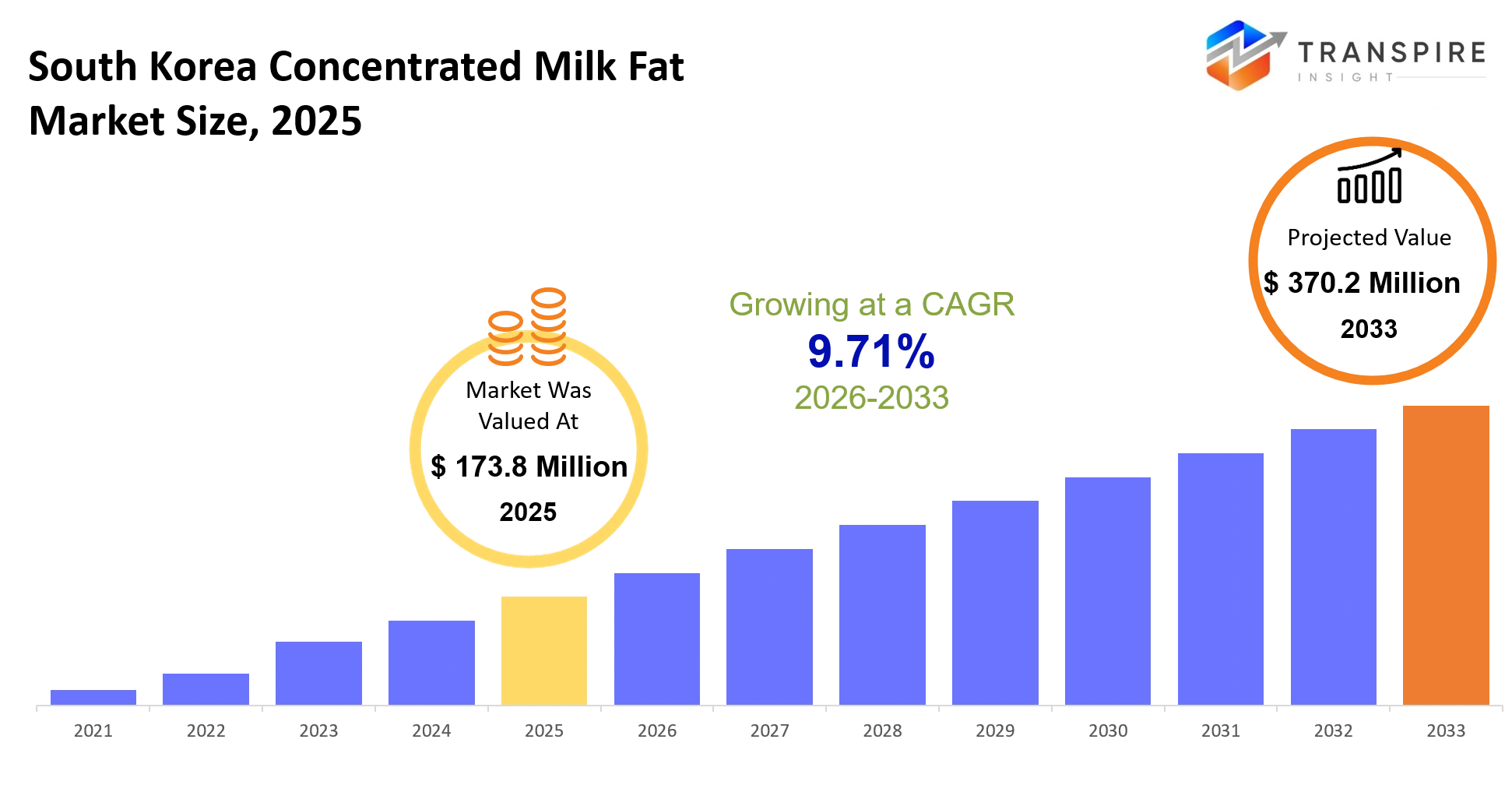
As per Transpire Insight Analysis the South Korea Concentrated Milk Fat Market size is estimated at USD 173.8 Million in 2025 and is anticipated to reach USD 370.2 Million by 2033, growing at a CAGR of 9.71% from 2026 to 2033.
South Korea's concentrated milk fat market provides a constant flow of high-fat dairy ingredients into bakery lines, confectionery kitchens, and daily dairy production - giving manufacturers consistent texture and flavor without having to deal with too many raw material issues all the time. Essentially, it's more like a core ingredient category rather than just a fill-in item, allowing food producers to maintain their formulations whilst reducing waste further along the line. These products really do play a key part in decreasing our reliance on imported fat blends for certain types, helping local dairies run their processing lines even more smoothly. Over the past three to five years, this entire category has moved a bit more towards anhydrous milk fat and customised fat blends, becoming part of our everyday bakery and confectionery workflows quite gradually. At the same time, an increase in infant nutrition formulations, as well as much stricter quality standards, have driven demand even higher. Meanwhile, the pandemic initially disrupted our usual import schedules somewhat, yet it also encouraged domestic processors to expand their capacity and kept product availability relatively consistent. Even today, as consumers seek out cleaner labels, richer taste profiles, and wider use of concentrated fat blends - changing how food companies formulate their products all the time - producers are getting their better-tasting goods to market faster ever so often.
South Korea Concentrated Milk Fat Market Size & Forecast:
- South Korea Concentrated Milk Fat Market Size 2025: USD 173.8 Million
- Expected Market Value 2033: USD 370.2 Million
- Forecast CAGR: 9.71%
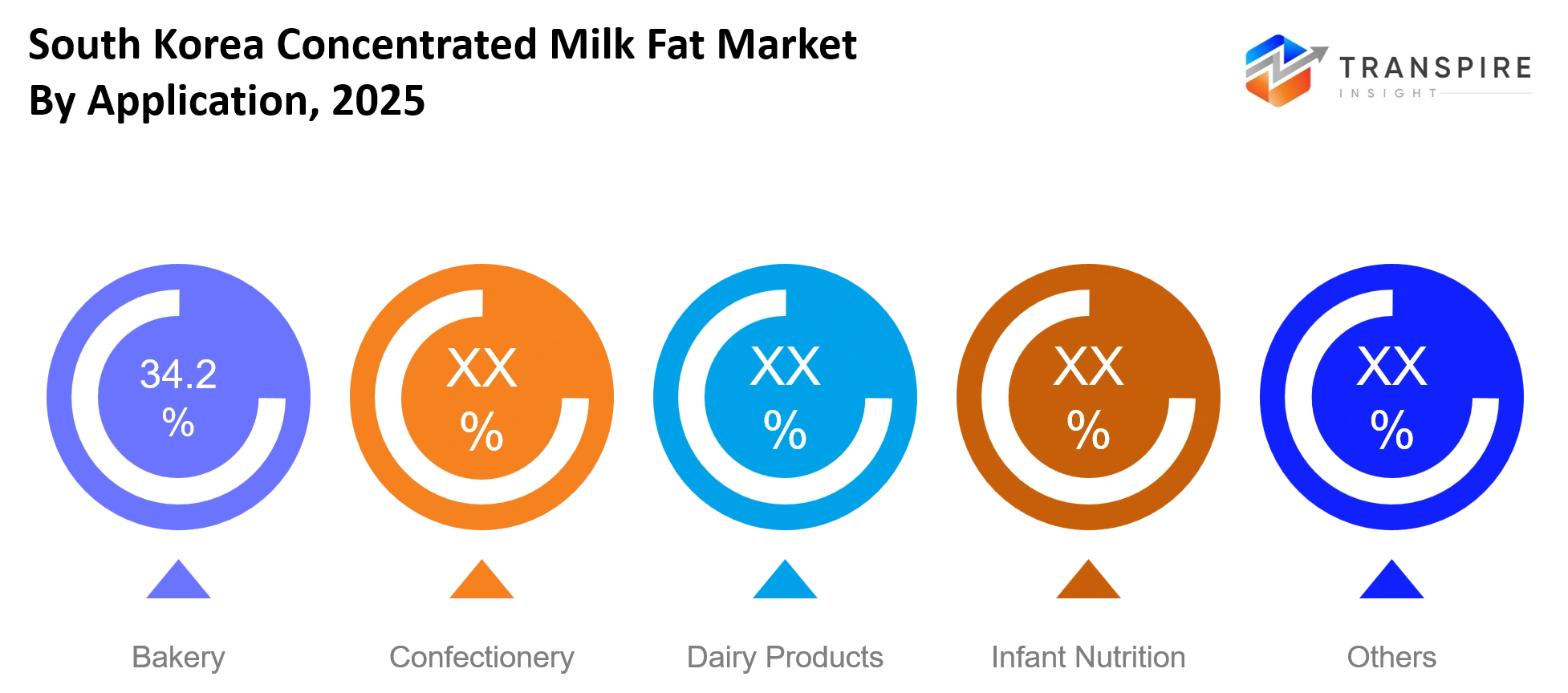
- Leading application segment in 2025: Bakery Applications (34.2%)
- Fastest Growing product segment: Anhydrous Milk Fat
Key Profile: Fonterra, Arla Foods, FrieslandCampina, Lactalis, Saputo, Kerry, Nestle, Danone, Yili, DFA, Land O'Lakes, Ornua, Amul, Parag Milk, Megmilk Snow
Key Market Insights
- Bakery applications really drive demand - kind of at the forefront of attention - taking up approximately 34. 2% market share by 2025 - mostly because concentrated milk fat adds a more luxurious feel to baked goods that consumers continue asking for.
- Confectionery is predicted to grow quite steadily too - mainly because chocolate and premium candy makers rely even more heavily on milk fat for a smoother melt and better storage stability.
- On the product side, butter oil still holds a strong top spot in 2025 - since it easily fits into existing bakery and confectionery recipes with little to no reformulation required.
- Anhydrous milk fat is set to be the fastest-growing product category through 2033 - primarily due to its longer shelf life and higher purity making it attractive for export-focused processors.
- Dairy fat blends are gaining acceptance as manufacturers seek out more affordable methods to achieve exacting fat content targets without losing taste quality.
- Demand for infant nutrition products continues to expand significantly as well - associated with tighter quality standards and an increasing preference for high-end formula ingredients among South Korean parents.
- The Seoul Capital Area still holds the largest processing and consumption presence - due to its high concentration of food manufacturing facilities and well-developed cold storage networks.
- The Gyeongsang region is forecasted to see the most rapid regional growth, with continuous new dairy processing investments pouring in over our forecast period.
What are the Key Drivers, Restraints, and Opportunities in the South Korea Concentrated Milk Fat Market?
Primary market expansion is really being driven by an increase in bakery and confectionery production all over South Korea - coupled with a consistent movement of consumers towards even richer and more decadent flavour profiles. Food manufacturers are increasingly relying on concentrated milk fat since it really provides consistent taste and texture batch after batch. Whenever formulations stay pretty consistent, brands build much stronger consumer trust - and repeat purchase behaviour tends to follow suit. This actually results in higher recurring procurement volumes for dairy fat products while also increasing demand among bakery, confectionery, and infant nutrition manufacturers.
However, the largest structural obstacle remains our reliance on imported raw milk fat inputs, because domestic raw milk supply can't always meet processing demand. As a result, cost volatility creeps in - and margin pressure builds for smaller regional processors. Based on the Transpire Insight analysis of dairy trade patterns, currency fluctuations and global milk price cycles are still our major operational concern, and they tend to really hinder predictable procurement planning.
Our next phase of growth is quite likely going to come from premiumisation - kind of driven by clean label requirements plus the increased export of Korean bakery and confectionery products throughout Asia. Local processors continue to invest more heavily in fractionation technology and cold chain logistics. And the expanded use of dairy fat blends is offering formulators so much more flexibility - which sounds simple but really matters a lot for cost control.
What Has the Impact of Artificial Intelligence Been on the South Korea Concentrated Milk Fat Market?
Artificial intelligence and digital tools really are changing dairy fat processing - by helping plants refine fat separation, reduce energy use, and hold batch quality much more constant over production runs. AI-powered monitoring systems assist plant operators monitor temperature, moisture, and fat content almost in real-time, then guide line workers towards faster adjustments if a batch starts drifting away from specifications.
Machine learning is also achieving similar results right along the wider supply chain itself. Processors rely on predictive models to forecast raw milk intake, schedule fractionation times, and predict shifts in demand from bakeries and candy makers. Distributors, meanwhile, use predictive analytics to plan cold chain routes and lower the chance of spoilage while products are being transported.
Still though, AI adoption encounters some very real hurdles indeed. Smaller local dairies very frequently don't have the necessary capital for complete digital upgrades, and irregular data recording on older equipment can undermine model accuracy. So deployment actually tends to happen step-by-step instead of all at once, even if interest remains quite high among larger processors themselves.
Key Market Trends
- Demand for clean label dairy fat blends kinda really picked up after 2023, so formulators leaned into simpler ingredient lists while still chasing rich taste.
- Anhydrous milk fat also got more processor buy in between 2023 and 2025, mostly because its stability suits export bound bakery and confectionery goods.
- Food companies bumped up investment in premium infant nutrition formulations, which helped make higher fat content products more common on retail shelves.
- After 2022, cold chain logistics improved a lot across metropolitan hubs, and that shifted more fat distribution toward faster, temperature controlled routes.
- During 2024, digital batch tracking became more routine at larger dairies, so quality consistency improved even when raw milk supply shifted quickly.
- Strategic sourcing deals with global dairy cooperatives increased across 2023-2025, as local processors tried to secure steadier raw fat input pipelines.
- On the production side, manufacturing spend focused more on fractionation upgrades, improving output purity after earlier supply disruptions.
- Regulatory scrutiny on dairy fat labeling got tighter after 2023, which encouraged more transparent sourcing claims across the category.
South Korea Concentrated Milk Fat Market Segmentation
By Product Type :
Butter oil sits in the lead, since it slots into existing bakery and confectionery lines without heavy reformulation, and processors already trust its familiar handling. Anhydrous milk fat is picking up more momentum too, mostly because its purity and shelf stability fit export focused manufacturing well. Dairy fat blends still play a useful role for cost sensitive formulators chasing specific fat targets, and other specialty fat products keep adding fresh options as niche bakery and confectionery needs keep popping up.
By Application :
Bakery applications lead the pack, mainly since richer mouthfeel and better crumb structure keep bakers reaching for concentrated milk fat over plain butter. Confectionery follows close behind, as chocolate and premium sweets producers value smoother melt profiles. Dairy products round out a steady share too, while infant nutrition keeps climbing on the back of stricter quality benchmarks, and other food applications continue opening smaller but growing pockets of demand.
|
Report Metrics |
Details |
|
Market size value in 2025 |
USD 173.8 Mn |
|
Market size value in 2026 |
USD 193.5 Mn |
|
Revenue forecast in 2033 |
USD 370.2 Mn |
|
Growth rate |
CAGR of 9.71% from 2026 to 2033 |
|
Base year |
2025 |
|
Historical data |
2021 - 2024 |
|
Forecast period |
2026 - 2033 |
|
Report coverage |
Revenue forecast, competitive landscape, growth factors, and trends |
|
Regional scope |
South Korea (Seoul Capital Area, Gyeongsang, Chungcheong, Jeolla, and Others) |
|
Key company profiled |
Fonterra, Arla Foods, FrieslandCampina, Lactalis, Saputo, Kerry, Nestle, Danone, Yili, DFA, Land O'Lakes, Ornua, Amul, Parag Milk, Megmilk Snow. |
|
Customization scope |
Free report customization (country, regional & segment scope). Avail customized purchase options to meet your exact research needs. |
|
Report Segmentation |
By Product Type (Butter Oil, Anhydrous Milk Fat, Dairy Fat Blends, Others); By Application (Bakery, Confectionery, Dairy Products, Infant Nutrition, Others) |
Which Regions are Driving the South Korea Concentrated Milk Fat Market Growth?
Seoul Capital Area is still the dominant regional driver, making up the largest chunk of national processing and consumption, mostly thanks to its dense concentration of bakery chains, confectionery makers, and cold chain warehousing. The combo of strong retail demand, tighter quality regulation, and easy access to ports keeps ingredient flow steady, year over year. Large food manufacturers and dairy importers reinforce the regional supply base too, mostly through continuous investment plus reliable logistics.
Gyeongsang shows a noticeably different growth pattern, since new dairy processing facilities keep opening up alongside expanding food manufacturing clusters. Regulatory support for local dairy investment builds a calmer setup for capacity growth, without needing fast or dramatic pricing shifts. With relatively stable industrial conditions, Gyeongsang remains a dependable contributor for generating regional revenue, and it is expected to post the quickest growth through 2033 as processors keep expanding.
What are the Key Use Cases Driving the South Korea Concentrated Milk Fat Market?
Bakery production is still the main use case, mostly because richer texture and consistent fat content keep bread and pastry lines running at scale. In other words bakers arent just adding fat once and thats it, they need steady supply batch after batch. Confectionery makers drive a big share of purchasing too, since chocolate and premium sweets need smooth, stable fat sources. The goal is to keep taste consistent, reduce waste, and hold onto shelf appeal.
For infant nutrition, demand is growing too, but the pattern looks a bit different. It keeps spreading through stricter quality certification requirements and rising parental willingness to pay for premium formula. Looking ahead, emerging opportunities are showing up around export oriented bakery goods, and digital quality tracking is another, especially when paired with premium fat blends.
Who are the Key Players in the South Korea Concentrated Milk Fat Market and How Do They Compete?
Competition still feels moderately fragmented because global dairy cooperatives hold a meaningful portion of premium fat supply, while regional players compete mostly on price and delivery reliability. In practice, competitive position is influenced by sourcing consistency, product purity, and cold chain capability far more than branding alone. Meanwhile, long time dairy processors keep upgrading fractionation technology, and newer entrants add another layer of rivalry by rolling out specialty fat blends.
Fonterra stands out with steady global sourcing plus strong butter oil supply, reinforced by established trade relationships. Arla Foods and FrieslandCampina improve competitive stance through premium anhydrous milk fat lines, helping broaden availability across bakery and infant nutrition segments. Lactalis and Saputo tend to focus on dairy fat blends backed by large scale manufacturing strength, which supports supply consistency across the region.
Company List
- Fonterra
- Arla Foods
- FrieslandCampina
- Lactalis
- Saputo
- Kerry
- Nestle
- Danone
- Yili
- DFA
- Land O'Lakes
- Ornua
- Amul
- Parag Milk
- Megmilk Snow
Recent Development News
In February 2026, Fonterra expanded its dairy fat export program to South Korea, aiming to strengthen supply reliability for bakery and confectionery manufacturers across the region. The move reinforces the company's long term commitment to Asian ingredient markets and supports steadier raw material access for local food producers.
In late 2025, Arla Foods entered a supply partnership with a South Korean infant nutrition producer to provide premium anhydrous milk fat for formula manufacturing. The deal added a new distribution channel and strengthened competitive positioning within the country's growing infant nutrition segment.
What Strategic Insights Define the Future of the South Korea Concentrated Milk Fat Market?
Over the next five to seven years, the South Korea Concentrated Milk Fat Market is going to lean more toward premium and clean label fat blends, supported by rising bakery exports, tighter infant nutrition standards, and heavier use of digital quality tracking when processors are deciding on sourcing. In the end this movement should boost formulation consistency, and also nudge wider adoption of specialty fat products across food manufacturing.
There's also a bit of a less visible risk, tied to import dependency for certain raw milk inputs where global price cycles or currency swings could slow down predictable procurement, even if domestic demand stays healthy. At the same time, an important opportunity is forming around fractionation technology investment, matching processors with purer, more tailored fat products before formulation even starts.
South Korea Concentrated Milk Fat Market Report Segmentation
By Product Type
- Butter Oil
- Anhydrous Milk Fat
- Dairy Fat Blends
- Others
By Application
- Bakery
- Confectionery
- Dairy Products
- Infant Nutrition
- Others
Frequently Asked Questions
Find quick answers to common questions.
The expected South Korea Concentrated Milk Fat Market size will be USD 370.2 Mn in 2033.
Key segments for the South Korea Concentrated Milk Fat Market are By Product Type (Butter Oil, Anhydrous Milk Fat, Dairy Fat Blends, Others); By Application (Bakery, Confectionery, Dairy Products, Infant Nutrition, Others).
Major South Korea Concentrated Milk Fat Market players are Fonterra, Arla Foods, FrieslandCampina, Lactalis, Saputo, Kerry, Nestle, Danone, Yili, DFA, Land O'Lakes, Ornua, Amul, Parag Milk, Megmilk Snow.
The South Korea Concentrated Milk Fat Market size is USD 173.8 Mn in 2025.
The South Korea Concentrated Milk Fat Market CAGR is 9.71% from 2026 to 2033.
- Fonterra
- Arla Foods
- FrieslandCampina
- Lactalis
- Saputo
- Kerry
- Nestle
- Danone
- Yili
- DFA
- Land O'Lakes
- Ornua
- Amul
- Parag Milk
- Megmilk Snow
About the Authors

Chetan Dhatrak
I’m Chetan Dhatrak, a Senior Research Analyst at Transpire Insight, specializing in the Consumer Goods, Foods and Beverages industry. I focus on analyzing market trends, consumer behavior, competitive landscapes, and industry developments to deliver accurate, data-driven insights. My research at Transpire Insight is built on credible sources and in-depth analysis, helping businesses and readers better understand market dynamics, emerging opportunities, and evolving consumer preferences. I’m committed to creating reliable, well-researched content that supports informed decision-making and reflects the latest developments in the consumer goods and food & beverage sectors.

Chakradhar Khansole
Chakradhar serves as the Research Director at Transpire Insight, bringing over 8 years of experience in technology, innovation, and strategic market intelligence. He specializes in transforming complex market data into actionable business insights that enable organizations to make informed, growth-oriented decisions. Recognized for his strategic vision and analytical expertise, Chakradhar leads high-impact research initiatives, delivering comprehensive market assessments, competitive intelligence, and forward-looking industry analysis.
Recently Published Reports
-
Apr 2026
Baby Infant Formula Market
Baby Infant Formula Market Size, Share & Analysis Report By ype (Infant Milk, Follow On Milk, Specialty Baby Milk, Growing-Up Milk), By Ingredient (Carbohydrate, Fat, Protein, Minerals, Vitamins, and Others), By Product Form (Powder, Liquid, and Ready-to-feed), By Distribution Channels (Supermarket/Hypermarket, Specialty Store, Pharmacies, Online Retail, and Others), and Geography (North America, Europe, Asia-Pacific, Middle East and Africa, South and Central America), 2021 - 2031
-
Apr 2026
Edible Insects for Animal Feed Market
Edible Insects for Animal Feed Market Size, Share & Analysis Report By Type (Insect Powder, Insect Meal, Insect Bar, Insect Paste, Insect Oil, and Others), By Insect Type (Beetles, Cricket, Caterpillar, Hymenoptera, Orthoptera, Tree Bugs, and Others), By Application (Livestock, Pet Food, and Aquaculture), By Livestock Type (Poultry, Swine, and Others), and Geography (North America, Europe, Asia-Pacific, Middle East and Africa, South and Central America), 2021 - 2031
-
Apr 2026
Food Industry Disinfection and Bacterial Control Market
Food Industry Disinfection and Bacterial Control Market Size, Share & Analysis Report By Type (Chemical Disinfectants, Physical Disinfectants, and Biocides and Antimicrobials), By Application (Food Processing Equipment Surface Disinfection, Food Preparation Areas Surface Disinfection, Storage Areas Surface Disinfection, Anti-microbial Coatings Food Preservation, and Preservative Solutions Food Preservation), By End User (Meat and Poultry Processing, Dairy Processing, Seafood Processing, Bakery and Confectionery, Restaurants and Commercial Kitchens, and Food Service Providers), By Sales Channel (Online, Offline), and Geography (North America, Europe, Asia-Pacific, Middle East and Africa, South and Central America), 2021 - 2031
-
May 2026
Freeze Dried Food Market
Freeze Dried Food Market Size, Share & Analysis Report By Product Type (Fruits, Vegetables, Freeze-Dried Dairy Products, Freeze-Dried Meat and Seafood, Freeze-Dried Pet Food, and Prepared Meal), By Nature (Organic, and Conventional), By Form (Powdered, Granules, and Diced), By End Use (Breakfast Cereals, Dairy Products, Bakery & Confectionery, Nutritional Bars & Supplements, Powdered Beverages, Snacks, and Retail (Household)), and Geography (North America, Europe, Asia-Pacific, Middle East and Africa, South and Central America), 2021 - 2031