

Freeze-Dried Fruits and Vegetables Market Summary:
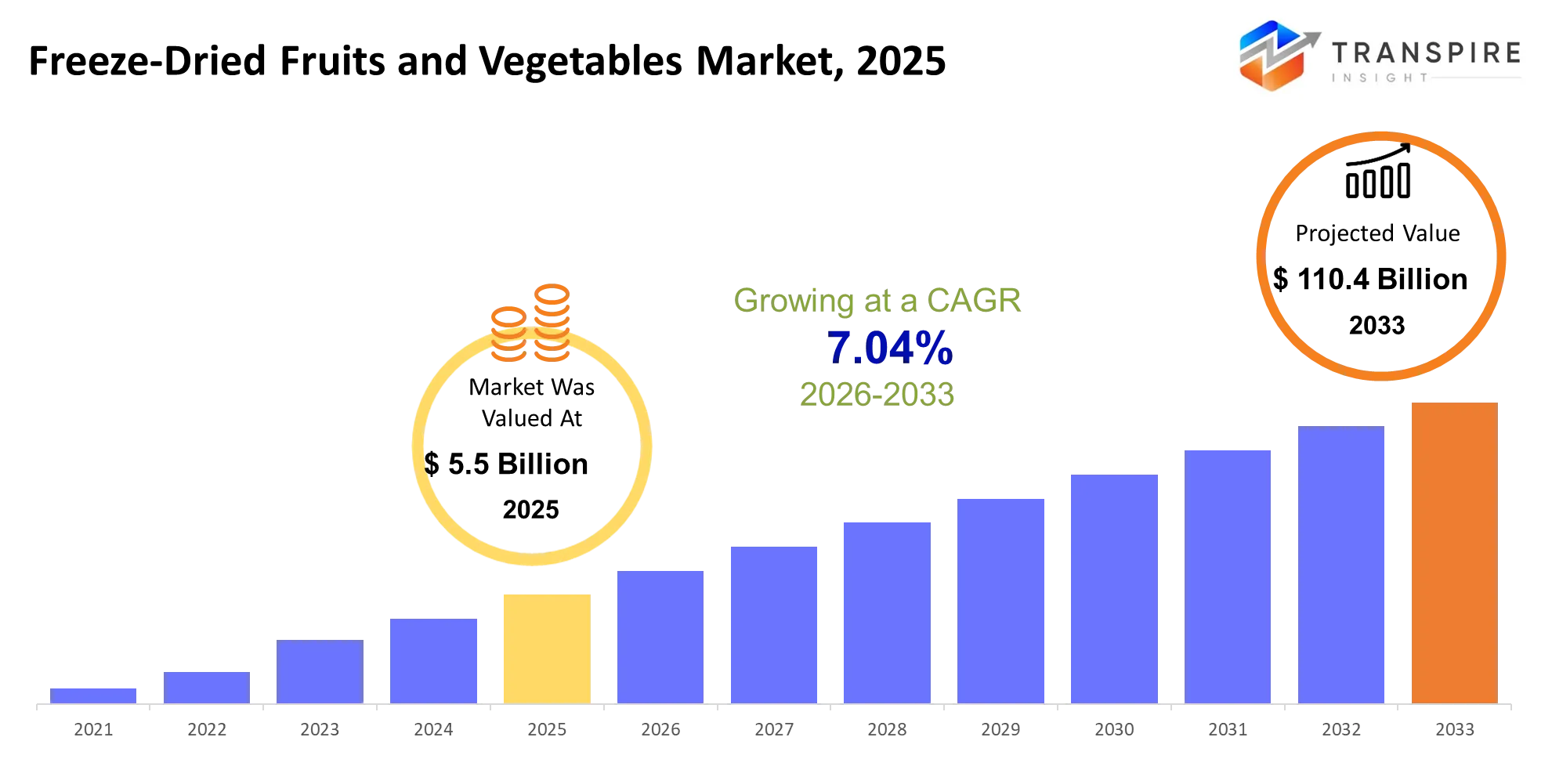
As Per the Transpire Insight, The Freeze-Dried Fruits and Vegetables Market size is estimated at USD 5.5 billion in 2025 and is anticipated to reach USD 5.9 billion by 2033, growing at a CAGR of 7.04% from 2026 to 2033.
The freeze-dried fruits and vegetables market supplies light, shelf-stable ingredients that preserve colour, aroma, nutrition, and texture without refrigeration. The market supports snack, cereal, bakery, beverage, ready-meal, infant-food brands, and foodservice operators. The market has shifted from a niche category used for camping and emergency foods to a mainstream clean-label ingredient category over the past three to five years, driven by consumer desire for recognisable ingredients and a reduction in artificial additives. A major structural change is the adoption of AI-assisted process control and hybrid drying technology with sensor-based control, reducing batch-to-batch variability, processing time, and energy use. Food safety and the industry's desire to replace petroleum-derived synthetic colourants with fruit and vegetable power disruptors such as fresh or freeze-dried carrot, beet, and turmeric. Cleaner labels increase demand for formulations with functional attributes, and more energy-efficient production equipment improves commercial viability across snacks, beverages, and convenience foods.
Freeze-Dried Fruits and Vegetables Market Size & Forecast:
- Market Size 2025: USD 5.5 Billion
- Expected Market Value (2033): USD 5.9 Billion
- Forecast CAGR (2026–2033): 7.04%
- Leading Region in 2025: North America
- Fastest Growing Region: Asia Pacific
- Key Company Profiles: Chaucer Foods, European Freeze Dry, Mercer Foods, OFD Foods, Freeze-Dry Foods, Paradise Fruits Solutions, Van Drunen Farms, Sosa Ingredients, Döhler, Kerry Group, Nutradry, Berrico Food Company, Harmony House Foods, Crispy Green, Brothers-All-Natural.
Key Freeze-Dried Fruits and Vegetables Market Insights:
The market is transitioning from preservation-driven supply to ingredient-driven innovation, with the use of freeze-dried produce for clean label colour, texture, nutrition and convenience. Traceable sourcing, formats for specific applications, and energy efficiency in processing are now the key to competitive advantage, not just drying capacity.
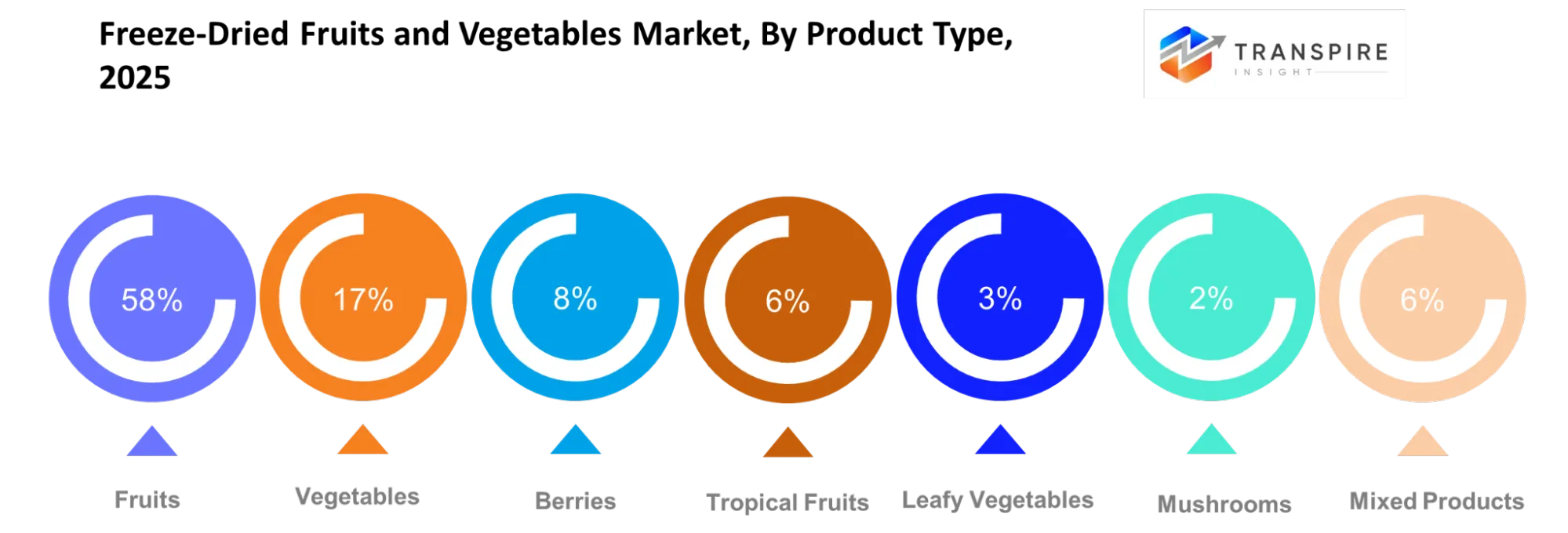
- Fruits occupy 58.5% of the market, as they better fit into premium snacks, cereals, bakery inclusions and beverages.
- Vegetables are used in 17.0%, including an increase in savoury ready meals, seasonings, soups and natural colour systems.
- Berries accounted for 8.5%, with demand for these unique, nutrient-rich additions to dairy and breakfast foods.
- Tropical fruits account for 6.5% and are benefiting from beverage and confectionery formulation trends as well as exotic-snack formulations.
- Chaucer Foods is developing further infant nutrition “melts” to adult wellness, smoothie bowls, and trail mixes.
- Chaucer Foods is also marketing fruit and vegetable powders for clean label drinks, supplements, and low-sugar products.
- In November 2025, OFD Foods launched a new product line of single-serve pouches of organic frozen sweet corn and broccoli for its retail business.
- Döhler is distinguishing itself with multi-sensory products like crunches, granulates, drops, bits, infused fruits and soft inclusions in bakery, snacks and ice cream.
- Kerry Group is growing its speciality ingredient portfolio in plant-based, functional, and clean-label applications, which is adding to the competitive landscape in formulated ingredient solutions.
What are the Key Drivers, Restraints, and Opportunities in the Freeze-Dried Fruits and Vegetables Market?
Driver:
Food manufacturers are reformulating products to reduce dependence on refrigerated ingredients and improve shelf stability. Disruptions in agricultural supply chains and seasonal crop availability have reinforced this shift because freeze-dried ingredients allow producers to maintain product formulations beyond harvest periods. This supports repeat ingredient purchases from cereal, snack, bakery, and beverage manufacturers. Government-backed food-processing infrastructure is another catalyst; India’s February 2026 food-processing policy update highlighted support for modern processing, value addition, and improved supply-chain infrastructure.
Restraint:
High capital and operating costs continue to limit growth. Freeze-drying requires prolonged freezing, vacuum pumping, and energy-intensive sublimation, making production costly relative to spray drying or air drying. The constraint persists because batch-based equipment, long cycle times, and specialised cold-chain sourcing create structural inefficiencies, especially for smaller processors and emerging-market suppliers.
Opportunity:
AI-enabled continuous freeze-drying can improve production economics by adjusting temperature, pressure, and moisture endpoints using real-time process data. Investment in continuous vacuum systems, heat recovery, and predictive maintenance can reduce energy waste, equipment downtime, and operating costs. Europe and North America offer near-term opportunities through premium clean-label ingredients and natural-colour applications. Meanwhile, Asia-Pacific can expand production through cost-efficient processing capacity, agricultural integration, and growing packaged-food manufacturing, helping suppliers convert seasonal produce into higher-value, shelf-stable ingredients.
Driver Impact Analysis — Freeze-Dried Fruits and Vegetables Market
|
Driver |
Relative Impact on Growth (%) |
Geographic Relevance |
Impact Timeline |
Demand Strength |
Growth Mechanism |
Key Beneficiaries |
Major Constraint |
|
Rising demand for healthy, convenient, minimally processed snacks |
28% |
North America, Europe, Asia-Pacific |
Short-term (≤2 years) |
High |
Preserves fruit structure, flavor, and nutrients without conventional frying |
Freeze-dried snack brands, fruit processors, retailers, consumers |
Premium pricing limits mass-market affordability |
|
Expanding use in packaged foods and industrial food ingredients |
24% |
North America, Europe, China, India |
Medium-term (2–4 years) |
High |
Enables stable inclusions in cereals, bakery, beverages, soups, and confectionery |
Ingredient manufacturers, food processors, bakery and beverage companies |
Reformulation costs and inconsistent raw-material quality |
|
Longer shelf life and reduced produce spoilage |
18% |
Europe, North America, Asia-Pacific |
Short-term (≤2 years) |
High |
Reduces moisture-driven spoilage and extends ambient storage periods |
Produce processors, food distributors, emergency food suppliers |
High processing costs and moisture-sensitive packaging |
|
Technological improvements in freeze-drying efficiency and capacity |
17% |
Europe, North America, China, India |
Long-term (≥4 years) |
High |
Improves drying efficiency, throughput, and consistency while reducing unit costs |
Freeze-drying equipment vendors, contract processors, large manufacturers |
High capital expenditure and energy consumption |
|
Growth in clean-label, organic, and sustainable food portfolios |
13% |
Europe, North America, Asia-Pacific |
Medium-term (2–4 years) |
Medium |
Supports preservative-free formulations and value-added produce utilisation |
Organic suppliers, premium food brands, sustainable ingredient processors |
Organic sourcing premiums and certification complexity |
|
Total |
100% |
Global |
— |
— |
— |
— |
— |
What Has the Impact of Artificial Intelligence Been on the Freeze-Dried Fruits and Vegetables Market?
Artificial intelligence-driven manufacturing will provide a step change to the fixed batch process for fruit and vegetable freeze-drying. By leveraging data on drying curve profile, chamber pressure, shelf temperature, fruit/vegetable thickness, and moisture activity, artificial intelligence and machine-learning models optimise sublimation conditions to avoid the waste product of over- and under-drying. Product quality is improved for colour, texture, rehydration, and nutrition, and batch rejection is minimised.
AI-powered automation includes computer vision and optical sensing to monitor product size, colour, and foreign materials before drying, and predictive models to extend predictive maintenance for vacuum pumps, compressors, refrigeration systems, and sensors. This reduces unplanned downtime that impacts product quality and adds food waste. Cloud-based monitoring also enables remote management of several plants and helps bolster supply chain traceability for buyers and regulators. The biggest challenge is cost and access to consistently high-quality data. Many freeze-drying process players use older equipment with patchy sensor deployment that hinders AI model training and validation. Until retrofit-ready sensor deployment, standardised data streams and continuous drying solutions are more affordable, ownership will remain limited to the largest ingredient producers.
In July 2026, Wave Trockensysteme GmbH (WAVE) partnered with Interkey to implement "Brain," an artificial intelligence-based industrial control system that generates machine logic from natural language descriptions rather than traditional PLC code.
Key Freeze-Dried Fruits and Vegetables Market Trends:
The market is evolving from preservation-driven supply to formulation-driven demand, positioning freeze-dried produce as a high-quality functional and visual ingredient. Today, technology, clean labelling, and convenience-driven consumption are changing the way procurement and product development are done.
- Freeze-dried fruit is no longer just an emergency food but a premium snack, cereal, bakery addition, or beverage garnish.
- As brands comply with regulatory requirements and consumers demand more transparency around ingredients, vegetable powders are taking the place of synthetic colourants.
- Clean label, non-GMO, organic, vegan and gluten-free are now more of a requirement than premium attributes when it comes to procurement.
- AI-driven monitoring is transforming production from experience-based batch control to predictive sensor-driven process optimisation.
- Manufacturers are experimenting with microwave-assisted and hybrid freeze-drying to cut cycles and energy costs.
- Supplier qualification, food-safety compliance and sourcing transparency are enhanced by digital traceability.
- Online retail is increasing consumer access, allowing for smaller packs, subscriptions, and speciality fruit varieties.
- There is a growing demand for lightweight, nutrient-rich vegetable and berry ingredients, including ready meals, infant nutrition and nutraceutical formats.
- Food processors are looking for suppliers who can provide them with consistent particle size, moisture content and rehydration characteristics at commercial levels, as well as consistent colour.
Freeze-Dried Fruits and Vegetables Market Segmentation
Product Type:
Fruit continues to rule the market with 58.5% (this dominance is supported by its use in high-end snacks, in cereals, as a decoration on bakery products, drinks, and confectionery). Berries cover 8.5% of this market while tropical fruits cover 6.5%, due to their attractive colours, unique flavour, and use in yoghurts, smoothies, or in highly convenient snacks. Vegetables take up 17.0% of the market with leafy vegetables 3.5%, mushrooms 2.5%, and mixed products 2.0%, which use to be used in main dishes, condiments, seasonings and functional powders. The use of vegetables in the future can expand into natural colouring, nutrient-rich products, and convenient plant-based foods, allowing processors to diversify beyond simple fruits.
Form:
Whole, sliced, and diced freeze-dried products serve retail snacking and visible food inclusions, offering recognisable appearance and convenient portioning. Powdered, granulated, crushed, and flaked formats support easier blending into beverages, bakery mixes, seasonings, and instant meals. Their commercial value depends on particle uniformity, moisture stability, and rehydration performance. Manufacturers are likely to prioritise application-specific formats that reduce formulation waste, improve production consistency, and meet customer specifications across retail and industrial food-processing operations.
Nature:
Conventional freeze-dried products support cost-sensitive procurement and large-volume food manufacturing. Organic, non-GMO, natural, clean-label, and vegan variants address specialised formulation requirements and consumer preferences for transparent ingredient lists. Gluten-free positioning can expand suitability for particular dietary applications when cross-contamination controls and labelling requirements are satisfied. Future opportunities depend on verified certifications, traceable sourcing, and consistent quality. Producers that substantiate product claims can differentiate their offerings, strengthen buyer confidence, and potentially secure premium contracts in specialised retail and ingredient markets.
Application:
Snacks benefit from portability and crisp texture, while cereals and bakery products use freeze-dried ingredients for colour, flavour, and visual appeal. Confectionery and dairy manufacturers incorporate fruit pieces and powders to differentiate formulations. Beverages require suitable particle sizes and dispersion characteristics, whereas ready meals prioritise storage stability and convenient preparation. Infant food applications demand particularly stringent safety and quality controls. Future growth will favour suppliers that customise ingredient specifications, demonstrate reliable performance, and meet application-specific manufacturing and regulatory requirements.
Distribution Channel:
Supermarkets, speciality stores, and convenience stores provide physical visibility and opportunities for consumers to compare packaged products. Online platforms extend geographical reach, support niche product discovery, and provide direct access to specialised freeze-dried snacks. Foodservice distributors, wholesalers, and direct-sales networks connect processors with industrial buyers requiring consistent volumes and specifications. Future channel development will depend on dependable fulfilment, appropriate packaging, and transparent product information. Manufacturers combining digital reach with established distribution partnerships can improve market access and respond more effectively to changing purchasing patterns.
End User:
Food manufacturers and ingredient suppliers generate recurring demand by incorporating freeze-dried ingredients into multiple product formulations. Beverage manufacturers use powders and fruit pieces, while bakeries and foodservice operators value convenient storage and controlled portioning. Retail consumers purchase ready-to-eat snacks, whereas nutraceutical companies may use selected fruit and vegetable ingredients in specialised formulations, subject to validated composition and quality requirements. Future growth will depend on dependable supply, consistent specifications, and competitive processing costs, enabling suppliers to serve diverse customer requirements without compromising product integrity.
What are the Key Use Cases Driving the Freeze-Dried Fruits and Vegetables Market?
The core use case is fruit-based snacking, supported by the 58.5% share attributed to fruits. Whole and sliced apples, bananas, strawberries, and other fruit varieties offer lightweight, shelf-stable alternatives to fresh snacks, while their crisp texture suits retail packs and lunchbox products.
Expanding applications include cereals, bakery toppings, confectionery, dairy products, beverages, and ready meals. Food manufacturers use freeze-dried pieces, flakes, and powders to add flavour, colour, and texture without introducing substantial moisture that could compromise product stability.
Emerging use cases include customised nutrition blends, plant-based meal formulations, emergency food supplies, and ingredient recovery from surplus seasonal produce. These applications create opportunities for processors to serve nutraceutical companies, foodservice operators, and export-oriented manufacturers seeking dependable ingredients with extended storage potential.
|
Report Metrics |
Details |
|
Market size value in 2025 |
USD 5.5 Billion |
|
Market size value in 2026 |
USD 5.9 Billion |
|
Revenue forecast in 2033 |
USD 110.4 Billion |
|
Growth rate |
CAGR of 7.04% from 2026 to 2033 |
|
Base year |
2025 |
|
Historical data |
2021 - 2024 |
|
Forecast period |
2026 - 2033 |
|
Report coverage |
Revenue forecast, competitive landscape, growth factors, and trends |
|
Regional scope |
United States; Canada; Mexico; United Kingdom; Germany; France; Italy; Spain; Denmark; Sweden; Norway; China; Japan; India; Australia; South Korea; Thailand; Brazil; Argentina; South Africa; Saudi Arabia; United Arab Emirates |
|
Key companies profiled |
Chaucer Foods, European Freeze Dry, Mercer Foods, OFD Foods, Freeze-Dry Foods, Paradise Fruits Solutions, Van Drunen Farms, Sosa Ingredients, Döhler, Kerry Group, Nutradry, Berrico Food Company, Harmony House Foods, Crispy Green, Brothers-All-Natural. |
|
Customization scope |
Free report customization (country, regional & segment scope). Available customised purchase options to meet your exact research needs. |
|
Report Segmentation |
Product Type (Fruits, Vegetables, Berries, Tropical Fruits, Leafy Vegetables, Mushrooms, Mixed Products, Others)Form (Whole, Sliced, Diced, Powdered, Granulated, Crushed, Flakes, Others)Nature (Conventional, Organic, Non-GMO, Natural, Clean-Label, Vegan, Gluten-Free, Others)Application (Snacks, Cereals, Bakery, Confectionery, Dairy, Beverages, Ready Meals, Infant Food)Distribution Channel (Supermarkets, Specialty Stores, Convenience Stores, Online, Foodservice, Direct Sales, Wholesalers, Others)End User (Food Manufacturers, Beverage Manufacturers, Retail Consumers, Foodservice Operators, Ingredient Suppliers, Bakeries, Nutraceutical Companies, Others). |
Which Regions are Driving the Freeze-Dried Fruits and Vegetables Market Growth?
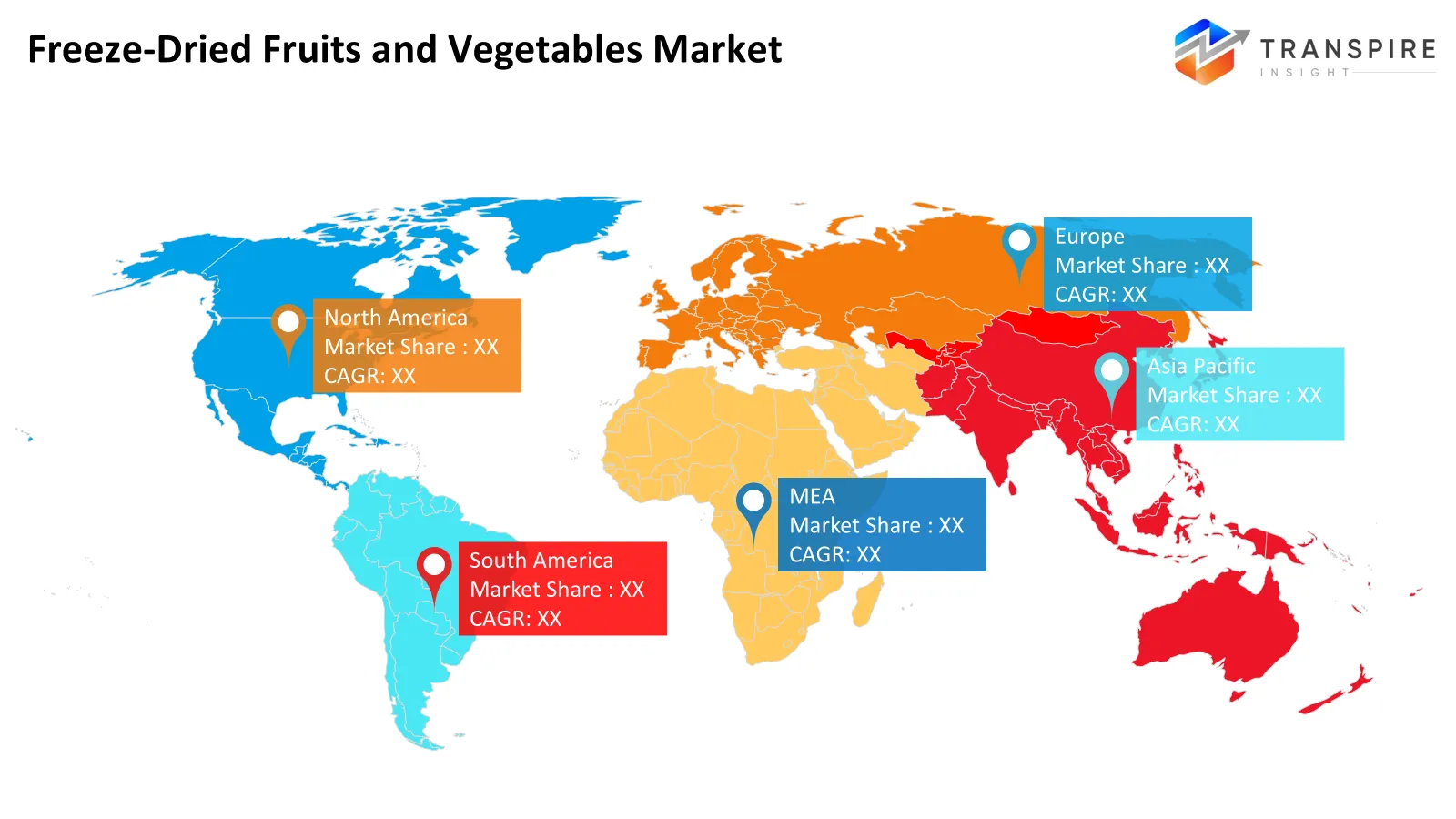
North America accounts for the largest market share at 35.4% due to its already existing demand for convenient, clean-label products and the presence of food manufacturers, nutraceuticals, and speciality retailers. North America benefits from mature cold-chain systems, established freeze-drying facilities and consumer willingness to buy organic, non-GMO, functional formats. Policies and retailer demands for fewer synthetics encourage brands to leverage fruit- and vegetable-based natural ingredients and give North America a sizeable, high-value consumption market as well as an innovation hub. (U.S. And Canada)
In October 2026, Megmilk Snow Brand Co., Ltd. launched its newly formed Functional Ingredients Group to accelerate the B2B sales of its science-driven nutraceutical ingredients.
https://nutraceuticalbusinessreview.com/megmilk-snow-brand-co-ltd-establishes-functional-ingredients
Europe has a 31.0% share in emerging markets with competitive advantage based on formulation depth rather than volume. The market has a strong focus on regulatory compliance, sustainability, traceability, and high-value clean label claims, increasing the demand for certified organic and natural ingredients. With strong food processing clusters, sustainable retailer policies, and ingredient suppliers such as Chaucer Foods, European Freeze Dry and Döhler, the European market has a mature regulatory landscape for reformulation and premium product launches.
In June 2026, Döhler acquired Nukoko, a UK-based food technology company specializing in bean-to-bar chocolate platforms. This strategic move enables the scale-up and commercialisation of a patent-pending, cocoa-free chocolate alternative derived from fava beans, delivering a sustainable, low-emission, and clean-label ingredient that directly addresses cocoa supply volatility and cost pressures for international confectionery and bakery brands.
Asia-Pacific has the highest CAGR of 10.1% and contributes 21.5% to the market. This region's recent growth was fueled by higher consumption of healthy convenience foods in the region's urban centres, rising disposable income, an increased penetration of online grocery shopping and growing investment in local fruit and vegetable processing. Unlike North America and Europe, the growth is driven by the scale of manufacturing, lower-cost supply chains and domestic demand for healthy snacks and ready-to-eat meals. The key future opportunities for the region are export-grade processing capacity, cold-chain reliability, and supply of brands with low-cost tropical fruit, vegetables, and tailor-made powders.
In October 2026, a consortium of leading ingredient and manufacturing giants—including AAK, Bühler, Givaudan, and Ingredion—launched the Healthy Snacks Challenge collaborative innovation partnership.
Who are the Key Players in the Freeze-Dried Fruits and Vegetables Market, and how do they compete?
The competitive landscape is segmented between ingredient specialisation, integrated food solution providers, and consumer-facing snack brands. Ingredient providers will compete on customisation, food safety, traceability, and technical services, whereas retail brands will compete on convenience, flavour, packaging, and clean-label attributes. We see the market now bifurcating between industrial formulation partnerships and direct-to-consumer luxury snack brands.
Chaucer Foods pursues an innovation strategy built on custom blends, private-label manufacturing, and sustainably sourced ingredients for snacks, beverages, meal kits, and infant nutrition. Its differentiator is defined by application-specific formats, such as its freeze-dried melts and powders that retain natural colour, flavour, and nutrition. Döhler's innovation strategy is focused on providing a wide range of applications for its offering, including freeze-dried fruits, powders, crunches, granulates, drops, bits, and fruit-infused products for bakery, cereal, confectionery, and ice cream, and seeking to help brands develop multi-sensory clean-label products. Kerry Group's strategy is an integrated one leveraging knowledge in taste, nutrition and functional ingredients to support plant-based and clean-label reformulation. OFD Foods leverages consumer-ready emergency and outdoor food formats to broaden retail access with single-serve organic vegetable pouches. Mercer Foods, European Freeze Dry, Freeze-Dry Foods, Paradise Fruits Solutions, Van Drunen Farms, Nutradry and Berrico Food Company apply crop-unique expertise, private-label manufacturing, and custom ingredient supply. Crispy Green, Brothers-All-Natural and Harmony House Foods focus on consumer convenience, transparent ingredient labelling and e-commerce distribution.
Key Players are:
- Chaucer Foods
- European Freeze Dry
- Mercer Foods
- OFD Foods
- Freeze-Dry Foods
- Paradise Fruits Solutions
- Van Drunen Farms
- Sosa Ingredients
- Döhler
- Kerry Group
- Nutradry
- Berrico Food Company
- Harmony House Foods
- Crispy Green
- Brothers-All-Natural
Freeze-Dried Fruits and Vegetables Market — Enhanced Competitive Benchmarking
|
Company |
Est. Revenue Share Range |
Key Offerings |
Strategic Positioning |
Geographic Strength |
Technology Focus |
|
Van Drunen Farms |
12.1–14.0% |
Freeze-dried fruits, vegetables, herbs, organic ingredients |
Vertically integrated sourcing and customised ingredient solutions |
North America, Europe, Asia Pacific |
Vacuum sublimation, traceability, multi-format processing |
|
OFD Foods (Oregon Freeze Dry) |
8.0–10.0% |
Freeze-dried fruit and vegetable ingredients, shelf-stable food products |
Scalable freeze-drying expertise and institutional customer relationships |
North America, international export markets |
Industrial lyophilisation, moisture control, shelf-life preservation |
|
Chaucer Foods |
8.0–10.0% |
Fruit pieces, vegetable powders, organic fruit, snack melts |
Large-scale ingredient supply with customised product development |
Europe, North America, Asia Pacific |
Multi-site freeze-drying, powder processing, flexible packaging |
|
European Freeze Dry |
6.0–8.0% |
Freeze-dried fruits, vegetables, powders, foodservice ingredients |
Specialist processing for industrial and consumer food applications |
Europe, North America |
Low-temperature dehydration, rehydration optimisation, quality control |
|
Freeze-Dry Foods GmbH |
5.0–7.0% |
Freeze-dried fruits, vegetables, herbs, spices, superfoods |
Broad ingredient portfolio serving food manufacturers |
Europe, North America, Latin America |
Ingredient fractionation, freeze-drying, blending |
|
Mercer Foods |
3.0–5.0% |
Freeze-dried fruits, vegetables, fruit powders, custom ingredients |
Flexible contract manufacturing and customized ingredient supply |
North America, Europe |
Vacuum freeze-drying, custom sizing, powder production |
|
Paradise Fruits Solutions |
2.0–4.0% |
Freeze-dried fruit pieces, fruit preparations, ingredient inclusions |
Application-led differentiation for confectionery and food producers |
Europe, North America |
Fruit processing, ingredient formulation, texture optimization |
|
Döhler Group |
1.0–3.0% |
Freeze-dried fruit ingredients, fruit preparations, natural food ingredients |
Integrated ingredient solutions and customer-specific formulation |
Europe, Asia Pacific, North America |
Ingredient formulation, drying-process integration, application development |
|
Crispy Green |
0.5–2.0% |
Crispy Fruit freeze-dried fruit snacks, single-ingredient fruit products |
Consumer-brand differentiation through convenient fruit snacking |
North America, selected export markets |
Freeze-drying for crisp texture, portion-focused packaging |
|
Harmony House Foods |
0.5–2.0% |
Freeze-dried vegetables, fruit ingredients, vegetable blends |
Specialty retail and food-preparation ingredients for convenience-focused buyers |
North America, selected international markets |
Freeze-drying, ingredient blending, shelf-stable packaging |
Recent Development News
- In May 2026, BranchOut Food reported expanding its partnership with a major warehouse-club retailer through additional regional programs, new product launches, and broader retail distribution. The company secured a regional launch of its mango chips in the San Francisco Bay Area and received an additional pineapple chips order, supporting wider distribution of shelf-stable fruit snacks and creating further opportunities for product-line expansion. https://www.globenewswire.com/news-release/2026/05/14/3294881/0/en/BranchOut-Food-Shareholder-Update-Record-Production-and-Major-Customer-Deliveries-Position-Company-for-Record-Q2.html
- In July 2026, Avio Smart Market Stack Limited signed a memorandum of understanding (MoU) with the Government of Tripura to establish a freeze-drying facility for fruits and vegetables. The project is expected to reduce post-harvest losses, improve the shelf life and marketability of locally grown produce, and create approximately 1,300 direct and indirect employment opportunities, strengthening regional fruit and vegetable processing capacity. https://manufacturing.economictimes.indiatimes.com/amp/news/hi-tech/avio-smart-market-stack-partners-with-tripura-to-launch-innovative-freeze-drying-facility/132382610
- In June 2026, Nothing But, an Indian freeze-dried fruit snack startup, secured an undisclosed seed funding round from investors including Atul Rajani, Deeksha Rajani, Sifat Khurana, Dhruv Bhasin, Gaurav Khatri, and Saurav Adlakha. The funding is intended to strengthen manufacturing and supply capabilities, expand distribution through quick-commerce platforms and online marketplaces, and support new product development, improving the startup’s ability to reach consumers seeking convenient fruit-based snacks. https://app.dealroom.co/news/note/indian-fruit-snack-startup-nothing-but-lands-seed-round-from-notable-founders
What Strategic Insights Define the Future of the Freeze-Dried Fruits and Vegetables Market?
The future of the market is returning towards application-specific ingredients platforms. Here, suppliers are meeting success through offering verified colour stability, particle-size control, rehydration performance, and traceable sourcing, rather than commodity dried produce. Growth will come increasingly from beverages, functional snacks, infant nutrition and clean-label reformulation. An intrinsic risk is exposure to energy costs: freeze-drying is capital- and energy- intensive. Suppliers without process optimisation or heat-recovery features will face margin pressure as retailer pricing creeps up. An emerging opportunity is AI-enabled and hybrid drying, which may shorten cycle times, improve batch-to-batch consistency and make mid-sized processors more competitive. Companies should be focusing on traceable sourcing, energy-efficient capacity, and co- development partnerships with food and drink brands. It will be the suppliers that can turn freeze-dried produce into ready-to-use, clean-label formulations that will be best placed to defend themselves.
Key Segmentations are:
Product Type
- Fruits
- Vegetables
- Berries
- Tropical Fruits
- Leafy Vegetables
- Mushrooms
- Mixed Products
- Others
Form
- Whole
- Sliced
- Diced
- Powdered
- Granulated
- Crushed
- Flakes
- Others
Nature
- Conventional
- Organic
- Non-GMO
- Natural
- Clean-Label
- Vegan
- Gluten-Free
- Others
Application
- Snacks
- Cereals
- Bakery
- Confectionery
- Dairy
- Beverages
- Ready Meals
- Infant Food
Distribution Channel
- Supermarkets
- Speciality Stores
- Convenience Stores
- Online
- Foodservice
- Direct Sales
- Wholesalers
- Others
End User
- Food Manufacturers
- Beverage Manufacturers
- Retail Consumers
- Foodservice Operators
- Ingredient Suppliers
- Bakeries
- Nutraceutical Companies
- Others
By Regional Analysis
North America
- US
- Canada
- Mexico
Europe
- Germany
- UK
- France
- Italy
- Spain
- Russia
- Rest of Europe
Asia Pacific
- China
- Japan
- India
- South Korea
- Australia
- Rest of Asia Pacific
South America
- Brazil
- Argentina
- Rest of South America
Middle East & Africa
- UAE
- Saudi Arabia
- Qatar
- South Africa
- Rest of the Middle East & Africa
Frequently Asked Questions
Find quick answers to common questions.
The freeze-dried fruits and vegetables market size was valued at USD 5.5 billion in 2025 and is poised to reach USD 9.5 billion by 2033, expanding at a 7.04% CAGR.
Key segments for the freeze-dried fruits and vegetables market are Product Type (Fruits, Vegetables, Berries, Tropical Fruits, Leafy Vegetables, Mushrooms, Mixed Products, Others)Form (Whole, Sliced, Diced, Powdered, Granulated, Crushed, Flakes, Others)Nature (Conventional, Organic, Non-GMO, Natural, Clean-Label, Vegan, Gluten-Free, Others)Application (Snacks, Cereals, Bakery, Confectionery, Dairy, Beverages, Ready Meals, Infant Food)Distribution Channel (Supermarkets, Specialty Stores, Convenience Stores, Online, Foodservice, Direct Sales, Wholesalers, Others)End User (Food Manufacturers, Beverage Manufacturers, Retail Consumers, Foodservice Operators, Ingredient Suppliers, Bakeries, Nutraceutical Companies, Others).
Growth is primarily driven by demand for shelf-stable snack ingredients, clean-label food formulations, convenient ready meals, reduced post-harvest losses, and wider use of freeze-dried produce in cereals, bakery products, beverages, and confectionery.
The freeze-dried fruits and vegetables market is led by major manufacturers, including Chaucer Foods, European Freeze Dry, Mercer Foods, OFD Foods, Freeze-Dry Foods, Paradise Fruits Solutions, Van Drunen Farms, Sosa Ingredients, Döhler, Kerry Group, Nutradry, Berrico Food Company, Harmony House Foods, Crispy Green, Brothers-All-Natural.
North America influences market dynamics through established food-processing infrastructure, strong demand for convenient snacks, advanced preservation technologies, and extensive retail and e-commerce distribution networks.
Commercial opportunities include energy-efficient processing, organic and clean-label product development, AI-enabled quality control, value-added fruit and vegetable powders, and regional facilities that convert surplus produce into shelf-stable ingredients.
- Chaucer Foods
- European Freeze Dry
- Mercer Foods
- OFD Foods
- Freeze-Dry Foods
- Paradise Fruits Solutions
- Van Drunen Farms
- Sosa Ingredients
- Döhler
- Kerry Group
- Nutradry
- Berrico Food Company
- Harmony House Foods
- Crispy Green
- Brothers-All-Natural
About the Authors

Chetan Dhatrak
I’m Chetan Dhatrak, a Senior Research Analyst at Transpire Insight, specializing in the Consumer Goods, Foods and Beverages industry. I focus on analyzing market trends, consumer behavior, competitive landscapes, and industry developments to deliver accurate, data-driven insights. My research at Transpire Insight is built on credible sources and in-depth analysis, helping businesses and readers better understand market dynamics, emerging opportunities, and evolving consumer preferences. I’m committed to creating reliable, well-researched content that supports informed decision-making and reflects the latest developments in the consumer goods and food & beverage sectors.

Chakradhar Khansole
Chakradhar serves as the Research Director at Transpire Insight, bringing over 8 years of experience in technology, innovation, and strategic market intelligence. He specializes in transforming complex market data into actionable business insights that enable organizations to make informed, growth-oriented decisions. Recognized for his strategic vision and analytical expertise, Chakradhar leads high-impact research initiatives, delivering comprehensive market assessments, competitive intelligence, and forward-looking industry analysis.
Recently Published Reports
-
Apr 2026
Baby Infant Formula Market
Baby Infant Formula Market Size, Share & Analysis Report By ype (Infant Milk, Follow On Milk, Specialty Baby Milk, Growing-Up Milk), By Ingredient (Carbohydrate, Fat, Protein, Minerals, Vitamins, and Others), By Product Form (Powder, Liquid, and Ready-to-feed), By Distribution Channels (Supermarket/Hypermarket, Specialty Store, Pharmacies, Online Retail, and Others), and Geography (North America, Europe, Asia-Pacific, Middle East and Africa, South and Central America), 2021 - 2031
-
Apr 2026
Edible Insects for Animal Feed Market
Edible Insects for Animal Feed Market Size, Share & Analysis Report By Type (Insect Powder, Insect Meal, Insect Bar, Insect Paste, Insect Oil, and Others), By Insect Type (Beetles, Cricket, Caterpillar, Hymenoptera, Orthoptera, Tree Bugs, and Others), By Application (Livestock, Pet Food, and Aquaculture), By Livestock Type (Poultry, Swine, and Others), and Geography (North America, Europe, Asia-Pacific, Middle East and Africa, South and Central America), 2021 - 2031
-
Apr 2026
Food Industry Disinfection and Bacterial Control Market
Food Industry Disinfection and Bacterial Control Market Size, Share & Analysis Report By Type (Chemical Disinfectants, Physical Disinfectants, and Biocides and Antimicrobials), By Application (Food Processing Equipment Surface Disinfection, Food Preparation Areas Surface Disinfection, Storage Areas Surface Disinfection, Anti-microbial Coatings Food Preservation, and Preservative Solutions Food Preservation), By End User (Meat and Poultry Processing, Dairy Processing, Seafood Processing, Bakery and Confectionery, Restaurants and Commercial Kitchens, and Food Service Providers), By Sales Channel (Online, Offline), and Geography (North America, Europe, Asia-Pacific, Middle East and Africa, South and Central America), 2021 - 2031
-
May 2026
Freeze Dried Food Market
Freeze Dried Food Market Size, Share & Analysis Report By Product Type (Fruits, Vegetables, Freeze-Dried Dairy Products, Freeze-Dried Meat and Seafood, Freeze-Dried Pet Food, and Prepared Meal), By Nature (Organic, and Conventional), By Form (Powdered, Granules, and Diced), By End Use (Breakfast Cereals, Dairy Products, Bakery & Confectionery, Nutritional Bars & Supplements, Powdered Beverages, Snacks, and Retail (Household)), and Geography (North America, Europe, Asia-Pacific, Middle East and Africa, South and Central America), 2021 - 2031