
France Temperature-Responsive Polymers Market Size & Forecast:
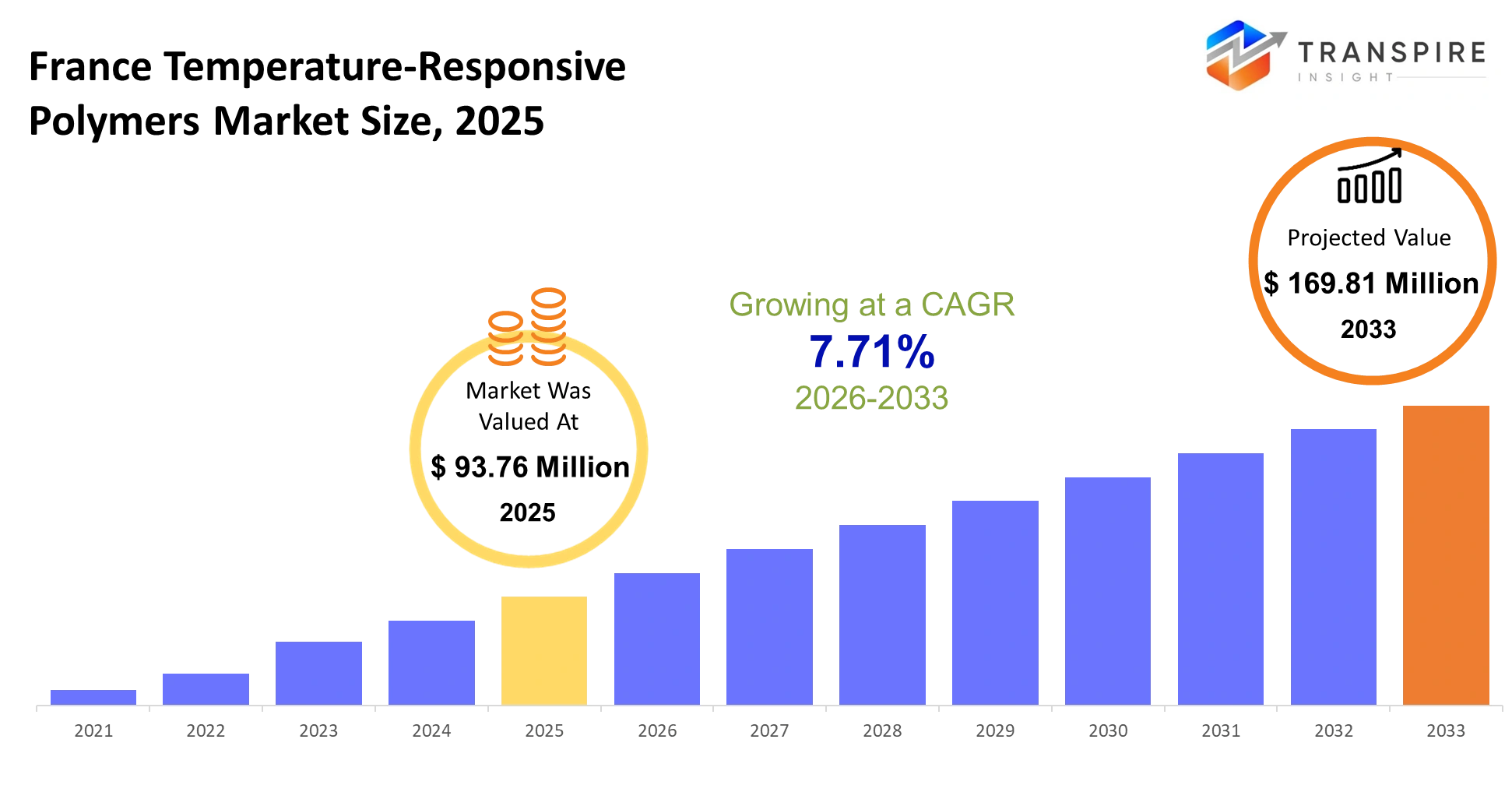
- France Temperature-Responsive Polymers Market Size 2025: USD 93.76 Million
- France Temperature-Responsive Polymers Market Size 2033: USD 169.81 Million
- France Temperature-Responsive Polymers Market CAGR: 7.71%
- France Temperature-Responsive Polymers Market Segments: By Type (LCST Polymers, UCST Polymers, Others); By Application (Drug Delivery, Tissue Engineering, Coatings, Sensors, Others); By End-User (Healthcare, Chemical Industry, Research Institutes, Industrial Sector, Others); By Form (Hydrogels, Films, Solutions, Others)
To learn more about this report,  Download Free Sample Report
France Temperature-Responsive Polymers Market Summary
The France Temperature-Responsive Polymers Market was valued at USD 93.76 Million in 2025. It is forecast to reach USD 169.81 Million by 2033. That is a CAGR of 7.71% over the period.
The France Temperature-Responsive Polymers Market serves essential functions in advanced drug delivery systems, smart coating technologies, biomedical medical devices, and industrial filtration systems which require materials to respond accurately to temperature alterations. The polymers enable manufacturers to achieve better product performance while minimizing waste and creating flexible operational capabilities in healthcare, automotive, and specialty packaging industries. The market has transitioned between five years from laboratory research to commercial deployment which focuses on pharmaceutical and tissue engineering fields.
The stronger focus of France on high-value biomaterials together with precision medicine research advanced this development while the post-pandemic healthcare supply chain challenges forced pharmaceutical companies to develop domestic sources for advanced materials and create new responsive polymer technologies. The research partnerships between French universities and specialty chemical producers experienced major growth after 2021. Temperature-responsive polymers have transitioned from specialized research products to commercial use because industrial and healthcare manufacturers require advanced materials that provide controlled performance capabilities, which generates more predictable revenue streams for companies that produce specialty polymers and biomedical products.
Key Market Insights
- The France Temperature-Responsive Polymers Market distribution reached 38% through pharmaceutical manufacturing operations which concentrated their activities in Northern France during 2025.
- The Western France market will experience its fastest growth between now and 2033 because of biotechnology funding and academic research partnerships.
- The product market for Poly(N-isopropylacrylamide) materials maintained its top position because of their extensive application in controlled drug delivery systems and bioseparation technologies.
- Hydrogel-based temperature-responsive polymers represented the second-largest segment which grew because of regenerative medicine and wound-care product development.
- The biodegradable smart polymers category shows the fastest growth rate which will continue until 2033 because of new biomedical material performance requirements.
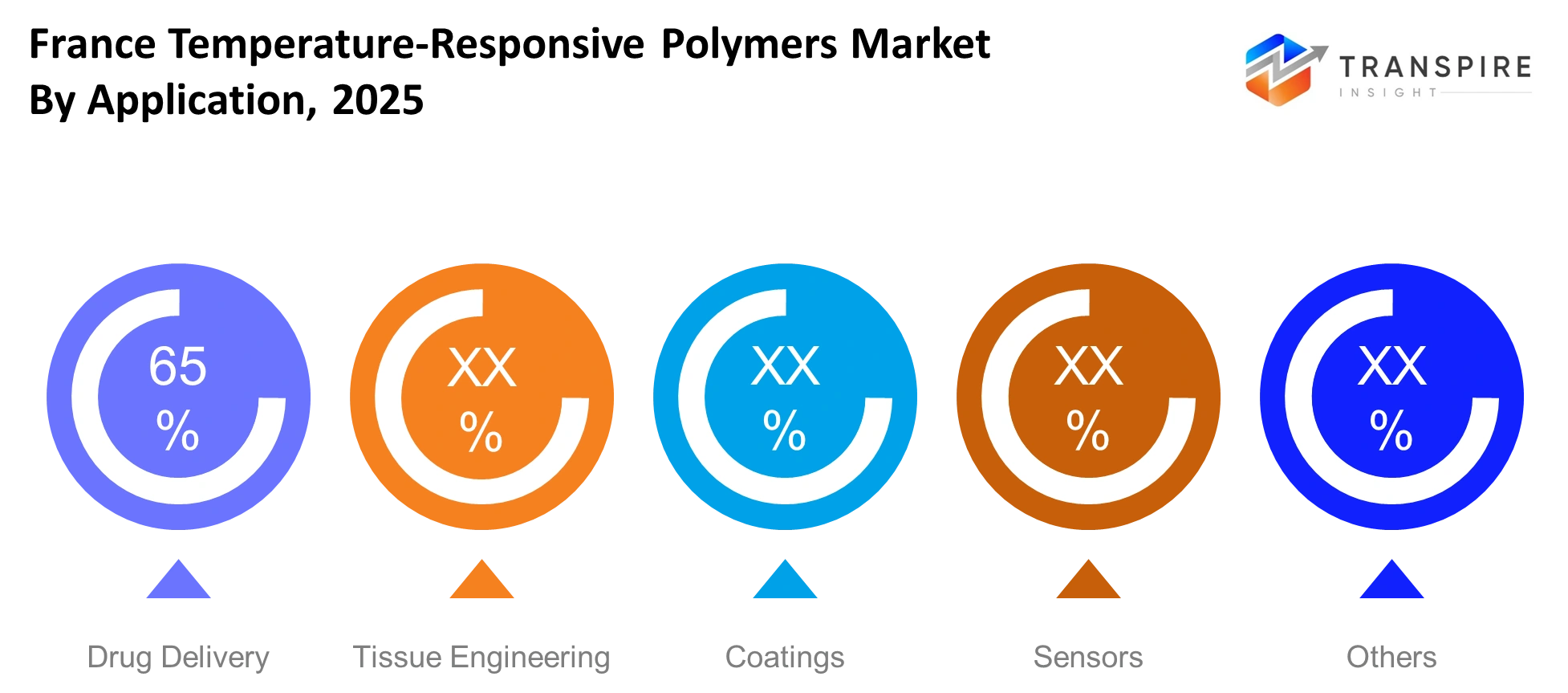
- The France Temperature-Responsive Polymers Market generated 34% of its revenue from drug delivery applications because precision therapeutics became more common in 2025.
- French healthcare research institutes expanded their regenerative medicine funding after 2022 which caused tissue engineering applications to grow at their fastest rate.
- The pharmaceutical industry continued to function as the primary customer base because companies increased their investments in smart biomaterials and responsive therapeutic solutions.
- The biotechnology startup market in France is experiencing rapid growth because investors are showing increased interest in responsive biomaterial development platforms.
- The manufacturing process now depends on AI-assisted polymer modeling and automated synthesis platforms which help companies achieve faster material development while enhancing their formulation accuracy.
What are the Key Drivers, Restraints, and Opportunities in the France Temperature-Responsive Polymers Market?
The France Temperature-Responsive Polymers Market grows because precision drug delivery systems and regenerative medicine methods become commercially available. French pharmaceutical manufacturers and biomedical research institutions have intensified investment in smart biomaterials capable of controlled therapeutic release under specific temperature conditions. The healthcare industry began to concentrate on targeted therapies and minimally invasive treatments because of the pandemic. Temperature-responsive polymers enable drug formulations to release active compounds at precise biological temperatures which helps doctors treat patients more effectively while reducing medication side effects.
The most significant restraint is the high production complexity associated with specialty responsive polymers. Advanced synthesis methods and strict purity control and highly specialized testing infrastructure are required for manufacturing these materials. The structural restrictions of biomedical-grade polymers which need regulatory approval create higher production expenses and longer time periods until they become available in the market. Smaller manufacturers would face difficulties when trying to increase their production capacity because this problem causes mid-sized industrial applications to experience slow growth in revenue and market adoption of their products.
Smart wearable healthcare devices and implantable biomedical systems present a substantial business opportunity. French research centers and medtech companies are actively developing temperature-sensitive hydrogels and adaptive biomaterials for real-time therapeutic monitoring. The healthcare manufacturing clusters across high-value regions benefit from personalized medicine platforms and bioelectronic devices which create better conditions for implementing next-generation responsive polymer technologies.
What Has the Impact of Artificial Intelligence Been on the France Temperature-Responsive Polymers Market?
The France Temperature-Responsive Polymers Market experiences transformation through artificial intelligence and advanced digital technologies because these technologies drive material discovery and enhance manufacturing precision and boost product performance assessment. Machine learning models now enable specialty chemical producers and biomedical research organizations to study polymer behavior under different thermal conditions without conducting physical tests. The approach enables pharmaceutical and medical development processes to advance faster by shortening development time and reducing the need for experimental testing.
Polymer synthesis and quality control processes experience improvements through AI-driven automation systems. Manufacturers use predictive analytics to monitor reaction stability, molecular consistency, and temperature sensitivity during production, which leads to material defects reduction and batch failure costs minimization. Digital modeling tools enable biomedical researchers to enhance hydrogel responsiveness for drug release and tissue engineering optimization. The technologies enable organizations to achieve better operational efficiency while they expedite their regulatory validation and product launch processes.
Advanced data platforms enable industrial production equipment operators to implement predictive maintenance which results in reduced equipment downtime and increased production capacity at specialty polymer manufacturing facilities. Several French laboratories now use digital twin technologies to create polymer behavior models that simulate real-world biomedical environments before clinical testing begins.
The practical challenges of AI adoption create obstacles for organizations. High integration costs and fragmented experimental datasets together with inconsistent real-world biological performance create challenges for model training. The smaller polymer manufacturers face difficulties because they lack both digital infrastructure and specialized knowledge.
Key Market Trends
- The French pharmaceutical industry began to purchase smart biomaterials from local sources after 2021 because they wanted to decrease their reliance on Asian specialty polymer imports.
- The French biomedical manufacturing sector started to use hydrogel-based responsive materials after funding for regenerative medicine research expanded throughout the country between 2022 and 2025.
- The French specialty chemical industry established more partnerships with universities to commercialize temperature-sensitive polymer technologies which researchers developed in laboratory settings.
- The clinical development of precision therapeutics and targeted drug delivery systems led to a major increase in demand for injectable smart polymer systems.
- The use of AI-based polymer modeling tools in development procedures helped manufacturers to shorten their experimental testing periods during formulation and thermal response evaluations.
- French biotech startups started to develop biodegradable responsive polymers after the European Union implemented stricter biomedical compliance requirements in 2023.
- Arkema and BASF boosted their research funding for specialty polymers to improve their market position in manufacturing advanced healthcare materials.
- Industrial filtration companies started using adaptive polymer membranes to enhance their thermal stability and operational efficiency during chemical production processes.
- The medical field experienced rapid growth in tissue engineering because hospitals and research institutions developed advanced wound healing and regenerative treatment technologies.
- Polymer suppliers increasingly pursued long-term pharmaceutical supply agreements instead of short-term research contracts to stabilize recurring revenue streams.
France Temperature-Responsive Polymers Market Segmentation
By Type
The market leadership of LCST polymers stems from their widespread adoption by pharmaceutical companies and biomedical researchers who use these materials for temperature-responsive drug delivery systems and hydrogel applications. The commercial value of LCST materials arises from their strong capability to respond to human body temperatures which makes them suitable for therapeutic uses and tissue scaffolding and injectable biomedical applications. The healthcare materials market in France grows stronger because research funding supports ongoing projects while pharmaceutical companies increase their material demand.
The market share of UCST polymers remains smaller than other products but they maintain technical significance through their use in controlled separation systems and smart coatings and industrial processing technologies. The healthcare use of LCST alternatives becomes limited because they show less responsiveness under actual human body conditions. The industry and specialty chemical markets receive funding because demand for advanced filtration systems and adaptive material systems continues to grow.
The field of material science now experiences expansion in its "others" category which includes dual-responsive and hybrid smart polymers through research work that focuses on developing specific applications. Research institutions and specialized polymer manufacturing companies develop multifunctional systems which can detect both temperature changes and pH or light variations. Product developers plan to create customized polymer architectures during the forecast period in order to achieve better precision and scalability and compatibility with future biomedical technologies.
By Application
The drug delivery system holds the top market position because pharmaceutical companies now require temperature-sensitive polymers to create systems which deliver medications at controlled rates and to develop precise medical treatments. Smart polymer systems enable better drug delivery results by decreasing negative effects and providing effective treatment solutions to oncology and biologics and injectable drug delivery systems. The ongoing development of personalized healthcare technologies has created strong demand for procurement needs in this specific application area.
Tissue engineering has become a rapidly expanding industry because hospitals and biotechnology companies and medical research institutions are now developing regenerative medicine solutions. Temperature-responsive hydrogels have started to establish their presence in wound healing and cell scaffolding and bioactive implant applications because these materials can effectively adapt to human body temperature changes. Industrial manufacturers are increasing their use of coatings applications because they want adaptive surfaces which provide better protection against thermal damage and corrosion while maintaining performance during challenging production conditions.
The development of sensors and smart monitoring technologies which use responsive materials in healthcare wearables and industrial automation systems will emerge as a significant growth area for future markets. The "others" category which includes adaptive packaging and responsive filtration systems continues to draw specialized manufacturing investments from niche research laboratories. The forecast period will show application development progress toward building multifunctional biomedical systems and intelligent industrial material platforms.
To learn more about this report, Download Free Sample Report
By End-User
The main users of temperature-responsive polymers which pharmaceutical companies and hospitals and biomedical manufacturers use their products make healthcare the top sector of their businesses. The healthcare sector in France needs materials for three applications which are precision drug delivery systems and regenerative medicine and minimally invasive treatment methods. The medical technology sector benefits from governmental funding which promotes advanced medical systems and increased financial support for biotechnology research which establishes a foundation for permanent technology adoption.
The chemical industry maintains its market stability because companies use responsive polymers to develop separation technologies and specialty coatings and adaptive industrial materials. Industrial sector demand is also expanding steadily as manufacturers integrate smart polymers into filtration systems packaging technologies and temperature-sensitive processing environments. Research institutes continue to shape material innovation at early development stages because they provide laboratory development support and commercialization assistance to specialty polymer manufacturers.
Environmental technology companies and advanced electronics developers from the "others" category now increase their funding for responsive material systems which enable new applications. The end-user demand will become more diverse during the forecast period because smart healthcare devices and wearable technologies and industrial automation systems will create new market opportunities for adaptive polymer materials.
By Form
The market for hydrogels remains most competitive because biomedical manufacturers and pharmaceutical companies utilize these materials for drug delivery and tissue engineering and wound-care applications. Hydrogels possess advanced healthcare applications because they retain high water content and match biological materials and their structures change according to temperature. The rising development of injectable therapeutic systems and expanding regenerative medicine research continue to drive strong growth for this particular market segment.
Films maintain a significant market share because the demand for smart coatings and packaging systems and sensor technologies that need thermal control capacity continues to rise. Industrial manufacturers increasingly adopt responsive polymer films because these materials enhance their products' durability and barrier performance and adaptive material behavior under changing environmental conditions. The research laboratories and specialty chemical manufacturers need flexible processing formats which Solutions-based formulations can provide for their experimental development and industrial integration requirements.
The "others" category which includes nanoparticles and fibers and composite responsive structures has developed into a niche market that now shows increasing innovation potential across biomedical and industrial applications. The material developers need to concentrate on developing better scalability solutions and more accurate structural control methods and new multifunctional responsive systems during the upcoming forecast period. The growing demand for wearable healthcare systems and smart industrial materials will create new business opportunities for advanced polymer manufacturing technologies.
What are the Key Use Cases Driving the France Temperature-Responsive Polymers Market?
The main usage for temperature-responsive polymers in France operates through controlled drug delivery systems which pharmaceutical companies use. French pharmaceutical manufacturers increasingly use temperature-sensitive polymers to release active compounds at precise body temperatures which enables them to achieve better therapeutic results while decreasing the number of doses needed. The application generates maximum demand through its ability to support high-value biologics and injectable therapeutics and precision medicine platforms which require consistent treatment to achieve successful patient results.
The field now extends its applications to both tissue engineering and advanced wound-care products which hospitals and biotechnology firms currently use. Biomedical manufacturers are integrating smart hydrogels into regenerative medicine products that adapt to physiological temperature changes during healing and tissue repair. Responsive polymer membranes now serve as an essential technology for industrial filtration companies because these membranes enhance separation performance during chemical and water treatment operations.
The medical field is developing new applications for smart wearable healthcare devices and bioelectronic implants which can detect temperature changes in real time. French researchers are investigating responsive polymers for two applications which include soft robotics and temperature-sensitive pharmaceutical logistics through protective packaging materials.
|
Report Metrics |
Details |
|
Market size value in 2025 |
USD 93.76 Million |
|
Market size value in 2026 |
USD 100.99 Million |
|
Revenue forecast in 2033 |
USD 169.81 Million |
|
Growth rate |
CAGR of 7.71% from 2026 to 2033 |
|
Base year |
2025 |
|
Historical data |
2021 - 2024 |
|
Forecast period |
2026 - 2033 |
|
Report coverage |
Revenue forecast, competitive landscape, growth factors, and trends |
|
Regional scope |
France |
|
Key company profiled |
BASF, Dow, Evonik, Merck, Akzo Nobel, Ashland, Lubrizol, Solvay, Clariant, Huntsman, DSM, SABIC, Mitsubishi Chemical, Kuraray, Arkema |
|
Customization scope |
Free report customization (country, regional & segment scope). Avail customized purchase options to meet your exact research needs. |
|
Report Segmentation |
By Type (LCST Polymers, UCST Polymers, Others); By Application (Drug Delivery, Tissue Engineering, Coatings, Sensors, Others); By End-User (Healthcare, Chemical Industry, Research Institutes, Industrial Sector, Others); By Form (Hydrogels, Films, Solutions, Others) |
Which Regions are Driving the France Temperature-Responsive Polymers Market Growth?
Northern France serves as the primary regional market because it has numerous pharmaceutical manufacturing facilities and biomedical laboratories and specialty chemical production sites. The region benefits from established industrial infrastructure which provides advanced logistics connectivity and supports research institutions to work together with polymer manufacturers. Government-supported innovation initiatives for biomaterials and healthcare technologies have enhanced the region's implementation of responsive polymers. The pharmaceutical companies located near Paris and Lille drive demand for advanced smart materials which they use in their targeted therapeutics and medical devices.
The specialized chemical manufacturing industry and industrial processing capabilities of Eastern France generate continuous market revenue for the region. The region develops through industrial applications in coatings and membranes and advanced manufacturing materials because it does not rely on pharmaceutical growth for development. The region benefits from stable cross-border trade links with Germany and Switzerland which support specialty polymer supply chains and technology transfer partnerships. The ongoing financial support from multinational chemical producers has established a manufacturing foundation which enables long-term production of high-performance polymers.
Western France has become the fastest developing area because biotechnology investments are increasing and medtech research activities are growing. The regional innovation clusters expanded their budget for regenerative medicine and wearable healthcare technologies after 2023 which created fresh possibilities for developers of responsive biomaterials.
Who are the Key Players in the France Temperature-Responsive Polymers Market and How Do They Compete?
The France Temperature-Responsive Polymers Market demonstrates moderate market consolidation because businesses compete through their ability to create specific formulations and their understanding of biomedical applications and their advanced polymer design skills. The dominant specialty chemical companies maintain control over most of the market supply chain whereas material innovators who specialize in biotechnology now challenge established players within specialized healthcare markets. Pharmaceutical and biomedical companies prefer to evaluate vendors based on their ability to provide dependable products which meet all regulations and offer customized solutions. The establishment of strategic partnerships between research institutions and drug manufacturers has become a crucial factor for businesses that want to achieve successful market growth.
BASF develops advanced smart materials which function as pharmaceutical delivery systems and industrial coating materials. The company establishes its market distinction through its ability to conduct research and development at a large scale while maintaining complete control over its chemical production facilities which enable swift market entry of specialized polymer products. BASF has expanded collaborative research programs with European biomedical institutions to strengthen its healthcare materials portfolio.
Evonik Industries uses its precision polymer technologies to compete in drug delivery systems and bioresorbable medical device markets. Its EUDRAGIT® and specialty methacrylate platforms provide strong positioning in pharmaceutical formulation systems where controlled thermal responsiveness is critical. The company continues to expand its operations through distribution agreements and development of dedicated innovation initiatives which focus on healthcare and specialized manufacturing industries.
Company List
- BASF
- Dow
- Evonik
- Merck
- Akzo Nobel
- Ashland
- Lubrizol
- Solvay
- Clariant
- Huntsman
- DSM
- SABIC
- Mitsubishi Chemical
- Kuraray
- Arkema
Recent Development News
In April 2026, Evonik Industries announced expansion of its high-performance polymer innovation footprint through new PEEK and polyamide research facilities in Asia. The initiative strengthens its temperature- and stimulus-responsive polymer pipeline used in biomedical and controlled drug delivery applications, indirectly reinforcing supply capability for the France Temperature-Responsive Polymers Market.https://www.evonik.com/en.html (Evonik)
What Strategic Insights Define the Future of the France Temperature-Responsive Polymers Market?
The market for temperature-responsive polymers in France is currently following a commercial path that will create high-value biomedical products instead of producing mass-market commodity polymers. The industry now invests in precision medicine and regenerative healthcare and smart therapeutic systems which will drive all future investment decisions. The next five to seven years will see companies with strong pharmaceutical integration abilities and advanced biomaterials knowledge to gain more market share because of their healthcare applications which produce higher profits and longer-lasting supply agreements.
The market faces a hidden danger because it relies on particular raw materials and essential manufacturing methods that require strict regulatory control. The commercial progress of small manufacturers will face major obstacles because specialty monomer supply chains experience disruptions and biomedical certification processes encounter approval delays.
The field of responsive polymer development presents new possibilities for creating wearable bioelectronic devices and implantable monitoring systems. France is currently investing in personalized healthcare technologies which will later create commercial opportunities for these applications that are now in their early development stage. The market requires participants to focus on establishing partnerships with pharmaceutical developers and medtech startups and research institutions who provide them with upcoming scalable applications.
France Temperature-Responsive Polymers Market Report Segmentation
By Type
- LCST Polymers
- UCST Polymers
- Others
By Application
- Drug Delivery
- Tissue Engineering
- Coatings
- Sensors
- Others
By End-User
- Healthcare
- Chemical Industry
- Research Institutes
- Industrial Sector
- Others
By Form
- Hydrogels
- Films
- Solutions
- Others
Frequently Asked Questions
Find quick answers to common questions.
The confirmed 2033 market size figure is USD 169.81 Million.
Key segments for the France Temperature-Responsive Polymers Market are By Type (LCST Polymers, UCST Polymers, Others); By Application (Drug Delivery, Tissue Engineering, Coatings, Sensors, Others); By End-User (Healthcare, Chemical Industry, Research Institutes, Industrial Sector, Others); By Form (Hydrogels, Films, Solutions, Others).
Major France Temperature-Responsive Polymers Market players are BASF, Dow, Evonik, Merck, Akzo Nobel, Ashland, Lubrizol, Solvay, Clariant, Huntsman, DSM, SABIC, Mitsubishi Chemical, Kuraray, Arkema.
The France Temperature-Responsive Polymers Market size is USD 93.76 Million in 2025.
The France Temperature-Responsive Polymers Market CAGR is 7.71% from 2026 to 2033.
- BASF
- Dow
- Evonik
- Merck
- Akzo Nobel
- Ashland
- Lubrizol
- Solvay
- Clariant
- Huntsman
- DSM
- SABIC
- Mitsubishi Chemical
- Kuraray
- Arkema
Recently Published Reports
-
Apr 2026
Healthcare Polymer Packaging Market
Healthcare Polymer Packaging Market Size, Share & Analysis Report By Packaging Type (Syringes, IV Bottles and Pouches, Clamshells, Blisters, Bottles & Jars, Containers, Tubes, IV Parental Packaging, Others), By Type (Regulated, Non-regulated), By Polymer Type (LDPE (Low-Density Polyethylene), HDPE (High-Density Polyethylene), Homo-polymer (Homo), Random Copolymer (Random), Block Copolymer (Block), PET, Polystyrene, Polyvinyl Chloride, Polyamide/EVOH, Others), and Geography (North America, Europe, Asia-Pacific, Middle East and Africa, South and Central America), 2021 - 2031
-
Apr 2026
Hydrophilic Tape (Waterstop) Market
Hydrophilic Tape (Waterstop) Market Size, Share & Analysis Report By Type (Bentonite-Based Hydrophilic Tape, Rubber-Based Hydrophilic Tape), By Application (Residential Buildings, Commercial Buildings, Infrastructure Projects), and Geography (North America, Europe, Asia-Pacific, Middle East and Africa, South and Central America), 2021 - 2031
-
Apr 2026
Metalens Market
Metalens Market Size, Share & Analysis Report By Type (Visible Light Metalens, and Infrared Metalens), By Application (Consumer Electronics, Automotive Electronics, Industrial, Medical, and Others), and Geography (North America, Europe, Asia-Pacific, Middle East and Africa, South and Central America), 2021 - 2031
-
Apr 2026
PBT Resin Market
PBT Resin Market Size, Share & Analysis Report By Type (Reinforced PBT Resin, Unreinforced PBT Resin), By Processing Method (Injection Molding, Extrusion, Blow Molding, Others), By End-User (Automotive, Electrical & Electronics, Consumer Appliances, Industrial Machinery, Medical Devices, Packaging, Others), and Geography (North America, Europe, Asia-Pacific, Middle East and Africa, South and Central America), 2021 - 2031