

France Scheduling Apps Market Size & Forecast:
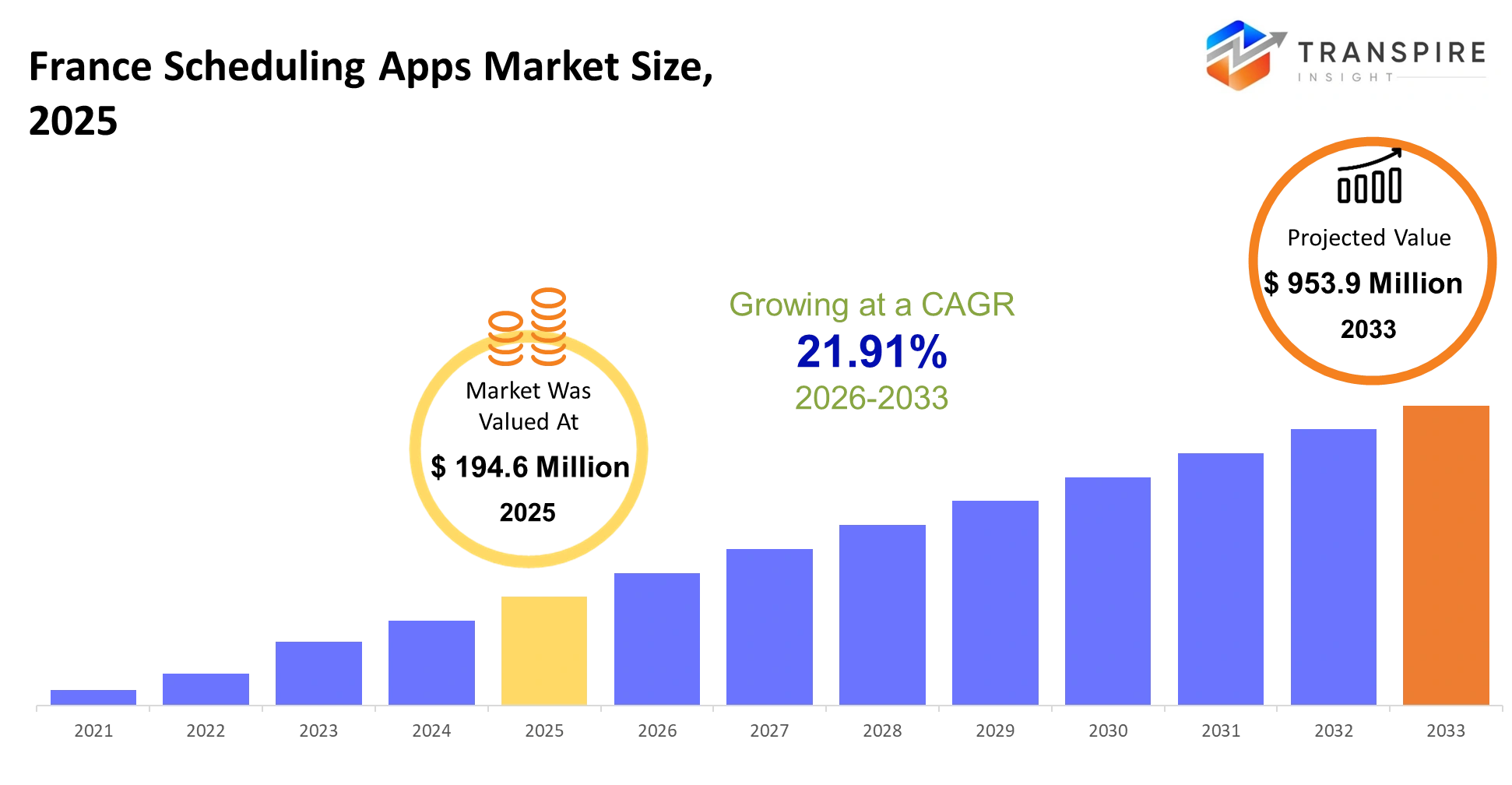
- France Scheduling Apps Market Size 2025: USD 194.6 Million
- France Scheduling Apps Market Size 2033: USD 953.9 Million
- France Scheduling Apps Market CAGR: 21.91%
- France Scheduling Apps Market Segments: By Type (Meeting Scheduling Apps, Workforce Scheduling Apps, Appointment Scheduling Apps, Others); By Application (Corporate Scheduling, Healthcare Appointments, Education, Freelancing, Others); By End-User (Enterprises, SMEs, Healthcare Providers, Individuals, Educational Institutions, Others); By Deployment (Cloud, On-premise, Hybrid, Others)
To learn more about this report,  Download Free Sample Report
France Scheduling Apps Market Summary
The France Scheduling Apps Market was valued at USD 194.6 Million in 2025. It is forecast to reach USD 953.9 Million by 2033. That is a CAGR of 21.91% over the period.
Organizations use France Scheduling Apps Market to manage time across their teams and clients and operational activities. The platforms help various industries like healthcare and education and corporate services by using their automated systems to handle meeting scheduling and staff shift arrangements and appointment scheduling. The system addresses three main operational problems, which include improper time allocation, failure to attend scheduled events, and inefficient use of assets.
The market has progressed during the past three to five years toward cloud-based scheduling systems which use artificial intelligence to connect with enterprise software systems such as CRM and HR tools. The rise of hybrid work environments created a need for automatic systems because organizations. The COVID-19 pandemic created a major requirement for digital appointment systems which forced healthcare organizations and businesses to implement those systems at their activities. Businesses now use intelligent scheduling systems because they want to boost productivity and decrease operational issues and improve user experiences, which results in higher software adoption and recurring revenue through software subscriptions.
Key Market Insights
- Île-de-France dominates the France Scheduling Apps Market with over 35% share in 2025 because the region has high business density and advanced digital systems.
- The southernmost area of France displays the highest growth rate until 2033 because small and medium enterprises are adopting digital technology and healthcare scheduling systems are expanding their reach.
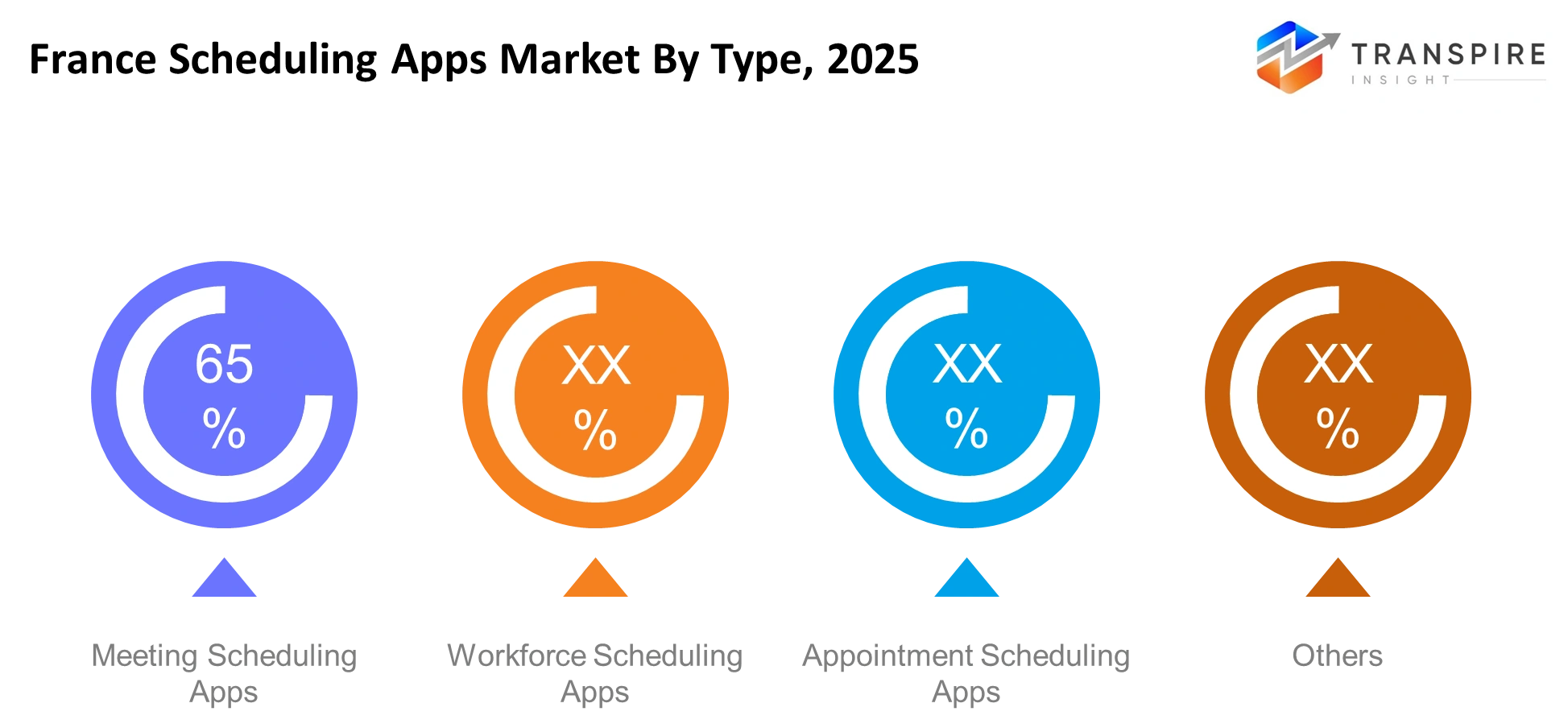
- Meeting scheduling applications control about 40% of the market because businesses commonly use them and they work well with productivity tools.
- Appointment scheduling applications stand as the second most popular scheduling solution because healthcare organizations and service-based companies need to automate their operations.
- The workforce scheduling application market will experience its strongest growth period between 2025 and 2033 because companies need to improve their labor management processes.
- The corporate scheduling market holds the highest market share because more than 45% of businesses use it to create automated workflows and enhance their productivity.
- Digital patient management systems and regulatory compliance requirements make healthcare system appointments the most rapidly expanding application.
- Enterprises dominate the France Scheduling Apps Market with around 50% share because they need to connect their entire workflow processes.
- Healthcare providers are the fastest-growing end-user segment, adopting advanced scheduling tools to reduce patient wait times and no-shows.
- Strategic partnerships with CRM and HR platforms enhance ecosystem integration while improving customer retention rates.
- The company strengthens its market position through European regional expansion and SaaS subscription models that create ongoing revenue streams.
What are the Key Drivers, Restraints, and Opportunities in the France Scheduling Apps Market?
The primary driver of the France Scheduling Apps Market is the structural shift toward hybrid and distributed work environments. Organizations adopted flexible work models after COVID-19, which made manual coordination inefficient and error-prone. Enterprises began to spend money on automatic scheduling solutions, which they used with their teamwork software. Businesses achieved better results through improved operational efficiency and employee productivity, which led to increased software usage and subscription-based revenue growth.
The main limitation exists because organizations must deal with complex difficulties which arise when they try to connect their existing systems with outdated ERP and HR software. Many organizations in France still rely on fragmented IT infrastructure, making seamless adoption difficult. The existing structure of the system forces organizations to spend more money while their progress gets delayed. Small and mid-sized firms usually postpone their adoption process, which leads to decreased market earnings and reduced growth potential in industries that have not yet fully embraced digital technology.
Organizations can gain significant advantages through the use of AI-based systems that provide advanced prediction capabilities along with industry-tailored solutions. Healthcare platforms, such as Doctolib, are developing intelligent appointment scheduling systems which utilize patient behavior data to enhance their services. As AI models improve, scheduling apps can forecast demand, reduce no-shows, and optimize workforce allocation. The company developed various revenue models, which allowed them to enter new markets that cover telemedicine, education, and freelance platforms.
What Has the Impact of Artificial Intelligence Been on the France Scheduling Apps Market?
The scheduling platforms now experience operational changes because artificial intelligence systems automate their complex coordination processes while enhancing their overall performance. The AI-powered systems perform meeting bookings and workforce allocation together with appointment reminders without needing human operators. Intelligent assistants use user calendar information and personal preferences with their available time slots to find the best meeting times which decrease the need for administrative work.
Machine learning models also enable predictive capabilities which include forecasting appointment demand and identifying peak scheduling periods while decreasing no-show rates in healthcare systems. Doctolib uses predictive analytics to enhance patient scheduling which leads to better clinic utilization and decreased idle time. AI systems assist workforce scheduling in enterprise environments by matching employee work availability with projected work needs which results in better operational efficiency and decreased operational costs.
The technologies bring operational benefits through enhanced scheduling precision which minimizes operational delays while boosting customer satisfaction. The businesses experience improved time management and decreased costs for coordination because of these benefits. AI adoption faces challenges because organizations must pay high integration expenses while their systems depend on data. The majority of systems need excellent historical data to make precise predictions while smaller organizations do not have the required infrastructure to fully implement AI capabilities.
Key Market Trends
- The implementation of hybrid work systems since 2020 has made businesses use automated cloud-based scheduling systems which work with their collaboration tools instead of manual scheduling methods.
- The development of AI-based scheduling assistants which began after 2022 enables organizations to use predictive booking systems while decreasing their need for manual operational tasks in both corporate and healthcare settings.
- Digital appointment systems became more popular among healthcare providers after the pandemic because these systems helped leading platforms achieve over 20% reductions in no-show rates.
- The period between 2023 and 2026 saw workforce scheduling apps become popular because businesses wanted to achieve better labor efficiency and they needed to manage employee shifts in real time.
- SaaS-based subscription models replaced one-time software purchases which gave scheduling app providers dependable revenue sources through their subscription services.
- The period after 2021 saw businesses enhance their CRM and HR system integration capabilities which created automated workflow systems that functioned throughout their entire organizations.
- Freelancers and small and medium enterprises (SMEs) began using mobile-first scheduling solutions which became popular because of the emerging flexible and remote work trends.
- The global expansion of Calendly and Zoho created more market competition which resulted in faster development of new features.
- European data privacy regulations shaped platform development, which resulted in platforms obtaining better compliance capabilities and safer methods for data protection.
- Healthcare and education sectors developed vertical-specific platforms which provide specialized scheduling systems along with essential functions for their respective industries.
France Scheduling Apps Market Segmentation
By Type
The type-based segmentation system controls product differentiation which determines revenue distribution throughout the scheduling system. The main portion of meeting coordination tools exists because businesses depend on automated calendar systems that work with their collaboration tools. Appointment-focused solutions follow closely because they receive strong adoption in healthcare and service industries where structured booking systems provide efficiency improvements. The workforce scheduling tools maintain a minor market share which continues to grow in industries that need to establish shift patterns and distribute resources.
The segment expands because each solution needs to solve a particular coordination problem. Meeting tools benefit from their connection to productivity systems while appointment platforms increase their user base through systems that help customers and decrease no-shows. Businesses need workforce scheduling tools to fulfill their requirements for labor optimization and compliance monitoring. The industry will experience category convergence throughout the forecast period because vendors will develop integrated scheduling solutions that deliver extensive value for businesses and service providers.
To learn more about this report, Download Free Sample Report
By Application
The application-based segmentation method shows how scheduling tools match operational workflows used in various industries. The corporate scheduling system establishes itself as the primary method because it serves to handle both internal meetings and client meetings and project management activities in large companies. Digital appointment systems enable healthcare organizations to achieve operational efficiency through their patient flow management and administrative system processing capabilities. The education and freelancing sectors maintain their market share at smaller levels but experience continued growth through the rising adoption of digital technology in learning environments and gig-based work structures.
Time coordination and service delivery efficiency determine the operational needs of each application segment which leads to its subsequent growth. Corporate use cases gain value through automated workflow systems that connect with enterprise software, while healthcare organizations use exact scheduling procedures to enhance their service delivery results. Educational institutions and freelance workers use mobile-friendly solutions that allow them to create schedules at their convenience. The upcoming growth period will probably benefit from vertical-specific custom solutions which will utilize application features to enhance user experiences while enhancing operational efficiency for both business users and software developers.
By End-User
End-user segmentation demonstrates that organizations with different sizes and operational complexities experience different rates of technology adoption. The majority market share belongs to large enterprises because they possess greater financial resources and need to implement unified scheduling systems throughout their various departments and worldwide operations. The healthcare sector constitutes a significant secondary market segment because it relies on prearranged appointment systems and must adhere to government mandates. The digital tool accessibility has grown throughout educational institutions and SMEs and individual users who now provide smaller market shares which are expected to expand.
The different operational scales and resource distribution patterns create separate development paths for organizations. Organizations invest their resources in developing sophisticated integrations together with analytics capabilities while healthcare organizations concentrate on achieving dependable operations and better patient treatment systems. Users in SMEs together with individual users select affordable basic solutions which focus on providing simple operation. The rising costs and SaaS delivery systems will bring increased usage by smaller users because vendors will create solutions which meet both enterprise and individual user needs.
By Deployment
The process of deployment-based segmentation establishes the methods which organizations use to implement and control their scheduling systems. The market favors cloud-based deployment because it provides both flexible resource allocation and scalable system development together with reduced initial hardware needs. Organizations that need to control their data at all times with their current systems prefer on-premise solutions which have become their main option. Organizations are adopting hybrid models to achieve their security needs while keeping their operational flexibility.
Digital transformation strategies together with changing data management preferences drive this segment's growth. Cloud adoption accelerates because remote users require immediate access to data while organizations need continuous system updates. Organizations that are modernizing their legacy systems through hybrid deployment see this method as a transitional solution. The cloud will continue to strengthen its market position during the forecast period which will drive vendors to focus on developing SaaS solutions together with secure multi-tenant systems that can fulfill business and regulatory requirements.
What are the Key Use Cases Driving the France Scheduling Apps Market?
The primary purpose of corporate scheduling exists because enterprises need to manage their internal meetings and client interactions and their cross-departmental work processes. Large organizations rely on automated scheduling tools to reduce coordination delays and improve time utilization across distributed teams. The system gains additional strength from its ability to connect meeting data with sales and project pipelines through its CRM and collaboration platform integration.
The healthcare industry and service-based sectors experience rapid growth because healthcare providers and small to medium-sized enterprises (SMEs) adopt their services. Hospitals and clinics use appointment scheduling systems to manage patient flow, reduce missed visits, and optimize staff allocation. The growth of structured scheduling systems for customer-facing functions has led freelancers and small businesses to adopt these tools for their client booking needs.
AI-driven systems for predictive scheduling and educational coordination tools are emerging as new use cases. The platforms now predict user demand patterns while their system automates scheduling tasks according to user activities. Educational institutions are also testing scheduling systems for managing classroom activities and virtual learning environments, which shows a strong potential for future development.
|
Report Metrics |
Details |
|
Market size value in 2025 |
USD 194.6 Million |
|
Market size value in 2026 |
USD 238.3 Million |
|
Revenue forecast in 2033 |
USD 953.9 Million |
|
Growth rate |
CAGR of21.91% from 2026 to 2033 |
|
Base year |
2025 |
|
Historical data |
2021 - 2024 |
|
Forecast period |
2026 - 2033 |
|
Report coverage |
Revenue forecast, competitive landscape, growth factors, and trends |
|
Regional scope |
France |
|
Key company profiled |
Calendly, Microsoft, Google, Zoho, HubSpot, Doodle, SimplyBook.me, Setmore, Acuity Scheduling, Square, Slack, Asana, Monday.com, ClickUp, Salesforce |
|
Customization scope |
Free report customization (country, regional & segment scope). Avail customized purchase options to meet your exact research needs. |
|
Report Segmentation |
By Type (Meeting Scheduling Apps, Workforce Scheduling Apps, Appointment Scheduling Apps, Others); By Application (Corporate Scheduling, Healthcare Appointments, Education, Freelancing, Others); By End-User (Enterprises, SMEs, Healthcare Providers, Individuals, Educational Institutions, Others); By Deployment (Cloud, On-premise, Hybrid, Others) |
Which Regions are Driving the France Scheduling Apps Market Growth?
The market expansion of Île-de-France region happens because of its numerous big companies and tech businesses and healthcare systems which depend on scheduling automation systems. The combination of advanced digital networks and early SaaS platform adoption enables businesses to implement CRM systems and HR tools across their operations. The digital transformation programs that receive government support together with the strict data compliance requirements create an environment that encourages regulated industries to adopt new technologies. The regional startup ecosystem provides mature companies with venture capital sources which enable them to create new products and improve existing platforms.
The Auvergne-Rhône-Alpes region acts as a reliable second market contributor because of its diverse industrial base which includes both large corporations and small-to-medium businesses together with its healthcare facilities. The region experiences growth through constant funding efforts which concentrate on operational improvements and the development of digital technologies. The regional businesses use scheduling systems to enhance their employee management processes and customer appointment handling while avoiding major system changes. The region demonstrates economic strength through its ongoing small business digital progress which makes it an essential market contributor that generates consistent revenue.
The Occitanie region experiences its fastest growth because of new healthcare facilities and increasing adoption from educational institutions and freelancers. The healthcare industry has shifted towards appointment-based systems because of increased investments in telehealth services and regional digital programs. The demand for scheduling solutions has increased because remote work and gig-based jobs require workers to have mobile-friendly flexible work schedules. The growth trajectory of the market presents SaaS providers and investors with excellent chances to enter markets that exist between 2026 and 2033 through the development of markets that have not yet reached their full potential.
Who are the Key Players in the France Scheduling Apps Market and How Do They Compete?
The market maintains moderate fragmentation because both global SaaS companies and specialized scheduling software developers compete for enterprise customers and individual users. Buyers choose products based on their need for smooth operational processes which develop from integrated technology and user-friendly design. Companies that operate established software ecosystems maintain their market position by adding scheduling capabilities to their complete productivity packages, while dedicated scheduling systems emphasize user-friendliness and industry-specific functions. Companies that enter the market today use AI-based automation tools and adaptable payment structures to compete against established businesses.
Calendly uses its straightforward design and smooth calendar connection process to attract users who work in professional roles and small to medium-sized businesses. Microsoft uses its business ecosystem to drive customer loyalty by adding scheduling features to Outlook and Teams for enterprise customers. Google Workspace users can access scheduling features which enable them to work together in real time from multiple devices.
Zoho provides budget-friendly business software packages which include scheduling tools for small and medium-sized enterprises. Salesforce develops its business operations through the CRM-based scheduling system, which helps users manage customer interactions and sales processes. The companies establish competitive advantages through their ability to manage ecosystems, their ongoing development of products, and their establishment of partnerships that improve business process integration.
Company List
- Calendly
- Microsoft
- Zoho
- HubSpot
- Doodle
- SimplyBook.me
- Setmore
- Acuity Scheduling
- Square
- Slack
- Asana
- Monday.com
- ClickUp
- Salesforce
Recent Development News
In July 2025, Meet-Ting secured €289K in funding. The investment supported the expansion of its AI-driven email-based scheduling assistant, accelerating innovation in automated meeting coordination and challenging traditional booking platforms.https://en.wikipedia.org/wiki/Meet-Ting
What Strategic Insights Define the Future of the France Scheduling Apps Market?
The market is establishing its future through complete workflow ecosystems which use scheduling as their fundamental system for coordination instead of using it as an independent component. The combination of AI technology together with cloud computing platforms and enterprise software integration systems has created a new system which transforms scheduling into a predictive decision-making support tool.
Platform consolidation creates hidden risks because major ecosystems will restrict system compatibility which will decrease chances for smaller companies to enter the market. The need to use extensive software systems forces users into operational constraints which will grow more expensive to change because all software environments depend on these systems.
Vertical-specific AI scheduling solutions create a new business opportunity which telehealth and educational institutions can use because their operational patterns require data-based optimization to produce measurable efficiency improvements.
Market participants should invest in open integration frameworks and AI-driven features while maintaining flexibility to operate across multiple enterprise ecosystems to avoid dependency risks and capture broader adoption.
France Scheduling Apps Market Report Segmentation
By Type
- Meeting Scheduling Apps
- Workforce Scheduling Apps
- Appointment Scheduling Apps
- Others
By Application
- Corporate Scheduling
- Healthcare Appointments
- Education
- Freelancing
- Others
By End-User
- Enterprises
- SMEs
- Healthcare Providers
- Individuals
- Educational Institutions
- Others
By Deployment
- Cloud
- On-premise
- Hybrid
- Others
Frequently Asked Questions
Find quick answers to common questions.
The confirmed 2033 market size figure in USD 953.9 Million.
Key segments for the France Scheduling Apps Market are By Type (Meeting Scheduling Apps, Workforce Scheduling Apps, Appointment Scheduling Apps, Others); By Application (Corporate Scheduling, Healthcare Appointments, Education, Freelancing, Others); By End-User (Enterprises, SMEs, Healthcare Providers, Individuals, Educational Institutions, Others); By Deployment (Cloud, On-premise, Hybrid, Others).
Major France Scheduling Apps Market players are Calendly, Microsoft, Google, Zoho, HubSpot, Doodle, SimplyBook.me, Setmore, Acuity Scheduling, Square, Slack, Asana, Monday.com, ClickUp, Salesforce.
The France Scheduling Apps Market size is USD 194.6 Million in 2025.
The France Scheduling Apps Market CAGR is 21.91% from 2026 to 2033.
- Calendly
- Microsoft
- Zoho
- HubSpot
- Doodle
- SimplyBook.me
- Setmore
- Acuity Scheduling
- Square
- Slack
- Asana
- Monday.com
- ClickUp
- Salesforce
Recently Published Reports
-
Apr 2026
3D Optical Profiler Market
3D Optical Profiler Market Size, Share & Analysis Report By Type (Desktop 3D Optical Profiler, and Portable 3D Optical Profiler), By Technology (Confocal Technology, and White Light Interference), By End-Use Industry (Manufacturing, Research Institutions, Automotive, Aerospace and Defense, Medical Devices, and Other), and Geography (North America, Europe, Asia-Pacific, Middle East and Africa, South and Central America), 2021 - 2031
-
Apr 2026
Depth Sensor Market
Depth Sensor Market Size, Share & Analysis Report By Type (Infrared Depth Sensors, Time-of-Flight (ToF) Sensors, Stereo Vision Sensors, Structured Light Sensors, Ultrasonic Depth Sensors), By Application (Automotive, Robotics, Gaming, Consumer Electronics, Industrial Automation, Healthcare, Security & Surveillance, Others), By End Users (Automotive Manufacturers, Consumer Electronics Companies, Healthcare Providers, Industrial Companies, Security Agencies, Gaming Companies, Robotics Companies, Others), and Geography (North America, Europe, Asia-Pacific, Middle East and Africa, South and Central America), 2021 – 2031
-
Apr 2026
Digital Manufacturing Market
Digital Manufacturing Market Size, Share & Analysis Report By Component (Hardware, Software, and Services), By Technology (Robotics, 3D Printing, Internet of Things (IoT), and Others), By Application (Automotive and Transportation, Aerospace and Defense, Consumer Electronics, Industrial Machinery, and Others), By Process Type (Computer-Based Designing, Computer-Based Simulation, Computer 3D Visualization, Analytics, and Others), and Geography (North America, Europe, Asia-Pacific, Middle East and Africa, South and Central America), 2021 – 2031
-
Apr 2026
Digital Visa Services Market
Digital Visa Services Market Size, Share & Analysis Report By Type (Individual Travelers, Group Travelers), By Application (Tourism, Business Travel, Others), and Geography (North America, Europe, Asia-Pacific, Middle East and Africa, South and Central America), 2021 – 2031