
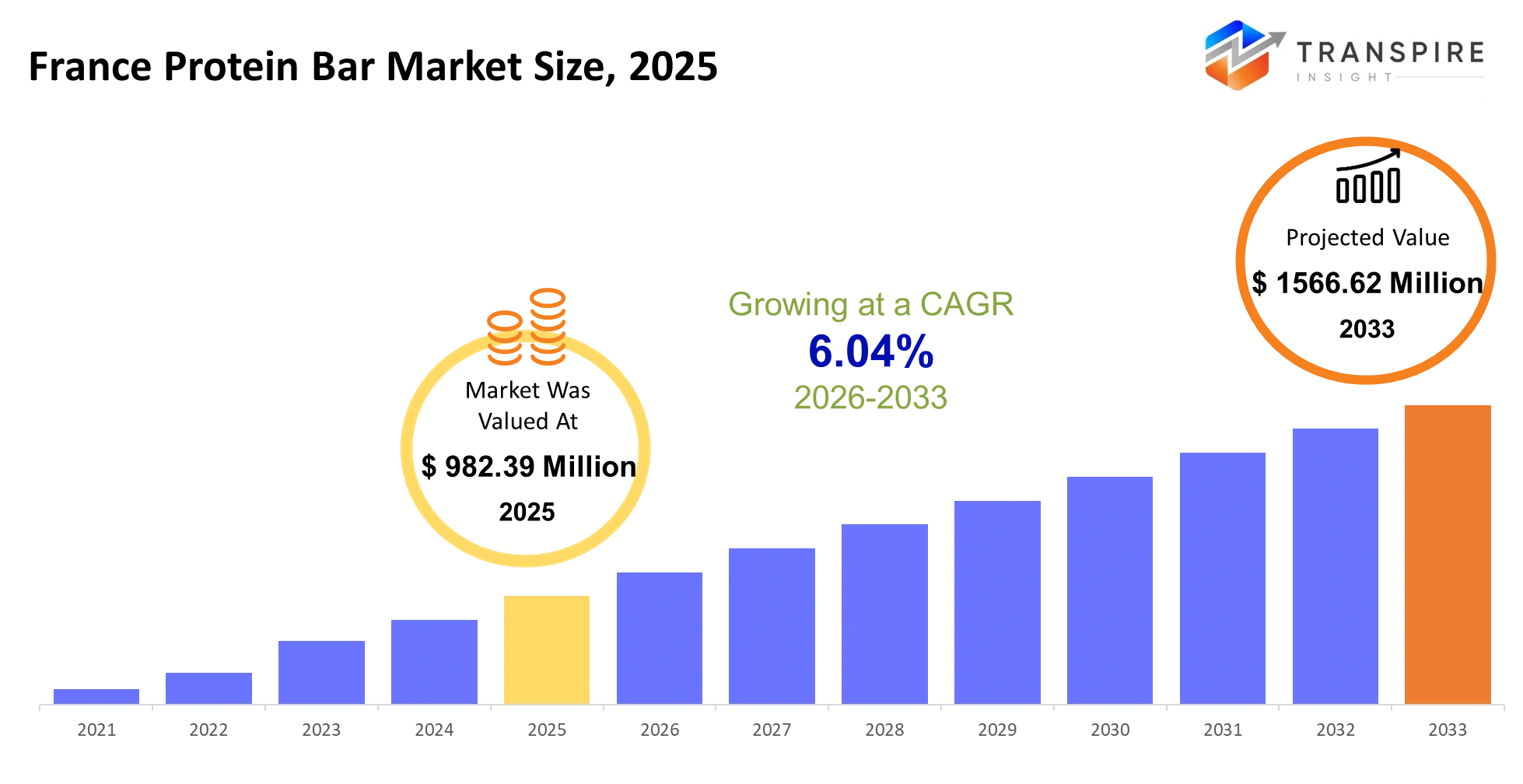
France Protein Bar Market Size & Forecast:
- France Protein Bar Market Size 2025: USD 982.39 Million
- France Protein Bar Market Size 2033: USD 1566.62 Million
- France Protein Bar Market CAGR: 6.04%
- France Protein Bar Market Segments: By Type (Whey Protein Bars, Plant-based Protein Bars, High Fiber Bars, Low Carb Bars, Gluten-free Bars, Others); By Application (Sports Nutrition, Meal Replacement, Snacking, Weight Management, Clinical Nutrition, Energy Boost, Others); By End-User (Athletes, Fitness Enthusiasts, Gym Users, Consumers, Healthcare Users, Lifestyle Users, Others); By Distribution (Online Stores, Supermarkets, Specialty Stores, Pharmacies, Convenience Stores, Others).
To learn more about this report,  Download Free Sample Report
France Protein Bar Market Summary
The France Protein Bar Market was valued at USD 982.39 Million in 2025. It is forecast to reach USD 1566.62 Million by 2033. That is a CAGR of 6.04%over the period.
The France protein bar market kinda fills a practical need in modern nutrition, mostly because it gives people something portable and portion controlled for protein when their work days are hectic, or when they are juggling fitness routines and meal replacement ideas. Protein bars have stopped being just a niche sports thing, and now they sort of slide into wider lifestyle functions like appetite management, energy supplementation, and functional snacking you see in stores, gyms, pharmacies, and also those convenience channels. Over the past five years the whole market has shifted, structurally speaking , away from the high sugar bodybuilding type products and more toward clean label options, plant based ingredients, and low carb formulations that fit mainstream health and wellness expectations.
That shift gained real momentum after the COVID-19 pandemic, since it changed eating habits and pushed up interest in shelf stable functional foods while supply chains got strained and mobility was limited. In France, as more consumers choose nutritional density over classic confectionery snacks, brands are moving into premium formulations, localized flavors, and fortified ingredients. In the end this evolution helps retail reach grow, pushes average selling prices higher, and makes recurring purchases feel more likely across both workout focused and everyday wellness categories.
Key Market Insights
- Northern France sort of took about 34% market share in 2025, mostly because urban retail penetration is stronger there, and functional snack consumption is higher.
- Western France looks like it will be the fastest-growing regional market through 2033, it’s driven by fitness culture picking up, along with bigger supermarket shelf expansion.
- In 2025 Plant-based protein bars were the main choice across the France Protein Bar Market with around 41% share, mainly as pea protein and soy protein adoption moved ahead more quickly.
- Whey-based bars stayed in the second spot, because sports nutrition consumers still want full amino acid profiles for muscle recovery performance, and not less than that.
- Meanwhile Low-sugar and keto-compatible bars have been growing the quickest since 2022, since shoppers are trying to cut back on traditional confectionery, and they’re also reducing processed sugar intake.
- Meal replacement use cases pulled in close to 38% market share in 2025, largely due to portable nutrition demand rising among working professionals.
- Sports and fitness nutrition applications continue to expand quite rapidly, as boutique gyms and endurance training communities spread around metropolitan France.
- Millennials are showing up as the leading end-user segment with over 45% share, and it’s tied to stronger spending on premium wellness and functional food products.
- Consumers above 50 years old are becoming a rapidly growing customer group too, because protein supplementation is gaining acceptance for active aging, and for mobility support.
What are the Key Drivers, Restraints, and Opportunities in the France Protein Bar Market?
The main thing steering the France protein bar market looks like a sort of meeting point between fitness culture, the convenience-first way people eat, and nutritional customization that feels personal. More and more, French consumers seem to want smaller, more manageable foods that still give them that “I’m full” feeling, with added protein, plus functional additions, all without having to do any meal prep. This pattern really got stronger once hybrid work models moved into a lot of cities across France, so demand rose for portable nutrition products that people can grab between meetings during commutes, or right after training. Retailers then did the obvious, they gave more shelf space to functional snacks, and that let premium brands earn bigger margins, while also pushing category revenue forward faster.
Still, there’s a big limitation that keeps showing up, ingredient and formulation cost volatility. High-quality whey isolates, plant proteins, nuts, and various functional additives are still dealing with uneven global commodity pricing, and supply-chain disruptions that pop up at the wrong times. This is structural too, because manufacturers can’t just swap out core protein inputs without risking the nutritional story they sell, or the taste reliability customers expect. When production costs rise, it limits pricing flexibility and it can slow adoption among buyers who are more price-sensitive, especially during inflation stretches.
On the opportunity side, one of the most interesting paths is personalized and clinically positioned protein bars aimed at aging customers, digestive well-being, and weight control. Brands that are putting money into microbiome-friendly ingredients, collagen enhancement, and low-glycemic formulations are seeing more momentum. And France’s growing preventive healthcare mindset, plus nutrition products being pushed through pharmacy-like retail channels, makes a more favorable environment for medically aligned functional snack options over the next ten years.
What Has the Impact of Artificial Intelligence Been on the France Protein Bar Market?
Artificial intelligence plus advanced digital technologies are kind of remaking the France protein bar market, via smarter making, more accurate demand predicting, and kind of personalized product development that feels more nuanced. Food manufacturers increasingly lean on AI driven analytics to watch ingredient quality in real time, run production line checks with less manual effort, and keep batch consistency steadier across big, high-volume plants. There are also computer vision setups that can spot coating defects, texture mismatches, or packaging irregularities faster than people doing the same reviews by hand, which lets producers cut down waste and boost day to day operational efficiency.
Then there is machine learning, it’s getting better at demand forecasting too. These models look at retail sales patterns, seasonal buying behavior, gym membership movements, and e-commerce consumption signals. With that kind of view, manufacturers and retailers can plan inventory allocation more intelligently, so supermarkets and direct to consumer channels don’t end up with odd shortages or stock imbalances. On top of that, some nutrition companies use AI consumer analytics in order to create more targeted formulations, like high fiber vegan bars or low sugar recovery options, shaped around particular demographic clusters, and not just generic preferences.
Digital optimization has also improved production uptime, sped up new product launches, and reduced logistics friction across the whole functional snack supply chain. Still, AI adoption has limits because integration can be expensive, and consumer nutrition data is fragmented. Smaller manufacturers often don’t have the digital groundwork, nor the historical buying records needed to train predictable and reliable systems, so wider adoption across the French functional food scene is slower, and sometimes it kind of stalls for reasons that are hard to explain in a single paragraph.
Key Market Trends
- Since 2021, French retailers have sorta expanded those dedicated functional snack aisles, and it has boosted visibility for premium protein bars, across supermarkets and pharmacy chains—kinda everywhere.
- Plant-based formulations got a stronger shelf spot after pea protein plus oat-based ingredients improved the taste and texture, on a lot of mainstream products.
- Brands also started dialing back sugar levels between 2022 and 2025, mainly to fit stricter nutritional expectations and those front-of-pack labeling preferences people actually look at.
- Online, protein snack sales moved faster once pandemic-era habits kind of normalized, especially with subscription-style nutrition buying among urban consumers.
- Over the last four years, sports nutrition companies leaned their marketing toward lifestyle wellness messaging, not so much bodybuilding-focused campaigns anymore.
- Then premium bars with collagen, probiotics, and adaptogenic ingredients showed up as more differentiated options, aimed at recovery, digestion, and stress management uses.
- French consumers increasingly leaned toward locally sourced ingredients, and recyclable packaging too. That push encouraged manufacturers to regionalize supply chains, and do more sustainability initiatives.
- Convenience stores and petrol retail chains also widened their protein snack lineups, because impulse purchasing patterns strengthened among commuting professionals after 2023.
- Big names like Myprotein and Barebells ramped up influencer-led digital campaigns, trying to build brand loyalty with younger consumers.
- Meanwhile, private-label supermarket brands increased competitive pressure by rolling out lower-priced protein bars, with simpler ingredient lists and broader retail availability.
France Protein Bar Market Segmentation
By Type
Whey Protein Bars keep getting the largest chunk of the market, mainly because fitness people and sports nutrition users seem to really go for them. There’s high protein density, the full amino acid picture is there, and the brands are already familiar so it feels easier to pick up and try. You see them everywhere—at gyms, supermarkets, and through online channels—so adoption keeps rolling. People who are more performance driven usually lean toward whey-based formulations for after workout recovery, and for muscle upkeep too, especially in busy city groups. Also, strong shelf presence and lots of flavors kinda lock in the category lead.
Plant-based Protein Bars are the fastest growing part, since vegan eating habits, plus dairy-free routines, are getting more momentum across France. Growth is coming from shoppers who want a more sustainable protein option, with cleaner ingredient messaging and also better digestive comfort. Within that, High Fiber Bars and Low Carb Bars are still pulling in folks focused on weight management and general wellness, mostly because they help with satiety, and they cut down on sugar. Gluten-free Bars meanwhile hold steady demand, particularly for people with sensitivities and those looking for specialized nutrition setups. Over the forecast period, plant-style products and functional blends are expected to speed up new product ideas and push manufacturers to vary their protein sources, not just stick with traditional dairy ingredients.
By Application
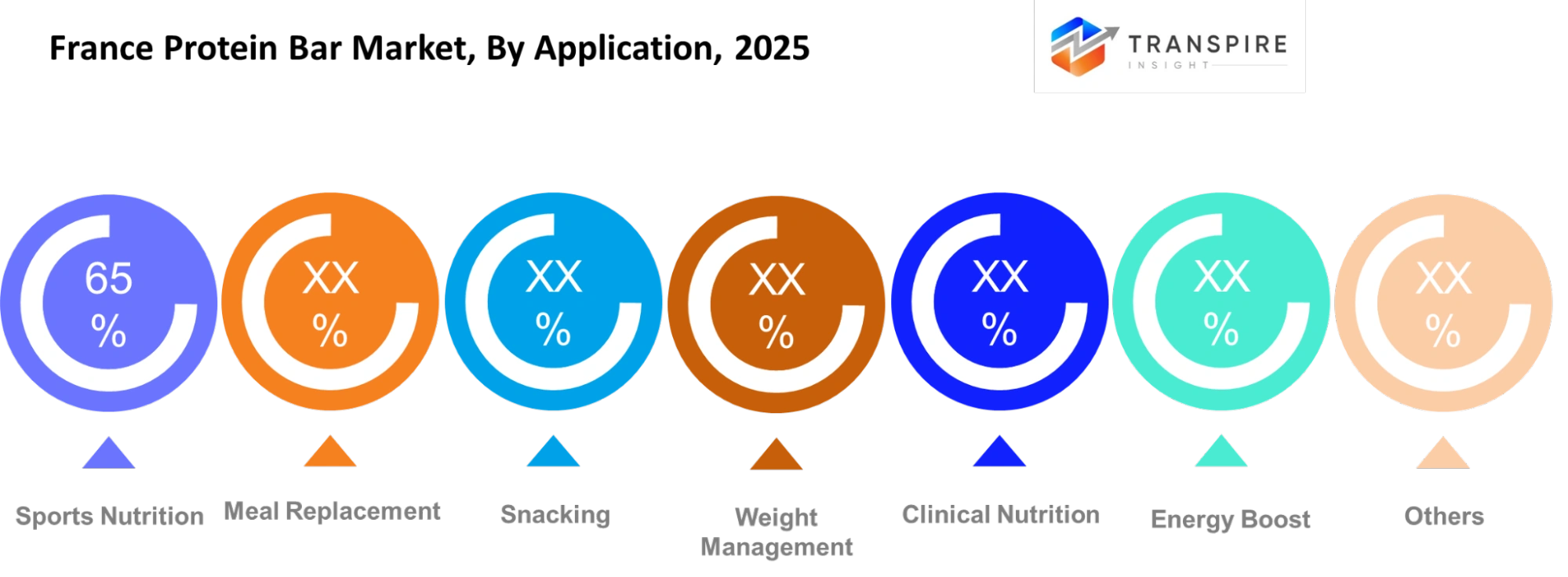
Sports Nutrition keeps that leading spot , sort of because people keep buying it regularly—athletes, gym goers, and performance minded consumers who want an easy protein supplement. You see strong pull after workouts, like in that post-exercise recovery routine, and also inside more structured fitness programs, where muscle repair matters and energy support stays consistent. The people making products keep aiming at this crowd with more advanced blends, higher protein levels, plus extra recovery friendly add-ins. Then there are those brand tie-ins with fitness communities and sports events, which helps the market keep getting deeper over time.
Meal Replacement is starting to move faster too, especially with working professionals and city residents who need portable nutrition while schedules get hectic. Snacking is still a big secondary use case, because consumers are swapping the usual confectionery choice for protein enriched options that help with fullness , and also with that energy balance. The Weight Management and Clinical Nutrition areas keep growing , mostly via pharmacy led distribution and a medically aligned way of presenting the nutrition. Energy Boost use is catching interest among younger buyers as well, they want functional snack style products for travel, work, and physical activity. Over time, personalized nutrition habits and wellness oriented consumption patterns should widen the variety of applications across the whole category.
To learn more about this report, Download Free Sample Report
By End-User
Athletes are pretty much the dominant end-user segment, because structured training routines, and performance recovery needs… they end up creating this pretty steady consumption frequency. Pros and amateurs in sports lean toward high-protein products, mostly because they help with muscle recovery endurance, and also keep nutritional balance in check during heavy physical activity. Brand loyalty stays strong, and the product specialization thing keeps adding fuel to the demand from this group. At the same time, fitness enthusiasts, gym users, they also matter a lot through regular supplement use that gets mixed into everyday workouts.
Then there are consumers and lifestyle users and honestly they’re rising faster, since protein bars are moving from “sports only” into more mainstream wellness snacks. Busy professionals, and health-aware households, are now buying these bars for convenience, appetite control, and a slightly better snacking habit overall. Healthcare users are another expanding segment, helped by aging populations, plus preventive nutrition strategies aimed at mobility, strength retention, and balanced dietary intake. Besides that, there are other niche groups, like people doing outdoor activities and wellness communities, they keep broadening the category reach. Over the forecast period, mainstream lifestyle adoption is expected to grow quicker, than the older sports-focused consumption pattern.
By Distribution Channel
Supermarkets still seem to hold the leading position, mainly because people can reach them easily, the products look very clear on the shelves, and brand availability stays broad across both urban and suburban retail routes. Big retail chains kind of nudge impulse buying too, and they also help manufacturers scale up national distribution in a pretty efficient way. When items land near healthy snacks and functional foods, product exposure rises even more among regular shoppers. And of course, competitive pricing plus constant promotions help keep the supermarket channel way ahead.
Meanwhile Online Stores are growing really fast, as digital shopping habits keep strengthening in health and wellness categories. E-commerce platforms give shoppers access to a wider set of flavors, plus subscription models, and those direct-to-consumer promotional plays that tend to keep customers coming back. Specialty Stores still matter a lot because they can lean into premium positioning and offer individualized nutritional guidance, especially for sports minded buyers and clinically oriented products. Pharmacies are also quietly adding more shelf space for functional nutrition bars, often tied to wellness ideas and preventive health use cases.
Over the forecast period, digital retail channels are expected to reshape purchasing behavior noticeably, while pharmacies and specialty outlets should back stronger growth in the premium segment.
What are the Key Use Cases Driving the France Protein Bar Market?
In France, the main use case for protein bar use still feels like sports nutrition and post workout recovery , kind of the obvious “go to” thing. People who work out, go to the gym a lot, or just amateur train usually count on protein bars for fast protein intake, without having to cook a whole meal , especially right after resistance training or even endurance exercise. That specific moment tends to pull the most demand, because the bars give portability, calorie control, plus that muscle recovery support in a pretty practical format for hectic city days and commutes.
Other use cases are creeping in too, like meal replacement and workplace nutrition, not totally taking over but definitely growing. Office professionals often grab protein bars during commuting hours or between meetings, using them as a substitute for regular bakery snacks and, yes, for high sugar confectionery. At the same time pharmacy retail is pushing fortified options , aimed at weight management and also active aging consumers who want convenient protein supplementation , in a way that feels simple and steady.
Then there are the newer, more emerging uses which sound more personal, like customized nutrition and medical wellness routines. Makers are experimenting with microbiome friendly ingredients, collagen enriched mixes, and low glycemic formulations , trying to support digestive health, senior nutrition, and glucose management. These products are still niche right now , but they look like they could matter a lot long term as preventive healthcare spending keeps rising across France.
|
Report Metrics |
Details |
|
Market size value in 2025 |
USD 982.39 Million |
|
Market size value in 2026 |
USD 1039.41 Million |
|
Revenue forecast in 2033 |
USD 1566.62 Million |
|
Growth rate |
CAGR of6.04% from 2026 to 2033 |
|
Base year |
2025 |
|
Historical data |
2021 - 2024 |
|
Forecast period |
2026 - 2033 |
|
Report coverage |
Revenue forecast, competitive landscape, growth factors, and trends |
|
Regional scope |
France |
|
Key company profiled |
Quest Nutrition, Clif Bar, RXBAR, Optimum Nutrition, KIND, MyProtein, Grenade, Gatorade, Nature Valley, Herbalife, Amway, MusclePharm, BSN, Labrada, One Brands. |
|
Customization scope |
Free report customization (country, regional & segment scope). Avail customized purchase options to meet your exact research needs. |
|
Report Segmentation |
By Type (Whey Protein Bars, Plant-based Protein Bars, High Fiber Bars, Low Carb Bars, Gluten-free Bars, Others); By Application (Sports Nutrition, Meal Replacement, Snacking, Weight Management, Clinical Nutrition, Energy Boost, Others); By End-User (Athletes, Fitness Enthusiasts, Gym Users, Consumers, Healthcare Users, Lifestyle Users, Others); By Distribution (Online Stores, Supermarkets, Specialty Stores, Pharmacies, Convenience Stores, Others). |
Which Regions are Driving the France Protein Bar Market Growth?
Northern France seems to be leading the protein bar market right now, mainly because it has a dense urban population, solid retail infrastructure, and sort of a concentration of fitness and wellness buyers. Paris, and the metropolitan area around it, really supports high volume supermarkets, pharmacy, and convenience store distribution which in turn helps premium items get adopted faster. The region also taps into pretty strong e-commerce logistics, plus disposable income is higher compared with some rural markets. Because of this, many international nutrition brands often prioritize Northern France when they do product launches, since consumer uptake cycles are quicker and retail partnerships are already more mature, kind of ready to move.
Western France brings in more steady market revenue, but its growth path is different. It leans more toward lifestyle wellness and consistent household spending rather than the same kind of dense metropolitan consumption. Shoppers here also tend to lean harder into clean label choices, locally sourced ingredients, and plant based nutrition formats. Regional supermarkets and specialty organic chains keep protein snack demand fairly consistent even during inflation, not just “spike then drop” kind of behavior. That steadiness means Western France works as a dependable revenue source for manufacturers looking for long term category resilience instead of only short-term volume jumps.
Southern France is starting to look like the fastest growing regional market, after fitness club expansion keeps accelerating, and outdoor sports participation rises, plus tourism related convenience retail becomes more visible. Since 2023, several international and local brands have increased shelf placement in coastal urban centers and at transport hubs, aiming at younger customers and active travelers. Demand is also getting stronger through pharmacies and health focused retail channels as wellness style buying habits spread beyond the usual gym crowd, and it feels like that trend keeps widening month after month.
Who are the Key Players in the France Protein Bar Market and How Do They Compete?
In France the protein bar market stays pretty moderately fragmented ,you know, with big sports nutrition players rubbing shoulders with lifestyle snack brands and also those direct-to-consumer specialists. Lately the fight isn’t only about price ,it’s more like formulation quality, sugar reduction, ingredient transparency, and flavor creativity that really matter. Older companies are holding their ground by locking in retail partnerships and differentiating through functional products, while newer entrants tend to chase people who want cleaner labels, vegan proteins, or more indulgent taste profiles that still feel light, and without the usual traditional confectionery ingredients.
Quest Nutrition stands out with high-protein, low-sugar formulations for macro-conscious consumers and also ketogenic routines. Its nutritional story plus a broad flavor range tends to appeal to performance-focused buyers who care about low net carbohydrates. Grenade competes a bit differently, more with indulgent flavor engineering and confectionery-like textures, basically targeting mainstream snack shoppers who are edging toward sports nutrition. It has also expanded via retail distribution deals and licensed collaborations connected to familiar dessert brands.
Myprotein leans hard on its direct-to-consumer digital setup, online promotions that are pretty aggressive, and partnerships around fitness events to keep pricing flexibility and keep customers coming back. Its move into licensed “confectionery” flavors helps it reach beyond the core gym crowd. KIND Snacks instead focuses on clean-label positioning and minimally processed ingredients, which creates differentiation for wellness-oriented consumers who prioritize what’s inside over pure protein density. Clif Bar keeps a solid position among endurance athletes and outdoor consumers through oat-based energy formulations.
Company List
- Quest Nutrition
- Clif Bar
- RXBAR
- Optimum Nutrition
- KIND
- MyProtein
- Grenade
- Gatorade
- Nature Valley
- Herbalife
- Amway
- MusclePharm
- BSN
- Labrada
- One Brands
Recent Development News
In March 2026, Myprotein expanded its partnership with Mars Wrigley through the launch of MARS® Impact Whey Protein. The collaboration strengthened flavor-led sports nutrition positioning and supported broader grocery retail expansion across Europe in 2026.
Source: http://www.foodbev.com
In November 2025, Grenade launched its limited-edition Soft Core Creme Egg protein bar in collaboration with Cadbury Creme Egg. The launch introduced a new indulgent texture format designed to attract mainstream snack consumers into the protein bar category.
Source: http://www.foodbev.com
What Strategic Insights Define the Future of the France Protein Bar Market?
The France protein bar market is kinda slowly shifting toward personalized functional nutrition instead of plain standardized sports supplementation. Over the next five to seven years, a lot of the growth will come from people actively looking for targeted benefits , like digestive support, active aging, metabolic health, and longer-lasting satiety rather than just getting enough protein in a simple way. Because of this, manufacturers will likely end up leaning more into clinically positioned formulations, premium ingredients, and distribution models that feel more pharmacy integrated, kind of like they belong in that lane.
But there’s also a risk that doesn’t get talked about enough: raw material concentration exposure. That is especially relevant for whey protein isolates, nuts, and cocoa derivatives. If agricultural commodity pricing stays volatile and global dairy supply chains keep wobbling, margins could get squeezed , and premium brands may struggle to stay price competitive. At the same time, personalized nutrition that’s connected to AI-driven dietary tracking and biomarker-based wellness platforms looks like a real emerging opportunity, even if it still feels underdeveloped in France.
So market participants should probably focus on flexible formulation abilities and smart regional ingredient sourcing strategies. Firms that blend functional nutrition science with scalable clean-label manufacturing will be in a better spot to land long-term retail partnerships, and build stronger premium consumer loyalty.
France Protein Bar Market Report Segmentation
By Type
- Whey Protein Bars
- Plant-based Protein Bars
- High Fiber Bars
- Low Carb Bars
- Gluten-free Bars
- Others
By Application
- Sports Nutrition
- Meal Replacement
- Snacking
- Weight Management
- Clinical Nutrition
- Energy Boost
- Others
By End-User
- Athletes
- Fitness Enthusiasts
- Gym Users
- Consumers
- Healthcare Users
- Lifestyle Users
- Others
By Distribution Channel
- Online Stores
- Supermarkets
- Specialty Stores
- Pharmacies
- Convenience Stores
- Others
Frequently Asked Questions
Find quick answers to common questions.
The approximate France Protein Bar Market size for the market will be USD 1566.62 Million in 2033.
Key segments for the France Protein Bar Market are By Type (Whey Protein Bars, Plant-based Protein Bars, High Fiber Bars, Low Carb Bars, Gluten-free Bars, Others); By Application (Sports Nutrition, Meal Replacement, Snacking, Weight Management, Clinical Nutrition, Energy Boost, Others); By End-User (Athletes, Fitness Enthusiasts, Gym Users, Consumers, Healthcare Users, Lifestyle Users, Others); By Distribution (Online Stores, Supermarkets, Specialty Stores, Pharmacies, Convenience Stores, Others).
Major France Protein Bar Market players are Quest Nutrition, Clif Bar, RXBAR, Optimum Nutrition, KIND, MyProtein, Grenade, Gatorade, Nature Valley, Herbalife, Amway, MusclePharm, BSN, Labrada, One Brands.
The France Protein Bar Market size is USD 982.39 Million in 2025.
The France Protein Bar Market CAGR is 6.04% from 2026 to 2033.
- Quest Nutrition
- Clif Bar
- RXBAR
- Optimum Nutrition
- KIND
- MyProtein
- Grenade
- Gatorade
- Nature Valley
- Herbalife
- Amway
- MusclePharm
- BSN
- Labrada
- One Brands
Recently Published Reports
-
Apr 2026
Baby Infant Formula Market
Baby Infant Formula Market Size, Share & Analysis Report By ype (Infant Milk, Follow On Milk, Specialty Baby Milk, Growing-Up Milk), By Ingredient (Carbohydrate, Fat, Protein, Minerals, Vitamins, and Others), By Product Form (Powder, Liquid, and Ready-to-feed), By Distribution Channels (Supermarket/Hypermarket, Specialty Store, Pharmacies, Online Retail, and Others), and Geography (North America, Europe, Asia-Pacific, Middle East and Africa, South and Central America), 2021 - 2031
-
Apr 2026
Edible Insects for Animal Feed Market
Edible Insects for Animal Feed Market Size, Share & Analysis Report By Type (Insect Powder, Insect Meal, Insect Bar, Insect Paste, Insect Oil, and Others), By Insect Type (Beetles, Cricket, Caterpillar, Hymenoptera, Orthoptera, Tree Bugs, and Others), By Application (Livestock, Pet Food, and Aquaculture), By Livestock Type (Poultry, Swine, and Others), and Geography (North America, Europe, Asia-Pacific, Middle East and Africa, South and Central America), 2021 - 2031
-
Apr 2026
Food Industry Disinfection and Bacterial Control Market
Food Industry Disinfection and Bacterial Control Market Size, Share & Analysis Report By Type (Chemical Disinfectants, Physical Disinfectants, and Biocides and Antimicrobials), By Application (Food Processing Equipment Surface Disinfection, Food Preparation Areas Surface Disinfection, Storage Areas Surface Disinfection, Anti-microbial Coatings Food Preservation, and Preservative Solutions Food Preservation), By End User (Meat and Poultry Processing, Dairy Processing, Seafood Processing, Bakery and Confectionery, Restaurants and Commercial Kitchens, and Food Service Providers), By Sales Channel (Online, Offline), and Geography (North America, Europe, Asia-Pacific, Middle East and Africa, South and Central America), 2021 - 2031
-
Apr 2026
Freeze Dried Food Market
Freeze Dried Food Market Size, Share & Analysis Report By Product Type (Fruits, Vegetables, Freeze-Dried Dairy Products, Freeze-Dried Meat and Seafood, Freeze-Dried Pet Food, and Prepared Meal), By Nature (Organic, and Conventional), By Form (Powdered, Granules, and Diced), By End Use (Breakfast Cereals, Dairy Products, Bakery & Confectionery, Nutritional Bars & Supplements, Powdered Beverages, Snacks, and Retail (Household)), and Geography (North America, Europe, Asia-Pacific, Middle East and Africa, South and Central America), 2021 - 2031