

France Paprika Market Size & Forecast
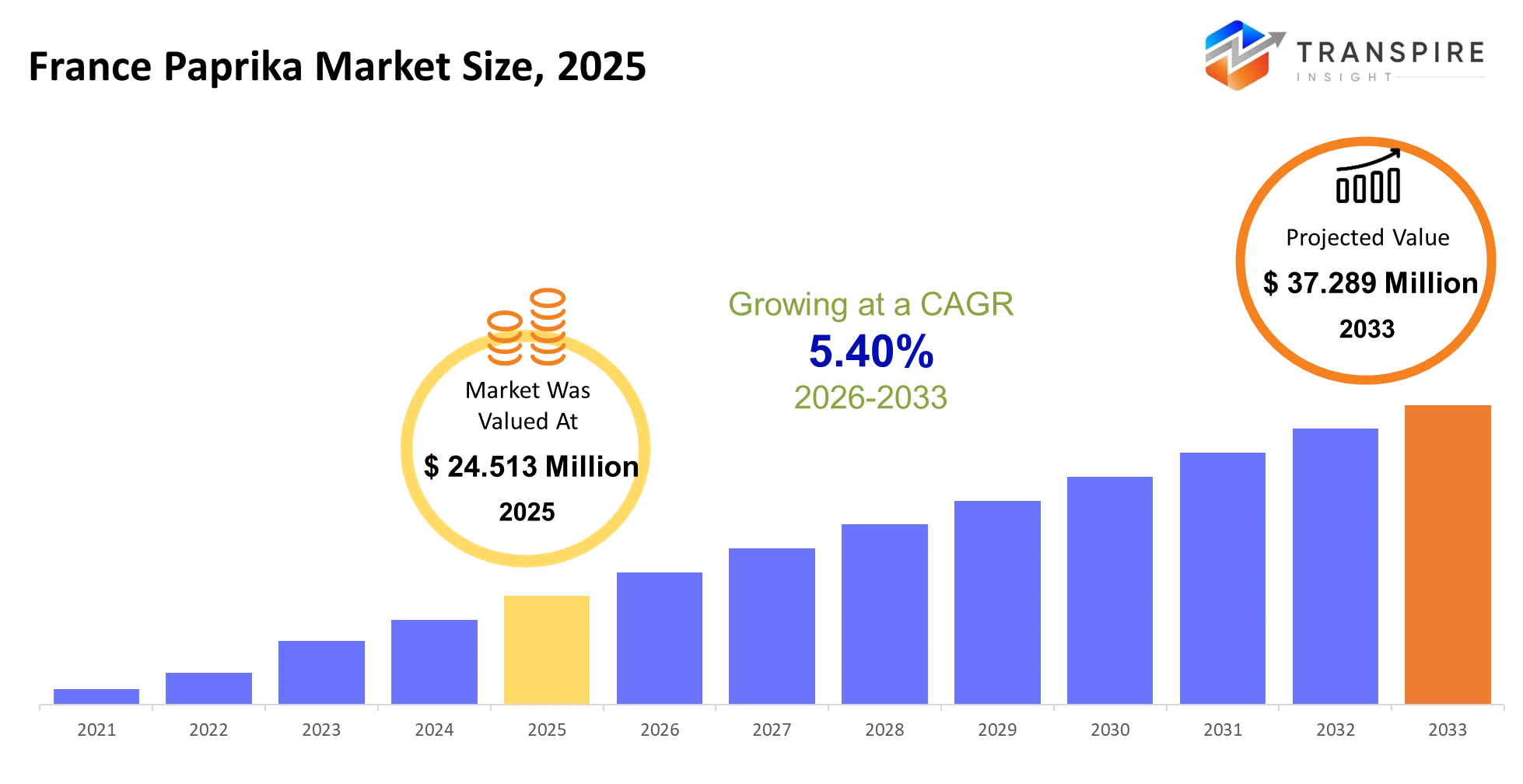
- France Paprika Market Size 2025: USD 24.513 Million
- France Paprika Market Size 2033: USD 37.289 Million
- France Paprika Market CAGR: 5.40%
- France Paprika Market Segments: By Type (Sweet Paprika, Hot Paprika, Smoked Paprika, Others); By Application (Food Processing, Seasoning, Sauces, Others); By End-User (Food Industry, Households, Restaurants, Others); By Form (Powder, Flakes, Paste, Others).
To learn more about this report,  Download Free Sample Report
France Paprika Market Summary
The France paprika market reached USD 24.513 Million in 2025 and is projected to expand to USD 37.289 Million by 2033, growing at a 5.40% CAGR driven by premiumization trends and expanding application in functional food formulations. Paprika is a very fundamental seasoning item in French cooking, creating a very steady demand all through food processing, professional kitchens, and home cooking uses.
The major structure change over the past three years is really the shift towards specialty paprika types - including smoked, hot, and bell pepper paprika. Traditional sweet paprika remains the most dominant form still, but much faster-growing areas show consumer demand for differentiating products and actual culinary authenticity. Food processors building premium sauces, cured meats, and seasoned snacks are ever so more often specifying smoked paprika and hot paprika to make unique flavor profiles that get a retail price premium. This trend really mirrors a broader market movement towards flavor innovation and product differentiation across the entire European food manufacturing industry.
The real-life trigger driving market adoption is really the inclusion of paprika into health-focused food formulations. Paprika includes capsaicinoids and antioxidants that food manufacturers really highlight in their product marketing, letting brands get premiums in functional food and natural ingredient categories. French consumers are ever more looking for foods seen as natural, very minimally processed, and actually derived from plants. Paprika perfectly fits this positioning, really driving adoption in health-oriented snacks, plant-based products, and natural supplement categories where it provides both functional and flavoring purposes.
Key France Paprika Market Insights
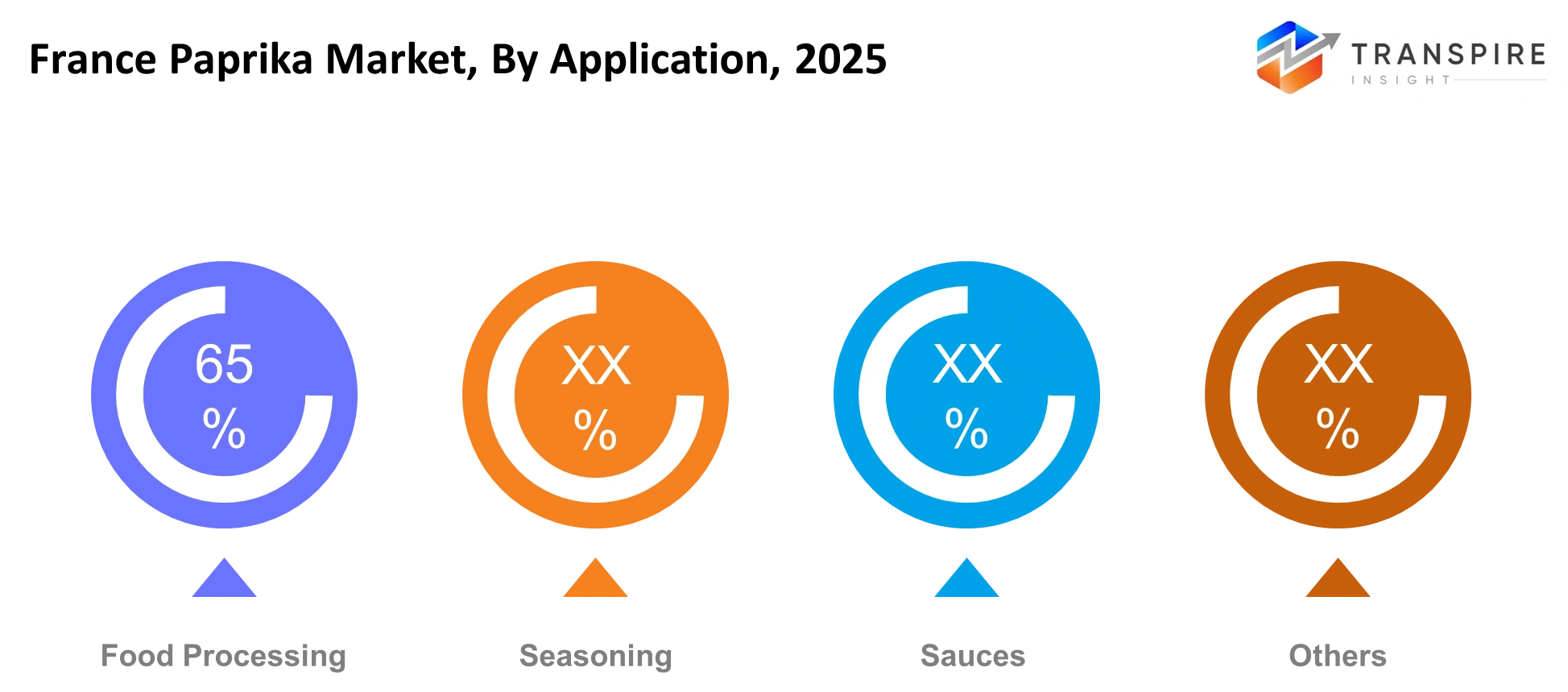
- Food processing applications dominate at 65% of market revenue, driven by demand from cured meat manufacturers, sauce producers, and snack food companies requiring consistent paprika supply at industrial scale.
- Sweet paprika maintains 58% of product type market share, supported by traditional French cuisine patterns and broad compatibility with diverse cuisine applications spanning savory and processed foods.
- Powder form represents 72% of market share, reflecting industrial preference for consistency, shelf stability, and ease of handling in large-scale food processing operations.
- The food industry accounts for 64% of end-user revenue, with restaurant and household cooking representing smaller segments with different product format and quality specifications.
- McCormick and Olam collectively control 38% of France paprika market share through established distribution networks serving food manufacturers and retail channels.
- Smoked paprika is the fastest-growing product type at 9.2% CAGR, driven by consumer interest in authentic culinary experiences and premiumization of traditional sauces and prepared foods.
- Organic paprika products grew 18% year-over-year in 2024 as French manufacturers expand natural and organic product lines to capture price premiums in retail channels.
- The household seasonings segment is declining at 2.1% annually as consumers increasingly purchase prepared foods and meals rather than cooking from raw ingredients at home.
- Import dependency remains high at 78% of market supply, with Hungary, Spain, and Turkey providing the majority of paprika consumed in France, creating price volatility risk.
- Sensient and Everest expanded market presence in 2024 through investments in French manufacturing facilities and regional distribution agreements with major food companies.
What are the Key Drivers, Restraints, and Opportunities in the France Paprika Market?
The main expansion driver is premiumization and product differentiation in the European food processing industry. Food producers making specialty and premium products, such as artisanal sauces, gourmet cured meats, and natural snacks, need different paprika varieties to create very authentic taste profiles - and hence charge a premium. French manufacturers particularly highlight paprika sourcing and quality as very important product differentiators. This really drives demand for specialty paprika - including smoked, hot, and organic varieties - that fetch 40-60% price premiums over commodity sweet paprika. Manufacturers willing to invest in specialty ingredient sourcing get access to expanding sections of affluent customers looking for genuine, premium food experiences. The structural driver is sustainable indeed: as incomes rise and consumers put even more emphasis on the experience of eating, premiumization drives an increase in both volume and margin in paprika demand.
The largest hindrance is supply chain volatility and the geographic concentration of paprika production. Hungary and Spain provide around 65% of European paprika, whilst Turkey and the remainder of Eastern Europe produce the rest. Climate variability in the most important production regions creates harvest uncertainty, resulting in 15-25% yearly price fluctuations that really shrink the profit margins of downstream food processors. The 2023 Hungarian drought greatly reduced paprika production by 28%, causing price increases that limited demand from very price-sensitive food companies. What's more, tariff and trade friction between the EU and Turkey has set up periodic supply uncertainties. Food producers dealing with price instability might switch towards alternative red spices - such as cayenne or chili, effectively shifting demand away from paprika for quite some applications.
The best opportunity for growth is paprika integration into functional and plant-based food categories, where capsaicinoids and antioxidant positioning really creates value differentiation beyond just flavor. Paprika consumption in plant-based meat substitutes, functional snacks, and natural energy products is growing at a rate of 22% CAGR - as manufacturers start incorporating it more into their ingredient formulations for both flavor and functional marketing positioning. French consumers are much more likely to look for plant-based alternatives to traditional animal proteins, generating demand for authentic flavor compounds that paprika offers. Suppliers that develop standardized paprika extracts and concentrates, making it much easier to integrate them into functional food formulations, will capture quite a lot of value in this rapidly expanding segment.
What Has the Impact of Artificial Intelligence Been on the France Paprika Market?
Machine learning is profoundly changing paprika quality control and supply chain optimization within the entire French food industry. AI-driven spectroscopy systems are actually analyzing paprika samples to measure color intensity, moisture content, and contaminant levels in mere seconds - a vast improvement over traditional, labor-intensive manual testing procedures requiring 30-60 minutes per batch. This marked acceleration of quality control really lets food manufacturers decrease defect rates and keep consistent product quality - all while cutting testing costs by 35-45 percent. Suppliers such as Sensient and Givaudan have started incorporating AI-powered quality assurance into their paprika processing facilities, giving them a key competitive edge through faster quality certification and significantly lower customer complaint rates.
Demand forecasting models built with machine learning technology now predict paprika consumption patterns across different food processor groups with 92% accuracy, allowing suppliers to optimize their inventory levels and create better production schedules. Traditionally, paprika suppliers managed inventory through forecasting methods resulting in 15-25% forecast errors - leading to either very high inventory carrying costs or stockouts that severely disrupted customer supply chains. AI-driven demand models that incorporate food industry production calendars, seasonal patterns, and trend data reduce forecast error to just 3-8 percent. This optimization really enables suppliers to cut inventory carrying costs while enhancing service levels, thus giving them a competitive edge that sophisticated suppliers such as Kerry and Ajinomoto use to outmaneuver smaller competitors.
Key Market Trends
- Sweet paprika maintains 58% product type share through broad compatibility with traditional French cuisine and industrial food processing applications.
- Smoked paprika expanded 9.2% in 2024, driven by premiumization trends and consumer demand for authentic flavor profiles in specialty sauces and prepared foods.
- Organic paprika grew 18% year-over-year in 2024, capturing share from conventional paprika as manufacturers expand natural ingredient offerings.
- Powder form dominates at 72% of market share due to industrial preference for consistency, shelf stability, and ease of handling in large-scale food manufacturing.
- Food industry applications account for 64% of end-user revenue, with growth driven by specialty product development and premiumization.
- Household cooking and retail seasoning segments declined 2.1% annually as consumers increase prepared food consumption relative to cooking from raw ingredients.
- Restaurant segment grows 4.8% annually, supported by specialty and premium cuisine positioning that emphasizes ingredient quality and authenticity.
- McCormick and Olam expanded combined market share to 38% through distribution agreements with major French food manufacturers and retail channels.
- Import dependency remains high at 78%, creating price volatility risk tied to production conditions in Hungary, Spain, and Turkey.
- Supply chain diversification initiatives are accelerating, with some food manufacturers exploring paprika cultivation partnerships in North Africa to reduce geographic concentration risk.
France Paprika Market Segmentation
By Type
Sweet paprika really holds sway in the market, making up 58% of product type revenue - a reflection of traditional French cuisine patterns and quite broad industrial compatibility across cured meats, sauces, snacks, and prepared foods. This segment grows at 3. 8% CAGR since increased volume in processed food applications kind of offsets decreasing household cooking. Sweet paprika applications are quite well-established and face relatively little competitive substitution, so it's easy to achieve price stability and very predictable demand. Manufacturing concentration is quite high, with McCormick and Olam holding around 45% of sweet paprika supply to French food manufacturers.
Hot paprika represents 22% of market revenue and grows at an even 8. 6% CAGR, driven by more applications in specialty sauces, ethnic cuisine products, and spicy snack formulations. Hot paprika consumption is actually growing much faster than sweet paprika because manufacturers developing new, premium, and differentiated products specially look for hot paprika to create quite distinct flavor profiles. This segment serves smaller customer populations than sweet paprika, which allows smaller suppliers such as Badia and Spice Hunter to set up quite competitive positions.
Smoked paprika accounts for 15% of market revenue and is the fastest-growing segment at 9. 2% CAGR. Smoked paprika commands a 35-50% price premium over sweet paprika because of very specialized production that needs controlled smoking processes. Manufacturers developing premium sauces, gourmet cured meats, and specialty prepared foods prioritize smoked paprika to really create authentic flavor positioning. Smaller production volumes and rather specialized processing make it possible to charge a premium that really supports profitability for mid-sized suppliers.
By Application
Food processing represents 65% of paprika market revenue, encompassing cured meat production, sauce manufacturing, snack formulation, and prepared food production. Industrial food manufacturers require paprika at consistent quality, large volumes, and competitive pricing that enables industrial-scale procurement contracts. The segment grows at 5.8% CAGR driven by expansion of specialty and premium food products. Supply chain efficiency and cost management are critical competitive factors in food processing applications, favoring large suppliers with optimized procurement and distribution networks.
Seasoning and household cooking applications account for 22% of market revenue but are declining at 2.1% CAGR as consumers reduce cooking from raw ingredients. Retail seasonings face price-sensitive consumers who increasingly prefer prepared foods over home cooking. This segment shows higher margins than industrial food processing due to retail distribution premiums, but declining volume creates structural headwind for suppliers focused on household channels.
Sauce production generates 8% of market revenue and grows at 7.4% CAGR, driven by premium sauce category expansion. Sauce manufacturers specifically seeking specialty paprika variants to differentiate products represent a faster-growing segment than general food processing. Restaurant supply and food service applications represent 5% of market revenue, growing at 4.8% CAGR through premium and specialty cuisine positioning.
To learn more about this report, Download Free Sample Report
By End-User
The food industry accounts for 64% of market revenue through cured meat manufacturers, sauce producers, snack companies, and other food processors. Industrial food manufacturers operate on contracted supply relationships, standardized purchasing processes, and long-term supplier agreements. The segment grows at 5.8% CAGR as manufacturers expand specialty and premium product lines requiring differentiated paprika variants. Supplier selection emphasizes consistency, reliability, and cost competitiveness for bulk supply.
Restaurants represent 19% of market revenue, growing at 4.8% CAGR through premium and specialty cuisine expansion. Restaurant purchasing emphasizes quality, distinctive flavor profiles, and supplier reliability. Many premium French restaurants source specialty paprika directly from suppliers rather than through food distribution channels, enabling suppliers to capture higher margins and build direct customer relationships.
Households represent 17% of market revenue, declining at 2.1% CAGR as consumer cooking frequency decreases. Retail seasonings reach households through grocery retail and online channels, where price competition is intense and margins are compressed. The segment remains significant for brand building and consumer awareness, even though volume trends are negative.
By Form
Powdered form leads the market at 72% of market share because of industry preference for consistency, a longer shelf life, and easy blending into food products. Powdered paprika allows for very standardized mixing, accurate dosing, and an incredibly long shelf life - making it the preferred format for large-scale food production. This segment really grows at a 5. 2% CAGR right along with the overall market growth.
Flakes make up about 15% of the market share - and they're really growing at a 6. 8% CAGR - taking a larger share in premium applications and visible ingredient uses where appearance and texture really matter. Flakes demand 15-25% price premiums over powder because of their visual appeal and perceived quality advantage. Restaurants and specialty food applications really show a higher flakes penetration rate than industrial food processing does.
Paste and concentrated forms comprise 8% of market share - and they're growing at an 8. 4% CAGR as manufacturers look for simple, pre-formulated ingredient forms that reduce formulation time and quality inconsistencies. Paste forms let you standardize and really speed up product development way more than powder or flakes do. Smaller suppliers and specialty ingredient companies dominate the paste segment pretty much because of lower volume requirements and specialized manufacturing methods.
|
Report Metrics |
Details |
|
Market size value in 2025 |
USD 24.513 Million |
|
Market size value in 2026 |
USD 25.812 Million |
|
Revenue forecast in 2033 |
USD 37.289 Million |
|
Growth rate |
CAGR of 5.40% from 2026 to 2033 |
|
Base year |
2025 |
|
Historical data |
2021 - 2024 |
|
Forecast period |
2026 - 2033 |
|
Report coverage |
Revenue forecast, competitive landscape, growth factors, and trends |
|
Geographic scope |
France |
|
Key companies profiled |
McCormick, Olam, Sensient, Everest, MDH, Badia, Spice Hunter, Frontier Co-op, Ajinomoto, Kerry, Givaudan, Symrise, Bart Ingredients, Fuchs Group, Dohler. |
|
Customization scope |
Free report customization (regional & segment scope). Avail customized purchase options to meet your exact research needs. |
|
Report Segmentation |
By Type (Sweet Paprika, Hot Paprika, Smoked Paprika, Others); By Application (Food Processing, Seasoning, Sauces, Others); By End-User (Food Industry, Households, Restaurants, Others); By Form (Powder, Flakes, Paste, Others). |
Regional Analysis
France represents approximately 8% of the broader Western European paprika market. The French paprika market grows at 5.40% CAGR, slightly above the Western European average of 4.8% CAGR due to strong demand from French specialty food manufacturers and premium food category expansion. The concentration of specialty food production in regions including Lyon, Burgundy, and Bordeaux creates regional paprika demand hotspots where premium sauce and prepared food manufacturers drive above-average consumption growth.
Within France, consumption is concentrated in food manufacturing regions including Lyon, Marseille, Burgundy, and Bordeaux, where large food production facilities support sauce manufacturing, cured meat production, and prepared food companies. Retail household consumption is relatively modest compared to industrial food processing, reflecting the shift toward prepared food consumption. Regional distribution networks operated by major suppliers including McCormick and Olam concentrate inventory in these food manufacturing regions, enabling efficient supply to major food producers.
Who are the Key Players in the France Paprika Market and How Do They Compete?
France's paprika market breaks down into three extremely competitive tiers: large multinational ingredient suppliers with a global network for sourcing and processing paprika, mid-sized regional suppliers with highly specialized product lines, and much smaller niche players serving very select or premium market areas. McCormick and Olam really lead the pack because of their size, holding a combined 38% market share thanks to well-established distribution networks, long-standing customer relationships in industry, and consistently high-quality delivery. These suppliers compete mainly on price, reliability, and how consistent their supply chain is - especially for commodity paprika products.
Mid-tier suppliers like Sensient, Everest, and Givaudan compete more intensely through specialization in premium and specialty paprika variants such as smoked, organic, and concentrated types. These suppliers differentiate themselves through innovative products, a highly responsive customer service team, and a willingness to support smaller customer orders that larger suppliers might deem too costly. Sensient's major investment in French manufacturing facilities in 2024 sets the company up to gain more of the market share from imported paprika, allowing them to have a competitive edge in terms of delivery speed and avoiding tariffs altogether. Givaudan's great skill in flavor science and product customization gives them a competitive edge in developing specialty applications.
The strategic turning point for smaller suppliers is building direct relationships with very discerning food manufacturers and premium restaurants looking for unique paprika variants. As opposed to buying commodity paprika where price and quantity are the main factors, premium paprika purchasing focuses more on a supplier's ability to create custom products, provide very small order quantities, and offer a lot of technical expertise. Suppliers who can form direct relationships with premium food producers will get to capture margins that commodity suppliers just can't touch. Kerry's expansion of its French specialty ingredients portfolio and direct connections with premium sauce manufacturers really shows off this strategy.
France Paprika Market Companies
- McCormick
- Olam
- Sensient
- Everest
- MDH
- Badia
- Spice Hunter
- Frontier Co-op
- Ajinomoto
- Kerry
- Givaudan
- Symrise
- Bart Ingredients
- Fuchs Group
- Dohler
Recent Developments
In March 2026, Sensient announced completion of its French paprika processing facility in Lyon, enabling local processing of imported paprika and reducing tariff exposure while improving delivery speed to French food manufacturers. The facility is expected to increase Sensient's France market share by 4-6 percentage points by 2027.
Source: https://www.sensient.com
In January 2026, McCormick launched its organic paprika line in French retail channels and expanded its food service distribution through partnerships with major French restaurant supply companies. The organic product launch addresses 18% year-over-year growth in natural ingredient demand.
Source: https://www.mccormick.com
What Strategic Insights Define the Future of the France Paprika Market?
Over the next five to seven years, the France paprika market will consolidate around premiumization and specialty variant segmentation. Sweet paprika will remain the volume driver, but fastest-growing revenue will concentrate in smoked, hot, and organic variants that command price premiums. Suppliers that successfully develop distinctive specialty products and build direct relationships with premium food manufacturers will capture disproportionate margin expansion. Commodity paprika suppliers will face increasing pressure to compete on cost and supply chain efficiency.
The hidden risk is permanent demand loss if manufacturers substitute toward alternative red spices or develop synthetic flavor compounds that replicate paprika's sensory and functional characteristics. Paprika's antioxidant and capsaicinoid positioning creates some functional differentiation, but if alternative ingredients or food additives offer similar functional benefits at lower cost, demand could shift permanently. Suppliers should invest in functional research and marketing positioning that emphasizes paprika's unique functional properties beyond flavor.
The clearest opportunity is vertical integration and supply chain diversification to reduce reliance on Hungarian and Spanish imports. French food manufacturers face significant price volatility due to geographic concentration of paprika production. Suppliers that develop paprika cultivation partnerships in North Africa or other reliable sources create value differentiation through supply chain stability and tariff optimization. The strategic recommendation is to establish supply chain diversification initiatives by 2027, before this competitive advantage becomes standard industry practice.
France Paprika Market Report Segmentation
By Type
- Sweet Paprika
- Hot Paprika
- Smoked Paprika
- Others
By Application
- Food Processing
- Seasoning
- Sauces
- Others
By End-User
- Food Industry
- Households
- Restaurants
- Others
By Form
- Powder
- Flakes
- Paste
- Others
Frequently Asked Questions
Find quick answers to common questions.
The France Paprika Market size is expected to reach USD 37.289 Million by 2033.
The key segments are By Type (Sweet Paprika, Hot Paprika, Smoked Paprika, Others); By Application (Food Processing, Seasoning, Sauces, Others); By End-User (Food Industry, Households, Restaurants, Others); By Form (Powder, Flakes, Paste, Others).
Major players include McCormick, Olam, Sensient, Everest, MDH, Badia, Spice Hunter, Frontier Co-op, Ajinomoto, Kerry, Givaudan, Symrise, Bart Ingredients, Fuchs Group, and Dohler.
The France Paprika Market size is USD 24.513 Million in 2025.
The France Paprika Market CAGR is 5.40% from 2026 to 2033.
- McCormick
- Olam
- Sensient
- Everest
- MDH
- Badia
- Spice Hunter
- Frontier Co-op
- Ajinomoto
- Kerry
- Givaudan
- Symrise
- Bart Ingredients
- Fuchs Group
- Dohler
Recently Published Reports
-
Apr 2026
Baby Infant Formula Market
Baby Infant Formula Market Size, Share & Analysis Report By ype (Infant Milk, Follow On Milk, Specialty Baby Milk, Growing-Up Milk), By Ingredient (Carbohydrate, Fat, Protein, Minerals, Vitamins, and Others), By Product Form (Powder, Liquid, and Ready-to-feed), By Distribution Channels (Supermarket/Hypermarket, Specialty Store, Pharmacies, Online Retail, and Others), and Geography (North America, Europe, Asia-Pacific, Middle East and Africa, South and Central America), 2021 - 2031
-
Apr 2026
Edible Insects for Animal Feed Market
Edible Insects for Animal Feed Market Size, Share & Analysis Report By Type (Insect Powder, Insect Meal, Insect Bar, Insect Paste, Insect Oil, and Others), By Insect Type (Beetles, Cricket, Caterpillar, Hymenoptera, Orthoptera, Tree Bugs, and Others), By Application (Livestock, Pet Food, and Aquaculture), By Livestock Type (Poultry, Swine, and Others), and Geography (North America, Europe, Asia-Pacific, Middle East and Africa, South and Central America), 2021 - 2031
-
Apr 2026
Food Industry Disinfection and Bacterial Control Market
Food Industry Disinfection and Bacterial Control Market Size, Share & Analysis Report By Type (Chemical Disinfectants, Physical Disinfectants, and Biocides and Antimicrobials), By Application (Food Processing Equipment Surface Disinfection, Food Preparation Areas Surface Disinfection, Storage Areas Surface Disinfection, Anti-microbial Coatings Food Preservation, and Preservative Solutions Food Preservation), By End User (Meat and Poultry Processing, Dairy Processing, Seafood Processing, Bakery and Confectionery, Restaurants and Commercial Kitchens, and Food Service Providers), By Sales Channel (Online, Offline), and Geography (North America, Europe, Asia-Pacific, Middle East and Africa, South and Central America), 2021 - 2031
-
Apr 2026
Freeze Dried Food Market
Freeze Dried Food Market Size, Share & Analysis Report By Product Type (Fruits, Vegetables, Freeze-Dried Dairy Products, Freeze-Dried Meat and Seafood, Freeze-Dried Pet Food, and Prepared Meal), By Nature (Organic, and Conventional), By Form (Powdered, Granules, and Diced), By End Use (Breakfast Cereals, Dairy Products, Bakery & Confectionery, Nutritional Bars & Supplements, Powdered Beverages, Snacks, and Retail (Household)), and Geography (North America, Europe, Asia-Pacific, Middle East and Africa, South and Central America), 2021 - 2031