

France Green Roof Market Size & Forecast:
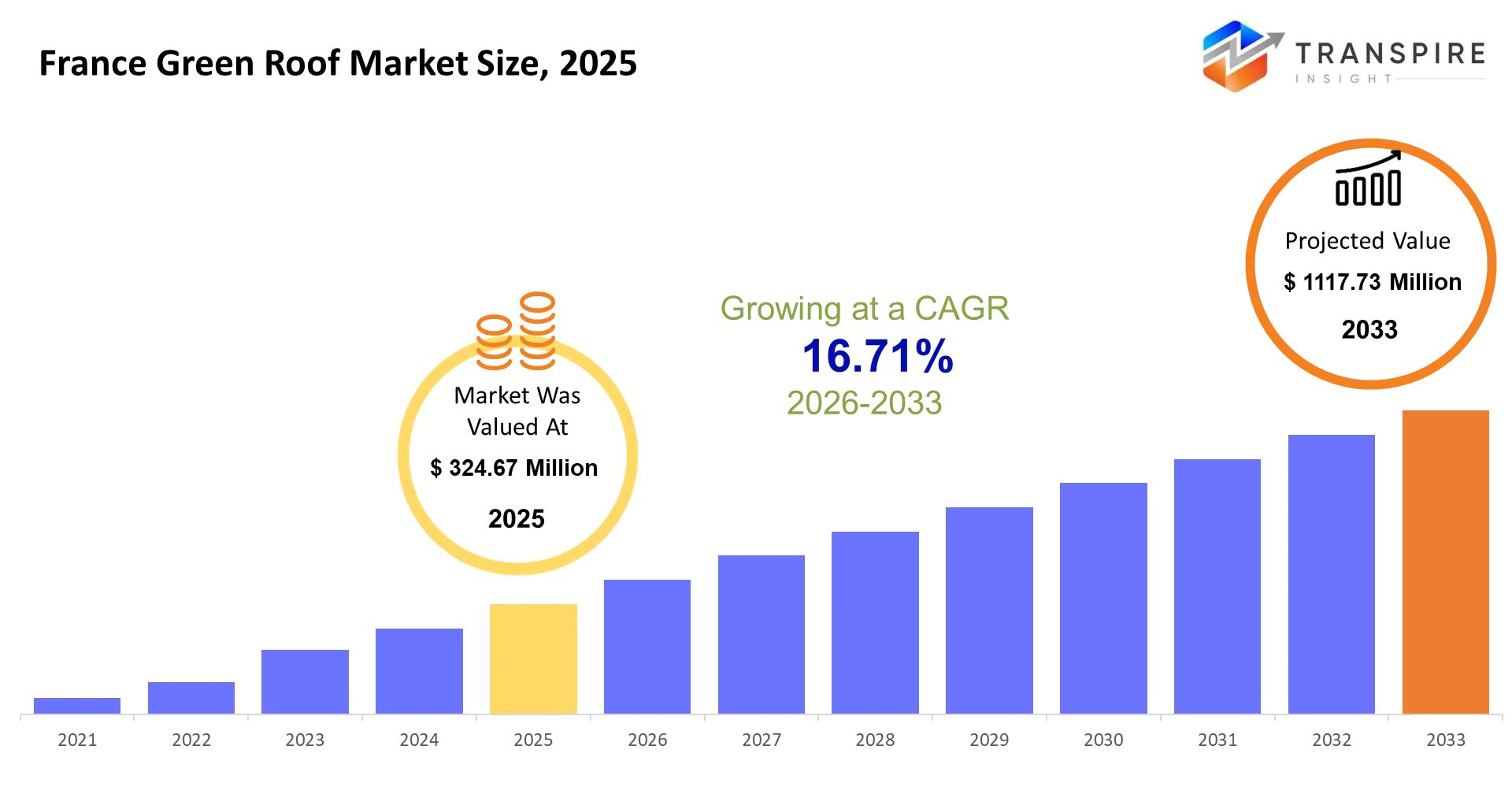
- France Green Roof Market Size 2025: USD 324.67 Million
- France Green Roof Market Size 2033: USD 1117.73 Million
- France Green Roof Market CAGR: 16.71%
- France Green Roof Market Segments:By Type (Extensive Roofs, Intensive Roofs, Semi-intensive Roofs, Others); By Application (Residential Buildings, Commercial Buildings, Industrial Buildings, Others); By End-User (Construction Companies, Real Estate Developers, Government, Others); By Component (Vegetation, Drainage Systems, Waterproofing, Others)
To learn more about this report,  Download Free Sample Report
France Green Roof Market Summary
The France Green Roof Market was valued at USD 324.67 Million in 2025. It is forecast to reach USD 1117.73 Million by 2033. That is a CAGR of 16.71% over the period.
The France Green Roof Market serves as an essential tool for cities which need to control heat retention and stormwater runoff and building energy usage in their highly populated urban areas. The commercial building sector and logistics centers and residential developments and public infrastructure projects now use green roof systems to achieve better insulation and longer roof durability and urban climate adaptation objectives. The market has evolved during the past five years from projects that focus on aesthetic landscaping to roofing systems that deliver energy efficiency and environmental compliance through performance-based design.
French building sustainability regulations and urban biodiversity requirements combined with climate transition policies brought about significant structural changes to the existing system. European cities began investing in temperature-resilient construction because heatwaves began to occur more frequently across the continent. Property owners and developers now use vegetative roofing systems because they support their ESG goals and their strategies to build low-carbon structures. The dual market segments of retrofit and new construction experience revenue growth because installation technologies advance and maintenance expenses become more predictable.
Key Market Insights
- The France Green Roof Market in 2025 belonged to Northern France which acquired almost 38% of the market because of its extensive business development and its environmental sustainability requirements from local governments.
- The Southern France market will grow at the fastest rate until 2033 because urban residential projects increase their spending on heat-resilient construction.
- The market for extensive green roof systems achieved the highest market share in 2025 because their lightweight design permits building owners to reduce structural reinforcement requirements for their current facilities.
- The second-largest market segment developed through semi-intensive roof systems because mixed-use projects required multiple uses from their rooftop landscape areas which also needed water drainage systems.
- Intensive green roofs will experience their highest growth rate until 2033 because cities are investing in new hospitality and urban redevelopment projects.
- ESG property modernization programs drove commercial buildings to become the leading application sector which reached 45% market share in 2025.
- Climate resilience funding programs support public infrastructure projects which include schools and municipal buildings as their most rapidly expanding application area.
- The French government developed low-carbon construction standards for large urban housing projects which resulted in real estate developers becoming the primary end-user group for its development.
- The operators of industrial and logistics facilities began to adopt new insulation technologies in 2022 to achieve better thermal performance and decrease their summer cooling costs.
- Manufacturers today use water retention membranes together with biodiversity vegetation systems and intelligent irrigation technology to create unique product distinctions from their rivals.
What are the Key Drivers, Restraints, and Opportunities in the France Green Roof Market?
The France Green Roof Market sees its main growth driver because French urban planning regulations now require stricter climate-resilient construction standards. The new regulations demand municipal governments and commercial developers to meet improved building performance standards which include stormwater management and urban heat reduction and carbon efficiency targets. The implementation of these policies started after cities experienced multiple summer heatwaves and flooding incidents which damaged their infrastructure systems. Green roofs have become essential building components because they enable property owners to reach sustainable development targets while reducing their future cooling and drainage expenses. The transition has resulted in office complexes and public buildings and mixed-use developments adopting the new system which has led to increased revenue from system installations and demand for maintenance services.
The primary barrier to progress exists because building owners must spend substantial funds to bring their existing facilities up to modern structural standards. Many urban properties in France were not originally engineered to support additional vegetation layers, irrigation systems, or water retention loads. The need for structural reinforcement causes significant delays and increases project costs because historical districts contain strict building modification rules. The existing structural restriction hampers the development of commercial buildings which have aged throughout the years.
The new opportunity has arisen from smart urban redevelopment projects which focus on both biodiversity restoration and water management technology. Developers increasingly combine green roofs with solar panels, rainwater harvesting systems, and IoT-based irrigation controls in large mixed-use projects.
What Has the Impact of Artificial Intelligence Been on the France Green Roof Market?
Artificial intelligence and advanced building management technologies are beginning to reshape the France Green Roof Market by improving maintenance efficiency and irrigation control and establishing long-term roof performance analytics. AI-enabled monitoring systems now analyze soil moisture levels and weather forecasts and drainage conditions and plant health data in real time to automate irrigation schedules across commercial rooftop installations. Property managers increasingly use connected sensors and machine learning models to reduce water consumption while maintaining vegetation quality during extreme summer temperatures.
Predictive analytics platforms enable facility operators to anticipate membrane deterioration and drainage blockages and vegetation stress before structural damage occurs. These systems decrease unplanned maintenance expenses while extending roof durability especially in extensive commercial and municipal projects. Multiple smart building operators in France achieved measurable water consumption reductions and maintenance intervention decreases after implementing automated environmental monitoring systems that work with their rooftop systems.
Advanced digital twins and AI-driven energy optimization platforms enhance thermal efficiency analysis through their rooftop temperature modeling capabilities which simulate different weather conditions. This method enables developers to evaluate insulation effectiveness and cooling energy requirements with precise accuracy throughout the building design process.
AI adoption currently encounters obstacles because organizations must spend considerable funds to achieve complete system integration while their building systems remain fragmented. The implementation process becomes technically challenging and financially unfeasible for small property owners because many older French buildings lack essential sensor networks and centralized digital management systems.
Key Market Trends
- In 2021 French municipalities mandate green infrastructure requirements for commercial projects that exceed their established environmental limits.
- Developers use rooftop solar systems together with green roofing systems because this combination boosts insulation performance while optimizing building space.
- The demand for lightweight modular roof systems increased after 2022 because retrofit projects needed solutions that could be installed faster without needing extensive structural enhancements.
- Commercial property owners shifted their investments toward drought-resistant vegetation because European heatwaves and seasonal water restrictions caused issues with their existing vegetation.
- Large office complexes adopted smart irrigation systems after AI monitoring technology proved effective in decreasing rooftop water usage and decreasing maintenance requirements.
- Public sector construction projects now emphasize biodiversity-oriented roofing systems which use native plants and create spaces for pollinators to thrive.
- Manufacturers during 2021 and 2022 supply chain interruptions which required them to obtain all substrate and drainage materials from European sources.
- Development projects in the hospitality industry and mixed-use spaces now use intensive rooftop gardens to boost property value and attract more tenants.
- Green roof contractors now provide their clients with extended maintenance packages since clients now spend more on lifecycle value than on initial installation services.
France Green Roof Market Segmentation
By Type
Roofing systems in the market network reach their highest performance because commercial property operators and municipal authorities prefer roofing systems which have low weight requirements and need minor structural changes and produce reduced operational costs. The implementation of extensive roof systems has become standard practice in large office buildings and logistics centers and public infrastructure projects because these systems help cities control urban heat and manage stormwater issues. The segment provides optimal value through its lightweight installation features which enable flexible installation across French cities that have high population density.
The intensive roof market shows its value through a small section which generates high revenue because hotel operations and upscale residential building projects and mixed-use commercial developments choose rooftops for their landscaping and recreational areas. The combination of increased soil depth needs and high maintenance expenses prevents organizations from implementing large-scale projects throughout urban areas that have older building structures which can handle only limited weight. The semi-intensive roof system design gets chosen by developers because it provides an effective solution to achieve biodiversity results while creating attractive outdoor areas that require easy upkeep. The “others” category, which contains biosolar and modular hybrid roof systems, is expanding at a steady pace because climate-adaptive construction technologies achieve commercial viability through current market developments. Product development during the forecast period will concentrate on creating lightweight substrates and developing drought-resistant vegetation systems and water-retention technologies which will enhance operational efficiency for all types of roofs.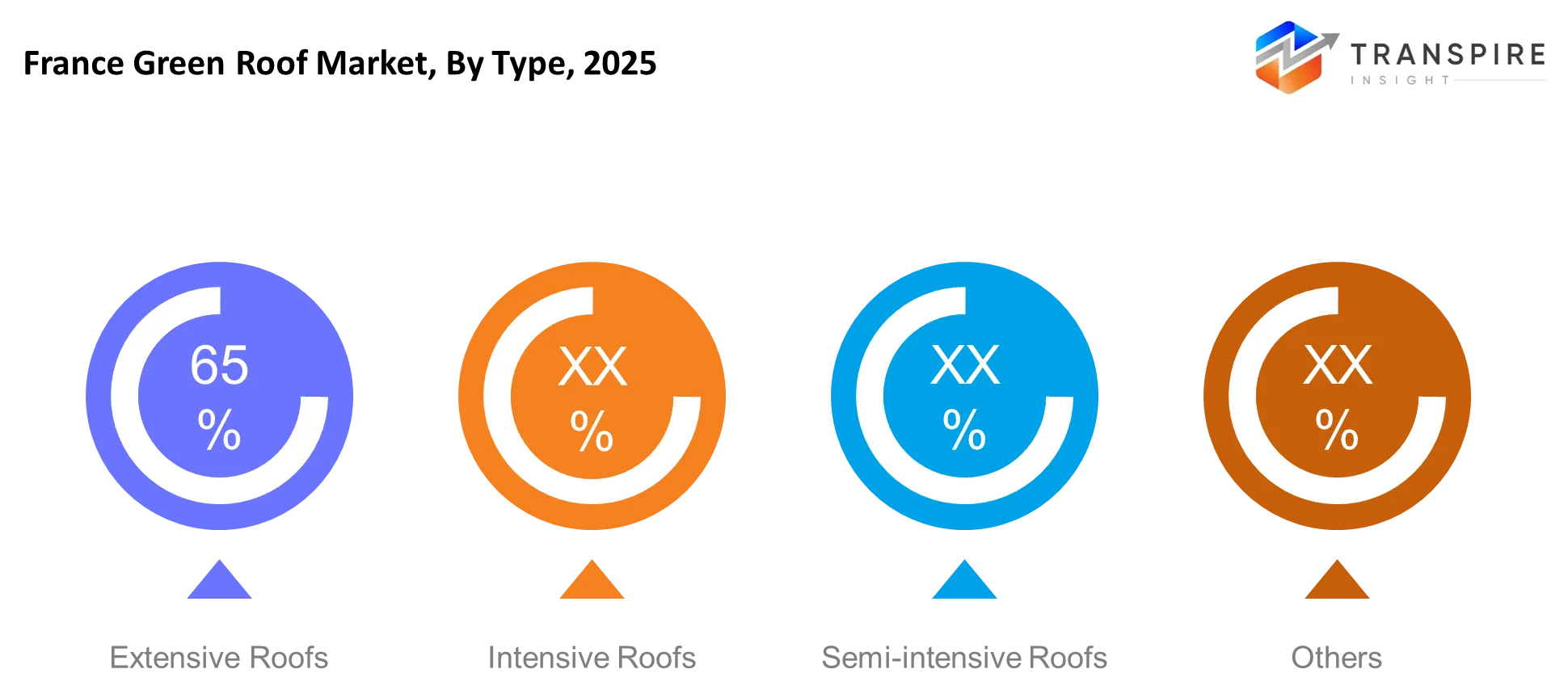
To learn more about this report, Download Free Sample Report
By Application
The market for commercial buildings remains strongest because office buildings and retail shopping centers and hotels and mixed-use properties now implement green roof systems as part of their environmentally sustainable building upgrade programs. Developers of commercial properties utilize vegetative roof systems because these systems help decrease energy use and increase building certification results and enhance property value throughout urban competitive markets. The active enforcement of policies in large cities enables continuous demand from construction projects that require substantial commercial building work.
The residential building sector is experiencing growth because apartment developers and urban housing projects now use rooftop vegetation to create better thermal insulation and stormwater management systems. The industrial sector is experiencing growth through its adoption of rooftop vegetation especially in logistics warehouses and manufacturing plants which need to cut their cooling costs and meet environmental compliance standards. Public sector climate adaptation funding for sustainable roofing design has created uninterrupted growth into the "others" category which includes schools and healthcare facilities and transportation infrastructure. The upcoming forecast period will show a shift in application demand toward rooftop ecosystems that generate energy and support biodiversity and manage rainwater through a single infrastructure development.
By End-User
The primary market control in France belongs to real estate developers because they use urban redevelopment projects and sustainable building requirements to determine their investment choices. Large property developers increasingly integrate green roofing systems into premium commercial and residential projects to improve environmental certification ratings and attract institutional investors who prioritize ESG performance. The segment shows increased procurement activity because the combination of long-term energy savings and greater tenant appeal creates economic benefits.
Construction companies represent another major end-user group because large contractors increasingly provide integrated roofing installation and climate-resilient building services within broader infrastructure projects. Government agencies are expanding influence through municipal climate adaptation programs, public infrastructure modernization, and biodiversity-focused urban planning initiatives. The "others" category which includes educational institutions, industrial facility operators and healthcare organizations is gradually increasing investment as energy efficiency targets become more operationally important. Future market development will create advantages for end-users who can implement smart irrigation systems and low-maintenance vegetation technologies and long-term rooftop performance monitoring within their building management systems.
By Component
The market remains dominated by waterproofing systems because vegetative roofing systems need their roofs to resist damage and stop water leaks as their essential performance requirements. Commercial developers and contractors require waterproof membranes which perform at high levels during extended moisture exposure and hide their root penetration dangers and changing weather patterns. The market maintains strong continuous demand for advanced membrane technologies because they benefit both current building upgrades and new building construction.
Drainage systems represent another essential component segment because efficient water flow management directly affects roof lifespan vegetation health and structural safety performance. The use of drought-resistant plant varieties and biodiversity-focused landscaping systems has resulted in continued expansion of vegetation components as developers now adopt these systems which match their local climate requirements. The “others” category which contains filtration layers and root barriers and irrigation technologies is starting to acquire commercial significance due to the increasing complexity of smart rooftop systems. The forecast period will see component innovation develop recyclable materials and lightweight engineering solutions and digitally monitored water management systems which will enhance lifecycle efficiency while cutting maintenance expenses.
What are the Key Use Cases Driving the France Green Roof Market?
The primary application for the France Green Roof Market is commercial office buildings and mixed-use urban developments. Property developers increasingly install vegetative roofing systems to reduce summer cooling loads and comply with municipal stormwater regulations and improve ESG performance ratings for premium urban assets. The application creates its highest demand because urban areas in Paris and Lyon need to control heat island effects while managing their restricted city space.
The secondary applications now extend their reach to logistics facilities and educational campuses and public infrastructure projects. Warehouse operators implement green roofs to enhance thermal insulation and reduce energy costs while municipalities use vegetative roofs in their schools and administrative buildings to achieve biodiversity and climate adaptation goals connected to public procurement requirements.
Rooftop urban agriculture and hybrid solar-green roof systems represent newly emerging use cases. Developers are testing multifunctional rooftops that combine photovoltaic panels with water-retention vegetation layers to maximize energy generation and environmental performance within space-constrained city environments.
|
Report Metrics |
Details |
|
Market size value in 2025 |
USD 324.67 Million |
|
Market size value in 2026 |
USD 378.92 Million |
|
Revenue forecast in 2033 |
USD 1117.73 Million |
|
Growth rate |
CAGR of 16.71% from 2026 to 2033 |
|
Base year |
2025 |
|
Historical data |
2021 - 2024 |
|
Forecast period |
2026 - 2033 |
|
Report coverage |
Revenue forecast, competitive landscape, growth factors, and trends |
|
Regional scope |
United States; Canada; Mexico; United Kingdom; Germany; France; Italy; Spain; Denmark; Sweden; Norway; China; Japan; India; Australia; South Korea; Thailand; Brazil; Argentina; South Africa; Saudi Arabia; United Arab Emirates |
|
Key company profiled |
Optigreen, ZinCo, Sika, BASF, Soprema, Carlisle Companies, Kingspan, Bauder, Tremco, LiveRoof, Green Roof Blocks, American Hydrotech, GAF, IKO, Owens Corning |
|
Customization scope |
Free report customization (country, regional & segment scope). Avail customized purchase options to meet your exact research needs. |
|
Report Segmentation |
By Type (Extensive Roofs, Intensive Roofs, Semi-intensive Roofs, Others); By Application (Residential Buildings, Commercial Buildings, Industrial Buildings, Others); By End-User (Construction Companies, Real Estate Developers, Government, Others); By Component (Vegetation, Drainage Systems, Waterproofing, Others) |
Which Regions are Driving the France Green Roof Market Growth?
The Île-de-France region leads the market because it contains most commercial real estate and its cities have extensive urban building systems while enforcing strict environmental construction regulations. Paris maintains its strict climate adaptation requirements which mandate new commercial and mixed-use developments to use green roof technology. The region contains established systems which allow architects and roofing experts and engineering companies and municipal sustainability initiatives to work together on extensive rooftop greening projects. The market demonstrates stable leadership because investors actively participate in both office modernization projects and public infrastructure improvements.
Auvergne-Rhône-Alpes serves as the second-largest regional economic contributor while its growth pattern differs from the Paris metropolitan area. The region achieves benefits from its industrial base and tourist construction activities and ongoing expenditures for energy-efficient building improvements rather than depending on enforcement of building regulations. Cities such as Lyon and Grenoble increasingly adopt vegetative roofing systems in hospitality, healthcare, and logistics projects where thermal performance and water management remain critical operational priorities. The demand pattern produces stable income which roofing companies and installation contractors receive throughout their business operations.
The Provence-Alpes-Côte d'Azur region has become the fastest-growing market because of increasing climate challenges which drive urban heat reduction funding. The 2023 cooling roofing infrastructure adoption process which municipalities and developers started after the summer heat and drought conditions became a regular occurrence. Regional authorities increasingly support projects that combine green roofs with rainwater retention and solar energy systems to improve.
Who are the Key Players in the France Green Roof Market and How Do They Compete?
The France Green Roof Market remains moderately fragmented because roofing system development and technical environment performance and maintenance capabilities control market competition, which extends beyond pricing. Established building envelope manufacturers maintain their market presence by creating vertical product lines that include waterproofing membranes and drainage systems and insulation materials and vegetative roofing layers. Specialist green roof providers have built their market presence by delivering green roof designs that support biodiversity and stormwater management systems and modular systems for urban retrofitting projects.
Soprema uses its Sopranature integrated roofing systems to create waterproofing solutions that include photovoltaic systems and rainwater management and green roof systems. The company expanded its sustainable insulation manufacturing capabilities and European roofing operations to strengthen its competitive position in 2026. ZinCo develops roofing systems that require advanced engineering to create solutions which enhance biodiversity and stormwater management and enable multiple rooftop uses. The Environmental Product Declaration system enables architects and developers to obtain project-specific environmental data which assists ESG-focused procurement activities.
Bauder provides commercial infrastructure projects with flat-roof solutions that combine insulation and waterproofing and vegetative systems. Kingspan establishes its sustainable construction leadership through its high-performance insulation technologies and energy-efficient building solutions while Sika grows its business through its long-lasting roofing membranes and cutting-edge waterproofing technologies.
Company List
- Optigreen
- ZinCo
- Sika
- BASF
- Soprema
- Carlisle Companies
- Kingspan
- Bauder
- Tremco
- LiveRoof
- Green Roof Blocks
- American Hydrotech
- GAF
- IKO
- Owens Corning
Recent Development News
In February 2026,Soprema announced the acquisition of Binné & Kluth Dachbaustoffe. The acquisition strengthened Soprema’s roofing distribution network and expanded its sustainable roofing and green infrastructure capabilities across Europe. Source Link:http://www.soprema.de/presse/soprema-uebernimmt-binne-kluth-dachbaustoffe.html
In February 2026,Soprema inaugurated a new cellulose insulation production facility in Beaune, France. The investment increased domestic supply capacity for sustainable insulation and energy-efficient roofing systems supporting green roof infrastructure projects. Source Link:http://www.lagazettefrance.fr/article/soprema-inaugure-sa-plus-grande-usine-de-ouate-de-cellulose-a-beaune
In June 2025, ZinCo completed Environmental Product Declaration verification for most of its green roof product portfolio. The certification improved transparency for lifecycle environmental assessment and strengthened ZinCo’s position in ESG-focused construction projects. Source Link:http://www.zinco-greenroof.co.uk/press-releases
What Strategic Insights Define the Future of the France Green Roof Market?
The France Green Roof Market is heading towards rooftop systems which provide multiple functions that include biodiversity improvement and stormwater management and thermal insulation and on-site energy production in one unified building system. The movement toward this change has been accelerated by increased climate adaptation policies and urban heat mitigation standards and the rising financial importance of real estate valuations which depend on environmental, social, and governance factors. The market will progress towards integrated smart roof systems which use digital monitoring and water management solutions within the next five to seven years after current vegetative roofing systems. The growing use of municipal funding programs together with urban development regulations represents a hidden danger that needs to be addressed. The pace of retrofit work and project production will decrease in secondary cities when public climate infrastructure funding and regulatory activities experience any form of slowdown.
The market has discovered a fresh business opportunity in hybrid biosolar roofing systems which use photovoltaic panels together with water-retentive vegetation systems. Businesses that establish early commitments to modular integrated systems together with predictive maintenance solutions and retrofit engineering partnerships will gain a competitive advantage for securing long-term urban redevelopment projects throughout France.
France Green Roof Market Report Segmentation
By Type
- Extensive Roofs
- Intensive Roofs
- Semi-intensive Roofs
- Others
By Application
- Residential Buildings
- Commercial Buildings
- Industrial Buildings
- Others
By End-User
- Construction Companies
- Real Estate Developers
- Government
- Others
By Component
- Vegetation
- Drainage Systems
- Waterproofing
- Others
Frequently Asked Questions
Find quick answers to common questions.
Confirmed 2033 Market size figure in USD 1117.73 Million.
Key Segments for the France Green Roof Market are By Type (Extensive Roofs, Intensive Roofs, Semi-intensive Roofs, Others); By Application (Residential Buildings, Commercial Buildings, Industrial Buildings, Others); By End-User (Construction Companies, Real Estate Developers, Government, Others); By Component (Vegetation, Drainage Systems, Waterproofing, Others).
Major France Green Roof Market Players are Optigreen, ZinCo, Sika, BASF, Soprema, Carlisle Companies, Kingspan, Bauder, Tremco, LiveRoof, Green Roof Blocks, American Hydrotech, GAF, IKO, Owens Corning.
The Current France Green Roof Market size is USD 324.67 Million in 2025.
The France Green Roof Market CAGR is 16.71% from 2026 to 2033.
- Optigreen
- ZinCo
- Sika
- BASF
- Soprema
- Carlisle Companies
- Kingspan
- Bauder
- Tremco
- LiveRoof
- Green Roof Blocks
- American Hydrotech
- GAF
- IKO
- Owens Corning
Recently Published Reports
-
Apr 2026
Handling and Lifting Equipment Market
Handling and Lifting Equipment Market Size, Share & Analysis Report By Product (Cranes and Hoists, Forklifts, Conveyor Systems, Aerial Work Platforms, Others), By Application (E-Commerce, Automotive and Railway, Food and Beverages, Aviation, Others), and Geography (North America, Europe, Asia-Pacific, Middle East and Africa, South and Central America), 2021 - 2031
-
Apr 2026
HVAC Equipment Market
HVAC Equipment Market Size, Share & Analysis Report By Heating Equipment Type (Boilers and Furnaces, Heat Pumps, and Unitary Heaters), By Ventilation Equipment (Air Handling Units, Humidifiers and Dehumidifiers, Air Filters, and Fan Coiling Units), By Air Conditioning Equipment (Unitary Air Conditioners, Room Air Conditioners, Packaged Terminal Air Conditioners, and Chillers), By End User (Commercial, Residential, Industrial, and others), and Geography (North America, Europe, Asia-Pacific, Middle East and Africa, South and Central America), 2021 – 2031
-
Apr 2026
Refrigeration Valves Market
Refrigeration Valves Market Size, Share & Analysis Report By Type (Solenoid Valves, Expansion Valves, Check Valves, Service Valves, Others), By Application (Commercial Refrigeration, Industrial Refrigeration, Transport Refrigeration, Residential Refrigeration, Air Conditioning Systems), By End User (Food and Beverage Industry, Pharmaceutical Industry, HVAC Industry, Chemical Industry, Others), and Geography (North America, Europe, Asia-Pacific, Middle East and Africa, South and Central America), 2021 – 2031
-
Apr 2026
E-Commerce Packaging Materials Market
E-Commerce Packaging Materials Market By Material Type (Corrugated Boxes, Paper & Paperboard, Foam & Cushioning Materials, Plastic Packaging, Flexible Packaging, Protective Packaging, Others), By Product(Primary Packaging, Secondary Packaging, Tertiary Packaging), By Packaging Function (Protective Packaging, Branding & Presentation Packaging, Transit & Logistic Packaging, Sustainable Packaging, Tamper Evidence Packaging), By End-User (Retail & Consumer Goods, Electronic Appliances, Food & Beverages, Healthcare & Pharmaceutical, Fashion & Apparel, Home & Furnishing, Others); By Industry Analysis, Size, Share, Growth, Trends, and Forecasts 2021-2033