

France Draught Beer Market Size & Forecast:
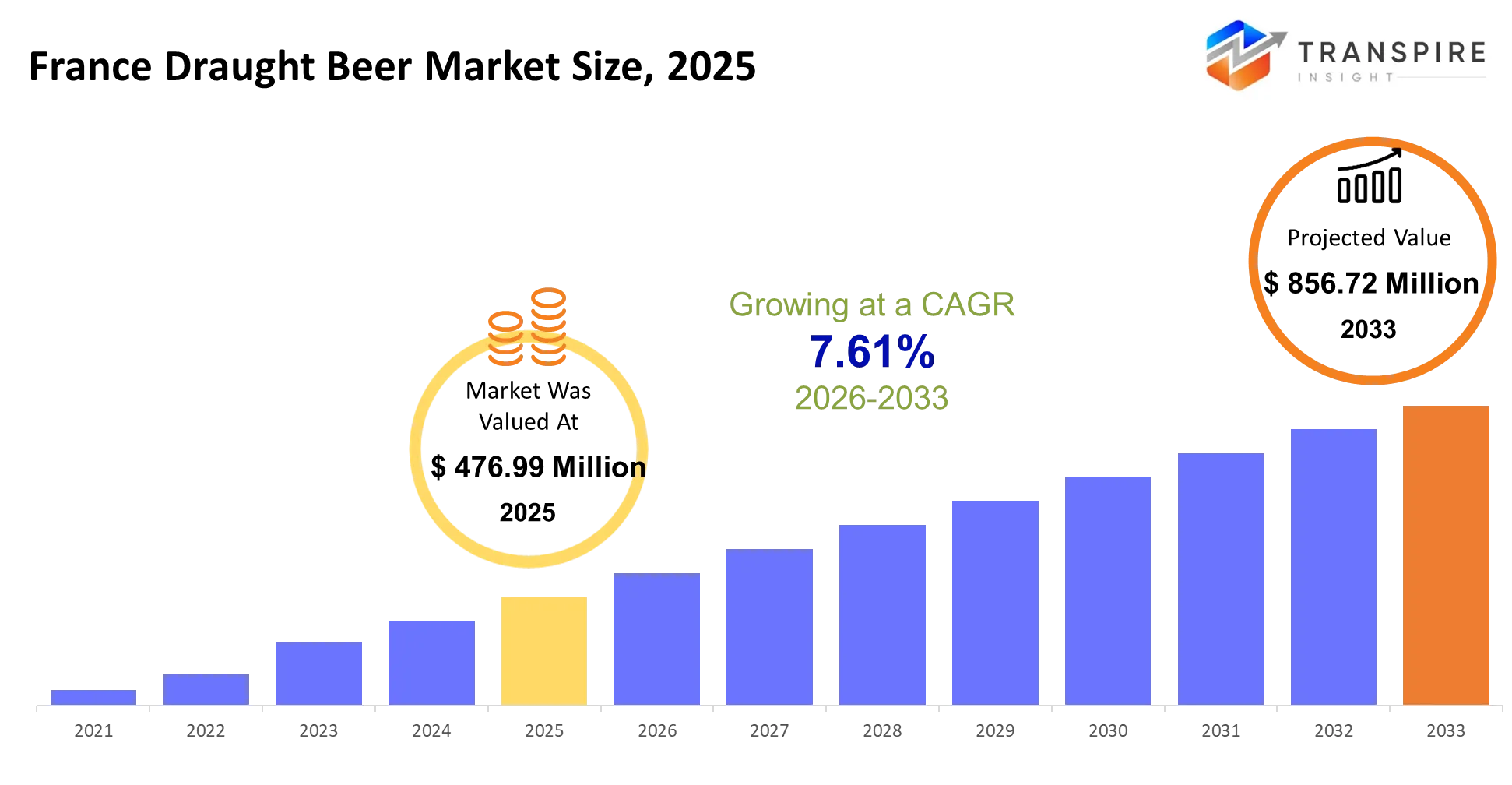
- France Draught Beer Market Size 2025: USD 476.99 Million
- France Draught Beer Market Size 2033: USD 856.72 Million
- France Draught Beer Market CAGR: 7.61%
- France Draught Beer Market Segments: By Type (Lager, Ale, Stout, Others); By Application (Bars & Pubs, Restaurants, Events, Others); By End-User (Consumers, Hospitality Industry, Others); By Distribution (On-trade, Off-trade, Others)
To learn more about this report,  Download Free Sample Report
France Draught Beer Market Summary
The France Draught Beer Market was valued at USD 476.99 Million in 2025. It is forecast to reach USD 856.72 Million by 2033. That is a CAGR of 7.61% over the period.
In France the draught beer market kind of acts like a linchpin inside the country's hospitality setup, because it lets bars, cafés, restaurants , stadiums and entertainment spaces serve beer that is more fresh and fast while improving their margins thanks to keg based delivery. If you compare it to bottle formats , the draught arrangement cuts down on packaging waste, helps venues lean into a more premium stance, and also builds a bit of a more experiential way of drinking that fits with France's growing craft and specialty beer scene. In the past five years there’s been a noticeable move away from just selling lots of lager, toward premium tap choices , local craft labels and even rotating beer menus.
Those menus are increasingly backed by digital dispensing systems and some cold chain improvements. When COVID-19 shut down on trade places , keg consumption took a hit, and brewery supply chains got stressed too. Still, the pause also pushed companies to invest in flexible distribution and more localized production networks. Then as tourism, nightlife, and overall foodservice movement came back, many operators started picking higher margin premium draught selections more often. That in turn helps breweries and distributors build stronger ongoing revenue, and also lifts tap utilization in many urban hospitality venues.
Key Market Insights
- Île-de-France kind of dominates the France Draught Beer Market, taking nearly 32% share in 2025 ,mostly because of dense hospitality and constant tourism activity.
- Meanwhile Southern France shows the fastest growth path through 2033, powered by tourism led pub and restaurant expansion, it sounds simple but it really moves the numbers.
- On the segment side, craft draught beer stays in front, with over 38% market share , since consumers are leaning toward localized and seasonal offerings more and more.
- Premium imported lager ends up as the second-largest share, largely driven by demand in sports bars, hotel chains, and urban nightlife spots.
- Also, nitro and flavored draught beer categories are starting to emerge quickly between 2026 and 2033 ,especially among younger urban drinkers who want something different.
- For applications, bars and pubs lead the revenue picture, contributing roughly 45% ,because draught systems boost serving efficiency and profitability, it’s basically the practical advantage.
- Hotels and fine-dining channels are adopting faster too, as operators upgrade the beverage experience to attract higher-spending tourists.
- Independent breweries are expanding taproom partnerships, to strengthen direct distribution and improve keg rotation efficiency across metropolitan areas.
- Lastly, brewers are increasingly rolling out smart dispensing systems, predictive keg management, and regional distribution partnerships, all to keep freshness higher and reduce wastage, small improvements add up a lot.
What are the Key Drivers, Restraints, and Opportunities in the France Draught Beer Market?
The main thing pushing the France draught beer market forward is the structural shift happening in the country’s hospitality and beverage consumption situation. French consumers are more and more trying to chase premium social drinking experiences, not only those high-volume packaged alcohol purchases. So bars and restaurants tend to widen their curated draught lineups, sort of like they are testing new formats, without saying it too loudly. This momentum got even sharper after hospitality venues reopened following pandemic restrictions, when operators were trying to rebuild profitability by putting higher margin beverage categories in front. Craft breweries and also international beer brands then kept the pace, putting money into tap installations, cold-chain logistics, and rotational keg programs that help with product freshness and , in the same breath, keep drinkers returning. In practice, all of this supports revenue growth for pubs, breweries, and distributors because draught beer typically delivers stronger margins than bottled alternatives.
Still, the biggest brake in the market is the capital-heavy nature of drought infrastructure. Putting in and keeping tap systems running, refrigeration units in place, keg storage, plus the cleaning equipment, needs major upfront spending. This hits small hospitality operators harder, because they often have tighter budgets. The issue is fairly structural too, since fragmented independent venues still dominate many parts of the French foodservice sector, so economies of scale don’t really kick in. And on top of that, keg transportation plus cold logistics adds operational overhead, which quietly dampens adoption, especially in smaller towns and rural areas.
A big opportunity sits in premium experiential retail and tourism-linked drinking. Urban taprooms, beer-centered gastronomy venues, and event-driven hospitality concepts are rising quickly across cities like Paris, Lyon, and Marseille. We’re also seeing investments in digital tap monitoring, self-pour setups, and locally branded craft collaboration.
What Has the Impact of Artificial Intelligence Been on the France Draught Beer Market?
Artificial intelligence plus advanced digital technologies are kinda reshaping operations across the France draught beer market, mainly by boosting dispensing efficiency, tightening inventory control, and refining beverage quality checks. Breweries and hospitality operators more and more often lean on AI keg monitoring systems, they watch temperature stability, pressure levels, and even dispensing rates, sort of in real time. What these setups do, is automate maintenance nudges and cut down beer wastage tied to foam imbalance, refrigeration inconsistencies, or simply delayed keg swaps. Big distributors too are running machine learning models to predict consumption habits across bars, stadiums, and restaurants, so they can manage keg allocation with better precision during high-season demand surges and tourism moments.
Predictive analytics is also getting used heavily for cold-chain optimization, plus equipment servicing. Smart tap systems can flag weird flow behavior early, before the equipment actually fails, which helps reduce downtime and keep serving consistency more steady. Digital sales forecasting then supports more disciplined production scheduling for craft breweries, it lowers excess inventory and can shrink transportation expenses. Several hospitality groups claim tangible reductions in beverage waste, plus higher tap utilization once automated dispensing analytics are in place, though results vary by site.
That said, AI adoption still hits limitations, mostly from fragmented venue infrastructure and integration costs. A lot of independent French pubs and smaller breweries keep using older dispensing equipment that is basically not connected, so data standardization becomes harder, and this slows down rollouts of advanced beverage analytics platforms.
Key Market Trends
- Since 2021, over 45% of urban French bars started using rotational craft beer taps, kind of to pull in younger consumers, who are after seasonal and locally brewed things.
- Digital keg monitoring systems actually got more common after 2023, since more venues were trying to cut beer wastage ,and keep the serving experience stable during busy peak hour stretches.
- Sales of premium imported draught beer rose noticeably across Paris and Lyon between 2023 and 2025, largely because tourism plus nightlife were bouncing back after pandemic disruptions.
- After 2022, independent breweries were teaming up more often with restaurants and boutique hotels, basically to dodge the slower, traditional retail distribution routes ,and to get better visibility in the market.
- Starting 2024, nitro beer along with flavored draught drinks had that quick uptick in demand with city buyers aged 25-40, especially across the big metro areas, it seemed to happen pretty fast.
- At the same time breweries started putting more money into reusable keg logistics, basically because the costs around glass packaging plus transport were getting worse, and that began to press profitability in bottled beer distribution.
- By 2025, hospitality brands started leaning into self-pour stations and automated tap systems more quickly than before, mostly because labor shortages started cropping up pretty hard during those busy service windows , like during event nights or on peak weekend hours, you know.
- Bigger brewers, like Heineken and AB InBev, also expanded their premium draught beer assortments for sports arenas and entertainment venues across France, trying to stay ahead of what people were ordering, pretty much.
- Also, cold chain infrastructure modernization got more urgent after supply disruptions made quality inconsistencies more obvious during long distance keg transport, and storage, so everyone kind of noticed it right away.
- And food pairing ideas, where craft draught beer meets French gastronomy, became more common in tourism focused restaurants and urban dining spots after 2024.
France Draught Beer Market Segmentation
By Type
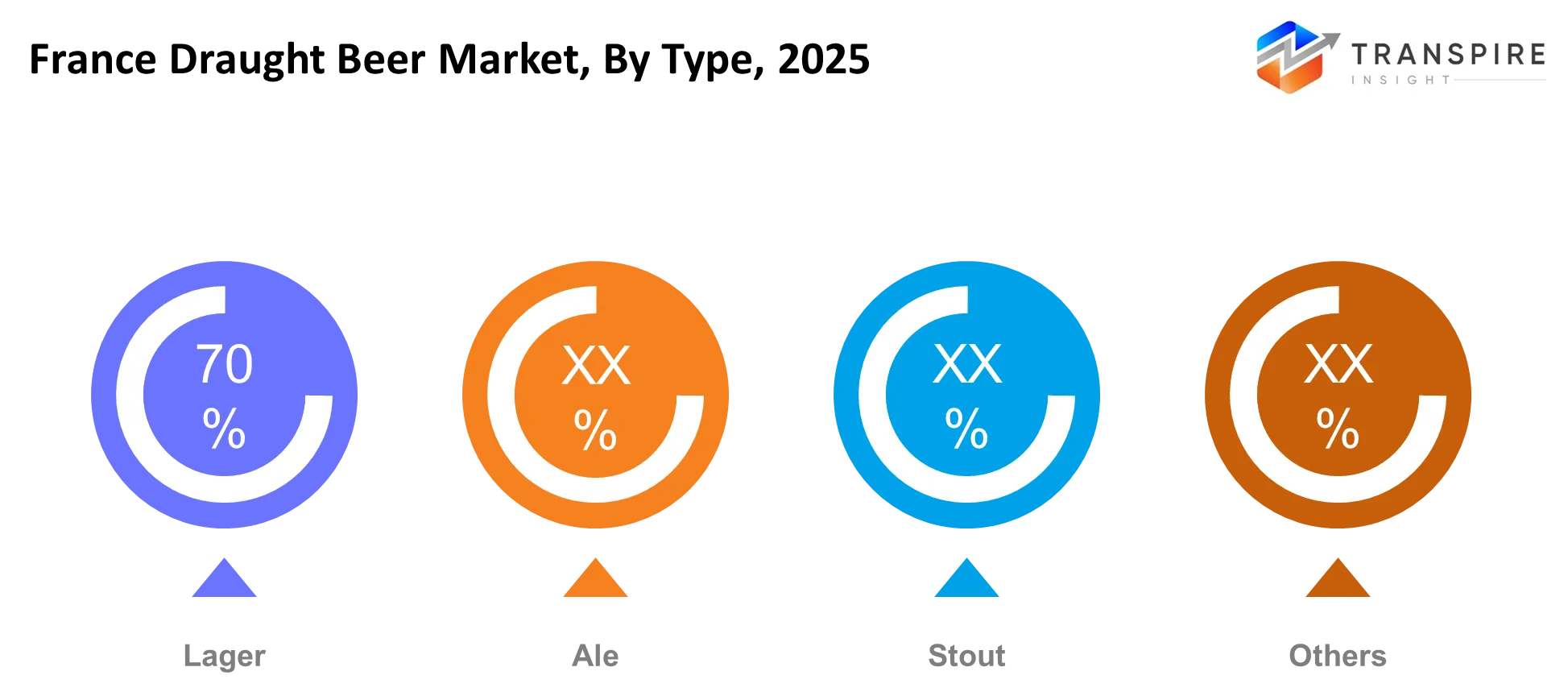
Lager holds a dominant spot in the France draught beer market, because the mainstream hospitality places keep focusing on high-volume and widely recognized beer formats. Big brewery groups back lager distribution with heavy duty keg logistics, steadier pricing models and noticeable brand presence at bars, restaurants and also sports venues. Ale ends up as the second-largest slice, since craft breweries and premium taprooms keep widening regional product options, plus more seasonal beer releases. Stout sits in a more specialized yet steady position, mainly via premium pub settings and imported Irish-style beverage portfolios. Meanwhile, the other beer styles support a mix of more niche tastes and experimental brewing formats, you know, the oddball preferences.
Lager segment expansion is helped by strong penetration in tourism led hospitality areas, where operational reliability and broad consumer pull still matter a lot. Ale gains momentum thanks to rising interest in locally brewed, flavor centered, rotational draught options, which often brings higher margins for independent operators. Stout growth stays mostly stuck in the city night life and sports oriented places, where those premium imported brands keep a loyal customer base. Going forward across the forecast window, ale and specialty beer categories are likely to grab more of the value share, so breweries are expected to put money into limited edition drops, regional competitions and a more distinctive taproom vibe.
To learn more about this report, Download Free Sample Report
By Application
Bars and pubs take up the largest part of draught beer consumption, mostly because keg based serving setups help with beverage margins, move things along faster, and keep freshness handling more controlled in those high traffic social zones. Urban nightlife areas, tourism hubs, and sports watching venues keep putting out steady repeat demand for both premium and mainstream draught pours, basically all year round. Restaurants are a noteworthy second slice too, since food pairing habits and well built premium drink lists become more tied in with French dining experiences. Event style uses are still climbing at a decent pace—think music festivals, stadium hospitality, corporate get togethers, plus temporary outdoor bar installs, and then the other uses fill in through institutional and recreational venues too.
The growth in bars and pubs is nudged forward by spending on premium tap systems, digital dispensing solutions, and wider craft beer choices that are meant to hold on to customers longer. For restaurants, the boost comes from consumers spending more on experiential dining, including locally sourced beverage offerings. When it comes to events, draught drinking gets more momentum as tourism rebounds, and as investments rise for mobile dispensing infrastructure, especially for seasonal entertainment programs. Looking across the forecast window, event applications are likely to show up as one of the quicker growing categories, which then opens doors for keg logistics providers, portable tap equipment brands, and suppliers of premium beverages, even if the mix feels a bit more complicated week to week.
By End-User
The hospitality industry takes the leading share in the France draught beer market, because hotels, restaurants, pubs and entertainment venues make up most of the commercial keg use. Larger hospitality operators are also trying to favor draught systems more and more, since premium tap setups increase profitability and help create more distinctive customer moments. At the same time, consumer-led direct drinking routes keep a solid role through brewery taprooms, beer festivals and niche retail experiences, these often link buyers tighter with craft and imported labels. Other end user segments add less overall volume, mainly via institutional catering and private event services.
Growth inside hospitality gets a lift from tourism bouncing back, nightlife growing, and more spending on premium beverage experiences across city areas. Consumer centered channels are picking up speed too, driven by rising interest in brewery led tasting occasions, locally produced pours and limited edition releases. The smaller categories still benefit from nimble mobile dispensing systems and short term, event type installations. Over the forecast period, direct engagement approaches are forecast to become even more strategically important, and that should push breweries to widen taproom concepts, create more experiential retail formats and introduce subscription based specialty beer programs.
By Distribution
On-trade distribution is still the biggest part of the market because draught beer drinking stays mainly stuck in bars, restaurants, hotels and entertainment venues ,so the keg dispensing setups there work the most efficiently. Breweries and distributors keep really solid ties with hospitality operators via equipment leasing, maintenance support and “exclusive” supply agreements, these things all help lock in steady repeat sales. Off-trade distribution is smaller, but it keeps edging upward through take-home keg systems, specialty beverage retail ,and also premium supermarket formats that aim at home based social moments. Other distribution routes show up too, like direct brewery sales and seasonal promo happenings.
On-trade growth is pushed by premiumization trends, the modernization of hospitality spaces, and people spending more on social drinking in major French cities . Off-trade channels get a boost from consumers wanting entertainment at home, plus compact draught dispensing technologies meant for residential use. Some alternative distribution models continue to widen through digital ordering platforms, and even direct-to-consumer brewery partnerships. During the forecast period, hybrid distribution strategies, blending hospitality sales with more direct consumer access, are expected to matter more and more . This should encourage breweries and distributors to widen their fulfillment abilities, while also strengthening regional delivery infrastructure.
What are the Key Use Cases Driving the France Draught Beer Market?
The main use case in the France draught beer market stays centered on high-volume pouring across bars, pubs and entertainment locations. These places lean on keg based dispensing, because it bumps up service velocity, keeps the beer fresher, and creates stronger beverage margins than bottled alternatives. Sports bars, nightlife spots, and tourism led hospitality operators make up a sizeable portion of the repeat keg consumption, month after month.
There are also expanding applications in premium restaurants and hotel beverage programs. Fine dining spots more and more match specialty draught beer with regional dishes, while hotels bring in a curated set of taps to lift guest enjoyment and beverage earnings. Craft breweries meanwhile use taproom formats to sharpen direct consumer engagement and to lessen reliance on retail distribution.
Newer use cases are showing up too, like self-pour beer walls, event driven mobile draught systems, and experiential retail setups. Music festivals, stadiums, and corporate hospitality spaces are starting to adopt digitally monitored dispensing platforms to speed up transactions, cut down wastage, and tailor beverage selections to what people actually want.
|
Report Metrics |
Details |
|
Market size value in 2025 |
USD 476.99 Million |
|
Market size value in 2026 |
USD 512.76 Million |
|
Revenue forecast in 2033 |
USD 856.72 Million |
|
Growth rate |
CAGR of 7.61% from 2026 to 2033 |
|
Base year |
2025 |
|
Historical data |
2021 - 2024 |
|
Forecast period |
2026 - 2033 |
|
Report coverage |
Revenue forecast, competitive landscape, growth factors, and trends |
|
Regional scope |
France |
|
Key company profiled |
Heineken, AB InBev, Carlsberg, Molson Coors, Asahi, Kirin, Diageo, SABMiller, BrewDog, Stone Brewing, Sierra Nevada, Peroni, Corona, Guinness, Pabst |
|
Customization scope |
Free report customization (country, regional & segment scope). Avail customized purchase options to meet your exact research needs. |
|
Report Segmentation |
By Type (Lager, Ale, Stout, Others); By Application (Bars & Pubs, Restaurants, Events, Others); By End-User (Consumers, Hospitality Industry, Others); By Distribution (On-trade, Off-trade, Others) |
Which Regions are Driving the France Draught Beer Market Growth?
The Île-de-France region stays a dominant force in the France draught beer market, mostly because it brings together the country’s biggest haul of hospitality venues , more tourism traffic than anywhere else, and a notably higher rate of premium beverage consumption. Paris by itself holds thousands of bars, restaurants, hotels, entertainment arenas, and event spaces, all of which lean hard on keg-based dispensing setups for day to day speed, and also for higher-margin drink sales. On top of that, the region has solid cold-chain logistics, lots of well-connected distributor networks, and quicker uptake of digital tap management systems, these tools help venues cut wastage, and keep service consistency steadier too.
Auvergne-Rhône-Alpes sits as the second-largest regional contributor, but the way it grows is pretty different, not really the same Paris pattern. Instead of leaning mainly on international tourism and late-night footfall, it leans on a dependable blend of local craft brewery culture, food-centric hospitality, and repeat regional consumption through the whole year. Places like Lyon still fuel strong draught beer demand via gastronomy-led venues where premium and specialty tap selections match the expectations of higher-end dining.
Southern France is looking like the fastest-growing regional arena, mainly due to tourism-led hospitality infrastructure expanding, alongside seasonal beverage use that keeps rising. Coastal cities—Marseille, Nice, and Montpellier—have seen extra investment since 2023 in beachfront bars, festival-oriented spaces , sports hospitality, and more experiential dining concepts . This momentum also picked up when operators modernized outdoor serving capabilities and broadened their premium tap menus, to win more of the tourist spending during peak travel months.
Who are the Key Players in the France Draught Beer Market and How Do They Compete?
Competition in the France draught beer market still looks moderately consolidated on the distribution side, but it is getting more fragmented at the product level, because craft breweries and premium imports are basically fighting for limited tap space. Large multinational brewers keep defending market share by leaning on distributor relationships, hospitality partnerships, and spend on dispensing infrastructure. Meanwhile smaller brands try to win with more localized identity, plus a kind of rotational craft rotation that feels a bit different every season. Overall, the “battle” feels less like pure pricing now , and more like freshness control, better premium framing, wider portfolio diversity and also real venue-level service support.Heineken competes quite aggressively with an integrated brewer-distributor set-up in France, using the France Boissons network to pull stronger direct links with cafés, hotels and restaurants across the country. It differentiates via logistics scale, localized production, and premium brand diversification , covering both mainstream options and craft-style categories. In 2026, Heineken extended sustainability-linked partnerships with Carrefour and Soufflet Malt, to shore up supply chain resilience, and to reinforce the premium brand positioning at the same time.
AB InBev is more centered on premium global brands like Corona and Stella Artois, while also expanding low-alcohol and experiential beverage lineups that seem to fit younger urban consumers better. Carlsberg Group relies on familiar recognition from Kronenbourg and 1664 within France, while growing international licensing partnerships to widen its premium distribution reach. The company tends to emphasize regional expansion, and a more premium imported positioning, instead of trying to compete directly on pricing.
Company List
- Heineken
- AB InBev
- Carlsberg
- Molson Coors
- Asahi
- Kirin
- Diageo
- SABMiller
- BrewDog
- Stone Brewing
- Sierra Nevada
- Peroni
- Corona
- Guinness
- Pabst
Recent Development News
In December 2025, AB InBev announced acquisition of an 85% stake in BeatBox for approximately USD 490 million. The deal expands AB InBev’s Beyond Beer portfolio and strengthens its position in alternative alcoholic beverage categories linked to evolving consumer preferences.http://www.reuters.com
In March 2025, Soufflet Malt entered a commercial partnership with Heineken to invest EUR 100 million in a new malting facility. The project strengthens localized barley sourcing and improves long-term brewing supply resilience for premium beer production networks.http://www.reuters.com
What Strategic Insights Define the Future of the France Draught Beer Market?
The France draught beer market is kinda slowly, and in a fairly structural way, moving toward premium and experience driven consumption, backed by digital dispensing systems, localized craft production and supply chains that are sustainability minded. In the next five to seven years, profitability more than just raw consumption volume will feel like the real growth engine, so breweries and hospitality operators will be nudged to favor premium keg formats, smart tap infrastructure and also more direct-to-venue distribution models.
One underappreciated risk is that the power in draught distribution is getting concentrated, not in a good way, among a handful of large beverage logistics networks. That can narrow tap access for independent breweries and, well, push pricing pressure onto smaller operators in the process. Meanwhile low-alcohol, and alcohol free draught options are turning into an emerging chance, especially as hospitality venues adjust menus for health conscious city people.
Market participants should probably invest early in connected dispensing technologies and flexible regional distribution partnerships , because operational efficiency and venue level data visibility are likely to turn into key competitive edges by 2033.
France Draught Beer Market Report Segmentation
By Type
- Lager
- Ale
- Stout
- Others
By Application
- Bars & Pubs
- Restaurants
- Events
- Others
By End-User
- Consumers
- Hospitality Industry
- Others
By Distribution
- On-trade
- Off-trade
- Others
Frequently Asked Questions
Find quick answers to common questions.
The expected France Draught Beer Market size for the market will be USD 856.72 Million in 2033.
Key segments for the France Draught Beer Market are By Type (Lager, Ale, Stout, Others); By Application (Bars & Pubs, Restaurants, Events, Others); By End-User (Consumers, Hospitality Industry, Others); By Distribution (On-trade, Off-trade, Others).
Major France Draught Beer Market players are Heineken, AB InBev, Carlsberg, Molson Coors, Asahi, Kirin, Diageo, SABMiller, BrewDog, Stone Brewing, Sierra Nevada, Peroni, Corona, Guinness, Pabst.
The France Draught Beer Market size is USD 476.99 Million in 2025.
The France Draught Beer Market CAGR is 7.61% from 2026 to 2033.
- Heineken
- AB InBev
- Carlsberg
- Molson Coors
- Asahi
- Kirin
- Diageo
- SABMiller
- BrewDog
- Stone Brewing
- Sierra Nevada
- Peroni
- Corona
- Guinness
- Pabst
Recently Published Reports
-
Apr 2026
Baby Infant Formula Market
Baby Infant Formula Market Size, Share & Analysis Report By ype (Infant Milk, Follow On Milk, Specialty Baby Milk, Growing-Up Milk), By Ingredient (Carbohydrate, Fat, Protein, Minerals, Vitamins, and Others), By Product Form (Powder, Liquid, and Ready-to-feed), By Distribution Channels (Supermarket/Hypermarket, Specialty Store, Pharmacies, Online Retail, and Others), and Geography (North America, Europe, Asia-Pacific, Middle East and Africa, South and Central America), 2021 - 2031
-
Apr 2026
Edible Insects for Animal Feed Market
Edible Insects for Animal Feed Market Size, Share & Analysis Report By Type (Insect Powder, Insect Meal, Insect Bar, Insect Paste, Insect Oil, and Others), By Insect Type (Beetles, Cricket, Caterpillar, Hymenoptera, Orthoptera, Tree Bugs, and Others), By Application (Livestock, Pet Food, and Aquaculture), By Livestock Type (Poultry, Swine, and Others), and Geography (North America, Europe, Asia-Pacific, Middle East and Africa, South and Central America), 2021 - 2031
-
Apr 2026
Food Industry Disinfection and Bacterial Control Market
Food Industry Disinfection and Bacterial Control Market Size, Share & Analysis Report By Type (Chemical Disinfectants, Physical Disinfectants, and Biocides and Antimicrobials), By Application (Food Processing Equipment Surface Disinfection, Food Preparation Areas Surface Disinfection, Storage Areas Surface Disinfection, Anti-microbial Coatings Food Preservation, and Preservative Solutions Food Preservation), By End User (Meat and Poultry Processing, Dairy Processing, Seafood Processing, Bakery and Confectionery, Restaurants and Commercial Kitchens, and Food Service Providers), By Sales Channel (Online, Offline), and Geography (North America, Europe, Asia-Pacific, Middle East and Africa, South and Central America), 2021 - 2031
-
Apr 2026
Freeze Dried Food Market
Freeze Dried Food Market Size, Share & Analysis Report By Product Type (Fruits, Vegetables, Freeze-Dried Dairy Products, Freeze-Dried Meat and Seafood, Freeze-Dried Pet Food, and Prepared Meal), By Nature (Organic, and Conventional), By Form (Powdered, Granules, and Diced), By End Use (Breakfast Cereals, Dairy Products, Bakery & Confectionery, Nutritional Bars & Supplements, Powdered Beverages, Snacks, and Retail (Household)), and Geography (North America, Europe, Asia-Pacific, Middle East and Africa, South and Central America), 2021 - 2031