

France Breakfast Cereal Market Size & Forecast:
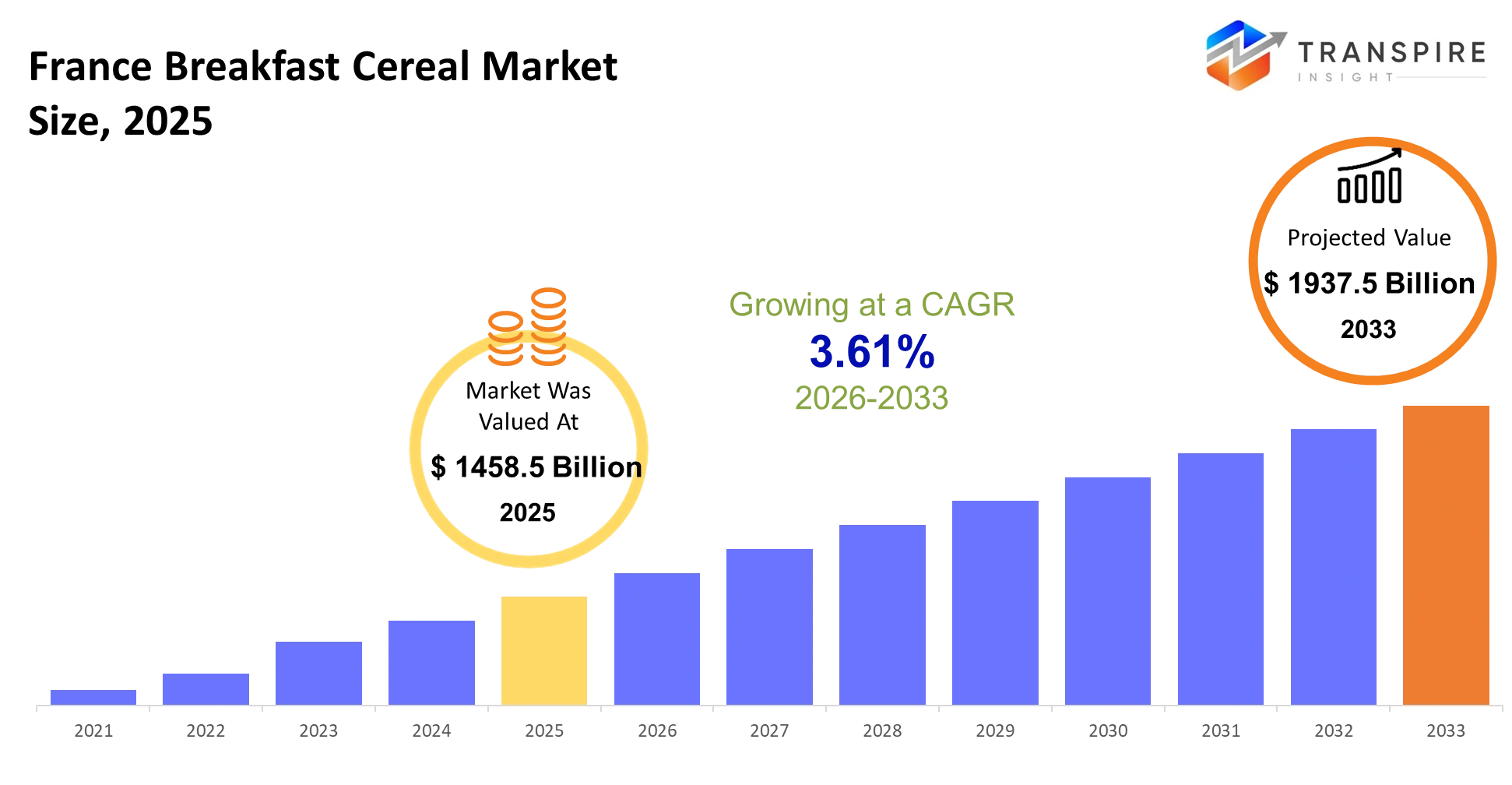
- France Breakfast Cereal Market Size 2025: USD 1458.5 Billion
- France Breakfast Cereal Market Size 2033: USD 1937.5 Billion
- France Breakfast Cereal Market CAGR: 3.61%
- France Breakfast Cereal Market Segments: By Type (Ready-to-eat, Hot Cereals, Organic Cereals, Others); By Application (Household, Food Service, Others); By End-User (Children, Adults, Health-conscious Consumers, Others); By Distribution (Supermarkets, Online, Convenience Stores, Others)
To learn more about this report,  Download Free Sample Report
France Breakfast Cereal Market Summary
The France Breakfast Cereal Market was valued at USD 1458.5 Billion in 2025. It is forecast to reach USD 1937.5 Billion by 2033. That is a CAGR of 3.61% over the period.
The France breakfast cereal market sort of sits in the middle of the country’s packaged food ecosystem , because it delivers fast , shelf-stable and fairly nutritionally shaped meal options for busy urban households. Breakfast cereals give both retailers and food manufacturers a way to keep up with changing day to day eating patterns, especially as people start valuing speed, portion discipline, and functional nutrition, yet still want a decent range of choices. Over the last five years, this market has drifted away from the older, more traditional sugar-led cereals toward high-protein items , organic blends, fiber-rich formats , and low-additive alternatives. You can feel this shift tied to how French shoppers now scrutinize ingredient transparency and Nutri-Score labeling a lot more closely.
The momentum jumped after COVID-19 messed with regular eating routines and also made at-home breakfast a bigger part of daily life, so retailers started widening their private-label and “wellness first” cereal selections. So, in response manufacturers kept reformulating their products, sort of putting money toward sustainable packagings , and started adding plant-based ingredients, mostly just to remain competitive on-shelf. And because premium wellness cereals usually cost more in retail, plus they tend to get better repeat buying, the firms are really trying to lift category profitability too. At the same time they’re deepening their presence with health-focused adults, as well as younger consumers, who seem to see breakfast as a functional ritual , not just a quick break in the day.
Key Market Insights
- In 2025 Northern France accounted for nearly 38% of the market share, because dense city populations, plus a bit stronger supermarket cereal penetration things like that.
- Western France is expected to show the swifter growth through 2033 , as organic food retail chains expand in a fairly aggressive way into secondary cities, you know those smaller but still busy hubs.
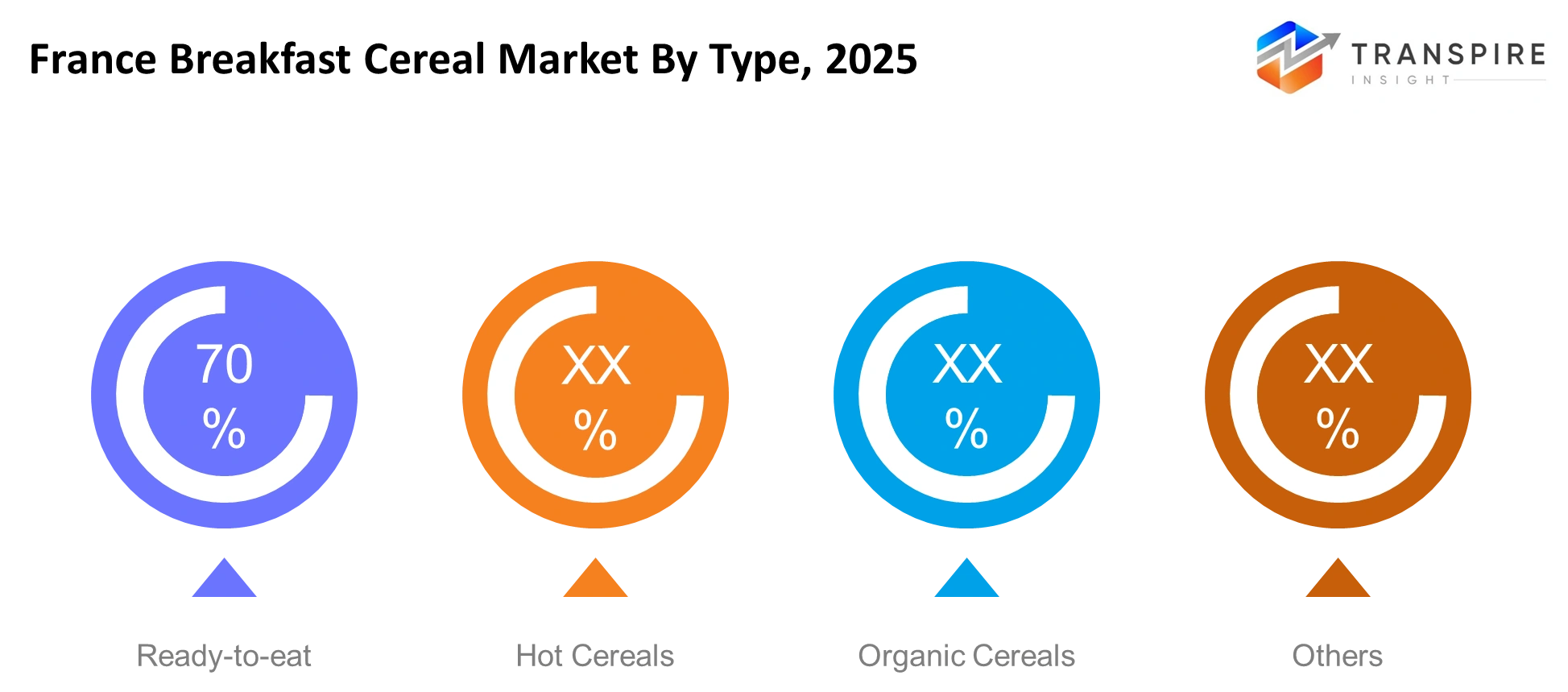
- Ready-to-eat cereals were the biggest driver in the France Breakfast Cereal Market, taking more than 54% share in 2025, mainly due to convenience oriented urban consumption.
- Hot cereals stayed in second place, while older consumers increasingly leaned toward oat- and grain-based breakfast options, with that perceived digestive help.
- Protein-enriched and low-sugar cereals are expected to be the fastest-moving segment from 2026 to 2033, because nutritional labeling standards are getting tighter.
- Household retail consumption contributed more than 68% of industry revenue in 2025 , as hybrid work setups kept the at-home breakfast habits going.
- After 2022 , online grocery platforms became the fastest-growing distribution channel, supported by subscription-style food delivery services that keep repeating.
- Millennials and working professionals remained the main end-user group, bringing in almost 46% share of packaged breakfast cereal purchases.
- For children, cereal products are changing quickly, as manufacturers reduce artificial additives and reformulate around Nutri-Score compliance.
- Private-label cereal brands also increased their shelf footprint after 2021, when inflationary pressure pushed shoppers toward lower-cost packaged breakfast alternatives.
- Last, strategic collaborations between cereal manufacturers and French retail chains sped up regional product launches, and improved visibility for premium categories overall.
What are the Key Drivers, Restraints, and Opportunities in the France Breakfast Cereal Market?
The main thing driving the France breakfast cereal market is a sort of structural move toward functional , and also convenience oriented nutrition. French consumers seem to ask for breakfast items that provide protein, fiber, digestive support, and less sugar , but they also want it to work with mornings that are more tight than before. This momentum sped up after Nutri-Score labels became more visible in basically everywhere , meaning on retail aisles and in the press , so manufacturers felt the pressure to adjust recipes and improve their nutritional stance. The firms that managed to bring in whole-grain , protein enriched and organic cereal options ended up with better pricing strength, plus more shelf space in supermarkets and online stores. Because of that, premium cereals now deliver higher margins than the older sugar heavy kinds , in a more uneven way than you would expect.
Still, the biggest holdback is raw material price ups and downs , mixed with France’s tough food formulation rules. Cereal producers are still pretty exposed to swings in wheat, corn, oats, and energy costs, especially after supply troubles connected to geopolitical instability and European agricultural inflation. These issues don’t get solved fast since production agreements , farm timelines and packaging sourcing all have long lead times. So higher input costs keep squeezing manufacturer margins and also make it harder to push bold new launches, especially for smaller brands that don’t have as much room to maneuver.
At the same time a real opening is starting to show up in personalized, plus functional breakfast nutrition, and it is helped by digital retail analytics together with newer ingredient development. Producers are now putting more money into probiotic cereals, plant protein mixtures, and fortified breakfast products that aim at particular age groups or wellness segments , almost like a targeted path rather than a one size plan.
What Has the Impact of Artificial Intelligence Been on the France Breakfast Cereal Market?
Artificial intelligence and more advanced digital technologies are reshaping the France breakfast cereal market in a way that feels almost right away, like , kind of immediate, improving manufacturing precision supply chain quickness, and also consumer targeting tactics, in a gradual yet noticeable shift. Food manufacturers increasingly run AI led production systems to automate ingredient measurements, keep an eye on roasting steadiness, and push packaging efficiency through cereal processing plants. Smart factory platforms, with machine learning algorithms at the center of it all, can pick up production anomalies in real time so waste generation goes down, and expensive downtime becomes less of a repeating problem during high volume operations.
At the same time, predictive analytics tools are changing inventory and demand expectations. Cereal producers now look at supermarket purchase behavior, weather conditions, promotion windows, and regional consumption cues to strengthen stock planning while cutting down the risk of excess production. Some manufacturers are also running AI supported formulation software to speed up the creation of low sugar and high protein cereals while still keeping taste stability and staying within regulatory requirements. These systems shorten product development phases, and they also help brands react faster at retail.
On the operational side, AI enabled logistics platforms have sort of improved warehouse workflows , and the delivery coordination. It helps brands keep shelf availability more steady even if raw material supply suddenly gets disrupted. Then there is the digital monitoring part, that also supports energy optimization inside cereal manufacturing facilities, which lowers operating expenses and makes sustainability indicators look better, overall.
Still, AI adoption isn’t frictionless, because integration costs can be high and the legacy manufacturing infrastructure is often fragmented. Many mid sized cereal producers in France do not yet have the digital connectivity or the consistent production datasets needed for reliable machine learning , like they can’t just plug it in and go.
Key Market Trends
- Since 2021, French cereal producers have cut sugar levels quite a lot, to fit their products better with tougher Nutri-Score retail expectations.
- At the same time, organic and plant-based breakfast cereals got more visible placement, like stronger shelf allocation, after niche grocery chains expanded across urban and suburban France.
- Private label cereal brands also started to show up more often in supermarkets during the inflation period, when customers adjusted their spending habits between 2022 and 2025.
- Meanwhile, manufacturers leaned more into recyclable paper-based packaging, because French retailers kept tightening sustainability rules for packaged food suppliers, and yes it mattered.
- Protein-fortified cereals grew fast among younger professionals who want quick meals, paired with sports and wellness kind of nutrition benefits.
- And then e-commerce grocery platforms seemed to rewire how people buy cereal, especially by offering subscription bundles and personalized breakfast product suggestions that feel more tailored than before.
- Big names, including Nestlé and Kellogg’s, sped up premium cereal releases that highlight ancient grains, plus functional ingredients.
- Regional supermarket chains even improved partnerships with local cereal growers, aiming for better sourcing transparency and a clearer distinction in those premium breakfast options.
- Also, AI powered inventory forecasting became more common after supply chain disruptions revealed weak spots in standard cereal distribution planning systems.
- Over time, consumer preference kept moving away from heavily processed children’s cereals, toward options that are fiber-rich and only minimally processed, with cleaner ingredient lists and fewer compromises.
France Breakfast Cereal Market Segmentation
By Type
Ready-to-eat cereals basically keep the lead because breakfast habits, that are convenience-driven, are kind of deeply built into city life across France. Supermarkets have strong reach, the shelf life stays long, and there is a wide spread of flavors so people keep buying again and again, especially working professionals and younger households. Manufacturers, well they get to use efficient large-scale production and also strong visibility in stores which helps keep revenue steady across both mass-market and the premium side. On top of that, there is this ongoing, almost relentless innovation, like protein-rich , low-sugar, and fiber-enriched formulations, and it’s basically letting ready-to-eat cereals keep that category leadership for now. Looking ahead, growth in this segment will rely mostly on nutritional reformulation, and on making premium products feel different enough , so they actually stand out. The money being put into plant-based ingredients, sustainable packaging, and functional health claims is expected to give companies more pricing leverage throughout the forecast period , even if it’s not immediate.
Hot cereals meanwhile, are holding a smaller but still steady share since oat-based and grain focused breakfast options are pretty attractive to older consumers and wellness shoppers who want digestive support and longer satiety. Organic cereals are also gaining ground, mostly because ingredient checks are stricter now , and people are leaning toward foods that are less processed . At the same time, other niche cereal types should open up only certain opportunities for specialized brands that market around specific wellness needs and basically tie everything to those benefits.
To learn more about this report, Download Free Sample Report
By Application
Household consumption is still the main use case, mainly because packaged breakfast cereals stay pretty much a standard buy for a lot of urban and suburban families. Every day breakfast, if you want to call it that, creates a steady kind of recurring need for ready-to-eat plus functional cereal items, the kind you typically see in supermarkets, or even on digital grocery platforms. With more hybrid work arrangements, and the usual time pressured mornings, people keep leaning into at-home cereal routines for both adults and school-age children. On top of that, premium breakfast habits are making many households willing to pay extra, especially for protein enriched, and organic cereal versions.
Food service is also growing in a steady way, hotels, cafés, schools, and corporate cafeterias are all adding cereals to their menus to match newer breakfast preferences. In those settings, bulk cereal packages and portion controlled serving options are becoming more important, because hospitality and institutional catering run on convenience and consistency. Meanwhile, product teams are investing in tailored cereal blends meant for buffet style service and wellness oriented operations, so the offering feels “made for the venue” not just generic. Other uses, like sports nutrition and meal replacement routines, are expected to open up longer term chances for fortified cereals and functional grain based products during the forecast period.
By End-User
Adults basically dominate the end-user space, since working professionals and city based consumers make up the biggest share in terms of packaged breakfast cereal buys across France. It’s not just a habit either, convenience keeps showing up with nutritional messaging , and the whole “quick to assemble” aspect still pulls people in who are juggling work hours. On top of that, health-minded eating routines continue to strengthen adoption, especially for middle income and higher income adults who lean toward premium cereal varieties. Those lines, with protein, fiber, and whole grains tend to be the most sought after, and the strong repeat purchases inside that segment helps manufacturers and retailers keep long term revenue feeling steadier.
Kids still hold a really noticeable slice of the market, largely because flavored cereals and fortified breakfast items stay common inside family households. Ongoing reformulations , aimed at lowering sugar and also improving Nutri-Score scores, are shifting how brands compete within the kid focused cereal shelves. Meanwhile health-conscious shoppers are showing the fastest growth, driven by more interest in clean-label, organic, and functional breakfast products. People are linking these choices with digestive comfort and fitness nutrition, so it’s getting traction quickly. Beyond that, several smaller niche groups should open up extra chances for specialized cereals, like options designed for senior nutrition, diabetic friendly diets, and plant based meal routines.
By Distribution
Supermarkets still keep the largest market share , mostly because those big, large-format retail chains give customers a kind of constant product visibility, plus competitive prices, and a broad mix of cereal assortments ranging from premium to economy. People keep using supermarkets a lot for their everyday shopping , so these places basically become the main sales channel for breakfast cereals in France. Also, strong promotional push, private brand growth, and those nationwide distribution networks really help lock in supermarket leadership in packaged breakfast categories. And because the in-store retail infrastructure is already there, manufacturers can roll out reformulated and seasonal cereals in an efficient way , to several regions at once, like it’s almost plug and play.
At the same time online distribution keeps growing fast, because digital grocery habits are becoming normal and subscription-based food shopping is speeding up especially among younger consumers. With personalized product suggestions, direct-to-consumer outreach , and easier discovery of niche cereal brands, online retail keeps gaining momentum. Convenience stores are still relevant too, since smaller urban setups make impulse breakfast buying easier , and also cover those “right now” consumption needs. Other channels, like specialty organic shops and health-focused grocery chains, are expected to deliver selective opportunities for premium cereal manufacturers that aim at wellness-driven consumer groups.
What are the Key Use Cases Driving the France Breakfast Cereal Market?
In France breakfast cereal market the dominant use case is basically easy , convenient daily consumption among city households, and people working full time. Ready-to-eat cereals keep pulling the most interest because they cut down on meal prep time, while still giving portion-controlled nutrition that fits quickly moving weekday routines. Big supermarket chains and hypermarkets keep giving cereal aisles priority too , since packaged breakfast products tend to repeat-buy in a predictable way, and brands often earn real loyalty.
Then there are the secondary angles that are moving faster lately , especially around fitness nutrition and the broader healthy snacking vibe. High-protein granola, oat clusters, and fiber-forward cereal blends are showing up more often as post-workout choices, and also as mid-day snacks for younger adults and wellness minded shoppers. Hotels , cafés, and corporate catering providers are also expanding their cereal options partly so they can serve lighter breakfasts that feel more customizable.
For emerging use cases, personalized nutrition cereals are starting to appear , made for digestive comfort, immunity support and senior nutrition needs. Producers are also looking into functional cereals with probiotics, plant proteins and low-glycemic ingredients. These are targeted at diabetic and aging consumer groups, over the 2026–2033 period.
|
Report Metrics |
Details |
|
Market size value in 2025 |
USD 1458.5 Billion |
|
Market size value in 2026 |
USD 1511.6 Billion |
|
Revenue forecast in 2033 |
USD 1937.5 Billion |
|
Growth rate |
CAGR of 3.61% from 2026 to 2033 |
|
Base year |
2025 |
|
Historical data |
2021 - 2024 |
|
Forecast period |
2026 - 2033 |
|
Report coverage |
Revenue forecast, competitive landscape, growth factors, and trends |
|
Regional scope |
France |
|
Key company profiled |
Nestle, Kellogg, General Mills, PepsiCo, Post Holdings, Weetabix, Nature Valley, Alpen, Jordans, Bagrrys, Marico, Bob’s Red Mill, Dorset Cereals, Mornflake, Seven Sundays |
|
Customization scope |
Free report customization (country, regional & segment scope). Avail customized purchase options to meet your exact research needs. |
|
Report Segmentation |
By Type (Ready-to-eat, Hot Cereals, Organic Cereals, Others); By Application (Household, Food Service, Others); By End-User (Children, Adults, Health-conscious Consumers, Others); By Distribution (Supermarkets, Online, Convenience Stores, Others) |
Which Regions are Driving the France Breakfast Cereal Market Growth?
Northern France remains the leading regional market, mostly because the area has a thick urban population, pretty mature retail setup and a heavy presence of big supermarket or hypermarket chains. The Paris area and the surrounding metro zones drive a lot of packaged food consumption, which means cereals keep selling in bigger volumes in both premium and everyday lines. On top of that , the region leans on logistics networks that are already in place, so manufacturers can ship products quickly into modern retail spaces, and also through e-commerce portals. People here are also buying more health-leaning food, so cereal brands have been pushing low-sugar, protein-enriched, and organic variants across Northern France, kind of steadily.
Western France adds revenue in a calm way, helped by consistent consumer spend and a solid agricultural ecosystem. Compared with Northern France, growth there doesn’t lean as hard on city-based convenience habits, and more on preferences for locally sourced, as well as organic foods. Retailers in the region, along with cooperative grocery groups, are actively promoting cereals made with oats, whole grains and “plain” natural ingredients, usually traced back to French farm producers. Because of this stability, Western France has turned into a dependable place for premium cereal makers, and also for private-label manufacturers looking for solid, long-run sales momentum.
Southern France is now showing the fastest growth, mainly due to shifting lifestyle behaviors, more retail activity tied to tourism, and higher uptake of organized grocery formats. In the past years, international food retailers and digital grocery delivery platforms have put more money into several cities, like Marseille, Nice, and Toulouse.
Who are the Key Players in the France Breakfast Cereal Market and How Do They Compete?
The France breakfast cereal market stays sort of moderately consolidated, with multinational packaged food companies keeping a lot of that supermarket shelf real estate while smaller health minded brands keep pushing into, and sorta disrupting, the usual product lanes. Competition is increasingly not just about straight up brand name recognition alone. It’s more about nutritional reformulation, ingredient clarity, pricing flexibility ,and also how strong a retailer distribution setup is. Bigger established manufacturers are trying to hold onto market share by investing in cleaner-label products, greener packaging, and premium cereal lines built around protein, fiber, and less sugar.
Nestlé stands out using nutritional reformulation plus localized product tweaking that matches France’s Nutri-Score system. Their plan is centered on better ingredient quality while still being mass market friendly across supermarket channels. Kellogg’s competes by leaning on brand scale and portfolio variety, and it’s also moving faster on removing synthetic dyes and creating healthier cereal options to reinforce consumer trust and keep in step with regulations. General Mills, meanwhile, is aiming at premium and wellness oriented buyers, using granola, whole grain, and protein centered cereal options that are framed around lifestyle nutrition.
Weetabix has improved its footing by focusing on fiber heavy breakfast products, health led packaging, and fixing up its operational supply chain. Dorset Cereals fights on niche specialization, especially in premium muesli and minimally processed cereal blends that appeal to higher income consumers looking for more artisanal breakfast choices. A few regional brands and private-label players are also expanding pretty fast by selling cereals at aggressive prices with clean-label positioning. That creates pricing pressure for multinational
Company List
- Nestlé
- Kellogg
- General Mills
- PepsiCo
- Post Holdings
- Weetabix
- Nature Valley
- Alpen
- Jordans
- Barrys
- Marico
- Bob’s Red Mill
- Dorset Cereals
- Mornflake
- Seven Sundays
Recent Development News
“In February 2025, Nestlé announced a partnership with the Association Française d’Agroforesterie to expand regenerative agriculture practices across its French dairy supply chain. The four-year initiative strengthens sustainable ingredient sourcing and supports cleaner-label cereal and breakfast product positioning in France.http://www.nestle.fr
“In February 2026, Weetabix introduced a health-led packaging refresh across its core cereal portfolio. The redesign highlights vitamin, fiber, and iron content more prominently, helping the company align products with evolving wellness-focused purchasing behavior.http://www.talkingretail.com
What Strategic Insights Define the Future of the France Breakfast Cereal Market?
In France the breakfast cereal market is kind of structurally shifting, towards more premium, health centered and very function specific nutrition types. This is mostly pushed by tougher nutritional scrutiny, more digital retail expansion, and the way people are changing how they eat breakfast. In the next five to seven years, the pace of growth will more and more favor companies who can mix clean label formulations with convenience plus a personalized wellness story. Still , there is a quieter risk in all this too—agricultural raw material volatility and tighter European food compliance rules could pinch margins and make it harder to reformulate if you are a mid sized producer without real scale advantages.
An emerging opportunity is cereals built around clinically framed benefits, like digestive health support, protein supplementation, and needs linked with aging populations. These products could use fortified grains alongside probiotic ingredients. In France this space is still not deeply penetrated, but it fits well with long run demographic shifts and where healthcare spending tends to go. Participants should focus investment on data driven product development and on partnerships for localized ingredient sourcing, so supply chain exposure is reduced and responsiveness to changing nutrition expectations stays higher.
France Breakfast Cereal Market Report Segmentation
By Type
- Ready-to-eat
- Hot Cereals
- Organic Cereals
- Others
By Application
- Household
- Food Service
- Others
By End-User
- Children
- Adults
- Health-conscious Consumers
- Others
By Distribution
- Supermarkets
- Online
- Convenience Stores
- Others
Frequently Asked Questions
Find quick answers to common questions.
The approximate Japan Dental Veneers Market size for the market will be USD 66.8 Billion in 2033.
Key segments for the Japan Dental Veneers Market are By Type (Ready-to-eat, Hot Cereals, Organic Cereals, Others); By Application (Household, Food Service, Others); By End-User (Children, Adults, Health-conscious Consumers, Others); By Distribution (Supermarkets, Online, Convenience Stores, Others).
Major France Breakfast Cereal Market players are Nestle, Kellogg, General Mills, PepsiCo, Post Holdings, Weetabix, Nature Valley, Alpen, Jordans, Barrys, Marico, Bob’s Red Mill, Dorset Cereals, Mornflake, Seven Sundays.
The Japan Dental Veneers Market size is USD 1458.5 Billion in 2025.
The France Breakfast Cereal Market CAGR is 3.61% from 2026 to 2033.
- Nestlé
- Kellogg
- General Mills
- PepsiCo
- Post Holdings
- Weetabix
- Nature Valley
- Alpen
- Jordans
- Barrys
- Marico
- Bob’s Red Mill
- Dorset Cereals
- Mornflake
- Seven Sundays
Recently Published Reports
-
Apr 2026
Baby Infant Formula Market
Baby Infant Formula Market Size, Share & Analysis Report By ype (Infant Milk, Follow On Milk, Specialty Baby Milk, Growing-Up Milk), By Ingredient (Carbohydrate, Fat, Protein, Minerals, Vitamins, and Others), By Product Form (Powder, Liquid, and Ready-to-feed), By Distribution Channels (Supermarket/Hypermarket, Specialty Store, Pharmacies, Online Retail, and Others), and Geography (North America, Europe, Asia-Pacific, Middle East and Africa, South and Central America), 2021 - 2031
-
Apr 2026
Edible Insects for Animal Feed Market
Edible Insects for Animal Feed Market Size, Share & Analysis Report By Type (Insect Powder, Insect Meal, Insect Bar, Insect Paste, Insect Oil, and Others), By Insect Type (Beetles, Cricket, Caterpillar, Hymenoptera, Orthoptera, Tree Bugs, and Others), By Application (Livestock, Pet Food, and Aquaculture), By Livestock Type (Poultry, Swine, and Others), and Geography (North America, Europe, Asia-Pacific, Middle East and Africa, South and Central America), 2021 - 2031
-
Apr 2026
Food Industry Disinfection and Bacterial Control Market
Food Industry Disinfection and Bacterial Control Market Size, Share & Analysis Report By Type (Chemical Disinfectants, Physical Disinfectants, and Biocides and Antimicrobials), By Application (Food Processing Equipment Surface Disinfection, Food Preparation Areas Surface Disinfection, Storage Areas Surface Disinfection, Anti-microbial Coatings Food Preservation, and Preservative Solutions Food Preservation), By End User (Meat and Poultry Processing, Dairy Processing, Seafood Processing, Bakery and Confectionery, Restaurants and Commercial Kitchens, and Food Service Providers), By Sales Channel (Online, Offline), and Geography (North America, Europe, Asia-Pacific, Middle East and Africa, South and Central America), 2021 - 2031
-
Apr 2026
Freeze Dried Food Market
Freeze Dried Food Market Size, Share & Analysis Report By Product Type (Fruits, Vegetables, Freeze-Dried Dairy Products, Freeze-Dried Meat and Seafood, Freeze-Dried Pet Food, and Prepared Meal), By Nature (Organic, and Conventional), By Form (Powdered, Granules, and Diced), By End Use (Breakfast Cereals, Dairy Products, Bakery & Confectionery, Nutritional Bars & Supplements, Powdered Beverages, Snacks, and Retail (Household)), and Geography (North America, Europe, Asia-Pacific, Middle East and Africa, South and Central America), 2021 - 2031