

France Air-dry Clay Market Size & Forecast:
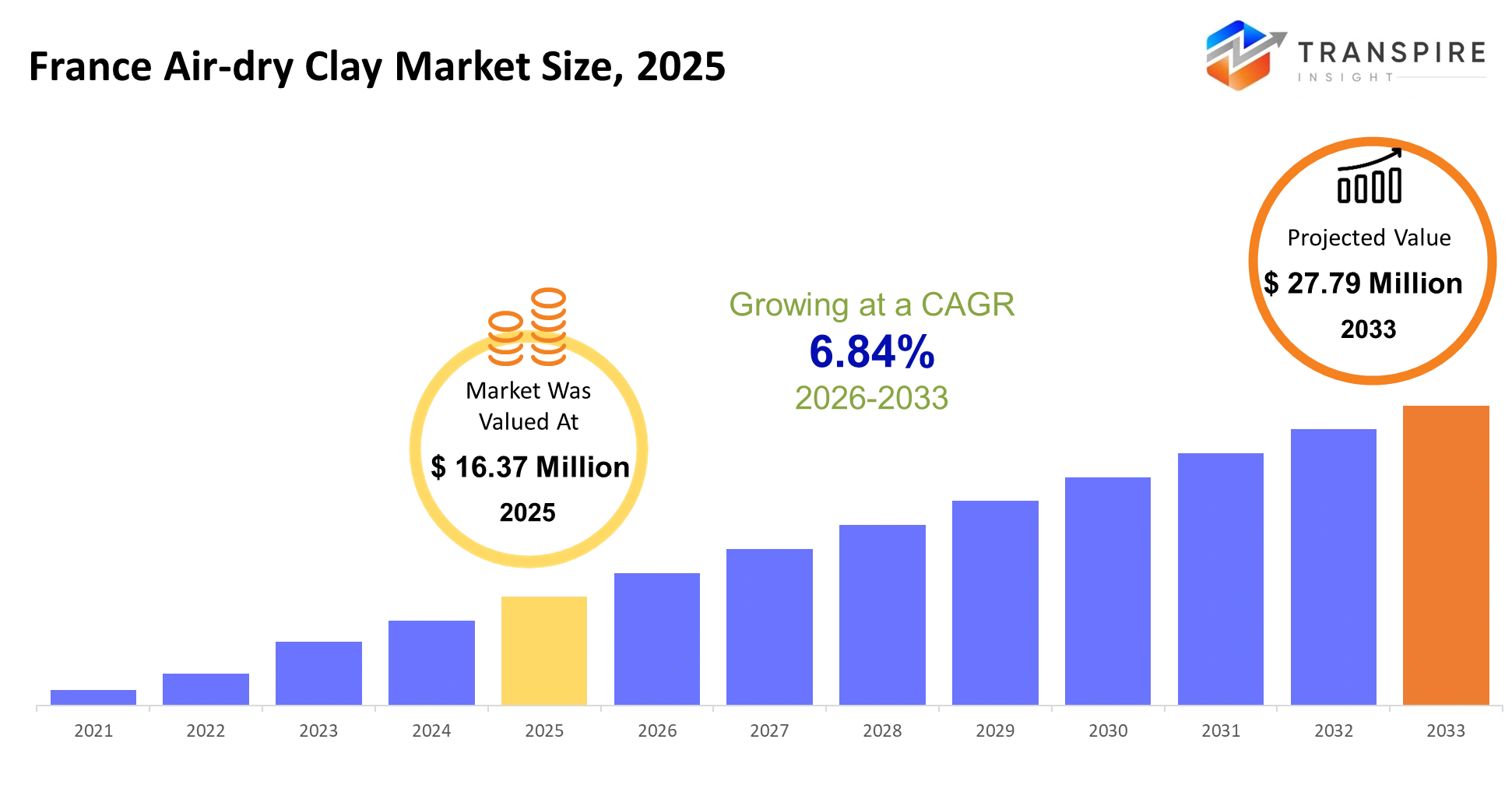
- France Air-dry Clay Market Size 2025: USD 16.37 Million
- France Air-dry Clay Market Size 2033: USD 27.79 Million
- France Air-dry Clay Market CAGR: 6.84%
- France Air-dry Clay Market Segments: By Type (Natural, Synthetic, Polymer, Others); By Application (Art & Craft, Educational, DIY, Sculpting, Others); By End-User (Students, Artists, Hobbyists, Schools, Others); By Distribution (Online, Retail, Art Stores, Others)
To learn more about this report,  Download Free Sample Report
France Air-dry Clay Market Summary
The France Air-dry Clay Market was valued at USD 16.37 Million in 2025. It is forecast to reach USD 27.79 Million by 2033. That is a CAGR of 6.84% over the period.
The France Air-dry Clay Market operates at the intersection of educational activities, hobby crafts, and small-scale artistic production, which enables users to make decorative objects and prototypes and learning models through the use of moldable non-baked clay because they do not need kiln access for their creations. The solution enables schools and studios and independent artists to access scanning technology because it eliminates both cost and infrastructure obstacles that exist in sculpting and creative design processes.
The market has transitioned to eco-certified low-toxicity products during the past three to five years because European material safety regulations for children's art supplies became more strict. At the same time, post-pandemic supply chain disruptions pushed manufacturers to localize sourcing of cellulose binders and natural minerals, which reduced their dependence on imported raw materials. The dual pressure from regulation and logistics led organizations to change their purchasing methods while they started using high-end products at a faster rate. The growth of French education now depends on two factors: creative learning integration and DIY craft culture, which drives consumers to choose safe and sustainable modeling materials that enhance production efficiency and user experience.
Key Market Insights
- France Air-dry Clay Market growth results from educational programs that teach structured art methods through their integration into school curriculum programs.
- Product development now follows eco-friendly standards that require safe and certified material usage because toxin-free product standards have become essential for product development.
- Urban French markets experience higher retail sales because DIY crafting and home décor customization have become popular among consumers.
- Young users increasingly choose premium air-dry clay kits because digital learning platforms and social media craft tutorials provide them with new learning resources.
- Île-de-France market share exceeds 35% because the region contains numerous educational institutions and art studios.
- Southern France experiences its fastest growth period because tourism drives craft retail expansion and artisan workshops increase their operations in the region.
- Standard air-dry modeling clay maintains its position as the top product segment which schools buy because it offers affordable pricing.
- The lightweight polymer-enhanced clay product segment experiences the highest growth rate because of its superior durability and professional-grade finishing capabilities.
- Educational institutions are the dominant end-users who use structured procurement processes to control 40% of their purchasing power.
What are the Key Drivers, Restraints, and Opportunities in the France Air-dry Clay Market?
The current French Air-dry Clay Market experiences its main growth because French primary and secondary schools have started to establish creative education programs which receive support from updated curricula that focus on practical learning. The transition resulted in increased purchases of safe non-bake modeling materials because schools abandoned kiln-based ceramic programs which schools found too expensive and unsafe to maintain. The institutional demand patterns which educational institutions follow during their academic schedule provide manufacturers with predictable sales patterns that help maintain their basic revenue flow.
Traditional air-dry clay materials create a performance limit which restricts expansion because they show two major problems which lead to cracking and moisture absorption during the drying process. The structural restriction prevents professionals from using advanced sculpture and design prototyping because they depend on polymer and kiln-fired materials for their work. The physical characteristics of the material create an unchangeable constraint which limits the possibilities of solving the issue, and this results in customers partially switching to alternative materials which they consider as substitutes.
Bio-based polymer integration together with hybrid clay composites which develop professional-grade strength, has become an emerging opportunity in the market. French startups and EU-funded material innovation programs are exploring cellulose-polymer blends that improve tensile strength while maintaining air-dry convenience. The advancements which need commercialization at large scale can create adoption in architectural modeling and industrial design education and high-end crafting markets which will result in substantial growth of the potential customer base.
What Has the Impact of Artificial Intelligence Been on the France Air-dry Clay Market?
The France Air-dry Clay Market experiences reshaped production and distribution processes because artificial intelligence improves manufacturing operations and demand forecasting systems. Producers use AI-enabled process monitoring to manage moisture control and drying consistency and pigment dispersion during batch production operations which results in decreased material waste and enhanced product uniformity during large-scale school supply production. The system functions better in manufacturing environments that require continuous production because of its operational efficiency improvements.
Predictive demand planning uses machine learning models to analyze seasonal purchasing patterns from schools and retail hobby markets for better inventory management. This system prevents stockouts during back-to-school periods while reducing excess inventory during non-peak times which results in better cash flow management for distributors.
AI-driven recommendation engines in digital retail channels enable product bundling optimization through their ability to recommend complementary sculpting tools and molds and color kits based on user shopping behavior. The solution has increased conversion rates for e-commerce platforms which focus on hobbyists and educators.
The process of AI adoption faces challenges because small and mid-sized manufacturers produce multiple manufacturing data types without establishing common digital systems. Manufacturers face high integration expenses which prevent them from deploying sensor-based monitoring systems throughout their production facilities. The current situation results in AI advantages being distributed exclusively to major European art supply companies while smaller companies within the industry remain excluded.
Key Market Trends
- The France Air-dry Clay Market switched to environmentally certified products because the European Union introduced stricter safety regulations for children's art materials in 2022.
- Schools started using air-dry ceramics instead of kiln-based ceramics because they wanted to save money during the cost-saving measures which started in 2023.
- E-commerce penetration increased rapidly after 2021, which resulted in higher online craft kit sales throughout all French urban areas.
- The introduction of fast-dry clay products by manufacturers in 2024 allowed school and hobby users to experience faster production times.
- The use of sustainable cellulose-based binders increased because supply chain disruptions during 2022 to 2023 showed the dangers of relying on imports.
- Social media DIY craft influencers driven premium kit usage among younger consumers throughout France.
- The company Pebeo expanded its retail partnerships during 2025 to improve its national distribution network.
- Educational procurement processes became more organized because schools started using multi-year supply agreements instead of making random purchases.
- The testing of new hybrid clay products began in 2025 to combine flexible polymer properties with the easy-to-use features of air-dry materials.
France Air-dry Clay Market Segmentation
By Type
The natural segment holds the dominant position because educational and creative training facilities prefer clay materials which come from mineral and cellulose-based sources. Schools and institutional buyers favor natural formulations because they offer safer handling, predictable drying behavior, and compliance with European material safety norms. The standardized product specifications in bulk procurement contracts help the organization maintain its market position because they decrease substitution threats and guarantee uniform product distribution for all students inside classrooms.
The synthetic and polymer markets keep growing because manufacturers develop new product designs that enhance flexibility while reducing cracking and extending shelf life. The production process controls of these formulations create consistent texture which makes them appropriate for both hobby kits and semi-professional sculpting applications. The Others category, which includes hybrid blends together with experimental eco-composites, has emerged as an important field for R&D in craft innovation. Natural products will maintain their dominant position across institutional channels, while polymer-based products will establish stronger market presence in premium retail and export-oriented craft segments.
By Application
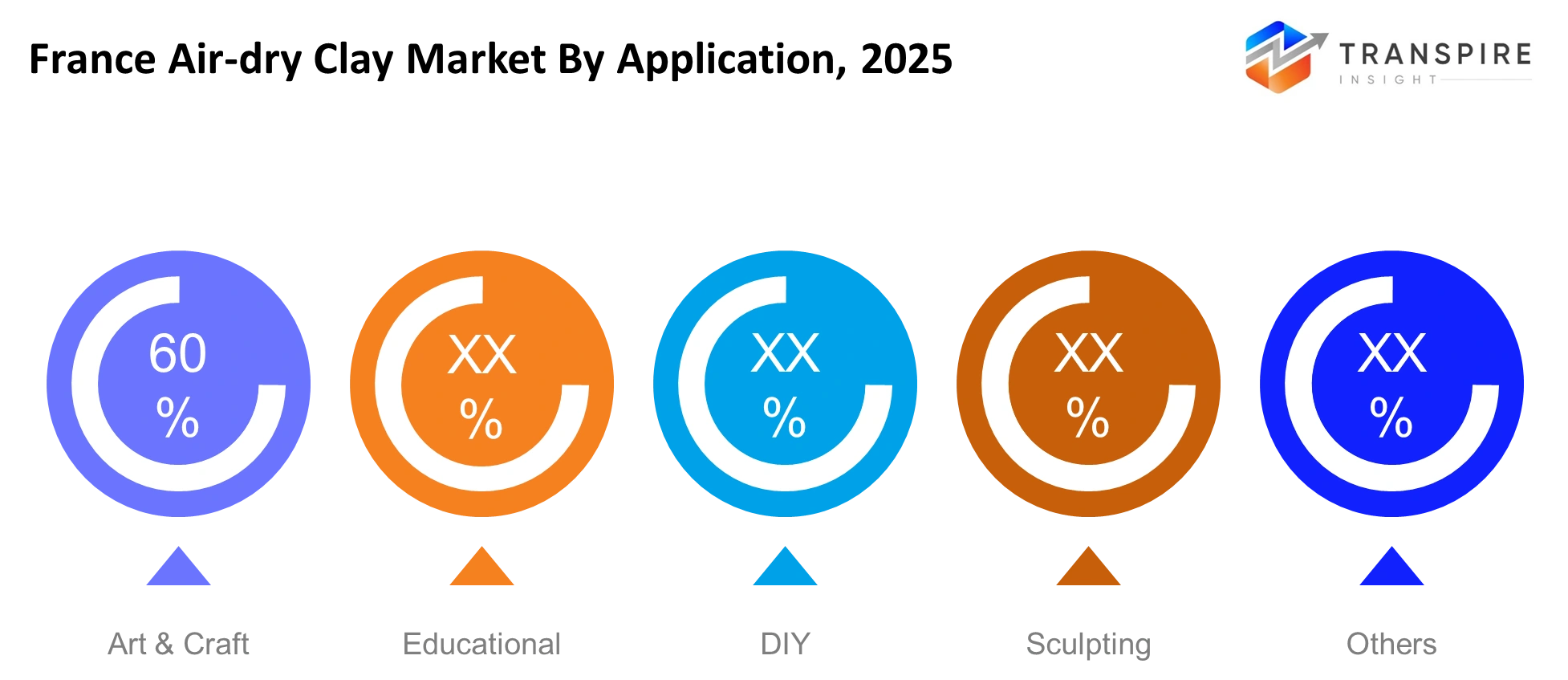
Art and Craft functions as the primary application category because air-dry modeling materials have become essential for creating hobby projects and decorative designs and sculpting activities which people do for fun. Retail demand remains stable because consumers use clay for personalized décor, figurines, and gift items that require no firing process. The segment drives mass-market consumption because urban and suburban households find its products to be accessible and easy to use.
The demand for educational applications remains strong because schools now use hands-on creative learning methods to teach art and design. Educational institutions will maintain their year-round resource use because structured procurement cycles and government-supported educational programs create predictable consumption patterns. DIY applications are expanding rapidly, supported by online tutorials and social media-driven craft culture that encourages at-home creative production. Professional training institutes and design workshops are experiencing growth in sculpting applications, which remain less common than other fields. The market will move toward blended usage models which combine education with DIY creativity, which will create new product versatility needs for manufacturers.
To learn more about this report, Download Free Sample Report
By End-User
Students form the dominant end-user segment because primary and secondary schools use modeling clay for art programs. Educational institutions require constant product availability because they need affordable safe classroom materials which enable teaching activities. Teachers choose materials which enable students to practice skills quickly because they need no special tools thus maintaining their dominant market position.
The user base for personalized art creation and home-based creative work is growing because both artists and hobbyists are discovering new ways to create art. Hobbyists now use digital platforms to find creative ideas which results in increased demand for premium and colored clay products. Schools function as organized bulk purchasers whereas training centers and workshop facilitators create stable but minor market requirements. The forecast period will witness hobbyists emerging as the fastest-growing group because creative consumption now emphasizes personalized learning through experiential education.
By Distribution Channel
The online channels experience rapid growth because e-commerce expands its reach and digital craft communities create strong market demand. Consumers choose online platforms because they offer different products and educational content and complete craft kits which make buying decisions easier. The growth of this distribution channel among young people increases because of subscription-based craft boxes and influencer marketing.
Retail stores maintain a stable share because physical availability remains important for impulse buying and immediate product access. Art stores function as targeted distribution centers which provide premium professional-grade materials to artists and training institutes that need expert product assistance. The Others category, which includes school supply distributors and wholesale channels, continues to support institutional demand cycles. The forecast period will see online distribution grow at the fastest pace while specialty art stores maintain their role as essential channels for selling high-value professional-grade products.
What are the Key Use Cases Driving the France Air-dry Clay Market?
The primary application of the France Air-dry Clay Market research serves educational purposes in schools where teachers use non-kiln modeling clay to teach art and geometry and help students develop their skills. The application demonstrates maximum demand because it enables safe classroom usage through multiple school sessions without needing any additional facilities.
The secondary applications of the product have expanded into both hobby crafting activities and small professional art studios. Air-dry clay serves as a material for home décor and figurines and custom gifts among individual hobbyists while creative studios use it for their rapid sculpture prototyping and design development work. The applications receive strong backing from the expanding base of DIY consumers and the structured procurement processes that educational institutions and training centers use.
Lightweight clay enables architectural model-making and product design prototyping because it allows designers to create and test their initial product designs before moving to digital rendering and manufacturing.
|
Report Metrics |
Details |
|
Market size value in 2025 |
USD 16.37 Million |
|
Market size value in 2026 |
USD 17.49 Million |
|
Revenue forecast in 2033 |
USD 27.79 Million |
|
Growth rate |
CAGR of 6.84% from 2026 to 2033 |
|
Base year |
2025 |
|
Historical data |
2021 - 2024 |
|
Forecast period |
2026 - 2033 |
|
Report coverage |
Revenue forecast, competitive landscape, growth factors, and trends |
|
Regional scope |
France |
|
Key company profiled |
Crayola, DAS, Sargent Art, Amaco, Mont Marte, Arteza, Jovi, Staedtler, Pebeo, Faber-Castell, Reeves, Royal Talens, Craft Smart, Activa, Polyform |
|
Customization scope |
Free report customization (country, regional & segment scope). Avail customized purchase options to meet your exact research needs. |
|
Report Segmentation |
By Type (Natural, Synthetic, Polymer, Others); By Application (Art & Craft, Educational, DIY, Sculpting, Others); By End-User (Students, Artists, Hobbyists, Schools, Others); By Distribution (Online, Retail, Art Stores, Others) |
Which Regions are Driving the France Air-dry Clay Market Growth?
The France Air-dry Clay Market identifies Île-de-France as its leading region because educational institutions and art schools and cultural training centers exist in high density throughout the area. Creative education programs receive active support from public policies which result in perpetual material acquisition from public schools throughout Paris and its nearby areas. The region possesses superior retail distribution systems together with dedicated art supply shops which fulfill institutional needs and general consumer requirements. The system generates continuous high-volume consumption patterns which other areas cannot replicate.
The Auvergne-Rhône-Alpes region functions as a reliable secondary contributor which maintains its strength because of balanced urban education facilities and industrial design schools. The region needs educational programs but its demand extends beyond that to include vocational training centers and design engineering schools. The region experiences predictable clay usage patterns because economic conditions remain stable and skill development programs receive constant funding. The pattern creates a dependable revenue source which suppliers can count on because demand remains stable.
Provence-Alpes-Côte d'Azur operates as the fastest expanding area in Southern France because of its growing tourist industry which supports craft workshops and stimulates artisan business development. The recent funding of cultural tourism infrastructure together with creative experience centers led to increased demand for materials used in craft projects. International tourists who wish to create their own art products have contributed to rising consumption levels. The region provides market newcomers with excellent opportunities to grow their businesses through both retail and experiential marketing methods.
Who are the Key Players in the France Air-dry Clay Market and How Do They Compete?
The France Air-dry Clay Market shows moderate market fragmentation which results in competition that depends on product safety and material quality and brand trust instead of using price as the only factor. Established global craft material manufacturers dominate institutional supply contracts while niche brands compete aggressively in hobbyist and DIY retail segments. Incumbents protect their existing shelf space within educational procurement systems while they work to boost their e-commerce presence because digital retail has become a vital sales channel.
Crayola stands out from its competitors because it holds child-safe certifications and achieves extensive sales in school supply programs which makes it the preferred choice for organizations that require bulk purchases. Faber-Castell competes through premium product positioning and long-term durability improvements which enable it to serve both educational and professional markets. DAS maintains its market leadership in structured classroom applications through its traditional air-dry products which offer extensive distribution throughout Europe.
Staedtler uses its extensive retail presence together with its product bundling methods to increase customer access to its complete range of art kits and stationery products. Pebeo boosts its competitive edge by operating production facilities in France and developing sustainable pigment and binder systems which meet regulatory standards and environmental sustainability requirements. Players expand their businesses through e-commerce growth and partnerships with schools and development of fast-drying and non-cracking clay products.
Company List
- Crayola
- DAS
- Sargent Art
- AMACO
- Mont Marte
- Arteza
- Jovi
- Staedtler
- Pébéo
- Faber-Castell
- Reeves
- Royal Talens
- Craft Smart
- Activa
- Polyform
Recent Development News
In April 2026, ClayScape research team introduced a Generative AI-supported clay design workflow integrated with clay 3D printing. The system enables designers to create ceramic and clay-based objects using AI-assisted modeling, reducing dependency on traditional CAD skills and improving accessibility for creative professionals. This development impacts the broader European clay materials ecosystem by expanding digital-to-physical clay design adoption in craft and education sectors.https://arxiv.org
In July 2024, research authors published findings on crack formation control in air-dried clay suspensions with tunable elasticity. The study demonstrated how modifying clay composition and additives can control drying behavior and reduce structural cracking, directly influencing formulation improvements for air-dry clay manufacturing. This has implications for product durability and premium-grade modeling clay used in education and hobby markets.https://arxiv.org
What Strategic Insights Define the Future of the France Air-dry Clay Market?
The French air-dry clay market demonstrates a market transformation which leads to increasing demand for premium compliant materials that educational institutions and creative sectors select because these materials provide safe and sustainable and user-friendly solutions. The upcoming period of 5 to 7 years will experience growth through certified performance-based clay products which educational institutions and do-it-yourself retail spaces will start using instead of using traditional products.
The use of digital modeling tools together with 3D printing technologies in advanced education settings creates a hidden danger which could lead to decreased demand for clay materials used in professional prototyping applications. The educational system will develop hybrid design programs which combine physical and digital elements between the present time and future.
The development of bio-composite clay materials which meet EU sustainability regulations creates new business opportunities for recyclable and low-carbon art materials. Market participants should make early investments in school partnerships and digital retail systems to establish ongoing demand while they move toward higher-profit eco-certified products.
France Air-dry Clay Market Report Segmentation
By Type
- Natural
- Synthetic
- Polymer
- Others
By Application
- Art & Craft
- Educational
- DIY
- Sculpting
- Others
By End-User
- Students
- Artists
- Hobbyists
- Schools
- Others
By Distribution Channel
- Online
- Retail Stores
- Art Stores
- Others
Frequently Asked Questions
Find quick answers to common questions.
The confirmed 2033 market size figure in USD 27.79 Million.
Key segments for the France Air-dry Clay Market are By Type (Natural, Synthetic, Polymer, Others); By Application (Art & Craft, Educational, DIY, Sculpting, Others); By End-User (Students, Artists, Hobbyists, Schools, Others); By Distribution (Online, Retail, Art Stores, Others).
Major France Air-dry Clay Market players are Crayola, DAS, Sargent Art, Amaco, Mont Marte, Arteza, Jovi, Staedtler, Pebeo, Faber-Castell, Reeves, Royal Talens, Craft Smart, Activa, Polyform.
The France Air-dry Clay Market size is USD 16.37 Million in 2025.
The France Air-dry Clay Market CAGR is 6.84% from 2026 to 2033.
- Crayola
- DAS
- Sargent Art
- AMACO
- Mont Marte
- Arteza
- Jovi
- Staedtler
- Pébéo
- Faber-Castell
- Reeves
- Royal Talens
- Craft Smart
- Activa
- Polyform
Recently Published Reports
-
Apr 2026
Healthcare Polymer Packaging Market
Healthcare Polymer Packaging Market Size, Share & Analysis Report By Packaging Type (Syringes, IV Bottles and Pouches, Clamshells, Blisters, Bottles & Jars, Containers, Tubes, IV Parental Packaging, Others), By Type (Regulated, Non-regulated), By Polymer Type (LDPE (Low-Density Polyethylene), HDPE (High-Density Polyethylene), Homo-polymer (Homo), Random Copolymer (Random), Block Copolymer (Block), PET, Polystyrene, Polyvinyl Chloride, Polyamide/EVOH, Others), and Geography (North America, Europe, Asia-Pacific, Middle East and Africa, South and Central America), 2021 - 2031
-
Apr 2026
Hydrophilic Tape (Waterstop) Market
Hydrophilic Tape (Waterstop) Market Size, Share & Analysis Report By Type (Bentonite-Based Hydrophilic Tape, Rubber-Based Hydrophilic Tape), By Application (Residential Buildings, Commercial Buildings, Infrastructure Projects), and Geography (North America, Europe, Asia-Pacific, Middle East and Africa, South and Central America), 2021 - 2031
-
Apr 2026
Metalens Market
Metalens Market Size, Share & Analysis Report By Type (Visible Light Metalens, and Infrared Metalens), By Application (Consumer Electronics, Automotive Electronics, Industrial, Medical, and Others), and Geography (North America, Europe, Asia-Pacific, Middle East and Africa, South and Central America), 2021 - 2031
-
Apr 2026
PBT Resin Market
PBT Resin Market Size, Share & Analysis Report By Type (Reinforced PBT Resin, Unreinforced PBT Resin), By Processing Method (Injection Molding, Extrusion, Blow Molding, Others), By End-User (Automotive, Electrical & Electronics, Consumer Appliances, Industrial Machinery, Medical Devices, Packaging, Others), and Geography (North America, Europe, Asia-Pacific, Middle East and Africa, South and Central America), 2021 - 2031