

Food Processing Automation Market Summary:
According to Transpire Insight, a detailed research report on the market reflects that the packaging and re-packaging application segment dominates the Food Processing Automation Market, accounting for approximately 34.8% of the total share worldwide. JBT Marel Corporation leads the market with approximately (around USD 3.8 billion) in annual revenue and a significant market presence, making it a leading contributor to market development, innovation, advanced food processing automation production, expanding manufacturing capabilities, and growth dynamics.
Market Snapshot
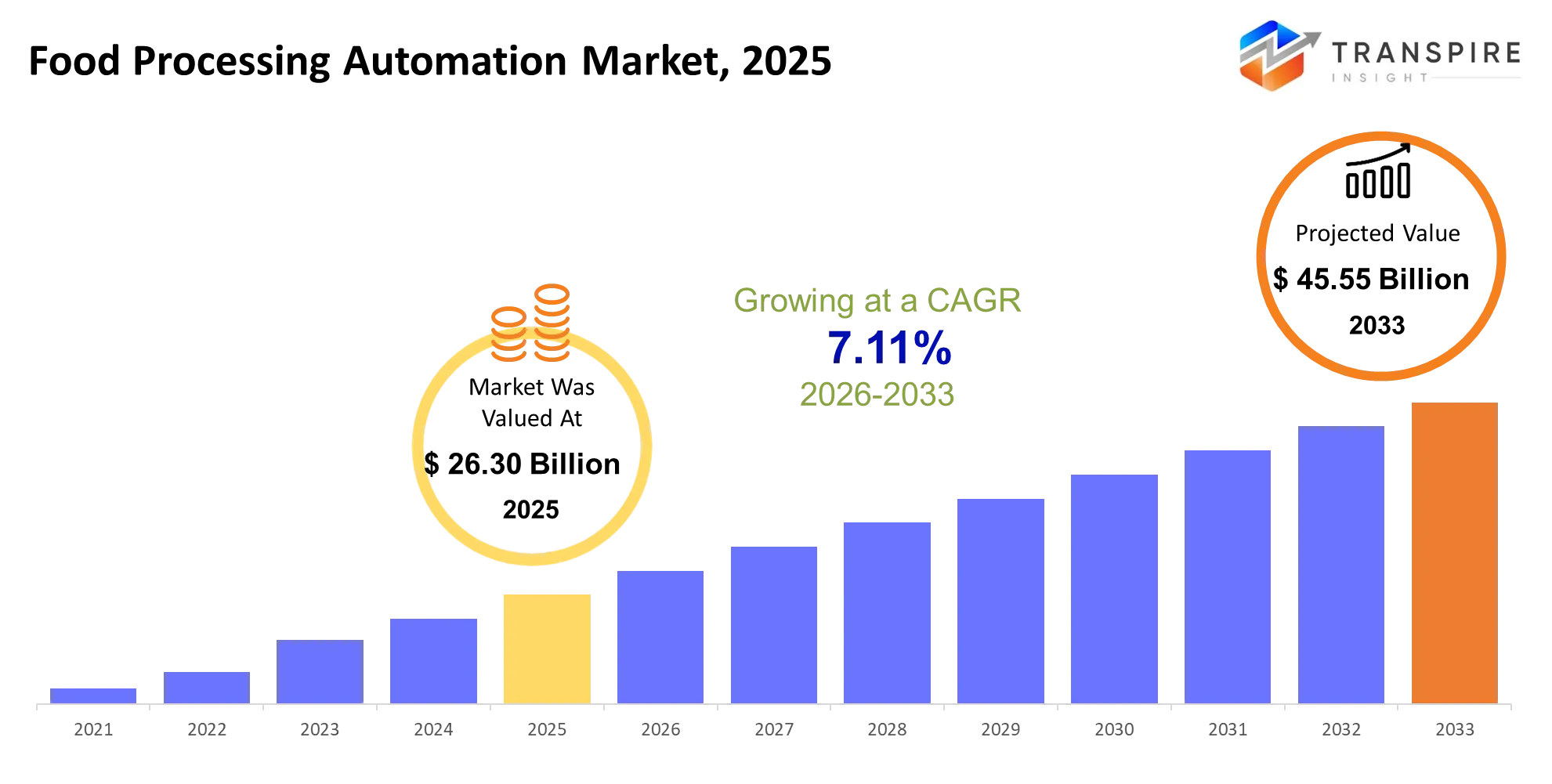
- Market Value (2025): USD 26.30 Billion.
- Expected Market Value (2026): USD 28.17 Billion.
- Estimated Market Value (2033): USD 45.55 Billion.
- Forecast CAGR (2026–2033): 7.11%.
- Leading Region in 2025: Asia Pacific
- Second-largest Region: North America
- Fastest Growing Region: Europe
Introduction
Food Processing Automation Market includes the use of automation technology, robotics, controls, smart sensors, and software for making the process of food manufacturing, processing, packaging, inspection, and material handling more efficient. The adoption of such technologies helps food processors increase production efficiency, maintain quality standards of the manufactured products, improve food safety standards, reduce human interventions, and make optimal use of the resources within production processes. Technologies used within the Food Processing Automation Market include PLC, industrial robotics, machine vision, AI, Internet of Things, automated inspection, and digital process control solutions. Automation technologies are increasingly being applied in ingredient handling, sorting, processing, cooking, filling, packaging, palletizing, and traceability processes. Increased attention towards clean production, productivity, staff management, flexibility, and sustainable resource management is driving food processors to adopt integrated and connected automation solutions.
For instance:-
- North America: The lack of manpower, need for food safety, and production efficiency are motivating the advanced food manufacturing industry to use robotics, machine vision, predictive maintenance, and automation technologies.
- Europe: Stringent food safety, sustainability, energy efficiency, and traceability standards are leading food processors to embrace intelligent automation, robotics, digital production systems, and resource-efficient technologies.
Key Market Highlights: -
- Asia Pacific is expected to grow at a rapid CAGR in the Food Processing Automation Market by holding around 38.7% of the share during the forecast period.
- North America is anticipated to hold roughly 34% share of the Food Processing Automation Market over the predicted timeframe.
- Europe is anticipated to hold nearly 24% share of the Food Processing Automation Market over the predicted timeframe.
- By Automation Type, the Discrete Automation dominated the market and holds nearly 35% share in 2025 and is projected to grow at a substantial CAGR during the forecast period.
- By Equipment, the Industrial Robots dominated the market and holds close to 24% share in 2025 and is projected to grow at a substantial CAGR during the forecast period.
- By Application, the Multinational Corporations dominated the market and holds about 38.82%share in 2025 and is projected to grow at a substantial CAGR during the forecast period.
- The market for automation in India's food-processing industry is growing due to infrastructure, production incentives, and modernization efforts backed by the government.
How is Technology Driving Growth in the Food Processing Automation Market?
Technological advancements are driving the growth of the Food Processing Automation Market by increasing efficiency of production, food safety, quality, traceability, and resource utilization. The use of artificial intelligence and machine learning can help with vision inspection, predictive maintenance, defect identification, and process optimization. Industrial robotics increase the efficiency of sorting, handling, packaging, palletizing, and other processes with minimum involvement of humans. IoT-based sensors and connected control systems help monitor the machinery in real time and optimize production and resource utilization.
|
Report Metrics |
Details |
|
Market size value in 2025 |
USD 26.30 Billion |
|
Market size value in 2026 |
USD 28.17 Billion |
|
Revenue forecast in 2033 |
USD 45.55 Billion |
|
Growth rate |
CAGR of 7.11% from 2026 to 2033 |
|
Base year |
2025 |
|
Historical data |
2021 - 2024 |
|
Forecast period |
2026 - 2033 |
|
Report coverage |
Revenue forecast, competitive landscape, growth factors, and trends |
|
Regional scope |
United States; Canada; Mexico; United Kingdom; Germany; France; Italy; Spain; Denmark; Sweden; Norway; China; Japan; India; Australia; South Korea; Thailand; Brazil; Argentina; South Africa; Saudi Arabia; United Arab Emirates |
|
Key company profiled |
ABB, Siemens, Rockwell Automation, Schneider Electric, Emerson, Honeywell, Mitsubishi Electric, Omron, FANUC, KUKA, Yaskawa, Bosch Rexroth, Rockwell, SICK, Keyence |
|
Customization scope |
Free report customization (country, regional & segment scope). Avail customized purchase options to meet your exact research needs. |
|
Report Segmentation |
By Automation Type (Process Automation, Discrete Automation, Batch Automation, Robotic Automation, Packaging Automation, Material Handling Automation, Quality Automation, Others); By Equipment (Robots, Conveyors, Sensors, PLCs, SCADA, Drives, Machine Vision, Others); By Application (Bakery, Dairy, Meat & Poultry, Beverages, Fruits & Vegetables, Grains & Cereals, Confectionery, Others); By Component (Discrete Automation, Software, Services, Controllers, Sensors, Actuators, HMI, Others); By Technology (AI, IoT, Robotics, Machine Vision, Digital Twins, Predictive Analytics, Cloud Computing, Others); By End User (Large Food Manufacturers, SMEs, Contract Manufacturers, Beverage Producers, Dairy Processors, Meat Processors, Bakery Producers, Others); By Function (Processing, Packaging, Sorting, Inspection, Filling, Mixing, Palletizing, Others) |
Market Drivers
There are some drivers that are contributing to the growth of the Food Processing Automation market, such as continuous labor shortage, high operational cost, strict food safety regulations, and the requirement for consistent quality of production. The food manufacturers are focusing on automation in the form of industrial robots, packaging automation, machine vision, automated inspection via artificial intelligence, sensors for Internet of Things applications, and predictive maintenance to increase efficiency while minimizing human involvement and downtime. In addition, there is scope for food processing automation due to development of smart manufacturing technologies. Increasing adoption of automated sorting, palletization, quality inspection, and traceability technologies will generate more opportunities in processing plants.
For instance:-
- Asia-Pacific: Food-processing industries, manufacturing capabilities, shortage of manpower, and digital transformation are making food processors adopt robotics, automated packaging, machine vision, and intelligent processing systems.
- Latin America: Food processors, owing to increased exports, modernization of the processing plants, and need for uniform product quality are adopting automated packaging, sorting, inspection, and material handling systems.
Restrain
Higher cost at the start time is considered to be one of the key limiting factors for the Food Processing Automation Market, especially for small and mid-sized companies. The installation of robots, artificial intelligence, IoT, control systems, and other automated inspection technology involves a lot of cost, as does maintenance and upgrades of systems. Also, the product variation along with processing complexity becomes a challenge in automation. Another factor that hinders automation in the field of food processing is the lack of technical manpower and cybersecurity issues.
|
Driver |
Relative Impact on Growth (%) |
Geographic Relevance |
Impact Timeline |
Demand Strength |
Growth Mechanism |
Key Beneficiaries |
Major Constraint |
|
Labor shortages and rising food-processing labor costs |
34% |
North America, Europe, Japan, Australia |
Short-term |
High |
Replaces repetitive labor with automated processing systems |
Robotics manufacturers, system integrators, large food processors |
High upfront automation and integration costs |
|
AI, machine vision and intelligent robotics adoption |
23% |
North America, Europe, China, Japan |
Medium-term |
High |
Enables automated inspection, sorting, handling, and process optimization |
AI vendors, vision-system providers, robotics companies, processors |
Data quality and integration complexity |
|
Rising food safety, traceability and quality-control requirements |
20% |
North America, Europe, Asia-Pacific |
Short-term |
High |
Automates monitoring, documentation, inspection, and traceability workflows |
Automation vendors, software providers, regulated food manufacturers |
Regulatory complexity and interoperability gaps |
|
Demand for higher production throughput and flexible manufacturing |
17% |
Asia-Pacific, North America, Europe |
Medium-term |
High |
Increases throughput while supporting rapid product changeovers |
Equipment OEMs, integrators, high-volume processors |
Retrofitting limitations in legacy facilities |
|
Sustainability, energy efficiency and food-waste reduction |
13% |
Europe, North America, Asia-Pacific |
Long-term |
Medium |
Optimizes energy, water, materials, yield, and waste through automation |
Smart-equipment vendors, processors, sustainability technology providers |
Longer ROI periods and technology costs |
Analysis of Prices and Consumer Behaviour
In terms of market segmentation, Food Processing Automation solutions are dominated by automation solutions of high quality (68% share of the market overall; primarily due to demand in food processing, packaging and food manufacturing industries). The price for high-end automation solutions with high-level performance is estimated to be 35% higher compared to other automation solutions as they contain sophisticated robotics, AI, IoT technologies, quality certified components and consistent performance. Approximately 45% of all unit sales of Food Processing Automation solutions occur in automated and integrated systems. This is due to the flexibility of automation solutions in performing processing, packaging, inspection and material handling tasks as well as their efficiency in the long run. Food processing and packaging industries account for roughly 70% of the demand from these industries. In terms of procurement process of the manufacturers, 55% of the buyers value automation performance, system reliability and standardization the most. Another 33% of buyers opt to buy automation solutions via bulk or long-term agreements as they seek to minimize costs for purchasing and to ensure steady supply of technologies and services for their facilities worldwide.
|
Company |
Est. Revenue Share Range |
Key Offerings |
Strategic Positioning |
Geographic Strength |
Technology Focus |
|
Tetra Pak |
6–9% |
Processing equipment, integrated processing lines, filling systems, Factory OS™, automation and digital solutions |
Integrated end-to-end food processing leadership |
Europe, Asia Pacific, North America |
Smart automation, Factory OS™, MES, connected processing |
|
GEA Group |
5–8% |
Process systems, separation, homogenization, filling, packaging, digital plant solutions |
Broad process-technology and lifecycle solutions |
Europe, North America, Asia Pacific |
Process automation, digitalization, smart equipment |
|
JBT Marel |
5–8% |
Food processing systems, protein processing, freezing, cooking, filling, automated material handling |
Full-line food processing and protein automation |
North America, Europe, Latin America |
Robotics, AGVs, digital monitoring, process automation |
|
Bühler Group |
4–7% |
SORTEX optical sorting, grain processing, milling, food processing systems, digital services |
Technology-led processing and optical sorting specialization |
Europe, Asia Pacific, North America |
AI sorting, deep learning, sensors, optical inspection |
|
Syntegon Technology |
3–5% |
Food packaging lines, robotic pick-and-place, confectionery processing, digital solutions |
Integrated packaging automation and lifecycle services |
Europe, North America, Asia Pacific |
Robotics, machine vision, connected lines, cloud analytics |
|
MULTIVAC Group |
3–5% |
Slicing, portioning, tray sealing, inspection, processing, automated packaging lines |
Integrated processing and packaging-line specialization |
Europe, North America, Asia Pacific |
Connected automation, inspection, robotics, line integration |
|
TOMRA Food |
2–4% |
Optical sorting, grading, peeling, post-harvest processing, AI sorting |
Precision sorting and yield-optimization specialist |
Europe, North America, Asia Pacific |
AI, machine learning, optical sensors, deep learning |
|
Ishida |
2–4% |
Multihead weighing, checkweighing, X-ray inspection, tray sealing, packaging systems |
Precision weighing and quality-control specialization |
Asia Pacific, Europe, North America |
Computer combination weighing, X-ray, inspection software |
|
Rockwell Automation |
2–4% |
PlantPAx, FactoryTalk, Plex MES, process control, food & beverage automation |
Industrial automation and digital transformation provider |
North America, Europe, Asia Pacific |
PLC/DCS, MES, analytics, cloud and industrial software |
|
ABB |
2–4% |
Robotics, drives, PLC/control, process automation, AMRs, food-production automation |
Robotics, electrification and automation integration |
Europe, North America, Asia Pacific |
Robotics, AMRs, motion control, IoT, digital automation |
Who are the Key Players in the Food Processing Automation Market and how do they compete?
Competition in the international market of Food Processing Automation is determined by companies focused on technological innovations, solutions oriented toward the needs of food processing industries, and distribution network building at the international level. Competing not on prices but using durable equipment, sophisticated automation technology, innovative solutions and integration with digital platforms and systems, such a competitive strategy implies constant product development and also ensures increased productivity, efficiency, resource optimization and operation transparency.
Developing intelligent automation solutions, precision food processing solutions, autonomous technologies and connected equipment, ABB increases its competitive edge in the market. Developing high-performing automation equipment designed for food processing, packaging, quality inspection, material handling and other food manufacturing purposes, Siemens sets itself apart from its competitors. Developing its competitive edge in food processing automation and industrial automation, process control, digitalization and smart manufacturing, Rockwell Automation offers integrated solutions to food manufacturers.
Top Companies in the Food Processing Automation Market
- ABB
- Siemens
- Rockwell Automation
- Schneider Electric
- Emerson
- Honeywell
- Mitsubishi Electric
- Omron
- FANUC
- KUKA
- Yaskawa
- Bosch Rexroth
- Rockwell
- SICK
- Keyence
|
Investment Factor |
Why It Matters to Investors |
Opportunity |
Investment Implication |
|
Labor Replacement and Productivity Automation |
Persistent labor shortages increase demand for automated processing, packaging, palletizing, and material handling. |
Robotic processing, automated packaging, palletizing, and intralogistics systems. |
Supports near-term equipment demand and productivity-focused capital spending. |
|
AI-Enabled Inspection and Intelligent Processing |
AI and machine vision improve defect detection, sorting accuracy, quality consistency, and process optimization. |
AI sorting, machine vision, predictive maintenance, and intelligent quality-control platforms. |
Creates technology-led differentiation and higher-value software opportunities. |
|
Integrated Processing and Packaging Lines |
Food manufacturers increasingly seek connected production lines rather than standalone automation equipment. |
End-to-end processing, inspection, packaging, controls, and digital integration. |
Favors scalable system integrators and diversified automation suppliers. |
|
Food Safety, Traceability and Quality Automation |
Stricter safety and traceability requirements increase demand for automated inspection and production-data systems. |
Automated inspection, traceability software, quality monitoring, and compliance-oriented automation. |
Creates resilient demand across regulated food-processing applications. |
|
Smart Factory and Recurring Digital Services |
Connected equipment enables remote monitoring, predictive maintenance, analytics, software, and lifecycle services. |
Industrial IoT, MES, cloud analytics, remote service, and predictive-maintenance platforms. |
Expands recurring revenue beyond traditional equipment sales. |
|
Asia-Pacific and Emerging-Market Automation |
Expanding food manufacturing capacity and modernization create opportunities for automation adoption beyond mature markets. |
Modular automation, processing equipment, robotics, and localized service networks. |
Supports medium- and long-term geographic expansion strategies. |
Food Processing Automation Market Segmentation
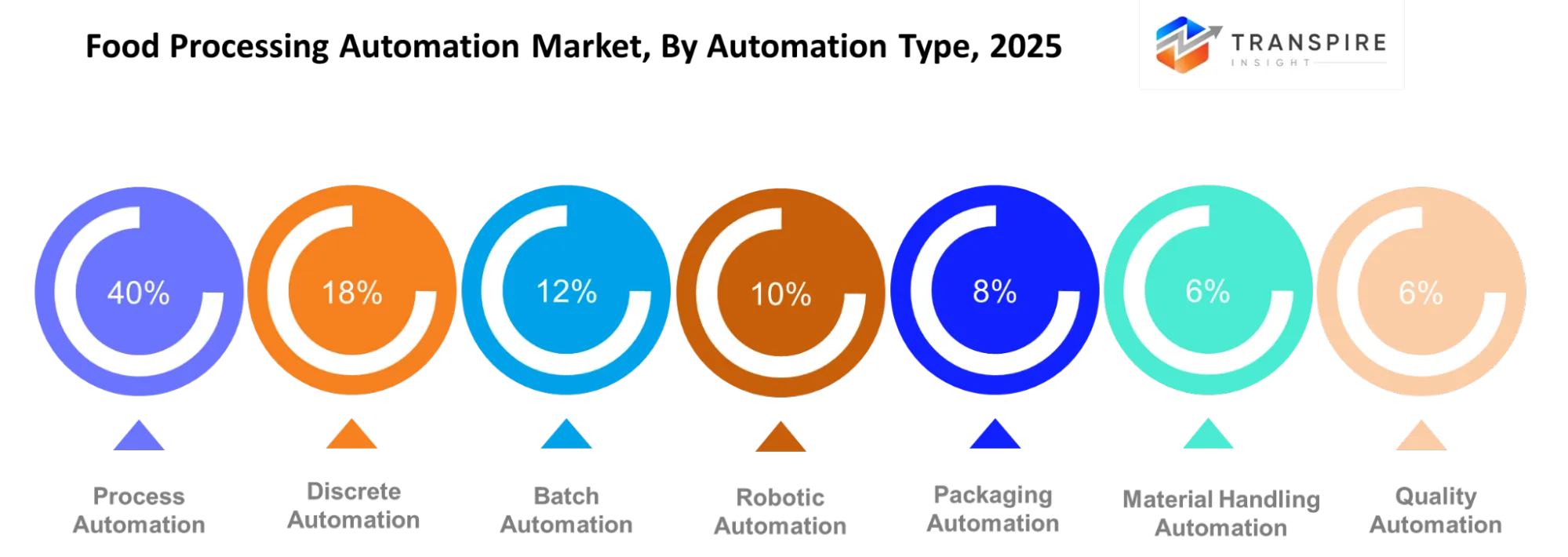
The Food Processing Automation Market share is divided into seven categories: By Automation Type, By Equipment, By Application, By Component, By Technology, By End User, By Function.
The Discrete Automation dominated the market, accounting for nearly 35% in 2025 and is expected to rise at a significant CAGR during the forecast period.
The Food Processing Automation Market is by automation type into process automation, discrete automation, batch automation, robotic automation, packaging automation, material handling automation, quality automation, others. Among these, Discrete Automation dominated the market, accounting for nearly 35% in 2025 and expected to increase at a significant CAGR during the forecast period. The Discrete Automation accounted for more than 35% share in 2025 and is projected to grow with a high CAGR through the forecast period due to the increasing use of robotics, automation handling, packaging, and precision processing.
The Industrial Robots dominated the market, accounting for close to 24% in 2025, and is expected to rise at a significant CAGR during the forecast period
The Food Processing Automation Market is segmented by equipment into robots, conveyors, sensors, plcs, scada, drives, machine vision, and others. Among these, the Industrial Robots dominated the market, accounting for close to 24% in 2025 and expected to increase at a significant CAGR during the forecast period. The Industrial Robots accounted for almost 24% share in 2025 owing to the growing demand for automated processing, packaging, and handling.
The Bakery and Confectionery dominated the market, accounting for about 38.82%in 2025 and is expected to rise at a significant CAGR during the forecast period.
The Food Processing Automation Market by application into bakery, dairy, meat & poultry, beverages, fruits & vegetables, grains & cereals, confectionery, others. Among these, theMultinational Corporations dominated the market, accounting for about 38.82%in 2025 and expected to increase at a significant CAGR during the forecast period. The Bakery and Confectionery segment held a dominant share of around 38.82% in 2025 due to the increased demand for automation.
Regional Segment Analysis of the Food Processing Automation Market
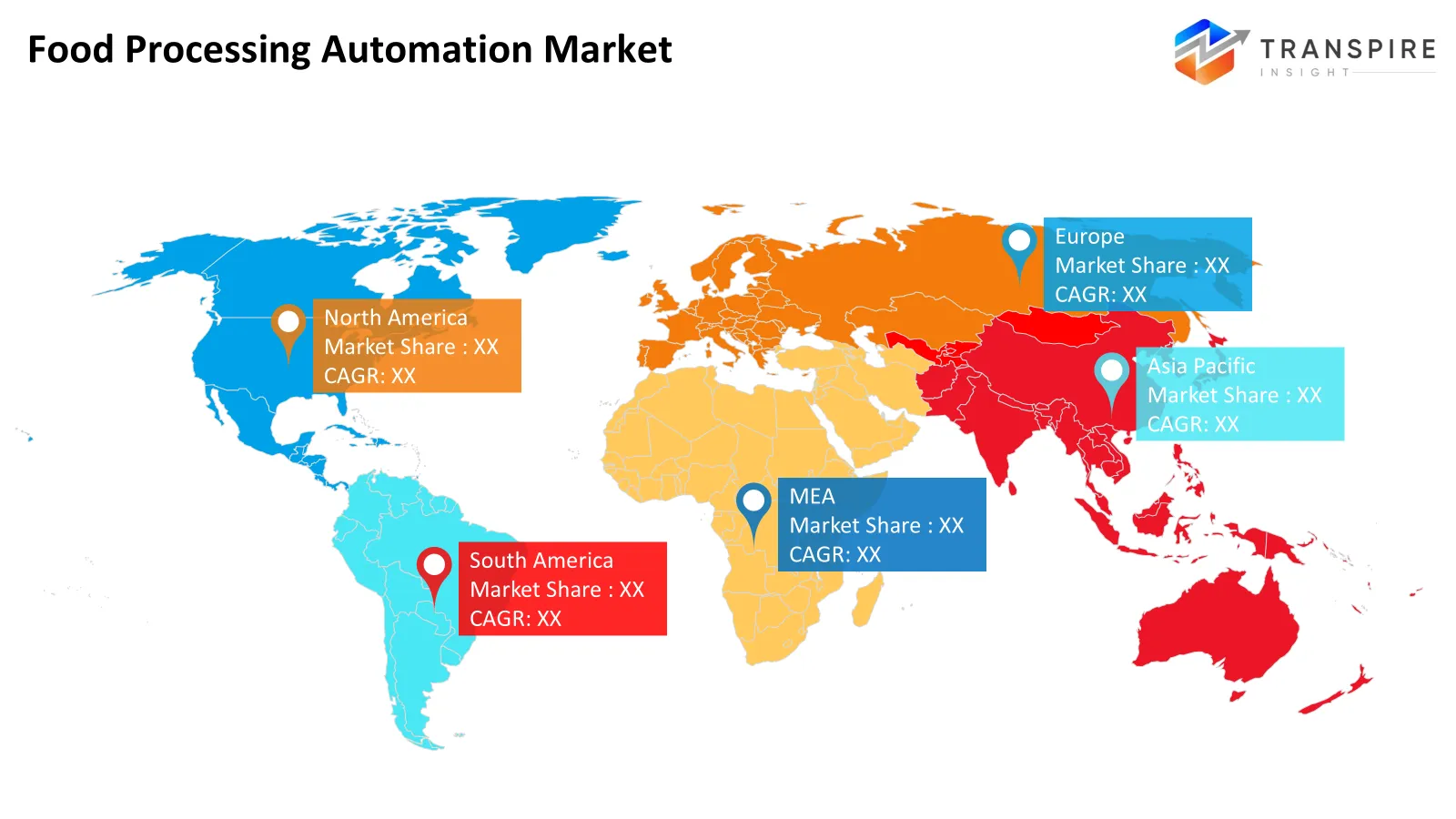
- Europe (Germany, France, U.K., Italy, Spain, Rest of Europe)
- North America (U.S., Canada, Mexico)
- Asia-Pacific (China, Japan, India, Rest of APAC)
- South America (Brazil and the Rest of South America)
- The Middle East and Africa (UAE, South Africa, Rest of MEA)
Asia Pacific is expected to grow at a rapid CAGR in the Food Processing Automation Market, holding around 38.7% of the share during the forecast period.
The Asia Pacific region is anticipated to experience high growth rates with respect to the CAGR in the Food Processing Automation Market owing to factors such as growing food processing industries, increased manufacturing investment, labor shortage, and adoption of robotics as well as smart automation technology. Growing demand for packed and processed food products, industry digitalization, improved manufacturing infrastructure, and government support towards advanced manufacturing are further propelling food processing companies to adopt food processing automation solutions across Asia Pacific.
North America is the high-growth region in the Food Processing Automation Market during the period, holding roughly 34% share.
North America is the high-growth region in the Food Processing Automation Market in the forecast period owing to its advanced food manufacturing infrastructure, labor shortage, strict food safety norms, and adoption of robotics, artificial intelligence, machine vision, and internet of things based automation technology. Growing demand for efficient food production processes, packaging automation, food inspection, and traceability systems is further fueling market growth.
Europe is the fastest-growing region in the Food Processing Automation Market during the period, holding nearly 24% share.
Europe is the fastest-growing region in the Food Processing Automation Market with about 24% of market share because of factors such as food safety standards, labor scarcity, sustainability, and investment in smart manufacturing. Increasing use of robotics, AI-powered inspection, internet of things, and packaging automation has improved the process efficiency. Increasing preference for hygienic food processing operations and traceability is also driving automation in Europe.
Strategies for Market Growth in Non-Leading Regions:
Automation and scalability technologies for effective food processing would help the non-leading areas develop. Implementation of automated food processing, packaging, inspection, and materials handling systems as well as creation of regional automation centers and services would allow reducing the dependency on imported equipment and decreasing the expenses. Development of strategic cooperation with regional food processors, automation technology suppliers, equipment providers, system integrators, and food distributors will facilitate the penetration of the market by suppliers of food processing automation systems. To improve the knowledge about automation technologies, equipment operation, quality control, preventive maintenance, and digital manufacturing systems, training and technical expertise will be needed. Besides, flexible financial terms, long-term equipment supply contracts, and contract manufacturing will make food processing automation systems cheaper and will stimulate their use by food processors. Implementation of collaborative initiatives related to the cooperation with government, food manufacturing, technology, and industrial development projects along with digital marketing approach would facilitate access to food processing automation solutions and promote sustainable worldwide market development in developing countries.
Future Market Trends for the Food Processing Automation Market: -
- Quality Control Using AI: Machine vision and automated inspection using AI is now becoming more sophisticated with respect to detecting contaminants, ensuring quality, improving sorting, and enhancing food safety at processing plants.
- Robotics That Are Wash-Down Ready: Robotic systems that can be used for food applications have started seeing usage due to their ability to provide automated processing and packaging solutions.
- OEE Performance Analytics: Real-time sensors and OEE analysis using the cloud is allowing predictive maintenance and optimizing equipment efficiency.
Recent Development
- In January 6, 2026: Indusfood Manufacturing 2026 and FoodTech 4.0 Inauguration at Yashobhoomi, New Delhi, focusing on automation, advanced packaging and value-added food manufacturing technologies.
- In September 29, 2026: Anuga FoodTec India 2026, at Bombay Exhibition Center, Mumbai, entered its 20th edition with AI inspection, food processing automation & Industry 4.0 technologies.
Market Segment
This study forecasts revenue at global, regional and country levels from 2020 to 2033. Transpire Insight has segmented the Food Processing Automation Market based on the below-mentioned segments:
Food Processing Automation Market, By Automation Type
- Process Automation
- Discrete Automation
- Batch Automation
- Robotic Automation
- Packaging Automation
- Material Handling Automation
- Quality Automation
- Others
Food Processing Automation Market, By Equipment
- Robots
- Conveyors
- Sensors
- PLCs
- SCADA
- Drives
- Machine Vision
- Others
Food Processing Automation Market, By Application
- Bakery
- Dairy
- Meat & Poultry
- Beverages
- Fruits & Vegetables
- Grains & Cereals
- Confectionery
- Others
Food Processing Automation Market, By Component
- Discrete Automation
- Software
- Services
- Controllers
- Sensors
- Actuators
- HMI
- Others
Food Processing Automation Market, By Technology
- AI
- IoT
- Robotics
- Machine Vision
- Digital Twins
- Predictive Analytics
- Cloud Computing
- Others
Food Processing Automation Market, By End User
- Large Food Manufacturers
- SMEs
- Contract Manufacturers
- Beverage Producers
- Dairy Processors
- Meat Processors
- Bakery Producers
- Others
Food Processing Automation Market, By Function
- Processing
- Packaging
- Sorting
- Inspection
- Filling
- Mixing
- Palletizing
- Others
Food Processing Automation Market, By Regional Analysis
North America
- US
- Canada
- Mexico
Europe
- Germany
- UK
- France
- Italy
- Spain
- Russia
- Rest of Europe
Asia Pacific
- China
- Japan
- India
- South Korea
- Australia
- Rest of Asia Pacific
South America
- Brazil
- Argentina
- Rest of South America
Middle East & Africa
- UAE
- Saudi Arabia
- Qatar
- South Africa
- Rest of the Middle East & Africa
Frequently Asked Questions
Find quick answers to common questions.
Labor shortages, rising operational costs, food safety requirements, and demand for efficient, consistent, and automated production are driving market growth.
Discrete Automation dominates with nearly 35% share in 2025, supported by growing adoption of robotics, automated handling, packaging, and precision processing.
Asia Pacific holds around 38.7% share, driven by expanding food manufacturing, industrial digitalization, robotics adoption, infrastructure investment, and workforce shortages.
AI enables automated inspection, contamination detection, sorting, predictive maintenance, process optimization, and improved quality control across modern food manufacturing facilities.
High initial investment, complex integration, skilled workforce shortages, product variability, maintenance requirements, and cybersecurity concerns can restrict automation adoption.
- ABB
- Siemens
- Rockwell Automation
- Schneider Electric
- Emerson
- Honeywell
- Mitsubishi Electric
- Omron
- FANUC
- KUKA
- Yaskawa
- Bosch Rexroth
- Rockwell
- SICK
- Keyence
About the Authors

Kartik bhong
I am Kartik Bhong, a Senior Research Analyst at Transpire Insight, specializing in the Packaging, Manufacturing, and Construction industry. My work focuses on analyzing market trends, emerging technologies, industry regulations, and competitive landscapes to deliver accurate, data-driven insights. I am passionate about transforming complex industry information into clear, practical content that helps businesses, professionals, and decision-makers stay informed and make confident strategic decisions. Through continuous research and a strong commitment to accuracy, I strive to create reliable, well-researched content that reflects the latest developments across these dynamic industries and supports the vision of Transpire Insight in delivering valuable market intelligence.

Chakradhar Khansole
Chakradhar serves as the Research Director at Transpire Insight, bringing over 8 years of experience in technology, innovation, and strategic market intelligence. He specializes in transforming complex market data into actionable business insights that enable organizations to make informed, growth-oriented decisions. Recognized for his strategic vision and analytical expertise, Chakradhar leads high-impact research initiatives, delivering comprehensive market assessments, competitive intelligence, and forward-looking industry analysis.
Recently Published Reports
-
Apr 2026
Handling and Lifting Equipment Market
Handling and Lifting Equipment Market Size, Share & Analysis Report By Product (Cranes and Hoists, Forklifts, Conveyor Systems, Aerial Work Platforms, Others), By Application (E-Commerce, Automotive and Railway, Food and Beverages, Aviation, Others), and Geography (North America, Europe, Asia-Pacific, Middle East and Africa, South and Central America), 2021 - 2031
-
Apr 2026
HVAC Equipment Market
HVAC Equipment Market Size, Share & Analysis Report By Heating Equipment Type (Boilers and Furnaces, Heat Pumps, and Unitary Heaters), By Ventilation Equipment (Air Handling Units, Humidifiers and Dehumidifiers, Air Filters, and Fan Coiling Units), By Air Conditioning Equipment (Unitary Air Conditioners, Room Air Conditioners, Packaged Terminal Air Conditioners, and Chillers), By End User (Commercial, Residential, Industrial, and others), and Geography (North America, Europe, Asia-Pacific, Middle East and Africa, South and Central America), 2021 – 2031
-
Apr 2026
Refrigeration Valves Market
Refrigeration Valves Market Size, Share & Analysis Report By Type (Solenoid Valves, Expansion Valves, Check Valves, Service Valves, Others), By Application (Commercial Refrigeration, Industrial Refrigeration, Transport Refrigeration, Residential Refrigeration, Air Conditioning Systems), By End User (Food and Beverage Industry, Pharmaceutical Industry, HVAC Industry, Chemical Industry, Others), and Geography (North America, Europe, Asia-Pacific, Middle East and Africa, South and Central America), 2021 – 2031
-
Apr 2026
E-Commerce Packaging Materials Market
E-Commerce Packaging Materials Market By Material Type (Corrugated Boxes, Paper & Paperboard, Foam & Cushioning Materials, Plastic Packaging, Flexible Packaging, Protective Packaging, Others), By Product(Primary Packaging, Secondary Packaging, Tertiary Packaging), By Packaging Function (Protective Packaging, Branding & Presentation Packaging, Transit & Logistic Packaging, Sustainable Packaging, Tamper Evidence Packaging), By End-User (Retail & Consumer Goods, Electronic Appliances, Food & Beverages, Healthcare & Pharmaceutical, Fashion & Apparel, Home & Furnishing, Others); By Industry Analysis, Size, Share, Growth, Trends, and Forecasts 2021-2033