Food Logistics Market Summary:
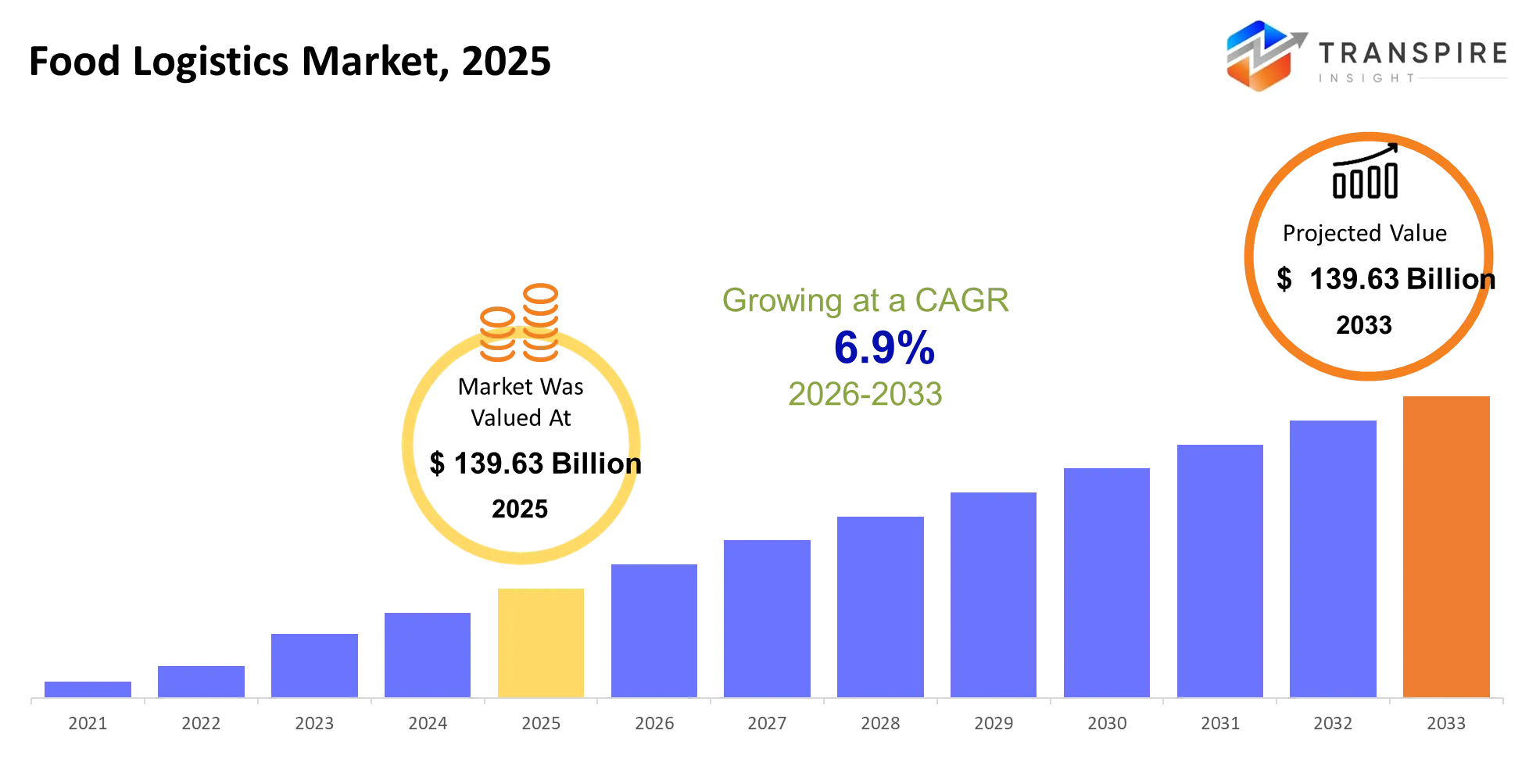
As per Transpire Insight Analysis, the Food Logistics Market size is estimated at USD 139.63 billion in 2025 and is anticipated to reach USD 139.63 billion by 2033, growing at a CAGR of 6.9% from 2026 to 2033.
The food logistics market moves food from farmers and makers to shops, restaurants, food service companies and people, making sure it stays safe, arrives on time, and is still fresh. The food logistics market has changed from using trucks to a smart system that keeps food at the right temperature. This system includes storage, tracking what’s in stock and using ways to deliver the food. A major change in the food logistics market is using sensors, digital tools for trucks, automated warehouses and looking at data to follow food during its whole trip. Problems with getting supplies going made companies create food logistics networks, and how people shop now has made sure that grocery delivery and the last part of the trip are even more important. Growth in the food logistics market happens because of the need to stop food from going bad, make deliveries more accurate, deal with how long products last and handle complicated food supply chains. As food moves, strong roads and cold chain abilities become more important for the food logistics market.
Food Logistics Market Size & Forecast:
- Market Size 2025: USD 139.63 Billion
- Expected Market Value (2033): USD 139.63 Billion
- Forecast CAGR (2026-2033): 6.9%
- Leading Region in 2025: North America
- Fastest Growing Region: Asia Pacific
- Key Company Profiles: DHL Supply Chain, UPS, FedEx, Maersk, Kuehne+Nagel, DB Schenker, DSV, Lineage Logistics, Americold, C.H. Robinson, GXO Logistics, XPO, CEVA Logistics, J.B. Hunt, Nippon Express
Key Market Insights:
The market has moved from basic transport towards logistics, where storage, distribution, and tracking take place, in addition to temperature control. The road sector continues to have the biggest percentage, although cold chain services have become very necessary in light of the efforts by food firms to keep food fresh.
- Road Transport Constitutes 46.30%, due to its versatility for food transport regionally and to individual stores.
- Cold Chain Logistics is likely to experience the highest growth rate at 8.70% CAGR, as there will be increased spending on refrigerated and frozen food infrastructure.
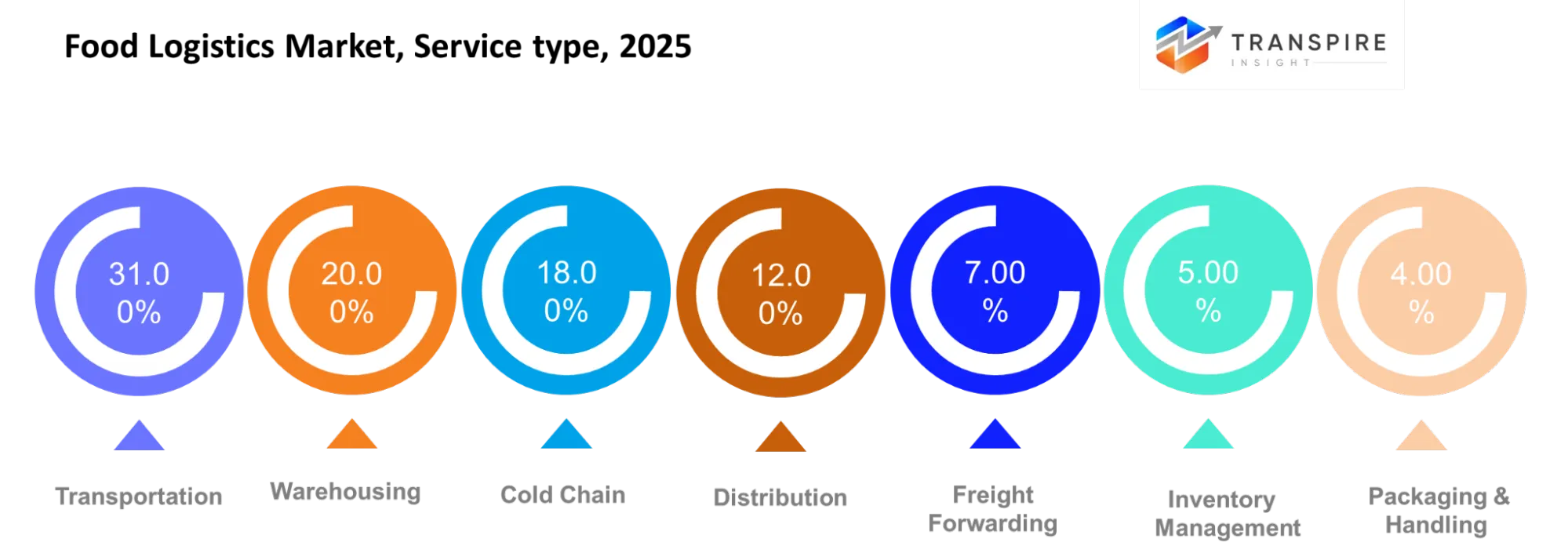
- The transportation sector represents 31.00% of the mix, whereby firms deploy more use of GPS technology, software-based fleet management, and digital route mapping.
- Warehousing takes up 20.00% of the mix, with efficiency and accuracy through automation and real-time inventory tracking.
- Distribution constitutes 12.00% of the mix, whereby retailers and food services demand quick turnaround times and shipment tracking.
- Freight forwarding makes up 7.00% of the mix, whereby there is digital shipment management and increased cross-border transport of food.
What are the Key Drivers, Restraints, and Opportunities in the Food Logistics Market?
Drivers
Growth is being driven by the development of food distribution using temperature-sensitive means, organised retailing, foodservice distribution, and cross-border trading. The main catalyst is the necessity of product protection through their short lifespan and delivery predictability. This leads to further investments in refrigerated transportations, cool storages, control measures, and logistics operations that become sources of extra income for those companies that are able to handle food products during several transportation operations. According to Maersk, real-time control and alerts based on artificial intelligence can help detect temperature problems before spoilage starts.
Restraints
The high cost of operation will continue to be a structural challenge. Cold storage facilities and cold storage vehicles need energy, specialised equipment, maintenance, trained personnel, and continuous monitoring. Small logistics companies may find it difficult to integrate their new information systems with legacy warehousing, fleet management, and inventory systems. In areas that lack good roads and reliable electricity, it is hard and costly to maintain an unbroken cold chain.
Opportunities
The opportunity is in upgrading the cold-chain infrastructure in developing economies. Building automated temperature-controlled warehouses, using IoT for monitoring purposes, developing reefer trains, and multimodal hubs will make it easy to export goods by reducing handling times. The investment in infrastructure seen recently in Asia, coupled with reefer services, shows how this can be achieved.
What Has the Impact of Artificial Intelligence Been on the Food Logistics Market?
AI transforms the management of food logistics from a reactive to a more predictive approach. Logistics companies can leverage the potential of AI combined with IoT and historical data on deliveries to predict demand, anticipate possible disruptions, determine optimal routes, and plan inventory. Sensor data can be analysed to detect abnormal temperatures or humidity levels, which will allow for raising alerts in advance in temperature-controlled logistics to prevent any negative effects on food quality. Predictive maintenance can also be done with the help of AI through analysing possible signs that refrigeration units might fail to work. Maersk mentions such potential uses of AI as demand forecasting, disruption detection, route planning, and refrigeration unit failure prediction. In the Middle East, the implementation of AI into logistics can lead to better fleet utilisation, higher productivity of warehouses, more reliable deliveries, and waste reduction. However, the process of AI integration into logistics does not take place without some problems. Companies have to deal with expenses associated with the integration, challenges connected with data quality, cybersecurity issues, and linking new AI technology with legacy logistics systems.
Instance
In February 2026, SATS launched an AI-controlled end-to-end Control Tower, via its subsidiary, Country Foods, in Singapore. This allows the company to keep track of supply chain disruptions in real time, such as port congestion, outbreaks of diseases, and shortages of refrigerated containers.https://www.sats.com.sg/media/latest-news/2026/sats-unveils-ai-enabled-control-tower-to-safeguard-singapore-s-f
Key Market Trends:
The market trend has moved from traditional logistics of goods movement towards integrated logistics that are connected, visible, and reactive. Adoption of technology has been increasingly geared towards avoiding any disruption.
- Logistics activities are changing from watching how things move to having real-time visibility. This is made possible by GPS, IoT sensors and cloud solutions.
- The development of the chain is growing. More money is being put into warehouses and transport. This is because there is attention to keeping products fresh and of good quality.
- Automation systems are becoming more useful for companies that have trouble finding workers and need to ship things quickly.
- Temperature monitoring is happening all the time. Sensors connected to the internet collect data about temperature at every step of storage and transport.
- Food e-commerce is driving logistics firms to manage deliveries, make deliveries within narrow windows of time, and manage temperature-controlled goods in the last mile.
- The customer often goes for logistics companies that can offer transportation, storage, inventory, and distribution in one integrated network.
Food Logistics Market Segmentation
By service type
Transportation constitutes 31.00% of market segmentation, followed by warehousing with 20.00%, cold chain with 18.00%, distribution with 12.00%, freight forwarding with 7.00%, inventory management with 5.00%, packaging and handling with 4.00%, and value-added services with 3.00%. The significance of transportation cannot be ignored because food products have to be constantly moved from producers to processors, from distribution centres to retailers and food service places.
By Mode of Transportation
Road transport holds the leading place at 46.30%, due to its flexibility in providing deliveries both locally and in last-mile delivery. Railways can deliver foodstuffs along inland routes. Air transport is appropriate for delivering goods that are valuable or easily perishable since they have to be delivered quickly. Shipping transport is still very vital in international food distribution due to its ability to carry large volumes of cargo; multimodal transport uses several modes of transport. Inland waterways and couriers cater for specialised transport needs.
By Food Type
Fresh fruits and vegetables, dairy products, meat and poultry, seafood, frozen foods, baked goods and confectioneries, beverages and processed foods need different logistical environments. Special care needs to be taken in handling and refrigerating fresh fruits and vegetables and seafood, as they have a tendency to deteriorate. An effective cold chain is needed for dairy products, meat, and frozen food, whereas beverages and processed food can be handled in flexible ways.
By Temperature
Ambient logistics is suitable for goods that can remain stable at normal temperatures, while chilled and frozen logistics are required for goods that require special conditions to remain stable. Deep-frozen logistics are more sophisticated concerning cooling and monitoring. Controlled atmosphere logistics is applicable only to certain fresh goods because the atmosphere can impact their shelf life. Temperature-sensitive and multi-temperature logistics are becoming increasingly widespread because logistics firms are dealing with mixed cargoes of food products.
By End User
Logistics services are provided for the food manufacturing industry, the retailing sector, supermarkets, restaurants, food services, online food companies and wholesalers in the food industry at different stages in the supply chain process. The manufacturing sector requires inbound and outbound logistics services, while supermarkets and retail require constant replenishment. Food service and restaurant sectors normally require deliveries within short time frames. Online food businesses are providing new prospects in fulfilment centres and last-mile deliveries.
By Technology
Logistics through the use of IoT, RFID, GPS, blockchain, warehouse automation, AI analytics, fleet management technology, and temperature monitoring technologies is changing logistics. IoT and temperature tracking enable shipment tracking, while GPS helps in tracking and planning routes for vehicles. RFID helps in effective inventory tracking, while warehouse automation enables efficient picking and storing. AI analytics helps in forecasting demand and disruptions for logistics providers.
What are the Key Use Cases Driving the Food Logistics Market?
Road transport is a key use case for food logistics. It refers to the transportation of food products from farms to processing facilities, to distribution centres, stores, restaurants, and warehouses located in other regions. The requirement is reliable transportation over short and medium distances. Cold chain logistics use cases involve fresh products, dairy products, meat and poultry, seafood, and frozen food products. Temperature monitoring, refrigeration, and transportation of the food products in refrigerated trucks contribute to reducing food losses and the quality of the food products during transportation. Some of the use cases currently being developed involve artificial intelligence for demand planning, automated warehousing, IoT for temperature notifications, multimodal reefer transportation, and inventory visibility.
|
Report Metrics |
Details |
|
Market size value in 2025 |
USD 139.63 Billion |
|
Market size value in 2026 |
USD 139.63 Billion |
|
Revenue forecast in 2033 |
USD 139.63 Billion |
|
Growth rate |
CAGR of 6.9% from 2026 to 2033 |
|
Base year |
2025 |
|
Historical data |
2021 - 2024 |
|
Forecast period |
2026 - 2033 |
|
Report coverage |
Revenue forecast, competitive landscape, growth factors, and trends |
|
Regional scope |
United States; Canada; Mexico; United Kingdom; Germany; France; Italy; Spain; Denmark; Sweden; Norway; China; Japan; India; Australia; South Korea; Thailand; Brazil; Argentina; South Africa; Saudi Arabia; United Arab Emirates |
|
Key company profiled |
DHL Supply Chain, UPS, FedEx, Maersk, Kuehne+Nagel, DB Schenker, DSV, Lineage Logistics, Americold, C.H. Robinson, GXO Logistics, XPO, CEVA Logistics, J.B. Hunt, Nippon Express |
|
Customization scope |
Free report customization (country, regional & segment scope). Avail customized purchase options to meet your exact research needs. |
|
Report Segmentation |
Service Type (Transportation, Warehousing, Cold Chain, Distribution, Freight Forwarding, Inventory Management, Packaging & Handling, Value-Added Services); Mode of Transportation (Road, Rail, Air, Sea, Multimodal, Inland Waterway, Courier); Food Type (Fresh Produce, Dairy, Meat & Poultry, Seafood, Frozen Food, Bakery & Confectionery, Beverages, Processed Food); Temperature (Ambient, Chilled, Frozen, Deep Frozen, Controlled Atmosphere, Temperature-Sensitive, Multi-Temperature); End User (Food Manufacturers, Retailers, Supermarkets, Restaurants, Foodservice Providers, E-Commerce, Wholesalers); Technology (IoT Tracking, RFID, GPS, Blockchain, Warehouse Automation, AI Analytics, Fleet Management, Temperature Monitoring) |
Which Regions are Driving the Food Logistics Market Growth?
North America
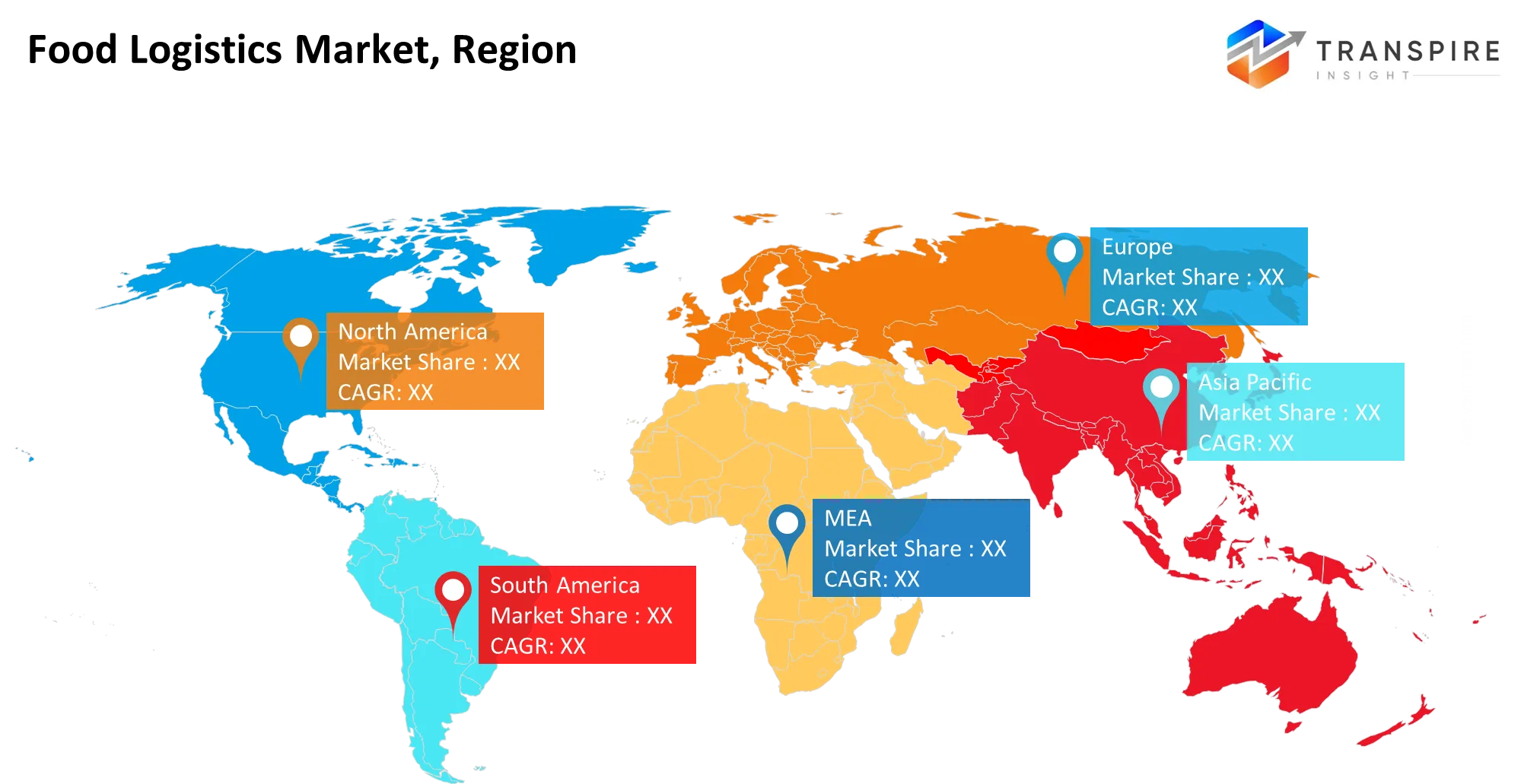
North America is the leading region in the market of food logistics, with its share accounting for 34.60%. Such dominance is accounted for by the well-developed system of transportation, the presence of large food retailers, and the development of temperature control infrastructure. This region is characterised by the presence of a large number of refrigerated warehouses, distribution centres, highway systems, and advanced logistics companies utilising technology solutions. Stringent food safety requirements and the need for constant availability of the products drive investment in visibility and temperature control systems. Recent infrastructure investments such as those implemented at Americold
In June 2026, Americold established a cold chain facility in Port Saint John, Canada, in collaboration with DP World and Canadian Pacific Kansas City (CPKC). The facility integrates cold storage, seaport logistics, and rail connectivity to facilitate the transport of temperature-sensitive food products from inland producing regions to international markets.https://ir.americold.com/press-releases/news-details/2026/Americold-Opens-Integrated-Cold-Chain-Facility-at-Port-Saint-John-One-of-North-Americas-Fastest-Growing-Trade-Gateways/default.aspx
Europe
Europe constitute 29.00% of the food logistics market due to the developed network of cross-border trade and distribution infrastructure. Much importance to effective cross-border transportation, sustainability of logistics activities, and coordinated temperature control in the supply chain. Increasingly often, food producers and retailers apply specialised storage solutions and logistics agreements for the management of perishable food within several countries. DHL’s ongoing frozen food logistics agreement with iglo proves how storage and transportation services, along with emissions-reduction fleet solutions, are used together for steady food distribution.
In March 2026, DHL Supply Chain and iglo Deutschland renewed their logistics partnership for another five years. Under the new contract, DHL will manage the central frozen food warehouse of iglo in Reken, Germany, in addition to in-plant and transport logistics, and will use emission-reducing vehicle technology in its transportation operations.https://group.dhl.com/en/media-relations/press-releases/2026/dhl-supply-chain-and-iglo-extend-their-exclusive-logistics-partnership.html
Asia-Pacific
Asia-Pacific region holds 27.00% of the market share and is categorised as the fastest-growing region with a CAGR of 8.30%. The recent development in the organisation of food distribution, export, cold chain, and multimodal logistics is bringing about a change in the logistics demands of this region. The case of India can be cited here, as the country has seen the emergence of reefers for rail services that connect the food-producing areas to the ports without relying much on truck transportation.
In April 2025, Indian Railways indicated that the total movement of perishables like fruits and vegetables via Kisan Rail services amounted to tonnes so far. The program ensures faster transport of perishable food products by rail in India.https://www.pib.gov.in/Pressreleaseshare.aspx
Who are the Key Players in the Food Logistics Marketand how do they compete?
The competition among food logistics companies in the international market is largely determined by the range of the network, temperature control competence, visibility in the digital environment, and capability of integrating multiple services in logistics into a single contract.DHL Supply Chain follows an integrated contract logistics model by offering the combined logistics services of warehousing, transportation, automation, and temperature-controlled operations. Kansas City import/export centre is connected with CPKC, connecting refrigerated food flows with rail connectivity in the U.S. and Mexico. Maersk relies on integrated ocean, inland, air, storage, customs, and reefer services for its competitive advantage. The collaboration with Geofrut reveals its narrow focus on the complete logistics of fresh produce, while its expanded cold storage network allows geographic diversity.
Food Logistics Market companies
- DHL Supply Chain
- UPS
- FedEx
- Maersk
- Kuehne+Nage
- DB Schenker
- DSV
- Lineage Logistics
- Americold
- C.H. Robinson
- GXO Logistics
- XPO
- CEVA Logistics
- J.B. Hunt
- Nippon Express
Recent Development News
In September 2025, Maersk and Arla entered into a further cooperation agreement for logistics involving the creation of a dedicated cold storage facility in Denmark. The purpose of the facility will be to store temperature-sensitive dairy products under an initial ten-year agreement.https://www.maersk.com/de-de/news/articles/2025/09/30/arla-and-maersk-expand-partnership-with-new-coldstore-facility-in-denmark
In February 2026, DHL Supply Chain has agreed on a Memorandum of Understanding with RLCold, which will involve the construction of square feet of advanced temperature-controlled facilities in North America. The initiative will increase the capacity of cold storage facilities for food and beverages.https://www.dhl.com/ca-en/home/press/press-archive/2026/dhl-supply-chain-signs-mou-with-rlcold-to-accelerate-next-generation-food-and-beverage-cold-chain-infrastructure.html
What Strategic Insights Define the Future of the Food Logistics Market?
The future of the world market of logistics for the food industry will revolve around connected systems and not stand-alone solutions. The operators will have to connect their solutions based on road, rail, water, warehousing, cold chain tracking, automation, and analysis so as to provide food transportation without handoffs and enhanced visibility. It is obvious that the aspects of physical transport and temperature control will remain critical. One of the risks that may lie in wait for players in the market is the cost associated with the operation of digital and cooling systems: energy costs, technical malfunctions, cybersecurity threats, and system integration risks may diminish the effect of technology investment. One of the opportunities for logistics players is the creation of modern cold chain hubs in the Asia Pacific region and other developing countries, where reefer rail and multimodal routes are developing.
Service Type
- Transportation
- Warehousing
- Cold Chain
- Distribution
- Freight Forwarding
- Inventory Management
- Packaging & Handling
- Value-Added Services
Mode of Transportation
- Road
- Rail
- Air
- Sea
- Multimodal
- Inland Waterway
- Courier
Food Type
- Fresh Produce
- Dairy
- Meat & Poultry
- Seafood
- Frozen Food
- Bakery & Confectionery
- Beverages
- Processed Food
Temperature
- Ambient
- Chilled
- Frozen
- Deep Frozen
- Controlled Atmosphere
- Temperature-Sensitive
- Multi-Temperature
End User
- Food Manufacturers
- Retailers
- Supermarkets
- Restaurants
- Foodservice Providers
- E-Commerce
- Wholesalers
Technology
- IoT Tracking
- RFID
- GPS
- Blockchain
- Warehouse Automation
- AI Analytics
- Fleet Management
- Temperature Monitoring
By Regional Analysis
North America
- US
- Canada
- Mexico
Europe
- Germany
- UK
- France
- Italy
- Spain
- Russia
- Rest of Europe
Asia Pacific
- China
- Japan
- India
- South Korea
- Australia
- Rest of Asia Pacific
South America
- Brazil
- Argentina
- Rest of South America
Middle East & Africa
- UAE
- Saudi Arabia
- Qatar
- South Africa
- Rest of the Middle East & Africa
Frequently Asked Questions
Find quick answers to common questions.
The food logistics market size was valued at USD 139.63 billion in 2025 and is poised to reach USD 139.63 billion by 2033, expanding at a 6.9% CAGR
Key segments for the food logistics market are Service Type (Transportation, Warehousing, Cold Chain, Distribution, Freight Forwarding, Inventory Management, Packaging & Handling, Value-Added Services); Mode of Transportation (Road, Rail, Air, Sea, Multimodal, Inland Waterway, Courier); Food Type (Fresh Produce, Dairy, Meat & Poultry, Seafood, Frozen Food, Bakery & Confectionery, Beverages, Processed Food); Temperature (Ambient, Chilled, Frozen, Deep Frozen, Controlled Atmosphere, Temperature-Sensitive, Multi-Temperature); End User (Food Manufacturers, Retailers, Supermarkets, Restaurants, Foodservice Providers, E-Commerce, Wholesalers); Technology (IoT Tracking, RFID, GPS, Blockchain, Warehouse Automation, AI Analytics, Fleet Management, Temperature Monitoring)
Growth is primarily driven by increasing consumer demand for fresh and frozen foods, growth in e-commerce and delivery of groceries online, isation of food markets, construction of cold chain facilities, and increased use of advanced logistics systems
The market is led by major manufacturers including DHL Supply Chain, UPS, FedEx, Maersk, Kuehne+Nagel, DB Schenker, DSV, Lineage Logistics, Americold, C.H. Robinson, GXO Logistics, XPO, CEVA Logistics, J.B. Hunt, Nippon Express
The North American region dominates the world food logistics market with a 34.60% share due to the presence of a sophisticated cold chain logistics setup, effective transportation systems, and strong food distribution demands
Opportunities in the international food logistics market are the development of cold chain facilities, real-time tracking and IoT technologies, the development of food delivery via the Internet, temperature controlled transportations and increase in cross-border food trade
- DHL Supply Chain
- UPS
- FedEx
- Maersk
- Kuehne+Nage
- DB Schenker
- DSV
- Lineage Logistics
- Americold
- C.H. Robinson
- GXO Logistics
- XPO
- CEVA Logistics
- J.B. Hunt
- Nippon Express
About the Authors

Mayur Shinde
I am Mayur Shinde, a Senior Research Analyst at Transpire Insight, specializing in the Automotive & Transportation and Information & Communication Technology (ICT) Industry. My work focuses on analyzing emerging market trends, technological advancements, competitive landscapes, and industry developments to deliver accurate, data-driven insights. I am passionate about transforming complex market information into clear, actionable content that helps businesses, professionals, and decision-makers stay informed and make confident strategic decisions.

Chakradhar Khansole
Chakradhar serves as the Research Director at Transpire Insight, bringing over 8 years of experience in technology, innovation, and strategic market intelligence. He specializes in transforming complex market data into actionable business insights that enable organizations to make informed, growth-oriented decisions. Recognized for his strategic vision and analytical expertise, Chakradhar leads high-impact research initiatives, delivering comprehensive market assessments, competitive intelligence, and forward-looking industry analysis.
Recently Published Reports
-
Apr 2026
ATV & UTV Market
ATV & UTV Market Size, Share & Analysis Report By Type (ATV, and UTV), By Variants (Less Than 400 CC, 400 CC To 800 CC, and More Than 800 CC), and Geography (North America, Europe, Asia-Pacific, Middle East and Africa, South and Central America), 2021 - 2031
-
Apr 2026
Automotive Central Gateway Module Market
Automotive Central Gateway Module Market Size, Share & Analysis Report By Type (Ethernet Central Gateway Module, CAN Central Gateway Module, LIN Central Gateway Module, and FlexRay), By Application (Powertrain Control, Body Control, Infotainment System, Advanced Driver Assistance Systems (ADAS), and Others), By End User (Passenger Vehicles, and Commercial Vehicles), and Geography (North America, Europe, Asia-Pacific, Middle East and Africa, South and Central America), 2021 - 2031
-
Apr 2026
Automotive Engine Oil Filter Market
Automotive Engine Oil Filter Market Size, Share & Analysis Report By Filter Type (Fuel Filter, Engine Oil Filter, Hydraulic Oil Filter, and Others), By Filter Media (Cellulose, Synthetic, and Micro), By Sales Channel (OEMs, and Aftermarket), By Vehicle Type (Passenger Cars, Light Commercial Vehicles, Heavy Duty Trucks, Buses and Coaches, and Off-road Vehicles), and Geography (North America, Europe, Asia-Pacific, Middle East and Africa, South and Central America), 2021 - 2031
-
Apr 2026
Automotive Parts Aluminium Die Casting Market
Automotive Parts Aluminium Die Casting Market Size, Share & Analysis Report By Production Process (Pressure Die Casting, Vacuum Die Casting, Squeeze Die Casting, Gravity Die Casting), By Application (Body Parts, Engine Parts, Transmission Parts, Battery And Related Components, Other Application Types), and Geography (North America, Europe, Asia-Pacific, Middle East and Africa, South and Central America), 2021 - 2031
Our Clients