
Meta Description:
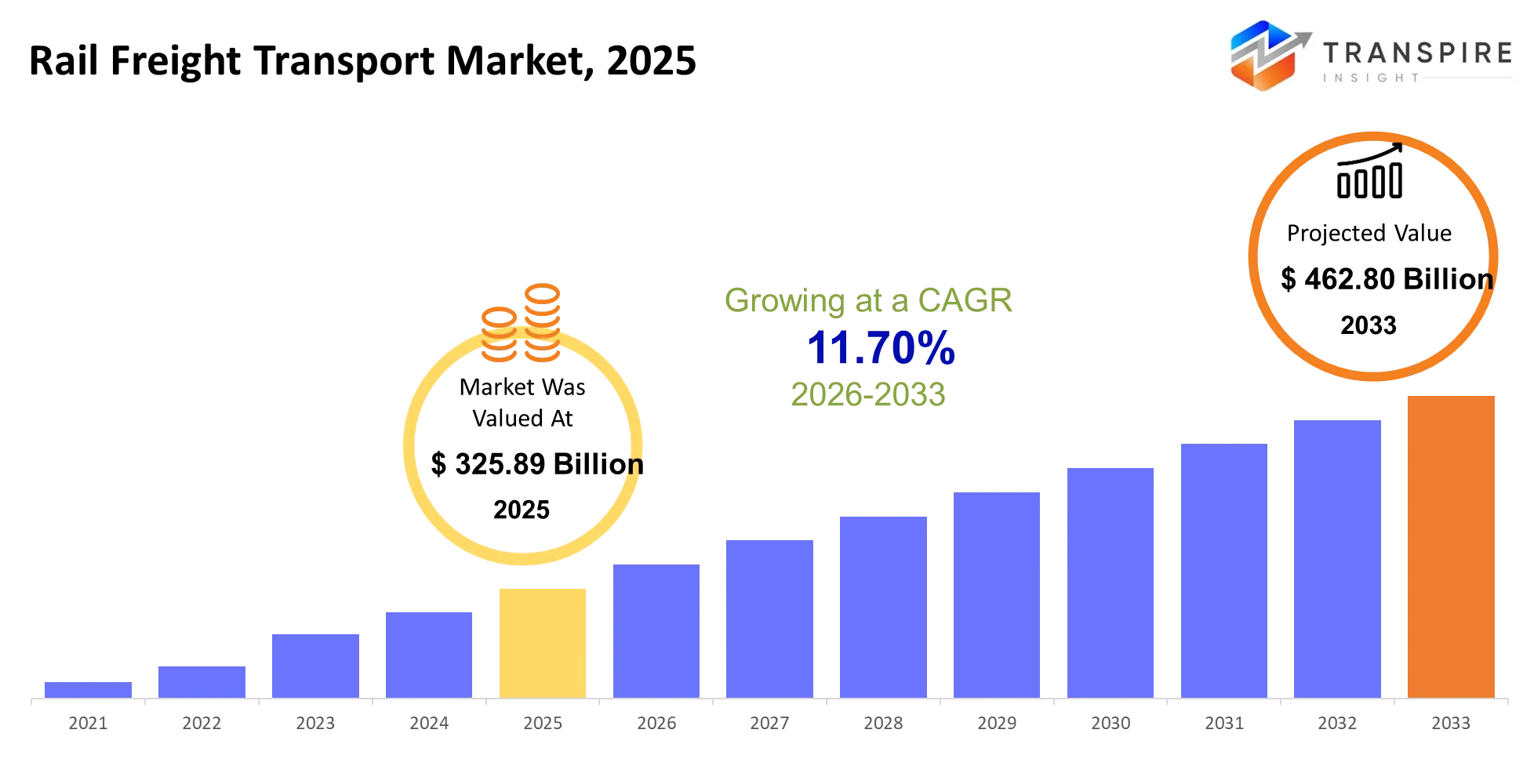
According to Transpire Insights analysis, the Rail Freight Transport Market Size is expected to expand significantly between 2026 and 2033, with a compound annual growth rate (CAGR) of 11.70% from USD 325.89 Billion in 2025 to USD 462.80 Billion by 2033.
Rail Freight Transport Market Summary:
According to Transpire Insights, a detailed research report on the market reflects that the dry bulk cargo segment dominates the Global Rail Freight Transport Market, accounting for approximately 41.75% of the total share worldwide. China Railway leads the market with an estimated 22.2% global market share, making it the leading contributor to global market development, rail freight transportation, network expansion, infrastructure modernization, advanced freight logistics, operational efficiency, and growth dynamics.
Market Snapshot
- Market Value (2025): USD 325.89 Billion.
- Expected Market Value (2026): USD 340.50 Billion.
- Estimated Market Value (2033): USD 462.80 Billion.
- Forecast CAGR (2026–2033): 4.48%
- Leading Region in 2025: Asia Pacific
- Second-largest Region: North America
- Fastest Growing Region: Europe
Introduction
Rail Freight Transport Market refers to the business organization involved in freight transport via railway systems both locally and internationally. The market consists of locomotives, freight cars, railroad infrastructure, terminals, intermodal centers, and logistics that aid in effective freight transportation. Major freight categories include coal, ores, agricultural products, minerals, chemicals, automotive freight, consumer goods, and containers. Intermodal rail freight links railway systems with road and other means of transport. This way, a chain of movement is coordinated without touching the freight while transferring from one mode of transport to another. Rail freight has several benefits due to its large volume capacity, economical long-distance transport, reliability, fuel efficiency, and lower emission than road freight.
For instance:-
North America: Demand for rail freight transportation, intermodal transport, and nearshoring is increasing in Mexico-U.S.-Canada corridors for automotive, consumer goods, and containerized freight shipments.
Europe: Investments in rail freight will be driven by the modernization of TEN-T projects, the use of ERTMS, the development of digital freight rail solutions, and sustainability considerations.
Key Market Highlights: -
- Asia Pacific is expected to grow at a rapid CAGR in the Rail Freight Transport Market by holding around43.1% of the share during the forecast period.
- North America is anticipated to hold roughly36.5% share of the Rail Freight Transport Market over the predicted timeframe.
- Europe is anticipated to hold nearly 77%share of the Rail Freight Transport Market over the predicted timeframe.
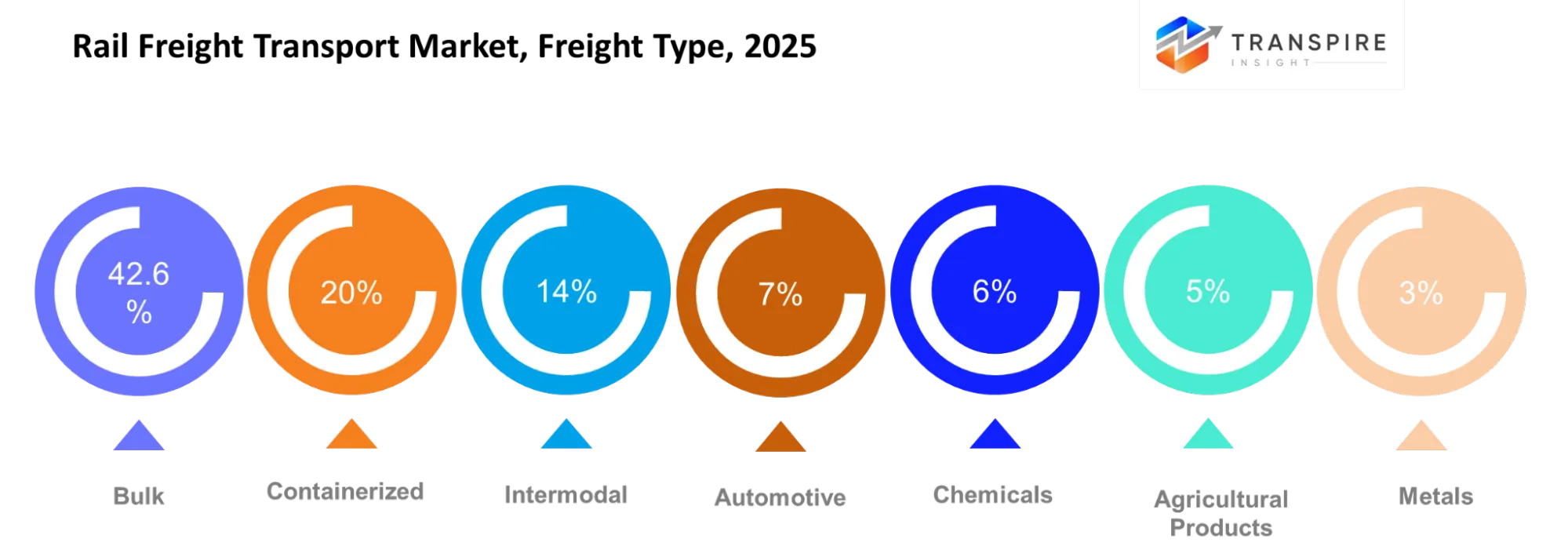
4. By Freight Type, the Bulk dominated the market and holds nearly 56% share in 2025 and is projected to grow at a substantial CAGR during the forecast period.
- By Service, the Full Trainload segments dominated the market and holds close to 52.4% share in 2025 and is projected to grow at a substantial CAGR during the forecast period.
- By Wagon Type, the Hopper Cars dominated the market and holds about 50% share in 2025 and is projected to grow at a substantial CAGR during the forecast period.
- The Rail Freight Transport Market of India is experiencing fast modernization through Dedicated Freight Corridors, Gati Shakti Cargo Terminals, private wagons, digital logistics platforms, and multimodal infrastructure.
How is Technology Driving Growth in the Rail Freight Transport Market?
Technology is driving innovation in the Rail Freight Transport Market through improved efficiency, utilization, safety, visibility of the freight being transported, and capacity in the network. Telematics and GPS technology in IoT help in tracking wagon movements in real time and enable predictive maintenance through early identification of potential problems with the equipment. The use of artificial intelligence and automation leads to better scheduling of trains, yard management, routing, and asset management; while the use of automation in freight transport helps in controlled operation of freight transport. Digital freight platforms enhance information sharing between rail carriers, shippers, ports, and logistics providers.
|
Report Metrics |
Details |
|
Market size value in 2025 |
USD 325.89 Billion |
|
Market size value in 2026 |
USD 340.50 Billion |
|
Revenue forecast in 2033 |
USD 462.80 Billion |
|
Growth rate |
CAGR of 11.70%from 2026 to 2033 |
|
Base year |
2025 |
|
Historical data |
2021 - 2024 |
|
Forecast period |
2026 - 2033 |
|
Report coverage |
Revenue forecast, competitive landscape, growth factors, and trends |
|
Regional scope |
United States; Canada; Mexico; United Kingdom; Germany; France; Italy; Spain; Denmark; Sweden; Norway; China; Japan; India; Australia; South Korea; Thailand; Brazil; Argentina; South Africa; Saudi Arabia; United Arab Emirates |
|
Key company profiled |
Union Pacific, BNSF Railway, CSX, Norfolk Southern, Canadian National Railway, Canadian Pacific Kansas City, Deutsche Bahn, SNCF, DB Cargo, Russian Railways, China Railway, Indian Railways, Aurizon, Genesee & Wyoming, VTG |
|
Customization scope |
Free report customization (country, regional & segment scope). Avail customized purchase options to meet your exact research needs. |
|
Report Segmentation |
By Freight Type (Bulk, Containerized, Intermodal, Automotive, Chemicals, Agricultural Products, Metals, Others); By Service (Full Trainload, Less-than-trainload, Intermodal, Multimodal, Dedicated Freight, Express Freight, Contract Freight, Others); By Wagon Type (Boxcars, Tank Cars, Flatcars, Hopper Cars, Refrigerated Cars, Gondolas, Specialized Cars, Others); By Cargo (Coal, Minerals, Grain, Oil & Gas, Chemicals, Manufactured Goods, Vehicles, Others); By Distance (Short-haul, Medium-haul, Long-haul, Cross-border, Domestic, International, Regional, Others); By End User (Mining, Hopper Cars, Agriculture, Energy, Automotive, Retail, Chemicals, Others); By Ownership (Private Railways, Government Railways, Third-party Logistics, Industrial Railways, Joint Ventures, Public-private, Leasing, Others) |
Market Drivers
The Rail Freight Transport Market is getting propelled by factors like infrastructure development, government logistics policies, cargo diversification, multimodal integration, and decarbonization goals. The DFCs are enhancing the capacity, efficiency, and performance of freight transport, whereas government policies like National Logistics Policy and PM Gatishakti are facilitating multimodal integration and participation of private companies. The rising demand for containerized freight from industries like manufacturing, retail, and ecommerce is expanding the scope of rail cargo beyond bulk cargo. The Multimodal Logistics Parks are facilitating better first and last mile connectivity through integration of rail, road, and port infrastructure.
For instance:-
Asia-Pacific: Industrial production growth, freight corridor development, intermodal links, and digital railway modernization will offer potential for high volumes of freight transport and logistics services.
India: Dedicated Freight Corridors, terminals upgrading, containerization, and multimodal logistics integration will increase rail freight capacities and improve connectivity between industrial locations, seaports, and consumption markets.
Restrain
In the case of Rail Freight Transport Market, there exist constraints such as lack of connectivity to both first and last mile, the cost of infrastructure and rolling stock investment, and stiff competition by flexible road freight transport services. Congestion on the network and the prioritization of passenger trains over freight trains limits the use of railways, just as the inadequacy of terminals and delays in handling the cargo affects the efficiency of the system. This may lead to increased time and logistics costs.
|
Driver |
Relative Impact on Growth (%) |
Geographic Relevance |
Impact Timeline |
Demand Strength |
Growth Mechanism |
Key Beneficiaries |
Major Constraint |
|
Driver 1: Rail Infrastructure Modernization and Capacity Expansion |
27% |
Europe, Asia-Pacific, North America |
Long-term |
High |
Expands capacity, reliability, terminals, and freight corridors |
Rail operators, infrastructure managers, logistics providers |
High capital requirements and lengthy project timelines |
|
Driver 2: Growth of Intermodal and Cross-Border Freight Transportation |
23% |
Europe, Asia-Pacific, North America |
Medium-term |
High |
Shifts freight volumes toward efficient multimodal rail networks |
Freight operators, logistics firms, ports, manufacturers |
Limited last-mile connectivity and terminal bottlenecks |
|
Driver 3: Digitalization, ERTMS, Automation and Smart Freight Technologies |
20% |
Europe, Asia-Pacific |
Medium-term |
High |
Improves capacity, tracking, scheduling, safety, and network utilization |
Technology vendors, rail operators, freight customers |
Interoperability complexity and high retrofit costs |
|
Driver 4: Decarbonization and Shift from Road to Rail |
17% |
Europe, Asia-Pacific, North America |
Long-term |
High |
Encourages lower-emission freight modal shifts and electrification |
Rail operators, manufacturers, sustainable logistics providers |
Competition from flexible road freight and infrastructure gaps |
|
Driver 5: Industrial and E-commerce Freight Demand |
13% |
Asia-Pacific, Europe, North America |
Short-term |
Medium |
Raises demand for bulk, containerized, automotive, and consumer-goods transport |
Manufacturers, retailers, 3PLs, rail freight operators |
Economic cycles and fluctuating freight volumes |
|
Total |
100% |
— |
— |
— |
— |
— |
— |
Analysis of Prices and Consumer Behaviour
The rail freight transport market is driven by the dry bulk cargo segment (41.75% share in the overall market share), owing to the constant demand for coal, minerals, agriculture commodities, and other bulky freight. The share of the transportation service segment is about 83.14% in the overall market revenue, owing to the significance of freight movement and logistics services. The intermodal freight holds around 47% of the overall rail freight traffic, thanks to the increasing use of containerized freight transport. The Asia-Pacific region is anticipated to grow at around 6.21% CAGR due to infrastructure development, industrialization, and cross-border freight corridors. North America constitutes an important freight market, owing to the rail transport network and intermodal operations in the region. Around 43.3% share of the wider rail logistics market is held by the top five players in the market.
|
Company |
Est. Revenue Share Range |
Key Offerings |
Strategic Positioning |
Geographic Strength |
Technology Focus |
|
China Railway |
20–24% |
Bulk freight, container freight, intermodal transport, international rail corridors |
Scale-driven integrated national freight network leadership |
Asia Pacific, Europe-linked corridors |
Digital freight platforms, intelligent logistics, electrified rail |
|
BNSF Railway |
4.5–6.5% |
Intermodal, consumer products, agricultural products, industrial freight |
Diversified North American freight network leadership |
North America |
Precision railroading, predictive maintenance, locomotive optimization |
|
Union Pacific |
4.5–6.5% |
Intermodal, agricultural, automotive, industrial, energy freight |
High-density corridor and intermodal network specialization |
North America |
Automated inspection, network optimization, predictive analytics |
|
Russian Railways (RZD) |
3.5–5.0% |
Bulk commodities, container freight, transit cargo, multimodal logistics |
Large-scale Eurasian corridor and commodity freight integration |
Europe, Asia Pacific |
Digital freight marketplace, electronic logistics, fleet monitoring |
|
Indian Railways |
3–5% |
Coal, containers, automobiles, minerals, agricultural freight |
High-volume domestic freight and corridor expansion strategy |
Asia Pacific |
Dedicated freight corridors, AI-enabled terminals, cargo tracking |
|
Canadian National Railway |
2–3.5% |
Intermodal, grain, petroleum, forest products, automotive freight |
Transcontinental network with diversified commodity exposure |
North America |
Precision scheduling, autonomous inspection, digital tracking |
|
Canadian Pacific Kansas City (CPKC) |
2–3.5% |
Intermodal, grain, automotive, coal, chemicals, cross-border freight |
Unique tri-national network and cross-border integration |
North America |
Precision railroading, digital dispatching, predictive maintenance |
|
CSX |
2–3.5% |
Intermodal, chemicals, agricultural, automotive, minerals freight |
Eastern U.S. network and intermodal efficiency specialization |
North America |
Automated inspection, train optimization, digital operations |
|
Norfolk Southern |
1.5–2.5% |
Intermodal, automotive, agriculture, chemicals, metals freight |
Eastern U.S. intermodal and industrial freight specialization |
North America |
Precision scheduled railroading, automation, predictive analytics |
|
DB Cargo |
1–2.5% |
Full-load freight, intermodal, automotive, bulk, cross-border logistics |
Europe-wide integrated freight and sustainability positioning |
Europe |
AI inspection, telematics, digital coupling, automated operation |
Who are the Key Players in the Rail Freight Transport Market and how do they compete?
In the case of the international market for Rail Freight Transport, competitiveness is determined by companies that innovate technology, have solutions aimed at the freight industry, as well as develop transportation and distribution networks on a global scale. Competitive not only on the price side, but on the basis of the existence of reliable railway infrastructure, innovative technology, intelligence and connected solutions, as well as integration with digital platforms and systems, this competitive strategy results not only in continuous service improvement but also allows organizations to become more productive and efficient.
Thanks to the development of innovative freight transportation services, intermodal solutions, digital rail technologies, and connected operations, Union Pacific creates a strong competitive advantage in the market. By developing fast, efficient rail freight services for intermodal, agricultural, automotive, industrial, and other freight applications, BNSF Railway differentiates itself from its competitors. CSX achieves differentiation through the development of integrated solutions in the area of rail freight transportation, intermodal logistics, automation, and digital freight management.
Top Companies in the Rail Freight Transport Market
- Union Pacific
- BNSF Railway
- CSX
- Norfolk Southern
- Canadian National Railway
- Canadian Pacific Kansas City
- Deutsche Bahn
- SNCF
- DB Cargo
- Russian Railways
- China Railway
- Indian Railways
- Aurizon
- Genesee & Wyoming
- VTG
|
Company |
Est. Revenue Share Range |
Key Offerings |
Strategic Positioning |
Geographic Strength |
Technology Focus |
|
China Railway |
20–24% |
Bulk freight, container freight, intermodal transport, international rail corridors |
Scale-driven integrated national freight network leadership |
Asia Pacific, Europe-linked corridors |
Digital freight platforms, intelligent logistics, electrified rail |
|
BNSF Railway |
4.5–6.5% |
Intermodal, consumer products, agricultural products, industrial freight |
Diversified North American freight network leadership |
North America |
Precision railroading, predictive maintenance, locomotive optimization |
|
Union Pacific |
4.5–6.5% |
Intermodal, agricultural, automotive, industrial, energy freight |
High-density corridor and intermodal network specialization |
North America |
Automated inspection, network optimization, predictive analytics |
|
Russian Railways (RZD) |
3.5–5.0% |
Bulk commodities, container freight, transit cargo, multimodal logistics |
Large-scale Eurasian corridor and commodity freight integration |
Europe, Asia Pacific |
Digital freight marketplace, electronic logistics, fleet monitoring |
|
Indian Railways |
3–5% |
Coal, containers, automobiles, minerals, agricultural freight |
High-volume domestic freight and corridor expansion strategy |
Asia Pacific |
Dedicated freight corridors, AI-enabled terminals, cargo tracking |
|
Canadian National Railway |
2–3.5% |
Intermodal, grain, petroleum, forest products, automotive freight |
Transcontinental network with diversified commodity exposure |
North America |
Precision scheduling, autonomous inspection, digital tracking |
|
Canadian Pacific Kansas City (CPKC) |
2–3.5% |
Intermodal, grain, automotive, coal, chemicals, cross-border freight |
Unique tri-national network and cross-border integration |
North America |
Precision railroading, digital dispatching, predictive maintenance |
|
CSX |
2–3.5% |
Intermodal, chemicals, agricultural, automotive, minerals freight |
Eastern U.S. network and intermodal efficiency specialization |
North America |
Automated inspection, train optimization, digital operations |
|
Norfolk Southern |
1.5–2.5% |
Intermodal, automotive, agriculture, chemicals, metals freight |
Eastern U.S. intermodal and industrial freight specialization |
North America |
Precision scheduled railroading, automation, predictive analytics |
|
DB Cargo |
1–2.5% |
Full-load freight, intermodal, automotive, bulk, cross-border logistics |
Europe-wide integrated freight and sustainability positioning |
Europe |
AI inspection, telematics, digital coupling, automated operation |
Airport Quick Service Restaurant (QSR) Market Segmentation
The Rail Freight Transport Market share is divided into seven categories: By Freight Type, By Service, By Wagon Type, By Cargo, By Distance, By End User, By Ownership
The Bulk dominated the market, accounting for nearly 56% in 2025 and is expected to rise at a significant CAGR during the forecast period.
The Rail Freight Transport Market is by freight type into bulk, containerized, intermodal, automotive, chemicals, agricultural products, metals, others. Among these, the Bulk dominated the market, accounting for nearly 56% in 2025 and expected to increase at a significant CAGR during the forecast period. Bulk freight is dominant due to high volume cargoes such as coal, minerals, agricultural goods, and industrial products, which need efficient transport over long distances.
The Full Trainload segments dominated the market, accounting for close to 52.4% in 2025, and is expected to rise at a significant CAGR during the forecast period
The Rail Freight Transport Market is segmented by service into full trainload, less-than-trainload, intermodal, multimodal, dedicated freight, express freight, contract freight, others. Among these, the Full Trainload segments dominated the market, accounting for close to 52.4% in 2025 and expected to increase at a significant CAGR during the forecast period. Full train load freight is dominant due to efficient high volume cargo movement, cost saving, predictable schedule, and high demands from bulk cargoes shippers.
The Hopper Cars dominated the market, accounting for about 50% in 2025 and is expected to rise at a significant CAGR during the forecast period.
The Rail Freight Transport Market by wagon type into boxcars, tank cars, flatcars, hopper cars, refrigerated cars, gondolas, specialized cars, others. Among these, the Hopper Cars dominated the market, accounting for about 50% in 2025 and expected to increase at a significant CAGR during the forecast period. Hopper cars are dominant due to efficient bulk handling, high loading capacity, quick discharge, and high demands from mining, agricultural, and energy industries.
Regional Segment Analysis of the Rail Freight Transport Market
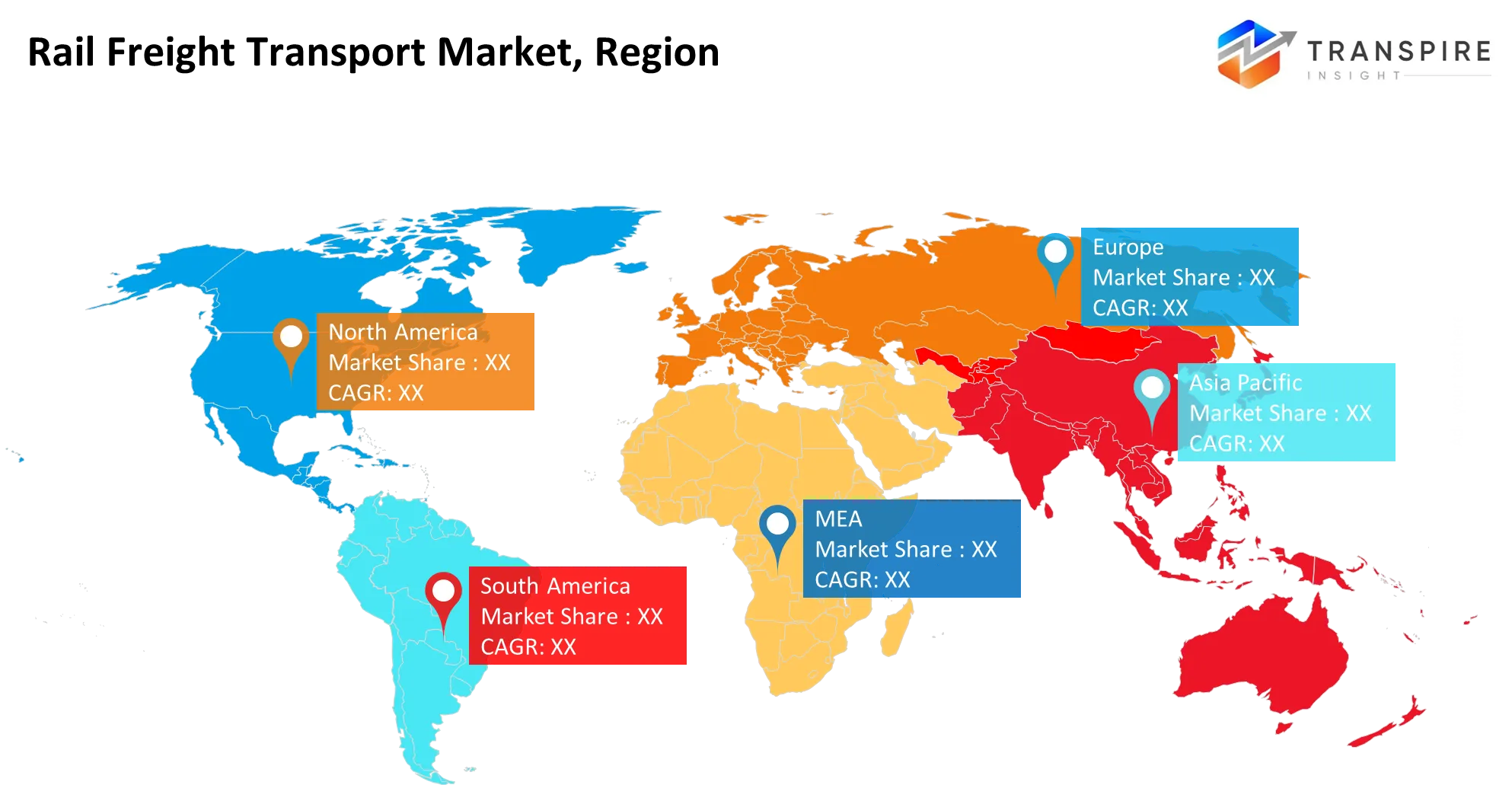
- Europe (Germany, France, U.K., Italy, Spain, Rest of Europe)
- North America (U.S., Canada, Mexico)
- Asia-Pacific (China, Japan, India, Rest of APAC)
- South America (Brazil and the Rest of South America)
- The Middle East and Africa (UAE, South Africa, Rest of MEA)
Asia Pacific is expected to grow at a rapid CAGR in the Rail Freight Transport Market, holding around 43.1% of the share during the forecast period.
The Asia Pacific region is forecasted to be dominant in the market for rail freight transport due to increased industrial production, large-scale commodity movement, international trading activities, and extensive railway infrastructure in China, India, Japan, and Australia. Investments made by governments in developing dedicated freight corridors, intermodal terminals, ports, and railway infrastructure will make rail freight transport more efficient. Increased containerized freight, mining activities, agriculture, and cross-border logistics are some factors boosting regional demands for rail freight transport.
North America is the high-growth region in the Rail Freight Transport Market during the period, holding roughly 36.5% share.
The North America region is a high-growth region in the Rail Freight Transport Market owing to the presence of an extensive rail freight network, intermodal transport, and cross-border trade in the US, Canada, and Mexico. The activities of nearshoring, auto production, agricultural freight, energy products, and containerization of freight are boosting demand for rail. Investment in rail infrastructural projects, digital freight, modern network, and logistics is enhancing the capacities of rail freight transport.
Europe is the fastest-growing region in the Rail Freight Transport Market during the period, holding nearly 77% share.
The Europe region is a high-growth region in the Rail Freight Transport Market owing to the presence of robust cross-border trade, extensive rail infrastructure, and focus on sustainable freight transportation. European Union investment in the development of TEN-T corridors, ERTMS, intermodal terminals, and digital rail technologies is enhancing the network capacity and interoperability. Increasing demand for low emission logistics, containerization of freight, and multimodal freight is adding value to the rail transport.
Strategies for Market Growth in Non-Leading Regions:
Developing non-core regions using efficient rail freight transport infrastructure will benefit small and medium logistics companies and cargo industries. The development of regional freight corridors, intermodal facilities and modern rail transport infrastructure will help reduce road dependency, improve connectivity and transport efficiency in general. Developing partnerships with regional manufacturers, logistics providers, ports, freight providers and distribution systems will provide better market access for rail freight services. For the increased usage of rail freight transportation, training and skills development will be necessary in railway transport, digital logistics, asset management and intermodal handling. Moreover, flexible financing and long-term freight contracts, as well as infrastructure public-private partnerships, will improve service access and foster increased usage of rail freight transport. Development of collaborative programs with government agencies, infrastructure agencies, industrial organizations, logistics organizations and digital freight platforms will increase access to rail freight services.
Future Market Trends for the Rail Freight Transport Market: -
Intermodal Freight Expansion: Increasing containerization, e-commerce, nearshoring, and multimodality are projected to bolster rail freight demand and increase integration within the global supply chain.
Decarbonization and Alternative Traction: Electrification, battery-electric, hydrogen, and alternative traction technologies are projected to increase as companies seek more efficient fuel options and greater sustainability goals.
Digital Rail and Automation: Internet-of-Things-enabled monitoring, predictive maintenance, AI logistics, automation of terminals, and digital freight platforms are projected to enhance asset management and efficiency.
Recent Development
In July 2026 – Freight Loading: Indian Railways achieved strong freight loading, which will help them increase their capacity and the need for efficient rail freight transport.
In August 13, 2026 – Gati Shakti Cargo Terminals: Indian Railways set up five new terminals to improve last mile connectivity and logistics of industrial freight in India.
In June 29, 2026 – Triple Stack Container Trials: Indian Railways conducted trial runs of triple stack container transport, contributing to greater freight capacity and logistics cost reduction.
In June 2026 – Market Development: Indian Railways, CONCOR, Adani Logistics, Gateway Rail Freight, and OM Logistics kept on improving India’s rail freight transport system.
Market Segment
This study forecasts revenue at global, regional and country levels from 2020 to 2033. Transpire Insights has segmented the Rail Freight Transport Market based on the below-mentioned segments:
Rail Freight Transport Market, By Freight Type
- Bulk
- Containerized
- Intermodal
- Automotive
- Chemicals
- Agricultural Products
- Metals
- Others
Rail Freight Transport Market, By Service
- Full Trainload
- Less-than-trainload
- Intermodal
- Multimodal
- Dedicated Freight
- Express Freight
- Contract Freight
- Others
Rail Freight Transport Market, By Wagon Type
- Boxcars
- Tank Cars
- Flatcars
- Hopper Cars
- Refrigerated Cars
- Gondolas
- Specialized Cars
- Others
Rail Freight Transport Market, By Cargo
- Coal
- Minerals
- Grain
- Oil & Gas
- Chemicals
- Manufactured Goods
- Vehicles
- Others
Rail Freight Transport Market, By Distance
- Short-haul
- Medium-haul
- Long-haul
- Cross-border
- Domestic
- International
- Regional
- Others
Rail Freight Transport Market, By End User
- Mining
- Hopper Cars
- Agriculture
- Energy
- Automotive
- Retail
- Chemicals
- Others
Rail Freight Transport Market, By Ownership
- Private Railways
- Government Railways
- Third-party Logistics
- Industrial Railways
- Joint Ventures
- Public-private
- Leasing
- Others
Rail Freight Transport Market, By Regional Analysis
North America
- US
- Canada
- Mexico
Europe
- Germany
- UK
- France
- Italy
- Spain
- Russia
- Rest of Europe
Asia Pacific
- China
- Japan
- India
- South Korea
- Australia
- Rest of Asia Pacific
South America
- Brazil
- Argentina
- Rest of South America
Middle East & Africa
- UAE
- Saudi Arabia
- Qatar
- South Africa
- Rest of the Middle East & Africa
Frequently Asked Questions
Find quick answers to common questions.
Infrastructure modernization, intermodal expansion, digitalization, cargo diversification, and decarbonization initiatives are strengthening rail freight demand worldwide.
Bulk freight leads due to sustained transportation requirements for coal, minerals, agricultural commodities, and other high-volume industrial materials.
IoT, AI, predictive maintenance, automation, telematics, and digital freight platforms are improving asset utilization, operational visibility, safety, and network efficiency.
Asia Pacific offers significant opportunities due to industrialization, extensive railway networks, freight corridor development, cross-border trade, and infrastructure investment.
Limited first-mile connectivity, high infrastructure costs, network congestion, terminal inefficiencies, and competition from flexible road freight constrain market expansion
- Union Pacific
- BNSF Railway
- CSX
- Norfolk Southern
- Canadian National Railway
- Canadian Pacific Kansas City
- Deutsche Bahn
- SNCF
- DB Cargo
- Russian Railways
- China Railway
- Indian Railways
- Aurizon
- Genesee & Wyoming
- VTG
About the Authors

Mayur Shinde
I am Mayur Shinde, a Senior Research Analyst at Transpire Insight, specializing in the Automotive & Transportation and Information & Communication Technology (ICT) Industry. My work focuses on analyzing emerging market trends, technological advancements, competitive landscapes, and industry developments to deliver accurate, data-driven insights. I am passionate about transforming complex market information into clear, actionable content that helps businesses, professionals, and decision-makers stay informed and make confident strategic decisions.

Chakradhar Khansole
Chakradhar serves as the Research Director at Transpire Insight, bringing over 8 years of experience in technology, innovation, and strategic market intelligence. He specializes in transforming complex market data into actionable business insights that enable organizations to make informed, growth-oriented decisions. Recognized for his strategic vision and analytical expertise, Chakradhar leads high-impact research initiatives, delivering comprehensive market assessments, competitive intelligence, and forward-looking industry analysis.
Recently Published Reports
-
Apr 2026
ATV & UTV Market
ATV & UTV Market Size, Share & Analysis Report By Type (ATV, and UTV), By Variants (Less Than 400 CC, 400 CC To 800 CC, and More Than 800 CC), and Geography (North America, Europe, Asia-Pacific, Middle East and Africa, South and Central America), 2021 - 2031
-
Apr 2026
Automotive Central Gateway Module Market
Automotive Central Gateway Module Market Size, Share & Analysis Report By Type (Ethernet Central Gateway Module, CAN Central Gateway Module, LIN Central Gateway Module, and FlexRay), By Application (Powertrain Control, Body Control, Infotainment System, Advanced Driver Assistance Systems (ADAS), and Others), By End User (Passenger Vehicles, and Commercial Vehicles), and Geography (North America, Europe, Asia-Pacific, Middle East and Africa, South and Central America), 2021 - 2031
-
Apr 2026
Automotive Engine Oil Filter Market
Automotive Engine Oil Filter Market Size, Share & Analysis Report By Filter Type (Fuel Filter, Engine Oil Filter, Hydraulic Oil Filter, and Others), By Filter Media (Cellulose, Synthetic, and Micro), By Sales Channel (OEMs, and Aftermarket), By Vehicle Type (Passenger Cars, Light Commercial Vehicles, Heavy Duty Trucks, Buses and Coaches, and Off-road Vehicles), and Geography (North America, Europe, Asia-Pacific, Middle East and Africa, South and Central America), 2021 - 2031
-
Apr 2026
Automotive Parts Aluminium Die Casting Market
Automotive Parts Aluminium Die Casting Market Size, Share & Analysis Report By Production Process (Pressure Die Casting, Vacuum Die Casting, Squeeze Die Casting, Gravity Die Casting), By Application (Body Parts, Engine Parts, Transmission Parts, Battery And Related Components, Other Application Types), and Geography (North America, Europe, Asia-Pacific, Middle East and Africa, South and Central America), 2021 - 2031
Our Clients



