

Sea Freight Transport Market Summary:
According to Transpire Insights, a detailed research report on the market reflects that the container shipping application segment dominates the Sea Freight Transport Market, accounting for approximately 58% of the total market share worldwide. Mediterranean Shipping Company (MSC) leads the market with approximately (around USD 44 billion) in estimated annual revenue and an estimated 21.5% global market share, making it the leading contributor to global sea freight market development, innovation, advanced container shipping solutions, expanding fleet capabilities, and growth dynamics.
Market Snapshot
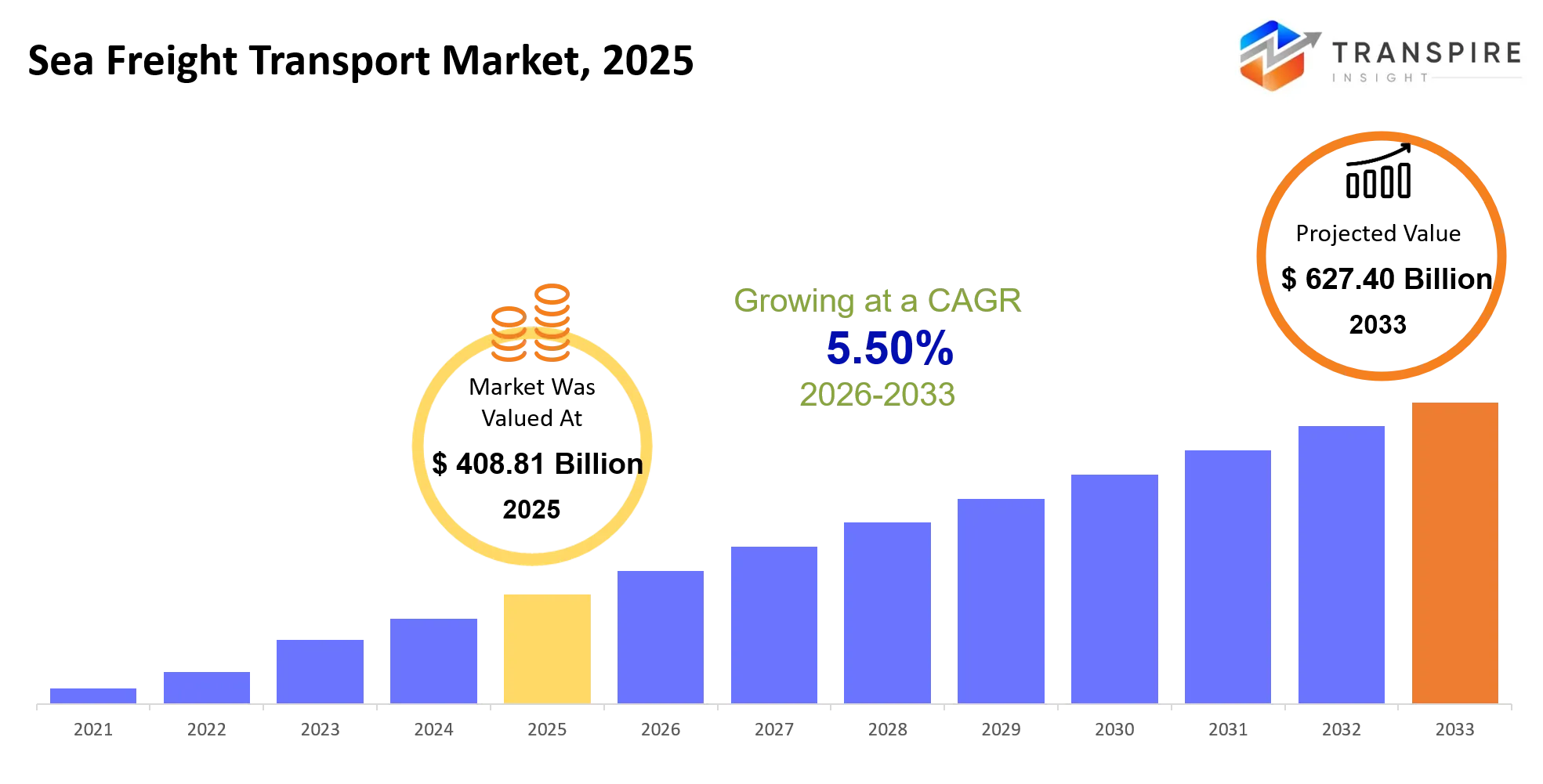
- Global Market Value (2025): USD 408.81 Billion.
- Expected Market Value (2026): USD 431.32 Billion.
- Estimated Market Value (2033): USD 627.40 Billion.
- Forecast CAGR (2026–2033): 5.50%
- Leading Region in 2025: North America
- Second-largest Region: Europe
- Fastest Growing Region: Asia Pacific
Introduction
The ocean shipping transportation business is the worldwide economic system of business activities and other transactions aimed at delivering goods and cargo by ships throughout the oceans and seas. It brings people together, such as sellers and buyers, shipowners and shipping exchanges within processes such as container shipping and goods transportation. Ocean Freight is transporting goods, including raw materials and ready products on commercial vessels in seas and oceans. It accounts for over 80% of all trade in terms of volume, being the most affordable solution for heavy, large or distant cargo. The Sea Freight Transport Market has a number of benefits for international trade and global supply chains. The cost-effectiveness of ocean transport makes it particularly affordable for transportation over long distances, bulk shipments, and high-volume deliveries. Given the enormous cargo capacity, modern container ships can carry thousands of TEUs at once. The advantage of having oversized and dangerous cargo makes it easy to transport machinery, vehicles, and other special types of goods. Environmentally-friendly nature of sea freight means lower carbon emissions while transporting goods, as compared to air freight. Global connectivity of sea freight transport through major ports along with full-container-load and less-than-container-load services enables companies to access their clients worldwide and be flexible and integrated in their logistics operations.
For instance:-The growth of the North American Sea Freight Forwarding Market has been attributed to e-commerce and Mexican nearshoring. There has been a rise in investments in port automation, Panama Canal improvements, and development of environmentally sustainable logistics.
Market Highlights: -
- Asia Pacific is anticipated to hold around 37% share of the Sea Freight Transport Market over the predicted timeframe.
- Europe is expected to grow at a rapid CAGR in the Sea Freight Transport Market by holding around24% of the share during the forecast period.
- North America is anticipated to hold around20% share of the Sea Freight Transport Market over the predicted timeframe.
- By service type, the Full Container Load segment dominated the market and holds nearly 60% share in 2025 and is projected to grow at a substantial CAGR during the forecast period.
- By cargo type, the Containerized Cargo segment dominated the market and holds nearly 65% share in 2025 and is projected to grow at a substantial CAGR during the forecast period.
- By end user, the Manufacturing segment dominated the market and holds nearly 30% share in 2025 and is projected to grow at a substantial CAGR during the forecast period.
- The Container Manufacturing Assistance Scheme (CMAS) is a scheme designed to promote domestic container manufacturing through government allocations of ₹10,000 crore over the 5 years duration. The scheme intends to promote new and extended manufacturing units and facilitate less dependence on empty container imports. It aims to enhance container availability and supply-chain capability while paving the way for impressive growth of India's marine transport and containerized logistics industries.
How is Technology Driving Growth in the Sea Freight Transport Market?
Advancements in technology are changing the Sea Freight Transport industry through using AI, IoT, blockchain, automation, and decarbonization. AI technology is used to improve the route by studying the weather conditions, currents, ship performance, and fuel consumption. IoT technology allows smart containers to monitor temperature, humidity, and condition of the cargo in real-time. Blockchain technology aids in ensuring paperless document processing as well as in cost-cutting at every stage in the supply chain. Last but not least, decarbonization and smart steaming technologies help ships run at optimal speed while decreasing fuel consumption, emissions, and complying with environmental regulations.
|
Report Metrics |
Details |
|
Market size value in 2025 |
USD 408.81 Billion |
|
Market size value in 2026 |
USD 431.32 Billion |
|
Revenue forecast in 2033 |
USD 627.40 Billion |
|
Growth rate |
CAGR of 5.50% from 2026 to 2033 |
|
Base year |
2025 |
|
Historical data |
2021 - 2024 |
|
Forecast period |
2026 - 2033 |
|
Report coverage |
Revenue forecast, competitive landscape, growth factors, and trends |
|
Regional scope |
United States; Canada; Mexico; United Kingdom; Germany; France; Italy; Spain; Denmark; Sweden; Norway; China; Japan; India; Australia; South Korea; Thailand; Brazil; Argentina; South Africa; Saudi Arabia; United Arab Emirates |
|
Key company profiled |
Maersk, MSC, CMA CGM, COSCO Shipping, Hapag-Lloyd, ONE, Evergreen Marine, Yang Ming, HMM, ZIM, PIL, Wan Hai Lines, Matson, Seaspan, Kuehne+Nagel |
|
Customization scope |
Free report customization (country, regional & segment scope). Avail customized purchase options to meet your exact research needs. |
|
Report Segmentation |
By Service Type (Full Container Load, Less-than-Container Load, Bulk Shipping, Breakbulk Shipping, Ro-Ro Shipping, Project Cargo, Reefer Shipping, Others); By Cargo Type (Containerized Cargo, Dry Bulk, Liquid Bulk, Breakbulk, Vehicles, Perishables, Chemicals, Others); By Vessel Type (Container Ships, Bulk Carriers, Tankers, Ro-Ro Ships, General Cargo Ships, Reefer Ships, LNG Carriers, Others); By Container Type (20-foot, 40-foot, High-cube, Refrigerated, Open-top, Flat-rack, Tank Container, Others); By Route (Intra-regional, Transpacific, Transatlantic, Asia-Europe, Europe-Asia, Middle East Routes, Africa Routes, Others); By End User (Manufacturing, Retail & E-commerce, Automotive, Food & Beverage, Chemicals, Energy, Pharmaceuticals, Others); By Service Provider (Shipping Lines, Freight Forwarders, NVOCCs, 3PLs, 4PLs, Port Operators, Logistics Integrators, Others) |
Market Drivers
The Sea Freight Transport market is spurred by the increasing global trade, rising import or export volumes as well as cost-effectiveness of maritime transportation for bulk and containerized goods. Fast increase in e-commerce and cross-border sales is boosting the requirement for container shipping and ocean freight forwarding services. Fleet modernization comprising delivery of bigger and more efficient vessels is enhancing effectiveness of operations and contributing to environmental compliance. Rising requirement for pharmaceutical goods, seafood as well as other temperature-sensitive goods is causing growth of transportation of refrigerator containers. Also, strategic management of cargo carriers via route optimizing, vessel alliances, capacity planning and slow steaming increases the efficiency of the network and contributes to long-term development of the world sea freight transport industry. Advantageous for international commerce and supply chain management, sea freight transport demonstrates its cost-effectiveness, making ocean freight considerably cheaper than air freight, particularly for big size and bulk commodity shipments. Due to gigantic carrying capacity, modern container ships can carry hundreds and thousands of containers, including heavy and oversized cargo. Also, sea freight is more environmentally friendly due to fewer carbon dioxide emissions measured in ton-kilometers in comparison with airfreight. The sea freight industry has achieved global connectivity with the help of sea routes linking major commercial ports around the globe.
For Instance: -
- The marine freight transportation sector in Russia is shifting its focus towards routes in the Asia-Pacific region and the Northern Sea Route due to the presence of sanctions. Port modernization, the introduction of local fleets, and the enhancement of intermodal connectivity are all significant investments in this field, guaranteeing sustainable development of the industry taking into account high security expenditures and operational risks in the region.
- The market for sea freight transportation in South Africa is slowly getting bigger, with the key ports being Durban and Cape Town. Investments are made in upgrading port infrastructure and improving terminals along with digitalizing processes to overcome past issues related to congestion.
Restrain
The Sea Freight Transport Market also has to deal with various challenges, such as problems with bottlenecks in ports that lead to delays and increased periods of the turnaround process. Stringent environmental regulations imposed by the IMO increase costs associated with meeting the regulations as well as the costs related to decarbonization measures adopted by companies. Global geopolitical issues may complicate voyages leading to longer shipping routes and bigger transit times. Changes in price for bunker fuel create uncertainty regarding operating costs.
|
Driver |
Relative Impact on Growth (%) |
Geographic Relevance |
Impact Timeline |
Demand Strength |
Growth Mechanism |
Key Beneficiaries |
Major Constraint |
|
1. Global Trade and Containerized Cargo Expansion |
30% |
Asia Pacific, North America, Europe |
Long-term |
High |
Expanding trade increases containerized maritime shipment volumes |
Shipping lines, ports, freight forwarders, manufacturers |
Trade slowdowns and tariff uncertainty |
|
2. E-Commerce and Supply-Chain Diversification |
22% |
Asia Pacific, North America, Europe |
Medium-term |
High |
Cross-border commerce increases frequent containerized shipments |
Shipping lines, 3PLs, retailers, logistics technology vendors |
Freight-rate volatility and capacity constraints |
|
3. Port Modernization and Maritime Digitalization |
18% |
Asia Pacific, Europe, North America |
Medium-term |
High |
Smart ports improve cargo handling, visibility, and efficiency |
Port operators, carriers, technology vendors, logistics providers |
High infrastructure investment requirements |
|
4. Fleet Modernization and Sustainable Shipping |
16% |
Europe, Asia Pacific, North America |
Long-term |
High |
Efficient vessels reduce operating costs and emissions |
Shipbuilders, carriers, fuel suppliers, technology vendors |
High vessel replacement and retrofit costs |
|
5. Resilient Routing and Multimodal Logistics Investment |
14% |
Middle East, Europe, Asia Pacific, Africa |
Short-term |
High |
Route diversification strengthens capacity and supply continuity |
Carriers, freight forwarders, ports, 3PLs |
Geopolitical disruptions and higher operating costs |
Analysis of Prices and Consumer Behaviour
Containerized cargo transportation dominates the sea freight transportation market (containerized sea freight transport accounts for 80% of the world’s merchandise trade transport due to the demand of the manufacturing, retail, consumer goods and international trade sectors). Shipments by premium and reliable sea freight providers cost much more than the standard freight service as the need for quick delivery, guarantee of estimated capacity, and the use of advanced technology cause freight charges to differ depending on ship availability, fuel prices, port congestion, disturbances during transportation and political situation. Thus, in 2024, about 920 million TEUs of containerized goods were handled in ports around the world, showing that sea container transportation is quite a huge industry. The shipping volume depends on container shipping's adaptability in the global shipping system and the improvement of production, intermediate, and consumer goods delivery. In Asia, less developed economies accounted for over 60 % of global container traffic by the end of 2024, thus proving their considerable significance in world sea transportation. Tankers consumer behavior shows that freight reliability, transport costs, schedule, and shipment visibility are considered to be the key factors in choosing sea freight suppliers. Long-term contracts and service agreements are also popular among big shippers who want to reserve transport capacity, control prices, and ensure the functionality of supply chains despite fluctuating freight market.
|
Investment Factor |
Why It Matters to Investors |
Opportunity |
Investment Implication |
|
Global Seaborne Trade Dependency |
Maritime transport remains essential to global merchandise supply chains |
Invest in scalable ocean logistics and cargo-handling infrastructure |
Long-term demand resilience, but cyclical freight rates remain a risk |
|
Port Modernization & Infrastructure |
Aging infrastructure creates capacity and efficiency investment requirements |
Automated terminals, smart ports, intermodal connectivity, and port logistics |
Medium-to-long-term infrastructure opportunity with capital-intensive execution |
|
Digitalization, AI & Automation |
Digital systems can improve visibility, operational efficiency, and port processes |
AI routing, predictive analytics, IoT containers, automated documentation |
Technology-enabled services can scale without matching fleet ownership |
|
Green Shipping & Alternative Fuels |
Decarbonization targets are driving fleet and infrastructure transformation |
Alternative-fuel vessels, bunkering infrastructure, energy-efficiency technologies |
Long-term transition opportunity with significant technology and regulatory risk |
|
Supply-Chain Resilience & Route Diversification |
Geopolitical disruptions are changing routes, capacity deployment, and logistics planning |
Multimodal logistics, alternative corridors, regional hubs, contingency services |
Creates demand for flexible logistics models and diversified networks |
|
Asia-Pacific & Emerging Trade Corridors |
Manufacturing and shifting production networks support expanding maritime connectivity |
Asia-Africa, Asia-Middle East, Latin America, and intra-Asian services |
Regional expansion can unlock new cargo flows and customer segments |
Who are the Key Players in the Sea Freight Transport Market and how do they compete?
The competitiveness in the global sea freight transport market relies on companies that engage in fleet expansion, innovations in digital logistics, cargo-specific solutions, and the establishment of international shipping networks. Competition takes place not only in terms of freight rates but also in terms of vessel capacity, port interconnectivity, digital shipment monitoring, schedule reliability, intermodal integration, and environmental technologies for shipping. Thus, this competitive strategy results in continuous service development and increased efficiency, visibility, reliability, and resilience of the companies involved in international supply chain processes.
In its attempt to strengthen its market position, A.P. Moller - Maersk incorporates integrated ocean shipping solutions, digital platforms of logistics, and services for end-to-end cargo visibility. Mediterranean Shipping Company (MSC) operates using one of the biggest fleets in the world and maintains extensive international shipping networks, which enables the company to be differentiated through high vessel capacity, wide trade lane coverage, and port connectivity. CMA CGM improves its position by offering integrated shipping and logistics solutions backed up by advanced digital freight management and a vast transportation network.
Top Companies in the Sea Freight Transport Market
- Maersk
- MSC
- CMA CGM
- COSCO Shipping
- Hapag-Lloyd
- ONE
- Evergreen Marine
- Yang Ming
- HMM
- ZIM
- PIL
- Wan Hai Lines
- Matson
- Seaspan
- Kuehne+Nagel
|
Company |
Est. Revenue Share Range |
Key Offerings |
Strategic Positioning |
Geographic Strength |
Technology Focus |
|
MSC |
9–12% |
Container shipping, FCL/LCL, reefer cargo, logistics services |
Scale leadership through global fleet expansion |
Europe, Asia Pacific, North America |
Digital tracking, fleet optimization, smart containers |
|
Maersk |
7–10% |
Ocean transport, FCL/LCL, terminals, integrated logistics |
End-to-end integrated logistics ecosystem |
Europe, Asia Pacific, North America |
AI logistics, IoT visibility, digital booking |
|
CMA CGM |
7–10% |
Container shipping, reefer services, terminals, logistics |
Integrated shipping and logistics diversification |
Europe, Asia Pacific, North America |
Digital freight platforms, smart containers, automation |
|
COSCO Shipping |
6–8% |
Container shipping, terminals, multimodal logistics, supply-chain services |
Network scale with strong Asia-Europe connectivity |
Asia Pacific, Europe, North America |
Digital supply chains, automated terminals, IoT |
|
Hapag-Lloyd |
4–6% |
Container shipping, reefer logistics, terminals, inland services |
Reliability-led network and terminal integration |
Europe, Latin America, North America |
AI network optimization, digital tracking, automation |
|
ONE |
3–5% |
Container shipping, reefer cargo, project cargo, logistics |
Alliance-based global network expansion |
Asia Pacific, North America, Europe |
Digital cargo visibility, booking platforms, analytics |
|
Evergreen Marine |
3–5% |
Container shipping, reefer services, logistics, terminals |
Fleet scale and Asia-centric trade connectivity |
Asia Pacific, Europe, North America |
Fleet efficiency, digital logistics, operational optimization |
|
HMM |
2–3% |
Container shipping, bulk transport, terminals, logistics |
Fleet modernization and diversified maritime services |
Asia Pacific, Europe, North America |
Smart shipping, fuel efficiency, digital platforms |
|
Yang Ming |
1–2% |
Container shipping, reefer cargo, logistics, terminal services |
Regional network strength with global partnerships |
Asia Pacific, North America, Europe |
Digital shipment tracking, fleet optimization, automation |
|
ZIM |
1–2% |
Container shipping, reefer cargo, automotive logistics, digital services |
Asset-light specialization and service flexibility |
North America, Mediterranean, Asia |
AI-enabled logistics, digital customer platforms, visibility |
Market Segmentation
The Sea Freight Transport Market share is divided into seven categories: By service type, cargo, vessel, container, route, end user and service provider.
The Full Container Load dominated the market, accounting for nearly 60% in 2025 and is expected to rise at a significant CAGR during the forecast period.
The Sea Freight Transport Market is segmented by service type into Full Container Load, Less-than-Container Load, Bulk Shipping, Breakbulk Shipping, Ro-Ro Shipping, Project Cargo, Reefer Shipping, Others. Among these, the Full Container Load segment dominated the market, accounting for nearly 60% in 2025 and expected to increase at a significant CAGR during the forecast period. The Sea Freight Transport Market was dominated by the Full Container Load (FCL) segment, which had a market share of around 60% by 2025. This can be attributed to its economic efficiency, faster handling of goods, better safety, and suitability for shipping large quantities. The rise of international trade, the increase in e-commerce, and the rapid growth of demand for direct containerized transportation service are contributing to the growth of FCL. This segment is expected to grow during the forecast period as companies strive for more reliable and effective means of ocean freight transportation.
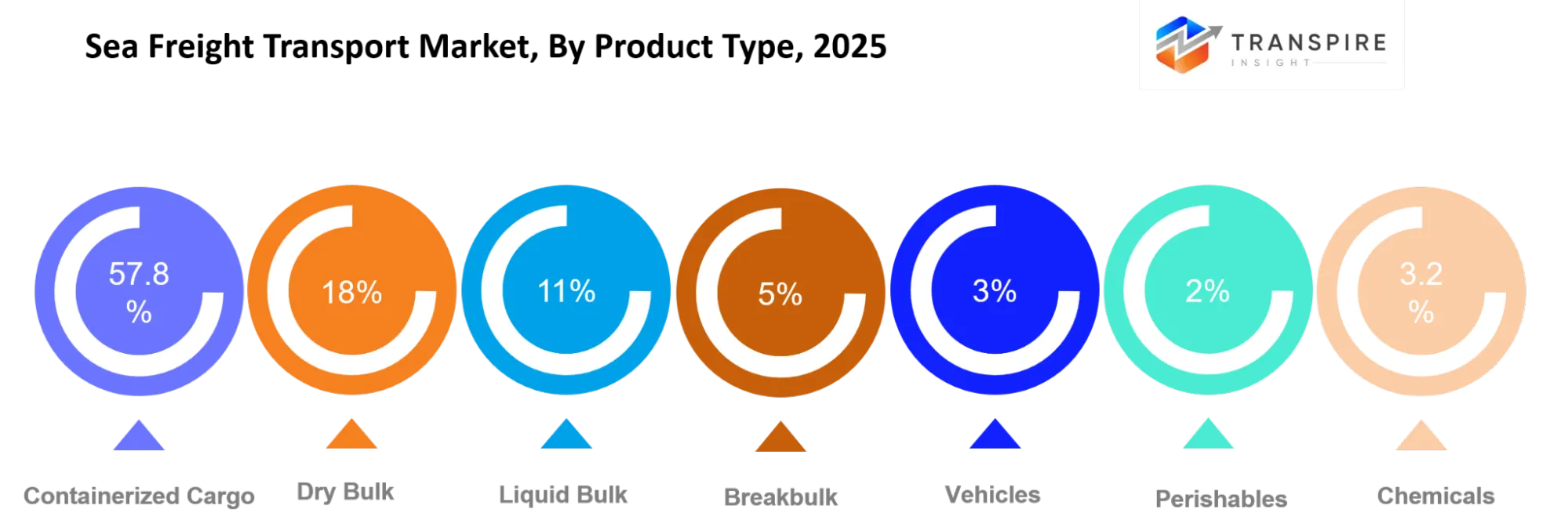
The Containerized Cargo dominated the market, accounting for nearly 65% in 2025, and is expected to rise at a significant CAGR during the forecast period.
The Sea Freight Transport Market is segmented by cargo type into Containerized Cargo, Dry Bulk, Liquid Bulk, Breakbulk, Vehicles, Perishables, Chemicals, Others. Among these, the Containerized Cargo segment dominated the market, accounting for nearly 65% in 2025 and expected to increase at a significant CAGR during the forecast period. The segment of Containerized Cargo was the largest segment in the Sea Freight Transport Market with around 65% share in 2025, thanks to standardized handling processes as well as efficient loading and unloading activities along with more security and suitability for various goods. This growing trend of container shipping is supported by the rise in overall international trade and e-commerce, manufacturing activities, as well as intermodal systems.
The Manufacturing dominated the market, accounting for nearly 30% in 2025 and is expected to rise at a significant CAGR during the forecast period.
The Sea Freight Transport Market is segmented by end user into Manufacturing, Retail & E-commerce, Automotive, Food & Beverage, Chemicals, Energy, Pharmaceuticals, Others. Among these, the Manufacturing segment dominated the market, accounting for nearly 30% in 2025 and expected to increase at a significant CAGR during the forecast period. The manufacturing sector held the largest share of the Sea Freight Transport Market in 2025, contributing almost 30% of the overall market share due to significant international shipments of raw materials, equipment, machines, and manufactured goods. With globalization, cross-border sourcing, increased industrial production, and the need for cost-effective mass transportation, the manufacturers have increasingly depended on sea freight services globally.
Regional Segment Analysis of the Sea Freight Transport Market:
- North America (U.S., Canada, Mexico)
- Europe (Germany, France, U.K., Italy, Spain, Rest of Europe)
- Asia-Pacific (China, Japan, India, Rest of APAC)
- South America (Brazil and the Rest of South America)
- The Middle East and Africa (UAE, South Africa, Rest of MEA)
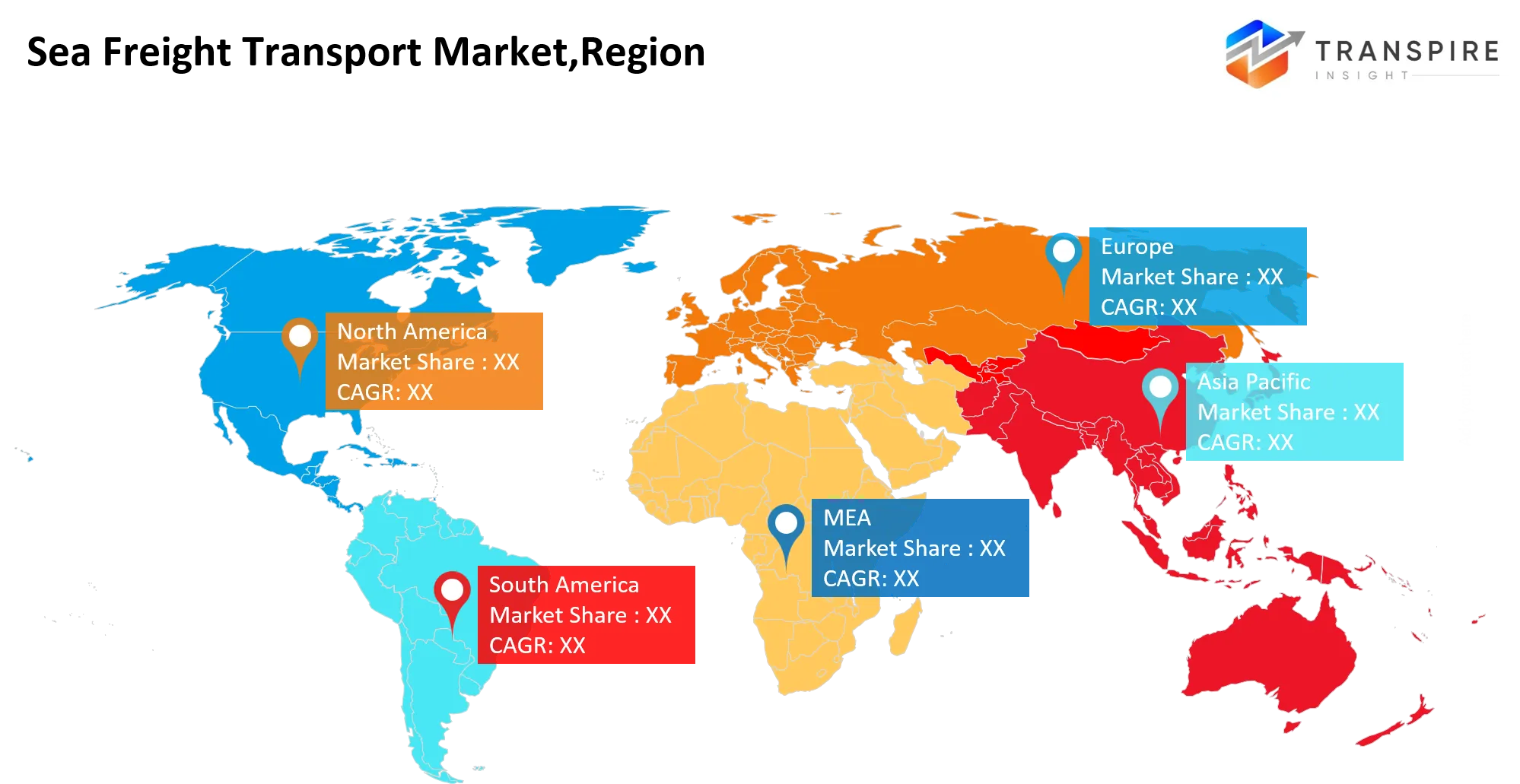
Asia Pacific is the fastest-growing region in the Sea Freight Transport Market during the period, holding around 37% share.
Asia Pacific is the fastest-growing region in the Sea Freight Transport Market during the forecast period, holding around 37% share during the forecast period. Asia Pacific is the region experiencing the fastest growth in the Sea Freight Transport Market with an approximate share of about 37%, as a result of the increase in manufacturing activities, strong economy focused on exports, rising trade between regions, and large port development. Increasing trade in containers and e-commerce, industrial growth, and investments in modernization of ports and maritime transportation connections are further boosting the demand for ocean cargo in the region.
Europe is expected to grow at a rapid CAGR in theSea Freight Transport Market, holding around 24% of the share during the forecast period.
Europe is expected to grow at a rapid CAGR in the Sea Freight Transport Market holding around 24% share during the forecast period. Europe is projected to register a tremendous growth in Sea Freight Transport Market at a CAGR of around 24% over the period of forecast owing to developed port facilities, strong regional as well as international trade, advanced logistics and technological networks, and major shipping hubs. The regional market growth is boosted by growing containerization, digitalization of supply chains, investments in sustainability, and modernization of ports.
North America is the fastest-growing region in the Sea Freight Transport Market during the period, holding around 20% share.
North America is expected to grow at a rapid CAGR in the Sea Freight Transport Market holding around 20% share during the forecast period. The Sea Freight Transport Market's fastest developing region is North America, accounting for a share of approximately 20 percent of the overall market. This fast growth is powered by strong international trade, transpacific shipping volumes, supported manufacturing and retail industries, and developed port infrastructure. Another factor contributing to the region's rapid growth is increasing demand for containerized cargo due to the rise of e-commerce, changes in supply-chain, and investments in port improvements.
Strategies for Market Growth in Non-Leading Regions:
Enhancement of underdeveloped regions via efficient and scalable maritime transport infrastructure and logistics technology will benefit not only small/medium ports but also freight forwarders, shipping companies, and logistics service providers. Modernization of local ports, increased capacities of container handling, better connections with hinterland regions, and construction of regional logistics centers will reduce congestion and facilitate trade since it will allow for economies of scale. Strategic alliances with regional producers, exporters and importers, port authorities, logistic firms and freight distributors will facilitate penetration into the market of maritime transport services. In order to raise the knowledge level in the area of maritime logistics, digital port operations and cargo tracking, strict attention has to be paid to training initiatives and development of technical skills. Besides, flexible financing schemes, long-term shipping agreements, PPP and financing schemes will make sea transport services more affordable and popular among businesses of developing countries.
Future Market Trends for the Sea Freight Transport Market: -
- Green Shipping and Alternative Fuels: Growing investment in low-emission vessels, compliance-testing methods, and environmentally friendly fuel.
- Digitalization and Intelligent Ports: Increasing use of Internet of Things (IoT) devices in containers, their tracking in real time, and predictive analysis.
- Sustainable trade routes: The relocation of production sites (for instance, through the "China plus one" concept or dual-sourcing strategies) resulting in shifting volume flows within Asia, Africa, and emerging routes.
- Multimodal Logistics: Deepening connections between maritime transport networks and road railways to avoid aggravating bottlenecks.
- Political instability: The necessity for carriers to keep changing routes and keeping the capacity of transport under control affects the volatility of spot rates.
Recent Development
- In September 2026: The Dutch chartering firm, Transito, introduced Total Freight, a comprehensive multi-modal system. The entire method includes ocean transport, port handling, transshipment, and transport along inland waterways under a single agreement and other terms. Overall, the new service intends to contain problems arising during low water levels at Rhine; at the same time, it helps to improve the coordination of logistics, continuity of supply, transparency of costs, and stability of the supply chain.
- In June 2026: Big shipping companies started raising their rates through General Rate Increases (GRIs) and Peak Season Surcharges (PSS) in response to increased booking demand and capacity issues for ocean trade from Asia to Europe and Transpacific shipping lanes. Because of these changes in cost, ocean transport rates, capacity planning, and implementation of cost management have undergone some important changes that are observed in the global Sea Freight Transport Market.
This study forecasts revenue at global, regional and country levels from 2020 to 2033. Transpire Insights has segmented the Sea Freight Transport Market based on the below-mentioned segments:
Sea Freight Transport Market, By Service Type
- Full Container Load
- Less-than-Container Load
- Bulk Shipping
- Breakbulk Shipping
- Ro-Ro Shipping
- Project Cargo
- Reefer Shipping
- Others
Sea Freight Transport Market, By Cargo Type
- Containerized Cargo
- Dry Bulk
- Liquid Bulk
- Breakbulk
- Vehicles
- Perishables
- Chemicals
- Others
Sea Freight Transport Market, By Vessel Type
- Container Ships
- Bulk Carriers
- Tankers
- Ro-Ro Ships
- General Cargo Ships
- Reefer Ships
- LNG Carriers
- Others
Sea Freight Transport Market, By Container Type
- 20-foot
- 40-foot
- High-cube
- Refrigerated
- Open-top
- Flat-rack
- Tank Container
- Others
Sea Freight Transport Market, By Route
- Intra-regional
- Transpacific
- Transatlantic
- Asia-Europe
- Europe-Asia
- Middle East Routes
- Africa Routes
- Others
Sea Freight Transport Market, End User
- Manufacturing
- Retail & E-commerce
- Automotive
- Food & Beverage
- Chemicals
- Energy
- Pharmaceuticals
- Others
Sea Freight Transport Market, Service Provider
- Shipping Lines
- Freight Forwarders
- NVOCCs
- 3PLs
- 4PLs
- Port Operators
- Logistics Integrators
- Others
Sea Freight Transport Market, By Regional Analysis
North America
- Mexico
- Canada
- US
Europe
- Germany
- UK
- France
- Italy
- Spain
- Russia
- Rest of Europe
Asia Pacific
- China
- Japan
- India
- South Korea
- Australia
- Rest of Asia Pacific
South America
- Brazil
- Argentina
- Rest of South America
Middle East & Africa
- UAE
- Saudi Arabia
- Qatar
- South Africa
- Rest of the Middle East & Africa
Frequently Asked Questions
Find quick answers to common questions.
The market is projected to reach USD 627.40 billion by 2033, growing at a 5.50% CAGR.
Containerized Cargo dominates, accounting for nearly 65% in 2025, driven by efficient handling and growing international trade.
Asia Pacific is the fastest-growing region, holding approximately 37% share, supported by manufacturing, exports, and port development.
Global trade, e-commerce, fleet modernization, port development, refrigerated logistics, and maritime digitalization are key market growth drivers.
Key players include Maersk, MSC, CMA CGM, COSCO Shipping, Hapag-Lloyd, ONE, Evergreen Marine, and ZIM.
- Maersk
- MSC
- CMA CGM
- COSCO Shipping
- Hapag-Lloyd
- ONE
- Evergreen Marine
- Yang Ming
- HMM
- ZIM
- PIL
- Wan Hai Lines
- Matson
- Seaspan
- Kuehne+Nagel
About the Authors

Mayur Shinde
I am Mayur Shinde, a Senior Research Analyst at Transpire Insight, specializing in the Automotive & Transportation and Information & Communication Technology (ICT) Industry. My work focuses on analyzing emerging market trends, technological advancements, competitive landscapes, and industry developments to deliver accurate, data-driven insights. I am passionate about transforming complex market information into clear, actionable content that helps businesses, professionals, and decision-makers stay informed and make confident strategic decisions.

Chakradhar Khansole
Chakradhar serves as the Research Director at Transpire Insight, bringing over 8 years of experience in technology, innovation, and strategic market intelligence. He specializes in transforming complex market data into actionable business insights that enable organizations to make informed, growth-oriented decisions. Recognized for his strategic vision and analytical expertise, Chakradhar leads high-impact research initiatives, delivering comprehensive market assessments, competitive intelligence, and forward-looking industry analysis.
Recently Published Reports
-
Apr 2026
ATV & UTV Market
ATV & UTV Market Size, Share & Analysis Report By Type (ATV, and UTV), By Variants (Less Than 400 CC, 400 CC To 800 CC, and More Than 800 CC), and Geography (North America, Europe, Asia-Pacific, Middle East and Africa, South and Central America), 2021 - 2031
-
Apr 2026
Automotive Central Gateway Module Market
Automotive Central Gateway Module Market Size, Share & Analysis Report By Type (Ethernet Central Gateway Module, CAN Central Gateway Module, LIN Central Gateway Module, and FlexRay), By Application (Powertrain Control, Body Control, Infotainment System, Advanced Driver Assistance Systems (ADAS), and Others), By End User (Passenger Vehicles, and Commercial Vehicles), and Geography (North America, Europe, Asia-Pacific, Middle East and Africa, South and Central America), 2021 - 2031
-
Apr 2026
Automotive Engine Oil Filter Market
Automotive Engine Oil Filter Market Size, Share & Analysis Report By Filter Type (Fuel Filter, Engine Oil Filter, Hydraulic Oil Filter, and Others), By Filter Media (Cellulose, Synthetic, and Micro), By Sales Channel (OEMs, and Aftermarket), By Vehicle Type (Passenger Cars, Light Commercial Vehicles, Heavy Duty Trucks, Buses and Coaches, and Off-road Vehicles), and Geography (North America, Europe, Asia-Pacific, Middle East and Africa, South and Central America), 2021 - 2031
-
Apr 2026
Automotive Parts Aluminium Die Casting Market
Automotive Parts Aluminium Die Casting Market Size, Share & Analysis Report By Production Process (Pressure Die Casting, Vacuum Die Casting, Squeeze Die Casting, Gravity Die Casting), By Application (Body Parts, Engine Parts, Transmission Parts, Battery And Related Components, Other Application Types), and Geography (North America, Europe, Asia-Pacific, Middle East and Africa, South and Central America), 2021 - 2031
Our Clients



