

Extended Reality (XR) Market Summary:
According to Transpire Insights, a detailed research report on the market reflects that the enterprise application segment dominates the Extended Reality (XR) Market, accounting for approximately 58% of the total share worldwide. Microsoft Corporation leads the market with approximately (around USD 281 billion) in annual revenue and an estimated 15-18% market share, making it the leading contributor to market development, innovation, advanced extended reality solutions, expanding XR ecosystem capabilities, and growth dynamics.
Market Snapshot
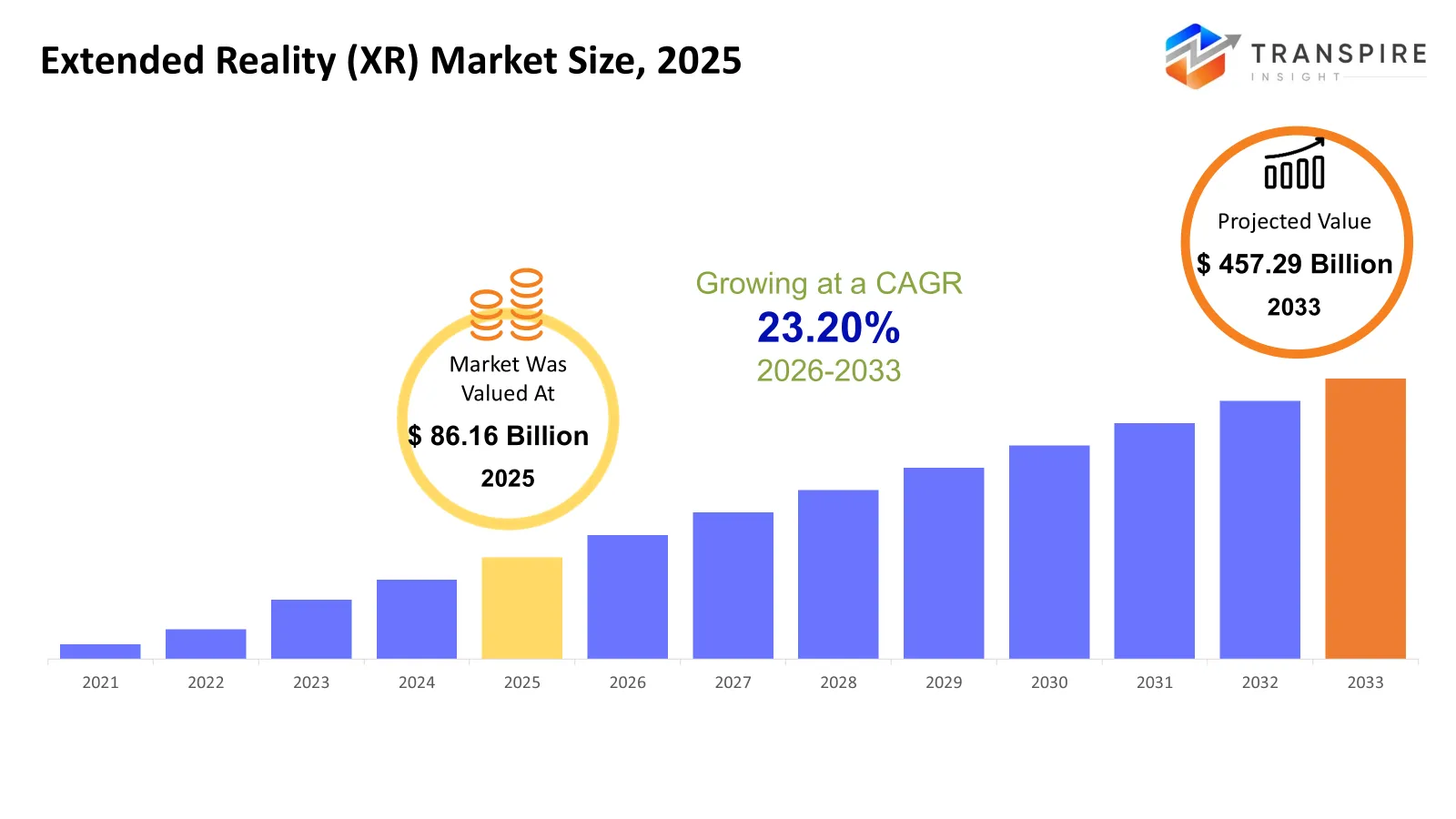
- Market Value (2025): USD 86.16 Billion.
- Expected Market Value (2026): USD 106.15 Billion.
- Estimated Market Value (2033): USD 457.29 Billion.
- Forecast CAGR (2026-2033): 23.20%.
- Leading Region in 2025: North America
- Second-largest Region: Asia Pacific
- Fastest Growing Region: Europe
Introduction
Extended Reality (XR) is a term covering all different forms of technology that bridge the gap between real and virtual worlds. Virtual Reality (VR) completely immerses someone into virtual reality using a computer-set environment. Augmented Reality (AR) superimposes the computer-generated images over the real-world situation. Mixed Reality (MR) combines both reality and virtuality together allowing a person to interact with objects from both. The Extended Reality (XR) Market is reshaping the way businesses operate by providing safer training methods, remote assistance, cost savings, and improved customer interaction. XR-based simulations make it possible for medical professionals, industrial specialists, and other skilled workers to practice difficult operations without any danger. AR enables specialists to provide remote assistance in the maintenance of machines and field work. Organizations save money by reducing the number of physical models, travelling, and the utilization of modern teaching infrastructure. VR and MR technologies also enhance customer satisfaction through the use of interactive 3D product visualization.
For instance: Due to enterprise acceptance, 5G deployment, and significant investments, the worldwide Extended Reality (XR) market is growing quickly, with the UK becoming a major regional hub in Europe.
Market Highlights: -
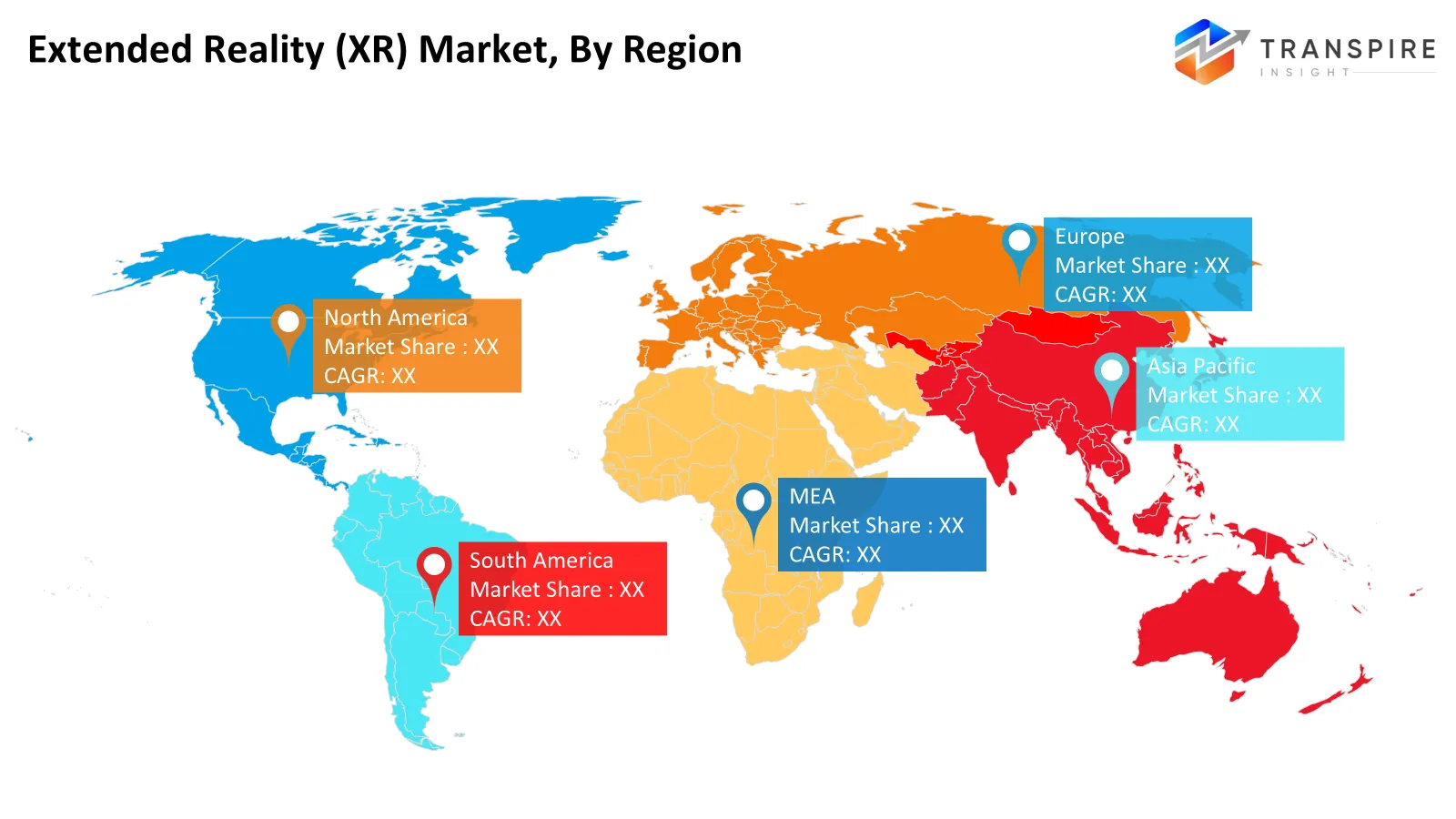
- North America is expected to grow at a rapid CAGR in the Extended Reality (XR) Market by holding around 42% of the share during the forecast period.
- Asia Pacific is anticipated to hold around 35% share of the Extended Reality (XR) Market over the predicted timeframe.
- Europe is anticipated to hold roughly 24% share of the Extended Reality (XR) Market over the predicted timeframe.
- By technology, the Virtual Reality segment dominated the market and holds nearly 48% share in 2025 and is projected to grow at a substantial CAGR during the forecast period.
- By application, the Gaming segment dominated the market and holds nearly 32% share in 2025 and is projected to grow at a substantial CAGR during the forecast period.
- By end user, the Consumers segment dominated the market and holds nearly 40% share in 2025 and is projected to grow at a substantial CAGR during the forecast period.
- India Initiatives: To bolster the AVGC-XR ecosystem, the Ministry of Information and Broadcasting established the WAVES Bazaar and WaveX digital platforms. These platforms facilitate B2B collaboration, startup incubation, investment facilitation, mentorship, and market access opportunities for up-and-coming Extended Reality (XR) companies and innovative technology innovators.
How is Technology Driving Growth in the Extended Reality (XR) Market?
The Extended Reality (XR) Market is growing with the help of constant hardware, software, and applications innovation. The lightweight XR headsets, the improvement of tracking devices, the use of advanced sensors, and the introduction of haptic feedback systems have contributed to better immersive experience for users. Technologies like AI, 5G, edge computing and cross-platform development tools have allowed for improvement of real-time spatial computing capabilities, to lower the response time and create seamless environments for multiple users. As a result, more and more companies start using XR solutions for advanced training purposes, defense simulations, healthcare, industrial design and prototyping ideas.
Market Drivers
The Extended Reality (XR) Market is experiencing significant growth due to innovations in technologies such as 5G networks, edge computing, and usage of immersive technologies. The existence of ultra-low-latency networks makes it possible to experience cloud-based XR with relative ease. Several sectors, including healthcare, aerospace, and manufacturing, embrace XR simulations for training and operational safety purposes. The advent of lightweight headsets, efficient battery life, and precise tracking systems is boosting user comfort and revolutionizing device adoption. In addition, increased interest in gaming, e-sports, and virtual entertainment boosts the inclusion of consumers. XR solutions increase productivity in the area of remote work, providing workers across the globe with a collaborative online working environment. The Extended Reality (XR) Market is witnessing increasing popularity among organizations, who use immersive technologies to improve training, collaboration, customer engagement, and operational efficiency. XR solutions make it possible for high-risk industries to carry out realistic 3D simulations, increasing safety and skill development. Virtual collaboration platforms enable teams from around the world to communicate visually through avatars and similar surroundings, helping them establish real-time communication and conduct design reviews. Companies use XR for their virtual product demonstrations, 3D visualization, and superior customer experience. Furthermore, XR significantly reduces operational costs by restricting travel and allowing prototyping in the virtual world before production in reality, thus facilitating innovation in various industries.
For Instance: -
- Strong international investments in hardware, corporate tools, and spatial computing are driving the worldwide extended reality (XR) market, while Russia's domestic industry concentrates on specialized industrial, educational, and defense simulations.
- Due to localized startup ecosystems, smart manufacturing investments, and the quick implementation of 5G, the worldwide Extended Reality (XR) industry is expanding at the quickest rate in Asia-Pacific. A thorough examination using Fortune Business Insights reveals significant regional scaling in important economies.
Restrain
The Extended Reality (XR) Market has obstacles such as high costs of hardware, complicated requirements of development, and less accessibility for small companies. Continuous use of devices may lead to the issues of eye strain and motion sickness. Furthermore, privacy issues linked to the accumulation of biometric and behavioral data and lack of standardized platforms lead to the problems with interoperability and complexity of development in XR ecosystems.
Analysis of Prices and Consumer Behaviour
Enterprise applications hold a dominating position in the market for extended reality (XR) solutions (around 60% of the total market due to the adoption of XR technology in healthcare, manufacturing, automotive, education, defense, and corporate training applications). The price of new-age XR systems that include high-resolution displays, AI-based functionalities, capabilities for spatial computing, and enterprise-level software solutions, is expected to be 30-40% more than that of basic XR solutions as the new technologies require advanced devices, sensors, and unique platforms. About 55% of all shipments made ly in terms of XR devices belong to the category of head-mounted displays (HMDs), which are actively used for virtual training, simulation, gaming, and immersive collaboration. The demand for XR technologies comes from enterprise, industrial and healthcare sectors making up about 65% of total demand. According to the purchasing habits of consumers and enterprises, 58% of users consider immersive experience, overall performance of the device, comfort, and compatibility of applications as the most important factors in making a decision to use XR technology. Additionally, 32% of companies prefer the subscription model, service agreement and a long-term contract model to decrease costs of deployment and provide updates and tech support worldwide.
Top Companies in the Extended Reality (XR) Market
- Meta Platforms
- Apple
- Microsoft
- Sony
- HTC
- Samsung Electronics
- Qualcomm
- Lenovo
- NVIDIA
- PTC
- Unity Technologies
- Epic Games
- Magic Leap
- Varjo
Market Segmentation
The Extended Reality (XR) Market share is divided into five categories: By technology, device, application, deployment and end user.
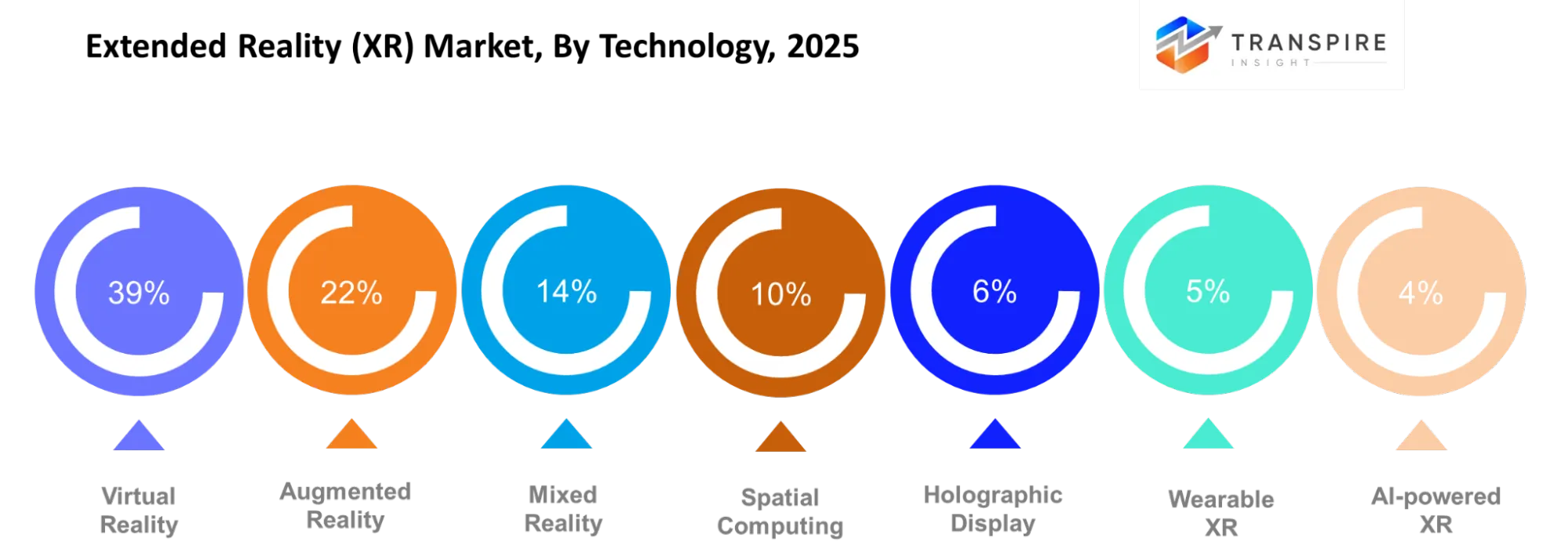
The Virtual Reality dominated the market, accounting for nearly 48% in 2025 and is expected to rise at a significant CAGR during the forecast period.
The Extended Reality (XR) Market is segmented by technology into Virtual Reality, Augmented Reality, Mixed Reality, Spatial Computing, Holographic Display, Wearable XR, AI-powered XR, Others. Among these, the Virtual Reality segment dominated the market, accounting for nearly 48% in 2025 and expected to increase at a significant CAGR during the forecast period. In terms of market share, Virtual Reality (VR) dominated the Extended Reality (XR) Market in 2025, making up approximately 48% of the overall market share, thanks to its increasing usage in various applications including gaming, enterprise training, healthcare, education, and industrial simulation. The adoption of the technology has been significantly accelerated by the introduction of autonomous VR headsets and immersive content ecosystems, spatial computing powered by artificial intelligence, and decreased costs of hardware. The ongoing escalation of investments in virtual collaboration platforms, defense training, and technologies related to the metaverse would ensure an unceasing demand, allowing the segment of VR to record a significant CAGR during the entire forecasting period.
The Gaming dominated the market, accounting for nearly 32% in 2025, and is expected to rise at a significant CAGR during the forecast period.
The Extended Reality (XR) Market is segmented by application into Gaming, Healthcare, Education, Manufacturing, Retail, Military & Defense, Architecture & Design, Others. Among these, the Gaming segment dominated the market, accounting for nearly 32% in 2025 and expected to increase at a significant CAGR during the forecast period. The Extended Reality (XR) Market was dominated by the gaming sector with an estimated share of about 32% in 2025, owing to the increasing demand for immersive gaming experiences, expanding ecosystem for VR/AR content, and growing adoption of advanced XR headsets. Continuous investments made in the areas such as cloud gaming, AI-based interactive experiences, and high-performance graphics along with the increasing popularity of e-sports and metaverse-based entertainment would further accelerate the growth of the market. Also, continuous innovation in hardware and support from developers will allow the gaming segment to register a high CAGR throughout the forecast period.
The Consumers dominated the market, accounting for nearly 40% in 2025 and is expected to rise at a significant CAGR during the forecast period.
The Extended Reality (XR) Market is segmented by end user into Consumers, Enterprises, Healthcare Providers, Educational Institutions, Government, Industrial Companies, Media & Entertainment, Others. Among these, the Consumers segment dominated the market, accounting for nearly 40% in 2025 and expected to increase at a significant CAGR during the forecast period. The Consumers segment accounted for almost 40% of the Extended Reality (XR) Market in 2025, dominating the sector due to its use in gaming, socializing, education, and virtual fitness. The availability of affordable headsets, 5G connectivity, an increase in content ecosystems, and AI-enabled innovative applications are driving consumer acceptance, leading to a high CAGR throughout the forecasting period.
Regional Segment Analysis of the Extended Reality (XR) Market:
- North America (U.S., Canada, Mexico)
- Europe (Germany, France, U.K., Italy, Spain, Rest of Europe)
- Asia-Pacific (China, Japan, India, Rest of APAC)
- South America (Brazil and the Rest of South America)
- The Middle East and Africa (UAE, South Africa, Rest of MEA)
North America is the fastest-growing region in the Extended Reality (XR) Market during the period, holding around42%share.
North America is expected to grow at a rapid CAGR in the Extended Reality (XR) Market holding around 42% share during the forecast period. Around 42% of the Extended Reality (XR) market was controlled by North America in 2025 as a result of massive investments in XR hardware and software, extensive acceptance in the gaming, healthcare, military, and business industries, and existence of influential tech companies. Quick incorporation of AI, growth of 5G network, and rise in demand for immersive virtual experience will assist in keeping robust market growth during the entire forecast period.
Asia Pacific is the fastest-growing region in the Extended Reality (XR) Market during the period, holding around35%share.
Asia Pacific is the fastest-growing region in the Extended Reality (XR) Market during the forecast period, holding around 35% share during the forecast period. With a market share of about 35%, the Asia Pacific region is the fastest growing region in the Extended Reality (XR) Market. This growth has been spurred by the rapid digital transformation, the expansion of the 5G infrastructure, the increase in investment in AR/VR technologies and the surge in usage in the gaming, manufacturing, education and healthcare sectors. The good support from governments as well as the rise in consumer demand and the presence of some of the leading electronic manufacturers are expected to further facilitate the growth of the market in the future.
Europe is expected to grow at a rapid CAGR in theExtended Reality (XR) Market, holding roughly24%of the share during the forecast period.
Europe is expected to grow at a rapid CAGR in the Extended Reality (XR) Market holding roughly 24% share during the forecast period. Europe is anticipated to experience significant growth at a high compound annual growth rate in the Extended Reality (XR) Market. This region's share in the market is expected to be around 24% during the predicted timeframe. The expansion can be attributed to the growing use of XR technology in such domains as manufacturing, healthcare, automotive and aerospace industries, and education. The government is also playing a vital role in promoting digital transformation; Industry 4.0 initiatives are gaining further traction and investing in immersive technology is growing in popularity among companies. Lastly, the increasing market demand for applications connected with AI and virtual collaboration and training.
Strategies for Market Growth in Non-Leading Regions:
By employing the right deployment strategies to utilize the extended reality (XR) technology, development opportunities in underdeveloped regions can be created for small and medium-sized technology providers, enterprises that develop solutions and companies that integrate services. Localized XR infrastructure development, immersive content creation capabilities, and regional innovation centers in the field of XR will allow for diminishing dependence on technology imports and lowering implementation costs. XR solution market access will also be facilitated through the establishment of partnerships with technological companies, cloud service providers, educational establishments, healthcare organizations, manufacturers, and government institutions. It is also important to address the lack of expertise in XR development and employ training programs as well as technical capacity-building solutions to gain knowledge in spatial computing, AI utilization, hardware infrastructure management, and application of XR technologies in enterprises. Flexible financing ideas, long-term partnerships with technology providers, and subscription-based service delivery will make XR technology solutions affordable.
Future Market Trends for the Extended Reality (XR) Market: -
- AI and Spatial Convergence: Current advances in AI technology provide real-time facial recognition, eye-tracking, and gesture recognition, allowing for highly personalized user engagements.
- 5G and Cloud Streaming: Communications infrastructure with ultra-low, 20ms latency combined with edge computing technologies enable real-time rendering and elimination of motion sickness.
- Changes in Form Factor: New devices are designed to be ultra-lightweight and energy-efficient by enabling both VR and AR functionalities.
- Hybrid headsets: Manufacturers are concentrating on creating adaptable gadgets that smoothly transition between virtual reality (VR) and augmented reality (AR).
Recent Development
- In July 2026: Amelia's Escape (Reality Syndrome Symphony) is a new immersive time travel puzzle escape game that has been released for virtual reality devices, showcasing the rising use of Extended Reality (XR) technologies in the entertainment and gaming industry and aiding in the growth of the XR Market by improving the interactive narrative.
- In June 2026: XREAL AURA The AURA XR glasses from XREAL have been officially launched, and the booking has commenced ly ahead of the expected launch during fall 2026. With the use of Android XR and modern spatial computing technologies, the AURA XR glasses are designed with lightweight attributes, AI-enabled features, an immersive display experience, as well as new-age XR applications, which strengthen the company's position in the Extended Reality (XR) Market.
- In May 2026: Google Android XR major announcements regarding the Android XR platform were made by Google during its Google I/O 2026. This includes news of various collaborations such as the intelligent eyewear partnership with Warby Parker and Gentle Monster. A focus on Artificial Intelligence (AI)-supported XR applications and smart glasses development serves to solidify Google’s involvement in the XR Market.
Market Segment
This study forecasts revenue at , regional and country levels from 2020 to 2033. Transpire Insights has segmented the Extended Reality (XR) Market based on the below-mentioned segments:
Extended Reality (XR) Market, By Technology
- Virtual Reality
- Augmented Reality
- Mixed Reality
- Spatial Computing
- Holographic Display
- Wearable XR
- AI-powered XR
- Others
Extended Reality (XR) Market, By Device Type
- Head-mounted Displays
- Smart Glasses
- Handheld Devices
- Projection Systems
- Wearable Devices
- XR Sensors
- Controllers
- Others
Extended Reality (XR) Market, By Application
- Gaming
- Healthcare
- Education
- Manufacturing
- Retail
- Military & Defense
- Architecture & Design
- Others
Extended Reality (XR) Market, By Deployment
- On-premise
- Cloud-based
- Edge Computing
- Hybrid
- Standalone Devices
- Tethered Devices
- Mobile XR
- Others
Extended Reality (XR) Market, By End User
- Consumers
- Enterprises
- Healthcare Providers
- Educational Institutions
- Government
- Industrial Companies
- Media & Entertainment
- Others
Extended Reality (XR) Market, By Regional Analysis
North America
- US
- Canada
- Mexico
Europe
- Germany
- UK
- France
- Italy
- Spain
- Russia
- Rest of Europe
Asia Pacific
- China
- Japan
- India
- South Korea
- Australia
- Rest of Asia Pacific
South America
- Brazil
- Argentina
- Rest of South America
Middle East & Africa
- UAE
- Saudi Arabia
- Qatar
- South Africa
- Rest of the Middle East & Africa
Frequently Asked Questions
Find quick answers to common questions.
AI, 5G, spatial computing, enterprise digitalization, immersive gaming, healthcare innovation, and increasing adoption across industrial, education, and remote collaboration applications.
Virtual Reality dominates with nearly 48% market share, driven by immersive gaming, enterprise training, healthcare simulations, industrial applications, and advancing headset technologies.
North America leads through advanced digital infrastructure, major technology companies, strong XR investments, enterprise adoption, AI innovation, and expanding 5G connectivity.
Gaming, healthcare, manufacturing, education, retail, aerospace, and defense increasingly adopt XR for training, visualization, collaboration, and operational efficiency improvements.
AI-powered spatial computing, lightweight headsets, hybrid XR devices, cloud streaming, edge computing, and enterprise-focused immersive applications will drive future market growth.
- Meta Platforms
- Apple
- Microsoft
- Sony
- HTC
- Samsung Electronics
- Qualcomm
- Lenovo
- NVIDIA
- PTC
- Unity Technologies
- Epic Games
- Magic Leap
- Varjo
About the Authors

Mayur Shinde
I am Mayur Shinde, a Senior Research Analyst at Transpire Insight, specializing in the Automotive & Transportation and Information & Communication Technology (ICT) Industry. My work focuses on analyzing emerging market trends, technological advancements, competitive landscapes, and industry developments to deliver accurate, data-driven insights. I am passionate about transforming complex market information into clear, actionable content that helps businesses, professionals, and decision-makers stay informed and make confident strategic decisions.

Chakradhar Khansole
Chakradhar serves as the Research Director at Transpire Insight, bringing over 8 years of experience in technology, innovation, and strategic market intelligence. He specializes in transforming complex market data into actionable business insights that enable organizations to make informed, growth-oriented decisions. Recognized for his strategic vision and analytical expertise, Chakradhar leads high-impact research initiatives, delivering comprehensive market assessments, competitive intelligence, and forward-looking industry analysis.
Recently Published Reports
-
Apr 2026
3D Optical Profiler Market
3D Optical Profiler Market Size, Share & Analysis Report By Type (Desktop 3D Optical Profiler, and Portable 3D Optical Profiler), By Technology (Confocal Technology, and White Light Interference), By End-Use Industry (Manufacturing, Research Institutions, Automotive, Aerospace and Defense, Medical Devices, and Other), and Geography (North America, Europe, Asia-Pacific, Middle East and Africa, South and Central America), 2021 - 2031
-
Apr 2026
Depth Sensor Market
Depth Sensor Market Size, Share & Analysis Report By Type (Infrared Depth Sensors, Time-of-Flight (ToF) Sensors, Stereo Vision Sensors, Structured Light Sensors, Ultrasonic Depth Sensors), By Application (Automotive, Robotics, Gaming, Consumer Electronics, Industrial Automation, Healthcare, Security & Surveillance, Others), By End Users (Automotive Manufacturers, Consumer Electronics Companies, Healthcare Providers, Industrial Companies, Security Agencies, Gaming Companies, Robotics Companies, Others), and Geography (North America, Europe, Asia-Pacific, Middle East and Africa, South and Central America), 2021 – 2031
-
Apr 2026
Digital Manufacturing Market
Digital Manufacturing Market Size, Share & Analysis Report By Component (Hardware, Software, and Services), By Technology (Robotics, 3D Printing, Internet of Things (IoT), and Others), By Application (Automotive and Transportation, Aerospace and Defense, Consumer Electronics, Industrial Machinery, and Others), By Process Type (Computer-Based Designing, Computer-Based Simulation, Computer 3D Visualization, Analytics, and Others), and Geography (North America, Europe, Asia-Pacific, Middle East and Africa, South and Central America), 2021 – 2031
-
Apr 2026
Digital Visa Services Market
Digital Visa Services Market Size, Share & Analysis Report By Type (Individual Travelers, Group Travelers), By Application (Tourism, Business Travel, Others), and Geography (North America, Europe, Asia-Pacific, Middle East and Africa, South and Central America), 2021 – 2031