

Europe Vinyl Flooring Market Summary
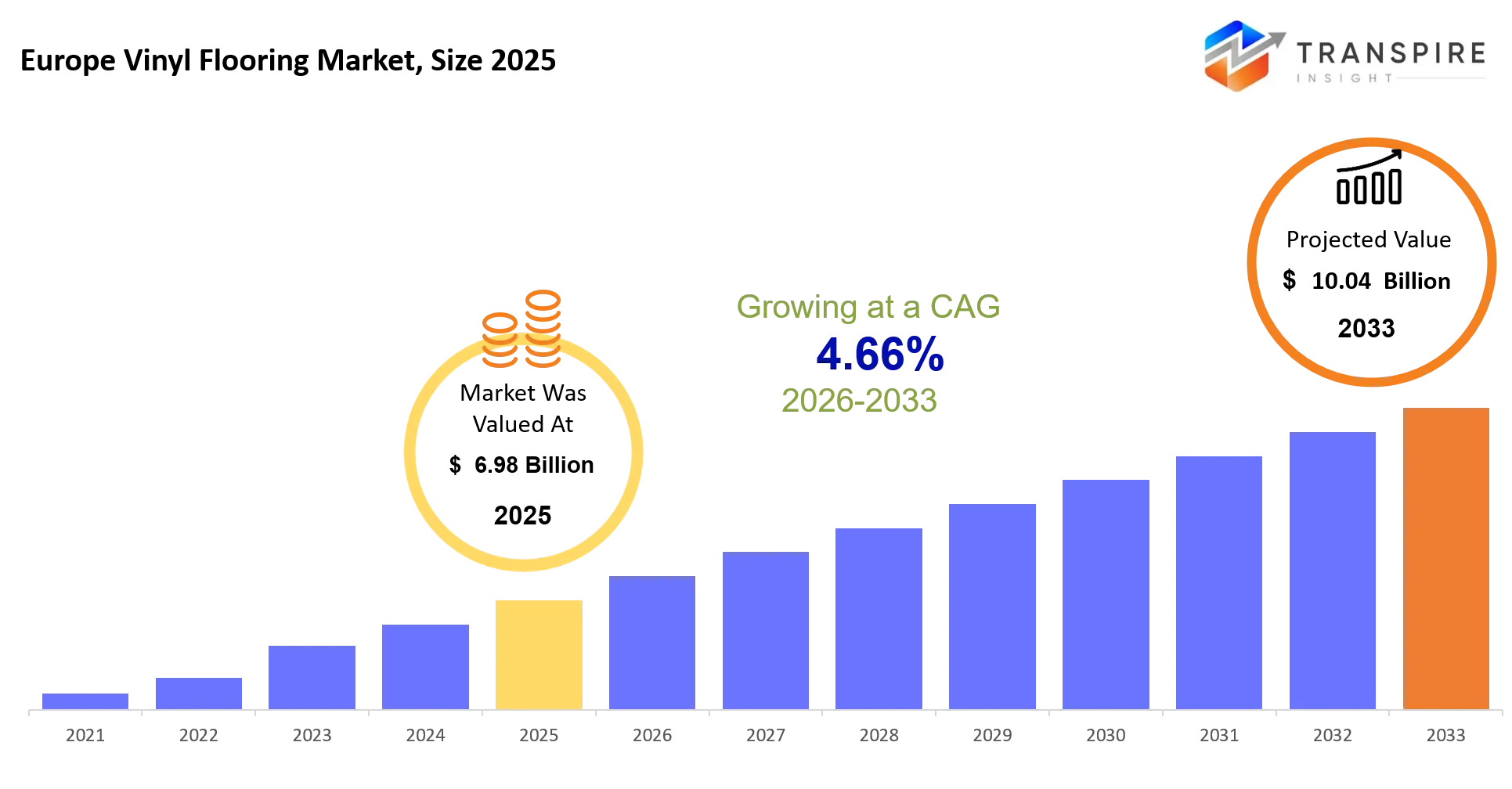
As per Transpire Insight Analysis, the Europe Vinyl Flooring Market size is estimated at USD 6.98 Billion in 2025 and is anticipated to reach USD 10.04 Billion by 2033, growing at a CAGR of 4.66% from 2026 to 2033.
Vinyl flooring kinda plays a practical role in residential buildings, commercial spaces, healthcare centers, education facilities, hospitality venues, and even industrial sites , mostly because it gives a durable surface that’s still low maintenance. It handles heavy foot traffic pretty well and it also makes installation faster, so the overall lifecycle costs tend to stay lower too. Facility owners and contractors end up leaning on vinyl flooring to cut down maintenance needs, raise hygiene expectations , and keep design flexibility pretty consistent across both renovations and new builds.
Over the last three to five years, in Europe, the market has seen a more structural shift toward sustainable and circular flooring solutions. Manufacturers are expanding recycled content and using low-emission materials, plus rolling out take-back programs , all to match stricter environmental requirements. And then the energy crisis, along with raw material supply disruptions connected to the Russia-Ukraine conflict, reshaped sourcing strategies and pushed production costs up. That situation also sped up investments in regional manufacturing and supply chain resilience, which is a big deal for continuity.
Right now building owners are prioritizing long-lasting, compliant, and cost-efficient flooring options, so replacement activity and renovation projects are still moving steadily. Those efforts keep supporting broader product adoption, and that creates stronger revenue prospects for manufacturers who focus on innovation, plus sustainable product portfolios.
Europe Vinyl Flooring Market Size & Forecast:
- Europe Vinyl Flooring Market Size 2025: USD 6.98 Billion
- Expected Market Value 2033: USD 10.04 Billion
- Forecast CAGR: 4.66%
- Leading region in 2025: Germany, France, and the United Kingdom
- Fastest Growing region: Poland, Romania, the Czech Republic, and Hungary
- Key Profile: Tarkett, Forbo Flooring Systems, Gerflor, Interface, Mohawk Industries, Armstrong Flooring, Shaw Industries, Beaulieu International Group, Polyflor, Mannington Mills, LG Hausys, NOX Corporation, Milliken & Company, Amtico, Responsive Industries
Key Market Insights
- Western Europe was pretty much running the Europe vinyl flooring scene , with something like 63% market share in 2025, mostly pushed by Germany, France, and the United Kingdom. it seems like this was sustained by renovation spend that never really stopped.
- Then you have Central and Eastern Europe, which is shaping up to be the quickest growing regional market during 2025–2033. That momentum comes from commercial builds, industrial expansion, and the modernization of public infrastructure, kind of a full package.
- On the product side, Luxury Vinyl Tiles (LVT) took the lead with around 46% market share in 2025.
- People seemed to like the premium look , and it’s also valued for durability. faster installation also helped, specially when projects are in commercial settings.
- Vinyl sheets stayed as the second-largest segment, and they kept getting picked for healthcare, education, and hospitality facilities.
- These places need smooth, hygienic flooring surfaces , so that demand never really cooled down.
- Rigid core vinyl flooring is projected as the fastest growing segment toward 2033. the key reasons are waterproof construction, and it fits better with modern renovation requirements , so it’s easier to work into newer upgrades.
- In terms of application, commercial buildings accounted for about 55% in 2025. offices , retail sites, hospitals, and hotels all pushed refurbishment cycles faster across Europe.
- Residential renovation is expected to grow the quickest between 2025 and 2033. the drivers are home modernization efforts and energy efficient building upgrades, plus the usual upgrading of interiors.
- For end users, commercial players led with roughly 58% in 2025. this mirrors ongoing replacement cycles across institutional and business infrastructure.
- Residential property owners look like the fastest-growing end-user group. that is mainly tied to more remodeling activity and premium flooring replacements across the existing housing stock , even when changes are gradual.
What are the Key Drivers, Restraints, and Opportunities in the Europe Vinyl Flooring Market?
Stricter European building rules, plus renovation-focused investment schemes, stay the main growth engine. As energy-efficiency targets and circular construction policies tighten, they have pushed the replacement of old flooring faster, both in residential and commercial spaces. At the same time luxury vinyl tile (LVT) tech has actually gotten better on durability, sound control , and faster fitting. That whole combo tends to shave off a lot of project time. Because of that, contractors are more often choosing resilient flooring when they refurbish, which then supports stronger sales volumes and lifts manufacturer revenues across many of the well established European markets.
That said, volatility in PVC resin prices, and the fact that the supply relies on imported raw materials still look like the biggest structural drag. Moving supply to new routes does need longer-term investments, and it cannot really be rushed, since production capacity, transport networks, and supplier vetting all take years to set up. From a Transpire Insight review of regional procurement notices and product launch timing, supply chain concentration continues to be the key execution risk. On top of that, cost inflation can slow down renovation work, squeezes manufacturer margins, and delays the next wave of commercial flooring changeouts. In practice, this limits when revenue gets realized across several European countries.
Digital manufacturing together with closed-loop recycling seems like the best long-term opening. Producers are putting money into advanced recycling processes, bio-based materials, and automated production systems, aiming to comply with the tougher environmental standards. Germany, Poland, and the Nordic countries are showing relatively good conditions, mainly due to industrial upgrades and continuing sustainable construction spending. These shifts are creating new premium product lines, which can raise profit margins, and they also reinforce long-term competitiveness in a more durable way.
What Has the Impact of Artificial Intelligence Been on the Europe Vinyl Flooring Market?
Artificial intelligence and digital technologies are getting better at improving manufacturing efficiency in the European vinyl flooring industry, sort of by automating production monitoring , quality checking, and process control. Computer vision setups spot surface defects in real time, which cuts down on material waste and helps keep the product more consistent before it ships. Machine learning models are also useful for predicting regional purchasing behaviors using construction momentum, renovation permits, and distributor inventory levels. That lets manufacturers fine tune their production calendars and avoid stock imbalances that happen when demand shifts. On top of that , predictive maintenance tools look at equipment vibration and real operating conditions to prevent surprise downtime and stretch machine life.
This boosts factory utilization, while lowering maintenance costs in a pretty tangible way. Digital twins and smarter planning software then help with energy optimization and production scheduling too, so manufacturers can manage overheads during periods when raw material prices swing around. AI-powered logistics platforms further help with inventory distribution across European distribution centers , meaning deliveries can be faster and customer support feels stronger. Still, broad rollout is not always smooth because integration costs are high, legacy manufacturing systems are fragmented , and the operational data quality is uneven across older production sites. Smaller and medium sized manufacturers often end up waiting longer for results, since upgrading equipment, linking data infrastructure, and training the staff takes a lot of capital before the measurable productivity gains show up.
Key Market Trends
- Since 2022, manufacturers have been speeding up the launch of recycled-content vinyl flooring, mostly to keep up with changing European circular economy rules and those green procurement policies that keep getting tighter.
- Luxury vinyl tile picked up a lot of market share from 2021 thru 2025, especially when commercial renovations started valuing durability, more design flexibility, and faster installation like it was the main deal.
- After 2022, regional manufacturing investments went up, so the industry became less vulnerable to global logistics disruptions. in a way, that also supported stronger supply chain resilience across Europe, overall.
- Digital production tech kept rolling out across the biggest manufacturers, improving quality control and cutting down material waste, and also trimming production cycles by using automated inspection systems.
- More and more product ranges now highlight phthalate-free formulations and low-VOC materials, because stricter indoor environmental performance standards are becoming non optional for institutional projects.
- Between 2023 and 2025, flooring recycling partnerships were further reinforced by manufacturers. This helped increase material recovery, and it supported circular business models across Europe too, in practice.
- Germany, France, and the United Kingdom kept leading commercial refurbishment activity, while Poland and Romania started showing up as meaningful expansion markets for manufacturers.
- Also, companies put more money into waterproof rigid core flooring systems as residential remodeling work shifted toward long life, low maintenance interior solutions that are easy to live with.
- Strategic acquisitions, plus distribution partnerships, really intensified after 2023. as a result, leading suppliers could extend their regional footprint and improve access to premium product lines.
Europe Vinyl Flooring Market Segmentation
By Product Type :
Luxury Vinyl Tiles (LVT) keep that top spot, mainly due to solid durability, nice surface finishes, and a pretty smooth fit for both residential as well as commercial renovation efforts. People also seem to like that they install fast , need little upkeep, and they handle moisture really well. So you still see them everywhere , like in offices, retail areas, hotels, and also in housing developments. And honestly the product keeps getting better over time, with upgrades to performance plus designs that look a lot like actual wood and stone, even if you’re not trying too hard to compare.
Vinyl Sheets still hold an important place especially in healthcare, education, and other institutional buildings. The seamless flooring idea matters here, because it supports hygiene and makes cleaning feel simpler. Vinyl Composite Tiles (VCT) remain a practical option for facilities that want flooring without the big cost, but still want trustworthy durability. Vinyl Planks keep getting more attention too, because the wood visuals look convincing and the construction is waterproof. Meanwhile the other categories show up for more specific decorative needs or functional requirements, particularly when the use case is more niche , and not just the standard everyday install.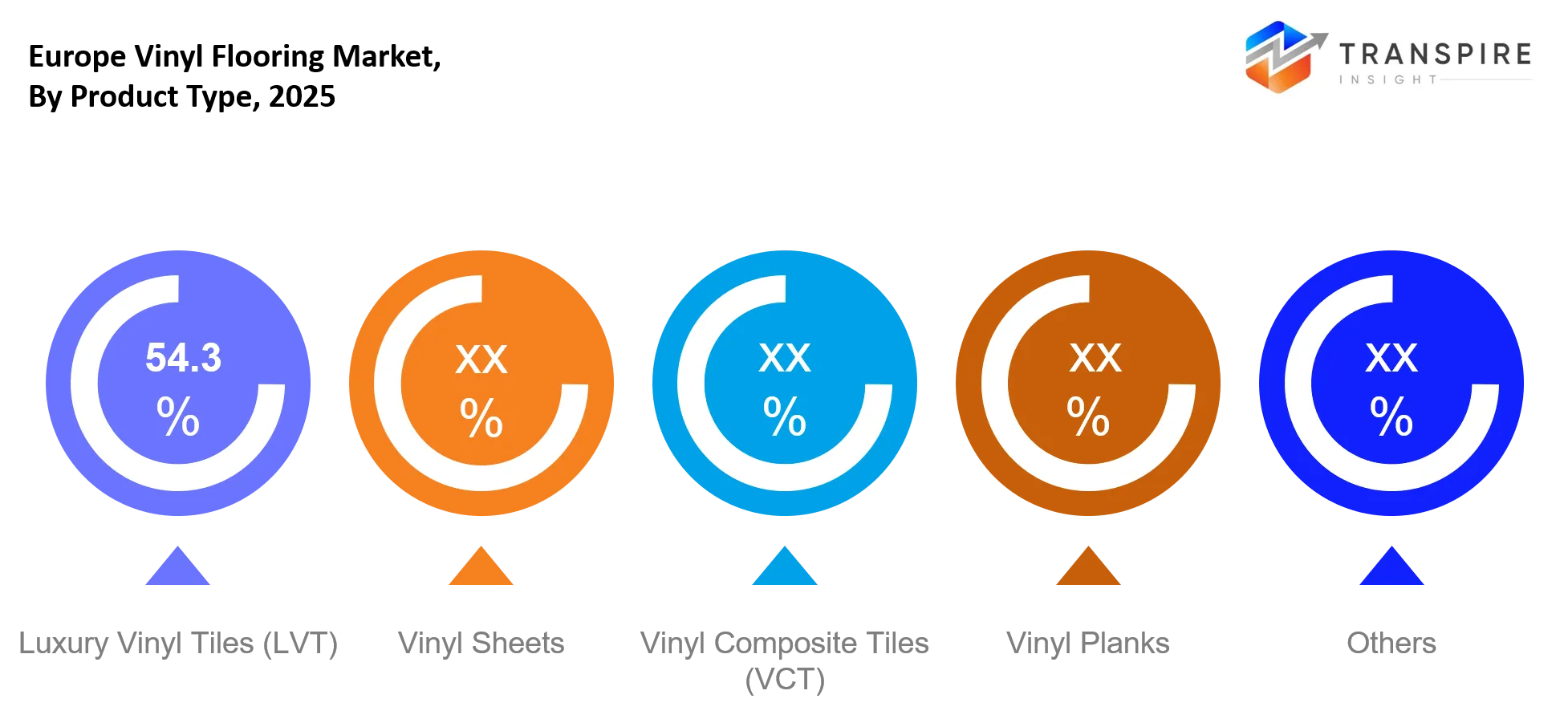
By Application :
Commercial applications take the biggest slice, mainly because offices, shopping centers, hospitality facilities, and public buildings often swap out flooring during renovation jobs. With high foot traffic, better maintenance efficiency, and a long service life, facility owners tend to pick resilient flooring options that can lower operating costs in the long run. On top of that the newer design choices allow commercial properties to refresh interior look and feel, without pushing installation schedules much further.
Residential applications keep growing too, since homeowners put more money into remodeling projects, and they want modern interior upgrades. Industrial sites lean on durable flooring that can handle daily operations, while healthcare and education environments usually want hygienic surfaces that are easy to keep clean. There are also other use cases that open extra business avenues, like specialized infrastructure and institutional projects where dependable flooring performance is a real requirement.
By Installation Type :
Glue-down installation still seems like the go-to choice, mostly due to strong bonding strength and dependable over time performance, especially in high-traffic commercial settings. You see this method a lot in large retail spaces, hospitals, schools, and office buildings, because it helps keep everything steady and also cuts down on those ongoing upkeep chores a bit. Many professional installers lean toward glue-down systems too, particularly for big jobs where you really need consistent outcomes.
Click lock systems keep showing solid growth, in part because faster fitting reduces labor hours and can lower project costs during residential makeovers. Loose lay flooring, meanwhile, works well when you need flexibility for temporary setups or for places where replacement should happen quickly. And of course, the other installation options can be matched to more specific needs, depending on the building design, the flooring requirements, and what the maintenance plan is trying to achieve.
By Distribution Channel :
Specialty stores still act like the main distribution route , because when customers shop there they typically get technical guidance, product comparisons and even installation recommendations before deciding to buy. At the same time, professional contractors also lean on specialized retailers for premium flooring collections, project support, and reliably stocked product availability. Those ongoing strong links between manufacturers and specialty distributors keep improving market coverage across Europe, like it’s sort of never stopping.
Meanwhile home improvement stores maintain a wide customer reach thanks to big retail networks and renovation centered product offerings . Online retail keeps growing as digital platforms make product selection easier and they help with price comparisons, and then direct sales support larger commercial projects through manufacturer ties. Beyond that, other distribution channels handle regional dealers and specialized construction supply networks, depending on the area and local demand.
By End User :
Commercial builders, yeah, they are often the leading end-user group, because big build outs and renovation timelines need durable flooring that can handle heavy day to day foot traffic. Over time, buyers keep caring about maintenance budget relief, dependable product functionality, and installation that goes quickly or at least doesn’t drag , and that mix still guides purchase choices across most commercial developments. Also, large institutional builds add some steady procurement volume pretty much through the whole forecast window.
Homeowners are still ramping up their flooring replacements too, mainly when interior renovation work leans toward durability, a more attractive look, and upkeep that’s not a hassle. Contractors keep product demand consistent via installation services for both residential and commercial jobs, plus they tend to recommend flooring depending on the jobsite needs. Other end users show up as institutional buyers and niche property developers, they usually want dependable flooring solutions across a range of construction efforts, not just one narrow style or application.
What are the Key Use Cases Driving the Europe Vinyl Flooring Market?
Commercial buildings are basically the main use case people talk about when it comes to vinyl flooring , you see it most often in offices, retail spaces, hotels, and even healthcare facilities where buying volume stays pretty high. Facility managers and commercial builders tend to pick these durable surfaces for busy foot traffic, straightforward upkeep, good hygiene performance, and also the kind of quicker project finish that helps timelines.
On the residential side, renovation projects and education facilities are getting more attention lately. Homeowners go for vinyl flooring because it is a budget-friendly interior upgrade , while schools and universities choose resilient surfaces for classrooms, corridors, and shared spaces where they want a long service life.
More emerging uses show up too, especially in sustainable construction efforts and modular building developments. Green building programs plus circular material targets are expected to open doors for recycled-content flooring options across European infrastructure projects, and that should matter over time.
|
Report Metrics |
Details |
|
Market size value in 2025 |
USD 6.98 Billion |
|
Market size value in 2026 |
USD 7.30 Billion |
|
Revenue forecast in 2033 |
USD 10.04 Billion |
|
Growth rate |
CAGR of 4.66% from 2026 to 2033 |
|
Base year |
2025 |
|
Historical data |
2021 - 2024 |
|
Forecast period |
2026 - 2033 |
|
Report coverage |
Revenue forecast, competitive landscape, growth factors, and trends |
|
Country scope |
Europe (Germany, United Kingdom, France, Italy, Spain and Rest of Europe) |
|
Key company profiled |
Tarkett, Forbo Flooring Systems, Gerflor, Interface, Mohawk Industries, Armstrong Flooring, Shaw Industries, Beaulieu International Group, Polyflor, Mannington Mills, LG Hausys, NOX Corporation, Milliken & Company, Amtico, Responsive Industries . |
|
Customization scope |
Free report customization (country, regional & segment scope). Avail customized purchase options to meet your exact research needs. |
|
Report Segmentation |
By Product Type (Luxury Vinyl Tiles (LVT), Vinyl Sheets, Vinyl Composite Tiles (VCT), Vinyl Planks, Others); By Application (Residential, Commercial, Industrial, Healthcare, Education, Others); By Installation Type (Glue-Down, Click Lock, Loose Lay, Others); By Distribution Channel (Specialty Stores, Home Improvement Stores, Online Retail, Direct Sales, Others); By End User (Homeowners, Contractors, Commercial Builders, Others) |
Which Regions are Driving the Europe Vinyl Flooring Market Growth?
Western Europe kind of dominates the Europe vinyl flooring industry , with something like 63% of the market share in 2025. this is backed by construction that is pretty mature already, and also by the renovation push that keeps showing up in Germany, France, and the United Kingdom. On top of that, strict environmental standards, circular economy rules, and building efficiency regulations are basically nudging customers toward more advanced flooring products that put out fewer emissions and also get recycled better. There’s also a solid local setup, an ecosystem that includes manufacturers, distributors, contractors, and material suppliers. you can see major production areas across Germany, Belgium, France, and the Netherlands. As commercial refurbishment keeps moving, infrastructure upgrades keep happening, and sustainability-led construction stays in focus, Western Europe is likely to hold onto its leadership through 2033.
Southern Europe, meanwhile, brings a steady revenue base mainly because renovation keeps being consistent across Italy, Spain, and Portugal. In these places, hospitality venues, retail outlets, and home remodeling projects all keep the flooring demand active. The region is a little different though, with a stronger leaning toward tourism related infrastructure, residential enhancement plans, and smaller scale construction investments. This is more common than the big commercial redevelopment cycles you might see elsewhere. Regulatory alignment with European sustainability standards creates a fairly consistent playbook for manufacturers and distributors that operate across these markets. Finally, steady housing upgrades plus modernization of public buildings should keep supporting reliable market contributions throughout the forecast period.
Central and Eastern Europe is showing the fastest growth, during 2025–2033, mostly because manufacturing is expanding, cities are filling out, and infrastructure is being modernized across Poland, Romania, Hungary and the Czech Republic. In the last period , new industrial investments , plus EU backed building programs, and a lot of commercial property development have nudged demand toward flooring that lasts and stays affordable. At the same time distribution networks are widening, and the overall construction costs remain comparatively lower, so international manufacturers are looking in—maybe not just casually, but quite deliberately—for fresh growth chances. All of this regional push makes entry routes more attractive for suppliers, investors and for flooring producers that plan to expand in the window from 2026 to 2033.
Who are the Key Players in the Europe Vinyl Flooring Market and How Do They Compete?
Competition inside the Europe vinyl flooring industry is still kinda moderately consolidated, and the biggest manufacturers usually push ahead via product innovation, sustainability credentials, distribution muscle, and some more specialized flooring solutions. The well known players try to hold their ground by leaning into recycled material development, digital manufacturing, and then bigger product portfolios, while the smaller suppliers tend to win with regional know-how and offerings that are more tailored, even if it is not always that wide.
Tarkett plays it mostly through sustainable flooring innovation, so they bring products with recycled content plus environmental certifications that basically help green building projects move faster. They also keep expanding by using circular flooring initiatives, and then they design solutions for healthcare, education, and commercial spaces at once. Forbo Flooring Systems is more about specialized resilient flooring technologies, including low emission products and design oriented collections meant for institutional applications, not just general installations. Their edge seems to be the mix of sustainability features, and European distribution capabilities that are pretty solid.
Gerflor leans into healthcare sports, and commercial flooring segments by developing hygienic, high performance surfaces. The specialization, plus sector specific solutions, helps them sit stronger versus general flooring suppliers. IVC Group expands through a wide spread of residential and commercial product ranges, manufacturing efficiency, and distribution partnerships, which in turn improve how available things are region by region. Taken together, these approaches let the companies compete through differentiated products, not only price competition and that's it.
Company List
- Tarkett
- Forbo Flooring Systems
- Gerflor
- Interface
- Mohawk Industries
- Armstrong Flooring
- Shaw Industries
- Beaulieu International Group
- Polyflor
- Mannington Mills
- LG Hausys
- NOX Corporation
- Milliken & Company
- Amtico
- Responsive Industries
Recent Development News
In April 2026, Forbo Flooring Systems introduced updated 2026 vinyl flooring collections including Novilon Scandinavia and Allura Decibel solutions. The product launches expand acoustic performance, recycled material options, and flexible installation features, supporting adoption in residential and commercial renovation projects across Europe.
Source https://www.forbo.com/
In 2025, Forbo Flooring Systems expanded its vinyl portfolio with updated Eternal, Modul’up, and Sarlon ranges focused on design, performance, and sustainability improvements. The development strengthened circular flooring offerings through adhesive-free solutions and faster installation options for commercial building applications. Source https://www.forbo.com/
What Strategic Insights Define the Future of the Europe Vinyl Flooring Market?
Over the next five to seven years, the Europe vinyl flooring industry is likely to drift toward solutions that are higher-value, more sustainable, and also digitally optimized, partly because building regulations, renovation programs, and circular economy targets keep showing up in purchasing decisions. There’s a quiet risk too, raw material dependency, especially around PVC related supply constraints and that annoying price volatility, could end up squeezing margins even if revenue growth stays relatively steady.
Another issue might show up from alternative flooring technologies, like bio-based materials, if the sustainability requirements get tightened. Still, the best opening feels closer to recycled-content flooring and advanced manufacturing processes, mainly across Central and Eastern Europe where construction modernization is still moving. Market players should put effort into circular production systems, tighter regional supply networks, and low-emission product development, so they can be more resilient and catch the demand that comes next. Companies that manage to blend sustainability compliance with cost efficient manufacturing will probably end up with a stronger position by 2033.
Europe Vinyl Flooring Market Report Segmentation
By Product Type
- Luxury Vinyl Tiles (LVT)
- Vinyl Sheets
- Vinyl Composite Tiles (VCT)
- Vinyl Planks
By Application
- Residential
- Commercial
- Industrial
- Healthcare
- Education
By Installation Type
- Glue-Down
- Click Lock
- Loose Lay
By Distribution Channel
- Specialty Stores
- Home Improvement Stores
- Online Retail
- Direct Sales
By End User
- Homeowners
- Contractors
- Commercial Builders
Frequently Asked Questions
Find quick answers to common questions.
The Expected Europe Vinyl Flooring Market size for the Market will be USD 10.04 Billion in 2033.
Key segments for the Europe Vinyl Flooring Market are By Product Type (Luxury Vinyl Tiles (LVT), Vinyl Sheets, Vinyl Composite Tiles (VCT), Vinyl Planks, Others); By Application (Residential, Commercial, Industrial, Healthcare, Education, Others); By Installation Type (Glue-Down, Click Lock, Loose Lay, Others); By Distribution Channel (Specialty Stores, Home Improvement Stores, Online Retail, Direct Sales, Others); By End User (Homeowners, Contractors, Commercial Builders, Others) .
Major Europe Vinyl Flooring Market players are Tarkett, Forbo Flooring Systems, Gerflor, Interface, Mohawk Industries, Armstrong Flooring, Shaw Industries, Beaulieu International Group, Polyflor, Mannington Mills, LG Hausys, NOX Corporation, Milliken & Company, Amtico, Responsive Industries .
The current Europe Vinyl Flooring Market size is USD 6.98 Billion in 2025.
The Europe Vinyl Flooring Market CAGR is 4.66% from 2026 to 2033.
- Tarkett
- Forbo Flooring Systems
- Gerflor
- Interface
- Mohawk Industries
- Armstrong Flooring
- Shaw Industries
- Beaulieu International Group
- Polyflor
- Mannington Mills
- LG Hausys
- NOX Corporation
- Milliken & Company
- Amtico
- Responsive Industries
About the Authors

Kartik bhong
I am Kartik Bhong, a Senior Research Analyst at Transpire Insight, specializing in the Packaging, Manufacturing, and Construction industry. My work focuses on analyzing market trends, emerging technologies, industry regulations, and competitive landscapes to deliver accurate, data-driven insights. I am passionate about transforming complex industry information into clear, practical content that helps businesses, professionals, and decision-makers stay informed and make confident strategic decisions. Through continuous research and a strong commitment to accuracy, I strive to create reliable, well-researched content that reflects the latest developments across these dynamic industries and supports the vision of Transpire Insight in delivering valuable market intelligence.

Chakradhar Khansole
Chakradhar serves as the Research Director at Transpire Insight, bringing over 8 years of experience in technology, innovation, and strategic market intelligence. He specializes in transforming complex market data into actionable business insights that enable organizations to make informed, growth-oriented decisions. Recognized for his strategic vision and analytical expertise, Chakradhar leads high-impact research initiatives, delivering comprehensive market assessments, competitive intelligence, and forward-looking industry analysis.
Recently Published Reports
-
Apr 2026
Handling and Lifting Equipment Market
Handling and Lifting Equipment Market Size, Share & Analysis Report By Product (Cranes and Hoists, Forklifts, Conveyor Systems, Aerial Work Platforms, Others), By Application (E-Commerce, Automotive and Railway, Food and Beverages, Aviation, Others), and Geography (North America, Europe, Asia-Pacific, Middle East and Africa, South and Central America), 2021 - 2031
-
Apr 2026
HVAC Equipment Market
HVAC Equipment Market Size, Share & Analysis Report By Heating Equipment Type (Boilers and Furnaces, Heat Pumps, and Unitary Heaters), By Ventilation Equipment (Air Handling Units, Humidifiers and Dehumidifiers, Air Filters, and Fan Coiling Units), By Air Conditioning Equipment (Unitary Air Conditioners, Room Air Conditioners, Packaged Terminal Air Conditioners, and Chillers), By End User (Commercial, Residential, Industrial, and others), and Geography (North America, Europe, Asia-Pacific, Middle East and Africa, South and Central America), 2021 – 2031
-
Apr 2026
Refrigeration Valves Market
Refrigeration Valves Market Size, Share & Analysis Report By Type (Solenoid Valves, Expansion Valves, Check Valves, Service Valves, Others), By Application (Commercial Refrigeration, Industrial Refrigeration, Transport Refrigeration, Residential Refrigeration, Air Conditioning Systems), By End User (Food and Beverage Industry, Pharmaceutical Industry, HVAC Industry, Chemical Industry, Others), and Geography (North America, Europe, Asia-Pacific, Middle East and Africa, South and Central America), 2021 – 2031
-
Apr 2026
E-Commerce Packaging Materials Market
E-Commerce Packaging Materials Market By Material Type (Corrugated Boxes, Paper & Paperboard, Foam & Cushioning Materials, Plastic Packaging, Flexible Packaging, Protective Packaging, Others), By Product(Primary Packaging, Secondary Packaging, Tertiary Packaging), By Packaging Function (Protective Packaging, Branding & Presentation Packaging, Transit & Logistic Packaging, Sustainable Packaging, Tamper Evidence Packaging), By End-User (Retail & Consumer Goods, Electronic Appliances, Food & Beverages, Healthcare & Pharmaceutical, Fashion & Apparel, Home & Furnishing, Others); By Industry Analysis, Size, Share, Growth, Trends, and Forecasts 2021-2033