
Europe Telecom Billing and Revenue Management System Market Summary
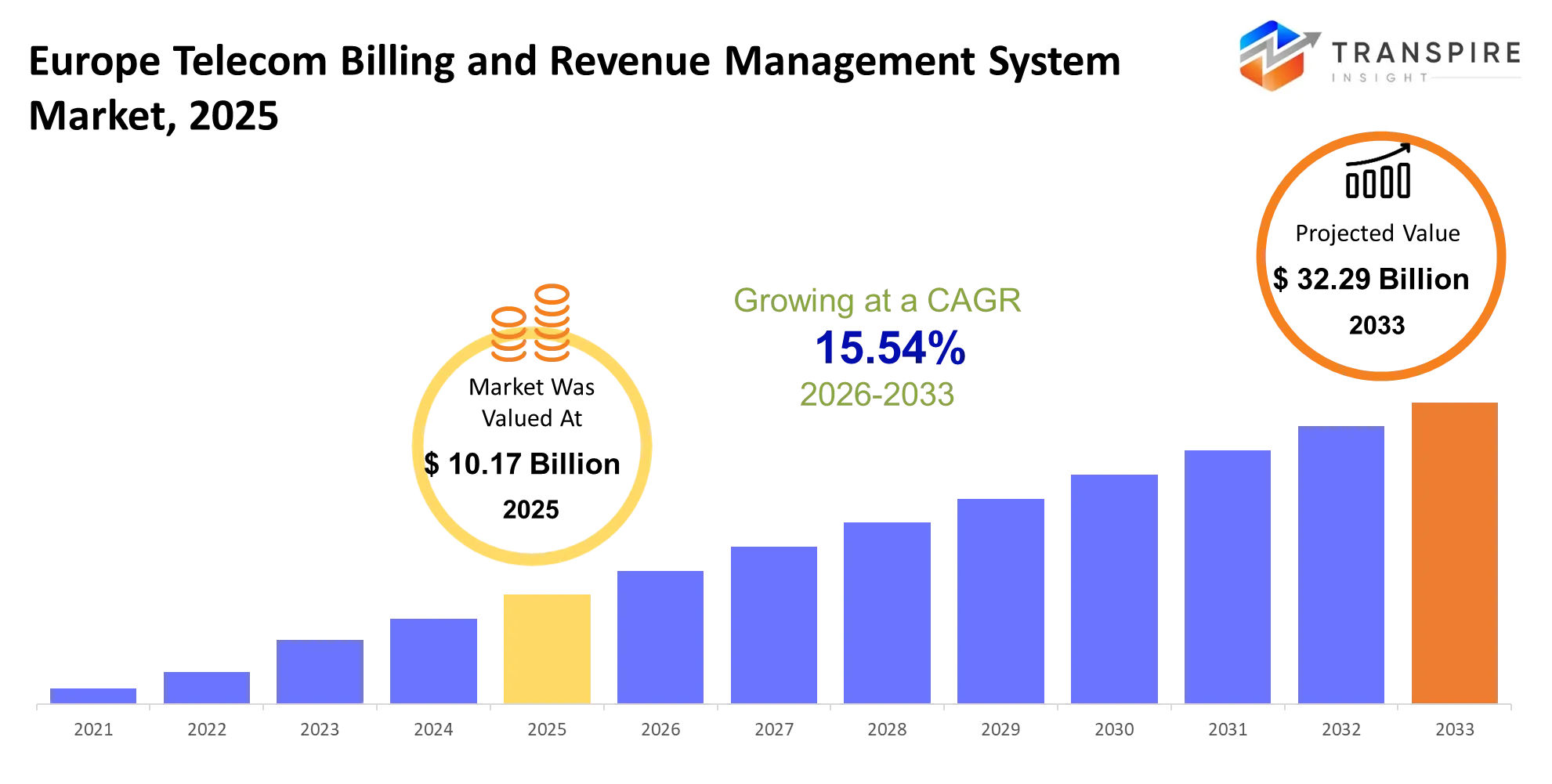
As per Transpire Insight Analysis the Europe Telecom Billing and Revenue Management System Market size is estimated at USD 10.17 Billion in 2025 and is anticipated to reach USD 32.29 Billion by 2033, growing at a CAGR of 15.54% from 2026 to 2033.
The Europe telecom billing and revenue management system market covers how operators set prices, run subscriptions, match usage data, stop lost revenue, and sell newer services. These newer services include 5G, IoT, and work that sits on digital platforms.
In the past three to five years, many operators moved away from old billing setups. They moved toward cloud based tools that connect through APIs. This shift happened because 5G and IoT made billing harder. Charging now needs more options and faster updates.By the end of 2024, Europe had over 200 million 5G connections. That figure was about 30% of all mobile connections. With that scale, operators needed more flexible real time charging and better ways to monetize services.
Europe Telecom Billing and Revenue Management System Market Size & Forecast:
- Europe Telecom Billing and Revenue Management System Market Size 2025: USD 10.17 Billion
- Expected Market Value 2033: USD 32.29 Billion
- Forecast CAGR: 15.54%
- Leading region in 2025: Europe
- Fastest Growing region: Western Europe
- Key Profile: Amdocs, Ericsson, Nokia, Netcracker Technology, CSG, Oracle, Optiva, Hansen Technologies, MATRIXX Software, Cerillion, Tecnotree, Comarch, Sigma Systems, Openet, Salesforce
Key Market Insights
- Europe made up about 27% of the worldwide telecom billing and revenue management market. This was helped by rules that operators must meet and by efforts to modernize older systems.
- In Western Europe, adoption is stronger than elsewhere. Many carriers are upgrading their billing setup to handle 5G services, cloud offerings, IoT use, and new digital products.
- Software is still the top category of solutions. At the same time, managed services and professional services are showing more demand. This happens as operators try to cut down on the complexity of their internal systems.
- Cloud plans are also growing quicker. Telecom firms want platforms that can scale, handle multi service charging, and let them launch products sooner.
- Mobile operators are the biggest group of buyers. Recent market estimates put them at more than 60% of global telecom billing revenue.
- By the end of 2024, 5G made up 30% of mobile connections in Europe. That share has pushed the need for charging that can change with service types.
- By 2030, the outlook says 5G will reach about 80% of European connections. That should open more chances for monetization tools that can support new models.
- Fraud checks are getting more attention. AI based detection, spotting unusual events, revenue assurance, and customer analytics are now key ways companies try to stand out.
- IoT and enterprise connectivity bring more varied usage patterns. Because of that, many operators want to move away from fixed legacy rating and charging designs.
- The GSMA Open Gateway is also playing a role. It is growing API based monetization, which pushes billing vendors to support faster, real time revenue management through APIs
What are the Key Drivers, Restraints, and Opportunities in the Europe Telecom Billing and Revenue Management System Market?
5G rollout is the main reason the market is growing. A few things depend on it, like slicing, IoT connections, business tools, and pay plans that scale with usage. Those areas need quicker response and more adaptable billing.
By the end of 2024, Europe passed 200 million 5G links. That adds a bigger pool of users to monetize with newer billing and charging tools.
Still, there are limits. Older network and billing systems are a hurdle. Many large firms run layered payment setups. Replacing them takes costly work, including migration, system linking, testing, and checks tied to rules.
Costs also weigh on operators. Spectrum prices take a large share of budgets. In Europe, spectrum spending has been around 8% of ongoing mobile operator revenue.
The best path ahead is cloud-first revenue systems. These platforms can use 5G APIs, handle IoT, support real-time charging, and improve revenue checks through automation.
GSMA Open Gateway is also a sign of momentum. By December 2024, it had 67 operator groups on board worldwide. European carriers made up more than 20% of those commitments, which helps open the door to new API-led revenue models.
What Has the Impact of Artificial Intelligence Been on the Europe Telecom Billing and Revenue Management System Market?
AI is altering how telecom billing works. It helps with fraud checks, revenue assurance, customer grouping, usage review, and anomaly monitoring. Instead of only using fixed rules, machine learning can look across huge billing records. It may spot odd usage, repeated charges, shady transactions, or possible revenue loss quicker than older systems.
AI can also support forecasts. It can find behavior patterns in customers, estimate how much service they will use, and help operators shape more specific offers. The GSMA sees this shift as a key change in Europe’s mobile space, along with 5G, IoT, and the Open Gateway work.
Better analytics can cut down on manual reviews. That can lead to quicker billing decisions and less back-and-forth for teams. Even so, older data setups still cause trouble. Past records may be messy or not consistent. OSS and BSS systems can be split across different stacks. New integrations can also cost a lot. These issues can lower how accurate models are and can raise project costs.
For these reasons, AI use in billing relies on cleaner data. It also needs modern APIs, clear governance, and a solid link to the billing systems that are already in place.
Key Market Trends
- In 2024, 5G made up about 30% of mobile links across Europe. That push is now driving more spending on flexible charging and monetization tools.
- Many carriers are leaving fixed billing dates behind. They want charges that match what customers use, right now. This shift is tied to 5G, IoT, and services that vary with usage.
- Older systems are also being swapped out. Cloud-native platforms are taking their place. Operators seem focused on shipping products faster. They also want to spend less effort on day to day infrastructure work.
- Revenue checks are changing too. Instead of doing set audits, more teams are using AI to spot odd behavior as it happens. They then route cases for review and follow up.
- The GSMA Open Gateway effort is picking up speed. By December 2024, 67 operator groups had signed on. The goal is to back monetization that runs through APIs.
- In Europe, carriers are putting more weight on 5G standalone. Monetization is shifting toward business accounts. It also leans on network slicing and more specialized connection offers.
- Traffic has climbed a lot. It went from 3 GB per month in 2019 to 15 GB in 2024. Along with that, operators are looking for money beyond basic connectivity.
- Hybrid cloud is starting to matter more. Operators want the scale of cloud while still meeting rules on data location. They also care about security and other regulatory needs.
- Enterprise IoT billing is getting more complex. With connected devices in the mix, usage is split up. Pricing and settlement needs are also harder to manage.
Europe Telecom Billing and Revenue Management System Market Segmentation
By Solution Type:
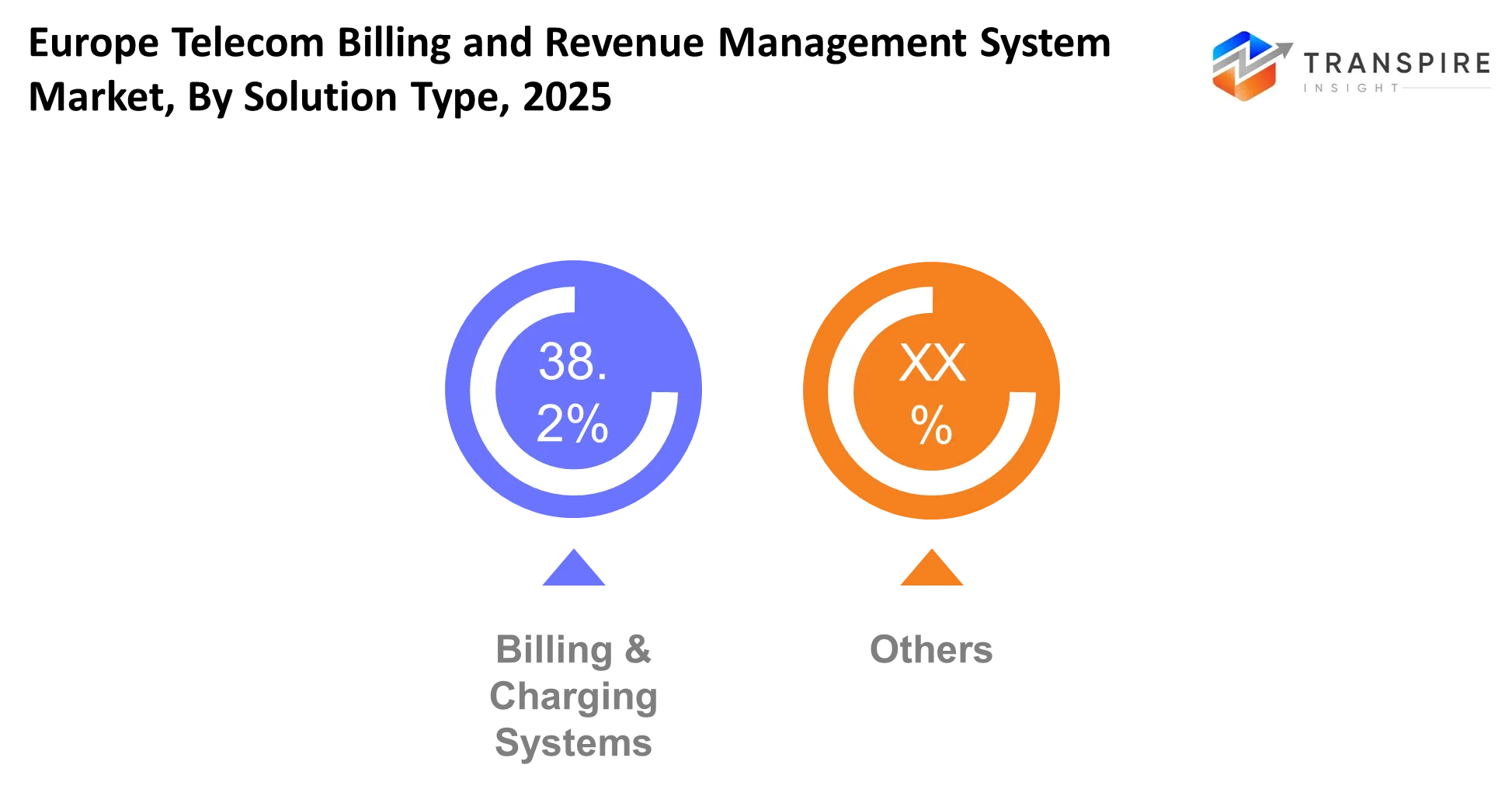
Billing platforms handle customer profiles, bills, repeat charges, usage logs, discounts, and payment details. This type of system still matters for mobile, broadband, business plans, and online services. When invoices are right, the business can collect money on time. Revenue management covers tracking money, setting prices, monitoring margin levels, and spotting revenue loss across telecom services. Charging systems work out what a customer owes from the usage they generate. They use plans, bundles, and subscription rules to price services.
Mediation systems gather and sort network usage records first. After that, billing and charging can run. Rating systems then apply tariffs and price rules to the stored usage. They also apply discounts and package terms.
Partner management supports deals, commission terms, settlement steps, and revenue share work. Fraud management looks for odd payment behavior, sign up tricks, and strange usage trends. Revenue assurance checks for billing misses and helps cut losses between network usage, charging, invoicing, and final revenue collection.
By Deployment:
Cloud-based deployment helps telecom firms adjust billing without being tied to fixed hardware. It can also bring extra compute online sooner when demand shifts.
Some operators prefer an on-prem setup. They get tighter oversight of day to day changes. This model can also fit special platform requirements. In this case, company data stays in the local site and follows stricter rules.
A hybrid approach mixes cloud tools with on-site systems. It can support a slower, safer move away from older billing platforms. Teams can keep what still works while adding new pieces.
With SaaS, billing software is provided as a paid service. A team can start using it quickly. They usually do not have to handle most infrastructure chores.
Private cloud runs on dedicated resources. Teams often have more say over how security rules are set. It also shapes data access and how data is managed inside the setup.
Public cloud tends to ramp up quickly. It can grow when load rises, so billing can handle peak usage with less delay.
Hosted models shift some infrastructure duties to another provider. The billing software still runs in its own separate environments.
An edge-based model puts billing and charging near the network sites. This can lower wait times for services that spread across many locations.
By Service Type:
Setup and tune a professional services support platform. This includes configuration, upgrades, and migration work. It also covers technical improvements as needed.
Managed services move specific billing tasks to outside specialists. They handle things like infrastructure monitoring. They also run maintenance and day to day administration.
Consulting services help telecom teams with billing choices. They guide tech selection and help plan system architecture. The goal is to improve revenue.
System integration links billing systems to other tools. That can include CRM and OSS. It can also include BSS, network systems, payments, and enterprise apps.
Implementation services cover installing billing platforms. They cover configuration, testing, and migration. They also support deployment.
Maintenance services keep the billing software current. They manage updates and push performance improvements. They apply security changes too. They also handle technical fixes.
Support services respond to system incidents. They address configuration issues and troubleshooting. They provide operational help when problems show up.
Training services build staff skills. This includes billing administration. It also covers revenue assurance, analytics, and platform management.
By Application:
Mobile Billing takes care of charges for calls, texts, data, and subscriptions. It also covers bundles and other services tied to mobile connectivity.
Fixed Broadband Billing runs the billing for internet plans. It handles regular payments, charges for equipment, and upgrades when customers change plans.
Enterprise Billing is built for business needs. It covers tough contract terms, different account setups, and usage plans. It also supports pricing that is set for each business customer.
IoT Billing charges for connected devices. It can use plans that are paid by subscription, usage tracking, or charges tied to events.
Roaming Management works out what customers owe when they travel. It also helps settle payments between operators across outside networks.
Interconnect Billing handles money moves between operators. This includes deals for voice and data traffic passing between networks.
Wholesale Billing manages pricing and settlements for network providers. It also supports agreements with partners who provide connectivity.
Digital Services Billing covers cloud and online services. It supports subscriptions and purchases for apps, content, security, and similar digital offerings.
By Operator Type:
Mobile Network Operators rely on billing tools to handle customer accounts. These tools cover data plans, roaming, 5G access, and business accounts.
Fixed-Line Operators run phone and internet services. They also sell leased lines and other subscriptions. Their billing is usually tied together in one system.
MVNOs need billing that can adjust as customers change. They also manage customers while riding on a host mobile network.
Broadband Providers bill for internet plans. They also charge for add-on packages and hardware fees. Updates to service can also show up on the bill.
Cable Operators offer more than internet. They often bundle TV, phone, and broadband. Billing is handled with an integrated charging setup.
Satellite Operators use billing made for links in the sky. They bill for connection and capacity. They also handle business links and ongoing contract renewals.
Enterprise Telecom Providers work with big customer billing. They track contract terms, usage, and service promises. Many accounts need detailed invoices and clear terms.
Digital Service Providers sell online services. They use billing for subscriptions, apps, and cloud plans. Digital payments are processed as part of the service.
By Region:
The UK has telecom systems that are already well built. People also use digital services a lot. The country keeps backing faster connection upgrades.
Germany is a big telecom player in Europe. Firms need reliable connections there. 5G is being rolled out in many areas. Updates to major networks are also ongoing.
France has solid mobile coverage and broadband access. New work continues on fast, high-capacity digital networks.
Spain is pushing ahead with 5G. More network spending is helping too. This creates room for better billing tools and ways to earn more from services.
Italy can gain from upgrades to broadband. 5G is expanding there as well. Companies are also moving through more digital change.
The Netherlands uses strong connection infrastructure. Cloud services are adopted quickly by many users.
Sweden has advanced digital foundations. It is also ready for 5G. This supports demand for smarter ways to monetize telecom services.
Switzerland has mature connectivity. 5G take up is high. That drives interest in tools for charging, billing, and managing telecom income.
What are the Key Use Cases Driving the Europe Telecom Billing and Revenue Management System Market?
Mobile and broadband billing stays a key job for operators. They handle huge numbers of plans, monthly fees, usage details, price cuts, and bundles. As 5G grows, billing gets harder too. Operators now roll out new enterprise connections, slicing options in the network, and plans that charge by measured use.
Billing for IoT and for business customers is picking up momentum. Sensors and connected gear keep sending many different usage records. Roaming, wholesale, and interconnect work add more steps. Deals across operators and partners need settlement and rating done by software, not by hand.
New areas are also forming. One example is charging via APIs. This links to efforts like the GSMA Open Gateway. Some teams are also using tools to improve revenue checks and to stop fraud. In Europe, more firms are adopting 5G standalone. That opens chances for charging in real time, tied to what the network can do.
|
Report Metrics |
Details |
|
Market size value in 2025 |
USD 10.17 Billion |
|
Market size value in 2026 |
USD 11.75 Billion |
|
Revenue forecast in 2033 |
USD 32.29 Billion |
|
Growth rate |
CAGR of 15.54% from 2026 to 2033 |
|
Base year |
2025 |
|
Historical data |
2021 - 2024 |
|
Forecast period |
2026 - 2033 |
|
Report coverage |
Revenue forecast, competitive landscape, growth factors, and trends |
|
Regional scope |
Europe |
|
Key company profiled |
Amdocs, Ericsson, Nokia, Netcracker Technology, CSG, Oracle, Optiva, Hansen Technologies, MATRIXX Software, Cerillion, Tecnotree, Comarch, Sigma Systems, Openet, Salesforce |
|
Customization scope |
Free report customization (country, regional & segment scope). Avail customized purchase options to meet your exact research needs. |
|
Report Segmentation |
By Solution Type (Billing Systems, Revenue Management, Charging Systems, Mediation Systems, Rating Systems, Partner Management, Fraud Management, Revenue Assurance); By Deployment (Cloud-Based, On-Premise, Hybrid, SaaS, Private Cloud, Public Cloud, Hosted, Edge-Based); By Service Type (Professional Services, Managed Services, Consulting, System Integration, Implementation, Maintenance, Support, Training); By Application (Mobile Billing, Fixed Broadband Billing, Enterprise Billing, IoT Billing, Roaming Management, Interconnect Billing, Wholesale Billing, Digital Services Billing); By Operator Type (Mobile Network Operators, Fixed-Line Operators, MVNOs, Broadband Providers, Cable Operators, Satellite Operators, Enterprise Telecom Providers, Digital Service Providers); By Region (UK, Germany, France, Spain, Italy, Netherlands, Sweden, Switzerland) |
Which Regions are Driving the Europe Telecom Billing and Revenue Management System Market Growth?
Western Europe stays in front. Germany, the UK, and France have big telecom customer groups. Their digital networks are also well developed. Operators keep upgrading billing stacks. They are pushing 5G out further. This helps drive spending on charging tools and revenue management. In Germany, the enterprise telecom scene is especially heavy. That leads to more needs for detailed invoicing and tailored rates. The whole region has long lived carriers, plus vendor partners, cloud firms, and system integrators.
Northern Europe grows in a more steady way. The drivers here are quick digital uptake and good tech readiness. Sweden, Denmark, Norway, and Finland use cloud services in depth. They also lean on automation and new 5G offerings. Because of that, there is steady demand for billing tools that can change with the market. People expect better service, and that pushes operators toward faster real time charging. It also pushes more focus on digital services that feel personal. With ongoing funding and a stable tech base, the region can keep contributing in a dependable way.
Eastern Europe is likely to rise faster. Many operators are replacing older platforms. They are also rolling out more digital services. Bulgaria and Poland are putting more money into cloud native BSS and revenue management. Recent setup work supports this move. Netcracker’s push in February 2026, tied to Bulgarian operator Vivacom, points to rising demand for systems that can scale. This may open doors for vendors that offer cost light cloud migration, automation, and flexible billing options up to 2033.
Who are the Key Players in the Europe Telecom Billing and Revenue Management System Market and How Do They Compete?
Competition is still mostly with big telecom tech firms. Smaller vendors often try to win with flexible cloud setups and quicker rollouts. Amdocs keeps building its edge with wide monetization tools and purchases. Ericsson puts more weight on cloud-native charging that ties closely to 5G network gear. Netcracker pushes an all-in-one approach with Digital BSS plus revenue management. That helps operators update billing without throwing out everything.
Amdocs added charging tools by buying MATRIXX Software for around $197 million. The deal brought in real-time charging and monetization tech. Ericsson takes a different tack by linking charging to the network. In its February 2026 MasOrange deal, Ericsson combined 5G Core with Ericsson Charging and Billing Evolved. Netcracker leans into modernization work in Europe. One example is Vivacom. The firm upgraded to Netcracker’s next-generation Revenue Management platform in Bulgaria.
Company List
- Amdocs
- Ericsson
- Nokia
- Netcracker Technology
- CSG
- Oracle
- Optiva
- Hansen Technologies
- MATRIXX Software
- Cerillion
- Tecnotree
- Comarch
- Sigma Systems
- Openet
- Salesforce
Recent Development News
- "In December 2025, Amdocs completed the acquisition of MATRIXX Software for approximately $197 million. The acquisition added real-time charging and rating capabilities to Amdocs’ telecom monetization portfolio and strengthened support for 5G and digital services.https://investors.amdocs.com/news-releases/news-release-details/first-quarter-results-fiscal-2026 (Amdocs)."
- "In February 2026, Ericsson entered a strategic partnership with MasOrange for 5G Standalone network deployment. The agreement includes Ericsson Charging and Billing Evolved, enabling faster design, launch, and monetization of new 5G services in Spain.https://www.ericsson.com/en/press-releases/3/2026/ericsson-and-masorange-sign-agreement-for-5g-core (Ericsson)."
- "In February 2026, Netcracker Technology extended its partnership with Vivacom for an IT modernization program. Vivacom will upgrade to the latest Netcracker Revenue Management platform to improve billing scalability, system performance, and support for B2C and B2B services in Bulgaria.https://netcracker.com/news/press-releases/netcracker-and-vivacom-extend-long-term-partnership-for-innovative-it-modernization-program (Netcracker Technology)."
What Strategic Insights Define the Future of the Europe Telecom Billing and Revenue Management System Market?
Cloud systems are taking over, and teams want faster billing and AI help. At the same time, 5G and IoT are bringing more devices and more connected work to manage. Enterprise connectivity is also getting more complex, so monetization is no longer simple.
One risk is vendor lock-in. Big operators can end up relying on only a few BSS vendors that offer a full stack. When that happens, it costs more to switch later. It can also make competition weaker.
There is also a real chance here. Operators can charge in near real time for 5G network features. This can include better connectivity options and services that can be changed through the network.
To act well, companies should use modular platforms. They should ask for open APIs. They should also pick a cloud setup that can move easily. Finally, they need an AI-ready design so they can launch new revenue ideas without doing a full system swap.
Europe Telecom Billing and Revenue Management System Market Report Segmentation
By Solution Type
- Billing Systems
- Revenue Management
- Charging Systems
- Mediation Systems
- Rating Systems
- Partner Management
- Fraud Management
- Revenue Assurance
By Deployment
- Cloud-Based
- On-Premise
- Hybrid
- SaaS
- Private Cloud
- Public Cloud
- Hosted
- Edge-Based
By Service Type
- Professional Services
- Managed Services
- Consulting
- System Integration
- Implementation
- Maintenance
- Support
- Training
By Application
- Mobile Billing
- Fixed Broadband Billing
- Enterprise Billing
- IoT Billing
- Roaming Management
- Interconnect Billing
- Wholesale Billing
- Digital Services Billing
By Operator Type
- Mobile Network Operators
- Fixed-Line Operators
- MVNOs
- Broadband Providers
- Cable Operators
- Satellite Operators
- Enterprise Telecom Providers
- Digital Service Providers
By Region
- UK
- Germany
- France
- Spain
- Italy
- Netherlands
- Sweden
- Switzerland
Frequently Asked Questions
Find quick answers to common questions.
The expected Europe Telecom Billing and Revenue Management System Market size for the market will be USD 32.29 Billion in 2033.
Key segments for the Europe Telecom Billing and Revenue Management System Market are By Solution Type (Billing Systems, Revenue Management, Charging Systems, Mediation Systems, Rating Systems, Partner Management, Fraud Management, Revenue Assurance); By Deployment (Cloud-Based, On-Premise, Hybrid, SaaS, Private Cloud, Public Cloud, Hosted, Edge-Based); By Service Type (Professional Services, Managed Services, Consulting, System Integration, Implementation, Maintenance, Support, Training); By Application (Mobile Billing, Fixed Broadband Billing, Enterprise Billing, IoT Billing, Roaming Management, Interconnect Billing, Wholesale Billing, Digital Services Billing); By Operator Type (Mobile Network Operators, Fixed-Line Operators, MVNOs, Broadband Providers, Cable Operators, Satellite Operators, Enterprise Telecom Providers, Digital Service Providers); By Region (UK, Germany, France, Spain, Italy, Netherlands, Sweden, Switzerland).
Major Europe Telecom Billing and Revenue Management System Market players are Amdocs, Ericsson, Nokia, Netcracker Technology, CSG, Oracle, Optiva, Hansen Technologies, MATRIXX Software, Cerillion, Tecnotree, Comarch, Sigma Systems, Openet, Salesforce.
The Europe Telecom Billing and Revenue Management System Market size is USD 10.17 Billion in 2025.
The Europe Telecom Billing and Revenue Management System Market CAGR is 15.54% from 2026 to 2033.
- Amdocs
- Ericsson
- Nokia
- Netcracker Technology
- CSG
- Oracle
- Optiva
- Hansen Technologies
- MATRIXX Software
- Cerillion
- Tecnotree
- Comarch
- Sigma Systems
- Openet
- Salesforce
About the Authors

Mayur Shinde
I am Mayur Shinde, a Senior Research Analyst at Transpire Insight, specializing in the Automotive & Transportation and Information & Communication Technology (ICT) Industry. My work focuses on analyzing emerging market trends, technological advancements, competitive landscapes, and industry developments to deliver accurate, data-driven insights. I am passionate about transforming complex market information into clear, actionable content that helps businesses, professionals, and decision-makers stay informed and make confident strategic decisions.

Chakradhar Khansole
Chakradhar serves as the Research Director at Transpire Insight, bringing over 8 years of experience in technology, innovation, and strategic market intelligence. He specializes in transforming complex market data into actionable business insights that enable organizations to make informed, growth-oriented decisions. Recognized for his strategic vision and analytical expertise, Chakradhar leads high-impact research initiatives, delivering comprehensive market assessments, competitive intelligence, and forward-looking industry analysis.
Recently Published Reports
-
Apr 2026
3D Optical Profiler Market
3D Optical Profiler Market Size, Share & Analysis Report By Type (Desktop 3D Optical Profiler, and Portable 3D Optical Profiler), By Technology (Confocal Technology, and White Light Interference), By End-Use Industry (Manufacturing, Research Institutions, Automotive, Aerospace and Defense, Medical Devices, and Other), and Geography (North America, Europe, Asia-Pacific, Middle East and Africa, South and Central America), 2021 - 2031
-
Apr 2026
Depth Sensor Market
Depth Sensor Market Size, Share & Analysis Report By Type (Infrared Depth Sensors, Time-of-Flight (ToF) Sensors, Stereo Vision Sensors, Structured Light Sensors, Ultrasonic Depth Sensors), By Application (Automotive, Robotics, Gaming, Consumer Electronics, Industrial Automation, Healthcare, Security & Surveillance, Others), By End Users (Automotive Manufacturers, Consumer Electronics Companies, Healthcare Providers, Industrial Companies, Security Agencies, Gaming Companies, Robotics Companies, Others), and Geography (North America, Europe, Asia-Pacific, Middle East and Africa, South and Central America), 2021 – 2031
-
Apr 2026
Digital Manufacturing Market
Digital Manufacturing Market Size, Share & Analysis Report By Component (Hardware, Software, and Services), By Technology (Robotics, 3D Printing, Internet of Things (IoT), and Others), By Application (Automotive and Transportation, Aerospace and Defense, Consumer Electronics, Industrial Machinery, and Others), By Process Type (Computer-Based Designing, Computer-Based Simulation, Computer 3D Visualization, Analytics, and Others), and Geography (North America, Europe, Asia-Pacific, Middle East and Africa, South and Central America), 2021 – 2031
-
Apr 2026
Digital Visa Services Market
Digital Visa Services Market Size, Share & Analysis Report By Type (Individual Travelers, Group Travelers), By Application (Tourism, Business Travel, Others), and Geography (North America, Europe, Asia-Pacific, Middle East and Africa, South and Central America), 2021 – 2031