

Europe Second Hand Apparel Market Summary
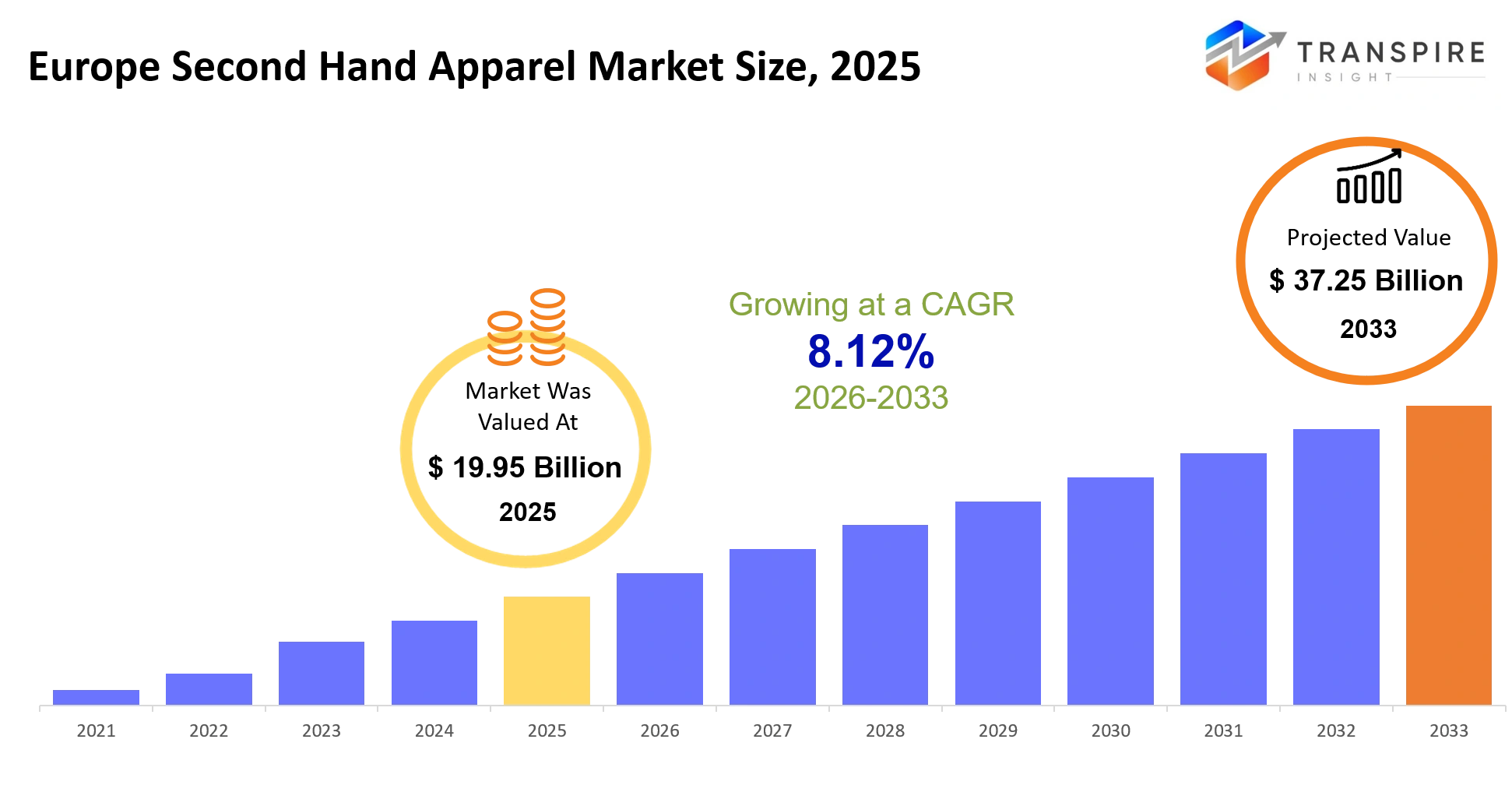
As per Transpire Insight Analysis the Europe Second Hand Apparel Market size is estimated at USD 19.95 Billion in 2025 and is anticipated to reach USD 37.25 Billion by 2033, growing at a CAGR of 8.12% from 2026 to 2033.
The Europe secondhand apparel market kinda extends the usable life of clothing by tying together consumers resale platforms, retailers and donation channels, which then cuts down on textile waste yet still gives people affordable style choices, sorta like a circular routine that feels less heavy on resources.This whole space has moved ,from mostly charity based resale toward more digitally enabled and professionally run commerce, and it kinda serves both value seeking shoppers and also premium brand resale. Over the last five years, tighter European sustainability policies and circular economy projects have pushed brands to treat resale as part of their longer term business plan, not just an afterthought.At the same time supply chain disruptions and inflation that came after the COVID-19 period sort of changed how people buy , so now a lot more consumers look at pre-owned apparel, without feeling like they must accept a lower quality. In practical terms, these shifts widen the product supply, make authenticated resale services more solid and they also push retailers to launch dedicated recommerce programs. And as trusted resale ecosystems mature, transaction volumes, platform revenues, and partnerships across fashion brands, logistics providers, and digital marketplaces should keep driving the market’s commercial pull, even a bit more than before.
Europe Second Hand Apparel Market Size & Forecast:
- Europe Second Hand Apparel Market Size 2025: USD 19.95 Billion
- Expected Market Value 2033: USD 37.25 Billion
- Forecast CAGR: 8.12%
- Leading region in 2025: Germany, the United Kingdom, France, and the Netherlands
- Fastest Growing region: Spain, Italy, Poland, Portugal, and Romania
- Key Profile: Vinted, Vestiaire Collective, Depop, eBay, ThredUp, Poshmark, Zalando Pre-owned, H&M Pre-Loved, The RealReal, Beyond Retro, Oxfam, Goodwill, Buffalo Exchange, Mercari, Grailed.
Key Market Insights
- Western Europe basically owned the Europe Second Hand Apparel Market in 2025, with roughly 56% share, kinda backed by Germany , the United Kingdom, France and the Netherlands.
- Meanwhile Southern and Eastern Europe will stay the quickest regional mover in 2025–2033, mainly steered by Spain, Italy, Poland , Portugal and Romania, plus more marketplace expansion happening over time.
- On the product side, casual apparel took the lead with close to 48% market share in 2025. This happened because resale cycles keep repeating, and shoppers keep showing up with pretty steady purchasing habits.
- Luxury and premium apparel showed up as the second biggest chunk, supported by authentication services , and premium resale platforms that continue spreading across major European cities.
- Children’s apparel is expected to grow the fastest all the way through 2033, largely due to brief ownership periods and a higher resale rhythm among families.
- For channels, online resale platforms accounted for about 68% market share in 2025, which signals continued digital marketplace growth, plus more cross-border buying.
- Looking at devices, mobile-first resale applications will likely see the quickest adoption through 2033 , enabled by AI-based suggestions and simpler payment flows.
- As for users, individual consumers stayed the main end-user group with nearly 72% market share in 2025, reflecting how common peer-to-peer trading and platform resale is.
- Finally, fashion brands and retailers are set to expand the quickest through 2033 as recommerce programs get folded into longer-term retail plans.
What are the Key Drivers, Restraints, and Opportunities in the Europe Second Hand Apparel Market?
The strongest driver is that circular retail keeps getting pushed into the mainstream, kinda quickly, thanks to European sustainability rules and Extended Producer Responsibility initiatives. Fashion brands now see resale as a steady recurring revenue stream, not just some “disposal fallback” thing. Digital marketplaces have also cut down transaction friction, mostly by automating pricing, authentication, and logistics connections. With that change, inventory starts turning over faster, and then premium brands feel more comfortable moving into recommerce too. When more branded players show up, people trust the whole system more, the range of items available goes up, and transaction values tend to run higher across the regional resale ecosystem.
Still, authentication consistency is the biggest structural bottleneck, and it stays pretty stubborn. Counterfeit risks show up, product quality can vary, and fragmented grading standards make things feel less predictable especially for cross-border deals. To handle it, companies have to invest in inspection infrastructure, digital verification tools, and logistics networks, but those fixes can't be rolled out evenly everywhere in a short period. From the Transpire Insight review of regional procurement announcements and launch schedules, supply chain concentration still looks like the main execution danger. So you end up with slower platform scaling, delayed premium category expansion, and weaker marketplace revenue even while consumer adoption looks favorable and steady.
The next growth stage is likely to show up via AI-enabled identity verification, digital product passports, and retailer-run resale networks. Big apparel players keep pouring money into integrated recommerce platforms, where new supply and secondhand stock sit together, kinda seamlessly. In particular, Southern, and Eastern Europe feel like a real opportunity too, partly because digital payments are getting more common, and marketplace involvement keeps rising. Overall these trends should help strengthen cross-border commerce, lift resale values, and unlock more monetization channels for brands, logistics operators, and the marketplace folks.
What Has the Impact of Artificial Intelligence Been on the Europe Second Hand Apparel Market?
Artificial intelligence is sorta transforming apparel resale, by taking over listing creation , doing image recognition, sorting products into categories , and also helping with counterfeit detection across digital markets. With computer vision, systems can spot garment attributes from the photos people upload, while natural language models make more standardized product narratives, which boosts search visibility and also cuts down the manual work. Then there is machine learning, it predicts resale values by looking at older transactions, seasonal buying habits, and brand momentum, so platforms can adjust pricing and decide where inventory should sit. Those predictive tools end up helping sell through faster, meaning fewer items stay unsold, and listings usually get activated quicker. On top of that AI recommendation engines guide shoppers in a more personal way, which tends to raise conversion rates and supports repeat purchases throughout online recommerce spaces.
Retailers that plug in recommerce operations also lean on analytics to estimate how many returns might happen, and they allocate warehouse capacity more precisely, lowering fulfillment costs and improving day to day operations. Still, AI adoption has a bunch of limitations. There are high implementation costs, historical product data can be messy or inconsistent, and different image quality makes the models less accurate, especially with vintage pieces and luxury fashion. Smaller resale platforms often don’t have the budgets or the well structured datasets needed for advanced AI deployment, so adoption moves slower across the wider European second-hand fashion ecosystem.
Key Market Trends
- Since 2022, branded resale programs have been expanding in a kind messy way, fashion retailers are integrating pre-owned collections into their existing online and offline retail channels.
- AI-powered authentication tools have really helped with luxury resale verification since 2023, which cuts down on manual inspections, and that also ends up strengthening buyer confidence, more or less.
- Cross-border marketplace transactions have been speeding up across the European Union because digital payment systems are simpler now, and logistics partnerships are more integrated.
- Premium fashion resale has shifted to authenticated commerce, with Vestiaire Collective and Vinted expanding their verification abilities during recent platform upgrades, yep.
- Children’s apparel resale is gaining momentum too, since shorter ownership cycles usually mean higher inventory turnover than most adult apparel categories.
- Retailers are also putting more money into digital product passport readiness, ahead of the evolving European circular economy regulations that are expected to reshape apparel traceability and well everything around it.
- Mobile commerce keeps nudging desktop purchases aside, so app- based resale platforms are now grabbing more of those repeat buys, in particular among younger consumers.
- Meanwhile, reverse logistics networks have gotten more tuned since 2021, which helps them gather, check, refurbish, and then route items around across regional operations.
- Strategic partnerships between fashion brands and resale platforms are moving product recirculation along faster, while also creating ongoing revenue chances beyond only primary apparel sales.
Europe Second Hand Apparel Market Segmentation
By Product Type:
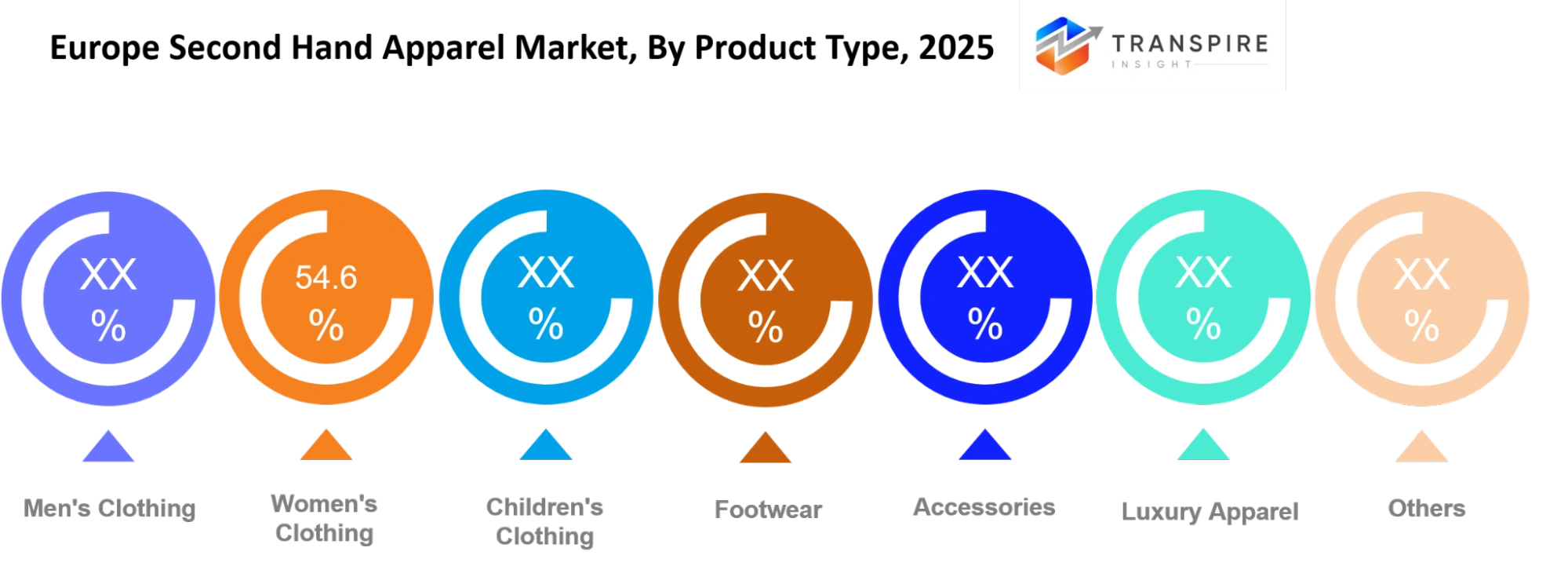
Women’s clothing takes the biggest slice of the market, largely because resale activity stays high across everyday fashion , seasonal drops and also branded apparel. People tend to refresh their wardrobes often enough, so there’s this fairly dependable stream of good-condition items, which helps resale platforms and stores keep a wide selection. On top of that, premium labels and designer lines keep holding resale value better, so both sellers and shoppers get more motivated to join in more regularly. Men’s clothing comes next, with pretty stable results since formal wear, casual outfits, and outerwear keep showing consistent resale movement.
Children’s clothing is seeing the quickest growth, mostly because kids grow so fast, the useful life of items ends sooner, and that naturally pushes repeat resales and repeat buying. Footwear plus accessories are also still pulling in buyers, especially those who want recognizable brands but at a lower price point. Luxury apparel does well too, since authentication services make it easier for shoppers to trust what they’re getting, and that confidence matters. Other categories round things out and add extra variety, so the whole marketplace stays broad and can attract more customer groups at once.
By Distribution Channel:
Online resale platforms kind of lead the market, because digital tools make it easier to list items, set the price, manage payment, and handle delivery. Mobile apps, image recognition, and reliable payment methods really improve everyday convenience, while also widening cross border transactions , without too much friction. Big marketplaces keep putting money into authentication and logistics, so the whole buying and selling experience feels smoother, more predictable. Meanwhile peer to peer platforms keep moving with real momentum through direct consumer exchanges, plus more flexible pricing arrangements.
Thrift stores and charity shops still matter a lot, since physical inspection helps a lot of shoppers trust what they’re getting . Consignment stores also support premium apparel resale by offering professional verification and a curated collection style. Other distribution paths remain useful for niche customer groups and local neighborhoods, in their own small way. Overall digital and physical retail formats together create a sort of balanced resale ecosystem across various European countries .
By End User:
Women are seen as the leading end-user segment, mainly since fashion replacement cycles stay more frequent across a bunch of apparel categories. There is strong pull coming from branded fashion, luxury resale, and seasonal lineups which keeps transaction volumes higher. On top of that digital resale platforms offer curated, almost tailored suggestions, so people end up buying more often within this group. Men follow as the second-largest share because there is steady demand for casual items, business attire, and also premium clothing.
Children are the fastest-growing end-user category, partly because clothing has to be swapped more often during early development phases. Unisex apparel keeps expanding too, as minimalist trends and gender-neutral collections get more common. Other customer groups bring in extra sales through more niche style preferences and value-minded purchasing habits. Overall, broad participation across different ages helps the business stay stable over the long run.
By Price Range:
Mid range apparel seems to dominate mostly because it has that kind of balanced pricing that pulls in value focused shoppers , and also buyers who want branded stuff but without the whole premium retail cost vibe. Product availability stays solid across casual workwear and the seasonal drops , so the number of purchases keeps moving. Even economy products do pretty well too , mainly because they help make everyday clothing easier to reach across different income groups. Meanwhile premium apparel still keeps demand steady thanks to authenticated branded resale , which kind of makes people more comfortable.
Luxury apparel is seeing the quickest expansion, especially as authentication technology gets better and users feel more confident about high value exchanges. Stronger digital verification lowers counterfeit worries , and that somehow invites more participation from premium brands. The other pricing levels also matter , since they give buyers more room to adjust to their spending mindset. In general, these balanced pricing options make the market more reachable across several customer segments.
By Application:
Casual wear takes the biggest slice because day to day outfits are, well constantly swapped out and they still stay good enough for resale again and again. There is also broad availability, pricing that looks doable, and fashion taste that keeps shifting ,which all help keep transaction volume moving without pause. Formal wear comes in next since work clothing, event clothing, and business clothing usually keep their resale value longer. Sportswear holds up fairly steady too, mainly because branded activewear stays in demand and performs well in the market.
Sportswear will show the quickest rise because more people are getting into fitness, and premium athletic brands keep backing resale activity . Ethnic wear meanwhile opens up seasonal buying moments during cultural events and celebrations, which keeps the cycle lively. The other application categories also widen the product mix and pull in smaller niche audiences. With this kind of strong category diversification, the commercial growth should keep going across resale platforms and regular retail channels.
What are the Key Use Cases Driving the Europe Second Hand Apparel Market?
Casual apparel is still basically the main use case, because everyday clothing tends to get passed around more often than those occasion oriented outfits. Like, individuals, students, and working professionals often grab pre-owned casual wear so they can reach branded fashion for less, and also so they don’t just ditch the items early. Digital resale platforms make all of this easier with quick listings, safe payments, and a pretty wide assortment of products.
Luxury apparel resale, plus children’s clothing, are getting more attention as secondary uses. Some fashion retailers run branded recommerce programs, meant to pull back some value from their premium collections. Meanwhile, families keep buying secondhand kids clothing, mainly because the garments become unusable as children grow, you know, fast. Both of these scenarios get a boost from authentication services, and from resale networks that are more organized.
Looking ahead, a few newer use cases are starting to show up. Retailer-operated take-back programs connect to circular economy rules, and there are also digital product passport initiatives showing up across Europe. On top of that, corporate fashion collections and uniform recovery programs seem like real future opportunities, since organizations want more structured textile reuse, and that can help cut disposal expenses while still supporting sustainability goals.
|
Report Metrics |
Details |
|
Market size value in 2025 |
USD 19.95 Billion |
|
Market size value in 2026 |
USD 21.57 Billion |
|
Revenue forecast in 2033 |
USD 37.25 Billion |
|
Growth rate |
CAGR of 8.12% from 2026 to 2033 |
|
Base year |
2025 |
|
Historical data |
2021 - 2024 |
|
Forecast period |
2026 - 2033 |
|
Report coverage |
Revenue forecast, competitive landscape, growth factors, and trends |
|
Country scope |
Europe (Germany, United Kingdom, France, Italy, Spain and Rest of Europe) |
|
Key company profiled |
Vinted, Vestiaire Collective, Depop, eBay, ThredUp, Poshmark, Zalando Pre-owned, H&M Pre-Loved, The RealReal, Beyond Retro, Oxfam, Goodwill, Buffalo Exchange, Mercari, Grailed. |
|
Customization scope |
Free report customization (country, regional & segment scope). Avail customized purchase options to meet your exact research needs. |
|
Report Segmentation |
By Product Type (Men's Clothing, Women's Clothing, Children's Clothing, Footwear, Accessories, Luxury Apparel, Others); By Distribution Channel (Online Resale Platforms, Thrift Stores, Consignment Stores, Charity Shops, Peer-to-Peer Platforms, Others); By End User (Men, Women, Children, Unisex, Others); By Price Range (Economy, Mid-Range, Premium, Luxury, Others); By Application (Casual Wear, Formal Wear, Sportswear, Ethnic Wear, Others). |
Which Regions are Driving the Europe Second Hand Apparel Market Growth?
In 2025 Western Europe accounted for roughly 56% of regional revenue, so it ends up being the main regional market. The thing is, strict circular economy regulations plus fairly advanced digital commerce infrastructure, along with textile waste policies that actually support it, end up encouraging resale activity that is more organized, across Germany, the United Kingdom, France and the Netherlands. You can see it in the way large resale platforms, authentication providers, logistics networks, and fashion brands work together, kind of like an integrated ecosystem, that keeps product circulation moving efficiently. And because companies keep investing in digital resale technology, retailer-operated recommerce programs, plus cross border marketplace expansion, the region should keep its leading position across most of the forecast period.
Northern Europe, meanwhile, feels structurally different, or at least the contribution is. Here, long standing sustainability policies and stable consumer purchasing habits make resale activity more predictable rather than something that grows super fast. Sweden, Denmark, Finland, and Norway do well with consistent regulatory frameworks that push textile reuse, and organized collection systems too. Also high digital adoption, plus dependable logistics infrastructure, helps the marketplaces run steady transactions throughout the year. So overall Northern Europe looks like a reliable revenue contributor, with resilient performance even when the broader economy shifts.
Southern and Eastern Europe are going to see the quickest growth between 2026 and 2033, kinda like Spain, Italy, Poland, Portugal, and Romania keep pushing ahead with digital resale infrastructure, and also with marketplace involvement. More money going into e-commerce capabilities, plus wider take up of mobile payments, and more retailers joining in have helped speed up organized second hand apparel deals across these countries. At the same time expanding circular economy efforts, and more solid cross-border logistics connections are making it easier for platforms to grow, and for branded recommerce to expand too. All of this momentum should open up solid possibilities for brand new marketplace operators, tech providers, logistics firms, and fashion brands that want to grow across the region during the forecast period.
Who are the Key Players in the Europe Second Hand Apparel Market and How Do They Compete?
Competition is still kinda fragmented, because international marketplaces, regional resale platforms, fashion retailers, and specialist luxury resellers, they basically chase different customer segments, at the same time. And it’s not only about pricing, not even close. Stuff like technology, authentication quality, platform convenience, and logistics efficiency tend to shape the competitive stance. Meanwhile, the established marketplace operators keep upgrading their digital toolkit, while newer platforms come in with more focused offerings, like premium fashion, local community vibes, or buyer groups that are more specific than average.
Vinted leans into low cost peer to peer transactions, with easy listing tools and shipping options bundled in, so it feels quick to reach high transaction volumes. Vestiaire Collective is more about luxury authentication and expert verification, which basically boosts buyer confidence when it comes to premium fashion resale. Zalando instead is expanding branded recommerce by plugging pre owned apparel into its existing retail operations , so customers can buy both new and second hand items through one interface.
eBay stays competitive by using artificial intelligence that helps with product discovery, pricing suggestions, and search accuracy across apparel listings. Depop targets younger fashion buyers by mixing social commerce features with creator-led selling experiences , which helps build community engagement and brings people back for repeat transactions. All these different approaches support growth through technology spending, platform upgrades, strategic partnerships, plus wider geographic reach across European countries.
Company List
- Vinted
- Vestiaire Collective
- Depop
- eBay
- ThredUp
- Poshmark
- Zalando Pre-owned
- H&M Pre-Loved
- The RealReal
- Beyond Retro
- Oxfam
- Goodwill
- Buffalo Exchange
- Mercari
- Grailed
Recent Development News
In April 2026, Vinted completed an €880 million secondary share transaction led by EQT and new investors, valuing the company at €8 billion. The investment strengthened the shareholder base and reinforced financial capacity for continued platform expansion across the European resale market.
Source: https://www.reuters.com/
In April 2025, Vinted expanded operations by launching services in Estonia, Latvia, and Slovenia while investing in new product categories and logistics capabilities. The strategic expansion increased cross-border marketplace reach and supported higher transaction volumes across Europe's second-hand apparel ecosystem.
Source: https://www.reuters.com/
What Strategic Insights Define the Future of the Europe Second Hand Apparel Market?
The Europe Second Hand Apparel Market seems to be moving toward a more connected circular retail model, where resale is becoming sort of the normal part of how fashion value chains work, not a separate store thing. In the next five to seven years, digital authentication , retailer-run recommerce platforms, and the evolving textile regulations are likely to push this shift in structure.
There is also a less noticeable risk, it’s growing market concentration. Basically a few big digital platforms could end up with more control over pricing, seller access and even cross-border transactions, which might quietly form barriers for smaller participants.
On the other side, an emerging opportunity is digital product passports. These should make garments easier to trace, and they should also simplify the resale verification step as European regulatory frameworks continue to mature. Market players will likely benefit if they invest early in authentication technology, better data sharing capabilities, and partnerships with logistics providers as well as fashion brands , so they can build scalable resale ecosystems before regulatory demands ramp up and competitive pressure grows even more.
Europe Second Hand Apparel Market Report Segmentation
By Product Type
- Men's Clothing
- Women's Clothing
- Children's Clothing
- Footwear
- Accessories
- Luxury Apparel
By Distribution Channel
- Online Resale Platforms
- Thrift Stores
- Consignment Stores
- Charity Shops
- Peer-to-Peer Platforms
By End User
- Men
- Women
- Children
- Unisex
By Price Range
- Economy
- Mid-Range
- Premium
- Luxury
By Application
- Casual Wear
- Formal Wear
- Sportswear
- Ethnic Wear
Frequently Asked Questions
Find quick answers to common questions.
The expected Europe Second Hand Apparel Market size for the market will be USD 37.25 Billion in 2033.
Key segments for the Europe Second Hand Apparel Market are By Product Type (Men's Clothing, Women's Clothing, Children's Clothing, Footwear, Accessories, Luxury Apparel, Others); By Distribution Channel (Online Resale Platforms, Thrift Stores, Consignment Stores, Charity Shops, Peer-to-Peer Platforms, Others); By End User (Men, Women, Children, Unisex, Others); By Price Range (Economy, Mid-Range, Premium, Luxury, Others); By Application (Casual Wear, Formal Wear, Sportswear, Ethnic Wear, Others).
Major Europe Second Hand Apparel Market players are Vinted, Vestiaire Collective, Depop, eBay, ThredUp, Poshmark, Zalando Pre-owned, H&M Pre-Loved, The RealReal, Beyond Retro, Oxfam, Goodwill, Buffalo Exchange, Mercari, Grailed.
The Europe Second Hand Apparel Market size is USD 19.95 Billion in 2025.
The Europe Second Hand Apparel Market CAGR is 8.12% from 2026 to 2033.
- Vinted
- Vestiaire Collective
- Depop
- eBay
- ThredUp
- Poshmark
- Zalando Pre-owned
- H&M Pre-Loved
- The RealReal
- Beyond Retro
- Oxfam
- Goodwill
- Buffalo Exchange
- Mercari
- Grailed
About the Authors

Chetan Dhatrak
I’m Chetan Dhatrak, a Senior Research Analyst at Transpire Insight, specializing in the Consumer Goods, Foods and Beverages industry. I focus on analyzing market trends, consumer behavior, competitive landscapes, and industry developments to deliver accurate, data-driven insights. My research at Transpire Insight is built on credible sources and in-depth analysis, helping businesses and readers better understand market dynamics, emerging opportunities, and evolving consumer preferences. I’m committed to creating reliable, well-researched content that supports informed decision-making and reflects the latest developments in the consumer goods and food & beverage sectors.

Chakradhar Khansole
Chakradhar serves as the Research Director at Transpire Insight, bringing over 8 years of experience in technology, innovation, and strategic market intelligence. He specializes in transforming complex market data into actionable business insights that enable organizations to make informed, growth-oriented decisions. Recognized for his strategic vision and analytical expertise, Chakradhar leads high-impact research initiatives, delivering comprehensive market assessments, competitive intelligence, and forward-looking industry analysis.
Recently Published Reports
-
Apr 2026
Bottled Water Market
Bottled Water Market Size, Share & Analysis Report By Product Type (Still Bottled Water, Carbonated Bottled Water, Functional Bottled Water, and Others), By Packaging (PET, Cans, and Others), By Sales Channel (Supermarkets/Hypermarkets, Convenience Stores/Drug Stores, Grocery Stores/Club Stores, Foodservice, and Others) and Geography (North America, Europe, Asia-Pacific, Middle East and Africa, South and Central America), 2021 - 2032
-
Apr 2026
Color Cosmetic Packaging Market
Color Cosmetic Packaging Market Size, Share & Analysis Report By Application (Mascara Packaging, Liquid Packaging, and Liquid Face), By Type (Tubes & Bottles, Pens & Markers, Compacts & Containers, and Droppers & Pumps), and Geography (North America, Europe, Asia-Pacific, Middle East and Africa, South and Central America), 2021 - 2031
-
Apr 2026
External Microphone For Camera Market
External Microphone For Camera Market Size, Share & Analysis Report By Type (Shotgun Microphone, Lavalier Microphone, and Others), By Application (Digital Camera, Professional Video Camera, and Others), and Geography (North America, Europe, Asia-Pacific, Middle East and Africa, South and Central America), 2021 - 2031
-
Apr 2026
Foot Orthotic Insoles Market
Foot Orthotic Insoles Market Size, Share & Analysis Report By Type (Pre-fabricated, and Custom-made), By Material (Thermoplastic, Composite Carbon Fiber, and Others), By Distribution Channel (Drug Stores, Hospitals & Clinics, and Others), and Geography (North America, Europe, Asia-Pacific, Middle East and Africa, South and Central America), 2021 - 2031