

Europe Robotic Pool Cleaner Market Summary
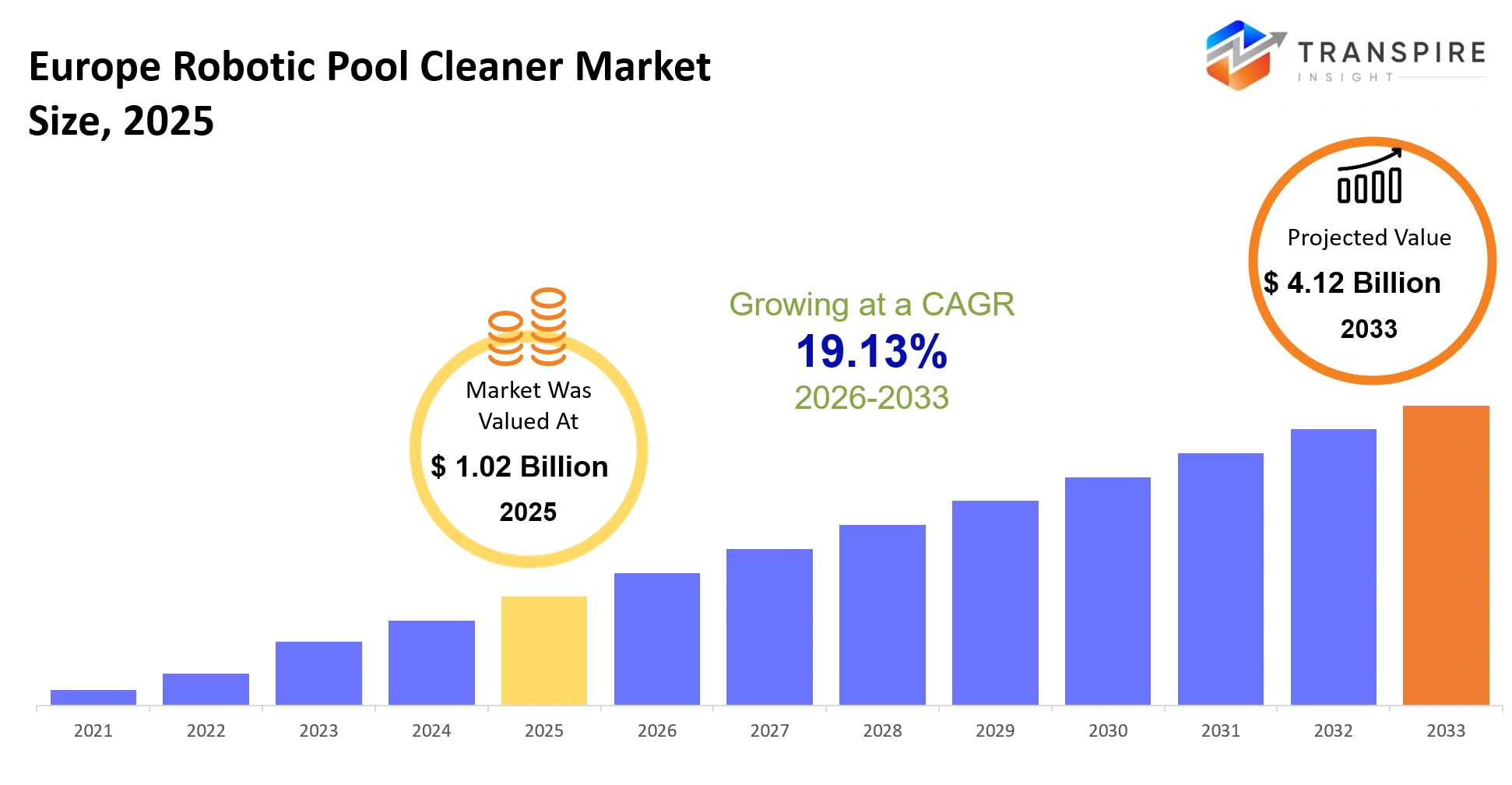
As per Transpire Insight Analysis the Europe Robotic Pool Cleaner Market size is estimated at USD 1.02 Billion in 2025 and is anticipated to reach USD 4.12 Billion by 2033, growing at a CAGR of 19.13% from 2026 to 2033.
The Europe Robotic Pool Cleaner Market basically helps pool owners and operators in residential, commercial, and hospitality environments by taking over routine cleaning chores that would otherwise demand a lot of manual labor , extra time, and careful water circulation management. In practice these units handle debris removal, they scrub pool surfaces, and they support better water quality too. That means the people running pools can cut down on upkeep expenses, use energy more sensibly, and keep hygiene standards steady across private homes, hotels, wellness centers, and even public recreation sites.
In the last three to five years, the market moved away from plain automated cleaning devices toward smarter sensor based robotic platforms with app connectivity. They also rely on navigation algorithms and more energy efficient operation , which sounds like a small change but it really matters. Meanwhile, Europe pushed tighter sustainability goals and electricity prices kept climbing, especially after the regional energy crisis that followed the Russia-Ukraine conflict. So investment shifted toward efficient pool maintenance technologies. When operating expenses started weighing more heavily, many buyers leaned toward robots that lower power usage and also reduce chemical consumption. That whole shift broadened adoption not only in upscale homes but also across commercial sites, which builds stronger replacement demand and keeps supporting higher value product sales around the region.
Europe Robotic Pool Cleaner Market Size & Forecast:
- Europe Robotic Pool Cleaner Market Size 2025: USD 1.02 Billion
- Expected Market Value 2033: USD 4.12 Billion
- Forecast CAGR: 19.13%
- Leading region in 2025: Western Europe
- Fastest Growing region: Eastern Europe
- Key Profile: Maytronics, Fluidra, Zodiac, Hayward, Pentair, Aiper, Water Tech, Mariner 3S, Kokido, Wybotics, Intex, BWT, Bestway, Aquatron, Dolphin Robotics
Key Market Insights
- Western Europe basically owned the Europe robotic pool cleaner scene in 2025, taking about 68% of the market share ,and that was mostly backed by dense residential pool setups plus solid, long standing distribution routes.
- Eastern Europe meanwhile looks like the fastest mover during 2025–2033, like really quickly growing, since hospitality infrastructure is expanding and newer housing keeps popping up with private swimming poolsincluded.
- When you zoom into product analysis, cordless robotic pool cleaners were on top with around 56% market share in 2025, helped by better battery output and that whole simpler installation story.
- Corded robotic pool cleaners still sit as the second major group, because commercial users keep preferring nonstop, continuous cleaning sessions for larger pools.
- AI-enabled smart robotic cleaners are expected to be the fastest growing product line by 2033. This is supported by improved navigation techniques, app based connectivity, and software updates that can roll out over time.
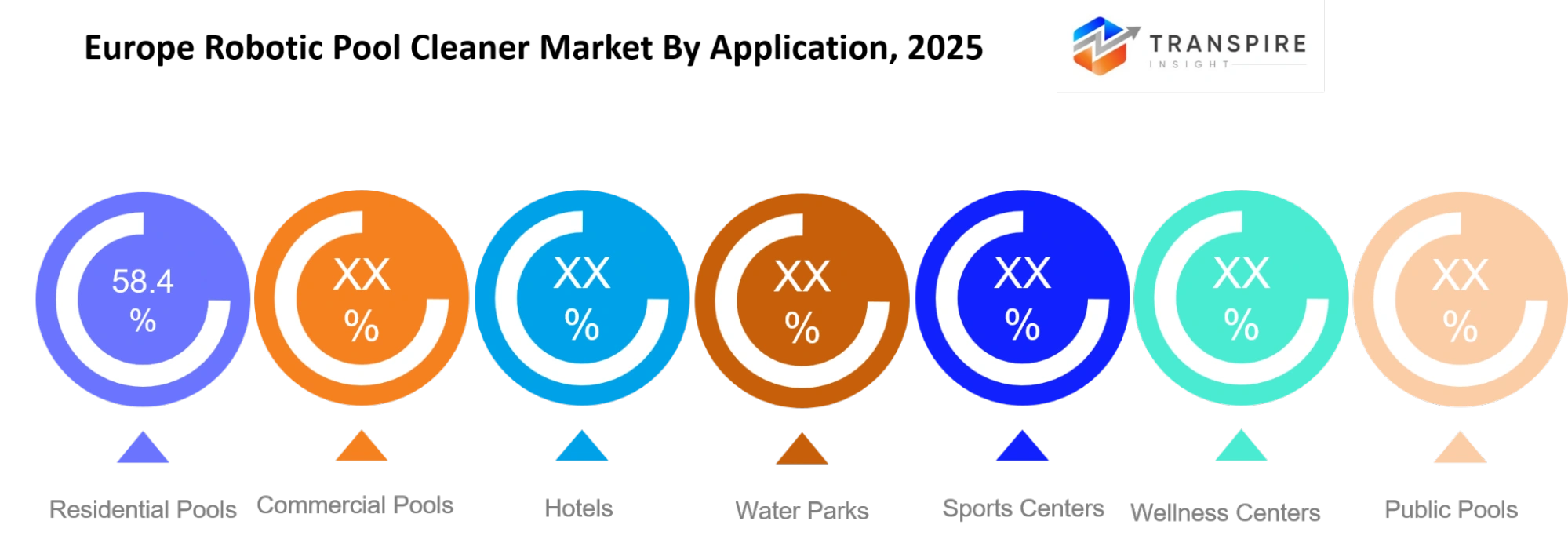
- For applications, residential swimming pools still dominated, around 61% revenue share in 2025, which tracks with replacement buys and a steady shift toward premium automation.
- Commercial swimming pools are projected to show the quickest application expansion through 2033, driven by hotels, wellness centers, and municipal leisure venues upgrading their upkeep operations.
- On the end-user side, residential homeowners stayed in front with roughly 64% market share in 2025, and that’s largely tied to stronger spending on smart home equipment.
- Finally, hospitality and leisure operators are expected to become the quickest growing end-user segment from 2025–2033 ,since labor optimization is turning into a strategic investment priority.
What are the Key Drivers, Restraints, and Opportunities in the Europe Robotic Pool Cleaner Market?
The main growth driver is basically the move to automated, energy efficient pool upkeep backed by higher day to day operating costs across Europe. With electricity getting more expensive and expectations around performance getting tighter, many operators started swapping the older suction, and pressure based cleaners, for robotic alternatives. Then improvements in battery technology, smarter route finding, and less need for constant water circulation helped dial down operating expenses, over time. Together, this kind of effect shortened the time it takes to get the investment back and it also helped premium item sales climb across hotels, sports venues, and even private residential properties.
The biggest limiting factor is still the high upfront price plus the reliance on specialized electronic parts. A lot of premium robotic cleaners can end up costing several times what traditional cleaning systems cost, so buyers that are more price sensitive tend to postpone the decision to replace what they already have. From a Transpire Insight look at regional buying notices and launch timing, the supply chain clustering is still the main execution problem. Availability of semiconductors, battery sourcing, and the procurement of electronics keep shaping manufacturing timelines. All of this tends to hold back near term revenue because deliveries get delayed and product replacement cycles stretch out longer than planned.
The most powerful opportunity seems to sit in AI-driven autonomous cleaning platforms that plug into smart pool ecosystems. Cloud connectivity, predictive diagnostics, and software-guided optimization are getting treated more like a baseline than some fancy, premium add on. In particular, Western European hospitality investments plus the ongoing rise of smart home installations are setting up good deployment conditions. Manufacturers that pair subscription-based software services with connected hardware will likely end up with sturdier recurring revenue, and at the same time, better customer retention across both commercial spaces and residential pools.
What Has the Impact of Artificial Intelligence Been on the Europe Robotic Pool Cleaner Market?
Artificial intelligence together with connected digital techs is, kind of, reshaping robotic pool cleaning systems from “just automated devices” into more like intelligent maintenance platforms. With upgraded vision sensors, mapping methods, and a more flexible navigation layer, these robots can figure out where the debris density is higher, then refine the cleaning lines they follow, and even tweak the suction level on the fly based on what the pool is doing in real time. Then there are mobile apps plus cloud links, so the people running the system can watch the whole cleaning session from a distance, set up timings ahead of time, and get maintenance reminders without needing to go over and check it manually.
Also, machine learning is sharpening the forecasting side across the whole robotic cleaning ecosystem. Builders collect and study real operating logs, in order to estimate things like motor wear, battery decline, filter blockage, and when certain parts should be swapped. The goal is to catch these issues before they actually become failures. When predictive features work well they cut down on surprise downtime, raise overall readiness, and keep maintenance spending lower for commercial sites that manage multiple pools at once. Intelligent route tuning, in the same way, can also shrink cleaning time, reduce electricity usage, and help preserve battery health, which overall boosts day to day efficiency for both homes and hospitality venues.
Even so, big AI rollout is still slowed by several real-world constraints. Upfront integration expenses, uneven wireless coverage around outdoor pool zones, and a lack of consistent, standardized datasets for operations all limit how strong the algorithms stay when conditions shift. Weather changes, water chemistry, and debris variations can throw off performance if the data base is thin. Because of these hurdles, adoption still lags among customers who are very cost sensitive even though the efficiency gains from intelligent robotic cleaning sound pretty clear and persuasive.
Key Market Trends
- Since 2023, cordless robotic cleaners have kept grabbing extra market share, mainly because lithium battery performance ,and the charging efficiency improved across the premium product lineups.
- Also, AI navigation systems came in and basically swapped out those more or less random cleaning routes, so coverage feels more efficient , and the cleaning cycles end faster on newer platforms.
- Smart app connectivity, well, it has become a normal standard on premium models since 2024, letting users do remote scheduling, run diagnostics , and receive firmware updates without much hassle.
- In Europe, hospitality operators have pushed procurement harder since 2022, mostly to shrink labor dependency and keep maintenance more consistent, instead of dealing with it case by case.
- Manufacturers have started expanding production partnerships too, sort of to diversify electronic component sourcing after the supply chain disruptions seen during 2021–2023.
- Maytronics, Fluidra, and Hayward are still putting money into connected pool ecosystems that blend robotics, water monitoring, and mobile management platforms.
- Sustainability goals have also nudged product development toward less energy consumption , reusable filtration systems, and cleaning algorithms that are more finely optimized across new releases.
- Meanwhile, distributors in Eastern Europe have broadened availability of premium robotic cleaners since 2024, which helps regional market reach and improves aftermarket service coverage.
- Overall, the competition is slowly moving away from pure hardware power and toward software strength, better AI navigation accuracy, and predictive maintenance capabilities across the premium robotic cleaner portfolios.
Europe Robotic Pool Cleaner Market Segmentation
By Product Type :
In-ground pool cleaners ended up with the biggest revenue share, since big residential estates, hotels, and leisure centers kept putting money into advanced automated cleaning kits. Above-ground pool cleaners stayed pretty steady in adoption, mainly because easy, lower-cost maintenance options became more frequent for homeowners. Corded cleaners were still favored in commercial places where ongoing running time matters more than moving around. Cordless cleaners grew fast too, as battery capability got better and the time it took to charge became shorter, like noticeably.
Smart cleaners also got broader buy-in thanks to mobile app control, kind of intelligent navigation, and built-in automated timing. Wall-climbing cleaners pulled interest from customers who wanted full surface cleaning, walls plus water lines, without having to do extra manual work. Solar powered units saw selective uptake where energy efficiency helped cut day to day operating expenses over the long run. Other specialized models kept covering smaller, specific needs, so the overall product mix stayed kind of balanced across different customer expectations.
By Application :
Residential pools still looked like the biggest application, mostly because homeowners were leaning toward automated cleaning systems, to cut down maintenance time a lot and also keep water quality steadier. Commercial pools kept bringing in steady revenue since cleaning was basically nonstop, plus the operating rules were higher than average. Hotels helped push adoption too, since guest satisfaction matters and maintenance efficiency became this kind of day to day operational priority. Water parks went harder on robotic cleaning solutions, mainly for big, high-throughput sites, so less manual labor was needed overall, not just “sometimes.”
Sports centers expanded equipment deployment in order to support regular pool maintenance routines and keep operations more consistent. Wellness centers grabbed automated cleaning technologies as well, aiming to meet hygiene expectations from their more premium customers. Public pools kept upgrading their maintenance gear while local authorities started caring more about operational efficiency and cleaner facilities for everyone. Then the other applications also added extra openings, like private clubs and specialized recreational venues, where dependable cleaning performance is required, basically always.
By Distribution Channel :
Online retail took a pretty big chunk of the market, mainly because digital product comparisons, real customer reviews, and direct delivery made the whole buying step feel much easier, like less hesitation. Specialty stores still mattered though, because hands on technical guidance and the after-sales support side really swayed people who were buying premium equipment. Hypermarkets helped move entry-level products in some countries where the retail footprint is already well established, and that network matters more than you might think. Then there’s direct sales, which worked well for business projects that needed tailored product advice and installation services, not just a simple order
Dealers also helped things spread out locally through service know-how and long standing customer ties. Pool equipment stores stayed as a trusted place to grab replacement items and maintenance accessories too. Home improvement stores added more options by pairing automated pool cleaning equipment with wider home automation offerings, so customers could look at both in one trip. Beyond that, other pathways covered the region via independent retailers and specialized distributors, kind of a patchwork approach but it kept coverage consistent.
By End User :
Households took the biggest slice of it because automated cleaning kinda cut down on routine maintenance, but still kept pool hygiene pretty consistent. Hotels kept right on investing in robotic systems, aiming for better operational efficiency and basically making sure guest expectations stay on point, especially during peak travel seasons. Sports clubs went with automated cleaning equipment so the pools could be used more often without the usual headaches, and with dependable maintenance schedules. Municipal facilities also updated their maintenance operations, to push up public service quality, while still keeping an eye on labor costs that pile up.
Educational institutions slowly rolled robotic cleaning solutions into their campus sports facilities, so maintenance work is easier, less time consuming. Resorts put money into premium cleaning technologies, to uphold those luxury standards across several swimming pools at once. Property managers chose automated systems to keep maintenance more uniform across residential communities and commercial spaces, kind of a steadier experience overall. Other end users added more stable demand via healthcare, rehabilitation, and recreational facilities, usually with dedicated aquatic infrastructure.
By Technology :
AI navigation kind of came out on top as the leading thing since smart route planning cut down cleaning time while also boosting surface coverage. Sensor based cleaning, helped a lot with operational accuracy, because it can notice debris levels and then just tweak cleaning performance on the fly. App controlled setups got adopted pretty fast too, mainly because remote operation and scheduling made things more convenient for the user. The scheduled cleaning features also lowered how often people had to step in, and kept maintenance routines more steady.
Then there’s remote monitoring, which really strengthens equipment management, sending operating updates and maintenance alerts via connected platforms. Mapping technology improved how efficiently it navigated by building optimized cleaning paths for different pool layouts, not just one size fits all. Self docking systems add even more convenience since they handle automatic charging after each cleaning cycle, so there’s less manual handling required. Other related technologies kept adding support for product differentiation, with smaller upgrades in automation, energy efficiency, and operating reliability, over time.
What are the Key Use Cases Driving the Europe Robotic Pool Cleaner Market?
The biggest use case sorta comes from residential swimming pools, where homeowners buy robotic cleaners to cut down on routine upkeep while still keeping the water kinda clean and steady. A lot of people also lean into these systems because it means automated scrubbing that saves time, reduces hands-on work, and lets the pool stay usable across most of the swim season without as much hassle.
Commercial spaces are also taking it up more, like hotels, sports clubs, wellness centers, and those public recreation complexes. In practice, property managers and hospitality teams use robotic cleaning systems to boost maintenance efficiency, meet hygiene requirements, and trim labor costs while not really stopping day to day operations.
Fresh opportunities show up in municipal aquatic centers and in schools or colleges that are upgrading their maintenance tools as part of wider modernization programs. On top of that, premium residential communities that come with connected home systems are starting to include smart pool cleaning technologies, so demand for more advanced automated solutions should keep rising over the next stretch of years.
|
Report Metrics |
Details |
|
Market size value in 2025 |
USD 1.02 Billion |
|
Market size value in 2026 |
USD 1.21 Billion |
|
Revenue forecast in 2033 |
USD 4.12 Billion |
|
Growth rate |
CAGR of 19.13% from 2026 to 2033 |
|
Base year |
2025 |
|
Historical data |
2021 - 2024 |
|
Forecast period |
2026 - 2033 |
|
Report coverage |
Revenue forecast, competitive landscape, growth factors, and trends |
|
Regional scope |
Europe (Germany, United Kingdom, France, Italy, Spain and Rest of Europe) |
|
Key company profiled |
Maytronics, Fluidra, Zodiac, Hayward, Pentair, Aiper, Water Tech, Mariner 3S, Kokido, Wybotics, Intex, BWT, Bestway, Aquatron, Dolphin Robotics . |
|
Customization scope |
Free report customization (country, regional & segment scope). Avail customized purchase options to meet your exact research needs. |
|
Report Segmentation |
By Product Type (In-Ground Pool Cleaners, Above-Ground Pool Cleaners, Corded Cleaners, Cordless Cleaners, Smart Cleaners, Wall-Climbing Cleaners, Solar Powered Cleaners, Others); By Application (Residential Pools, Commercial Pools, Hotels, Water Parks, Sports Centers, Wellness Centers, Public Pools, Others); By Distribution Channel (Online Retail, Specialty Stores, Hypermarkets, Direct Sales, Dealers, Pool Equipment Stores, Home Improvement Stores, Others); By End User (Households, Hotels, Sports Clubs, Municipal Facilities, Educational Institutions, Resorts, Property Managers, Others); By Technology (AI Navigation, Sensor-Based Cleaning, App-Controlled Systems, Scheduled Cleaning, Remote Monitoring, Mapping Technology, Self-Docking Systems, Others) |
Which Regions are Driving the Europe Robotic Pool Cleaner Market Growth?
Western Europe made up around 68% of regional revenue in 2025,so yeah it’s basically the main place for market expansion. The reason is partly that energy efficiency policies stay strong, and commercial facilities keep pretty strict pool maintenance standards too. Plus the residential infrastructure is already mature, which still helps product adoption move along. On top of that, established manufacturers and their dealer networks, along with specialized service providers, and even the more advanced distribution channels, all end up forming this dependable business ecosystem across France, Germany Italy and Spain (not that it’s one big thing but it feels linked). Looking ahead, the continued need for replacements, more premium product buys, and ongoing technology upgrades should keep Western Europe in the leadership spot for the whole forecast window.
Northern Europe is the next biggest regional contributor, because buyers tend to focus on product durability, energy efficiency, and a long useful life, rather than chasing seasonal volume. Economic conditions are fairly steady, building maintenance routines stay consistent, and consumer spending remains predictable,so equipment replacement keeps happening across both residential and commercial sites. Also, strong retail coverage plus professional installation services provide manufacturers and distributors with recurring revenue that feels reliable. Even though the installed base is comparatively smaller, these structural advantages still create a stable sales environment, which is kinda the key point.
Eastern Europe is expected to see the quickest growth from 2026 through 2033, while hospitality investment, residential building, and leisure infrastructure keep moving ahead across multiple countries. It seems like newer hotel builds and private housing undertakings are boosting the need for automated maintenance devices that actually lower the operating costs. On top of that, distributor channels are widening, and premium robotic cleaning technologies are becoming more available, which in turn makes market access easier throughout the region. All that progress will likely open up interesting space for manufacturers, technology providers, and even brand new distributors, who want steady, long-run expansion during the 2026–2033 window.
Who are the Key Players in the Europe Robotic Pool Cleaner Market and How Do They Compete?
The competitive landscape still looks pretty consolidated , but the way people decide what to buy is more about technology innovation and how the product actually performs, rather than some straight price struggle. The established manufacturers keep nudging their market share upward, using connected cleaning platforms, better navigation systems, and wider service networks, while newer brands try to catch attention by rolling out feature-rich products at prices that are still competitive. In practice , things like product reliability, battery performance, software capabilities, and after-sales support keep showing up as the main dealbreakers for both residential and commercial buyers.
Maytronics goes hard on intelligent robotic cleaning systems , with advanced navigation, mobile app connectivity, and ongoing software improvements, which kind of solidify its premium positioning across European markets. Fluidra expands by bundling robotic cleaners together with integrated pool equipment solutions, so customers can obtain multiple technologies from one provider. Hayward, on the other hand , tends to stand out with durable, commercial-grade offerings and wireless control features that help professional pool operators run things with less friction.
Super grows presence by pushing more cordless product lines, focusing on lighter designs and improved battery efficiency, aiming at residential users who prefer easy setup. BWT emphasizes energy-efficient cleaning technologies , backed by investments in product innovation and stronger regional distribution, which boosts awareness across residential and hospitality settings. Overall, these moves keep sharpening product differentiation, speed up technology adoption, and make the European robotic pool cleaning market more competitive, pretty consistently.
Company List
- Maytronics
- Fluidra
- Zodiac
- Hayward
- Pentair
- Aiper
- Water Tech
- Mariner 3S
- Kokido
- Wybotics
- Intex
- BWT
- Bestway
- Aquatron
- Dolphin Robotics
Recent Development News
In April 2025, Fluidra announced a strategic alliance with Aiper and committed an initial USD 100 million investment for a 27% equity stake. The partnership strengthens cordless robotic pool cleaner innovation and expands both companies' reach in the global and European pool equipment market. Sourcehttps://www.fluidra.com/
In January 2026, Mammotion unveiled the Spino S1 Pro robotic pool cleaner at CES 2026. The new product introduced an automated dock that lifts the cleaner from the pool for charging, highlighting continued innovation in autonomous pool maintenance and raising competition in the premium robotic cleaner segment. Sourcehttps://www.theverge.com/
What Strategic Insights Define the Future of the Europe Robotic Pool Cleaner Market?
The Europe Robotic Pool Cleaner Market is probably going to move past the whole “just automated cleaning” idea and go more toward connected maintenance platforms that mix intelligent navigation with predictive diagnostics and also software based service features. I mean, this shift gets pulled forward by commercial operators who want lower day to day costs, and residential buyers who kinda expect easy integration with the rest of their smart property setup , not some separate little gadget.
There’s also a less obvious risk that people don’t talk about much, it’s still tied to how much the industry relies on concentrated battery cells and electronic component supply chains, so if sourcing gets disrupted then product availability can slip, even while real customer demand stays pretty strong. At the same time municipal aquatic facilities and public leisure infrastructure upgrades across Eastern Europe could become a quiet opportunity that’s still underpenetrated, but likely to pick up speed once modernization programs expand.
Firms that put money in earlier localized assembly, build diversified supplier networks, and grow AI enabled software ecosystems together with hardware work, will be in a better spot overall—stronger margins, higher resilience, and a better shot at long term contracts. Especially since purchasing priorities are shifting more toward lifecycle value than equipment price, end of story.
Europe Robotic Pool Cleaner Market Report Segmentation
By Product Type
- In-Ground Pool Cleaners
- Above-Ground Pool Cleaners
- Corded Cleaners
- Cordless Cleaners
- Smart Cleaners
- Wall-Climbing Cleaners
- Solar Powered Cleaners
By Application
- Residential Pools
- Commercial Pools
- Hotels
- Water Parks
- Sports Centers
- Wellness Centers
- Public Pools
By Distribution Channel
- Online Retail
- Specialty Stores
- Hypermarkets
- Direct Sales
- Dealers
- Pool Equipment Stores
- Home Improvement Stores
By End User
- Households
- Hotels
- Sports Clubs
- Municipal Facilities
- Educational Institutions
- Resorts
- Property Managers
By Technology
- AI Navigation
- Sensor-Based Cleaning
- App-Controlled Systems
- Scheduled Cleaning
- Remote Monitoring
- Mapping Technology
- Self-Docking Systems
Frequently Asked Questions
Find quick answers to common questions.
The expected Europe Robotic Pool Cleaner Market size for the market will be USD 4.12 Billion in 2033.
Key segments for the Europe Robotic Pool Cleaner Market are By Product Type (In-Ground Pool Cleaners, Above-Ground Pool Cleaners, Corded Cleaners, Cordless Cleaners, Smart Cleaners, Wall-Climbing Cleaners, Solar Powered Cleaners, Others); By Application (Residential Pools, Commercial Pools, Hotels, Water Parks, Sports Centers, Wellness Centers, Public Pools, Others); By Distribution Channel (Online Retail, Specialty Stores, Hypermarkets, Direct Sales, Dealers, Pool Equipment Stores, Home Improvement Stores, Others); By End User (Households, Hotels, Sports Clubs, Municipal Facilities, Educational Institutions, Resorts, Property Managers, Others); By Technology (AI Navigation, Sensor-Based Cleaning, App-Controlled Systems, Scheduled Cleaning, Remote Monitoring, Mapping Technology, Self-Docking Systems, Others).
Major Europe Robotic Pool Cleaner Market players are Maytronics, Fluidra, Zodiac, Hayward, Pentair, Aiper, Water Tech, Mariner 3S, Kokido, Wybotics, Intex, BWT, Bestway, Aquatron, Dolphin Robotics.
The Europe Robotic Pool Cleaner Market size is USD 1.02 Billion in 2025.
The Europe Robotic Pool Cleaner Market CAGR is 19.13% from 2026 to 2033.
- Maytronics
- Fluidra
- Zodiac
- Hayward
- Pentair
- Aiper
- Water Tech
- Mariner 3S
- Kokido
- Wybotics
- Intex
- BWT
- Bestway
- Aquatron
- Dolphin Robotics
About the Authors

Chetan Dhatrak
I’m Chetan Dhatrak, a Senior Research Analyst at Transpire Insight, specializing in the Consumer Goods, Foods and Beverages industry. I focus on analyzing market trends, consumer behavior, competitive landscapes, and industry developments to deliver accurate, data-driven insights. My research at Transpire Insight is built on credible sources and in-depth analysis, helping businesses and readers better understand market dynamics, emerging opportunities, and evolving consumer preferences. I’m committed to creating reliable, well-researched content that supports informed decision-making and reflects the latest developments in the consumer goods and food & beverage sectors.

Chakradhar Khansole
Chakradhar serves as the Research Director at Transpire Insight, bringing over 8 years of experience in technology, innovation, and strategic market intelligence. He specializes in transforming complex market data into actionable business insights that enable organizations to make informed, growth-oriented decisions. Recognized for his strategic vision and analytical expertise, Chakradhar leads high-impact research initiatives, delivering comprehensive market assessments, competitive intelligence, and forward-looking industry analysis.
Recently Published Reports
-
Apr 2026
Bottled Water Market
Bottled Water Market Size, Share & Analysis Report By Product Type (Still Bottled Water, Carbonated Bottled Water, Functional Bottled Water, and Others), By Packaging (PET, Cans, and Others), By Sales Channel (Supermarkets/Hypermarkets, Convenience Stores/Drug Stores, Grocery Stores/Club Stores, Foodservice, and Others) and Geography (North America, Europe, Asia-Pacific, Middle East and Africa, South and Central America), 2021 - 2032
-
Apr 2026
Color Cosmetic Packaging Market
Color Cosmetic Packaging Market Size, Share & Analysis Report By Application (Mascara Packaging, Liquid Packaging, and Liquid Face), By Type (Tubes & Bottles, Pens & Markers, Compacts & Containers, and Droppers & Pumps), and Geography (North America, Europe, Asia-Pacific, Middle East and Africa, South and Central America), 2021 - 2031
-
Apr 2026
External Microphone For Camera Market
External Microphone For Camera Market Size, Share & Analysis Report By Type (Shotgun Microphone, Lavalier Microphone, and Others), By Application (Digital Camera, Professional Video Camera, and Others), and Geography (North America, Europe, Asia-Pacific, Middle East and Africa, South and Central America), 2021 - 2031
-
Apr 2026
Foot Orthotic Insoles Market
Foot Orthotic Insoles Market Size, Share & Analysis Report By Type (Pre-fabricated, and Custom-made), By Material (Thermoplastic, Composite Carbon Fiber, and Others), By Distribution Channel (Drug Stores, Hospitals & Clinics, and Others), and Geography (North America, Europe, Asia-Pacific, Middle East and Africa, South and Central America), 2021 - 2031