
Europe Risk Analytics Market Summary
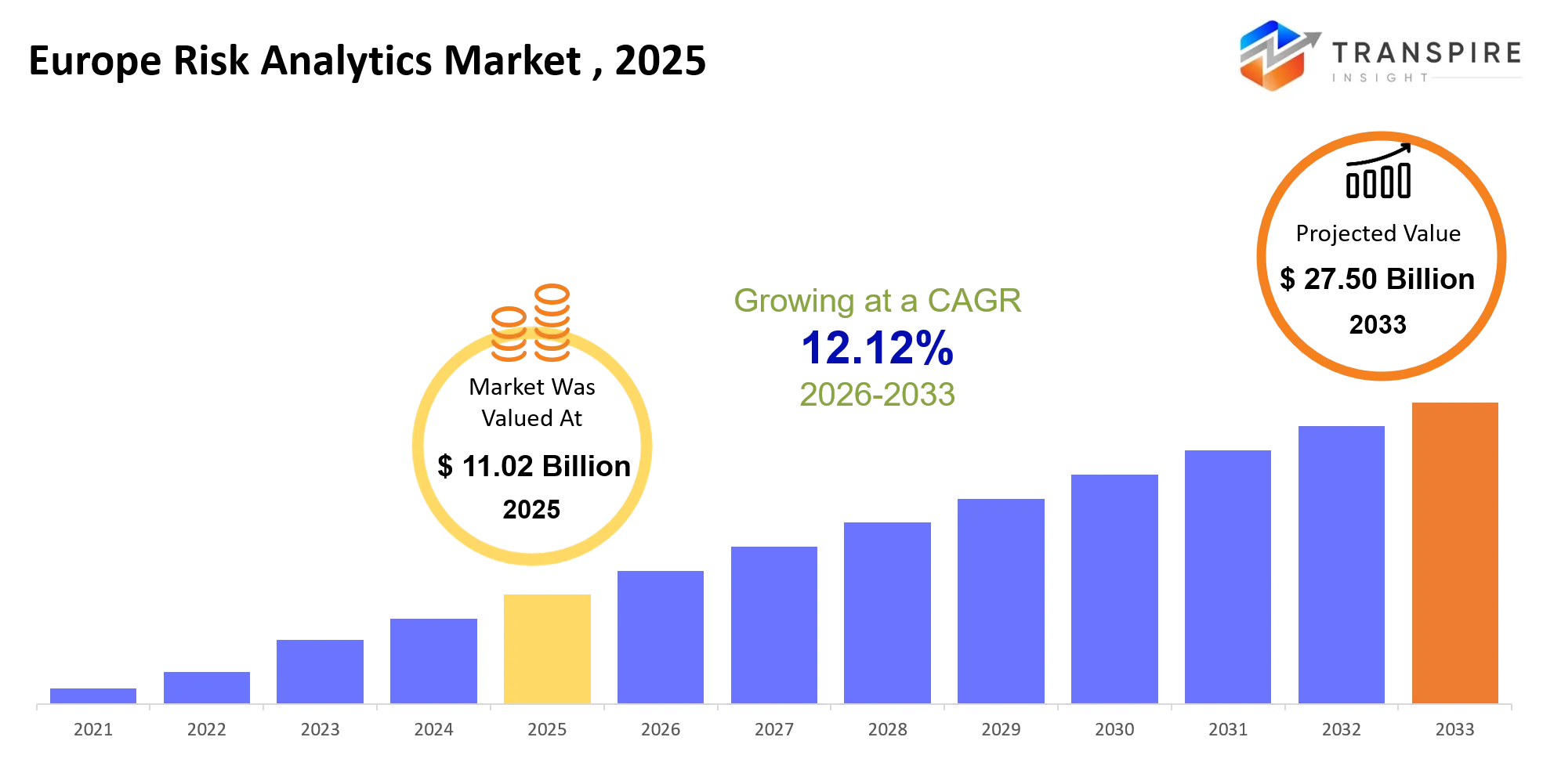
As per Transpire Insight Analysis the Europe Risk Analytics Market size is estimated at USD 11.02 Billion in 2025 and is anticipated to reach USD 27.50 Billion by 2033, growing at a CAGR of 12.12% from 2026 to 2033.
Transpire Insight estimates the Europe Risk Analytics Market at about USD 11.02 billion for 2025. It projects growth to roughly USD 27.50 billion by 2033.Air freight software is used in many roles. Airlines use it. Freight forwarders use it too. Airports, customs teams, and cargo handlers also rely on it. The software helps connect everyday work. It supports booking and keeps shipment records. It manages space or capacity. It also tracks shipments. Billing and compliance tasks are part of it as well. Teams can work from the same digital setup. In the past three to five years, the industry has changed. It moved away from scattered electronic data steps. More players now use API based data sharing. This makes the exchange of cargo information more consistent.
IATA’s ONE Record is set to be the main standard for air cargo data sharing starting in January 2026. It supports a shared digital shipment record across the parties involved. The COVID-19 period also exposed weak spots. Manual paperwork was slow and hard to manage. Visibility during the disruption was limited. That pushed more spending on cloud tools, live tracking, and workflow automation.
Now the customs picture is more strict. ICS2 asks for advance safety and security details for goods that enter or move through the EU. Because of this, there is a clear need for software that brings compliance and visibility together. Capacity planning and data exchange also depend on connected digital systems. In 2025, European carriers saw air cargo demand rise by 2.9 percent. Cargo demand for Europe to Asia grew by 10.3 percent. These numbers back continued investment in cargo management and digital coordination tools.
Europe Risk Analytics Market Size & Forecast:
- Europe Risk Analytics Market Size 2025: USD 11.02 Billion
- Expected Market Value 2033: USD 27.50 Billion
- Forecast CAGR: 12.12%
- Leading region in 2025:Germany
- Fastest Growing region:Poland
- Key Profile: IBM, SAS, Moody's Analytics, S&P Global, FIS, Refinitiv, Experian, Equifax, NICE Actimize, Oracle, SAP, Microsoft, Accenture, Deloitte, KPMG
Key Market Insights
- Europe air freight software outlook: The move toward shared digital cargo files, smoother API links, and less manual work should help this market.
- Digital standard shift: In January 2026, ONE Record became a top choice for sharing air cargo data. That change increases the need for systems that can talk to each other.
- Survey signals: IATA’s 2025 survey showed awareness above 70% for ONE Record. About half of the group said they are ready to put it in place.
- Demand momentum: In 2025, European carriers saw cargo demand rise by 2.9% from the year before. That growth supports spending on software for capacity handling and shipment work.
- Route changes: Europe to Asia air cargo demand grew 10.3% in 2025. More volume puts pressure on cross-border tracking, booking, paperwork, and coordination of available capacity.
- Rules and automation: ICS2 has pushed players toward earlier data submission. It also encourages checks for data quality, security scans, and customs steps that run in an automated flow.
- Cloud move: Many cargo groups are stepping away from older stand alone tools. They are picking cloud systems that can connect airlines, forwarders, ground handlers, customs bodies, and shippers.
- Live shipment view: Pharma, cold chain, and other high-value loads increasingly rely on linked tracking. Shared data helps teams watch conditions and spot problems sooner.
- Machine learning use: Tools based on machine learning are becoming more useful for real operations. They help with demand outlooks, capacity plans, handling exceptions, detecting fraud, and sorting documents with less manual effort.
- Vendor moves: Software firms are building better ways to integrate data and systems. They are also improving analytics, automation, security, and connections so they can win and keep long term deals with logistics operators.
What are the Key Drivers, Restraints, and Opportunities in the Europe Risk Analytics Market?
Driver: Digital standardization is a key structural force. In January 2026, ONE Record became the go-to way to share air cargo data. This push helped airlines, forwarders, handlers, and tech firms move away from scattered data links. They could use standardized APIs and keep shipment records in a common format. Another reason to adopt is Europe’s customs setup. Under ICS2, safety and security data is needed for goods entering or moving through the EU. So software firms can earn money from rollout work, system setup, compliance automation, reporting tools, and ongoing managed support.
Restraint: Old systems still slow progress. Many cargo groups run several tools at once. This can span airline platforms, warehouse systems, freight forwarding software, customs workflows, and ground handling systems. Updating or tying in older platforms takes funds. It also needs skilled staff, data moves, security safeguards, and careful live testing. IATA points out that split up data causes repeat work, slower handling, and more compliance risk. All these setup steps can stretch project schedules. That can also delay full take-up of new software.
Opportunity: Interoperable cloud tools are a real chance to grow. ONE Record gives a common data setup and an API layout. That foundation can help teams add new digital services across the air cargo chain. With that data in place, teams can add features like AI forecasts, auto paperwork, pricing that can change, handling of exceptions, and live shipment tracking. These add-ons can bring in more revenue beyond the base data layer. Adoption in Europe should also improve as rule systems accept standardized digital cargo data. At the same time, more vendors can offer secure services through APIs.
What Has the Impact of Artificial Intelligence Been on the Europe Risk Analytics Market?
Air cargo software is changing fast because of AI. It helps with document work that used to take many hours. It also supports demand forecasts, capacity plans, and faster checks for odd cases. Shipment risk can be reviewed with analytics, not guesswork.In practice, machine learning looks at past bookings and cargo totals. It studies season effects and how routes perform. It also considers limits in day to day operations. With that, teams can adjust how space is assigned. They can also make smarter pricing calls.
When data streams in, real time views can spot exceptions sooner. That gives cargo staff time to move people or tools. The goal is to stop delays from spreading to other steps later in the chain. IATA points to market intelligence and analytics as key for route choices, capacity control, and pricing improvement.Digital platforms are also helping with rules and checks. They can validate data automatically and run regulatory tasks in order. IATA’s cargo work shows the value of shared formats and built in validation. This can raise data quality and cut rejections, especially for shipments under tight controls.
AI can add more support too. It can help find possible fraud, flag unusual events, and automate parts of customer service. It can also track shipments in a way that predicts issues before they grow. Still, rollout is not easy.Many groups rely on old, separate systems. Data is often uneven across the network. Cybersecurity rules add cost and time. Also, it is hard to find common historical datasets that all partners can use. If data does not connect well, model results can drop even when the methods are strong.
Key Market Trends
- In 2024, many cargo firms began moving off paper work. They now use digital documents, tracking tools, and more automated customs steps.
- Starting in January 2026, ONE Record took over as the main way to share shipment data. This change also pushed new interoperability needs for everyone involved in cargo.
- In a 2025 survey, over 70% of people said they had heard of ONE Record. But only about half said they were ready to use it.
- For 2025, European carriers reported 2.9% growth in cargo demand. That rise helped justify spending on digital systems for booking, tracking, and revenue handling.
- Cargo between Europe and Asia grew by 10.3% in 2025. Because of that, teams shifted focus toward better border visibility and tighter coordination on trade routes.
- ICS2 has also changed how compliance work gets done. Firms now share advance electronic cargo data. They run automated risk checks too, using clearer customs information.
- E-commerce and pharmaceutical shipments are seeing faster, near real-time tracking. Shippers want stronger sight of shipments and better checks on shipment conditions.
- Cloud tools are starting to replace older, separate apps. Cargo groups want one shared data setup across airlines, forwarders, handlers, and shippers.
- AI use is becoming more practical. People focus on forecasting, checking data, flagging odd cases, improving pricing, and handling exceptions. This is instead of trying AI in a one-off way.
- Vendors are putting more weight on open APIs, security, and system compatibility. They do this because broken, scattered cargo data still causes daily operational trouble.
Europe Risk Analytics Market Segmentation
By Component
Software will keep playing the main role in cargo booking, shipment handling, live tracking, document work, capacity decisions, and day to day coordination. Support services will cover setup, moving from older tools, ongoing upkeep, and tuning of the full stack for airlines and logistics groups. Consulting will guide cargo teams on system choices, help them change workflow steps, and make sure digital spending matches what the business needs. Risk Platforms will back compliance checks, shipment risk reviews, and the handling of exceptions. Analytics Tools will turn cargo, booking, route, and capacity data into useful operational views. Data Services will help teams share facts in a steady format, add data where needed, and keep real time status visible for all linked parties.
Managed Services will cover platform upkeep and daily watching, plus help with cyber defense and routine technical support for groups that do not have large internal tech teams. Integration Services will link cargo platforms with airline systems, yard and warehouse tools, customs systems, customer portals, and outside data networks. IATA ONE Record supports API based links and a shared data model. This helps integration work matter more in air cargo. Vendors that can ship flexible deployments, provide safe APIs, include analytics, and offer managed help should see better chances across cargo networks in Europe.
By Risk Type
Credit Risk manages risk from the other party, including exposure and whether payments arrive on time in cargo deals and business ties.Market Risk helps with pricing work and checks how capacity and fuel costs can shift with market changes and new trade conditions.Operational Risk looks at what can go wrong in day to day movement. This includes delays, problems with handling, mistakes in documents, disruptions in capacity, and weak spots in processes.Cyber Risk is getting more attention as cargo work links more systems with APIs and cloud tools.Compliance Risk covers the rules around customs, security, dangerous goods, document work, and other legal requirements.Fraud Risk tracks red flags like odd payments, identity mismatches, document issues, and commercial activity that does not look normal.
Liquidity Risk supports financial planning for groups that deal with swings in cargo volume, payments, and day to day operating costs.Enterprise Risk gives wider risk insight across finance, operations, cyber, compliance, and commercial work.European regulators are also pushing for better and accurate pre arrival cargo data. Because of that, automated risk checks matter more for digital platforms.ICS2 uses the safety and security info that is submitted to run risk analysis. It also helps place focused controls on goods that enter or move through the European Union.With these integrated risk tools in place, the result is support for both stronger operations and meeting regulatory needs.
By Technology
AI and machine learning can help with demand forecasts, spotting odd patterns, ranking shipment risk, routing items to the right category, and giving teams decision help during day to day work. Predictive analytics can estimate cargo volume, check capacity needs, flag possible delays, and judge how routes are performing. Big data analytics can sort and review huge collections of information like bookings, managed services shipment moves, rates, customer actions, and other operational events. Cloud tools give room to scale for cargo partners who are spread out, and they let teams roll out changes faster at more locations. Natural language processing can pull data from documents, handle parts of customer support, process cargo instructions, and deal with regulatory text.
Robotic process automation can take over routine tasks like typing in details, checking documents, sending status updates, and matching records across systems. Blockchain analytics can back some traceability and transaction checks when shared records add clear value. Data visualization can turn the large, messy operational data into charts and screens for capacity views, shipment status, service performance, and alerts about exceptions. IATA’s digital cargo plan calls for standard data, APIs, and live sharing of information so cargo operations can connect more smoothly. As time goes on, more adoption will go toward shared platforms that link automation with analytics, run on cloud infrastructure, and use data that can work across systems.
By Application
Financial Risk Management helps with exposure checks, finance controls, pricing choices, and ongoing watch of commercial risk tied to cargo work. Fraud Detection looks at odd payments, unclear paperwork, strange account behavior, and mismatched shipment details. Credit Scoring reviews how customers and partners pay, so teams can make better commercial calls. Regulatory Compliance supports data gathering, checking quality, creating reports, handling customs steps, and meeting security rules. Cybersecurity guards cargo systems, APIs, shipment details, customer data, and the linked tools that run daily operations.
Insurance Risk backs cargo risk review, claim analysis, and exposure evaluation. Supply Chain Risk tracks delays, limited capacity, new routes, shipment problems, and how much suppliers depend on each other. Enterprise Risk Management offers a wider view for risks across strategy, daily operations, money matters, rules, and technology areas. Digital compliance matters a lot now. Many European cargo firms must meet advance data duties via systems like ICS2. Teams tend to choose applications that work as one set. These platforms can blend operational data with risk insights, compliance controls, and alerts that fire automatically.
By End User
Banks will rely on systems that focus on risk when they look at exposure, watch transactions, spot fraud, and judge risks tied to trades.Insurance firms will use data tools for claims work, underwriting, cargo exposure checks, and day to day risk.Investment firms will lean on market data, prediction tools, and risk scoring to guide portfolio choices and other finance actions.
Large companies will run enterprise tools for supply chain risk, rule checks, finance controls, and basic planning for operations.Government agencies will need safe setups for customs steps, screening, legal data, and risk reviews.Healthcare groups will track risk steps for drugs, medical gear, and cargo that must stay at the right temperature.Retailers will use online tools to line up global shipments, manage stock movement, share customer updates, and run e commerce logistics.
Manufacturers will use supply chain analysis, shipment updates, capacity plans, and checks on supplier risk to keep production on time.Air cargo digital work now ties together different groups. It is not just one company operating alone.IATA’s ONE Record plan aims to connect shippers, airlines, ground handlers, freight forwarders, and other cargo partners.Because of this, people who adopt the approach will tend to choose platforms that can share data among many parties and still fit different process needs.
By Region
The UK should keep a key role thanks to its cargo setup in the air, its links to world trade, and its large airport hubs. There is also steady need for customs work, better shipment handling, and tools for staying in line with rules.
Germany is likely to stay a top market in Europe. Frankfurt acts as a major cargo entry point. On top of that, Germany has a strong industrial base and active global trade.France should see steady support from cargo work centered on Paris. It also has wide logistics routes across countries. Pharmaceutical shipments and other high value freight tend to move through these networks.Switzerland can lean into focused needs. Demand often ties to pharma, precision production, and cross border shipping. High value cargo also fits well with what the country already serves.The Netherlands has good potential for software use. Amsterdam Schiphol has a cargo network that supports this. The country also has many routes for moving goods across Europe.
Italy can benefit from export work tied to manufacturing. It also has trade movement and airport based logistics. There is demand for systems that bring shipment management into one place.Spain may open up chances via global cargo entry points. E commerce logistics also matter here. The country connects European traffic with wider trade routes worldwide.Sweden can support niche adoption. Its logistics scene is often tech minded. International manufacturing plays a part too. There is also interest in digital views of the supply chain.Across regions, rollout of these tools will rely more on smooth working between systems. It will also depend on customs links, live data, and links into wider cargo networks across borders.
What are the Key Use Cases Driving the Europe Risk Analytics Market?
Prompt: Write 100–120 words across three short paragraphs describing the key use cases driving adoption of Europe Risk Analytics Market.
Paragraph 1 – Core use case: Describe the dominant application area (linked to the leading market segment) and explain why this use case generates the most demand.
Paragraph 2 – Expanding applications: Describe 1–2 adjacent or secondary use cases that are gaining traction, and link them to a specific industry segment or end-user type identified in the report's segmentation.
Paragraph 3 – Emerging use cases: Identify one or two nascent applications that are not yet mainstream but show strong potential over the forecast period.
Rules: Do not repeat the segmentation explanation from the previous section. Link all use cases to concrete industries, vessel types, or regulatory contexts. Avoid bullet points. Use human-like language, active voice without em dashes
|
Report Metrics |
Details |
|
Market size value in 2025 |
USD 11.02 Billion |
|
Market size value in 2026 |
USD 12.35 Billion |
|
Revenue forecast in 2033 |
USD 27.50 Billion |
|
Growth rate |
CAGR of 12.12% from 2026 to 2033 |
|
Base year |
2025 |
|
Historical data |
2021 - 2024 |
|
Forecast period |
2026 - 2033 |
|
Report coverage |
Revenue forecast, competitive landscape, growth factors, and trends |
|
Regional scope |
Europe |
|
Key company profiled |
IBM, SAS, Moody's Analytics, S&P Global, FIS, Refinitiv, Experian, Equifax, NICE Actimize, Oracle, SAP, Microsoft, Accenture, Deloitte, KPMG |
|
Customization scope |
Free report customization (country, regional & segment scope). Avail customized purchase options to meet your exact research needs. |
|
Report Segmentation |
By Component (Software, Services, Consulting, Risk Platforms, Analytics Tools, Data Services, Managed Services, Integration Services); By Risk Type (Credit Risk, Market Risk, Operational Risk, Cyber Risk, Compliance Risk, Fraud Risk, Liquidity Risk, Enterprise Risk); By Technology (AI & Machine Learning, Predictive Analytics, Big Data Analytics, Cloud Computing, Natural Language Processing, Robotic Process Automation, Blockchain Analytics, Data Visualization); By Application (Financial Risk Management, Fraud Detection, Credit Scoring, Regulatory Compliance, Cybersecurity, Insurance Risk, Supply Chain Risk, Enterprise Risk Management); By End User (Banks, Insurance Companies, Investment Firms, Corporations, Government Agencies, Healthcare Organizations, Retailers, Manufacturing Companies); By Region (UK, Germany, France, Switzerland, Netherlands, Italy, Spain, Sweden) |
Which Regions are Driving the Europe Risk Analytics Market Growth?
Germany is at the front in Europe. Frankfurt and Leipzig-Halle handle big cargo volumes. At the same time, the country has heavy industry. It also exports a lot. Those two things help demand for freight services. Strong logistics routes also matter. So do long lived freight forwarding links. Many firms use newer tech. That supports tools for cargo handling, tracking, and analytics.
German industry also runs shipments that are hard to manage. Many loads move by more than one mode. Because of that, firms want software that fits into the full chain. This includes airlines, ground handlers, warehouses, and freight forwarders. Market figures put Germany above other European markets. People also point to the state of the logistics network. Digital work is a key reason for take up.
The United Kingdom is still steady, but it looks different. It has strong links for global cargo. It also has a mature service setup. Airports like Heathrow and East Midlands support outside freight routes. After Brexit, rules for customs changed. That has kept demand high for digital docs. It also raises needs for compliance tools and shipment management.
The UK aviation and logistics tech base is already in place. Because of that, companies keep spending on software. They do not only fund new build projects. Cross link work still matters too. Carriers, forwarders, customs steps, and logistics firms keep needing to align. That should keep the UK as a strong source of revenue.
Poland is growing the fastest in the group. The outlook points to about 4.0% to 4.8% growth. Freight work is expanding there. Transportation spending is also rising. Modern upgrades are happening in Warsaw and other hubs. This opens room for cloud cargo tools. It also supports combined tracking systems. Poland sits between Western Europe and Central and Eastern Europe, so routes can be more flexible.
Who are the Key Players in the Europe Risk Analytics Market and How Do They Compete?
Competition now hinges more on how well firms use technology than on software fees by themselves. Big enterprise vendors push for strength in analytics, cloud services, security, automation of workflows, and system integration. Specialized aviation firms often win by focusing on cargo needs and by rolling out changes faster. The market is still a blend. Some well known enterprise tech companies cover many business areas at once. Other specialists focus on airline and freight-forwarder tasks. IATA ONE Record is also changing the game by pushing better API fit and data that can move between systems more easily.
In the set of companies listed, IBM and Oracle can play on their wide reach in cloud, data, AI, and enterprise connection tools. This can help cargo groups link day to day operations to other business systems. SAP stands out with ERP and supply chain integration. That can tie logistics work to finance, buying, inventory, and what customers see. Microsoft adds cloud infrastructure plus analytics, AI, and teamwork tools. These can support digital cargo setups that need to scale. A clear edge shows up when large logistics firms want one main technology stack instead of many separate tools.
Accenture often competes through rollout work and digital change efforts. It helps airlines and logistics firms move from older systems to cloud platforms, analytics, and automation. SAS focuses on analytics and AI used for forecasting, spotting unusual patterns, optimization, and risk checks. At the same time, aviation focused providers keep improving cargo specific links.
Company List
- IBM
- SAS
- Moody's Analytics
- S&P Global
- FIS
- Refinitiv
- Experian
- Equifax
- NICE Actimize
- Oracle
- SAP
- Microsoft
- Accenture
- Deloitte
- KPMG
Recent Development News
"In April 2026, CHAMP Cargosystems and Neurored expanded their strategic partnership to enable ONE Record through CHAMP's 1Neo-Connect solution. The collaboration strengthens standardized, real-time data exchange between freight forwarders, airlines, and logistics providers as the industry moves toward interoperable digital cargo systems.https://www.champ.aero/press-releases/neurored-and-champ-cargosystems-expand-partnership-to-enable-one-record-with-1neo-connect-and-eawB-solutions (CHAMP Cargosystems)."
"In March 2026, Lufthansa Cargo selected Jettainer as the launch customer for a next-generation IoT-based ULD tracking solution. The technology will be rolled out across Lufthansa Cargo's ULD fleet, strengthening real-time visibility and digital management of cargo equipment.https://lufthansa-cargo-ag-com.mynewsdesk.com/pressreleases/lufthansa-cargo-becomes-launch-customer-for-jettainers-next-generation-iot-tracking-for-digital-uld-management-3436831 (Lufthansa Cargo)."
"In July 2025, IAG Cargo entered a partnership with CHAMP Cargosystems to adopt CHAMP A2Z Scan, an AI-powered document-processing application. The solution automates Air Waybill and document data entry, helping reduce manual processing and improve downstream cargo workflows.https://www.champ.aero/press-releases/champ-cargosystems-and-iag-cargo-partner-in-ai-driven-document-automation (CHAMP Cargosystems)."
What Strategic Insights Define the Future of the Europe Risk Analytics Market?
The freight market is shifting toward systems that can work together. These are cloud based. They connect cargo more than they connect a single airline or a single forwarding tool.One key driver is shared data. ONE Record supports that idea. With it, companies can use common APIs. They can also track shipments in near real time. Automation becomes easier too. Cross company digital services can be built on the same base.
There is a risk that people do not always see at first. Some firms may end up relying on only a few platforms. Those platforms can link old setups with newer standards. That can raise switching costs. It can also increase exposure to cyber threats.There is also a clear chance to gain from this change. AI can be used when shipment data is standardized. That can help with forecast planning for capacity. It can support automated documents. It can enable pricing that adjusts as conditions change. It can also improve handling for exceptions.
Poland looks like a good place to expand. Freight and logistics upgrades are growing there. More investment is pushing the need for platforms that can scale.In this market, players should focus on open APIs. They should aim for ONE Record fit. They should choose cloud tools that can be added in parts. They should also put strong security in place.If firms take that path, they can make integrations easier. They can also keep their tech spend safer through 2033.
Europe Risk Analytics Market Report Segmentation
By Component
- Software
- Services
- Consulting
- Risk Platforms
- Analytics Tools
- Data Services
- Managed Services
- Integration Services
By Risk Type
- Credit Risk
- Market Risk
- Operational Risk
- Cyber Risk
- Compliance Risk
- Fraud Risk
- Liquidity Risk
- Enterprise Risk
By Technology
- AI & Machine Learning
- Predictive Analytics
- Big Data Analytics
- Cloud Computing
- Natural Language Processing
- Robotic Process Automation
- Blockchain Analytics
- Data Visualization
By Application
- Financial Risk Management
- Fraud Detection
- Credit Scoring
- Regulatory Compliance
- Cybersecurity
- Insurance Risk
- Supply Chain Risk
- Enterprise Risk Management
By End User
- Banks
- Insurance Companies
- Investment Firms
- Corporations
- Government Agencies
- Healthcare Organizations
- Retailers
- Manufacturing Companies
By Region
- UK
- Germany
- France
- Switzerland
- Netherlands
- Italy
- Spain
- Sweden
Frequently Asked Questions
Find quick answers to common questions.
The expected Europe Risk Analytics Market size for the market will be USD 27.50 Billion in 2033.
Key segments for the Europe Risk Analytics Market are By Component (Software, Services, Consulting, Risk Platforms, Analytics Tools, Data Services, Managed Services, Integration Services); By Risk Type (Credit Risk, Market Risk, Operational Risk, Cyber Risk, Compliance Risk, Fraud Risk, Liquidity Risk, Enterprise Risk); By Technology (AI & Machine Learning, Predictive Analytics, Big Data Analytics, Cloud Computing, Natural Language Processing, Robotic Process Automation, Blockchain Analytics, Data Visualization); By Application (Financial Risk Management, Fraud Detection, Credit Scoring, Regulatory Compliance, Cybersecurity, Insurance Risk, Supply Chain Risk, Enterprise Risk Management); By End User (Banks, Insurance Companies, Investment Firms, Corporations, Government Agencies, Healthcare Organizations, Retailers, Manufacturing Companies); By Region (UK, Germany, France, Switzerland, Netherlands, Italy, Spain, Sweden)
Major Europe Risk Analytics Market players are IBM, SAS, Moody's Analytics, S&P Global, FIS, Refinitiv, Experian, Equifax, NICE Actimize, Oracle, SAP, Microsoft, Accenture, Deloitte, KPMG
The Europe Risk Analytics Market size is USD 11.02 Billion in 2025
The Europe Risk Analytics Market CAGR is 12.12% from 2026 to 2033.
- IBM
- SAS
- Moody's Analytics
- S&P Global
- FIS
- Refinitiv
- Experian
- Equifax
- NICE Actimize
- Oracle
- SAP
- Microsoft
- Accenture
- Deloitte
- KPMG
About the Authors

Mayur Shinde
I am Mayur Shinde, a Senior Research Analyst at Transpire Insight, specializing in the Automotive & Transportation and Information & Communication Technology (ICT) Industry. My work focuses on analyzing emerging market trends, technological advancements, competitive landscapes, and industry developments to deliver accurate, data-driven insights. I am passionate about transforming complex market information into clear, actionable content that helps businesses, professionals, and decision-makers stay informed and make confident strategic decisions.

Chakradhar Khansole
Chakradhar serves as the Research Director at Transpire Insight, bringing over 8 years of experience in technology, innovation, and strategic market intelligence. He specializes in transforming complex market data into actionable business insights that enable organizations to make informed, growth-oriented decisions. Recognized for his strategic vision and analytical expertise, Chakradhar leads high-impact research initiatives, delivering comprehensive market assessments, competitive intelligence, and forward-looking industry analysis.
Recently Published Reports
-
Apr 2026
3D Optical Profiler Market
3D Optical Profiler Market Size, Share & Analysis Report By Type (Desktop 3D Optical Profiler, and Portable 3D Optical Profiler), By Technology (Confocal Technology, and White Light Interference), By End-Use Industry (Manufacturing, Research Institutions, Automotive, Aerospace and Defense, Medical Devices, and Other), and Geography (North America, Europe, Asia-Pacific, Middle East and Africa, South and Central America), 2021 - 2031
-
Apr 2026
Depth Sensor Market
Depth Sensor Market Size, Share & Analysis Report By Type (Infrared Depth Sensors, Time-of-Flight (ToF) Sensors, Stereo Vision Sensors, Structured Light Sensors, Ultrasonic Depth Sensors), By Application (Automotive, Robotics, Gaming, Consumer Electronics, Industrial Automation, Healthcare, Security & Surveillance, Others), By End Users (Automotive Manufacturers, Consumer Electronics Companies, Healthcare Providers, Industrial Companies, Security Agencies, Gaming Companies, Robotics Companies, Others), and Geography (North America, Europe, Asia-Pacific, Middle East and Africa, South and Central America), 2021 – 2031
-
Apr 2026
Digital Manufacturing Market
Digital Manufacturing Market Size, Share & Analysis Report By Component (Hardware, Software, and Services), By Technology (Robotics, 3D Printing, Internet of Things (IoT), and Others), By Application (Automotive and Transportation, Aerospace and Defense, Consumer Electronics, Industrial Machinery, and Others), By Process Type (Computer-Based Designing, Computer-Based Simulation, Computer 3D Visualization, Analytics, and Others), and Geography (North America, Europe, Asia-Pacific, Middle East and Africa, South and Central America), 2021 – 2031
-
Apr 2026
Digital Visa Services Market
Digital Visa Services Market Size, Share & Analysis Report By Type (Individual Travelers, Group Travelers), By Application (Tourism, Business Travel, Others), and Geography (North America, Europe, Asia-Pacific, Middle East and Africa, South and Central America), 2021 – 2031