
Europe Prepaid Card Market Size & Forecast:
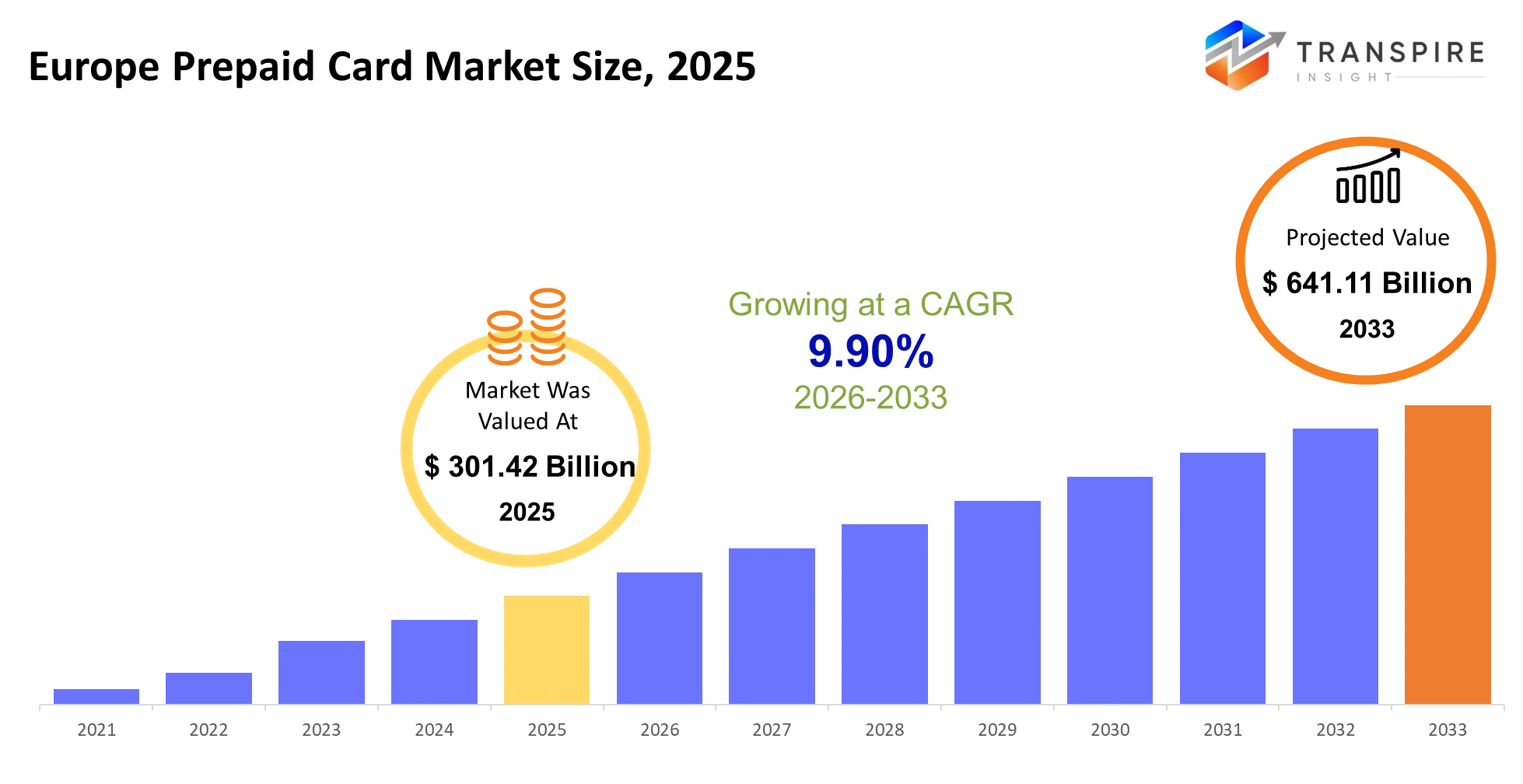
- Europe Prepaid Card Market Size 2025: USD 301.42 Billion
- Europe Prepaid Card Market Size 2033: USD 641.11 Billion
- Europe Prepaid Card Market CAGR: 9.90%
- Europe Prepaid Card Market Segments: By Type (Open-loop Cards, Closed-loop Cards, Reloadable Cards, Gift Cards, Payroll Cards, Others), By Application (Retail Payments, Travel, Corporate Expenses, Government Benefits, Others), By End-User (Consumers, Businesses, Government, Others), By Distribution (Online, Banks, Retail Stores, Others).
To learn more about this report,  Download Free Sample Report
Europe Prepaid Card Market Summary:
The Europe Prepaid Card Market size is estimated at USD 301.42 Billion in 2025 and is anticipated to reach USD 641.11 Billion by 2033, growing at a CAGR of 9.90% from 2026 to 2033. The Europe prepaid card market serves as financial infrastructure which enables employers and transit operators and retailers and gig platforms and governments to transfer restricted funds without using standard banking methods. Companies use prepaid cards to control their temporary worker payrolls and their welfare benefit payments and their travel expenses and their online business operations while reducing their risk of fraud and their need for complicated processing tasks.
The market has experienced a transition during the past three to five years which resulted in a shift from plastic-based stored value products toward digital prepaid systems that connect through applications with digital wallets and enable real-time payment processing. The pandemic served as the main catalyst because merchants and consumers adopted contactless payment methods during lockdowns which established e-commerce as a new normal.
The European Union implemented stricter financial compliance regulations which led organizations to prefer traceable prepaid solutions instead of cash transactions. The transition enables issuers to generate revenue through two new areas which include financial services embedded in their systems and loyalty programs and management of cross-border payments for both mobile workers and online marketplaces.
Key Market Insights
- The European Prepaid Card Market in 2025 showed Western Europe as its dominant force through 42% market share which developed from established fintech systems and increasing use of cashless payments.
- The United Kingdom together with Germany and France functions as the principal revenue source through its strong adoption of prepaid payroll cards and retail gift cards.
- The Eastern European market will experience its fastest growth until 2030 because digital banking services reach previously underserved consumer groups.
- The Nordic countries maintain their status as the top region for contactless prepaid transactions because people use mobile wallets and payment systems have developed.
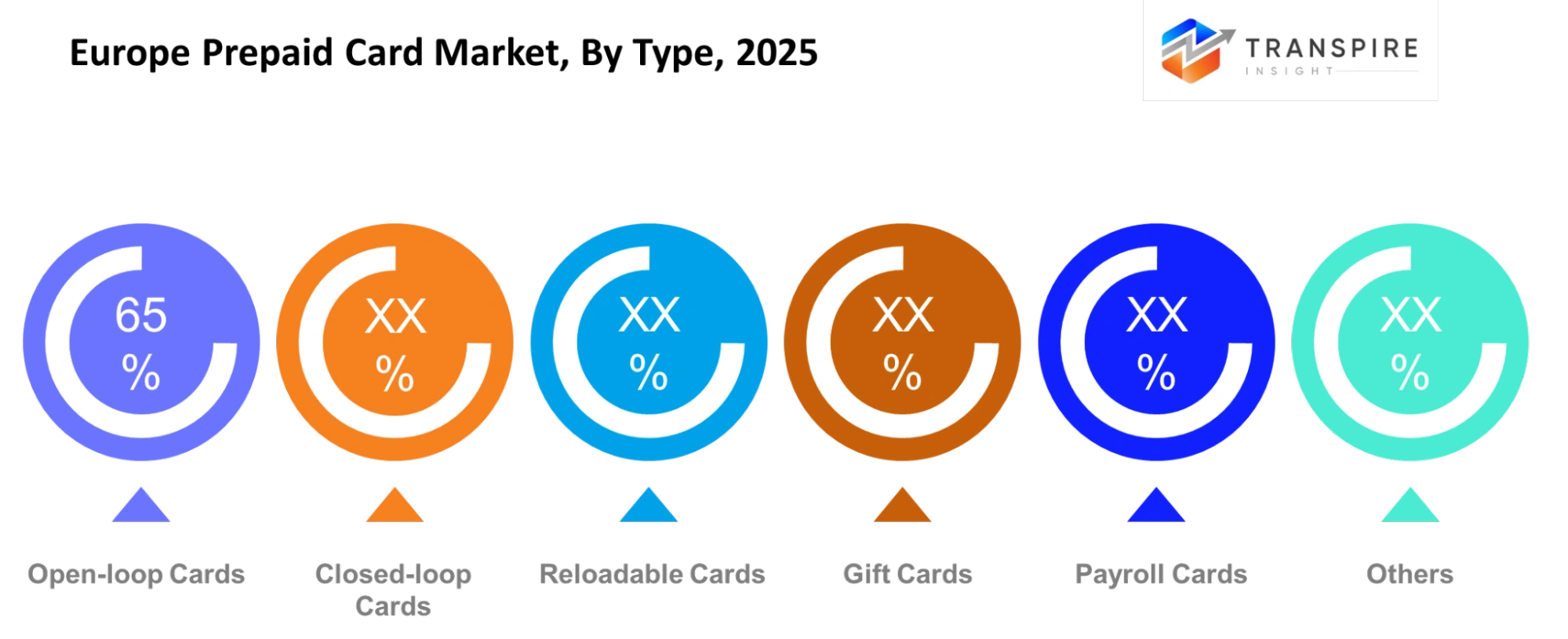
- The Europe prepaid payments market in 2025 saw open-loop prepaid cards become its dominant force through their more than 48% market share which developed from their ability to work with multiple merchant networks.
- The second-largest market segment after open-loop prepaid cards consists of closed-loop prepaid cards which receive backing from retail loyalty programs and corporate incentive distribution systems.
- Between 2025 and 2030, e-commerce fraud management and remote workforce spending create virtual prepaid cards as the market segment with the highest growth rate.
- The international tourism recovery led to increased cross-border spending which boosted the popularity of multi-currency prepaid travel cards among travelers.
- The European Prepaid Card Market generated 38% of its 2025 revenue from retail and e-commerce applications because these platforms handled high volumes of digital transactions.
- The gig economy and temporary workforce businesses use prepaid cards for their primary payroll functions.
- European agencies currently prioritize digital payment systems with traceability features which has created rising demand for government benefit disbursement programs.
What are the Key Drivers, Restraints, and Opportunities in the Europe Prepaid Card Market?
The Europe Prepaid Card Market experiences its most substantial growth because prepaid products now blend into digital payment systems. The shift began to accelerate after the implementation of PSD2 together with the post-pandemic rise in contactless payments which made banks and fintech companies and merchants focus on creating seamless electronic payment systems. Employers now use prepaid payroll cards to pay contract workers while retailers use virtual prepaid cards to process refunds and loyalty credits and subscription payments. The transition from conventional payment methods to prepaid cards leads to higher transaction revenue for payment processors and issuers because prepaid cards produce ongoing interchange fees and digital wallet transactions and international payment fees. The growth of app-based financial services has decreased onboarding expenses which enables prepaid programs to provide services for underbanked customers and small business.
The market faces its most significant structural challenge because European countries maintain different regulations for their respective jurisdictions. Prepaid issuers face operational challenges because different countries enforce different rules for anti-money laundering compliance and KYC verification and cross-border financial reporting. The compliance costs of organizations stay high because they rely on the current national regulations and the developing EU financial regulatory system. The high costs of licensing and fraud monitoring drive smaller fintech companies to postpone their entry into new markets which limits their ability to grow revenues in regional markets and impacts their ability to attract low-margin customers.
Embedded finance functions as the most substantial permanent growth possibility for the European Prepaid Card Industry. Fintech platforms now provide prepaid services through their partnerships with mobility applications and gig economy platforms and digital marketplaces. Eastern Europe shows exceptional expansion potential because both smartphone adoption and digital banking systems develop concurrently. Companies that invest in AI-driven expenditure management systems and instant virtual card creation technology will benefit from the growing demand for enterprise expense tracking and international worker payment solutions.
What Has the Impact of Artificial Intelligence Been on the Europe Prepaid Card Market?
The Europe Prepaid Card Market experiences transformation through artificial intelligence and advanced digital technologies which enhance fraud detection system capabilities and enable real-time transaction observation and deliver detailed customer spending patterns. Payment processors and fintech platforms use AI-based behavior analytics systems to identify suspicious transaction activities which occur in real time, thereby assisting issuers in preventing unauthorized prepaid card transactions and decreasing chargeback expenses. Machine learning algorithms enable organizations to automate their compliance processes by checking transactions against anti-money laundering and KYC standards, which results in decreased need for manual checks and quicker customer onboarding.
The use of predictive analytics tools has become vital for businesses which seek to enhance their prepaid programs. Card issuers apply machine learning models to predict how customers will spend their money and to find inactive accounts, while using customer spending patterns to create personalized marketing campaigns. These features enhance card activation success rates together with boosting ongoing transaction activity within retail and payroll and travel prepaid systems. Enterprises achieve cost savings through advanced cloud-based payment systems which deliver real-time balance information together with automatic expense management and virtual card creation through API connections.
AI-powered fraud detection systems assist businesses to decrease their suspicious transaction losses by achieving double-digit percentage reductions while they also enhance their transaction approval processes. The substantial costs required for system integration serve as a primary barrier for small financial institutions which depend on traditional banking systems. Many regional issuers encounter difficulties when attempting to merge their payment data which exists in different regions, thus hindering the effectiveness of artificial intelligence risk assessment systems.
Key Market Trends
- The demand for secure corporate spending solutions which staff members can use without delay has driven the rapid growth of virtual prepaid card issuance since 2021.
- European retailers shifted nearly 35% of loyalty and refund programs toward digital prepaid formats between 2022 and 2025 to reduce processing delays.
- Open banking reforms which PSD2 established created a quick path for integrating prepaid wallets with fintech platforms which enabled instant peer-to-peer transfers and ongoing transaction verification.
- After 2023 cross-border prepaid travel cards experienced renewed popularity because tourism recovery increased multi-currency transaction activity throughout Southern and Western Europe.
- Visa Inc. and Mastercard Incorporated developed tokenized prepaid solutions which protect online payment systems from fraud risks that arise in busy e-commerce settings.
- Gig economy employers increasingly replaced cash reimbursement systems with reloadable payroll cards, which enabled better payment tracking for workers while decreasing costs needed to handle payments.
- The use of AI-based fraud monitoring systems became a standard practice for large prepaid processors beginning in 2022 because these systems enabled issuers to detect suspicious transaction patterns within seconds.
- Eastern European fintech providers expanded their operations to new regions because smartphone banking became popular among underbanked consumers who needed prepaid payment solutions.
- From 2021 onward subscription-based digital services led younger consumers to use prepaid cards for their gaming, streaming and app-based microtransaction purchases.
- The regulatory examination process for anti-money laundering compliance requirements became stricter after 2022, which led smaller prepaid issuers to spend significant resources on building automated KYC verification systems.
Europe Prepaid Card Market Segmentation
By Type
The type segment of open-loop cards maintains its top market share because their extensive merchant network and ability to process international payments enable customers to make purchases at retail locations and travel services and online shopping platforms. Younger consumers and gig economy workers adopt reloadable prepaid cards because these cards enable them to access funds repeatedly which helps them control their spending without needing standard bank services. Employers who handle temporary and migrant workforces in the logistics and hospitality and delivery service industries increasingly use payroll cards as their preferred payment method.
Retail loyalty systems still depend on closed-loop cards and gift cards for their operations. However, digital wallets have taken over as the main payment method for customers who shop at single-brand stores, which has led to a decrease in usage. The type segment will develop future products through mobile application-based virtual prepaid systems that operate with embedded financial technology. Financial institutions and fintech providers are expected to prioritize tokenized payment security instant issuance capabilities and AI-based fraud management to strengthen user retention and transaction frequency.
To learn more about this report, Download Free Sample Report
By Application
The primary application segment for retail payments exists as a prepaid product which best supports contactless commerce and subscription billing and online marketplace transactions. The demand for travel-related prepaid cards has increased after international tourism recovery because travelers now need multi-currency payment solutions with controlled foreign exchange costs. The corporate expense management market experienced strong growth because companies used prepaid systems to track employee expenses while decreasing the time needed for reimbursement processing.
Digital prepaid delivery systems enable government benefit distribution programs to expand throughout various European nations because they enhance transaction visibility while decreasing administrative costs that stem from cash-based systems. Digital-first payment systems that use mobile wallet integration and real-time spending analytics have become the preferred choice of users in the application segment. Payment processors and issuers will direct their investments toward building API-enabled systems that allow prepaid solutions to connect with e-commerce platforms and workforce management systems and digital public service networks.
By End-User
Consumers hold the biggest portion of the end-user market because they use prepaid products to manage their budgets and shop online while making safe cashless payments that protect them from total credit risk. Younger demographics and underbanked populations drive most of the transaction activity which occurs across gaming platforms and streaming services and app-based products. Businesses represent the second-largest end-user category as employers increasingly use prepaid payroll cards and expense management systems to simplify workforce payments.
Government agencies expanded their use of prepaid systems for welfare distribution and refugee support and transportation subsidies because those systems offer better compliance tracking and simpler administrative processes. Growth dynamics differ between end-user groups because consumer demand requires simple solutions while enterprises need better operational efficiency and financial transparency. The small and medium-sized business sector will experience rapid growth because fintech companies will provide affordable prepaid management systems that include automated reporting and spending controls and international payment capabilities.
By Distribution
The distribution network still operates through banks because those banks possess established customer bases and regulatory knowledge and customers trust them with their high-value payments. The fastest expanding sector of the market is online distribution channels which fintech applications use to enable users to onboard digitally and issue virtual cards and manage their accounts through mobile devices. Retail stores continue playing a relevant role in prepaid gift card sales and reloadable cash-based transactions, particularly among consumers with limited banking access.
The distribution network now extends through alternative networks which include telecom providers and digital commerce platforms that offer embedded payment solutions. The distribution sector now operates under competitive conditions which favor service models that use technology to provide better customer service through smoother onboarding procedures and more effective customer acquisition methods. The upcoming channel strategies will establish bank partnerships with fintech companies and e-commerce platforms to create systems that enable real-time payment processing and loyalty program integration and support digital payment expansion into new markets.
What are the Key Use Cases Driving the Europe Prepaid Card Market?
Prepaid cards serve as the primary payment method for retail and e-commerce transactions across Europe because online merchants need secure payment systems that process transactions and refunds and subscription payments with immediate results. Supermarkets and entertainment platforms and online marketplaces generate their highest transaction volumes through their extensive use of contactless payment methods.
The logistics industry and hospitality sector and gig economy platforms have started to implement corporate payroll systems and employee expense tracking systems. The tourism industry has shown increased interest in travel-related prepaid cards because airlines and hotel chains and travel agencies need multi-currency spending solutions which enable them to control exchange rate expenses.
The emerging applications of prepaid technology will create use cases which combine mobility platforms with digital public welfare systems and embedded finance ecosystems. Fintech companies are developing virtual prepaid cards with programmable features which businesses can use to make automatic payments and provide specific customer rewards and execute regulated international payments through immediate transaction monitoring.
|
Report Metrics |
Details |
|
Market size value in 2025 |
USD 301.42 Billion |
|
Market size value in 2026 |
USD 330.99 Billion |
|
Revenue forecast in 2033 |
USD 641.11 Billion |
|
Growth rate |
CAGR of 9.90% from 2026 to 2033 |
|
Base year |
2025 |
|
Historical data |
2021 - 2024 |
|
Forecast period |
2026 - 2033 |
|
Report coverage |
Revenue forecast, competitive landscape, growth factors, and trends |
|
Regional scope |
Europe (Germany, United Kingdom, France, Italy, Spain and Rest of Europe) |
|
Key company profiled |
Visa, Mastercard, American Express, PayPal, Stripe, Adyen, Worldline, Square, NetSpend, Green Dot, Revolut, Klarna, Payoneer, Skrill, Wirecard. |
|
Customization scope |
Free report customization (country, regional & segment scope). Avail customized purchase options to meet your exact research needs. |
|
Report Segmentation |
By Type (Open-loop Cards, Closed-loop Cards, Reloadable Cards, Gift Cards, Payroll Cards, Others), By Application (Retail Payments, Travel, Corporate Expenses, Government Benefits, Others), By End-User (Consumers, Businesses, Government, Others), By Distribution (Online, Banks, Retail Stores, Others). |
Which Regions are Driving the Europe Prepaid Card Market Growth?
Western Europe leads the Europe Prepaid Card Market because mature digital banking infrastructure and strong regulatory harmonization support large-scale prepaid transaction ecosystems. The UK and Germany and France operate their contactless payment systems at high levels while they use advanced fintech solutions and their merchants accept payments through multiple channels. Prepaid wallet usage increased across retail and payroll and travel payment systems because PSD2 and open banking systems became operational. The established network of banks and payment processors and fintech companies and e-commerce businesses maintains its market position through ongoing work to develop fraud protection and virtual card services and international payment solutions.
Northern Europe represents the second-largest regional contributor but stability rather than scale determines market performance in this region while Western Europe achieves higher growth rates. Nordic countries maintain consistent prepaid adoption because their citizens possess high digital skills and their banking sectors operate securely and their people trust digital payment systems. Digital identity programs backed by the government together with low cash usage rates create an environment which drives transaction growth for both consumer and business payment systems. Regional banks and payment providers establish long-term financial backing which creates a stable business environment that enables prepaid issuers to generate consistent revenue during times of economic volatility.
Eastern Europe has become the fastest-growing regional market because its fintech industry expands rapidly while digital financial services reach more people in underserved areas.
Who are the Key Players in the Europe Prepaid Card Market and How Do They Compete?
The Europe Prepaid Card Market shows a moderately fragmented competitive structure where global payment networks compete alongside regional fintech firms and digital banking platforms. The competition between businesses now depends on their capacity to deliver secure transactions, virtual card services, mobile wallet compatibility, and automated compliance solutions as their primary competitive advantage. Traditional financial institutions use their extensive merchant networks and knowledge of regulations to protect their market position while fintech companies create industry disruptions through their quick client onboarding process and mobile application account management and their integrated financial services. Prepaid card usage patterns show different adoption rates in Western Europe and Nordic countries and Eastern European emerging markets which makes geographic specialization crucial for prepaid adoption.
Visa Inc. focuses heavily on tokenized prepaid transactions and AI-driven fraud detection systems that improve payment authorization accuracy across e-commerce platforms. Visa uses strategic partnerships with European fintech companies to develop virtual prepaid card services and international payment solutions for travel and workforce payment needs.
Mastercard Incorporated establishes itself as a distinct brand through its open banking framework and instant payment processing system which enables businesses to create integrated prepaid financing solutions. Mastercard expands its merchant acceptance capabilities throughout Central and Eastern Europe to take advantage of new digital payment trends. Paysafe Group competes through niche specialization in online gaming, digital entertainment, and alternative payment ecosystems where prepaid transactions reduce credit exposure and fraud risks.
Company List
- Visa
- Mastercard
- American Express
- PayPalStripe
- Adyen
- Worldline
- Square
- NetSpend
- Green Dot
- Revolut
- Klarna
- Payoneer
- Skrill
- Wirecard
Recent Development News
In May 2026, UK regulator investigates Visa, Mastercard and PayPal over digital wallet competition concerns: The UK Financial Conduct Authority (FCA) has opened a competition probe into major payment players including Visa and Mastercard over suspected anti-competitive arrangements linked to PayPal’s digital wallet operations. The investigation focuses on how prepaid and card-linked digital payment ecosystems may restrict competition in Europe’s rapidly expanding prepaid card-linked wallet market.
Source: https://www.reuters.com
In May 2025, EU expands probe into Visa and Mastercard over fee structures impacting prepaid and card payments: European Commission regulators have expanded their investigation into Visa and Mastercard, examining fee structures across card-based payments—including prepaid card transactions used widely in Europe. Merchants and payment processors are being questioned about transparency and pricing practices across 2017–2024, with outcomes expected to shape prepaid card cost structures across Europe.
Source: https://www.reuters.com
What Strategic Insights Define the Future of the Europe Prepaid Card Market?
The Europe Prepaid Card Market will evolve between 2023 and 2028 because businesses are implementing payment systems which combine embedded technology with programmable payment methods for use in digital retail and employee management and transportation systems. The shift requires open banking regulations and API-based financial systems and consumer demand for payment tools which operate through mobile applications to replace standard bank-issued credit and debit cards. Businesses will favor virtual prepaid solutions over physical cards because they need to manage expenses in real time while tracking their transactions automatically.
The market faces a hidden danger because it depends on a limited number of payment networks and cloud processing services. Payment systems need centralization which creates operational hazards and price challenges and demands regulatory scrutiny from authorities who oversee digital finance competition. Consumers in Eastern Europe now have a new opportunity to access banking services through digital identity systems and fintech-based banking solutions which operate in partnership with financial institutions to serve underserved communities and cross-border workers. Companies should invest in AI-powered compliance systems and modular prepaid platforms which functionality to meet multiple country regulations and support embedded finance connections.
Europe Prepaid Card Market Report Segmentation
By Type
- Open-loop Cards
- Closed-loop Cards
- Reloadable Cards
- Gift Cards
- Payroll Cards
- Others
By Application
- Retail Payments
- Travel
- Corporate Expenses
- Government Benefits
- Others
By End-User
- Consumers
- Businesses
- Government
- Others
By Distribution
- Online
- Banks
- Retail Stores
- Others
Frequently Asked Questions
Find quick answers to common questions.
The approximate Europe Prepaid Card Market size for the market will be USD 641.11 Billion in 2033.
The key segments of the Europe Prepaid Card Market are By Type (Open-loop Cards, Closed-loop Cards, Reloadable Cards, Gift Cards, Payroll Cards, Others), By Application (Retail Payments, Travel, Corporate Expenses, Government Benefits, Others), By End-User (Consumers, Businesses, Government, Others), By Distribution (Online, Banks, Retail Stores, Others).
Major players in the Europe Prepaid Card Market are Visa, Mastercard, American Express, PayPal, Stripe, Adyen, Worldline, Square, NetSpend, Green Dot, Revolut, Klarna, Payoneer, Skrill, Wirecard.
The current market size of the Europe Prepaid Card Market is USD 301.42 Billion in 2025.
The Europe Prepaid Card Market CAGR is 9.90%.
- Visa
- Mastercard
- American Express
- PayPalStripe
- Adyen
- Worldline
- Square
- NetSpend
- Green Dot
- Revolut
- Klarna
- Payoneer
- Skrill
- Wirecard
Recently Published Reports
-
Apr 2026
3D Optical Profiler Market
3D Optical Profiler Market Size, Share & Analysis Report By Type (Desktop 3D Optical Profiler, and Portable 3D Optical Profiler), By Technology (Confocal Technology, and White Light Interference), By End-Use Industry (Manufacturing, Research Institutions, Automotive, Aerospace and Defense, Medical Devices, and Other), and Geography (North America, Europe, Asia-Pacific, Middle East and Africa, South and Central America), 2021 - 2031
-
Apr 2026
Depth Sensor Market
Depth Sensor Market Size, Share & Analysis Report By Type (Infrared Depth Sensors, Time-of-Flight (ToF) Sensors, Stereo Vision Sensors, Structured Light Sensors, Ultrasonic Depth Sensors), By Application (Automotive, Robotics, Gaming, Consumer Electronics, Industrial Automation, Healthcare, Security & Surveillance, Others), By End Users (Automotive Manufacturers, Consumer Electronics Companies, Healthcare Providers, Industrial Companies, Security Agencies, Gaming Companies, Robotics Companies, Others), and Geography (North America, Europe, Asia-Pacific, Middle East and Africa, South and Central America), 2021 – 2031
-
Apr 2026
Digital Manufacturing Market
Digital Manufacturing Market Size, Share & Analysis Report By Component (Hardware, Software, and Services), By Technology (Robotics, 3D Printing, Internet of Things (IoT), and Others), By Application (Automotive and Transportation, Aerospace and Defense, Consumer Electronics, Industrial Machinery, and Others), By Process Type (Computer-Based Designing, Computer-Based Simulation, Computer 3D Visualization, Analytics, and Others), and Geography (North America, Europe, Asia-Pacific, Middle East and Africa, South and Central America), 2021 – 2031
-
Apr 2026
Digital Visa Services Market
Digital Visa Services Market Size, Share & Analysis Report By Type (Individual Travelers, Group Travelers), By Application (Tourism, Business Travel, Others), and Geography (North America, Europe, Asia-Pacific, Middle East and Africa, South and Central America), 2021 – 2031