

Europe Pneumonia Testing Market Summary
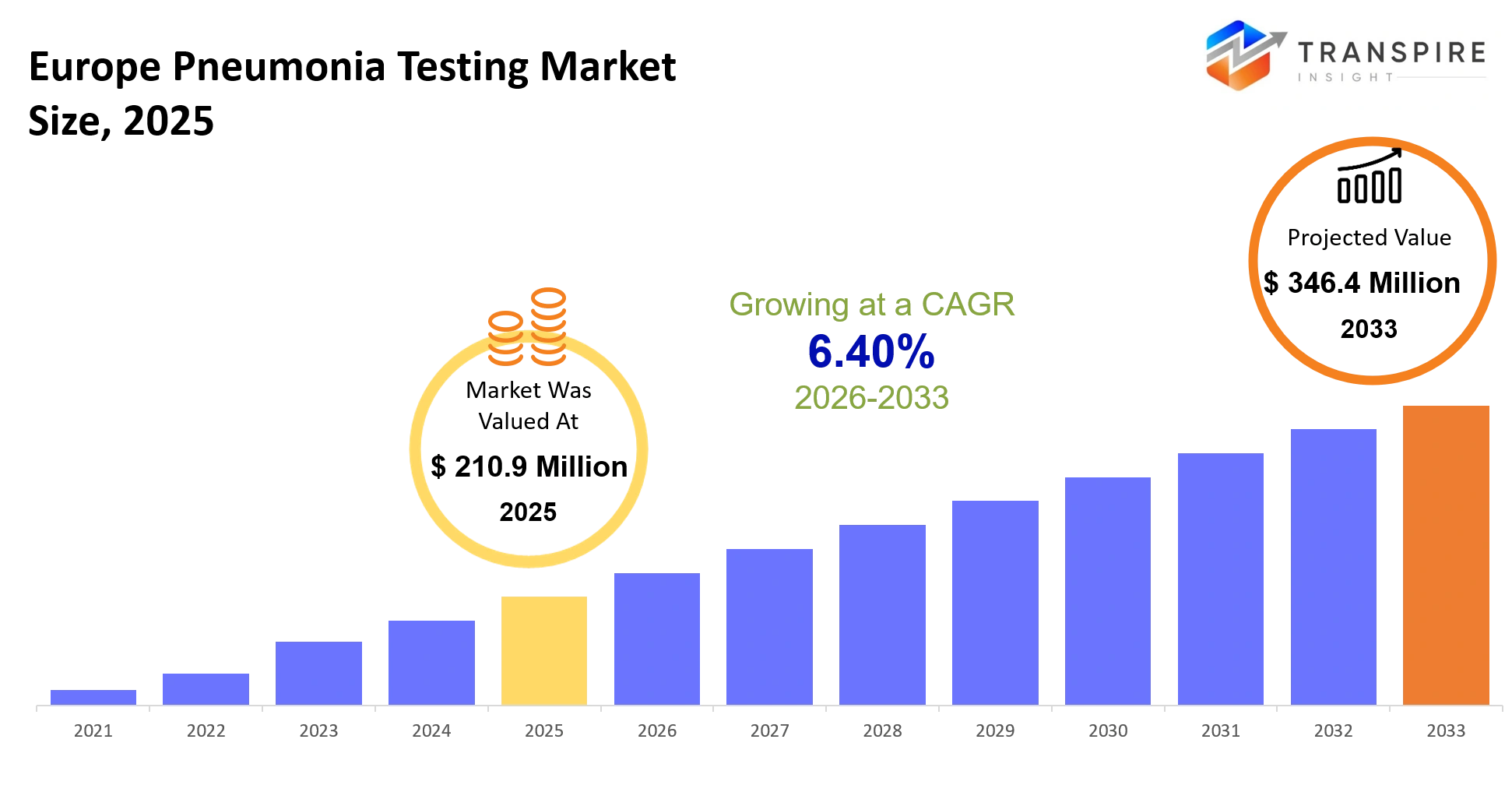
As per Transpire Insight Analysis the Europe Pneumonia Testing Market size is estimated at USD 210.9 Million in 2025 and is anticipated to reach USD 346.4 Million by 2033, growing at a CAGR of 6.40% from 2026 to 2033.
The Europe Pneumonia Testing Market kinda supports hospitals, diagnostic centers, and those healthcare networks by helping enable quicker detection of pneumonia cases ,so clinicians can choose the right therapies, keep patient flow steadier ,and also ease the strain on intensive care resources. In the last 3–5 years, things have moved away from the older culture based way of diagnosing, toward rapid molecular testing, automated systems, and more combined respiratory panels, that basically return outcomes in tighter clinical time windows. Then the COVID-19 pandemic really showed up as a strong trigger ,it highlighted weak spots in respiratory disease detection capacity and pushed investment into advanced diagnostic infrastructure across Europe. Because of that ,adoption has become more solid, especially as providers put more focus on early separation between bacterial, viral, and mixed infections. Market expansion is also being shaped by the need for streamlined hospital workflows, antimicrobial stewardship initiatives, and dependable testing setups that support better clinical choices while still keeping healthcare costs under control.
Europe Pneumonia Testing Market Size & Forecast:
- Europe Pneumonia Testing Market Size 2025: USD 210.9 Million
- Expected Market Value 2033: USD 346.4 Million
- Forecast CAGR: 6.40%
- Leading region in 2025: Western Europe
- Fastest Growing region: Eastern Europe
- Key Profile: Roche, Abbott, Thermo Fisher Scientific, bioMérieux, Siemens Healthineers, Danaher, QIAGEN, BD, Hologic, Bio-Rad, Seegene, QuidelOrtho, Sysmex, Trinity Biotech, Randox
Key Market Insights
- In 2025, Western Europe basically dominates the landscape with roughly 60% market share ,backed by advanced hospitals, smoother reimbursement schemes, and pretty solid diagnostic infrastructure.
- Eastern Europe, meanwhile, is the fastest riser over 2025–2033, because healthcare modernization programs are expanding and laboratory investment keeps moving up.
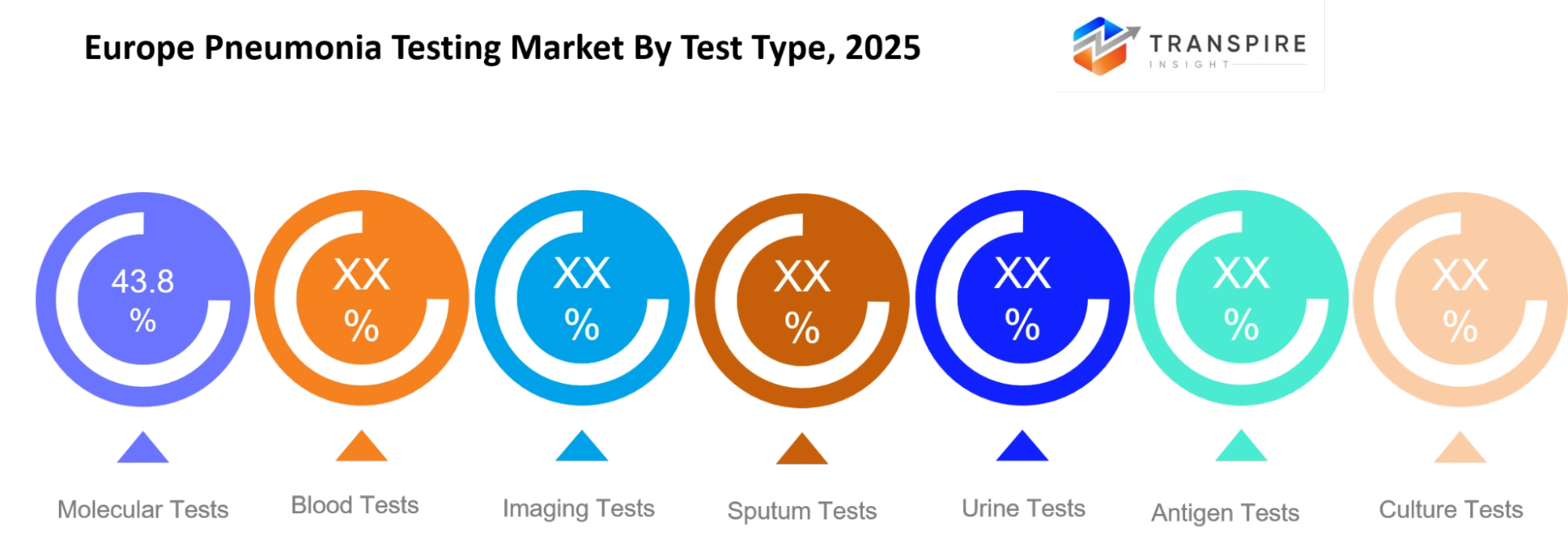
- When it comes to product segments, molecular testing is in the lead at almost 45% share, mainly since it helps with quicker pathogen identification ,which is kind of the point.
- Immunoassay based testing still sits as the second-largest segment, as hospitals tend to lean on cost-effective screening approaches for routine work.
- AI-integrated diagnostic platforms are likely the fastest growing segment up to 2033, with automation gradually improving how respiratory disease detection is handled.
- For applications, hospital diagnostics take the lead, about 55% in 2025, largely tied to pneumonia case management requirements.
- Point-of-care pneumonia testing is growing fastest too, driven by decentralized healthcare delivery trends, and the need to test closer to where patients are.
- On the end-user side, hospitals and diagnostic laboratories lead combined ,with nearly 70% share, rooted in well-established testing workflows.
- Homecare, along with outpatient centers, shows the quickest growth path through 2033, as remote monitoring adoption keeps accelerating.
- Finally, Roche expanded its molecular diagnostics capabilities via advanced respiratory testing solutions, plus extra laboratory automation investment.
What are the Key Drivers, Restraints, and Opportunities in the Europe Pneumonia Testing Market?
The Europe Pneumonia Testing Market is kinda being pushed along by the move toward fast molecular diagnostics, after COVID-19 really pointed out issues in the usual respiratory testing routines. There’s also regulatory pressure, like antimicrobial stewardship and hospital infection oversight, that’s nudging providers to use quicker pathogen identification tools. In practice, this change cuts down diagnostic delays, helps with more accurate treatment selection, and it boosts purchases of automated testing systems in hospitals and labs. So as healthcare networks start focusing more on operational efficiency, these upgraded testing platforms are opening up additional revenue streams for makers of diagnostics, and, honestly, it becomes a bigger deal over time.
Still, the main restraint is that procurement across Europe is fragmented. You see different reimbursement setups, approval paths, and hospital purchasing styles from country to country, and that slows adoption of new technology. This obstacle isn’t going away quickly, because healthcare systems run on national rules and budget cycles. Smaller diagnostic companies then end up with longer commercialization timelines, which limits where they can realistically penetrate the market and it delays their product launches. And, based on a Transpire Insight review of regional procurement announcements and rollout schedules, supply chain concentration stays the biggest execution risk.
The next growth phase is likely to come from AI enabled respiratory diagnostics and decentralized testing models, not just one thing. With machine learning based interpretation , portable molecular devices, and cloud connected platforms companies can extend access past centralized laboratories. In Eastern Europe, the healthcare modernization pushes are creating pretty solid conditions for adoption as hospitals upgrade their diagnostic capabilities. And if there’s strategic investment in connected testing ecosystems then companies should boost scalability and catch these emerging opportunities sooner rather than later.
What Has the Impact of Artificial Intelligence Been on the Europe Pneumonia Testing Market?
Artificial intelligence, plus digital techs, is basically reworking pneumonia diagnostics—like, not just by making test interpretation clearer, but also by speeding up workflow automation and giving clinicians better decision support . AI models are now being folded into diagnostic platforms to parse respiratory samples, sort results automatically, and help with laboratory quality monitoring, which is kinda important. In a similar way, digital systems support compliance tracking because they can generate automated logs for testing accuracy, turnaround duration, and even how results are reported.
Meanwhile, machine learning is also being used for forecasting testing volumes, pointing out seasonal pneumonia signals, and tuning laboratory resource allocation in a more organized way. All these things can reduce operational slowdowns and raise diagnostic efficiency across healthcare facilities. In practice, AI enabled platforms can cut the analysis time down and make faster treatment choices more likely, so lab productivity goes up while unnecessary testing costs can fall.
Still, adoption is not fully widespread, since integration expenses are high, healthcare data standards are inconsistent , and validating AI reliability across different clinical settings can be hard. Smaller hospitals often lack the digital infrastructure needed for advanced diagnostic approaches , so there is this noticeable divide between large health networks and regional sites.
Key Market Trends
- Between 2021–2023, respiratory outbreaks kind of sped up how quickly European hospitals started using multiplex molecular panels for pathogen ID, like they really needed answers sooner.
- After 2022 the uptake kept growing, mostly because providers were trying to sharply tell bacteria from viral pneumonia cases, and do it faster than before, it seemed.
- Then after 2023, AI-assisted imaging and diagnostic interpretation also got more momentum, especially once they integrated it into respiratory disease workflows, not just as a standalone tool.
- From 2022–2025, European hospitals leaned into automated laboratory investments, hoping to trim turnaround times and make testing run more smoothly overall, with less friction.
- Around 2024, point-of-care pneumonia testing gained traction too, as healthcare systems pushed decentralized diagnostic capabilities out into more locations.
- In parallel, companies like Roche and bioMérieux bolstered their respiratory offerings, using multiplex testing innovations along with laboratory automation strategies, kind of covering both sides.
- After 2021, antimicrobial stewardship programs expanded across Europe, and that boosted the demand for pathogen-specific pneumonia diagnosis that’s accurate.
- After 2022 disruptions, supply chain diversification became a real priority, since availability of diagnostic components and even lab equipment started wobbling, so they looked for backup routes.
- Starting after 2023, cloud-connected diagnostic platforms showed up more often, supporting remote monitoring, data sharing, and centralized healthcare analytics.
- And during 2024–2025, partnerships between diagnostic companies and hospitals increased, aimed at pushing adoption of digital respiratory testing solutions even quicker, as if timelines were everything.
Europe Pneumonia Testing Market Segmentation
By Test Type :
Molecular tests have started to get strong adoption, mainly because they can identify the pathogen faster, and still give pretty accurate results in clinical settings. PCR based methods usually help with early diagnosis, since they detect bacterial or viral causes with high sensitivity, and that matters for decision making. Blood tests still matter a lot for infection assessment, while imaging tests are what physicians use to check lung conditions and related issues.
Sputum tests along with culture tests keep supporting lab confirmation, especially when pneumonia is more complex or when the case is tricky. At the same time antigen and urine tests offer quicker screening options in hospitals and in outpatient visits. In practice, choosing which test type to use depends on how quickly the diagnosis is needed, how strict accuracy must be, what the healthcare infrastructure can handle, plus the patient’s current condition.
By Technology :
PCR technology is seeing broader adoption, because the detection capability is reliable, and the turnaround time is shorter than traditional methods. Immunoassays and rapid diagnostics also help with routine screening, they can be cost-effective and workable across different healthcare facilities. Meanwhile, culture testing stays useful for deeper pathogen analysis and it can guide antimicrobial treatment planning more effectively.
NGS technology is getting more attention, mainly due to its advanced sequencing capabilities for complicated respiratory infections. ELISA platforms continue to support lab based testing workflows, and they fit into many standard processes. Also, AI diagnostics are opening up new possibilities, with automated analysis, better reporting, and digital decision support across diagnostic environments.
By End User :
Hospitals are a pretty big end user chunk , mainly because pneumonia cases are coming in high numbers and clinicians keep looking for more advanced testing systems. Diagnostic laboratories back up big testing networks using centralized processing, specialized devices and trained professionals too. Clinics and ambulatory centers are also moving toward quicker testing solutions so outpatient care gets better , faster, and in a more steady way.
Research institutes, plus public health centers, help a lot through disease monitoring efforts and studies on respiratory infections. Homecare settings are getting a lot more attention these days with portable diagnostic tools and remote care models that feel less disruptive. End user growth really leans on healthcare reach, testing bandwidth, and how solid the digital infrastructure is.
By Sample Type :
For pneumonia diagnosis, blood samples stay widely used for infection evaluation and lab analysis in general. Sputum samples help with pathogen identification because they carry direct respiratory secretions for testing. Nasopharyngeal swabs became more important once respiratory outbreaks pushed demand for less invasive sample collection methods, which people can tolerate easier.
In more severe situations, bronchoalveolar lavage enables advanced diagnosis when a detailed respiratory look is needed. Saliva based testing is also emerging, it’s sort of a convenient alternate path with easier collection. Urine and tissue samples cover more specialized diagnostic needs across hospitals and research groups.
By Application :
Bacterial pneumonia still stays as this major use case, honestly, mostly because you really need to pin down the exact pathogen, then match it with targeted antibiotic therapy. Viral pneumonia testing started to get more attention after respiratory outbreaks, when everyone wanted faster viral detection, like right away. Community acquired pneumonia diagnosis helps guide whether a patient can stay outpatient or needs hospital care, depending on what shows up.
Hospital acquired pneumonia is different though, you kinda need more advanced testing, since the infections are more tangled , and there’s also antimicrobial resistance to worry about. For pediatric pneumonia, the applications keep growing, mainly thanks to better diagnostic access and earlier detection methods. When pneumonia is severe, clinicians tend to rely on more advanced testing technologies, for quicker clinical action and overall improved patient handling.
What are the Key Use Cases Driving the Europe Pneumonia Testing Market?
Hospital based diagnosis still stays, like the main use for pneumonia testing, backed by real pull from hospitals plus diagnostic labs that need quicker pathogen identification. In practice, healthcare providers end up purchasing molecules along with rapid diagnostic solutions , because it helps them decide treatments sooner, handle patient admissions more cleanly, and it also supports antimicrobial stewardship efforts.
Meanwhile outpatient clinics, and ambulatory centers are starting to use point of care respiratory testing so they can do faster evaluations in the room. Public health centers also lean on more advanced testing platforms for respiratory surveillance efforts, outbreak tracking , and broader population level infection management.
Some newer angles are showing up too, like homecare testing and AI assisted diagnostic workflows, and they could grow as remote healthcare expands, plus with more digital integration. Research institutes, as well as regional healthcare networks will likely test connected platforms for early detection and data driven pneumonia management.
|
Report Metrics |
Details |
|
Market size value in 2025 |
USD 210.9 Million |
|
Market size value in 2026 |
USD 224.4 Million |
|
Revenue forecast in 2033 |
USD 346.4 Million |
|
Growth rate |
CAGR of 6.40% from 2026 to 2033 |
|
Base year |
2025 |
|
Historical data |
2021 - 2024 |
|
Forecast period |
2026 - 2033 |
|
Report coverage |
Revenue forecast, competitive landscape, growth factors, and trends |
|
Regional scope |
Europe (Germany, United Kingdom, France, Italy, Spain and Rest of Europe) |
|
Key company profiled |
Roche, Abbott, Thermo Fisher Scientific, bioMérieux, Siemens Healthineers, Danaher, QIAGEN, BD, Hologic, Bio-Rad, Seegene, QuidelOrtho, Sysmex, Trinity Biotech, Randox . |
|
Customization scope |
Free report customization (country, regional & segment scope). Avail customized purchase options to meet your exact research needs. |
|
Report Segmentation |
By Test Type (Molecular Tests, Blood Tests, Imaging Tests, Sputum Tests, Urine Tests, Antigen Tests, Culture Tests, Others); By Technology (PCR, Immunoassays, Culture Testing, NGS, ELISA, Rapid Diagnostics, AI Diagnostics, Others); By End User (Hospitals, Diagnostic Laboratories, Clinics, Ambulatory Centers, Research Institutes, Public Health Centers, Homecare Settings, Others); By Sample Type (Blood, Sputum, Nasopharyngeal Swab, Bronchoalveolar Lavage, Saliva, Urine, Tissue Samples, Others); By Application (Bacterial Pneumonia, Viral Pneumonia, Fungal Pneumonia, Community-Acquired Pneumonia, Hospital-Acquired Pneumonia, Pediatric Pneumonia, Severe Pneumonia, Others) |
Which Regions are Driving the Europe Pneumonia Testing Market Growth?
Western Europe pretty much runs the Europe Pneumonia Testing Market, at least on paper with around 60% market share in 2025. A big reason is the strong healthcare infrastructure , plus advanced reimbursement frameworks and pretty strict infection control policies , that together help push adoption of molecular tests and quicker diagnostic tech. There’s also the fact that the region already has established diagnostic manufacturers, big hospital networks, and ongoing investment in lab automation. So the leadership looks set to keep going until 2033, mainly because healthcare systems want faster respiratory disease detection and clinical workflows that are more cost-efficient , even when things stay busy.
Southern Europe is more like a steady revenue engine, and the growth story there is tied to better healthcare access plus consistent public healthcare spending. Places like Italy and Spain keep a smooth pace of adoption , largely through national healthcare programs and the ongoing expansion of diagnostic capabilities. What’s a bit different is the pace of change: the region tends to do gradual technology upgrades instead of quick replacement of what’s already in place. With dependable hospital demand and structured healthcare budgets, the market should still stay active during the forecast window.
Eastern Europe, meanwhile, is showing up as the fastest-growing area. This is driven by healthcare modernization efforts and more money flowing into diagnostic infrastructure. Recently there have been upgrades across hospitals, lab networks, and respiratory disease management programs, which open the door for advanced testing uptake. As access to molecular diagnostics improves , regional expansion should accelerate between 2026 and 2033. For new market entrants and investors, there’s potential in still-untapped demand and in partnerships with healthcare systems that are still developing , step by step.
Who are the Key Players in the Europe Pneumonia Testing Market and How Do They Compete?
Competition in the Europe Pneumonia Testing Market is sort of moderately consolidated, and the big diagnostic players kind of go head to head via technology innovation, automation ability, and those integrated testing solutions that feel all connected. In practice, the battle is mostly about faster turnaround time , better accuracy , lab connectivity, and then widening respiratory testing portfolios. The established companies are defending their turf , while the more specialized diagnostic providers come in with focused offerings for decentralized healthcare environments.
Roche basically competes with advanced molecular diagnostic platforms plus laboratory automation systems, which in turn boost overall testing efficiency. They also keep building market strength by rolling out integrated solutions that link diagnostics into wider healthcare workflows, if that makes sense. bioMérieux leans into syndromic testing and multiplex respiratory panels, using its specialized infectious disease know-how , and also strong rapid pathogen identification abilities as a differentiator.
Abbott Laboratories grows its presence through portable diagnostic technologies, which support quicker testing outside the usual traditional laboratories. Thermo Fisher Scientific takes on the competition through molecular testing innovation , broad lab solutions , and research driven diagnostic development. QIAGEN, on the other hand, reinforces its position via molecular assay technologies and partnerships, which help improve access to respiratory testing solutions across healthcare networks.
Company List
- Roche
- Abbott
- Thermo Fisher Scientific
- bioMérieux
- Siemens Healthineers
- Danaher
- QIAGEN
- BD
- Hologic
- Bio-Rad
- Seegene
- QuidelOrtho
- Sysmex
- Trinity Biotech
- Randox
Recent Development News
In March 2026, bioMérieux received IVDR CE-marking for two BIOFIRE® SPOTFIRE® respiratory panels. The certification strengthened near-patient respiratory diagnostics across Europe by enabling point-of-care use outside traditional laboratories and expanding access to rapid molecular testing. Sourcehttps://live.euronext.com/
In March 2026, Roche launched the cobas eplex respiratory pathogen panel 3 in CE-marked markets. The new multiplex respiratory test detects up to 25 viruses and bacteria from a single sample, supporting faster treatment decisions and strengthening hospital respiratory testing workflows across Europe. Sourcehttps://www.prnewswire.co.uk/
What Strategic Insights Define the Future of the Europe Pneumonia Testing Market?
The Europe Pneumonia Testing Market is kind of moving , toward connected quicker and more decentralized diagnostic ecosystems, as providers start pushing for faster clinical decisions, and also for efficient resource allocation at the same time. The real driver is this shift away from classic lab workflows into molecular platforms, automation, and digital diagnostic integration, you know, the whole stack.
There’s also a quieter risk, like market concentration among a few major diagnostic technology providers. That can reduce supply flexibility and leave everyone a bit dependent on a small set of platforms if there are future disruptions in healthcare. Not a big headline issue , but it can matter a lot later.
At the same time an emerging opportunity is showing up with AI-supported respiratory diagnostics, paired with portable testing systems. This seems especially relevant across Eastern European healthcare networks that are upgrading lab access, and trying to bring capability closer to the patient. Market participants should therefore put money into adaptable testing platforms, strengthen regional partnerships, and build solutions that work with different healthcare procurement models, so they can better capture long-term adoption chances.
Europe Pneumonia Testing Market Report Segmentation
By Test Type
- Molecular Tests
- Blood Tests
- Imaging Tests
- Sputum Tests
- Urine Tests
- Antigen Tests
- Culture Tests
By Technology
- PCR
- Immunoassays
- Culture Testing
- NGS
- ELISA
- Rapid Diagnostics
- AI Diagnostics
By End User
- Hospitals
- Diagnostic Laboratories
- Clinics
- Ambulatory Centers
- Research Institutes
- Public Health Centers
- Homecare Settings
By Sample Type
- Blood
- Sputum
- Nasopharyngeal Swab
- Bronchoalveolar Lavage
- Saliva
- Urine
- Tissue Samples
By Application
- Bacterial Pneumonia
- Viral Pneumonia
- Fungal Pneumonia
- Community-Acquired Pneumonia
- Hospital-Acquired Pneumonia
- Pediatric Pneumonia
- Severe Pneumonia
Frequently Asked Questions
Find quick answers to common questions.
The expected Europe Pneumonia Testing Market size for the market will be USD 346.4 Million in 2033.
Key segments for the Europe Pneumonia Testing Market are By Test Type (Molecular Tests, Blood Tests, Imaging Tests, Sputum Tests, Urine Tests, Antigen Tests, Culture Tests, Others); By Technology (PCR, Immunoassays, Culture Testing, NGS, ELISA, Rapid Diagnostics, AI Diagnostics, Others); By End User (Hospitals, Diagnostic Laboratories, Clinics, Ambulatory Centers, Research Institutes, Public Health Centers, Homecare Settings, Others); By Sample Type (Blood, Sputum, Nasopharyngeal Swab, Bronchoalveolar Lavage, Saliva, Urine, Tissue Samples, Others); By Application (Bacterial Pneumonia, Viral Pneumonia, Fungal Pneumonia, Community-Acquired Pneumonia, Hospital-Acquired Pneumonia, Pediatric Pneumonia, Severe Pneumonia, Others).
Major Europe Pneumonia Testing Market players are Roche, Abbott, Thermo Fisher Scientific, bioMérieux, Siemens Healthineers, Danaher, QIAGEN, BD, Hologic, Bio-Rad, Seegene, QuidelOrtho, Sysmex, Trinity Biotech, Randox.
The Europe Pneumonia Testing Market size is USD 210.9 Million in 2025.
The Europe Pneumonia Testing Market CAGR is 6.40% from 2026 to 2033.
- Roche
- Abbott
- Thermo Fisher Scientific
- bioMérieux
- Siemens Healthineers
- Danaher
- QIAGEN
- BD
- Hologic
- Bio-Rad
- Seegene
- QuidelOrtho
- Sysmex
- Trinity Biotech
- Randox
About the Authors

Pankaj Ghogare Patil
I am Pankaj Ghogare Patil, a Senior Research Analyst at Transpire Insight, specializing in the Pharmaceutical, Chemicals & Materials, Healthcare IT, and Biotechnology industry. My expertise lies in conducting comprehensive market research, analyzing industry trends, evaluating competitive landscapes, and translating complex data into actionable insights. At Transpire Insight, I closely follow emerging technologies, regulatory developments, and market innovations to create accurate, well-researched, and informative content that helps businesses and professionals make informed decisions. I am committed to producing credible, evidence-based articles that reflect industry best practices while making technical topics accessible and valuable for a broad audience.

Chakradhar Khansole
Chakradhar serves as the Research Director at Transpire Insight, bringing over 8 years of experience in technology, innovation, and strategic market intelligence. He specializes in transforming complex market data into actionable business insights that enable organizations to make informed, growth-oriented decisions. Recognized for his strategic vision and analytical expertise, Chakradhar leads high-impact research initiatives, delivering comprehensive market assessments, competitive intelligence, and forward-looking industry analysis.
Recently Published Reports
-
Apr 2026
AI in Diabetic Retinopathy Market
AI in Diabetic Retinopathy Market Size, Share & Analysis Report By Type (Screening AI Systems, Diagnostic AI Systems, and Predictive AI Models), By Application Segment (Hospitals, Ophthalmology Clinics, Diagnostic Centers, and Research and Development), and Geography (North America, Europe, Asia-Pacific, Middle East and Africa, South and Central America), 2021 - 2031
-
Apr 2026
Psychometric Tests Market
Psychometric Tests Market Size, Share & Analysis Report By Type (Personality Tests, Ability/Aptitude Tests, Skill/Knowledge Tests, and Others), By Application (Talent Acquisition and Talent Management), and Geography (North America, Europe, Asia-Pacific, Middle East and Africa, South and Central America), 2021 – 2031
-
Apr 2026
Rare Biological Sample Collection Market
Rare Biological Sample Collection Market Size, Share & Analysis Report By Type (Isolation Kits & Reagent, Blood Collection Tubes, and Others), By Application (Oncology, Transcriptomics, Pharmacogenomics, and Others), and Geography (North America, Europe, Asia-Pacific, Middle East and Africa, South and Central America), 2021 – 2031
-
Jul 2026
Diabetic Retinopathy Market
Diabetic Retinopathy Market Size, Share & Analysis Report By Type (Proliferative Diabetic Retinopathy, and Diabetic Macular Edema (DME)), By Treatment Type (Anti VEGF Drug, Steroid Implants, Laser Surgeries, and Vitrectomy), and Geography (North America, Europe, Asia-Pacific, Middle East and Africa, South and Central America), 2021 – 2031
Our Clients







