

Europe Photonics Market Size & Forecast:
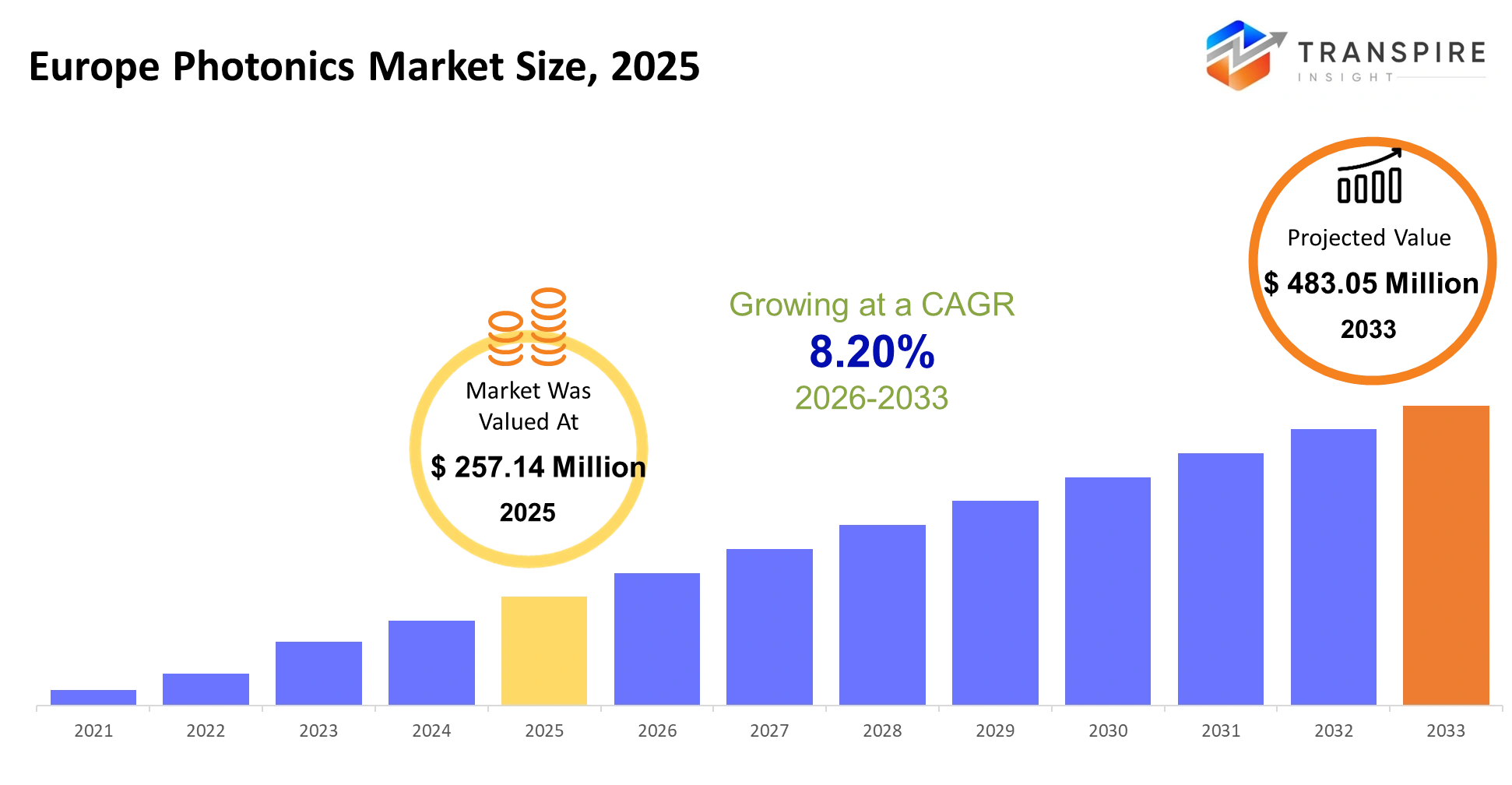
- Europe Photonics Market Size 2025: USD 257.14 Million
- Europe Photonics Market Size 2033: USD 483.05 Million
- Europe Photonics Market CAGR: 8.20%
- Europe Photonics Market Segments: By Type (Lasers, LEDs, Optical Components, Imaging Systems, Others), By Application (Telecom, Healthcare, Industrial Manufacturing, Defense, Consumer Electronics, Others), By End-User (Electronics Industry, Healthcare, Telecom Operators, Defense, Industrial Firms, Others), By Technology (Fiber Optics, Silicon Photonics, Others).
To learn more about this report,  Download Free Sample Report
Europe Photonics Market Summary:
The Europe Photonics Market size is estimated at USD 257.14 Million in 2025 and is anticipated to reach USD 483.05 Million by 2033, growing at a CAGR of 8.20% from 2026 to 2033. European photonics technology enables ships and factories and infrastructure to establish real-time visual and measurement and communication capabilities. Optical sensors track corrosion and structural stress in vessels, and laser systems enable precision cutting in manufacturing, while fiber networks carry high-speed data across ports and industrial locations. The system achieves three results by decreasing operational interruptions and increasing workplace security and enabling tighter monitoring of industrial operations.
The market has shifted during the past three to five years toward integrated photonic systems which combine sensing with data transmission and processing functions on small platforms. The transition began to accelerate after the pandemic supply disruptions demonstrated that manual inspection costs combined with monitoring system deficiencies. Operators adopted automated optical systems because they needed continuous diagnostics to solve their labor shortages and meet stricter emissions compliance requirements. The relationship between two elements leads to business adoption of technology which extends beyond pilot projects and results in full-scale implementation that converts technical skills into operational efficiencies and better understanding of expense patterns.
Key Market Insights
- The European Photonics Market in 2025 will be predominantly controlled by Western Europe which holds approximately 55% of the market share through its three main countries Germany France and the UK.
- The Nordic and Eastern European regions represent the quickest development area because they will grow at a rate exceeding 8% until 2030 due to their investments in smart manufacturing.
- Laser systems lead the market with their 35% market share because they fulfill the needs of precision manufacturing and semiconductor fabrication.
- Optical fibers together with communication components serve as the second largest market share holder, which benefits from the development of 5G networks and data infrastructure systems.
- The integrated photonics field will experience the fastest growth which will result in a market size that will double between 2025 and 2030.
- Industrial manufacturing stands as the leading application which generates almost 40% of the entire market revenue during 2025.
- The healthcare industry and medical imaging field experience their strongest growth through photonics-enabled diagnostics and minimally invasive technologies.
- The manufacturing industry serves as the main customer base for products because it accounts for more than 45% of total demand which results from their need to implement automation and perform quality control.
- The telecommunications sector experiences its fastest growth rate because of its increasing demand for fiber optic infrastructure and its requirement for high-speed data transmission.
What are the Key Drivers, Restraints, and Opportunities in the Europe Photonics Market?
The Europe Photonics Market experiences its most rapid growth because industrial facilities now move towards automated systems which operate based on real-time data. The labor crisis combined with new EU emissions standards and quality rules created the conditions which led to this industrial change. The manufacturing and maritime sectors now use laser inspection methods together with optical sensors and machine vision systems to eliminate their need for manual inspections. Companies adopt photonics systems at higher rates because these systems help them achieve lower defect rates while providing continuous monitoring and reduced equipment breakdowns. Companies validate their decision to spend more money upfront because they achieve higher productivity together with predictable expenses which results in better recurring income for photonics companies.
The most significant barrier is the high integration complexity of photonics systems within legacy industrial infrastructure. Most European factories and port systems use outdated equipment which has been in service for multiple decades and does not support modern optical technologies. Retrofitting demands organizations to go through multiple stages which include creating new operational procedures, providing staff education, and establishing connections between different national standards. The combination of these limitations creates delays in project execution while driving up expenses, which leads to decreased short-term income because of impending long-term financial benefits.
Silicon photonics development offers data centers and telecom networks an essential growth opportunity through their integrated solutions. The European region develops its cloud computing facilities together with data protection systems, which results in fast technology adoption for businesses. Hyperscale data centers now adopt photonic interconnect technology to decrease their power usage and improve response times, which creates a profitable business opportunity for manufacturers of these components.
What Has the Impact of Artificial Intelligence Been on the Europe Photonics Market?
AI along with modern digital technologies has brought major changes to the operational procedures of photonics-based systems which operate within industrial and maritime environments. AI control systems in exhaust gas cleaning technology now use continuous optical sensor data analysis to monitor scrubber operations through automatic control of exhaust gas cleaning equipment. The system maintains sulfur emission limits by using real-time flow rate adjustments and chemical dosing controls which decrease the need for manual operation.
Machine learning models enable systems to carry out predictive maintenance because they detect initial signs of equipment failure through monitoring of laser sensors and optical elements and filtration systems. The operating team uses these analytics to determine the optimal time for maintenance which prevents equipment breakdowns and enhances system functioning. AI platforms in fleet deployments gather photonic data to predict emission patterns and enhance fuel-air mixture optimization which results in improved fuel efficiency and decreased operational expenses.
The technologies provide definite operational benefits which result in better equipment uptime and enhanced accuracy of compliance documentation. The process of implementing this technology faces challenges because there is a shortage of high-quality training data that needs to be gathered from extreme marine conditions. The combination of changing weather conditions and equipment vibrations and sensor malfunctions leads to reduced model accuracy which creates difficulties in achieving standardized AI results for multiple fleets without doing major recalibrations and spending substantial resources.
Key Market Trends
- Manufacturers have transitioned their operations from using independent laser equipment to utilizing complete photonics systems since 2021 which enabled them to decrease their inspection duration by almost 30 percent throughout their automated production processes.
- After EU emissions enforcement tightened in 2020 maritime operators increasingly deployed optical sensing systems to enable continuous real-time compliance tracking instead of using periodic inspections.
- Telecom operators accelerated their fiber optic deployments between 2022 and 2025 because more than 60 percent of their new infrastructure depended on advanced photonic communication components.
- European chip shortages during 2021-2023 forced ASML and ams-OSRAM to establish domestic photonics supply chains which enabled them to reduce their reliance on Asian semiconductor components.
- Data centers began to use optical interconnects for data transmission when demand for silicon photonics increased after 2020 because this technology enabled them to reduce energy usage by 40 percent in high-density computer environments.
- Industrial buyers increasingly favor AI-enabled photonics systems which led to a sharp increase in machine vision adoption after 2022 because it allows businesses to achieve more than 95 percent accuracy in defect detection.
- The defense and aerospace sectors increased their photonics funding after 2022 geopolitical tensions because they needed to develop lidar and infrared sensing technology for their surveillance and navigation systems.
- The TRUMPF and semiconductor firm partnerships from 2023 to 2026 enabled laser technology development which resulted in a 25 percent increase in precision manufacturing throughput.
- Healthcare providers established photonics-based diagnostic systems after 2021 because optical imaging systems provided faster non-invasive medical procedures that decreased patient turnaround times.
Europe Photonics Market Segmentation
By Type
The main laser type exists as the leading laser technology because people use it for various applications including precision manufacturing and semiconductor lithography and defense targeting systems. Industrial firms demand high-power and ultra-fast laser systems because these technologies help them achieve better production output and higher precision, thus leading to revenue growth in this business area. The essential optical components required for photonic systems construction include lenses and filters and waveguides which function as fundamental elements.
The stable demand for LEDs exists because they serve both lighting and display purposes, yet their market growth has slowed down because the segment has reached maturity. The healthcare diagnostics and industrial inspection fields are adopting imaging systems because of the increasing need to maintain quality standards. The industry will create modular systems which enable manufacturers to build compact units through the integration of their components, demanding that manufacturers develop miniaturized systems which achieve high-performance results and greater profit margins.
By Application
The industrial manufacturing sector depends on photonics because companies use photonics for their cutting and welding and inspection processes. The automotive and electronics industries implement automation systems to meet their operational requirements and to achieve industry-standard quality expectations. The telecommunications sector ranks as the second most important application because fiber network development and data traffic expansion support its growth across Europe.
Healthcare applications expand more rapidly because medical professionals now use optical imaging and laser-based treatments for both diagnostic and less invasive medical procedures. The defense and aerospace industries maintain constant demand for sensing and navigation systems because geopolitical factors shape their technology requirements. The market will develop products that provide multiple functions through integrated sensing and communication and processing solutions. Product development in suppliers will need to match the requirements of end-use integration and the demands of long-term service models.

To learn more about this report, Download Free Sample Report
By End-User
Industrial firms dominate the market because end-users continue to invest in both automation and production efficiency improvements. The electronics manufacturers and automotive producers control most of the market because they need precise components and high production capacities. Telecom operators follow as key buyers of fiber optic and photonic communication systems, especially with their ongoing infrastructure upgrades.
Healthcare providers show rapid adoption as hospitals integrate advanced imaging and laser systems into their standard medical procedures. Defense organizations maintain consistent procurement focused on surveillance and targeting technologies. The growth outlook shows that various industries will connect through upgraded photonic solutions which end-users need, forcing suppliers to create closer partnerships while they provide engineering support for specific applications.
By Technology
The existing optical fiber network system has become the primary technology used for communication networks and industrial sensing applications. The broadband infrastructure has been extensively built which results in consistent demand while the system undergoes ongoing improvements. The data center industry needs high-speed energy-efficient data transmission which makes silicon photonics the fastest expanding technology in this sector. The ability to merge optical and electronic components onto a single chip design creates strong interest from organizations which operate large computing systems.
The market currently uses various technologies such as quantum photonics and advanced imaging techniques which have not yet reached their full potential. The upcoming period will see the development of hybrid systems that utilize different photonic technologies, which will drive research and development investments while creating new competitive dynamics among technology vendors.
What are the Key Use Cases Driving the Europe Photonics Market?
Industrial manufacturing remains the core use case, where photonics systems enable precise cutting and welding and inline inspection. Automotive and electronics plants use laser tools and optical sensors to decrease defects while they produce goods that match their strict quality requirements.
Healthcare and telecommunications represent expanding applications. Optical imaging and laser-based diagnostics help hospitals achieve better accuracy while decreasing procedure duration, and telecom operators use fiber-based photonics to manage increasing data traffic and network reliability needs.
Silicon photonics shows potential as an emerging use case for hyperscale data centers which also use lidar-based sensing for autonomous maritime navigation. The current usage of these applications remains confined to a small area, but they demonstrate strong potential for growth as data infrastructure expands and smart shipping regulatory frameworks develop.
|
Report Metrics |
Details |
|
Market size value in 2025 |
USD 257.14 Million |
|
Market size value in 2026 |
USD 278.23 Million |
|
Revenue forecast in 2033 |
USD 483.05 Million |
|
Growth rate |
CAGR of 8.20% from 2026 to 2033 |
|
Base year |
2025 |
|
Historical data |
2021 - 2024 |
|
Forecast period |
2026 - 2033 |
|
Report coverage |
Revenue forecast, competitive landscape, growth factors, and trends |
|
Regional scope |
Europe (Germany, United Kingdom, France, Italy, Spain and Rest of Europe) |
|
Key company profiled |
Coherent, Lumentum, IPG Photonics, Hamamatsu, Thorlabs, OSRAM, Signify, II-VI, TRUMPF, Jenoptik, Nikon, Canon, Sony, Zeiss, ams-OSRAM |
|
Customization scope |
Free report customization (country, regional & segment scope). Avail customized purchase options to meet your exact research needs. |
|
Report Segmentation |
By Type (Lasers, LEDs, Optical Components, Imaging Systems, Others), By Application (Telecom, Healthcare, Industrial Manufacturing, Defense, Consumer Electronics, Others), By End-User (Electronics Industry, Healthcare, Telecom Operators, Defense, Industrial Firms, Others), By Technology (Fiber Optics, Silicon Photonics, Others) |
Which Regions are Driving the Europe Photonics Market Growth?
Western Europe holds market dominance because it has strong regulatory systems and develops cutting-edge industrial facilities. The three countries of Germany and France and the Netherlands established strict emissions and quality requirements which create a demand for photonics-based monitoring and control technologies. The region operates its advanced automated factories and major ports and research institutions through a comprehensive system that creates ongoing development. The research partnership between manufacturers and universities and government programs creates a financial pipeline which enables quick development of photonic products.
Southern Europe represents a stable second region with a different growth profile. The maritime industry in Italy and Spain maintains steady operations because shipowners continue to invest without needing strict policy requirements. Organizations choose to adopt new technologies through a slow process because they prefer to implement small modifications instead of replacing entire systems. The maritime industry relies on tourism shipping and regional trade routes which create a stable demand pattern that produces moderate revenue growth across the entire market.
The industrial modernization of Eastern Europe together with EU-funded infrastructure development has created the fastest economic development rate in the region. Poland and Romania expanded their port facilities and upgraded their manufacturing plants since 2022 which created a demand for advanced optical systems. Photonics manufacturers establish their operations in the region because of reduced production expenses and rising foreign direct investment. The growth path between 2026 and 2033 creates excellent possibilities for new businesses and investors who want to expand their operations at minimal expenses.
Who are the Key Players in the Europe Photonics Market and How Do They Compete?
European Photonics Market Competition shows a divided market structure because major players hold some market share while smaller companies continue to operate their own independent business activities. The large market leaders maintain their market position through extensive research and development expenditures and their ongoing industrial partnerships, while the smaller companies enter the market through their expertise in particular fields like sensing or imaging. Technology performance and integration capability establish the main competitive foundation because customers today prefer complete photonic systems instead of individual components. Vendors choose their suppliers based on two factors which include their proximity to manufacturing centers and their capacity to deliver post-sales assistance.
ASML specializes in extreme ultraviolet lithography systems which depend on advanced photonics technology to produce semiconductor chips. The company achieves a strong competitive advantage through its special expertise which enables it to create highly accurate products at a large production capacity. Through its industrial automation solutions TRUMPF provides high-power laser systems that include hardware products and software tools for process optimization. Both companies plan to expand their operations through partnerships with semiconductor and electronics manufacturers which will help them develop products that meet future production requirements.
ams-OSRAM uses sensor technology to establish its market position while developing optical sensors that automotive and consumer markets need which require miniaturized products that consume less power. Jenoptik builds advantage through niche specialization in defense and industrial imaging, which European security programs support through its strong presence in European security programs. The Thales Group establishes permanent revenue sources by using integrated photonics in aerospace and defense systems which it develops through government contracts and international partnerships.
Company List
- Coherent
- Lumentum
- IPG Photonics
- Hamamatsu
- Thorlabs
- OSRAM
- Signify
- II-VI
- TRUMPF
- Jenoptik
- Nikon
- Canon
- Sony
- Zeiss
- ams-OSRAM
Recent Development News
In March 2026, High-growth photonics integration deals in Europe: European photonics ecosystem saw multiple strategic acquisitions involving integrated photonics used in AI and quantum systems, including cross-border deals strengthening Europe’s semiconductor-photonics supply chain. These transactions highlight increasing consolidation among photonics hardware providers serving AI data centers and advanced sensing applications.
Source: https://www.openpr.com
In January 2026, the 50 Million Euro European Pilot ‘Photonics For Quantum’ Launched: A major EU-backed initiative, Photonics for Quantum (P4Q), was launched across multiple European countries to industrialise photonic chip technologies for quantum computing and secure communications. The project focuses on scaling lab-grade photonics into manufacturable systems for quantum applications, marking a key step in Europe’s photonics industrialisation push.
Source: https://thequantuminsider.com
What Strategic Insights Define the Future of the Europe Photonics Market?
The Europe Photonics Market is expected to implement software-defined photonic systems through their upcoming five-to-seven-years development period. The shift is required because data needs to be processed and transmitted and acted upon at its origin in automated factories and ports and data infrastructure. The expansion of edge computing will enable photonics to become an essential element of industrial intelligence systems which will determine both their operational structure and revenue generation methods.
The increasing need for advanced semiconductor and optical material supply shows an unrecognized danger to organizations. Any disruption in rare materials or fabrication capacity could constrain production timelines and inflate system costs which would impede adoption despite strong demand signals. European data infrastructure currently develops silicon photonics technology which creates new opportunities because governments need secure and energy-efficient computing ecosystems.
Market participants should invest in vertically integrated capabilities which combine hardware with software and data services. The approach will create a stronger competitive advantage while decreasing the risks from supply-side market changes.
Europe Photonics Market Report Segmentation
By Type
- Lasers
- LEDs
- Optical Components
- Imaging Systems
- Others
By Application
- Telecom
- Healthcare
- Industrial Manufacturing
- Defense
- Consumer Electronics
- Others
By End-User
- Electronics Industry
- Healthcare
- Telecom Operators
- Defense
- Industrial Firms
- Others
By Technology
- Fiber Optics
- Silicon Photonics
- Others
Frequently Asked Questions
Find quick answers to common questions.
The approximate Europe Photonics Market size for the market will be USD 483.05 Million in 2033.
The key segments of the Europe Photonics Market are By Type (Lasers, LEDs, Optical Components, Imaging Systems, Others), By Application (Telecom, Healthcare, Industrial Manufacturing, Defense, Consumer Electronics, Others), By End-User (Electronics Industry, Healthcare, Telecom Operators, Defense, Industrial Firms, Others), By Technology (Fiber Optics, Silicon Photonics, Others).
Major players in the Europe Photonics Market are Coherent, Lumentum, IPG Photonics, Hamamatsu, Thorlabs, OSRAM, Signify, II-VI, TRUMPF, Jenoptik, Nikon, Canon, Sony, Zeiss, ams-OSRAM.
The current market size of the Europe Photonics Market is USD 257.14 Million in 2025.
The Europe Photonics Market CAGR is 8.20%.
- Coherent
- Lumentum
- IPG Photonics
- Hamamatsu
- Thorlabs
- OSRAM
- Signify
- II-VI
- TRUMPF
- Jenoptik
- Nikon
- Canon
- Sony
- Zeiss
- ams-OSRAM
Recently Published Reports
-
Apr 2026
Healthcare Polymer Packaging Market
Healthcare Polymer Packaging Market Size, Share & Analysis Report By Packaging Type (Syringes, IV Bottles and Pouches, Clamshells, Blisters, Bottles & Jars, Containers, Tubes, IV Parental Packaging, Others), By Type (Regulated, Non-regulated), By Polymer Type (LDPE (Low-Density Polyethylene), HDPE (High-Density Polyethylene), Homo-polymer (Homo), Random Copolymer (Random), Block Copolymer (Block), PET, Polystyrene, Polyvinyl Chloride, Polyamide/EVOH, Others), and Geography (North America, Europe, Asia-Pacific, Middle East and Africa, South and Central America), 2021 - 2031
-
Apr 2026
Hydrophilic Tape (Waterstop) Market
Hydrophilic Tape (Waterstop) Market Size, Share & Analysis Report By Type (Bentonite-Based Hydrophilic Tape, Rubber-Based Hydrophilic Tape), By Application (Residential Buildings, Commercial Buildings, Infrastructure Projects), and Geography (North America, Europe, Asia-Pacific, Middle East and Africa, South and Central America), 2021 - 2031
-
Apr 2026
Metalens Market
Metalens Market Size, Share & Analysis Report By Type (Visible Light Metalens, and Infrared Metalens), By Application (Consumer Electronics, Automotive Electronics, Industrial, Medical, and Others), and Geography (North America, Europe, Asia-Pacific, Middle East and Africa, South and Central America), 2021 - 2031
-
Apr 2026
PBT Resin Market
PBT Resin Market Size, Share & Analysis Report By Type (Reinforced PBT Resin, Unreinforced PBT Resin), By Processing Method (Injection Molding, Extrusion, Blow Molding, Others), By End-User (Automotive, Electrical & Electronics, Consumer Appliances, Industrial Machinery, Medical Devices, Packaging, Others), and Geography (North America, Europe, Asia-Pacific, Middle East and Africa, South and Central America), 2021 - 2031