

Japan Logic Semiconductor Market Size & Forecast:
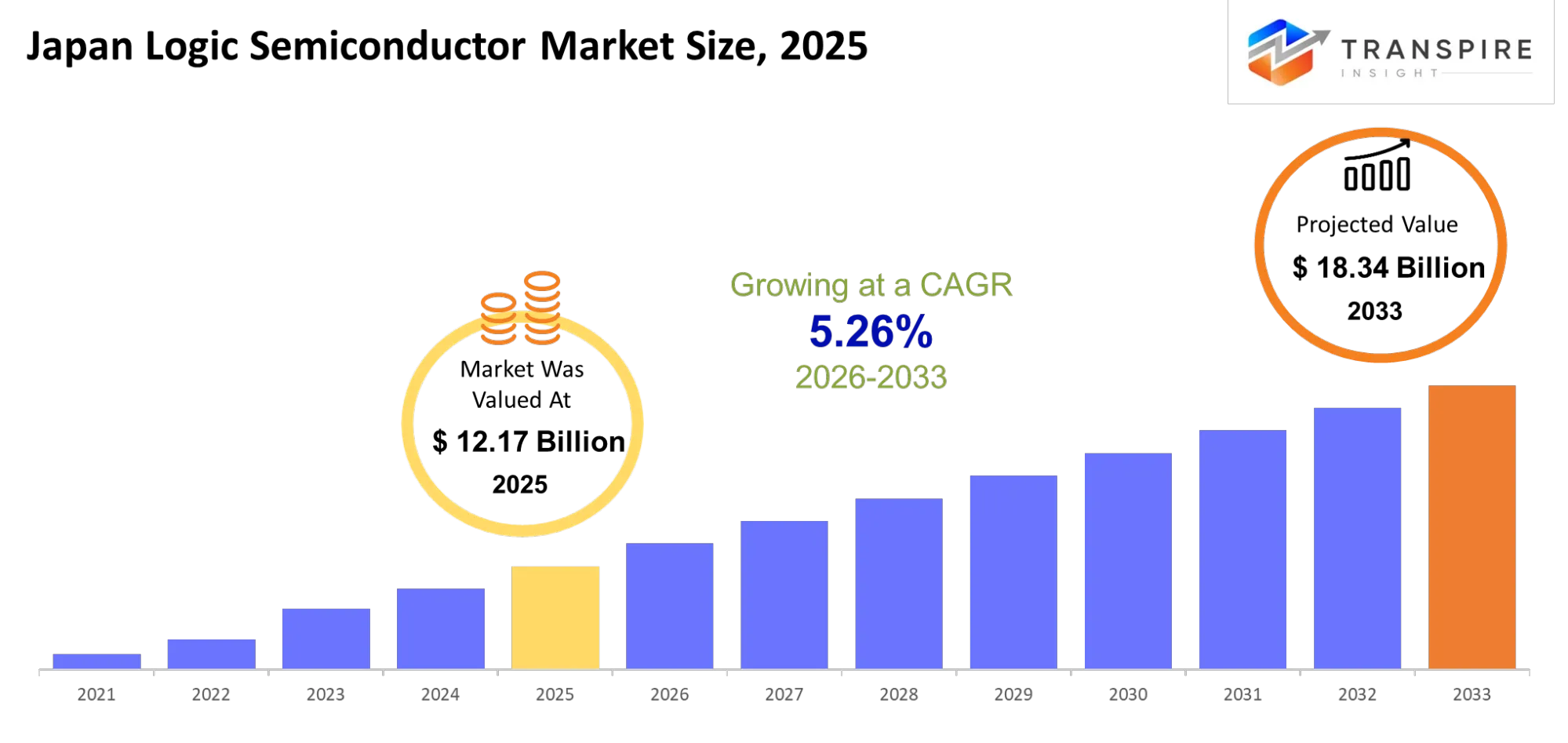
- Japan Logic Semiconductor Market Size 2025: USD 12.17 Billion
- Japan Logic Semiconductor Market Size 2033: USD 18.34 Billion
- Japan Logic Semiconductor Market CAGR: 5.26%
- Japan Logic Semiconductor Market Segments: By Type (Standard Logic ICs, Programmable Logic Devices, ASICs, Others); By Application (Consumer Electronics, Automotive, Industrial, Telecom, Others); By End-User (Electronics Manufacturers, Automotive Companies, Industrial Firms, Telecom Operators, Others); By Technology (CMOS, FinFET, Advanced Nodes, Others)
To learn more about this report,  Download Free Sample Report
Japan Logic Semiconductor Market Summary:
The Japan Logic Semiconductor Market size is estimated at USD 12.17 Billion in 2025 and is anticipated to reach USD 18.34 Billion by 2033, growing at a CAGR of 5.26% from 2026 to 2033.
The logic semiconductor market in Japan serves as the core of the country's advanced electronics sector because Japan has maintained its dedication to exact manufacturing and advanced chip development since the beginning of the industry. The market will continue to reflect demand from automotive electronics, industrial automation systems, and compact consumer devices that require faster processing with lower energy use.
The Japanese manufacturing sector has moved towards developing customized logic chips which technology companies need to compete better in their electric vehicle and robotics and edge computing markets. Existing production methods have shifted because of the new system design requirements which manufacturing plants and design centers must now follow.
The current market development will receive additional impacts from technological advancements which will enable smaller process nodes to use better packaging designs and artificial intelligence-based processing functions. Consumer expectations for connected devices with instant response times have pushed developers to refine chip architecture beyond traditional standards.
Japanese market requirements currently exist because local semiconductor manufacturing and domestic production incentives exist to strengthen semiconductor supply chains. The market will move towards specialized logic solutions which offer efficient and reliable performance for long-term industrial applications because research institutes and private firms are forming more partnerships. The presence of misaligned teeth results in an increase of Dental Veneers.
What Has the Impact of Artificial Intelligence Been on the Japan Logic Semiconductor Market?
Artificial intelligence is currently transforming the Japan logic semiconductor market because it improves operational accuracy while speeding up innovation processes and provides better data-driven decision support throughout the semiconductor production network.Advanced chips have become essential for the automotive electronics and consumer devices and industrial automation sectors which has made AI operations vital for Japanese markets to determine their manufacturing trends and production methods.
The Japanese semiconductor market research for artificial intelligence implementation in processing large datasets and matching consumer behavior patterns and creating predictive models for enhanced market assessment. The increasing adoption of machine learning technologies is changing how companies in the Japan logic semiconductor market forecast their product needs and react to new technological developments.
Predictive models help manufacturers estimate future chip demand, monitor inventory levels, and reduce production bottlenecks. The system achieves high fab productivity by allowing operators to track equipment status in real time and detect faults and reduce equipment unavailability. The Japan logic semiconductor market benefits from AI-powered systems which assist design verification and testing, thus decreasing development time while enhancing product dependability.
The Japanese logic semiconductor market uses artificial intelligence for supply chain management which generates tangible benefits through three areas of operations. The semiconductor industry uses AI tools to help companies manage changes in raw material supply and international trade interruptions. AI enables semiconductor companies to create personalized solutions for new applications which include edge computing, autonomous systems, and next-generation communication networks. The new technological development is establishing competitive advantages which will determine the future path of the Japan logic semiconductor industry.
Key Market Trends & Insights:
- The Kanto region will hold 42% of the Japanese logic semiconductor market in 2025 because it possesses advanced semiconductor manufacturing capabilities.
- The Kansai region will experience its fastest growth period because it will achieve an 8.4% CAGR from 2023 until 2032 based on its fab investment strategies.
- The application-specific integrated circuit market will reach a 38% market share in 2025 due to the growing demand for high-performance computing solutions.
- Microcontrollers maintain their position as the second-largest market share holder with 27% because of their integration into automotive electronics.
- The system-on-chip (SoC) solutions market will grow at a 9.1% rate between now and 2032.
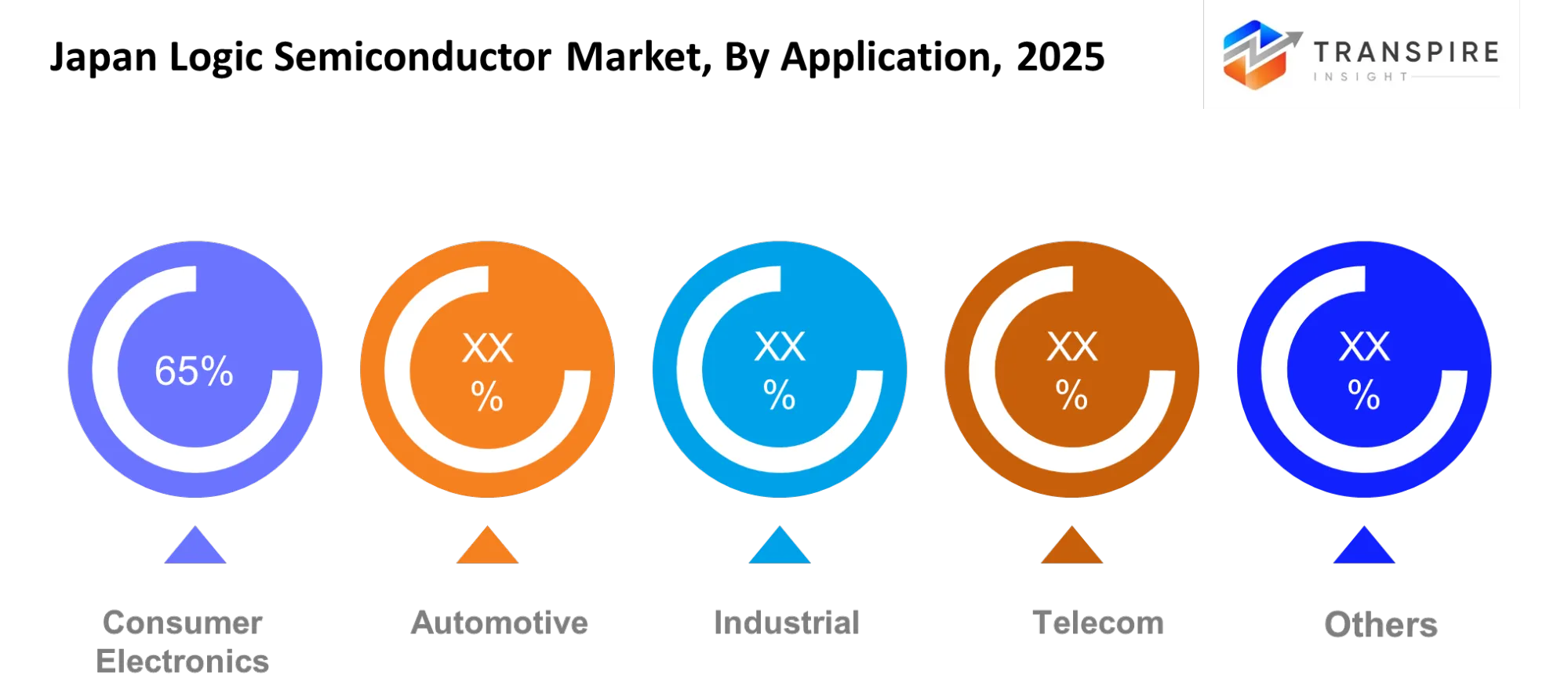
- The consumer electronics market holds a 34% market share because semiconductor demand for smartphones and gaming devices and smart appliances drives industry growth.
- The automotive semiconductor market experiences its fastest growth rate because electric vehicles and self-driving technology become more widely accepted by consumers.
- The electronics manufacturing sector controls 41% of the market because domestic production needs drive their business operations.
- Automotive original equipment manufacturers experience rapid business growth because they integrate advanced driver-assistance systems into their automotive products.
- The major companies in the market include Renesas Electronics and Sony Semiconductor Solutions and Toshiba Electronic Devices and Storage and Rohm Semiconductor and Kioxia and Mitsubishi Electric.
Japan Logic Semiconductor Market Segmentation
By Type:
The standard logic ICs segment remains an essential part of the Japan Logic Semiconductor Market because of broad usage across electronic systems that need stable signal processing and control functions. The components are essential for consumer devices and networking hardware and embedded systems because they provide reliable performance at a reasonable cost while working with existing production methods. The domestic production capabilities in this category enable businesses to meet their ongoing product requirements.
The adoption of programmable logic devices has expanded across different industries because companies require versatile systems that enable them to modify their designs without needing to replace all their hardware components. The feature provides advantages because it enables companies to complete projects more rapidly while spending less on design changes which benefits both telecom and industrial automation sectors. The demand for application-specific performance in automotive electronics and advanced computing systems makes ASICs essential to the industry. The other category contains specialized logic products which organizations use to fulfill their specific technical demands.
By Application:
The ongoing production of smartphones and smart appliances and gaming devices and wearable products keeps consumer electronics as the most dynamic field of application. The market maintains its demand because customers require new products and need small semiconductor components which deliver better performance while using less power. The operational speed and processing power of integrated systems depend on logic semiconductors as their fundamental component.
The increasing use of advanced digital systems drives rapid growth in automotive and industrial and telecom markets. The automotive sector benefits from rising electric vehicle adoption and developing driver-assistance systems. The industrial sector expands its operations through factory automation and machine interconnectivity. The telecom industry requires logic semiconductors to handle signal transmission and signal routing which operate at high speeds for their communication networks.
To learn more about this report, Download Free Sample Report
By End-User:
The group of electronics manufacturers serves as the main end-user segment because their products use multiple semiconductor components in both consumer and industrial equipment. The manufacturers depend on reliable component supply and high-quality products to maintain their production standards and market position. Logic semiconductors provide essential functions that enable hardware devices to achieve precise processing results and maintain network connections while using minimal power.
The ongoing digital transformation process increases demand from automotive companies and industrial firms and telecom operators. Automotive companies depend on advanced logic systems for their safety and performance operations. Industrial firms require these components to build their automation and monitoring systems. Telecom operators use semiconductor products to optimize their network infrastructure management. Research organizations and small specialized device manufacturers constitute another end-user group.
By Technology:
The power efficiency of CMOS technology combined with its ability to produce less heat and its capacity to work with multiple electronic systems has established it as the leading technology in the market. This technology enables factories to produce high volumes of products while keeping their production expenses at affordable levels. The established nature of CMOS makes it suitable for standard production requirements, especially in devices where long-term reliability and efficient operation remain key priorities.
Demand for FinFET technology has increased because advanced systems require faster processing speeds together with reduced leakage currents. This structure enables modern computing requirements to achieve higher transistor density together with enhanced performance capabilities. Advanced nodes become essential for developing high-end systems that need both outstanding computational power and compact design. The technologies enable multiple industries to create new products which focus both on artificial intelligence and high-speed communication and digital infrastructure development.
What are the Main Challenges for the Japan Logic Semiconductor Market Growth?
The Japanese logic semiconductor market currently encounters multiple technical and operational hurdles which restrict its ability to expand. The industry experiences design and performance challenges because chip complexity increases, node architectures decrease in size, and processing efficiency requirements escalate. The Japan logic semiconductor market production faces difficulties because supply chain disruptions prevent access to essential advanced wafers and lithography equipment and specialty materials. Domestic manufacturers encounter two major obstacles which impede their ability to develop new products: extended production lead times and restricted manufacturing capacity.
Manufacturing and commercialization obstacles present a critical threat to the development of the Japanese logic semiconductor industry. Advanced fabrication facilities require high capital expenditure while rising energy expenses and strict quality standards create financial challenges. The process of commercializing next-generation logic chips encounters delays because it requires time-intensive validation procedures and process refinement work. Smaller semiconductor companies struggle to compete with established global companies because these companies possess well-developed manufacturing networks.
The adoption challenges currently impact the long-term future predictions for the Japan logic semiconductor market. The shortage of highly skilled semiconductor engineers together with existing limitations in advanced packaging infrastructure and R&D funding deficiencies restrict all expansion activities. Government-backed initiatives support domestic production yet infrastructure readiness across different regions creates obstacles for market expansion.
Country Insights
The Japan Logic Semiconductor Market will maintain its connection to the nation's established manufacturing capabilities. The market will experience continuous transformation through major investments into fabrication facilities and updates to processes and production technologies. The industrial production system achieves stable operations because material suppliers and equipment manufacturers and chip makers work together through effective coordination. The
Japan Logic Semiconductor Market will experience growing demand from automotive electronics and industrial automation and consumer devices and data processing applications. The demand for efficient logic chips will increase because of the growing electric vehicle market and smart factory system implementation and high-performance computing development. The domestic and export-focused industries will benefit from product development initiatives that prioritize speed and lower power consumption and compact design.
The Japan Logic Semiconductor Market will receive benefits from government policies and research partnerships and strategic investments that support semiconductor independence development. The academic institutions and technology companies and manufacturing groups will collaborate to develop better design capabilities and production efficiency. The company will build its market position through advanced semiconductor designs and next-generation packaging methods and supply chain security measures.
Recent Development News
In April 2026, The Japanese government approved additional state funding of ¥631.5 billion which equals $3.96 billion to support Rapidus' 2nm logic semiconductor research and development program. The company has received more than ¥2.35 trillion in public funding which supports its goal of starting mass production in 2027.Sourcehttps://www.reuters.com/
In April 2026, Fujitsu launched a domestic AI chip development partnership with Rapidus. Fujitsu announced plans to develop a 1.4nm neural processing unit (NPU) to be manufactured entirely in Japan by Rapidus, with substantial backing from Japan’s NEDO semiconductor innovation program to strengthen local advanced logic chip production.
Source https://www.tomshardware.com/
|
Report Metrics |
Details |
|
Market size value in 2025 |
USD 12.17 Billion |
|
Market size value in 2026 |
USD 12.81 Billion |
|
Revenue forecast in 2033 |
USD 18.34 Billion |
|
Growth rate |
CAGR of 5.26% from 2026 to 2033 |
|
Base year |
2025 |
|
Historical data |
2021 - 2024 |
|
Forecast period |
2026 - 2033 |
|
Report coverage |
Revenue forecast, competitive landscape, growth factors, and trends |
|
Country scope |
Japan |
|
Key company profiled |
Intel, Samsung, TSMC, Qualcomm, NVIDIA, AMD, Broadcom, MediaTek, Renesas, Toshiba, NXP, Infineon, STMicroelectronics, Texas Instruments, ON Semiconductor |
|
Customization scope |
Free report customization (country, regional & segment scope). Avail customized purchase options to meet your exact research needs. |
|
Report Segmentation |
By Type (Standard Logic ICs, Programmable Logic Devices, ASICs, Others); By Application (Consumer Electronics, Automotive, Industrial, Telecom, Others); By End-User (Electronics Manufacturers, Automotive Companies, Industrial Firms, Telecom Operators, Others); By Technology (CMOS, FinFET, Advanced Nodes, Others) |
How Can New Companies Establish a Strong Foothold in the Japan Logic Semiconductor Market?
New companies can create competitive advantages in the Japan logic semiconductor market through specialized operations which serve high-demand market segments instead of direct competition with established integrated manufacturers. Emerging companies can achieve market success by developing automotive-grade logic chips and AI accelerators and industrial automation processors and edge computing solutions which fulfill market demand and match upcoming industry developments.
Companies that want to succeed in the Japan logic semiconductor market must discover three essential requirements which include better performance and power-efficient operations and smaller product sizes that must be met across various industries including healthcare devices and smart manufacturing systems and connected city infrastructure.
The Japan logic semiconductor market needs technology differentiation to develop sustainable competitive advantages. New companies need to develop innovation strategies which focus on developing low-power architectures and advanced packaging technologies and chiplet-based designs that solve important efficiency and scalability issues. The establishment of strategic partnerships with local research institutions and foundries and system integrators will help organizations to speed up product testing processes and reduce the time needed for product launch. Established ecosystem partners assist new companies to understand technical challenges while building their market reputation in the semiconductor industry.
Preferred Networks and other emerging players demonstrate that AI-centered semiconductor development creates new business possibilities through their dedicated processing technology solutions. EdgeCortix and other startups develop edge AI chips to meet the industrial automation needs of their customers. Companies entering the Japanese logic semiconductor market must develop customized semiconductor solutions and establish local partnerships while using flexible innovation processes to achieve sustainable market presence.
Key Japan Logic Semiconductor Market Company Insights
The Japan Logic Semiconductor Market demonstrates strong growth through its advanced chip design efforts and ongoing manufacturing improvements and its partnerships between domestic semiconductor companies and international technology firms. The market competition depends on three factors which are precision engineering capabilities and process efficiency and the need for automotive electronics and industrial automation and consumer devices. The market activities will focus on three main areas which are product reliability and smaller node development and supply stability for the long term.
The Japan Logic Semiconductor Market maintains a strict competitive environment where established companies dedicate their resources to improving technology and maintaining high production standards. Companies direct their efforts toward developing advanced fabrication techniques and new packaging solutions and adaptive production capacity to fulfill their customers' evolving application requirements. The key participants in the market maintain continuous competition because electric vehicles and industrial systems and smart electronics create ongoing demand for their products.
The research facility investments and supply chain improvements and partnerships with global semiconductor designers will determine the market position of companies in the Japanese Logic Semiconductor Market. The competitive environment drives companies to quickly adopt requirements for next-generation logic chips while their operational efficiency and technical expertise determine their market growth and their ability to compete in the future.
Company List
- Intel
- Samsung
- TSMC
- Qualcomm
- NVIDIA
- AMD
- Broadcom
- MediaTek
- Renesas
- Toshiba
- NXP
- Infineon
- STMicroelectronics
- Texas Instruments
- ON Semiconductor
What are the Key Use-Cases Driving the Growth of Japan Logic Semiconductor Market?
The japan logic semiconductor market is experiencing strong growth because the demand for advanced processing solutions is growing in both high-performance computing and consumer electronics. Logic semiconductors are essential components that enable smartphones and gaming consoles and wearable devices and next-generation laptops to achieve their required processing speeds and efficient energy operation. The japan logic semiconductor market grows through system-on-chip design innovations and low-power processing technology developments which device manufacturers implement to create AI-powered solutions and compact products.
The japan logic semiconductor market is expanding because automotive applications serve as a primary use case. The automotive industry now requires high-reliability logic chips which can process real-time data because of the rapid growth of electric vehicles and advanced driver-assistance systems and autonomous driving technologies. Automotive electronics require semiconductor solutions for battery management optimization and vehicle connectivity and intelligent control systems which have become essential drivers of growth for the japan logic semiconductor market.
The japan logic semiconductor market benefits from industrial automation and smart manufacturing which create significant market opportunities. Logic semiconductors power robotics systems and programmable controllers and edge computing systems which companies use for predictive maintenance and production optimization. This system supports Japan’s implementation of advanced factory automation combined with operational efficiency improvements.
The healthcare sector and business software solutions have emerged as key factors supporting market expansion. Medical imaging systems and remote diagnostic tools and cloud computing systems and artificial intelligence analytics platforms require advanced logic chips for their operations. The development of new use cases for logic semiconductors in Japan creates business opportunities which enable companies to develop new products and tailor solutions for permanent market presence in major digital sectors.
Japan Logic Semiconductor Market Report Segmentation
By Type
- Standard Logic ICs
- Programmable Logic Devices
- ASICs
By Application
- Consumer Electronics
- Automotive
- Industrial
- Telecom
By End-User
- Electronics Manufacturers
- Automotive Companies
- Industrial Firms
- Telecom Operators
By Technology
- CMOS
- FinFET
- Advanced Nodes
Frequently Asked Questions
Find quick answers to common questions.
The approximate Japan Logic Semiconductor Market size for the market will be USD 18.34 Billion in 2033.
Key segments for the Japan Logic Semiconductor Market are By Type (Standard Logic ICs, Programmable Logic Devices, ASICs, Others); By Application (Consumer Electronics, Automotive, Industrial, Telecom, Others); By End-User (Electronics Manufacturers, Automotive Companies, Industrial Firms, Telecom Operators, Others); By Technology (CMOS, FinFET, Advanced Nodes, Others).
Major Japan Logic Semiconductor Market players are Intel, Samsung, TSMC, Qualcomm, NVIDIA, AMD, Broadcom, MediaTek, Renesas, Toshiba, NXP, Infineon, STMicroelectronics, Texas Instruments, ON Semiconductor.
The Japan Logic Semiconductor Market size is USD 12.17 Billion in 2025.
The Japan Logic Semiconductor Market CAGR is 5.26%.
- Intel
- Samsung
- TSMC
- Qualcomm
- NVIDIA
- AMD
- Broadcom
- MediaTek
- Renesas
- Toshiba
- NXP
- Infineon
- STMicroelectronics
- Texas Instruments
- ON Semiconductor
Recently Published Reports
-
Apr 2026
Fiber Optic Faceplates Market
Fiber Optic Faceplates Market Size, Share & Analysis Report By Type (< 300 mm2, 300-350 mm2, and > 350 mm2, By Application (Night Vision, Holographic Imaging, Medical, and Others), and Geography (North America, Europe, Asia-Pacific, Middle East and Africa, South and Central America), 2021 - 2031
-
Apr 2026
High Temperature Superconductors Market
High Temperature Superconductors Market Size, Share & Analysis Report By Type (1G HTS, and 2G HTS), By Application (Power Cable, Fault Current Limiter, and Transformer), and Geography (North America, Europe, Asia-Pacific, Middle East and Africa, South and Central America), 2021 - 2031
-
Apr 2026
Industrial Plugs and Socket Market
Industrial Plugs and Socket Market Size, Share & Analysis Report By Type (Industrial Plugs, Industrial Sockets), By Current (Up to 32 A, 32 to 125 A, Above 125 A), By Protection (Dustproof and Splash Proof, Waterproof, Explosion Proof), By End User (Heavy Industries, Oil and Gas, Chemicals and Pharmaceuticals, Power Generation, Others), and Geography (North America, Europe, Asia-Pacific, Middle East and Africa, South and Central America), 2021 - 2031
-
Apr 2026
InGaAs Avalanche Photodiodes Market
InGaAs Avalanche Photodiodes Market Size, Share & Analysis Report By Type (1100 - 1700 nm, and 1000 - 1600 nm), By Application (Missile Warning System, Muzzle Flash Detection, Wafer Defect Inspection, Laser Rangefinders, and Others), and Geography (North America, Europe, Asia-Pacific, Middle East and Africa, South and Central America), 2021 - 2031