

Europe Motor Control Center Market Summary
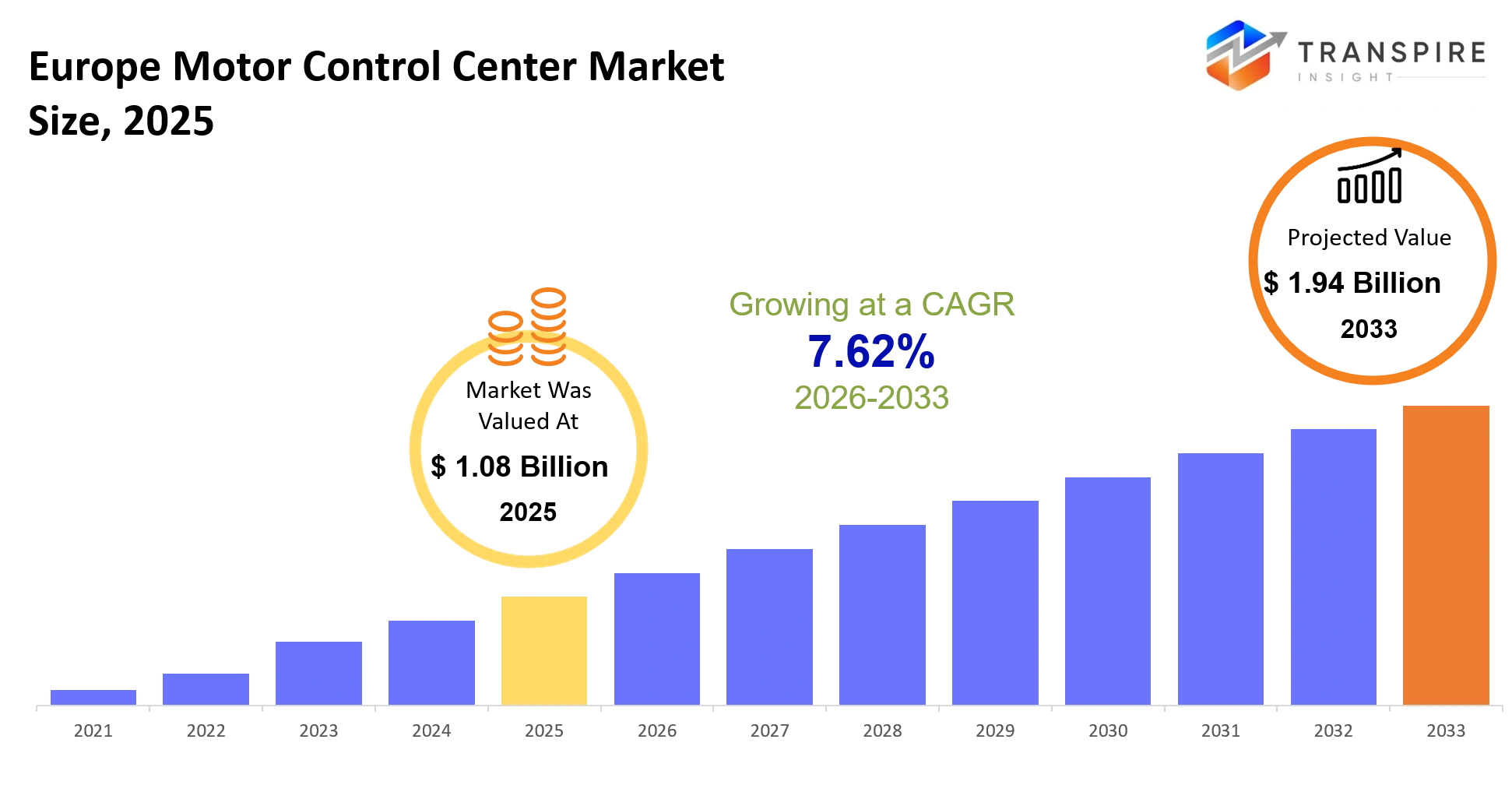
As per Transpire Insight Analysis the Europe Motor Control Center Market size is estimated at USD 1.08 Billion in 2025 and is anticipated to reach USD 1.94 Billion by 2033, growing at a CAGR of 7.62% from 2026 to 2033.
Motor control centers basically work as the operational backbone of factories, utilities, energy facilities, and big commercial sites. They handle the safe managing, protection, and coordination of electric motors that keep production lines moving, pumps pumping compressors, compressing conveyors running and ventilation systems working too. In practice their job is not only about electrical distribution anymore, operators want more visibility into how the equipment actually behaves, also into downtime patterns. Over the last three to five years, the European market has moved away from the older style motor control panels and toward more intelligent digitally connected setups, the kind that lets people do remote monitoring, predictive maintenance, and even energy optimization with less guesswork. The energy price swings after the Russia-Ukraine conflict seemed to really speed up spending on efficient electrical infrastructure, so many industrial operators started to modernize older installations. Because of that, companies are now more often combining smart motor control centers with automation platforms, which helps with asset utilization, reduces ongoing operating costs, and supports compliance with energy efficiency targets. and that’s, translating into a wider rollout across both fresh industrial builds and modernization initiatives, at a pretty steady pace.
Europe Motor Control Center Market Size & Forecast:
- Europe Motor Control Center Market Size 2025: USD 1.08 Billion
- Expected Market Value 2033: USD 1.94 Billion
- Forecast CAGR: 7.62%
- Leading region in 2025: Western Europe
- Fastest Growing region: Central & Eastern Europe
- Key Profile: ABB, Siemens, Schneider Electric, Eaton, Rockwell Automation, Mitsubishi Electric, General Electric, Hitachi Energy, WEG, Larsen & Toubro, Fuji Electric, Toshiba, Hyundai Electric, Powell Industries, Vertiv
Key Market Insights
- Western Europe really dominated, with something like a 46% market share in 2025 . This was backed by mature manufacturing, some automation upgrades and ongoing investment in industrial electrical infrastructure, basically that never stops.
- Central and Eastern Europe will stay the fastest-growing regional market across 2025–2033 , because industrial spending and factory expansion keeps speeding up in those emerging manufacturing hubs.
- When it comes to products, intelligent motor control centers led the segment with nearly 58% in 2025 , since industrial sites are putting more and more weight on digital monitoring and remote diagnostics, more or less all the time.
- Conventional motor control centers still stayed second, mainly for brownfield facilities where modernization is gradual , so capex doesn’t hit as hard, and equipment life also gets stretched out.
- For solution types, intelligent low-voltage motor control is expected to see the quickest expansion through 2033, as Industry 4.0 adoption kinda reorganizes how industrial automation is planned.
- On applications, manufacturing took the top spot with roughly 48% market share in 2025 , driven by continuous production processes that need dependable motor protection and centralized electrical control.
- Renewable energy along with utility installations is forecasted to grow the quickest, because grid modernization and electrification projects keep rolling across Europe during the forecast window.
- As for end users, manufacturing companies remained the major end-user slice, with around 52% market share, largely because production continuity really relies on dependable motor management systems.
- Energy and utilities should show the fastest growth end-user category through 2033 , as renewable integration keeps rising and therefore boosts demand for more advanced motor control architecture.
What are the Key Drivers, Restraints, and Opportunities in the Europe Motor Control Center Market?
The most powerful driver of growth comes from whats basically Europes industrial digitalization, plus tighter rules around energy efficiency , and in general it pushes companies to move. There’s also the whole thing with energy price volatility, and the carbon reduction targets, which basically nudge manufacturers to swap out older motor control hardware with smarter systems. Those newer setups cut electricity use and at the same time give better asset visibility, or at least, better insight than before. In the end, connected motor control platforms end up tying directly into plant automation software, so teams get real time diagnostics , plus predictive maintenance. With that, operating expenses get lower, nasty unplanned downtime drops, and investment returns look better too, which then encourages wider rollout across manufacturing, utilities, and process sectors.
Still, the biggest structural restraint feels like supply chain concentration for electrical parts, semiconductors, and specialized switchgear , and that one is stubborn. The long qualification periods for industrial electrical equipment make it hard to swap suppliers quickly, and then the certification steps mean alternative sourcing takes longer. From a Transpire Insight review of regional procurement announcements and launch timelines, this concentration stays the main execution risk. On top of that extended lead times keep pushing modernization programs further out , so revenue doesn’t arrive as soon as planned. Even if the project pipeline looks healthy, the timing slips, and large industrial installations get delayed.
The most promising opportunity is in bringing together intelligent motor control centers with industrial AI, digital twin models, and cloud led asset management platforms. Like utilities, pharmaceutical manufacturing plants, food processing sites, and battery production facilities they are already putting more capital budgets into connected electrical infrastructure. You can see this especially in Central and Eastern Europe where investment still looks strong since multinational manufacturers are setting up new production facilities, backed by automation ready electrical systems.
What Has the Impact of Artificial Intelligence Been on the Europe Motor Control Center Market?
Artificial intelligence and quite advanced digital tech are changing motor control systems, from being mostly passive electrical gear into something that actually behaves like an intelligent working asset. On the AI side, there are platforms that keep watching motor health, electrical load habits, the thermal situation, and basically how the whole unit performs. This helps maintenance teams spot unusual behavior early, so failures don’t pop up and stop production in the middle of everything. With machine learning, they can look at old operating records, predict how components will wear down over time, tune maintenance timelines, and even keep electrical loading more balanced across the connected machines. In the end, the result is better uptime, fewer sudden stops, and steadier energy use across industrial spaces.
Then the digital control setups also make things stronger operationally, by tying motor control equipment into supervisory control systems, industrial IoT networks, and enterprise asset management platforms. Automated diagnostics reduce the whole troubleshooting scramble , while predictive analytics lets operators plan maintenance around scheduled downtime instead of rushing into emergency repairs. Quite a few industrial operators say they can actually see improved equipment availability and maintenance efficiency after they roll out these connected control approaches.
Still, despite all that, AI rollout doesn’t go smoothly everywhere and there are practical constraints. For example high integration costs, older sites with fragmented legacy infrastructure, messy or inconsistent operational data, and strict cybersecurity requirements can make adoption difficult. Many plants have to modernize their communication networks and control architecture first, before advanced analytics can deliver reliable operational value, at scale.
Key Market Trends
- Intelligent motor control centers started getting more common after 2021. I mean, manufacturers leaned into remote diagnostics and predictive maintenance more than the usual reactive maintenance kind of approach, and it kind of stuck.
- Since 2022, the volatility in energy prices has pushed companies to replace old electrical infrastructure faster, swapping in higher-efficiency motor control solutions across process industries, rather than waiting.
- From 2022 to 2025, Industrial IoT integration grew pretty fast, so it was possible to run centralized monitoring for thousands of connected motors using a more unified operational platform, instead of scattered dashboards and separate workflows.
- Siemens, ABB, and Schneider Electric also put extra money into software, which strengthened their digital service catalogs and lifecycle management features for industrial customers.
- Renewable energy facilities between 2023 and 2025 increasingly chose intelligent motor control architecture, to improve equipment reliability and get better operational visibility without too much guessing.
- Meanwhile, manufacturers began shifting procurement toward modular motor control designs. This reduces the install time, and it also makes future production capacity expansion easier to do.
- Cybersecurity, for a change, became a standard buying requirement after industrial connectivity expanded across European manufacturing plants and other critical infrastructure.
- Central and Eastern Europe ended up attracting new automation investments too, because multinational manufacturers ramped up production capacity and upgraded electrical infrastructure after 2023, sort of all at once.
- Digital twin technology came up as a key assessment tool, helping operators optimize motor performance, prior to rolling out large-scale industrial modernization projects.
Europe Motor Control Center Market Segmentation
By Type :
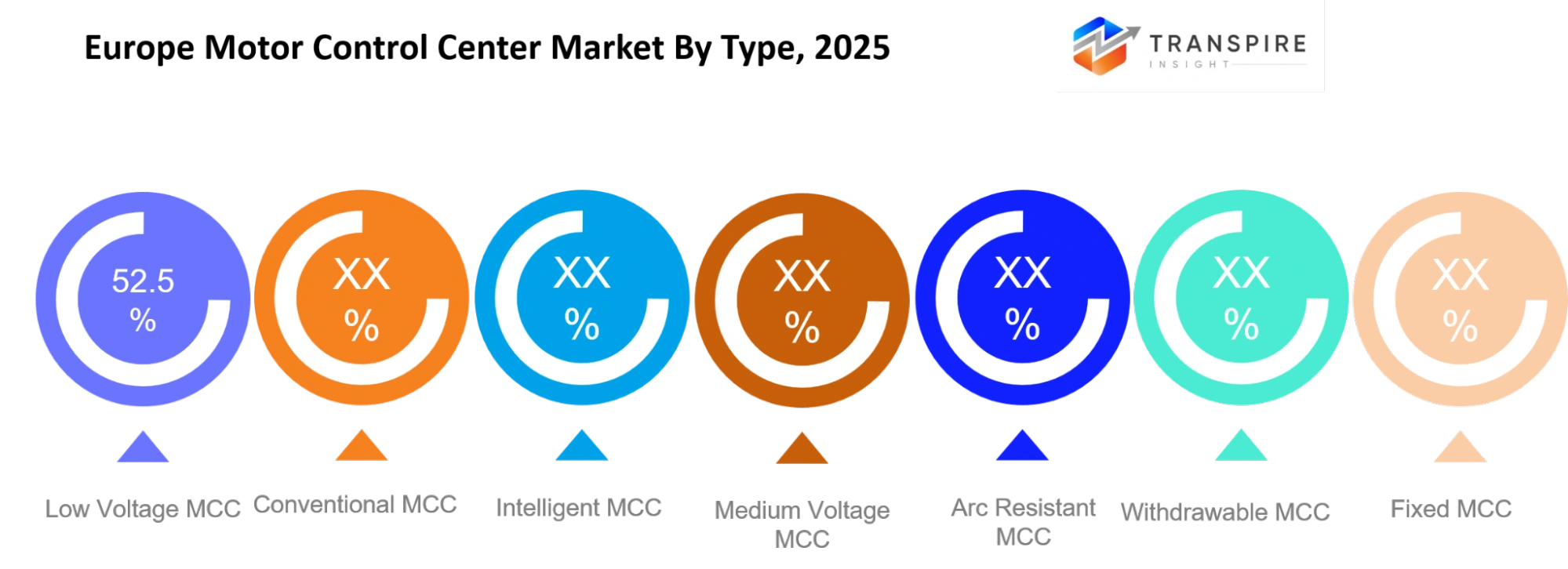
Intelligent MCC holds the leading position, because industrial facilities now ask for constant equipment monitoring , remote diagnostics and better regulation of energy usage. Digital communications add up pretty well for predictive maintenance and they can cut those surprise production shutdowns, so intelligent systems are often the go-to for modernization projects . Also, when it’s integrated with automation platforms it gives more operational insight and makes maintenance schedules easier to plan. Conventional MCC is still around in many plants where solid reliability and cost efficiency stay the main purchase reasons.
Low Voltage MCC counts as another big category, mostly because it’s used pretty widely across manufacturing sites , commercial buildings , and utility operations. Medium Voltage MCC shows up for heavy industrial work, where dependable power distribution is needed for big motors and demanding processes. Arc Resistant MCC is getting more attention where safety rules for workers ask for stronger protection against electrical faults. Withdrawable and Fixed MCC designs continue being chosen based on different maintenance routines and installation preferences, and then there are other specialized setups too, which match unusual operating environments in industry.
By Component :
Circuit Breakers are kinda the biggest part i guess, since dependable electrical protection still stays essential throughout nearly every motor control setup. In newer industrial projects there's more attention on gear that can cut downtime and at the same time keeps critical electrical assets safer. Protection Devices and Relays are still very relevant too, especially as industrial automation grows, fault detection has to be accurate, and the overall system reliability really matters. Busbars keep showing up as the backbone for efficient power distribution across more and more complicated electrical assemblies.
Variable Frequency Drives keep growing fast, mostly because energy saving goals push precise motor speed control, and that lowers overall electricity use. Soft Starters help ease the mechanical strain during startup, while also helping extend motor life in tough conditions where it has to run day after day. Contactors stay widely used because solid switching operations make sure motor work stays safe across a lot of industries. Then the other supporting parts keep evolving, with digital monitoring features added, and with higher electrical performance expectations too.
By End User :
Manufacturing is the leading end-user group , kind of because production sites really rely on reliable motor control so the plant can keep running, without stoppages or drama. Factory automation projects keep swapping out old electrical infrastructure for smarter control systems and yes that boosts productivity , while also lowering the upkeep headaches. Food processing, automotive, pharmaceuticals, and consumer goods plants still show up as big investment zones for advanced motor control solutions , and it makes sense.
Power Generation also adds real weight to demand, mainly as companies modernize the electrical assets they already have, not just replace everything. Water & Wastewater facilities, on the other hand, keep moving toward advanced control equipment to sharpen pumping efficiency, plus operational reliability. Oil & Gas, Chemicals, and Mining keep their spending pretty steady too, because those sites operate in rough conditions and need dependable electrical protection.Commercial Buildings are increasingly leaning into centralized motor management, especially for heating, ventilation, and cooling systems. And the rest of the industrial world keeps putting money into electrical upgrades, in order to improve day to day operational performance , as well as energy management.
By Voltage :
Below 1kV is still, kinda the biggest voltage category, because manufacturing plants , commercial buildings and infrastructure projects mostly run in that band. There’s also broad compatibility with the usual industrial gear, and that helps steady adoption across quite a few uses. Regular Standard Voltage installations keep showing up in routine industrial projects , since standardized equipment lowers engineering complexity and makes the on site work faster. Then Custom Voltage shows up for those facilities that have specialized operational needs, more than usual.
For the 1–5kV and 5–15kV categories they fit medium-scale industrial operations, where you need more power, especially for large motors and processing equipment. The 15–25kV and Above 25kV ranges remain important too, mostly for heavy industry, utilities, and huge infrastructure builds where the electrical loads are high. Custom Voltage systems keep expanding as well, mainly where the project specific engineering requirements cannot be matched by standard setups. And the other voltage classifications? they cover specialized industrial installations with unique performance needs.
By Application :
Process Industries generate the largest share, simply because continuous production really leans on dependable motor protection, a more centralized control setup,and stable electrical performance in practice. Chemical processing, food manufacturing, pharmaceuticals, and pulp operations keep on upgrading their electrical systems, to squeeze out operational efficiency while also cutting those annoying unplanned shutdowns. Utilities meanwhile maintain a substantial amount of investment, via electrical infrastructure modernization and grid reliability programs, even when the timelines are long. Infrastructure projects keep supporting long term deployment across public facilities and industrial developments too, somehow.
Renewable Energy shows up as the fastest growing application, since wind, solar, and energy storage projects need advanced motor management so the equipment can run efficiently. Data Centers are also expanding their electrical control investments, so uninterrupted power distribution stays intact and the cooling systems don’t fall behind. Transportation projects increasingly adopt intelligent motor control technologies for better operational efficiency, and for sharper asset management as well. Marine applications, plus other specialized industries, continue selecting advanced control solutions aimed at improved safety, stronger reliability, and that long range operational performance that operators care about.
What are the Key Use Cases Driving the Europe Motor Control Center Market?
Manufacturing is still the main thing, because production sites need centralized motor control so the automated lines can keep running safely and efficiently. Automotive , food processing, pharmaceutical, and consumer goods manufacturers are buying intelligent motor control systems for cutting downtime, making equipment more reliable, and keeping continuous output going while still honoring tight quality standards.
Utilities, plus water and wastewater operators, are ramping up adoption too, mainly when modernization programs swap out older electrical infrastructure. Renewable energy facilities are doing something similar, they are bringing in advanced motor control solutions to handle pumps, compressors and auxiliary equipment , all while staying on top of grid behavior and energy efficiency tasks.
Also, battery manufacturing plants and hydrogen production facilities show up as newer chances as fresh industrial investments roll out across Europe. Even data center operators are looking at advanced motor control platforms, partly to boost cooling system reliability, strengthen power management, and stay aligned with tougher energy efficiency rules and operational resilience expectations.
|
Report Metrics |
Details |
|
Market size value in 2025 |
USD 1.08 Billion |
|
Market size value in 2026 |
USD 1.16 Billion |
|
Revenue forecast in 2033 |
USD 1.94 Billion |
|
Growth rate |
CAGR of 7.62% from 2026 to 2033 |
|
Base year |
2025 |
|
Historical data |
2021 - 2024 |
|
Forecast period |
2026 - 2033 |
|
Report coverage |
Revenue forecast, competitive landscape, growth factors, and trends |
|
Regional scope |
Europe (Germany, United Kingdom, France, Italy, Spain and Rest of Europe) |
|
Key company profiled |
ABB, Siemens, Schneider Electric, Eaton, Rockwell Automation, Mitsubishi Electric, General Electric, Hitachi Energy, WEG, Larsen & Toubro, Fuji Electric, Toshiba, Hyundai Electric, Powell Industries, Vertiv . |
|
Customization scope |
Free report customization (country, regional & segment scope). Avail customized purchase options to meet your exact research needs. |
|
Report Segmentation |
By Type (Conventional MCC, Intelligent MCC, Low Voltage MCC, Medium Voltage MCC, Arc Resistant MCC, Withdrawable MCC, Fixed MCC, Others); By Component (Busbars, Circuit Breakers, Soft Starters, Variable Frequency Drives, Contactors, Relays, Protection Devices, Others); By End User (Oil & Gas, Power Generation, Manufacturing, Water & Wastewater, Mining, Chemicals, Commercial Buildings, Others); By Voltage (Below 1kV, 1–5kV, 5–15kV, 15–25kV, Above 25kV, Custom Voltage, Standard Voltage, Others); By Application (Process Industries, Utilities, Infrastructure, Marine, Renewable Energy, Data Centers, Transportation, Others) |
Which Regions are Driving the Europe Motor Control Center Market Growth?
Western Europe, region wise, accounted for around 46% of the market in 2025, so it comes out as the biggest regional contributor. The reason is pretty obvious: strict energy efficiency rules, policies for modern industrial automation, and steady investment into manufacturing modernization kinda keep things moving in the same direction. Also, there’s strong involvement from electrical equipment manufacturers, automation suppliers, engineering firms, plus well established component supply routes, which ends up making the day to day business environment feel steady. And as older industrial infrastructure keeps getting replaced, while digital transformation initiatives continue, the region should hold that leadership stance during the whole forecast window.
Southern Europe looks different, almost like a structurally separate pathway, since investment is tightly connected to industrial diversification, renewable energy growth, and upgrades for public infrastructure, instead of being driven by big manufacturing clustering. Regulatory consistency and long term financing for energy and utility programs help keep procurement activity steady across several sectors. In practice, food processing, chemicals, water treatment, and commercial infrastructure are still pulling demand for advanced motor control systems. Because that spending pattern stays balanced, the region tends to act as a dependable contributor for long term market revenue.
Central and Eastern Europe kinda stands out as the fastest-growing area, as industrial relocation ramps up, factory building gets going, and manufacturing expansion accelerates in a number of countries. In the last while, investment incentives from governments , European Union funding programs , and the modernization of industrial infrastructure have pushed deployment of more advanced electrical control systems inside newly built production facilities. Automotive, electronics, battery manufacturing , and logistics developments are still producing new chances for intelligent motor control solutions, sort of quietly but consistently. If strong industrial spending keeps showing up between 2026 and 2033 it should make a really appealing setup for tech providers, engineering contractors, plus component manufacturers who are looking to expand into the region.
Who are the Key Players in the Europe Motor Control Center Market and How Do They Compete?
Competition still seems pretty consolidated, sort of moderately, because big global players in electrical equipment keep strong footholds via wide ranging product sets, engineering knowhow, and those long term industrial ties. Instead of just competing on price, the real push comes from tech advances, digital connectivity, lifecycle support abilities and local/regional help networks. Even the long standing suppliers keep tightening their market position, often through software integration and service growth, while the more specialized manufacturers go for application focused options in particular industries, not everything at once.
Siemens stands out with intelligent automation platforms that mix motor control hardware with industrial software and digital monitoring tools, so customers gain better operational sight across large and complicated plants. Schneider Electric rolls out connected electrical infrastructure using EcoStruxure enabled solutions , where energy management is tied in with industrial automation. ABB leans into predictive maintenance, stronger motor protection, and digital asset management, which helps customers that want higher reliability from equipment and lower downtime, or less maintenance costs overall.
Eaton kinda strengthens competitiveness by expanding regional manufacturing support , and also via modular motor control designs that help make installation smoother and future upgrades easier. Rockwell Automation leans into software driven industrial control systems , connecting production assets with enterprise level operational data so teams can make smarter maintenance choices . Mitsubishi Electric keeps moving forward too , broadening intelligent motor management technologies and automation capabilities aimed at industrial modernization projects across Europe , while at the same time strengthening partnerships with system integrators, and engineering contractors .\
Company List
- ABB
- Siemens
- Schneider Electric
- Eaton
- Rockwell Automation
- Mitsubishi Electric
- General Electric
- Hitachi Energy
- WEG
- Larsen & Toubro
- Fuji Electric
- Toshiba
- Hyundai Electric
- Powell Industries
- Vertiv
Recent Development News
In June 2025, Eaton and Siemens Energy announced a strategic partnership to deliver integrated electrical power and technology solutions for accelerating global data center capacity. The collaboration strengthens advanced power distribution, automation, and motor control infrastructure opportunities across industrial and critical facility projects.
Sourcehttps://www.eaton.com/
In October 2025, Eaton introduced the compact dual feeder for low-voltage motor control centers. The new design increases feeder density within a single MCC structure, reduces installation footprint, and supports industrial customers seeking flexible expansion of motor control systems. Source https://www.eaton.com/
What Strategic Insights Define the Future of the Europe Motor Control Center Market?
The Europe Motor Control Center Market is heading pretty steadily toward a more smart, software linked electrical setup, while industrial plants put more and more value on operational see-through, energy optimization, and lifecycle asset care, rather than just buying standalone bits of hardware. This shift is going to be bolstered by factory digitalization, grid modernization, and the ongoing push to electrify industrial processes.
There is also a less obvious risk tucked in there, basically the reliance on a small number of vendors for key electrical parts and power semiconductors. That kind of dependence can stretch lead times and slow down project delivery, even if overall investment is still quite strong.
On the upside, one emerging thing to watch is the growth of integrated motor control arrangements tailored for battery manufacturing, hydrogen production, and large energy storage sites. This feels especially relevant across Central and Eastern Europe, since new industrial capacity keeps rolling in.
Firms that blend intelligent devices with cybersecurity, predictive analytics, and long term support commitments, may end up in a better spot to lock in recurring revenue and keep customers coming back throughout the forecast window.
Europe Motor Control Center Market Report Segmentation
By Type
- Conventional MCC
- Intelligent MCC
- Low Voltage MCC
- Medium Voltage MCC
- Arc Resistant MCC
- Withdrawable MCC
- Fixed MCC
By Component
- Busbars
- Circuit Breakers
- Soft Starters
- Variable Frequency Drives
- Contactors
- Relays
- Protection Devices
By End User
- Oil & Gas
- Power Generation
- Manufacturing
- Water & Wastewater
- Mining, Chemicals
- Commercial Buildings
By Voltage
- Below 1kV
- 1–5kV
- 5–15kV
- 15–25kV
- Above 25kV
- Custom Voltage
- Standard Voltage
By Application
- Process Industries
- Utilities
- Infrastructure
- Marine
- Renewable Energy
- Data Centers
- Transportation
Frequently Asked Questions
Find quick answers to common questions.
The expected Europe Motor Control Center Market size for the market will be USD 1.94 Billion in 2033.
Key segments for the Europe Motor Control Center Market are By Type (Conventional MCC, Intelligent MCC, Low Voltage MCC, Medium Voltage MCC, Arc Resistant MCC, Withdrawable MCC, Fixed MCC, Others); By Component (Busbars, Circuit Breakers, Soft Starters, Variable Frequency Drives, Contactors, Relays, Protection Devices, Others); By End User (Oil & Gas, Power Generation, Manufacturing, Water & Wastewater, Mining, Chemicals, Commercial Buildings, Others); By Voltage (Below 1kV, 1–5kV, 5–15kV, 15–25kV, Above 25kV, Custom Voltage, Standard Voltage, Others); By Application (Process Industries, Utilities, Infrastructure, Marine, Renewable Energy, Data Centers, Transportation, Others).
Major Europe Motor Control Center Market players are ABB, Siemens, Schneider Electric, Eaton, Rockwell Automation, Mitsubishi Electric, General Electric, Hitachi Energy, WEG, Larsen & Toubro, Fuji Electric, Toshiba, Hyundai Electric, Powell Industries, Vertiv.
The Europe Motor Control Center Market size is USD 1.08 Billion in 2025.
The Europe Motor Control Center Market CAGR is 7.62% from 2026 to 2033.
- ABB
- Siemens
- Schneider Electric
- Eaton
- Rockwell Automation
- Mitsubishi Electric
- General Electric
- Hitachi Energy
- WEG
- Larsen & Toubro
- Fuji Electric
- Toshiba
- Hyundai Electric
- Powell Industries
- Vertiv
About the Authors

Kartik bhong
I am Kartik Bhong, a Senior Research Analyst at Transpire Insight, specializing in the Packaging, Manufacturing, and Construction industry. My work focuses on analyzing market trends, emerging technologies, industry regulations, and competitive landscapes to deliver accurate, data-driven insights. I am passionate about transforming complex industry information into clear, practical content that helps businesses, professionals, and decision-makers stay informed and make confident strategic decisions. Through continuous research and a strong commitment to accuracy, I strive to create reliable, well-researched content that reflects the latest developments across these dynamic industries and supports the vision of Transpire Insight in delivering valuable market intelligence.

Chakradhar Khansole
Chakradhar serves as the Research Director at Transpire Insight, bringing over 8 years of experience in technology, innovation, and strategic market intelligence. He specializes in transforming complex market data into actionable business insights that enable organizations to make informed, growth-oriented decisions. Recognized for his strategic vision and analytical expertise, Chakradhar leads high-impact research initiatives, delivering comprehensive market assessments, competitive intelligence, and forward-looking industry analysis.
Recently Published Reports
-
Apr 2026
Handling and Lifting Equipment Market
Handling and Lifting Equipment Market Size, Share & Analysis Report By Product (Cranes and Hoists, Forklifts, Conveyor Systems, Aerial Work Platforms, Others), By Application (E-Commerce, Automotive and Railway, Food and Beverages, Aviation, Others), and Geography (North America, Europe, Asia-Pacific, Middle East and Africa, South and Central America), 2021 - 2031
-
Apr 2026
HVAC Equipment Market
HVAC Equipment Market Size, Share & Analysis Report By Heating Equipment Type (Boilers and Furnaces, Heat Pumps, and Unitary Heaters), By Ventilation Equipment (Air Handling Units, Humidifiers and Dehumidifiers, Air Filters, and Fan Coiling Units), By Air Conditioning Equipment (Unitary Air Conditioners, Room Air Conditioners, Packaged Terminal Air Conditioners, and Chillers), By End User (Commercial, Residential, Industrial, and others), and Geography (North America, Europe, Asia-Pacific, Middle East and Africa, South and Central America), 2021 – 2031
-
Apr 2026
Refrigeration Valves Market
Refrigeration Valves Market Size, Share & Analysis Report By Type (Solenoid Valves, Expansion Valves, Check Valves, Service Valves, Others), By Application (Commercial Refrigeration, Industrial Refrigeration, Transport Refrigeration, Residential Refrigeration, Air Conditioning Systems), By End User (Food and Beverage Industry, Pharmaceutical Industry, HVAC Industry, Chemical Industry, Others), and Geography (North America, Europe, Asia-Pacific, Middle East and Africa, South and Central America), 2021 – 2031
-
Apr 2026
E-Commerce Packaging Materials Market
E-Commerce Packaging Materials Market By Material Type (Corrugated Boxes, Paper & Paperboard, Foam & Cushioning Materials, Plastic Packaging, Flexible Packaging, Protective Packaging, Others), By Product(Primary Packaging, Secondary Packaging, Tertiary Packaging), By Packaging Function (Protective Packaging, Branding & Presentation Packaging, Transit & Logistic Packaging, Sustainable Packaging, Tamper Evidence Packaging), By End-User (Retail & Consumer Goods, Electronic Appliances, Food & Beverages, Healthcare & Pharmaceutical, Fashion & Apparel, Home & Furnishing, Others); By Industry Analysis, Size, Share, Growth, Trends, and Forecasts 2021-2033