

Europe Low-Voltage Differential Signaling (LVDS) Chip Market Size & Forecast:
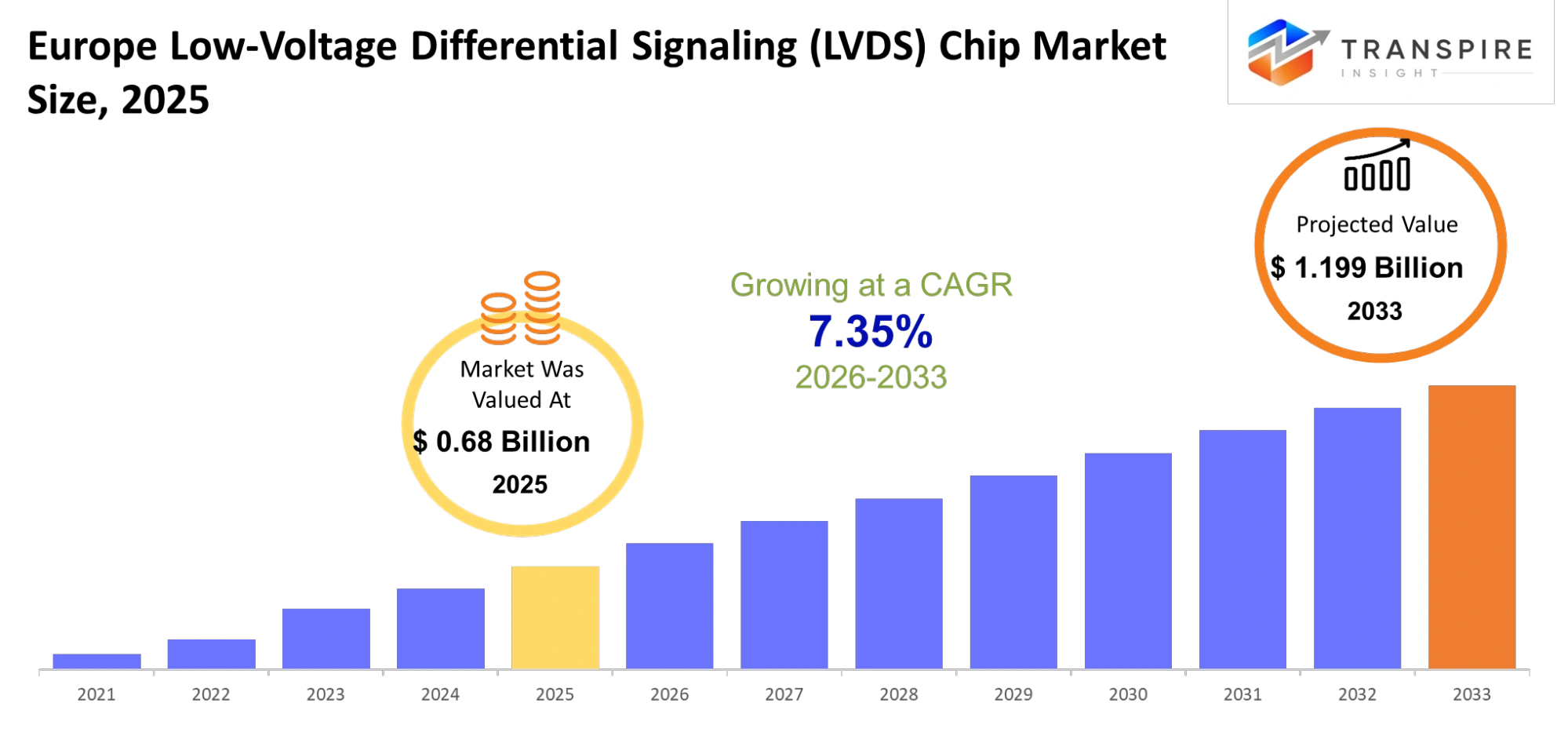
- Europe Low-Voltage Differential Signaling (LVDS) Chip Market Size 2025: USD 0.68 Billion
- Europe Low-Voltage Differential Signaling (LVDS) Chip Market Size 2033: USD 1.199 Billion
- Europe Low-Voltage Differential Signaling (LVDS) Chip Market CAGR: 7.35%
- Europe Low-Voltage Differential Signaling (LVDS) Chip Market Segments: By Type (Single Channel LVDS, Dual Channel LVDS, Multi-channel LVDS, Others), By Application (Automotive Displays, Consumer Electronics, Industrial Systems, Medical Devices, Telecom Equipment, Others), By End-User (Electronics Manufacturers, Automotive Companies, Industrial Firms, Healthcare Providers, Telecom Companies, Others), By Technology (CMOS-based, Low Power ICs, High-speed ICs, Others).
To learn more about this report,  Download Free Sample Report
Europe Low-Voltage Differential Signaling (LVDS) Chip Market Summary:
The Europe Low-Voltage Differential Signaling (LVDS) Chip Market size is estimated at USD 0.68 Billion in 2025 and is anticipated to reach USD 1.199 Billion by 2033, growing at a CAGR of 7.35% from 2026 to 2033. The Europe Low-Voltage Differential Signaling (LVDS) chip market supports high-speed low-noise data transfer operations in systems which require precise signal maintenance for their shipboard control panels industrial automation displays and machine vision systems. The LVDS system permits processors and sensors and displays to communicate successfully under conditions of electrical interference while it decreases data errors without increasing power usage.
The demand for high-resolution interfaces and compact system architectures has emerged as the main driving force behind market changes during the last three to five years. The integration of advanced human-machine interfaces into industrial and maritime equipment has sustained the use of LVDS because of its stable performance and minimal electromagnetic interference characteristics, despite the introduction of new industry standards.
The supply chain disruptions which followed the Russia-Ukraine conflict had a major impact because they revealed how much Europe depended on imported semiconductor parts. The situation forced OEMs to select new suppliers while they focused on established interface technologies which demonstrated their capacity to operate effectively. The LVDS technology currently remains in use for essential legacy systems while it expands to new systems, which need dependable performance beyond their maximum capacity for data transmission.
Key Market Insights
- The Low-Voltage Differential Signaling (LVDS) Chip Market in Europe will be dominated by Western Europe which will hold more than 45% of market share in 2025 through the strength of Germany's industrial electronics sector.
- The Eastern European region develops at the fastest pace with a projected 6% annual growth rate which will continue until 2030 because of manufacturing companies that move their production facilities to new locations.
- The market for LVDS display interface chips will reach approximately 40% share in 2025 because these chips enable automotive infotainment systems to work with industrial display systems.
- The second-largest market share belongs to LVDS line drivers and receivers which manufacturers widely use for factory automation and embedded system applications.
- The fastest segment of growth between 2025 and 2030 belongs to serializer/deserializer (SerDes) LVDS chips which producers use for high-speed data transmission.
- The automotive display systems market will reach a 35% market share in 2025 because the digital cockpit and advanced driver-assistance systems (ADAS) systems require display technologies.
- Industry 4.0 implementation together with machine vision system installation drives industrial automation development to become the most rapidly expanding application area.
- The Europe Low-Voltage Differential Signaling (LVDS) Chip Market operates under automotive original equipment manufacturers who hold 38% market share in 2025 because vehicle electronic systems become more complex.
- The industrial equipment manufacturing sector segments between different user groups with industrial equipment producers emerging as the most rapidly growing segment which will continue until 2030 because of their smart factory development initiatives.
What are the Key Drivers, Restraints, and Opportunities in the Europe Low-Voltage Differential Signaling (LVDS) Chip Market?
The European Low-Voltage Differential Signaling (LVDS) Chip Market experiences its primary growth driver from the swift adoption of digital cockpits together with high-definition displays used inside vehicles. The user interface quality together with safety visualization systems drove European automakers to develop unique vehicle features which resulted in the current industry transition. The industry keeps using LVDS technology because it enables businesses to transmit stable low-latency data across multiple displays without incurring major expenses for system changes. The growing demand for multi-screen systems in mid-range vehicles leads to an increase in LVDS usage which results in higher chip sales and continuous revenue generation for manufacturers.
The most significant structural barrier is the gradual migration toward higher-bandwidth interface standards such as Ethernet and MIPI. The two alternatives present better data transfer capabilities which modern autonomous systems and sensor-heavy systems require to function properly. The process of substituting LVDS requires complete electronic system redesign together with engineering staff retraining and automotive standard testing for components. The complicated system delays market entry for new products while restricting LVDS development in advanced domains which results in its use for existing systems and budget-friendly platforms while reducing future income possibilities.
Poland and Hungary serve as the primary center for Eastern European electronics manufacturing expansion which presents a significant business opportunity. Global OEMs are creating localized production facilities for industrial and automotive electronics as they move to diversified supply chains after the disruptions of 2022. The establishment of new facilities creates a market requirement for established interface technologies which provide cost-effective solutions at proven performance levels to maintain their operational existence while creating new business opportunities.
What Has the Impact of Artificial Intelligence Been on the Europe Low-Voltage Differential Signaling (LVDS) Chip Market?
Artificial intelligence and advanced digital technologies are beginning to reshape how LVDS-based systems operate within industrial automation and transport electronics across Europe. AI-based control systems now handle automatic display interface monitoring together with sensor link monitoring and embedded communication channel monitoring which uses LVDS for reliable data transmission. In factory automation lines AI algorithms use continuous signal calibration adjustments together with real-time error correction processes to decrease manual diagnostics while achieving faster system response times.
Machine learning models enable predictive maintenance through their analysis of signal degradation patterns and temperature fluctuations and transmission errors which occur in LVDS-connected components. These models can forecast connector wear or cable faults before failure occurs, helping operators avoid unplanned downtime. The automotive and industrial sectors experience measurable benefits which include 10 to 15 percent better system uptime and decreased maintenance expenses through condition-based servicing.
AI-enhanced optimization, which includes dynamic data transmission load management together with reduced signaling, helps organizations achieve better energy efficiency. Businesses encounter difficulties because of their need to combine various systems together. Many legacy LVDS systems lack the sensor density and data infrastructure required to train accurate models, forcing companies to invest heavily in retrofitting hardware before realizing AI-driven benefits.
Key Market Trends
- European automotive manufacturers transitioned from using single-display dashboards to implementing multi-screen cockpits during the period between 2020 and 2025 which resulted in more LVDS channels being installed in each vehicle despite new interface options becoming available.
- The supply chain problems which began in 2022 made automotive manufacturers such as Volkswagen AG and Stellantis N.V. choose established LVDS technologies instead of creating products based on untested industry standards.
- The industrial automation sector began using LVDS technology for machine vision systems because its electromagnetic interference performance proved effective in noisy factory conditions after the year 2021.
- The semiconductor companies Texas Instruments and STMicroelectronics started to develop low-power LVDS technology after 2023 because they wanted their products to remain relevant throughout their entire lifecycle.
- The period between 2022 and 2025 saw Ethernet-based interfaces become more popular in high-end vehicles which led to LVDS becoming less common in premium segments while mid-range systems remained mostly unchanged.
- Eastern European manufacturing hubs have increased their electronics assembly capabilities by more than 20 percent since 2020 which has created a higher demand for affordable LVDS solutions that manufacturers need for their local production facilities.
- Tier-1 suppliers established new LVDS procurement methods to decrease their reliance on single-source chip suppliers starting from 2023 which helped them manage geopolitical and logistical challenges.
- The industrial OEMs have maintained their use of LVDS technology through critical infrastructure systems because they needed to first complete their redesign work before adopting high-speed alternatives during the past five years.
- The implementation of AI-driven diagnostics into embedded systems has enabled better LVDS signal integrity monitoring since 2024 which leads to more accurate fault detection and decreased system downtime.
Europe Low-Voltage Differential Signaling (LVDS) Chip Market Segmentation
By Type
The dual-channel LVDS system stands as the top solution for automotive and industrial applications which need to transmit larger amounts of data without adopting intricate system designs. The single-channel systems remain important for budget-restricted projects which need to save space through basic display systems and embedded control units. The multi-channel LVDS technology is becoming popular for modern cockpit displays and machine vision systems which benefit from its ability to transmit data simultaneously.
Customers show a preference for system configurations which allow them to scale their bandwidth needs at an affordable cost instead of implementing new interface standards. The current situation enables dual-channel products to maintain their sales volume while companies develop multi-channel systems at a slow pace. The industry will move forward through small performance improvements which existing LVDS systems will implement to help manufacturers maintain product availability through typical bandwidth growth without requiring extensive system changes.
By Application
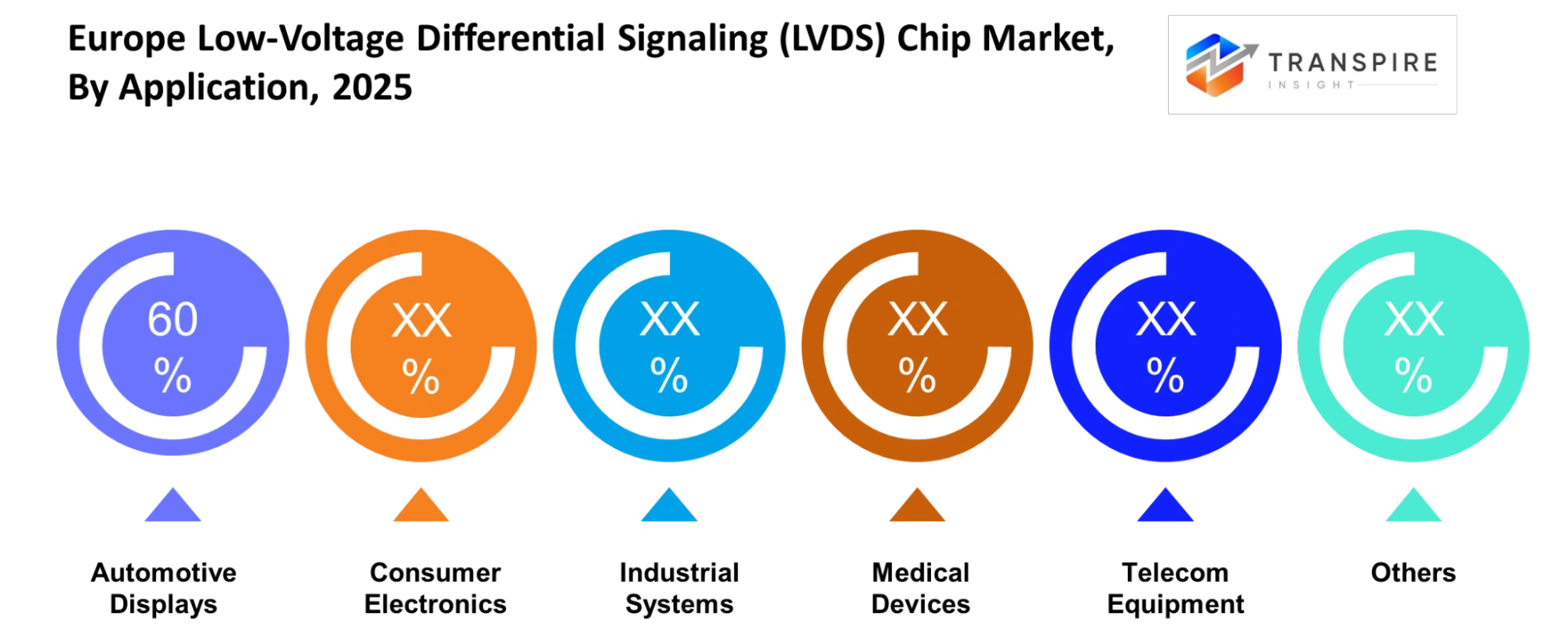
Automotive displays hold the largest market share because drivers now use infotainment systems together with digital instrument clusters and rear-seat entertainment units in their vehicles. The industrial sector ranks as the second largest market segment because machine vision and robotics and human-machine interface panels need stable signal transmission in environments with electrical interference. Medical devices and consumer electronics show limited application of their technology because they apply it only to specific situations which require dependable operation more than they need extremely fast data transmission.
Different growth patterns exist between market segments because automotive demand comes from standardized platforms while industrial sectors need equipment that lasts through challenging conditions. Telecom equipment adoption remains limited due to bandwidth constraints. The demand for automotive and industrial applications will continue to drive market growth while new imaging and diagnostic systems will provide sellers with additional chances to create business opportunities.
To learn more about this report, Download Free Sample Report
By End-User
The automotive industry requires electronic display systems which need validated communication interfaces to prove their operational capabilities. The electronics manufacturing sector serves as a significant secondary market because it provides components which both automotive and industrial customers use. Industrial companies experience their highest growth rates because factories implement automation and digital monitoring systems which require dependable data connections. The healthcare and telecom sectors deliver minimal market presence because they focus only on specific application needs.
Automotive and industrial customers show demand patterns which reflect their risk tolerance because they choose dependable products that require extended testing periods instead of embracing new technological developments. Suppliers enjoy secure revenue streams from this system yet face challenges in adopting new interface technologies. The industrial sector will achieve higher growth rates than the automotive sector because European smart factory investments will drive industrial sector expansion.
By Technology
The technology of CMOS-based LVDS chips achieves market dominance because of their cost efficiency and ability to scale and their compatibility with current semiconductor manufacturing processes. The design priorities of automotive and industrial electronics have created demand for low power integrated circuits because energy efficiency has become essential for their development. High-speed ICs represent a smaller but growing segment which needs better data rates to support advanced display systems that still need to use LVDS technology.
Other technologies occupy niche positions with limited scalability. Manufacturers concentrate their efforts on power consumption and signal integrity because growth logic shows these two aspects as more essential than reaching maximum bandwidth. This approach meets the requirements of existing systems which operate at mid-performance levels. The future will bring further advances in low power mixed-signal integration which will help suppliers stay competitive while high-speed interfaces become more common.
What are the Key Use Cases Driving the Europe Low-Voltage Differential Signaling (LVDS) Chip Market?
The European Low-Voltage Differential Signaling (LVDS) Chip Market depends on automotive display systems which need low-latency data links for their digital instrument clusters and infotainment screens. European OEMs use LVDS technology because it enables them to maintain display signal integrity while they control their design expenses and fulfill safety certification requirements.
Manufacturing companies that use robotics and inspection systems have begun to adopt industrial automation and machine vision as their new application areas. LVDS provides dependable image and data transmission capabilities in industrial factory settings because it withstands electromagnetic interference which disrupts other communication interfaces and decreases system performance.
Emerging use cases include medical imaging equipment and rail transport display systems, where consistent signal transmission is critical for diagnostics and passenger information systems. The infrastructure upgrades and healthcare digitization initiatives which are being implemented throughout Europe create new opportunities for these market segments.
|
Report Metrics |
Details |
|
Market size value in 2025 |
USD 0.68 Billion |
|
Market size value in 2026 |
USD 0.73 Billion |
|
Revenue forecast in 2033 |
USD 1.199 Billion |
|
Growth rate |
CAGR of 7.35% from 2026 to 2033 |
|
Base year |
2025 |
|
Historical data |
2021 - 2024 |
|
Forecast period |
2026 - 2033 |
|
Report coverage |
Revenue forecast, competitive landscape, growth factors, and trends |
|
Regional scope |
Europe (Germany, United Kingdom, France, Italy, Spain and Rest of Europe) |
|
Key company profiled |
Texas Instruments, NXP, STMicroelectronics, Infineon, Analog Devices, ON Semiconductor, Renesas, Rohm, Microchip, Broadcom, Qualcomm, Intel, Samsung, MediaTek, Toshiba |
|
Customization scope |
Free report customization (country, regional & segment scope). Avail customized purchase options to meet your exact research needs. |
|
Report Segmentation |
By Type (Single Channel LVDS, Dual Channel LVDS, Multi-channel LVDS, Others), By Application (Automotive Displays, Consumer Electronics, Industrial Systems, Medical Devices, Telecom Equipment, Others), By End-User (Electronics Manufacturers, Automotive Companies, Industrial Firms, Healthcare Providers, Telecom Companies, Others), By Technology (CMOS-based, Low Power ICs, High-speed ICs, Others) |
Which Regions are Driving the Europe Low-Voltage Differential Signaling (LVDS) Chip Market Growth?
The market in Western Europe exists as the leading market because Germany, France, and Italy possess strong automotive manufacturing clusters. The vehicle safety requirements combined with display integration requirements force OEMs to use certified communication systems which include LVDS as their standard. The semiconductor ecosystem achieves its full development when STMicroelectronics and NXP Semiconductors continue their product creation process while delivering semiconductor solutions. The automotive industry sustains its top market position through successful collaborations between automotive manufacturers Tier-1 suppliers and semiconductor production companies.
Northern Europe becomes the second-leading region as Sweden and Finland focus on advanced engineering fields together with their ongoing commitment to automotive electronics development. The region requires active R&D investment together with consistent industrial regulations to create its competitive edge instead of Western Europe, which benefits from its operational scale.
The manufacturing growth in Poland, Hungary, and Czech Republic fuels Eastern Europe, making it the fastest expanding region. Global OEMs have started to establish production facilities near European customer bases, which has become a trend since 2022. The new electronics assembly plants together with automotive facilities create a growing need for affordable, tested interface systems which include LVDS. The growth creates multiple entry points for investors and suppliers who want to access the projected increase in regional production capacity between 2026 and 2033.
Who are the Key Players in the Europe Low-Voltage Differential Signaling (LVDS) Chip Market and How Do They Compete?
The European LVDS chip market exhibits moderate market consolidation and competition because several semiconductor companies control most of the automotive and industrial supply markets. The established players use long qualification processes together with their complete system integration methods to OEM platforms which makes it expensive for customers to change their suppliers. The main competitive advantage of the market operates through three elements: signal reliability, power efficiency, and support throughout the entire product lifespan. New companies encounter obstacles because they must meet stringent automotive validation standards while demonstrating their products work with complex electronic systems, which prevents them from entering the market despite semiconductor advancements.
Texas Instruments develops high-volume LVDS solutions for automotive and industrial applications through cost-efficient design methods that utilize its extensive global distribution system and advanced analog design capabilities. STMicroelectronics uses its close relationships with European OEMs and integrated system-on-chip designs which combine LVDS with power management and sensing capabilities to create better system integration.
NXP Semiconductors uses its automotive-grade reliable technology to create secure interface solutions which include LVDS as part of its complete vehicle networking products. Analog Devices uses its advanced signal integrity and precision engineering technologies to compete in markets that require high performance industrial and imaging solutions. The companies grow their business by establishing partnerships with Tier-1 suppliers and developing programs with automakers while making strategic investments in Eastern European countries that match their manufacturing operations.
Company List
- Texas Instruments
- NXP
- STMicroelectronics
- Infineon
- Analog Devices
- ON Semiconductor
- Renesas
- Rohm
- Microchip
- Broadcom
- Qualcomm
- Intel
- Samsung
- MediaTek
- Toshiba
Recent Development News
In January 2026, TI Unveils AWR2188 Radar and High-Speed Automotive Compute Chip Family: Texas Instruments introduced new radar and compute chips designed for ADAS and digital cockpit integration. These systems rely heavily on high-speed differential signaling (including LVDS-class interfaces) for camera, radar, and display data pipelines in vehicles deployed across Europe.
Source: https://autonews.gasgoo.com
In January 2026, Texas Instruments Expands Automotive SerDes & In-Vehicle Connectivity Portfolio: Texas Instruments announced a new automotive semiconductor portfolio including high-speed connectivity and Ethernet PHY solutions supporting zonal vehicle architectures. These technologies directly support LVDS/SerDes-based display and cockpit data transmission systems used in modern European vehicles.
Source: https://www.ti.com
What Strategic Insights Define the Future of the Europe Low-Voltage Differential Signaling (LVDS) Chip Market?
The Europe Low-Voltage Differential Signaling (LVDS) chip market will establish its future operations through two distinct pathways because the market will continue to serve cost-sensitive and reliability-critical applications while it loses its capacity to handle high-bandwidth operations. The existing automotive and industrial systems continue to use their outdated designs because these systems provide better performance stability through lengthy validation periods than they do through advanced technological enhancements.
The supply chain danger becomes less obvious because many businesses depend on a few analog semiconductor manufacturers which creates a risk that OEMs will face both increased costs and restricted product availability during upcoming supply interruptions. At the same time, Eastern Europe presents a developing business possibility because local electronics production and nearshoring regulations create a need for interface solutions that companies can implement without difficulty.
Market participants should focus on hybrid integration strategies that combine LVDS with newer protocols because these strategies enable them to support both existing systems and future systems without needing to change their entire system design.
Europe Low-Voltage Differential Signaling (LVDS) Chip Market Report Segmentation
By Type
- Single Channel LVDS
- Dual Channel LVDS
- Multi-channel LVDS
- Others
By Application
- Automotive Displays
- Consumer Electronics
- Industrial Systems
- Medical Devices
- Telecom Equipment
- Others
By End-User
- Electronics Manufacturers
- Automotive Companies
- Industrial Firms
- Healthcare Providers
- Telecom Companies
- Others
By Technology
- CMOS-based
- Low Power ICs
- High-speed ICs
- Others
Frequently Asked Questions
Find quick answers to common questions.
The approximate Europe Low-Voltage Differential Signaling (LVDS) Chip Market size for the market will be USD 1.199 Billion in 2033.
The key segments of the Europe Low-Voltage Differential Signaling (LVDS) Chip Market are By Type (Single Channel LVDS, Dual Channel LVDS, Multi-channel LVDS, Others), By Application (Automotive Displays, Consumer Electronics, Industrial Systems, Medical Devices, Telecom Equipment, Others), By End-User (Electronics Manufacturers, Automotive Companies, Industrial Firms, Healthcare Providers, Telecom Companies, Others), By Technology (CMOS-based, Low Power ICs, High-speed ICs, Others).
Major players in the Europe Low-Voltage Differential Signaling (LVDS) Chip Market are Texas Instruments, NXP, STMicroelectronics, Infineon, Analog Devices, ON Semiconductor, Renesas, Rohm, Microchip, Broadcom, Qualcomm, Intel, Samsung, MediaTek, Toshiba.
The current market size of the Europe Low-Voltage Differential Signaling (LVDS) Chip Market is USD 0.68 Billion in 2025.
The Europe Low-Voltage Differential Signaling (LVDS) Chip Market CAGR is 7.35%.
- Texas Instruments
- NXP
- STMicroelectronics
- Infineon
- Analog Devices
- ON Semiconductor
- Renesas
- Rohm
- Microchip
- Broadcom
- Qualcomm
- Intel
- Samsung
- MediaTek
- Toshiba
Recently Published Reports
-
Apr 2026
Fiber Optic Faceplates Market
Fiber Optic Faceplates Market Size, Share & Analysis Report By Type (< 300 mm2, 300-350 mm2, and > 350 mm2, By Application (Night Vision, Holographic Imaging, Medical, and Others), and Geography (North America, Europe, Asia-Pacific, Middle East and Africa, South and Central America), 2021 - 2031
-
Apr 2026
High Temperature Superconductors Market
High Temperature Superconductors Market Size, Share & Analysis Report By Type (1G HTS, and 2G HTS), By Application (Power Cable, Fault Current Limiter, and Transformer), and Geography (North America, Europe, Asia-Pacific, Middle East and Africa, South and Central America), 2021 - 2031
-
Apr 2026
Industrial Plugs and Socket Market
Industrial Plugs and Socket Market Size, Share & Analysis Report By Type (Industrial Plugs, Industrial Sockets), By Current (Up to 32 A, 32 to 125 A, Above 125 A), By Protection (Dustproof and Splash Proof, Waterproof, Explosion Proof), By End User (Heavy Industries, Oil and Gas, Chemicals and Pharmaceuticals, Power Generation, Others), and Geography (North America, Europe, Asia-Pacific, Middle East and Africa, South and Central America), 2021 - 2031
-
Apr 2026
InGaAs Avalanche Photodiodes Market
InGaAs Avalanche Photodiodes Market Size, Share & Analysis Report By Type (1100 - 1700 nm, and 1000 - 1600 nm), By Application (Missile Warning System, Muzzle Flash Detection, Wafer Defect Inspection, Laser Rangefinders, and Others), and Geography (North America, Europe, Asia-Pacific, Middle East and Africa, South and Central America), 2021 - 2031