
United States Intelligent Electronic Devices Market Size & Forecast:
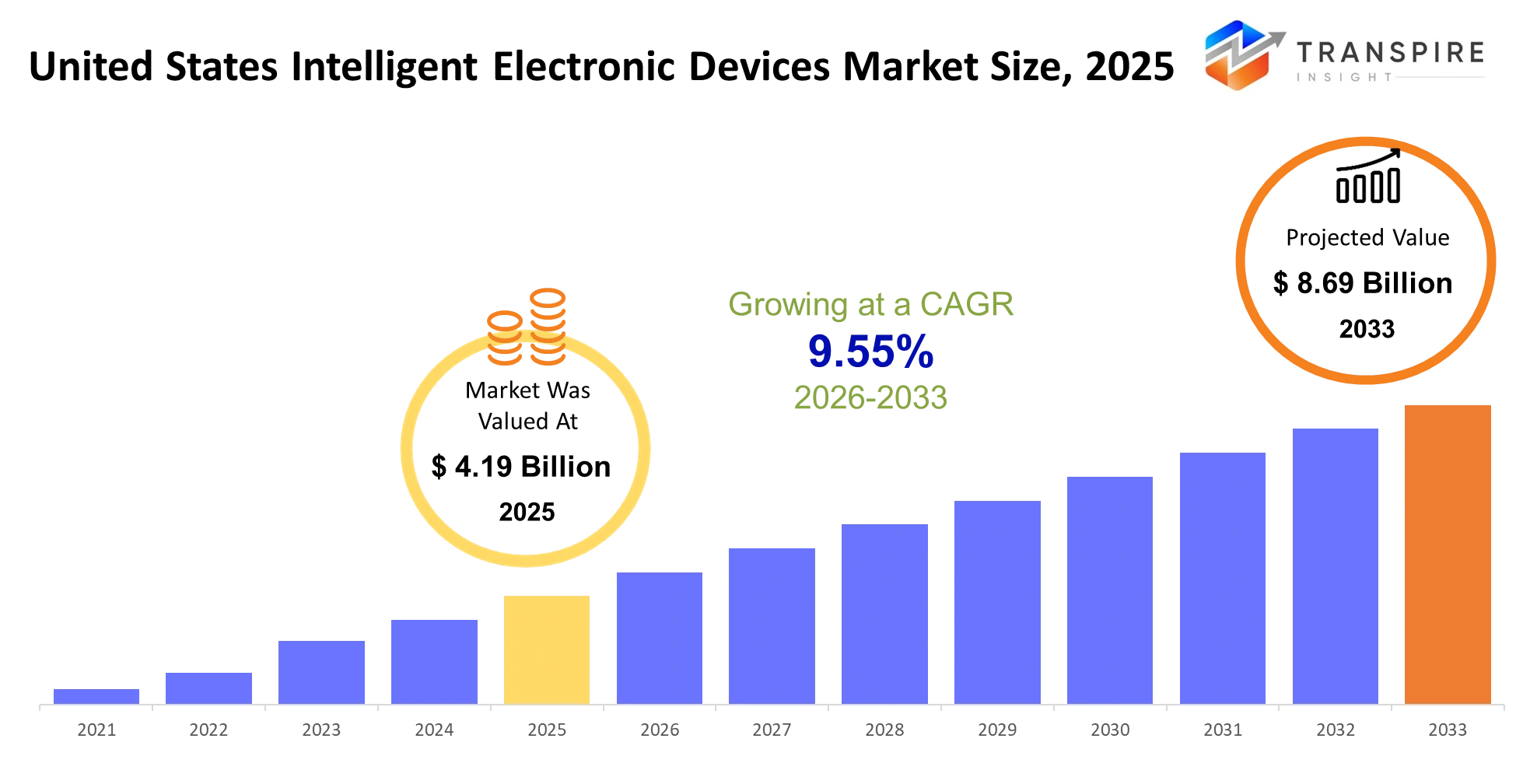
- United States Intelligent Electronic Devices Market Size 2025: USD 4.19 Billion
- United States Intelligent Electronic Devices Market Size 2033: USD 8.69 Billion
- United States Intelligent Electronic Devices Market CAGR: 9.55%
- United States Intelligent Electronic Devices Market Segments: By Device Type (Protective Relays, Smart Meters, Circuit Breakers, Controllers, Monitoring Devices, Others), By Voltage Range (Low Voltage, Medium Voltage, High Voltage, Ultra-high Voltage, Others), By Application (Power Distribution, Substation Automation, Industrial Automation, Renewable Energy Integration, Others), By End User (Utilities, Industrial Facilities, Commercial Buildings, Renewable Energy Sector, Others).
To learn more about this report,  Download Free Sample Report
United States Intelligent Electronic Devices Market Summary:
The United States Intelligent Electronic Devices Market size is estimated at USD 4.19 Billion in 2025 and is anticipated to reach USD 8.69 Billion by 2033, growing at a CAGR of 9.55% from 2026 to 2033.Intelligent electronic devices have slowly turned into the operational nerve system for the United States power and industrial infrastructure, in a way that is almost hard to ignore. Utilities , oil and gas operators, manufacturers and transport networks lean on these devices to keep an eye on electrical assets, automate fault detection, isolate outages, and keep grid stability steady, in real time. What’s basically happening is that they reduce downtime, boost energy efficiency, and help operators steer through increasingly complicated networks without depending on manual inspection cycles, which take ages and cost plenty.
In the last three to five years, the market has shifted, kind of away from isolated substation automation toward fully connected digital grid ecosystems. Utilities are now combining intelligent electronic devices with cloud analytics, edge computing, and predictive maintenance platforms to support decentralized renewable generation and electrified industrial activity. This shift sped up after pandemic era supply chain disruptions, and also when extreme weather events showed, pretty clearly, how fragile aging grid infrastructure can be. When utilities felt the pressure to raise resilience and cut the time it takes to respond to outages, capex started moving toward intelligent monitoring and automation systems. And now that investment is pushing beyond transmission networks, into factories, commercial facilities, and distributed energy environments, which in turn opens wider adoption pathways and tends to raise higher long term service revenue potential.
Key Market Insights
- In 2025, the Southern part of the United States seemed to take over the United States Intelligent Electronic Devices Market with roughly 34% market share, mostly because big grid modernization programs were rolled out at a large scale.
- Meanwhile, the Western states are showing the quickest rise until 2030, kind of fueled by renewable energy integration and money put into distributed energy resource management, lots of operators are pushing for that.
- Texas and California are leading intelligent grid infrastructure deployment , since utilities are focusing on outage reduction, predictive upkeep, and transmission automation technologies that help them stay ahead of problems.
- The Midwest utilities ramped up adoption after intense weather disruptions, it highlighted weaknesses in older transmission and distribution infrastructure that had been kind of overlooked for a while.
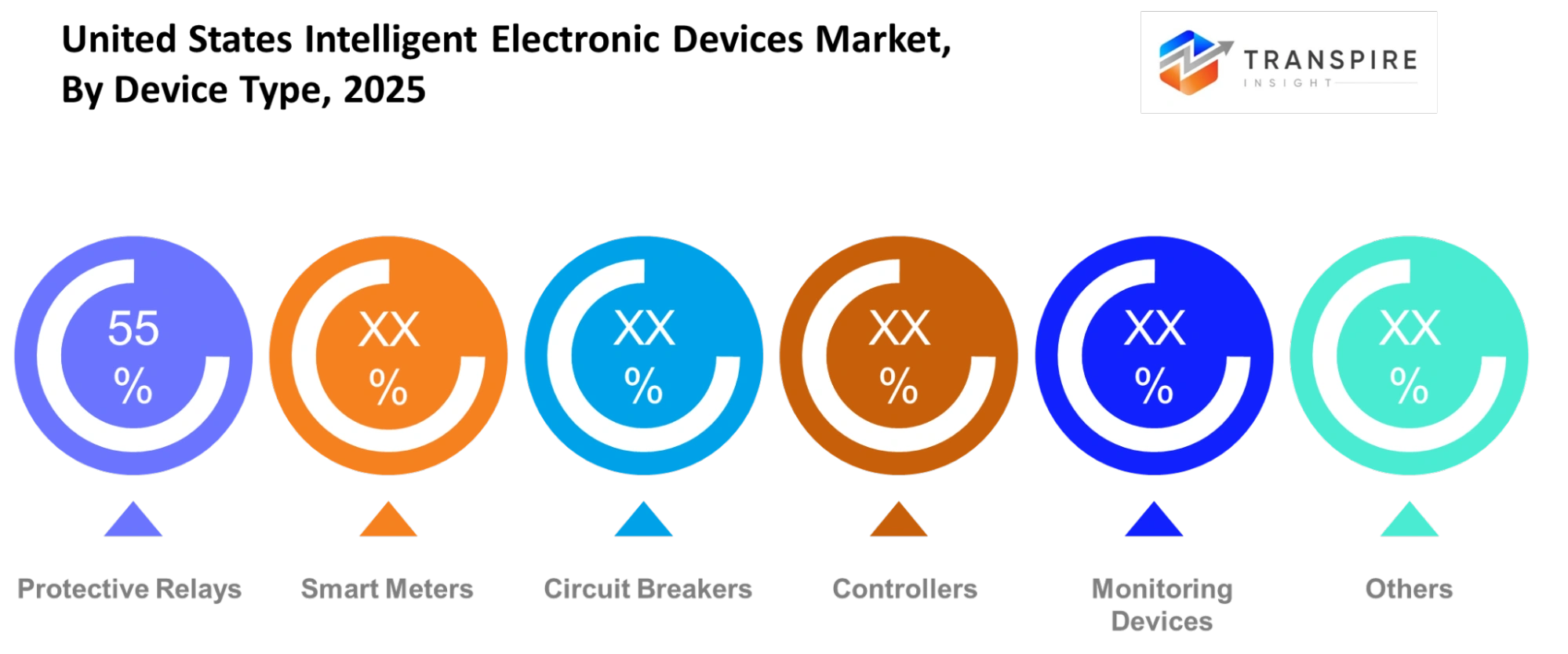
- Protective relays took top position in the United States Intelligent Electronic Devices Market, with about 38% revenue share in 2025. This happened largely due to broad substation upgrades across many utilities, not just a few projects.
- Communication-enabled intelligent controllers showed up as the second-largest segment, because industrial automation networks need real time operational awareness ,and quicker fault isolation when something goes wrong.
- Smart meters along with edge-connected monitoring devices are likely the fastest-growing segment from 2025 to 2030 , as utilities extend advanced metering infrastructure initiatives in different service areas.
- Ethernet-based intelligent electronic devices also gained substantial traction, since operators keep asking for interoperability across digital substations and industrial energy systems, it’s almost becoming a baseline requirement.
- Finally, power transmission and distribution applications made up more than 46% of the United States Intelligent Electronic Devices Market in 2025, driven by grid resilience investments and related upgrades.
What are the Key Drivers, Restraints, and Opportunities in the United States Intelligent Electronic Devices Market?
The strongest force pushing forward the United States Intelligent Electronic Devices Market is that fast modernization of aging power infrastructure, kind of the big background driver. Utilities started ramping up digital substation spending after those nasty grid failures , wildfire- related outages and weather-driven blackouts showed clear operational weak spots across transmission systems. Federal backing through grid resilience and infrastructure modernization programs also helped reduce the perceived financial danger of replacing older, legacy setups. Intelligent electronic devices now help utilities automate fault isolation, check asset condition on a continuous basis, and shrink how long it takes to bring service back. That ends up improving day-to-day operational efficiency while also lowering maintenance expenses and the regulatory penalties that follow service interruptions. And as utilities broaden renewable energy integration along with distributed power generation, device rollouts keep growing , largely because standard grid management approaches struggle with decentralized power flows.
Cybersecurity risk still stands as the market’s most stubborn structural obstacle. Intelligent electronic devices work inside critical infrastructure environments where utilities cannot accept either operational disruption or the compromise of data. In practice, many substations still run on very old operational technology architectures that basically were never built for connected digital operations. Fixing these surroundings requires multi-year capital plans, compliance validation, and workforce retraining initiatives. That overall complexity drags procurement timelines out and makes large-scale deployment projects slip , especially with smaller municipal utilities that have leaner cybersecurity budgets. Because of this, some sections of the market keep functioning below their full automation potential, even when the technology itself is ready.
Grid-edge intelligence is kind of, the next major growth opportunity coming up. Utilities in states like California and Texas are putting serious money into distributed energy resource management systems, for things like solar , battery storage and electric vehicle charging. With intelligent electronic devices that have edge analytics plus IEC 61850 communication capability, they can take in local grid data and work with it , kind of not needing to depend on centralized control centers all the time. That in turn opens up new revenue streams in predictive maintenance services, real time load balancing, and platforms for decentralized energy optimization.
What Has the Impact of Artificial Intelligence Been on the United States Intelligent Electronic Devices Market?
Artificial intelligence along with advanced digital technologies are kind of changing the way utilities and industrial operators handle intelligent electronic devices across substations, transmission corridors, and distributed energy setups. AI enabled control platforms are now automating things like fault recognition, voltage regulation, and load distribution by constantly scanning real time grid information from protective relays, smart meters, and digital controllers. Utilities lean on these platforms to cut down on the usual manual work during outages and to improve the way teams coordinate responses across different locations, even when networks are spread out geographically.
Machine learning methods are being rolled out more and more for predictive upkeep and for tuning how assets perform. Grid operators look at past malfunction trends, transformer temperatures, switching habits, and power quality swings to forecast equipment aging before a real breakdown shows up. Some utilities have shared measurable drops in unexpected maintenance incidents and also faster restoration of service, after predictive analytics got integrated into substation automation. AI based monitoring additionally supports energy efficiency by adjusting transformer loading more sensibly and reducing transmission losses during the hours when demand is at its highest. In industrial plants, intelligent automation systems tend to reduce operational downtime while also helping meet reliability requirements and cybersecurity expectations.
That said, AI adoption still hits a big obstacle: integration complexity inside legacy infrastructure. A lot of substations run on older operational technology architectures, with scattered communication protocols, and only limited interoperability between components.
Key Market Trends
- Since 2021 utilities started pushing digital substation rollouts faster, mainly after extreme weather caused outages that really showed where operations were kind of weak on older transmission and distribution infrastructure.
- IEC 61850 adoption also jumped a lot from 2020 to 2025 because operators kept asking for interoperable messaging across multi vendor smart grid setups, instead of just relying on one ecosystem.
- At the same time utilities moved their capital spending away from reactive repair work and into predictive analytics platforms, and that helped lower transformer failure odds while also making restoration faster, or at least more predictable.
- ABB and Siemens then broadened their AI enabled grid automation offerings as utilities leaned into autonomous fault detection and remote switching abilities, pretty directly.
- Since 2022 cybersecurity compliance spending rose substantially, after ransomware incidents went after critical infrastructure operators and made it obvious that connected operational technology systems had exposed weaknesses.
- Industrial manufacturers too became more active integrating intelligent electronic devices alongside cloud based energy management systems, with the goal of boosting plant efficiency and keeping electricity consumption patterns steadier.
- Renewable energy integration changed procurement behavior, because utilities began upgrading substations to handle decentralized solar, battery storage, and even electric vehicle charging networks, all together rather than separately.
- Domestic sourcing strategies gained real momentum after pandemic era semiconductor shortages, those delays affected intelligent relay and controller deliveries by several months during 2021 and 2022 , and everybody noticed.
- From around 2023 through 2025, competitive differentiation drifted away from only hardware dependability and toward software analytics, lifecycle service arrangements, and remote monitoring features.
United States Intelligent Electronic Devices Market Segmentation
By Device Type
Protective relays still seem like they keep the strongest spot in their device category, mostly because utilities and industrial operators care a lot about grid reliability and fault isolation, even while the electrical infrastructure gets older and older. Smart meters are right behind, since utilities are pushing advanced metering programs to get sharper energy visibility and more demand-side management style functions. Monitoring devices plus intelligent controllers are also starting to pick up momentum, because digital substations need continuous equipment diagnostics and automated switching behaviors, not just occasional checking. Circuit breakers that include communication protocols also showed better adoption, and honestly it makes sense , operators want closer to real-time operational control, not just standalone mechanical protection anymore.
Demand patterns are leaning more toward multifunctional devices, ones that can handle predictive maintenance, cybersecurity monitoring, and cloud connectivity, all in basically one platform. The manufacturers are then reacting by braiding artificial intelligence, edge analytics, and interoperable comms standards into new product lines, like they’re trying to squeeze out every advantage. Looking ahead, the competition inside this category will likely start tipping toward software enabled performance, lifecycle services, and remote asset management, not just hardware differentiation alone.
To learn more about this report, Download Free Sample Report
By Voltage Range
Medium voltage systems sort of dominate the voltage range category right now, because industrial facilities, utility substations, and commercial infrastructure basically rely on medium voltage distribution networks for operational continuity and day to day uptime. High voltage intelligent electronic devices stay really relevant in the market, mainly from transmission modernization budgets and renewable energy integration projects across broad utility territories. Low voltage systems are still growing in a steady way inside commercial buildings and distributed energy installations, where energy monitoring and automation capabilities are turning into something you need to have, not just a nice extra upgrade.
Ultra-high voltage applications remain comparatively limited, but they are pulling in a more selective type of investment, as transmission expansion efforts increase along renewable energy corridors. Still, each voltage tier has its own buying priorities. Medium voltage buyers tend to care most about reliability and maintenance efficiency, and high voltage deployments lean more toward grid resilience , plus outage prevention. Looking ahead, investment patterns imply a rising demand for scalable, communication-enabled devices that can work across mixed voltage environments without forcing a major infrastructure redesign, even when conditions get complicated.
By Application
Power distribution is still the main use case , mostly because utilities keep swapping out older infrastructure for digitally connected set-ups that can manage faults on their own and also do real-time oversight. Substation automation is right behind it, since operators are modernizing their control frameworks to cut down on the manual stuff, and yes, to make outage recovery a bit faster. Industrial automation keeps moving ahead too, in manufacturing, oil and gas, and even semiconductor sites, where power quality matters a lot for output and for how long equipment stays running. Renewable energy integration feels like the quickest growing area. Decentralized solar generation, battery storage, and charging for electric vehicles, these create more complicated power flow situations across distribution networks.
That’s why utilities increasingly want intelligent devices that can handle intermittent renewable supply, and still keep overall system stability steady. Looking ahead, future growth will probably lean toward platforms that merge operational intelligence, cybersecurity features, and predictive analytics all inside one energy management ecosystem. Vendors that can support interoperability between utility and industrial environments will, over time, end up in a stronger position.
By End-User
Utilities keep showing up as the biggest end-user slice, partly because transmission operators and distribution companies take the lion share of the grid modernization budget across the United States.Industrial facilities kinda keep that second-place position sort of, because manufacturers are pushing predictive maintenance pretty hard, along with making sure uptime stays solid and improving energy efficiency upgrades. Commercial buildings meanwhile are working on ramping up the rollout of intelligent devices, since data centers, hospitals, and airports really require power quality that doesn't flicker , and monitoring systems that are basically always on, for mission critical tasks.
On top of all that, the renewable energy side looks like the fastest-growing segment too, pulled forward by big solar, wind, and battery storage builds that are spreading across western , and southern states. Every end-user category tends to move through its own investment cycle and faces different regulatory pressures, so the market ends up using a mix of procurement approaches that vary a lot. Going forward, buying decisions will likely tip more toward vendors who bundle an integrated software ecosystem, cybersecurity assurance, and long-term service support, not just those standalone equipment supply arrangements.
What are the Key Use Cases Driving the United States Intelligent Electronic Devices Market?
Electric utilities kinda show up as the biggest use case for intelligent electronic devices, because transmission and distribution operators need continuous fault detection, automated switching and real-time grid observation. A lot of utilities roll out protective relays along with digital controllers, not just a little, to shorten outage duration , make grid resilience better, and also meet the reliability standards that are enforced by North American energy regulators.
On the other side, industrial facilities as well as commercial infrastructure are widening the adoption too, especially across manufacturing plants, semiconductor work, data centers, and airports. In these sectors people are using intelligent monitoring systems more and more, in order to steady power quality, lower equipment downtime, and back predictive maintenance efforts inside energy-heavy operations.
Then there are emerging applications that are growing around distributed energy resource management, plus the infrastructure for electric vehicle charging. For example, utilities in California and Texas are testing edge-based intelligent setups that can juggle localized solar output, battery storage , and the changing charging demand, without fully depending on centralized grid control systems.
|
Report Metrics |
Details |
|
Market size value in 2025 |
USD 4.19 Billion |
|
Market size value in 2026 |
USD 4.59 Billion |
|
Revenue forecast in 2033 |
USD 8.69 Billion |
|
Growth rate |
CAGR of 9.55% from 2026 to 2033 |
|
Base year |
2025 |
|
Historical data |
2021 - 2024 |
|
Forecast period |
2026 - 2033 |
|
Report coverage |
Revenue forecast, competitive landscape, growth factors, and trends |
|
Geographic scope |
United States of America |
|
Key company profiled |
ABB, Siemens, Schneider Electric, General Electric, Eaton, Mitsubishi Electric, SEL, Cisco Systems, Honeywell, Rockwell Automation, Toshiba, Hitachi Energy, Emerson Electric, Fuji Electric, Larsen & Toubro. |
|
Customization scope |
Free report customization (country, regional & segment scope). Avail customized purchase options to meet your exact research needs. |
|
Report Segmentation |
By Device Type (Protective Relays, Smart Meters, Circuit Breakers, Controllers, Monitoring Devices, Others), By Voltage Range (Low Voltage, Medium Voltage, High Voltage, Ultra-high Voltage, Others), By Application (Power Distribution, Substation Automation, Industrial Automation, Renewable Energy Integration, Others), By End User (Utilities, Industrial Facilities, Commercial Buildings, Renewable Energy Sector, Others). |
Which Regions are Driving the United States Intelligent Electronic Devices Market Growth?
The Southern United States still looks like the dominant regional market, mainly because many utilities across Texas, Florida, and a bunch of neighboring states are putting money into grid resilience, and transmission modernization at a fast pace. With hurricanes showing up pretty often, plus population increasing quite rapidly, regional utilities had to speed up installing automated substations, intelligent relays and real-time monitoring infrastructure. On top of that, strong industrial momentum across oil and gas, petrochemicals, and manufacturing keeps demand up for smarter power management systems. The whole area also has a mature supplier network, big utility capital budgets, and a kind of ongoing cooperation between grid operators, industrial users, and automation technology providers.
Meanwhile the Midwest is usually the second-largest contributor, though market stability feels more tied to long-term asset replacement cycles rather than any quick build-out. Utilities in Illinois, Ohio, and Michigan keep modernizing aging transmission infrastructure through staged investment programs, these focus on operational continuity and reliability compliance first. There’s also heavy manufacturing all across automotive, steel, and other industrial processing, which means steady need for predictive maintenance plus power quality monitoring systems. Compared with the Southern market, the Midwest tends to show steadier procurement behavior, and fewer swings in project timing, so it becomes a dependable place for recurring equipment sales, and service revenue.
The Western United States is becoming, kind of, the fastest-growing regional market because renewable energy integration is speeding up and distributed grid management needs are getting more serious. California, Arizona, and Nevada expanded their investments in battery storage infrastructure, electric vehicle charging networks,and wildfire prevention systems after grid reliability challenges started to feel stronger over the last few years. More and more utilities are asking for edge based intelligent electronic devices that can handle decentralized solar generation and these shifting energy loads in real time. So this whole shift, while not simple, is still creating solid opportunities for tech providers focused on advanced analytics, grid automation software, and interoperable communication platforms between 2026 and 2033.
Who are the Key Players in the United States Intelligent Electronic Devices Market and How Do They Compete?
The competitive landscape in the United States Intelligent Electronic Devices Market stays sort of moderately consolidated, with big industrial automation players running utility-scale rollouts while more specialized vendors tussle for smaller grid intelligence use cases. Lately, the fight looks less like hardware pricing and more like software integration , cybersecurity posture , and lifecycle service support, yes, pretty much that. Big suppliers still defend their footing using long-term utility contracts plus interoperability standards compliance, and meanwhile smaller tech firms swing toward distributed energy management plus edge analytics chances. Utilities and industrial buyers increasingly lean toward vendors that can blend intelligent protection systems, cloud connectivity, and predictive maintenance capabilities into one operational platform.
ABB leans into tech based separation with digital substations, IEC 61850 enabled automation systems, and AI supported predictive maintenance tools. Its strong utility ties across North America help ABB grab major modernization contracts tied to renewable energy enablement and transmission resilience upgrades. Siemens, on the other hand, differentiates through a grid software ecosystem approach that pulls together operational technology with real time analytics, along with cybersecurity monitoring. Siemens keeps widening its reach via partnerships with utilities, especially those funding decentralized energy management and the electric vehicle charging infrastructure buildouts.
Schneider Electric is sort of winning by pushing energy efficiency optimization, plus those cloud based asset management platforms that are made for commercial buildings, and also industrial facilities. It has strong penetration in data centers and manufacturing plants, which means it keeps getting recurring software and service revenue streams, even after the hardware sales stop, you know. Eaton on the other hand emphasizes resilient power distribution systems for industrial and utility customers who work in high risk outage situations. Eaton also improved its position by expanding intelligent breaker technologies , and adding remote monitoring capabilities across infrastructure projects in North America. Then Honeywell seems to be focusing more on industrial automation customers, using integrated operational control systems that bring together power monitoring, facility management and cybersecurity functions inside centralized digital platforms.
Company List
- ABB
- Siemens
- Schneider Electric
- General Electric
- Eaton
- Mitsubishi Electric
- SEL
- Cisco Systems
- Honeywell
- Rockwell Automation
- Toshiba
- Hitachi Energy
- Emerson Electric
- Fuji Electric
- Larsen & Toubro
Recent Development News
In May 2026, Analog Devices Reports Record Quarter Driven by AI Infrastructure Demand: U.S.-based semiconductor company Analog Devices announced its strongest quarterly performance to date in May 2026, supported by rising demand for intelligent power-management and signal-processing devices used in AI data centers and industrial automation systems. The company also increased its dividend and projected another record revenue quarter, highlighting strong momentum in intelligent electronic device applications across U.S. infrastructure markets.
Source: https://www.investors.com
In May 2026, U.S. Electronics Orders Surge on Demand for Measuring and Control Instruments: New U.S. factory orders for electromedical, measuring, and control instruments climbed sharply in March 2026, according to government data reported by Reuters. The growth reflects increasing deployment of intelligent electronic and automation systems across industrial and utility sectors, particularly for monitoring, grid management, and smart-control applications.
Source: https://www.reuters.com
What Strategic Insights Define the Future of the United States Intelligent Electronic Devices Market?
The United States Intelligent Electronic Devices Market is kind of structurally moving, toward decentralized , software defined grid management over the next five to seven years. The main driver behind it is the fast spread of distributed energy resources like battery storage rooftop solar microgrids and even electric vehicle charging infrastructure. In other words, the old centralized grid setup cant really handle the constantly changing two way power flows, so utilities are getting pushed toward intelligent edge based automation, plus real time analytics platforms. Over time the future market value seems likely to drift away from just buying standalone hardware and more into recurring software, cybersecurity support, and predictive maintenance service models.
There is also a risk that not enough people notice at first, like semiconductor concentration and how dependent components are on sourcing. A lot of the advanced relays, communications modules, and industrial controllers still lean on a fairly limited set of global semiconductor supply chains. That leaves utilities exposed to procurement delays, and price swings whenever geopolitical disruptions happen.
On the opportunity side, something newer is forming around grid edge orchestration platforms in wildfire prone western states, because utilities there need localized automation to avoid outages from escalating, and to keep renewable heavy networks steadier. Market players should focus on platforms that are interoperable, cybersecurity certified, and able to work with legacy infrastructure while also bringing AI enabled grid intelligence. Basically, buyers are increasingly valuing longer term operational flexibility rather than single function hardware deployments.
United States Intelligent Electronic Devices Market Report Segmentation
By Device Type
- Protective Relays
- Smart Meters
- Circuit Breakers
- Controllers
- Monitoring Devices
- Others
By Voltage Range
- Low Voltage
- Medium Voltage
- High Voltage
- Ultra-high Voltage
- Others
By Application
- Power Distribution
- Substation Automation
- Industrial Automation
- Renewable Energy Integration
- Others
By End User
- Utilities
- Industrial Facilities
- Commercial Buildings
- Renewable Energy Sector
- Others
Frequently Asked Questions
Find quick answers to common questions.
The approximate United States Intelligent Electronic Devices Market size for the market will be USD 8.69 Billion in 2033.
The key segments of the United States Intelligent Electronic Devices Market are By Device Type (Protective Relays, Smart Meters, Circuit Breakers, Controllers, Monitoring Devices, Others), By Voltage Range (Low Voltage, Medium Voltage, High Voltage, Ultra-high Voltage, Others), By Application (Power Distribution, Substation Automation, Industrial Automation, Renewable Energy Integration, Others), By End User (Utilities, Industrial Facilities, Commercial Buildings, Renewable Energy Sector, Others).
Major players in the United States Intelligent Electronic Devices Market are ABB, Siemens, Schneider Electric, General Electric, Eaton, Mitsubishi Electric, SEL, Cisco Systems, Honeywell, Rockwell Automation, Toshiba, Hitachi Energy, Emerson Electric, Fuji Electric, Larsen & Toubro.
The current market size of the United States Intelligent Electronic Devices Market is USD 4.19 Billion in 2025.
The United States Intelligent Electronic Devices Market CAGR is 9.55%.
- ABB
- Siemens
- Schneider Electric
- General Electric
- Eaton
- Mitsubishi Electric
- SEL
- Cisco Systems
- Honeywell
- Rockwell Automation
- Toshiba
- Hitachi Energy
- Emerson Electric
- Fuji Electric
- Larsen & Toubro
Recently Published Reports
-
Apr 2026
Fiber Optic Faceplates Market
Fiber Optic Faceplates Market Size, Share & Analysis Report By Type (< 300 mm2, 300-350 mm2, and > 350 mm2, By Application (Night Vision, Holographic Imaging, Medical, and Others), and Geography (North America, Europe, Asia-Pacific, Middle East and Africa, South and Central America), 2021 - 2031
-
Apr 2026
High Temperature Superconductors Market
High Temperature Superconductors Market Size, Share & Analysis Report By Type (1G HTS, and 2G HTS), By Application (Power Cable, Fault Current Limiter, and Transformer), and Geography (North America, Europe, Asia-Pacific, Middle East and Africa, South and Central America), 2021 - 2031
-
Apr 2026
Industrial Plugs and Socket Market
Industrial Plugs and Socket Market Size, Share & Analysis Report By Type (Industrial Plugs, Industrial Sockets), By Current (Up to 32 A, 32 to 125 A, Above 125 A), By Protection (Dustproof and Splash Proof, Waterproof, Explosion Proof), By End User (Heavy Industries, Oil and Gas, Chemicals and Pharmaceuticals, Power Generation, Others), and Geography (North America, Europe, Asia-Pacific, Middle East and Africa, South and Central America), 2021 - 2031
-
Apr 2026
InGaAs Avalanche Photodiodes Market
InGaAs Avalanche Photodiodes Market Size, Share & Analysis Report By Type (1100 - 1700 nm, and 1000 - 1600 nm), By Application (Missile Warning System, Muzzle Flash Detection, Wafer Defect Inspection, Laser Rangefinders, and Others), and Geography (North America, Europe, Asia-Pacific, Middle East and Africa, South and Central America), 2021 - 2031