

Europe Medical Supplies Market Summary
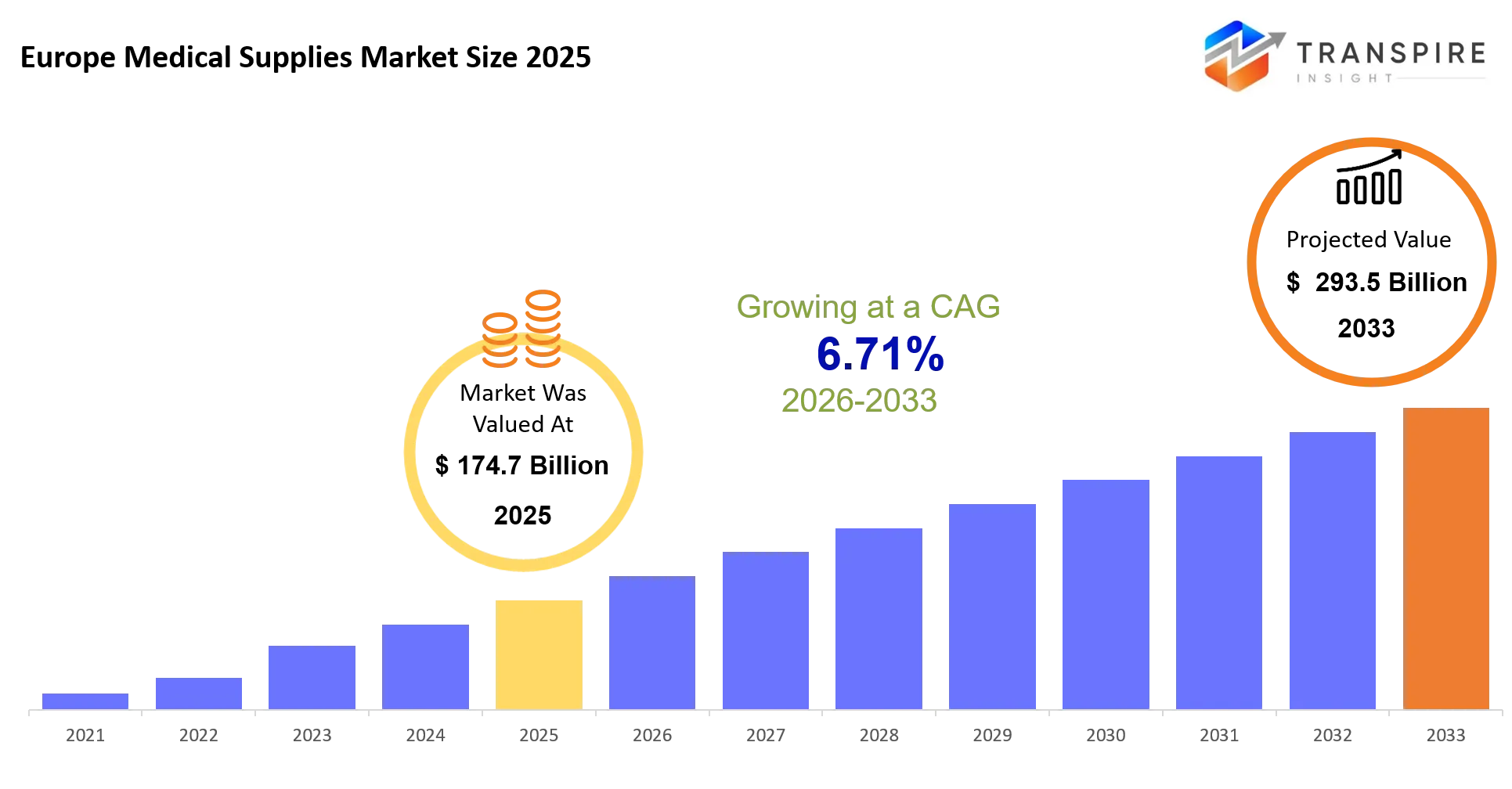
As per Transpire Insight Analysis the Europe Medical Supplies Market size is estimated at USD 174.7 Billion in 2025 and is anticipated to reach USD 293.5 Billion by 2033, growing at a CAGR of 6.71% from 2026 to 2033.
The Europe Medical Supplies Market is basically what keeps hospitals working day to day, also outpatient clinics, diagnostic laboratories, emergency services, and even home healthcare, you know, because there has to be constant availability of items like surgical consumables , wound care materials, diagnostic supplies, personal protective equipment and infection control products. When the medical supplies are steady and dependable, healthcare providers can keep patient safety in place, cut down on treatment delays and, in general, make clinical processes run smoother across all kinds of care environments.
In the last five years the market kind of flipped, not just buying stuff based on cost anymore, but leaning toward more resilient supply networks that are managed digitally. There is also more attention on local regional manufacturing, plus better inventory visibility, so everything is trackable and not a guess. The COVID-19 pandemic made it really obvious where cross border sourcing breaks down, and because of that, governments along with healthcare organizations started to diversify suppliers, while also beefing up stockpiles.
That whole change has pushed continued spending on supply chain modernization, automated inventory management systems, and higher grade medical consumables. As a result, healthcare systems are able to strengthen their operational resilience , while at the same time creating more stable revenue for manufacturers and distributors that can repeatedly satisfy changing regulatory and clinical expectations, without falling short.
Europe Medical Supplies Market Size & Forecast:
- Europe Medical Supplies Market Size 2025: USD 174.7 Billion
- Expected Market Value 2033: USD 293.5 Billion
- Forecast CAGR: 6.71%
- Leading region in 2025: Western Europe
- Fastest Growing region: Central and Eastern Europe
- Key Profile: Medtronic, Cardinal Health, Becton Dickinson, 3M, Johnson & Johnson, Baxter, B. Braun, Owens & Minor, Smith+Nephew, Henry Schein, McKesson, Thermo Fisher Scientific, Stryker, ConvaTec, Mölnlycke
Key Market Insights
- Western Europe kind of ruled the Europe medical supplies industry, with about 68% market share in 2025, mostly backed by a pretty mature healthcare setup, and also higher procurement spend.
- Central and Eastern Europe is forecast to grow the quickest during 2025–2033, you know, because healthcare modernization is moving along and EU-backed infrastructure funding keeps rolling in.
- Disposable medical supplies took the product lead with almost 44% market share in 2025, mainly because infection prevention rules are strict in healthcare facilities.
- Diagnostic and laboratory supplies were the second-biggest segment. This happened as hospitals expanded testing capability and leaned into decentralized diagnostic services after 2020.
- Home healthcare supplies are expected to show the fastest growth all the way through 2033, supported by remote patient monitoring becoming more common, and aging populations.
- As for applications, hospitals dominated with roughly 58% revenue share in 2025, which lines up with ongoing procedural volumes and centralized purchasing agreements.
- Meanwhile, home healthcare should end up as the fastest-growing application through 2025–2033, mostly pushed by chronic disease management that is happening outside the usual hospital places.
- Hospitals and clinics stayed at the top as the end-user segment, with roughly 61% market share in 2025, aided by large procurement deals , and wider specialty care.
- Home care providers are set to turn into the fastest-growing end-user group by 2033, since outpatient treatment models keep expanding all across Europe.
What are the Key Drivers, Restraints, and Opportunities in the Europe Medical Supplies Market?
Healthcare procurement policies are now, increasingly, pushing supply resilience more than just the absolute lowest cost sourcing. The COVID-19 disruption, plus revised public procurement strategies, sped up regional manufacturing investments and also the move toward digital inventory management. Hospitals tend to keep bigger safety stocks meanwhile, and they replace manual procurement with automated buying platforms. In practice this helps, it improves purchase visibility, cuts replenishment cycles down, and it can open recurring revenue for suppliers who can handle tight European regulatory and quality requirements.
Regulatory compliance is still the tightest kind of structural constraint. The Medical Device Regulation roll out means a lot of technical documentation, clinical evidence, and continuous post-market surveillance, before products even reach hospitals. Compliance expenses end up being quite high, especially for smaller manufacturers, so commercialization can get delayed by months, or sometimes longer, depending on the product category. From what Transpire Insight reviewed, meaning regional procurement announcements and launch timing, supply chain concentration stays the main execution risk. On top of that, weaker manufacturing diversification makes companies more exposed to raw material scarcities, and logistics disruptions too.
The best longer-term opportunity sits in digitally linked healthcare supply ecosystems. AI enabled inventory oversight, RFID tracing, predictive demand forecasting, plus automated hospital logistics are pulling steady investment across Western and Central Europe. In places where electronic health infrastructure is being expanded, conditions get better for integrated procurement platforms, so manufacturers that bundle digital services with dependable product availability can win larger multi year supply agreements.
What Has the Impact of Artificial Intelligence Been on the Europe Medical Supplies Market?
Artificial intelligence alongside digital technologies are, sort of, reshaping medical supply operations, mainly by helping procurement be more precise, accelerating warehouse automation, and making regulatory compliance a little less painful in practice. More recently, hospitals and distributors are leaning on AI driven inventory platforms that basically watch stock levels 24/7. They also execute replenishment choices on their own, and they notice unusual usage patterns well before shortages actually show up.Digital tracking tools, when they are tied in with RFID and IoT sensors, offer real-time visibility through distribution networks, which reduces those manual inventory mistakes and makes product traceability better.
At the same time, machine learning models seem to boost demand forecasting by fusing old purchasing records with seasonal illness signals, surgical schedule rhythms, and local healthcare utilization patterns. So, in practice, distributors can pin down warehouse space more intelligently, trim the last-minute buy expenses, and keep products more consistently on hand across various healthcare facilities. With automated planning systems, orders tend to get fulfilled faster, while the cost of holding inventory can go down too, plus it reduces expired stock that otherwise might happen.Plus, digital supply chain platforms improve compliance reporting by simplifying the paperwork that European regulatory frameworks call for.
Even with all these positives, adoption is still uneven across the regional healthcare supplies industry. Connecting with older hospital information systems takes a lot of capital investment, and it often demands specialized technical know how. Smaller healthcare providers, in many cases, don’t have consistent or standardized datasets. That situation reduces forecasting accuracy and it limits how much real operational value they get from AI-enabled procurement tools.
Key Market Trends
- Since 2021, European healthcare providers started leaning more into regional sourcing , to lessen their dependence on overseas suppliers after all those pandemic supply chain hiccups… not fully smooth.
- The EU Medical Device Regulation rolled out between 2021 and 2024 and it kinda forced everyone to tighten compliance, so manufacturers have been working to enhance product traceability, and documentation, even when it was a bit inconvenient.
- By 2025, hospitals across Germany, France, and Italy moved further into digital inventory management systems. That change helped cut procurement delays , and it made medical supply visibility much more real time, rather than “sort of later”.
- Since 2022, manufacturers have also jumped into investment about recyclable packaging and lower carbon production, because public healthcare procurement is increasingly leaning on sustainability criteria, not just cost, and honestly that does matter.
- B. Braun, Fresenius, and Mölnlycke, plus similar firms, expanded their European manufacturing capacity starting around 2023, sort of to keep delivery performance steadier, while shaving off logistics risk that can pop up, kind of out of nowhere.
- Between 2022 and 2025 demand drifted more toward single use infection prevention products, as healthcare facilities kept stricter hygiene rules even after the worst pandemic phase, and they stayed with it longer than some expected.
- After 2023, healthcare providers increasingly started relying on AI assisted demand forecasting , along with automated procurement platforms.
- This improved inventory accuracy, and it also helped avoid stockouts , and excessive supplies. Also, as outpatient care and home-based treatment expanded in 2022, procurement of portable medical consumables grew, along with wound care items, and disposable diagnostic supplies.
- Since 2024, procurement contracts are increasingly prioritizing supplier diversification. So regional manufacturers are encouraged to compete on supply security, regulatory readiness, and product quality , not only price, and not in the simple way companies were used to before.
Europe Medical Supplies Market Segmentation
By Product Type :
Diagnostic supplies do help with early disease detection and also for routine health assessments, seen across hospitals, laboratories, and outpatient settings. The growing reliance on rapid testing, molecular diagnostics, and point of care solutions keeps pushing demand for diagnostic products that are dependable, and not just “good enough”. Surgical supplies still take a big slice of the market, since basically every surgical procedure needs sterile instruments, drapes, sutures and other consumables. Disposable supplies stay essential for infection prevention and smoother patient care, in almost any healthcare environment you can name.
Wound care supplies keep gaining traction, mostly because newer dressings are made for chronic wounds, and for post surgical recovery too. Sterilization supplies support healthcare facilities to keep strict hygiene standards, while they also satisfy regulatory requirements. Infusion supplies help with medication delivery for long term therapies, emergency treatment and critical care services. Respiratory supplies are boosted by the expanding management of chronic respiratory diseases, while other specialized products adjust to changing clinical needs across different healthcare systems.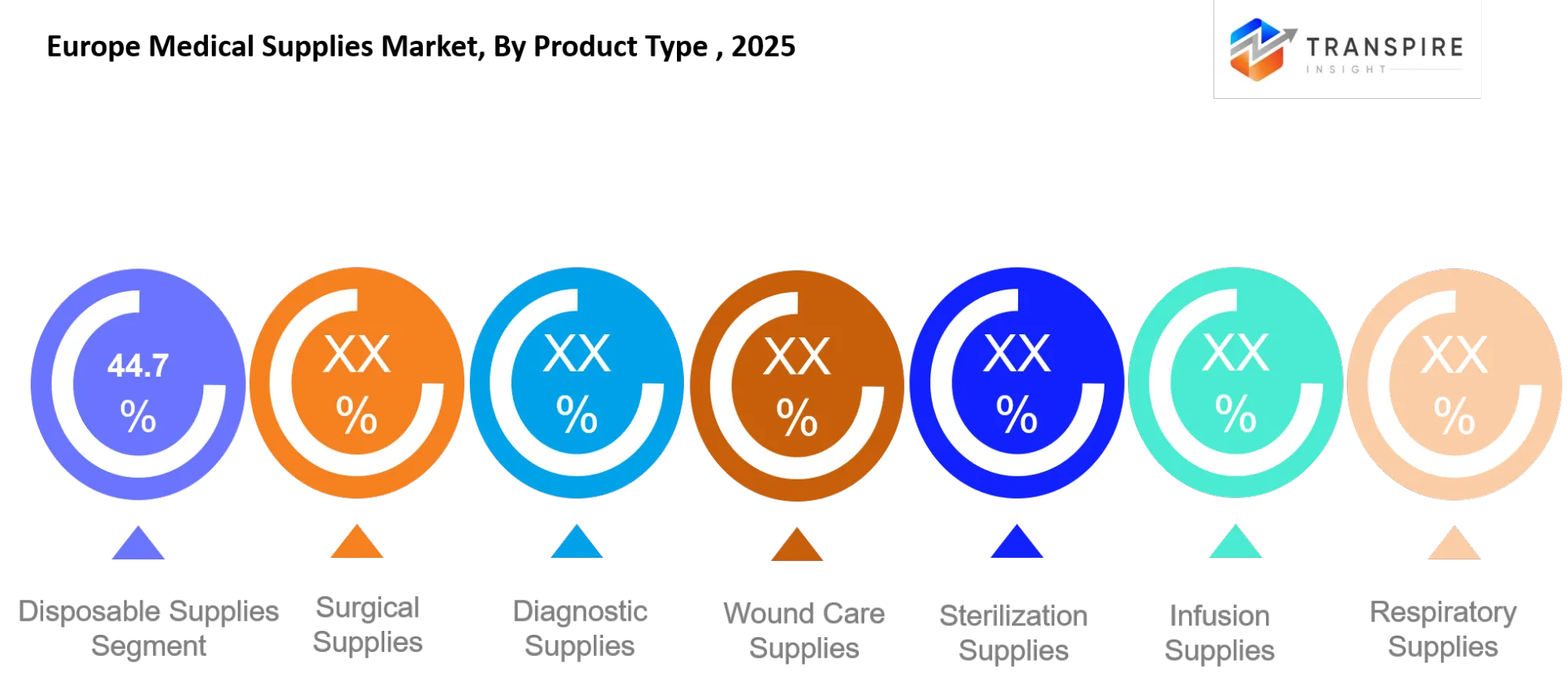
By Application :
Hospitals make up the biggest slice of the application because really complex medical procedures need continuous access to a wide set of clinical supplies. They also buy in large quantities , and with high patient admissions the purchasing keeps moving pretty steadily across the year. Clinics add a lot too, since routine checkups happen often, plus smaller interventions, and preventive care programs kind of keep the demand flowing. Diagnostic laboratories in particular lean on specialized consumables so tests stay accurate and the workflow stays consistent.
Homecare is still growing as chronic disease care shifts away from only the traditional hospital model. Ambulatory centers need nimble and efficient medical supplies to handle same-day work and those shorter patient stays. Rehabilitation centers and nursing homes lean heavily on wound care items, mobility supports, and daily medical consumables for longer term patient routines. Other healthcare settings also chip in with demand through specialized treatment programs as well as community-based healthcare services.
By End User :
Healthcare providers remain the leading end-user group because daily patient treatment depends on uninterrupted product availability. Government hospitals purchase large quantities through centralized procurement programs that focus on public healthcare delivery. Private hospitals invest in advanced medical supplies to improve treatment quality and operational efficiency. Specialty clinics require procedure-specific products that match specialized clinical services.
Research institutes purchase laboratory and testing supplies for clinical studies and medical innovation. Homecare providers continue expanding product use as long-term treatment shifts toward residential care. Emergency services depend on rapid access to trauma kits, respiratory products, and critical care supplies during urgent medical situations. Other healthcare organizations support additional demand through preventive care and specialized medical programs.
By Distribution Channel :
Direct sales still feel important for big healthcare institutions, mainly because they want tailored deals and kind of long term supplier bonds. Medical distributors keep a solid position too, largely by offering wide product portfolios, handling inventory management, and running reliable regional delivery networks that actually show up when needed. Hospital procurement departments keep leaning on centralized purchasing systems, to get steadier supply and better cost control. Group purchasing organizations then typically add more leverage by using collective procurement agreements, which is kinda the whole idea.
At the same time online sales are getting bigger, and digital procurement platforms make it easier to compare products and manage orders. Retail pharmacies also help with access to selected medical supplies, especially for outpatient cases and homecare needs. Specialty suppliers usually concentrate on niche clinical products, the kind that demands technical expertise and more customized service. And then other distribution channels fill the gaps, giving healthcare facilities extra flexibility when their purchasing requirements are specific or unusual.
By Material :
Plastic still stays as the main material, mostly because it is lightweight, long-wearing, and price friendly, so it fits a lot of disposable as well as re-usable medical uses. Metal keeps doing its job with surgical tools, orthopedic pieces, and other precision medical equipment that really needs strength ,plus a long service life. Rubber helps out with seals, tubing, gloves, and those bendy components you see in many clinic setups. Textile materials are still a big deal too, especially for gowns, drapes, masks and protective garments.
Paper based materials back up sterile packaging, medical records, and some specific disposable items across healthcare buildings. Composite materials keep moving forward into more specialized medical devices, the kind that need better durability and also less weight, at least compared to heavier alternatives. Biodegradable materials are getting more attention because healthcare teams look for waste reduction that actually feels practical without hurting how the product performs. Then, other material groups cover niche uses where you need distinctive physical or chemical traits.
What are the Key Use Cases Driving the Europe Medical Supplies Market?
Hospitals still remain the main users of medical supplies, because all those surgical procedures, emergency treatment, intensive care, and day to day patient handling really need product availability that never really stops, every single day. In practice the centralized purchasing groups buy large volumes of disposable items, surgical consumables, diagnostic materials, and infection prevention products, so clinical work can keep moving smoothly, while also complying with the tougher European healthcare quality and safety rules.
At the same time, homecare support services and diagnostic laboratories keep growing as real application spaces. Homecare operators buy infusion items, wound care materials, and respiratory supplies, to back longer term treatment outside the hospital walls, while diagnostic labs put money into testing consumables to speed up turnaround times, and to stay aligned with the accredited laboratory requirements.
New opportunities are also showing up, especially in digitally connected healthcare systems and mobile care delivery. Community health schemes, plus emergency response organizations, are rolling out smart inventory tracking, and portable medical kit solutions, which helps keep products ready when it matters most. These use cases are still kind of early, but they should gain a lot from healthcare modernization initiatives, and from broader digital procurement frameworks across Europe.
|
Report Metrics |
Details |
|
Market size value in 2025 |
USD 174.7 Billion |
|
Market size value in 2026 |
USD 186.3 Billion |
|
Revenue forecast in 2033 |
USD 293.5 Billion |
|
Growth rate |
CAGR of 6.71% from 2026 to 2033 |
|
Base year |
2025 |
|
Historical data |
2021 - 2024 |
|
Forecast period |
2026 - 2033 |
|
Report coverage |
Revenue forecast, competitive landscape, growth factors, and trends |
|
Regional scope |
Europe (Germany, United Kingdom, France, Italy, Spain and Rest of Europe) |
|
Key company profiled |
Medtronic, Cardinal Health, Becton Dickinson, 3M, Johnson & Johnson, Baxter, B. Braun, Owens & Minor, Smith+Nephew, Henry Schein, McKesson, Thermo Fisher Scientific, Stryker, ConvaTec, Mölnlycke . |
|
Customization scope |
Free report customization (country, regional & segment scope). Avail customized purchase options to meet your exact research needs. |
|
Report Segmentation |
By Product Type (Diagnostic Supplies, Surgical Supplies, Disposable Supplies, Wound Care Supplies, Sterilization Supplies, Infusion Supplies, Respiratory Supplies, Others); By Application (Hospitals, Clinics, Homecare, Ambulatory Centers, Diagnostic Laboratories, Rehabilitation Centers, Nursing Homes, Others); By End User (Healthcare Providers, Government Hospitals, Private Hospitals, Specialty Clinics, Research Institutes, Homecare Providers, Emergency Services, Others); By Distribution Channel (Direct Sales, Medical Distributors, Online Sales, Hospital Procurement, Retail Pharmacies, Group Purchasing Organizations, Specialty Suppliers, Others); By Material (Plastic, Metal, Rubber, Textiles, Paper-Based Materials, Composites, Biodegradable Materials, Others) |
Which Regions are Driving the Europe Medical Supplies Market Growth?
Western Europe basically accounts for around 68% of the regional revenue, so it is sort of the biggest slice of the market. There are strong public healthcare systems, plus strict regulatory oversight, and clear reimbursement frameworks that help keep procurement steady across hospitals and clinical networks. At the same time, you get this dense web of manufacturers, distributors, logistics providers and even research institutions, which makes products easier to find and keeps pushing new funding into advanced medical technologies. With healthcare modernization going on, replacement demand building up, and longer procurement commitments sticking around, this area should keep leading for most of the forecast period.
Northern Europe comes in next, as the second-largest regional contributor, mainly because healthcare investment tends to follow long term plans, not those fast expansion cycles. Regulatory frameworks stay stable and overall healthcare spending stays high, so the region keeps buying medical consumables, diagnostic products, and infection control supplies across public healthcare systems. There is also solid digital health adoption, and that helps procurement run more smoothly, especially for inventory management which creates pretty consistent ordering behavior for suppliers. So even if the landscape feels a bit mature, the overall setup makes Northern Europe a dependable place for recurring revenue.
Central and Eastern Europe is projected to be the fastest-growing regional market as governments keep investing in healthcare infrastructure and hospital modernization. Over time, greater access to European Union funding has sped up equipment upgrades, procurement reforms, and the expansion of regional healthcare facilities in recent years. In parallel, local manufacturing capability and distribution networks are getting better, which reduces reliance on imported medical supplies and adds a bit more supply resilience. Then, between 2026 and 2033, these structural improvements will open up attractive chances for manufacturers, distributors, and investors who want to expand into healthcare markets that are still developing.
Who are the Key Players in the Europe Medical Supplies Market and How Do They Compete?
Competition across the Europe Medical Supplies Market is still sort of moderately consolidated, like you have multinational manufacturers right there with specialized regional suppliers, and it can feel messy. In the end, product quality, regulatory compliance, distribution strength, and service reliability keep driving purchasing decisions , more often than price alone. Big established firms keep on defending their market share through manufacturing expansion , digital supply chain investment, and wider product portfolios, while smaller players usually go after niche clinical applications and try to stay extra responsive with customer support.
Medtronic tends to stand apart with technology-centric medical products, where advanced surgical and patient care solutions get tied together with clinical support services. Becton Dickinson pushes ahead by growing manufacturing capacity and putting more money into diagnostic and infection prevention technologies that have to satisfy pretty demanding healthcare standards. B. Braun leans into integrated treatment solution packages, covering infusion therapy, surgical products, and hospital services, so customers can pull multiple product categories from one place, instead of juggling vendors.
Smith+Nephew keeps expanding via innovation in advanced wound management and orthopedic care, backed by ongoing product development and clinical proof. 3M Health Care competes through specialized infection prevention offerings, sterilization technologies, and medical adhesives that are meant to boost clinical efficiency and patient safety. And then, strategic investments in manufacturing capacity, digital procurement assistance, and regional distribution networks help these companies keep the relationships steady, while also moving quickly as healthcare procurement needs start shifting around.
Company List
- Medtronic
- Cardinal Health
- Becton Dickinson
- 3M
- Johnson & Johnson
- Baxter
- B. Braun
- Owens & Minor
- Smith+Nephew
- Henry Schein
- McKesson
- Thermo Fisher Scientific
- Stryker
- ConvaTec
- Mölnlycke
Recent Development News
In March 2025, Baxter International launched the Voalte Linq device powered by Scotty assistant at HIMSS25. The voice-activated connected care technology expands hospital workflow automation and strengthens Baxter's digital healthcare portfolio, supporting more efficient communication and clinical operations.Source https://investor.baxter.com
In November 2025, Becton, Dickinson and Company (BD) launched the BD Surgiphor™ Surgical Wound Irrigation System in Europe following CE approval. The launch introduced the first CE-approved system of its kind in select European countries, strengthening infection prevention capabilities and expanding BD's surgical portfolio across European healthcare markets. Sourcehttps://investors.bd.com/
What Strategic Insights Define the Future of the Europe Medical Supplies Market?
In the next five to seven years , the Europe Medical Supplies Market seems headed toward more integrated and digitally connected supply ecosystems. where product availability , regulatory compliance, and the procurement decisions based on data matter as much as manufacturing capacity, kinda. This shift will get a nudge from healthcare modernization programs, new regional production investments and the increasing use of intelligent inventory systems across public and private healthcare channels.
But there’s also a less obvious risk underneath it all, namely that the market could stay too tied to a small set of suppliers for specialized raw materials and critical components. That kind of dependence can throw a wrench into production, even if overall demand stays steady.
Still, there’s an opportunity showing up especially in Central and Eastern Europe. there, hospital modernization plus digital purchasing platforms should build favorable conditions for smarter supply chain services and localized manufacturing. So firms that diversify their supplier footprints, put money into digital traceability, and build regional production partnerships today will likely be in a stronger spot to lock in long-term procurement contracts and keep competitive resilience through the entire forecast timeline.
Europe Medical Supplies Market Report Segmentation
By Product Type
- Diagnostic Supplies
- Surgical Supplies
- Disposable Supplies
- Wound Care Supplies
- Sterilization Supplies
- Infusion Supplies
- Respiratory Supplies
By Application
- Hospitals
- Clinics
- Homecare
- Ambulatory Centers
- Diagnostic Laboratories
- Rehabilitation Centers
- Nursing Homes
By End User
- Healthcare Providers
- Government Hospitals
- Private Hospitals
- Specialty Clinics
- Research Institutes
- Homecare Providers
- Emergency Services
By Distribution Channel
- Direct Sales
- Medical Distributors
- Online Sales
- Hospital Procurement
- Retail Pharmacies
- Group Purchasing Organizations
- Specialty Suppliers
By Material
- Plastic
- Metal
- Rubber
- Textiles
- Paper-Based Materials
- Composites
- Biodegradable Materials
Frequently Asked Questions
Find quick answers to common questions.
The Expected Europe Medical Supplies Market size for the Market will be USD 293.5 Billion in 2033.
Key Segments for the Europe Medical Supplies Market are By Product Type (Diagnostic Supplies, Surgical Supplies, Disposable Supplies, Wound Care Supplies, Sterilization Supplies, Infusion Supplies, Respiratory Supplies, Others); By Application (Hospitals, Clinics, Homecare, Ambulatory Centers, Diagnostic Laboratories, Rehabilitation Centers, Nursing Homes, Others); By End User (Healthcare Providers, Government Hospitals, Private Hospitals, Specialty Clinics, Research Institutes, Homecare Providers, Emergency Services, Others); By Distribution Channel (Direct Sales, Medical Distributors, Online Sales, Hospital Procurement, Retail Pharmacies, Group Purchasing Organizations, Specialty Suppliers, Others); By Material (Plastic, Metal, Rubber, Textiles, Paper-Based Materials, Composites, Biodegradable Materials, Others) .
Major Europe Medical Supplies Market Players are Medtronic, Cardinal Health, Becton Dickinson, 3M, Johnson & Johnson, Baxter, B. Braun, Owens & Minor, Smith+Nephew, Henry Schein, McKesson, Thermo Fisher Scientific, Stryker, ConvaTec, Mölnlycke.
The Current Europe Medical Supplies Market size is USD 174.7 Billion in 2025.
The Europe Medical Supplies Market CAGR is 6.71% from 2026 to 2033.
- Medtronic
- Cardinal Health
- Becton Dickinson
- 3M
- Johnson & Johnson
- Baxter
- B. Braun
- Owens & Minor
- Smith+Nephew
- Henry Schein
- McKesson
- Thermo Fisher Scientific
- Stryker
- ConvaTec
- Mölnlycke
About the Authors

Pankaj Ghogare Patil
I am Pankaj Ghogare Patil, a Senior Research Analyst at Transpire Insight, specializing in the Pharmaceutical, Chemicals & Materials, Healthcare IT, and Biotechnology industry. My expertise lies in conducting comprehensive market research, analyzing industry trends, evaluating competitive landscapes, and translating complex data into actionable insights. At Transpire Insight, I closely follow emerging technologies, regulatory developments, and market innovations to create accurate, well-researched, and informative content that helps businesses and professionals make informed decisions. I am committed to producing credible, evidence-based articles that reflect industry best practices while making technical topics accessible and valuable for a broad audience.

Chakradhar Khansole
Chakradhar serves as the Research Director at Transpire Insight, bringing over 8 years of experience in technology, innovation, and strategic market intelligence. He specializes in transforming complex market data into actionable business insights that enable organizations to make informed, growth-oriented decisions. Recognized for his strategic vision and analytical expertise, Chakradhar leads high-impact research initiatives, delivering comprehensive market assessments, competitive intelligence, and forward-looking industry analysis.
Recently Published Reports
-
Jul 2026
Alopecia Treatment Market
Alopecia Treatment Market Size, Share & Analysis Report By Disease Type (Alopecia Areata, Cicatricial Alopecia, Traction Alopecia, Alopecia Totalis, Androgenetic Alopecia, Alopecia Universalis, and Other Disease Types), By Treatment Type (Topical Treatments, Oral Medications, Injectable Therapies, and Hair Transplantation), By Gender (Male, and Female), By Distribution Channel (Hospitals and Clinics, Retail Pharmacies, and Online Retailers), and Geography (North America, Europe, Asia-Pacific, Middle East and Africa, South and Central America), 2021 - 2031
-
Jul 2026
Medical Ultrasound Probe Market
Medical Ultrasound Probe Market Size, Share & Analysis Report By Type (Linear Type, Convex Type, Endocavitary Probe, Phased Array/Cardiac Probe, Transesophageal (TEE) Probe, and Others), By Application (Ophthalmology, Cardiology, Musculoskeletal, Oncology, Obstetrics & Gynecology, General Imaging, and Others), By End User (Hospitals & Clinics, Diagnostic Centers, Ambulatory Surgical Centers, and Others), and Geography (North America, Europe, Asia-Pacific, Middle East and Africa, South and Central America), 2021 – 2031
-
May 2026
Biosimilars Market
Biosimilars Market By Product Type (Monoclonal Antibodies, Recombinant Hormones, Erythropoietin, G-CSF, Others), By Indication (Oncology, Autoimmune Diseases, Blood Disorders, Diabetes, Others), By Manufacturing Type (In-House Manufacturing, Contract Manufacturing), By Distribution Channel (Hospital Pharmacies, Retail Pharmacies, Online Pharmacies), By Industry Analysis, Size, Share, Growth, Trends, and Forecasts 2021-2033
-
Apr 2026
Gastrointestinal Endoscopy Market
Gastrointestinal Endoscopy Market By Type (Rigid Gastrointestinal Endoscope, Flexible Gastrointestinal Endoscopes, Disposable Gastrointestinal Endoscope), By Procedure Type (Colonoscopy, Gastroscopy, Duodenoscopy, Enteroscopy, Flexible Sigmoidoscopy, Others), By Application (Diagnosis, Treatment), By End-Users (Hospitals, Ambulatory Surgical Centers, Specialty Clinics, Laboratories, Others), By Industry Analysis, Size, Share, Growth, Trends, and Forecasts 2021-2033