

Europe Luxury Handbags Market Size & Forecast:
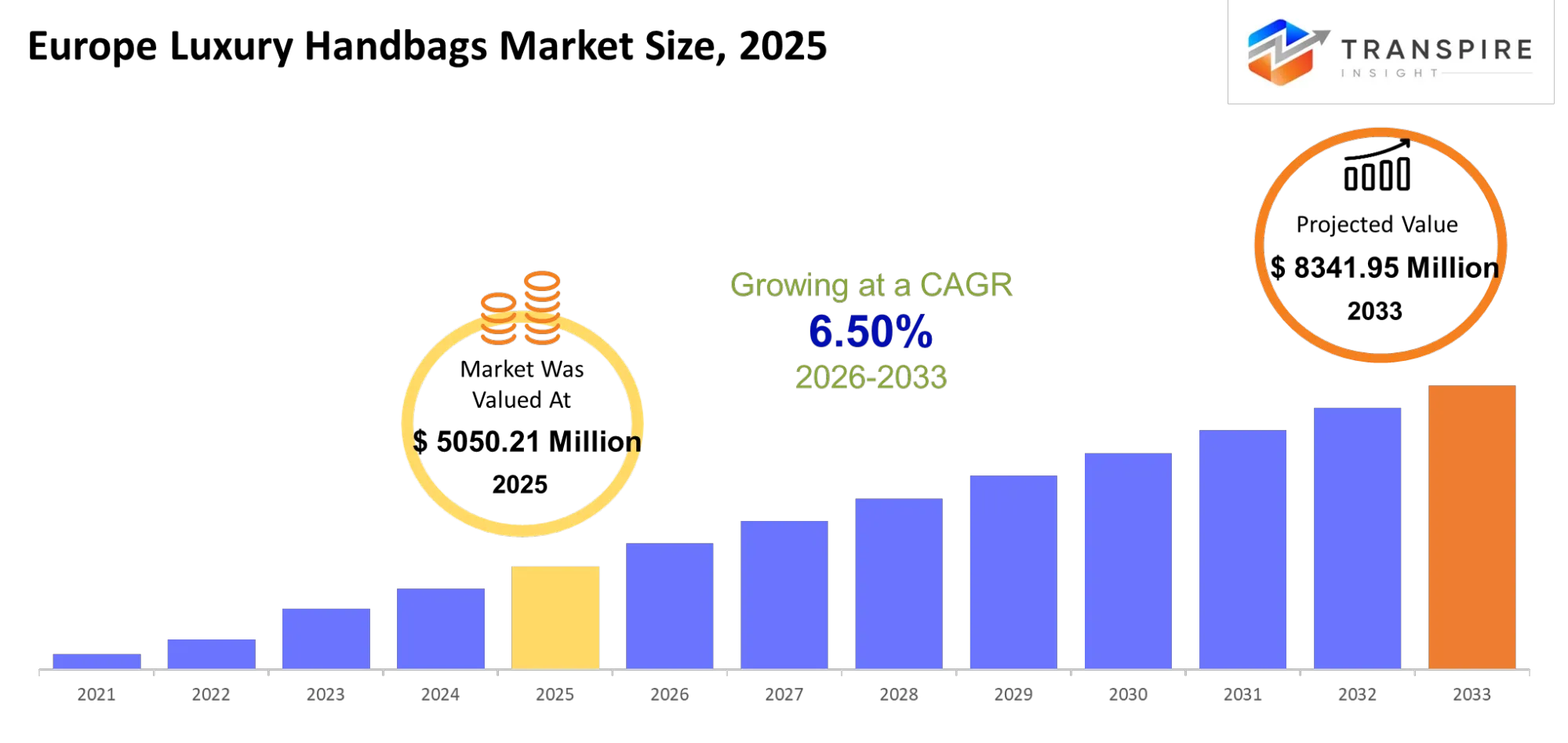
- Europe Luxury Handbags Market Size 2025: USD 5050.21 Million
- Europe Luxury Handbags Market Size 2033: USD 8341.95 Million
- Europe Luxury Handbags Market CAGR: 6.50%
- Europe Luxury Handbags Market Segments: By Type (Tote Bags, Shoulder Bags, Clutches, Satchels, Others); By Application (Daily Use, Travel, Fashion, Events, Gifting, Others); By End-User (Women, Men, Fashion Enthusiasts, High-income Consumers, Luxury Buyers, Others); By Distribution (Brand Stores, Online, Luxury Boutiques, Department Stores, Others)
To learn more about this report,  Download Free Sample Report
Europe Luxury Handbags Market Summary
The Europe Luxury Handbags Market was valued at USD 5050.21 Million in 2025. It is forecast to reach USD 8341.95 Million by 2033. That is a CAGR of 6.50% over the period.
European luxury handbags operate as status symbols while serving as permanent possessions for customers who appreciate craftsmanship and brand heritage and the ability to resell their purchases. The market system creates multiple design houses and artisanal manufacturing operations and high-margin retail stores which operate together with a developing secondary resale market.
The retail landscape underwent its most important transformation during the last three years when businesses began to use digital channels for their traditional boutique operations. Brands now use controlled e-commerce and clienteling tools to maintain exclusivity while expanding reach. The luxury industry experienced its most significant change when COVID-19 shutdowns forced companies to develop their online presence and establish new methods for inventory management.
The current combination of factors has created new business growth patterns. Digital sales through direct-to-consumer channels increase profit margins while businesses maintain their ability to charge premium prices through controlled product availability. Resale platforms work to enhance brand equity while offering first-time customers a less risky purchasing experience which helps businesses achieve consistent revenue growth.
Key Market Insights
- The Europe Luxury Handbags Market needs advanced data. Western Europe holds a dominant position in the European Luxury Handbag Market, which it controls with more than 60% market share throughout 2024, because France and Italy operate their heritage luxury houses.
- The fastest-growing area in Eastern Europe will experience more than 6% annual growth until 2030 because of its increasing wealthy population and retail business development.
- The Europe Luxury Handbags Market gets driven by tote and shoulder bags, which will achieve almost 35% market share in 2024 because people use them for multiple purposes throughout their daily activities.
- The urban mobility trends lead to crossbody bags becoming the second biggest market segment, which controls approximately 25% of the market share.
- The mini and micro handbag market will experience rapid growth because fashion trends create a demand that will push it to grow at more than 7% compound annual growth rate until 2030.
- About 85% of the market share in 2024 belongs to personal use, which shows that consumers regard luxury products as essential for demonstrating their social status.
- The secondary luxury market, which grows at over 10% per year, has created strong demand for both investment and resale purposes.
- The female consumer group leads the market, which will account for 75% of total demand in 2024.
- The luxury fashion industry introduces new products, which makes male consumers the fastest developing group because their annual growth rate reaches 6% or more.
- The top brands use their power to control product distribution channels, which enables them to set prices that create product shortages.
What are the Key Drivers, Restraints, and Opportunities in the Europe Luxury Handbags Market?
The European luxury handbag market experiences growth because customers prefer buying products through controlled direct-to-consumer channels which started when brands established their online distribution systems after 2020. Luxury brands established e-commerce systems and clienteling applications and personalized shopping experiences to compensate for their lost revenue during store closings. The new business model now delivers superior profit margins because it eliminates dependence on external retail partners and provides businesses with better inventory management which creates product scarcity and enables them to control prices. The brand uses digital channels to reach young customers in Europe and worldwide markets which generates higher revenue for each product they sell.
The primary structural obstacle occurs because the industry relies on traditional artisanal production methods which exist only in specific areas like Italy and France. The industry faces production limitations because it needs specialized workers who require extensive training to meet its high quality production standards. The company faces slow progress with its restriction because its business identity depends on the specialized production techniques that define its brand. The production process causes enterprises to experience extended waiting times because their maximum production capacity remains restricted which results in lost revenue despite strong customer demand.
The main business opportunity exists through connecting authenticated resale systems with main sales platforms to create integrated ecosystems. Blockchain technology enables digital platforms to use product passports which provide brands with complete tracking capabilities for their products throughout their ownership and condition monitoring process. Several European luxury groups are testing resale partnerships which will verify product authenticity through their existing resale initiatives. The entry-level market section will be attracted because this strategy creates new revenue streams which depend on commissions from certified pre-owned sales and extended product life cycles.
What Has the Impact of Artificial Intelligence Been on the Europe Luxury Handbags Market?
The operations of the European luxury handbag market undergo transformation through the implementation of artificial intelligence and advanced digital technologies which impact design and manufacturing and retail operations. The brands use AI-powered demand forecasting systems which help to match their production output with actual customer purchases, resulting in inventory reductions that range from 15% to 20% for some businesses. Workshop quality inspection now operates through computer vision systems which detect stitching and material defects with greater accuracy than human inspectors. The process increases product acceptance rates while decreasing expensive rework procedures.
Machine learning enables supply chain planning through its predictive capabilities. Algorithms use historical sales data and regional trend information and client behavior patterns to predict SKU-level product performance, which results in better inventory distribution between flagship stores and online platforms. AI-driven clienteling tools in retail environments use customer purchase records to suggest products that lead to higher conversion rates and larger average purchase amounts.
The operational benefits of these technologies enable organizations to achieve better margin management through their ability to decrease excess production and reduce risks associated price reductions while their implementation results in increased full-price sales. The inability to implement AI solutions with traditional craftsmanship-based production systems represents a major obstacle because of the expensive and intricate nature of AI technology integration. The current manual methods used in workshops restrict their ability to produce consistent data output which is essential for creating effective machine learning models.
Key Market Trends
- From 2020 onward, LVMH and Kering established their own e-commerce platforms which allowed them to decrease their reliance on wholesale partners while their European markets achieved higher rates of selling products at full price.
- Vestiaire Collective and other secondary resale platforms experienced growth, which resulted in pre-owned luxury transactions increasing by more than 10% each year and this trend affected customers' primary buying patterns.
- Businesses now produce products through two methods which involve creating limited drop items and producing capsule collections because these methods restrict product availability while sustaining price increases during times of economic instability.
- Between 2021 and 2024, luxury houses raised their prices by 15 to 25 percent because they used their brand value and limited product availability to counteract rising costs.
- Digital clienteling tools functioned as the main sales engine because AI-based personalization features raised customer purchase frequency and total value which customers brought to the business.
- Eastern Europe emerged as a fast-growing retail market after 2022 because people began spending more money and mono-brand boutiques started to expand.
- Sustainable sourcing practices required brands to implement traceable leather supply chains and use environmentally friendly materials to satisfy both regulatory standards and consumer demand for transparency.
- The brand expanded its partnerships with designers and celebrities to create exclusive products which sold out within several hours while these products increased brand presence on social media platforms.
- Consumers started to view iconic handbags as investment assets which would increase in value because their resale prices remained stable thus causing a surge in spending patterns that resulted from investment buying.
Europe Luxury Handbags Market Segmentation
By Type:
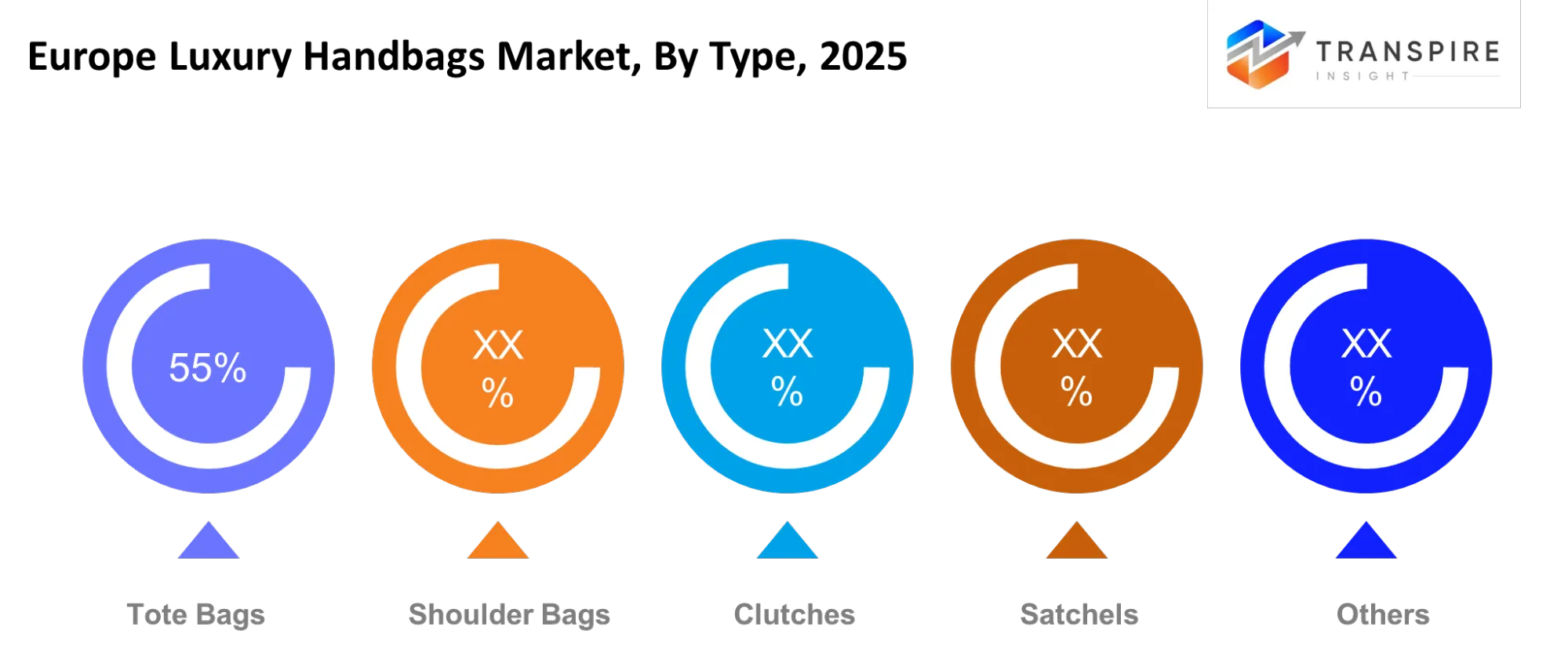
The sales distribution shows that tote bags and shoulder bags together control more than half of total sales because they offer functional benefits and bring brand recognition. Heritage houses use these two formats as their primary revenue sources because their two daily operating systems need to use these two formats. The demand for clutches and satchels exists because people need them for special events while their design needs require structured styles. The market for mini bags and niche designs which include smaller product categories continues to grow from its existing low market position.
The tote and shoulder segments experience growth because urban residents who practice hybrid work need luxurious products with functional features. Mini bags and statement bags develop popularity among younger consumers because social media platforms and limited edition product releases create a sense of urgency. Product developers will focus on creating products which combine practical needs with exclusive features throughout the forecast period to maintain their pricing authority while achieving customer loyalty.
To learn more about this report, Download Free Sample Report
By Application:
The application share distribution shows that daily use holds the most weight because people choose to buy products which offer them multiple uses and they can use for extended periods. People use travel and fashion-oriented applications as secondary options because tourism recovery and seasonal trends provide support for these use cases. The event-driven and gifting segments maintain a small market size but they experience temporary increases during holiday seasons which coincide with high-end gift giving traditions.
The daily use pattern remains strong because consumers now prefer to make fewer purchases of better quality items. The fashion industry shows strong growth through quick fashion cycles which attract customers who trust influencers. Brands will create product lines that serve various functions to meet customer needs across work, travel, and social contexts, which will enhance product value throughout its entire lifecycle.
By End-User:
The female population which constitutes more than 70 percent of fashion demand shows established patterns of fashion consumption together with the availability of diverse products. High-income consumers and luxury buyers represent core revenue contributors, driven by brand loyalty and repeat purchasing behavior. The fashion industry attracts both men and fashion enthusiasts who represent smaller groups that continue to expand because new product lines become available.
The male consumer market experiences growth through increased availability of unisex products and dedicated advertising efforts from major companies. Entry-level products serve as the first point of contact for aspirational buyers who later move to more expensive products. Future expansion will likely depend on engaging younger demographics and male buyers through tailored collections and digital storytelling, creating new demand layers beyond traditional segments.
By Distribution:
Brand stores lead distribution, accounting for nearly half of total sales due to controlled environments and premium customer experience. Online channels have gained significant share since 2020, driven by investments in direct-to-consumer platforms and personalized shopping tools. Luxury boutiques and department stores maintain their market position, although they experience reduced impact when compared to their proprietary retail outlets.
Digital technology has transformed purchasing behavior by making online research and buying the standard method for customers who purchase high-value products. Brands use integrated channels to manage inventory and maintain pricing consistency. Distribution strategies will focus on omnichannel models because physical locations enable customer experiences while online platforms enhance business growth and profitability through customer data management.
What are the Key Use Cases Driving the Europe Luxury Handbags Market?
The primary use of European luxury handbag products occurs through daily personal use because urban consumers and professionals require adaptable designs to use during work and commuting and social interactions. Customers in this product category purchase items frequently because they want accessories which can serve both their need to display social status and their daily functional requirements.
High-income consumers and international shoppers have established travel and gifting as new popular ways to use products. The recovery of tourism in France and Italy has led to an increase in premium handbag sales because these items serve as destination purchases, while luxury gifting during festive seasons continues to support seasonal sales spikes.
New market applications now include investment-driven purchasing and resale participation through verified product authentication. Consumers increasingly treat iconic handbags as appreciating assets, supported by strong secondary market performance. The digital authentication system together with brand-supported resale platforms will establish this trend as the forecast period progresses.
|
Report Metrics |
Details |
|
Market size value in 2025 |
USD 5050.21 Million |
|
Market size value in 2026 |
USD 5369.34 Million |
|
Revenue forecast in 2033 |
USD 8341.95 Million |
|
Growth rate |
CAGR of 6.50% from 2026 to 2033 |
|
Base year |
2025 |
|
Historical data |
2021 - 2024 |
|
Forecast period |
2026 - 2033 |
|
Report coverage |
Revenue forecast, competitive landscape, growth factors, and trends |
|
Regional scope |
Europe (Germany, United Kingdom, France, Italy, Spain, Rest of Europe) |
|
Key company profiled |
LVMH, Gucci, Prada, Chanel, Hermès, Burberry, Michael Kors, Coach, Dolce & Gabbana, Valentino, Fendi, Bottega Veneta, Tory Burch, Versace, Balenciaga |
|
Customization scope |
Free report customization (country, regional & segment scope). Avail customized purchase options to meet your exact research needs. |
|
Report Segmentation |
By Type (Tote Bags, Shoulder Bags, Clutches, Satchels, Others); By Application (Daily Use, Travel, Fashion, Events, Gifting, Others); By End-User (Women, Men, Fashion Enthusiasts, High-income Consumers, Luxury Buyers, Others); By Distribution (Brand Stores, Online, Luxury Boutiques, Department Stores, Others) |
Which Regions are Driving the Europe Luxury Handbags Market Growth?
The European luxury handbag market shows France and Italy as its main manufacturing centers while Western Europe maintains market leadership. Paris and Milan show their fashion industry dominance through their strong protection of intellectual property rights and their established fashion network. Retail locations which include flagship stores and high-value shopping areas create a sustained demand for products. The integrated supply chain system connects artisans with tanneries and design houses which allows the company to maintain brand identity while introducing new products.
The stable income stream from Northern European countries Germany the Netherlands and Nordic nations creates a dependable revenue foundation. This area depends on its consumers who have strong buying capacity to drive sales through established retail systems which exist because Western Europe focuses on brand superiority. Luxury products maintain stable demand because the economy shows strong resilience and there are reliable import routes. The retail industry uses shipowner-style procurement discipline which establishes structured purchasing methods that prevent unpredictable buying trends and product demand spikes.
Eastern Europe experiences its highest growth rate because disposable income increases and Polish and Romanian and Hungarian retail systems modernize. The luxury mall development market expanded after 2022 when global brands began entering the market. Demand increased because Western Europe established better trade links while more tourists visited the area. The period between 2026 and 2033 will see the region attract new businesses which want to achieve first-mover benefits in markets that remain unserved but are growing quickly.
Who are the Key Players in the Europe Luxury Handbags Market and How Do They Compete?
The luxury handbag market in Europe experiences high competition because a small group of global luxury companies and traditional fashion houses control the entire industry. Incumbents largely defend share through brand equity, controlled distribution, and pricing power rather than cost competition. The main competitive factors between businesses revolve around exclusivity and craftsmanship quality and their ability to manage retail environments. New entrants have limited ability to scale, while disruption mainly comes from resale platforms and direct-to-consumer digital channels that pressure traditional retail margins.
LVMH strengthens its position through a diversified portfolio of brands such as Louis Vuitton and Dior, supported by vertical integration across design, manufacturing, and retail. This structure enables tight supply control and consistent global pricing. Kering focuses on portfolio repositioning, with Gucci-led innovation cycles and sustainability-linked sourcing to appeal to younger luxury buyers. Hermès maintains differentiation through extreme scarcity, handcrafted production, and long waiting lists that sustain premium pricing and exceptionally high margins.
Chanel competes through strict boutique-only distribution and frequent price adjustments that reinforce exclusivity. Prada implements material research and design development while growing operational activities in select important European urban centers. Richemont uses its high-skill craft brands, including Delvaux, to appeal to customers who want exclusive premium leather products. The combination of these strategies creates a business environment where organizations gain market power through control of product availability, their ability to share brand narratives, and their ownership of sales distribution networks.
Company List
- LVMH
- Gucci
- Prada
- Chanel
- Hermès
- Burberry
- Michael Kors
- Coach
- Dolce & Gabbana
- Valentino
- Fendi
- Bottega Veneta
- Tory Burch
- Versace
- Balenciaga
Recent Development News
In April 2026, LVMH Moët Hennessy Louis Vuitton announced the acquisition of a minority stake in an emerging Italian leather goods atelier to strengthen its artisanal supply chain. The move aims to secure premium craftsmanship capabilities amid rising global demand for luxury handbags.https://www.reuters.com/
In March 2026, Kering completed the acquisition of a European luxury accessories brand to expand its handbag portfolio and reinforce its position in the high-end fashion segment. The deal aligns with Kering’s strategy to diversify beyond its flagship brands.https://www.ft.com/
What Strategic Insights Define the Future of the Europe Luxury Handbags Market?
The European luxury handbag market is transitioning toward a digital platform which creates value through limited product availability and practices which restrict production and use data for customer-specific solutions and generate revenue through product lifetime management. The next 5 to 7 years will experience growth through the combination of primary sales with authenticated resale networks which enable brands to generate revenue from multiple product ownership periods instead of only one sale. The demand for authentic luxury products together with the need for brands to safeguard their value in secondary markets drives this transformation.
The production risk emerges from French and Italian heritage ateliers which produce most goods because their limited capacity leads to future supply challenges and higher production costs. European luxury groups now have an emerging opportunity to implement digital product passports which enable them to track products and verify resale while meeting upcoming EU sustainability regulations.
Market participants should prioritize establishing unified digital identity systems which will link product information between manufacturing and retail and resale channels. Product ownership transparency will become the main value driver which determines long-term business competitiveness.
Europe Luxury Handbags Market Report Segmentation
By Type
- Tote Bags
- Shoulder Bags
- Clutches
- Satchels
- Others
By Application
- Daily Use
- Travel
- Fashion
- Events
- Gifting
- Others
By End-User
- Women
- Men
- Fashion Enthusiasts
- High-income Consumers
- Luxury Buyers
- Others
By Distribution
- Brand Stores
- Online
- Luxury Boutiques
- Department Stores
- Others
Frequently Asked Questions
Find quick answers to common questions.
The Europe Luxury Handbags Market size is USD 8341.95 Million in 2033.
Key segments for the Europe Luxury Handbags Market are By Type (Tote Bags, Shoulder Bags, Clutches, Satchels, Others); By Application (Daily Use, Travel, Fashion, Events, Gifting, Others); By End-User (Women, Men, Fashion Enthusiasts, High-income Consumers, Luxury Buyers, Others); By Distribution (Brand Stores, Online, Luxury Boutiques, Department Stores, Others).
Major Europe Luxury Handbags Market players are LVMH, Gucci, Prada, Chanel, Hermès, Burberry, Michael Kors, Coach, Dolce & Gabbana, Valentino, Fendi, Bottega Veneta, Tory Burch, Versace, Balenciaga.
The Europe Luxury Handbags Market size is USD 5050.21 Million in 2025.
The Europe Luxury Handbags Market CAGR is 6.50% from 2026 to 2033.
- LVMH
- Gucci
- Prada
- Chanel
- Hermès
- Burberry
- Michael Kors
- Coach
- Dolce & Gabbana
- Valentino
- Fendi
- Bottega Veneta
- Tory Burch
- Versace
- Balenciaga
Recently Published Reports
-
Apr 2026
Healthcare Polymer Packaging Market
Healthcare Polymer Packaging Market Size, Share & Analysis Report By Packaging Type (Syringes, IV Bottles and Pouches, Clamshells, Blisters, Bottles & Jars, Containers, Tubes, IV Parental Packaging, Others), By Type (Regulated, Non-regulated), By Polymer Type (LDPE (Low-Density Polyethylene), HDPE (High-Density Polyethylene), Homo-polymer (Homo), Random Copolymer (Random), Block Copolymer (Block), PET, Polystyrene, Polyvinyl Chloride, Polyamide/EVOH, Others), and Geography (North America, Europe, Asia-Pacific, Middle East and Africa, South and Central America), 2021 - 2031
-
Apr 2026
Hydrophilic Tape (Waterstop) Market
Hydrophilic Tape (Waterstop) Market Size, Share & Analysis Report By Type (Bentonite-Based Hydrophilic Tape, Rubber-Based Hydrophilic Tape), By Application (Residential Buildings, Commercial Buildings, Infrastructure Projects), and Geography (North America, Europe, Asia-Pacific, Middle East and Africa, South and Central America), 2021 - 2031
-
Apr 2026
Metalens Market
Metalens Market Size, Share & Analysis Report By Type (Visible Light Metalens, and Infrared Metalens), By Application (Consumer Electronics, Automotive Electronics, Industrial, Medical, and Others), and Geography (North America, Europe, Asia-Pacific, Middle East and Africa, South and Central America), 2021 - 2031
-
Apr 2026
PBT Resin Market
PBT Resin Market Size, Share & Analysis Report By Type (Reinforced PBT Resin, Unreinforced PBT Resin), By Processing Method (Injection Molding, Extrusion, Blow Molding, Others), By End-User (Automotive, Electrical & Electronics, Consumer Appliances, Industrial Machinery, Medical Devices, Packaging, Others), and Geography (North America, Europe, Asia-Pacific, Middle East and Africa, South and Central America), 2021 - 2031