
Middle East and Africa Small Satellite Market Size & Forecast:
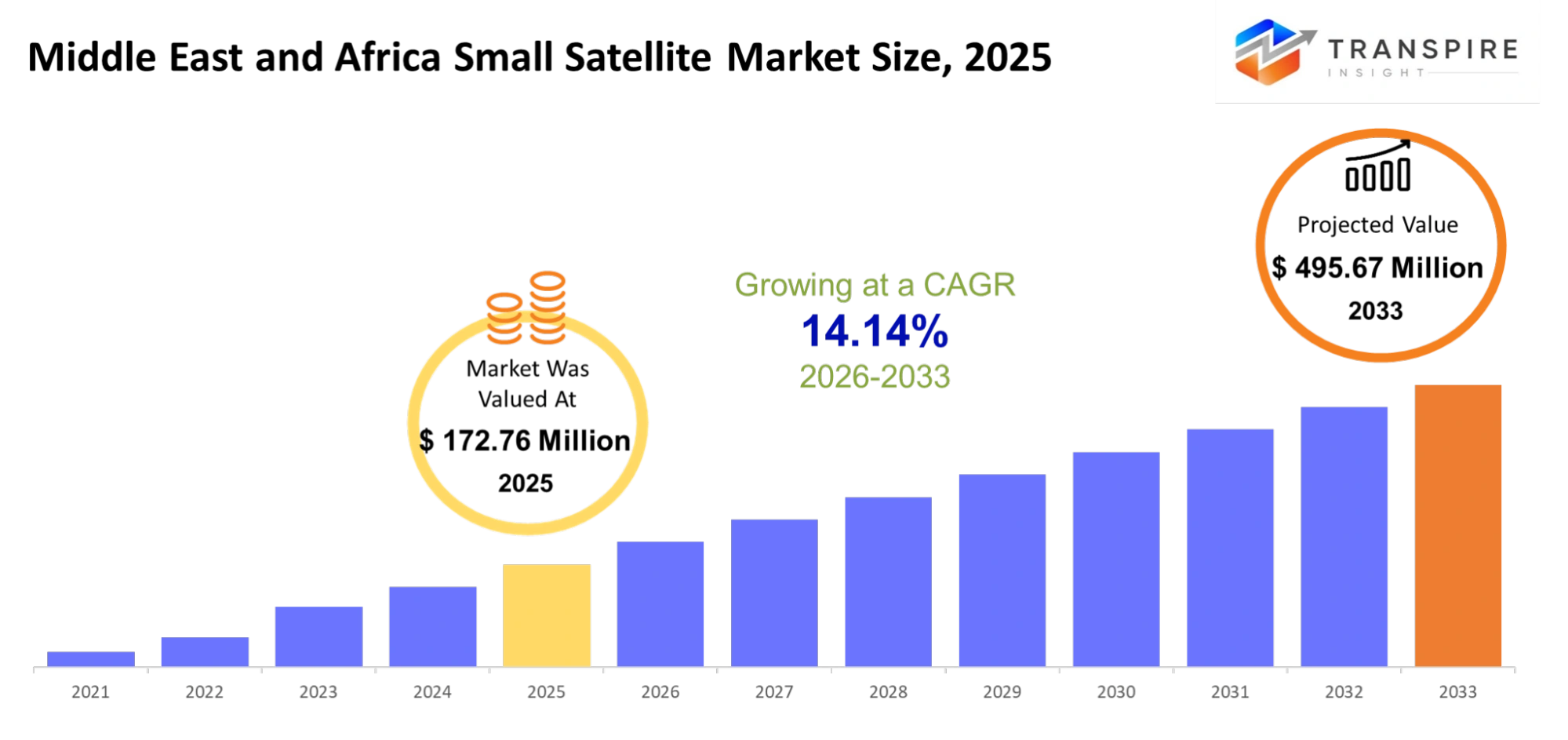
- Middle East and Africa Small Satellite Market Size 2025: USD 172.76 Million
- Middle East and Africa Small Satellite Market Size 2033: USD 495.67 Million
- Middle East and Africa Small Satellite Market CAGR: 14.14%
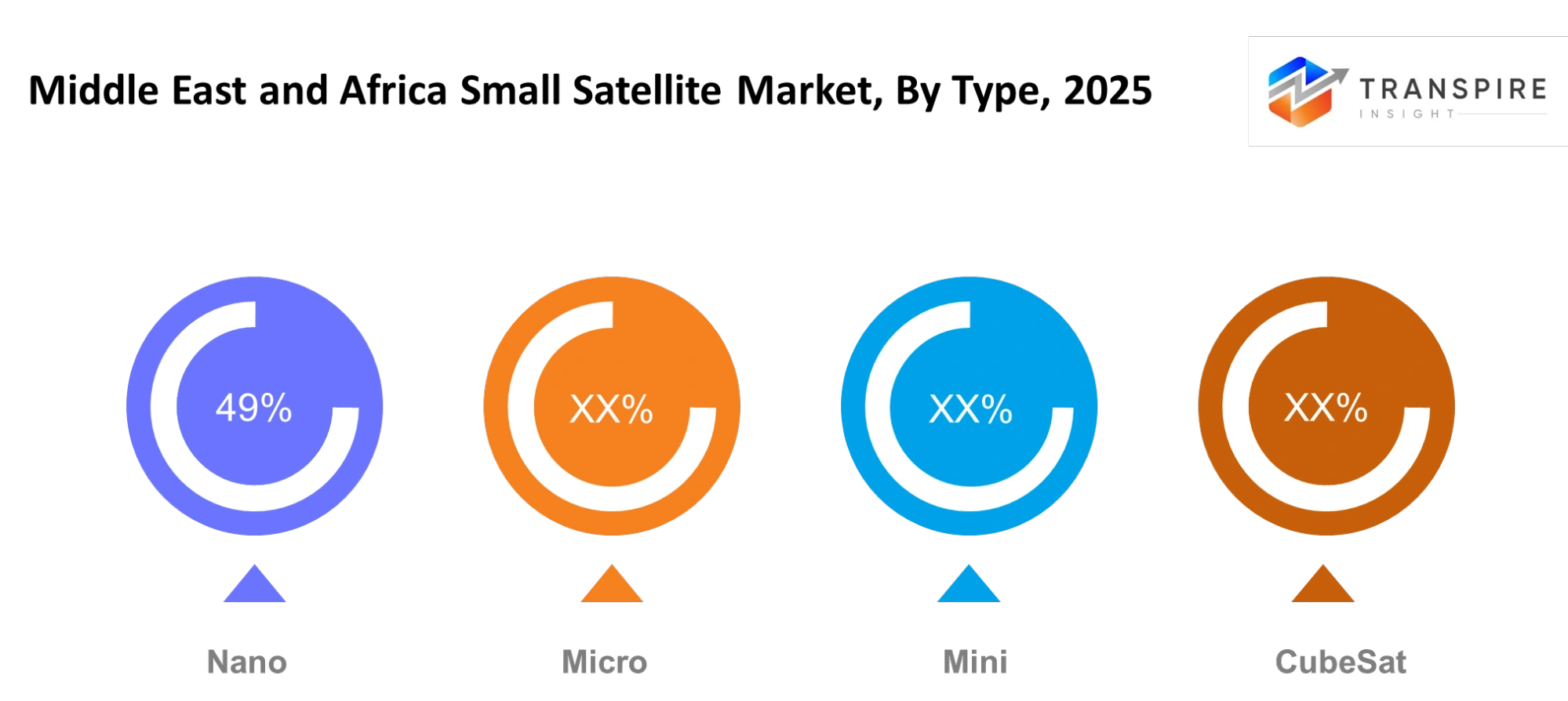
- Middle East and Africa Small Satellite Market Segments: By Type (Nano, Micro, Mini, CubeSat), By Application (Communication, Earth Observation, Navigation, Defense), By End-User (Government, Commercial, Military, Space Agencies), By Orbit (LEO, MEO, GEO)
To learn more about this report,  Download Free Sample Report
Middle East and Africa Small Satellite Market Summary:
The Middle East and Africa Small Satellite Market size is estimated at USD 172.76 Million in 2025 and is anticipated to reach USD 495.67 Million by 2033, growing at a CAGR of 14.14% from 2026 to 2033. The Middle East and Africa (Saudi Arabia, United Arab Emirates, South Africa, Rest of Middle East and Africa) small satellite market exists within the larger aerospace and space technology sector which will see compact and economical spacecraft change how regional entities handle their connectivity needs and surveillance operations and data control. Governments will create demands for space capabilities which they will control while private companies will focus on quick satellite launches and short operational deployment times. The market will experience increased demand for earth observation services which support climate monitoring and urban planning in regions that face water shortages. The regulatory frameworks will begin to allow private companies to enter the market while countries will increase their efforts to establish local satellite manufacturing capacities as they seek to decrease their reliance on imported satellite systems.
Key Market Trends & Insights:
The process of satellite design will undergo transformation through ongoing miniaturization which enables operators to use lighter payloads without losing operational effectiveness. The investment patterns in Saudi Arabia and the United Arab Emirates will shift toward satellite constellations instead of single large satellites because this approach delivers faster data refresh rates. The shift will create support for applications such as precision agriculture, border monitoring, and smart city planning which needed near real-time insights because high-cost long-cycle missions proved to be less valuable.
The trend of governments establishing control over geospatial intelligence will lead to increasing interest in localized data ownership from authorities. South Africa and emerging African space programs will place stronger emphasis on building domestic capabilities, including assembly and testing facilities. The approach will decrease dependency on outside service providers while it promotes partnerships between different regions. Universities and research institutions will take on an expanded responsibility for developing talent and creating innovation pathways.
Commercial demand will expand beyond traditional telecom applications to include mining and logistics and environmental tracking and other sectors. Remote work companies will increasingly use satellite-based internet services to manage their operational activities. Small satellites will provide a practical solution to bridge digital infrastructure gaps in Africa by delivering internet access and data services to areas without affordable terrestrial network options.
Regional companies will establish partnerships with international launch providers to develop their launch capabilities through extended investments while they develop local launch systems. The United Arab Emirates will establish itself as a space innovation center which attracts international startups and partnerships with foreign entities. Private companies will find it easier to enter the space industry for satellite deployment and downstream services because of improved regulatory clarity.
Middle East and Africa Small Satellite Market Segmentation
By Type
Nano- The market will show increased interest in nano satellites because their deployment costs remain low and their production processes enable quick satellite creation. The Middle Eastern and African regions will see universities and emerging businesses adopt this technology for their research work and brief trial initiatives. The compact design of the system enables multiple test launches which makes it ideal for evaluating sensors and communication equipment. Governments will support nano satellite projects because they enable local development of technical skills without requiring large financial investments in expensive systems.
Micro- Micro satellites provide an affordable solution for national programs because they deliver essential data at a reasonable cost. South Africa will probably use these tools to monitor the environment and respond to disasters.The extended lifespan of these satellites enables continuous data collection while they maintain mission design flexibility. The satellites function as intermediate steps which lead to the development of advanced space infrastructure.
Mini- Mini satellites will support missions which require bigger payloads and longer mission durations. The region will use these satellites for advanced imaging and communication networks and regional navigation applications. Governments that want to develop their space programs will use mini satellites to build their own capacity for independent data collection. The system can transport complex instruments which makes it useful for defense and strategic observation activities in areas with important geographic boundaries.
CubeSat- Educational institutions and private innovators will maintain their interest in CubeSats because the systems offer standard designs and reduced entry requirements. The technology demonstration platforms and international cooperation missions will see widespread usage of the technology across the Middle East and Africa region. The system's modular design enables operators to complete assembly tasks while maintaining cost-effective options for system expansion. CubeSats will evolve into operational systems that scientists will use for earth observation and communication research purposes.
To learn more about this report, Download Free Sample Report
By Application
Communication- Communication technology will have several applications, including broadband connectivity in underserved regions. The development of small satellites will facilitate broadband connectivity in rural African territories that do not possess adequate terrestrial infrastructure. Governments and telecommunication companies will incorporate satellite communication in their digital strategy, thus improving emergency communication systems and continuity in case of any network disruption or disaster.
Earth Observation- One application area of small satellites will be earth observation. There will be an increase in the use of earth observation in countries for environmental management. Countries will utilize satellite images for monitoring water sources, agricultural yields, and urbanization. Since there is a threat of climate change, countries will require real-time data for decision-making. Earth observation satellites will provide data frequently to enable governments to make decisions promptly.
Navigation- Small satellites will be used for navigation applications. Although there are global navigation systems that rely on satellites, there could be regional navigation applications based on small satellites. The implementation of satellite navigation systems will enable governments to operate their transportation networks and logistical operations and airport facilities and their respective systems in regions that lack proper infrastructure. Satellite navigation systems will support governments in their efforts to improve public safety for emergency situations and natural disaster responses.
Defense- Nations will start using defense-related applications because they need to improve surveillance and security functions. Small satellites will deliver strategic benefits through their capabilities to monitor borders and track maritime activities and gather intelligence. The system will use low-cost satellites to build operational networks that will maintain constant surveillance. The system will boost national security systems while decreasing the need for foreign intelligence, especially in areas of geopolitical tension.
By End-User
Government- Your training includes data which extends until the month of October in the year 2023. The Government departments will use small satellites to support their work in three areas. The funding will support the development of domestic space capabilities while decreasing the need for foreign satellite data. The government will promote satellite development through both local satellite development programs and domestic industry building initiatives. The approach will support the execution of national development plans which will extend to the future.
Commercial- Businesses will start using commercial equipment after they understand how satellite-derived data brings them business benefits. The agricultural sector and mining industry and logistics business will use satellite data to guide their daily work activities. Companies will use this data to create better supply chains and track their assets while increasing their operational productivity. More private enterprises will enter the market because of increasing competition which will result in companies providing local businesses with specialized solutions.
Military- The military will increasingly depend on small satellites to conduct secure communications and reconnaissance activities and execute their mission operations. The system enables real-time intelligence delivery which improves situational awareness capabilities. The mission will establish multiple satellites for its operation which will deliver mission essential backup systems. The defense forces will establish continuous monitoring which enables them to handle new threats that emerge in various landscape types.
Space Agencies- Regional space agencies will serve as the main drivers which will develop satellite programs. The organization will oversee three main tasks which include executing research activities and conducting launch operations and establishing international research partnerships. The United Arab Emirates and other countries will maintain their funding for projects which develop new technologies through international business partnerships. The agencies will develop workforce skills through their capacity-building programs which will create competent personnel needed for future space missions.
By Orbit
LEO- The Low Earth Orbit framework will establish itself as the leading deployment method because it offers both economical launch expenses and direct access to the Earth. The satellites operating within this orbit will deliver two main functions which include high-resolution imaging and low-latency communication services. LEO constellations will provide constant coverage which makes them suitable for internet services and environmental monitoring applications. Small satellite missions will continue to select this orbit as their main operational option.
MEO- Medium Earth Orbit will be used for specialized applications, particularly navigation and communication systems. The satellites that operate in this region will deliver wider coverage than LEO satellites which results in less satellites needed to achieve global or regional coverage. MEO develops extended infrastructure coverage and stable performance which makes it suitable for extended infrastructure projects and critical communication systems despite its high deployment expenses.
GEO- Geostationary Orbit will serve missions requiring constant coverage over a specific region. The technology will enable satellite deployment at reduced costs which will make smaller satellites more accessible to use in space. The satellites operating in GEO will enable broadcasting functions, weather monitoring capabilities and secure communication services. Their unchanging relationship to Earth will result in steady data transmission which government and defense organizations will find especially useful.
Regional Insights
Saudi Arabia will establish an ongoing space presence which will operate through satellite programs that serve national development objectives. The focus will shift toward using small satellites for environmental tracking, energy sector monitoring, and infrastructure planning. Local institutions will work together with global partners to develop their technical skills while government-sponsored programs will support the growth of domestic talent. The country will develop itself into a serious contender for satellite deployment operations throughout the region through this strategy.
The United Arab Emirates will maintain its role as a regional innovation center which attracts private funding and worldwide partnerships for satellite development activities. The organization will pursue its objectives through advanced research development and startup business creation and fast mission development. Small satellites will support smart city initiatives, climate observation, and digital connectivity projects. The country will become a preferred base for emerging space technology companies because its regulatory framework and supportive business environment will boost private sector participation.
South Africa will maintain a balanced approach by combining research-based programs with their actual implementation. Its satellite initiatives will focus on environmental monitoring and disaster management while improving agricultural practices. Academic institutions will drive innovation progress through their research activities which they will conduct in collaboration with other organizations throughout Africa. The collaborative model will enhance regional capabilities while enabling organizations to use satellite data for economic development purposes.
The entire Middle East and Africa region will experience different levels of progress because multiple countries are starting to develop their small satellite capabilities. Countries will focus on developing affordable solutions which will help them meet their needs for better connectivity and resource management and security protection. The region will experience increased regional cooperation which will allow countries to share their infrastructure resources and conduct joint operations. Governments will begin to investigate policies which enable private space industry growth as people learn about satellite advantages.
Recent Development News
5 April 2026, Saudi Arabia Expands Space Ambitions with “Shams” Satellite
Saudi Arabia marked a significant milestone by launching the “Shams” satellite, establishing communication shortly after deployment. This mission aligns with Vision 2030 and strengthens its participation in global programs like NASA’s Artemis initiative. The satellite will support scientific research and data collection in orbit. This development signals rising investment in national space infrastructure, with increasing allocation toward satellite-based research and international collaboration.
8 August 2025, UAE Strengthens Talent Pipeline in Satellite Engineering
The United Arab Emirates introduced a national training program focused on satellite engineering and mission design, running for 10 weeks with hands-on modules. Conducted in partnership with EDGE Group, the initiative will train Emirati professionals in advanced space technologies. This move reflects a strategic push toward self-reliance, as the country builds a skilled workforce to support future satellite missions and strengthen its long-term position in the regional space sector.
16 December 2025, Africa Advances Satellite Connectivity with Direct-to-Cell Technology
Airtel Africa partnered with SpaceX to roll out satellite-based direct-to-cell services across 14 markets starting in 2026. The system will enable messaging and data services using standard smartphones, delivering speeds up to 20 times higher than earlier solutions. This initiative targets connectivity gaps in rural areas, where traditional networks remain limited, and highlights how satellite integration is becoming essential for expanding telecom coverage across the continent.
|
Report Metrics |
Details |
|
Market size value in 2025 |
USD 172.76 Million |
|
Market size value in 2026 |
USD 196.43 Million |
|
Revenue forecast in 2033 |
USD 495.67 Million |
|
Growth rate |
CAGR of 14.14% from 2026 to 2033 |
|
Base year |
2025 |
|
Historical data |
2021 – 2024 |
|
Forecast period |
2026 – 2033 |
|
Report coverage |
Revenue forecast, competitive landscape, growth factors, and trends |
|
Country scope |
Middle East and Africa (Saudi Arabia, United Arab Emirates, South Africa, Rest of Middle East and Africa) |
|
Key company profiled |
Planet Labs, Spire Global, AAC Clyde Space, GomSpace, Surrey Satellite, Lockheed Martin, Airbus, Thales Alenia, Northrop Grumman, Sierra Space, Blue Canyon, SatRevolution, EnduroSat, NanoAvionics, Astroscale |
|
Customization scope |
Free report customization (country, regional & segment scope). Avail customized purchase options to meet your exact research needs. |
|
Report Segmentation |
By Type (Nano, Micro, Mini, CubeSat), By Application (Communication, Earth Observation, Navigation, Defense), By End-User (Government, Commercial, Military, Space Agencies), By Orbit (LEO, MEO, GEO) |
Key Middle East and Africa Small Satellite Market Company Insights
The middle east and africa (Saudi Arabia, United Arab Emirates, South Africa, Rest of Middle East and Africa) small satellite market will develop through state-supported organizations and new private companies which provide regional data solutions. Neo Space Group and Space42 will develop their geospatial and communication abilities while Orbitworks plans to manufacture 50 LEO satellites each year through its $100 million investments. Startups including SARsatX will attract funding and focus on earth observation innovation. The market will increasingly favor vertically integrated solutions which combine manufacturing processes with analytics and downstream data services.
Company List
- Planet Labs
- Spire Global
- AAC Clyde Space
- GomSpace
- Surrey Satellite
- Lockheed Martin
- Airbus
- Thales Alenia
- Northrop Grumman
- Sierra Space
- Blue Canyon
- SatRevolution
- EnduroSat
- NanoAvionics
- Astroscale
Middle East and Africa Small Satellite Market Report Segmentation
By Type
- Nano
- Micro
- Mini
- CubeSat
By Application
- Communication
- Earth Observation
- Navigation
- Defense
By End-User
- Government
- Commercial
- Military
- Space Agencies
By Orbit
- LEO
- MEO
- GEO
Frequently Asked Questions
Find quick answers to common questions.
The approximate Middle East and Africa Small Satellite Market size for the market will be USD 495.67 Million in 2033.
Key segments for the Middle East and Africa Small Satellite Market By Type (Nano, Micro, Mini, CubeSat), By Application (Communication, Earth Observation, Navigation, Defense), By End-User (Government, Commercial, Military, Space Agencies), By Orbit (LEO, MEO, GEO).
Major players in the Middle East and Africa Small Satellite Market are Planet Labs, Spire Global, AAC Clyde Space, GomSpace, Surrey Satellite, Lockheed Martin, Airbus, Thales Alenia, Northrop Grumman, Sierra Space, Blue Canyon, SatRevolution, EnduroSat, NanoAvionics, Astroscale.
The Middle East and Africa Small Satellite Market size is USD 172.76 Million in 2025.
The Middle East and Africa Small Satellite Market CAGR is 14.14%.
- Planet Labs
- Spire Global
- AAC Clyde Space
- GomSpace
- Surrey Satellite
- Lockheed Martin
- Airbus
- Thales Alenia
- Northrop Grumman
- Sierra Space
- Blue Canyon
- SatRevolution
- EnduroSat
- NanoAvionics
- Astroscale
Recently Published Reports
-
Apr 2026
Aerospace Fluoropolymers Market
Aerospace Fluoropolymers Market Size, Share & Analysis Report By Type (PTFE, FEP, PFA, ETFE, and Others), By Application (Electrical Insulation, Seals & Gaskets, Coatings, and Others), By End User (Commercial Aviation, Military Aviation, General Aviation, and Others), and Geography (North America, Europe, Asia-Pacific, Middle East and Africa, South and Central America), 2021 - 2031
-
Apr 2026
Airborne SATCOM System Market
Airborne SATCOM System Market Size, Share & Analysis Report By Type (SATCOM Terminals, Transceivers, Airborne Radio, Modems and Routers, SATCOM Radomes, and Other), By Application (Government and Defense and Commercial), and Geography (North America, Europe, Asia-Pacific, Middle East and Africa, South and Central America), 2021 – 2031
-
Apr 2026
Ship Leasing Market
Ship Leasing Market Size, Share & Analysis Report By Vessel Type (Container Ships, Bulk Carriers, Tankers, and Specialized Vessels), By Lease Duration (Short-Term Lease (Less than 1 year), Medium-Term Lease (1-5 years), and Long-Term Lease (More than 5 years)), By Lease Type (Bareboat Charter, Time Charter, Financial Lease, and Others), By End-User Industry (Oil and Gas, Manufacturing and Industrial, Automotive, Agriculture and Food, Retail and Consumer Goods, and Others), and Geography (North America, Europe, Asia-Pacific, Middle East and Africa, South and Central America), 2021 – 2031
-
Apr 2026
Thread Rolling Dies Market
Thread Rolling Dies Market Size, Share & Analysis Report By Type (Flat Thread Rolling Dies, Circular (Cylindrical) Dies, Tangential Thread Rolling Dies, Planetary Thread Rolling Dies, and Other Types), By Material Type (High-Speed Steel (HSS), Carbide, Tool Steel, Alloy Steel, and Other Specialized Alloys), By Distribution Channel (Direct Sales, Distributors and Dealers, and Online Platforms), By Application (Automotive Industry, Aerospace and Defense, Construction and Infrastructure, Industrial Machinery, Electronics and Electrical Components, Medical Devices, and Fastener Production), and Geography (North America, Europe, Asia-Pacific, Middle East and Africa, South and Central America), 2021 – 2031
Our Clients