

Europe Lab-Grown Diamonds Market Size & Forecast:
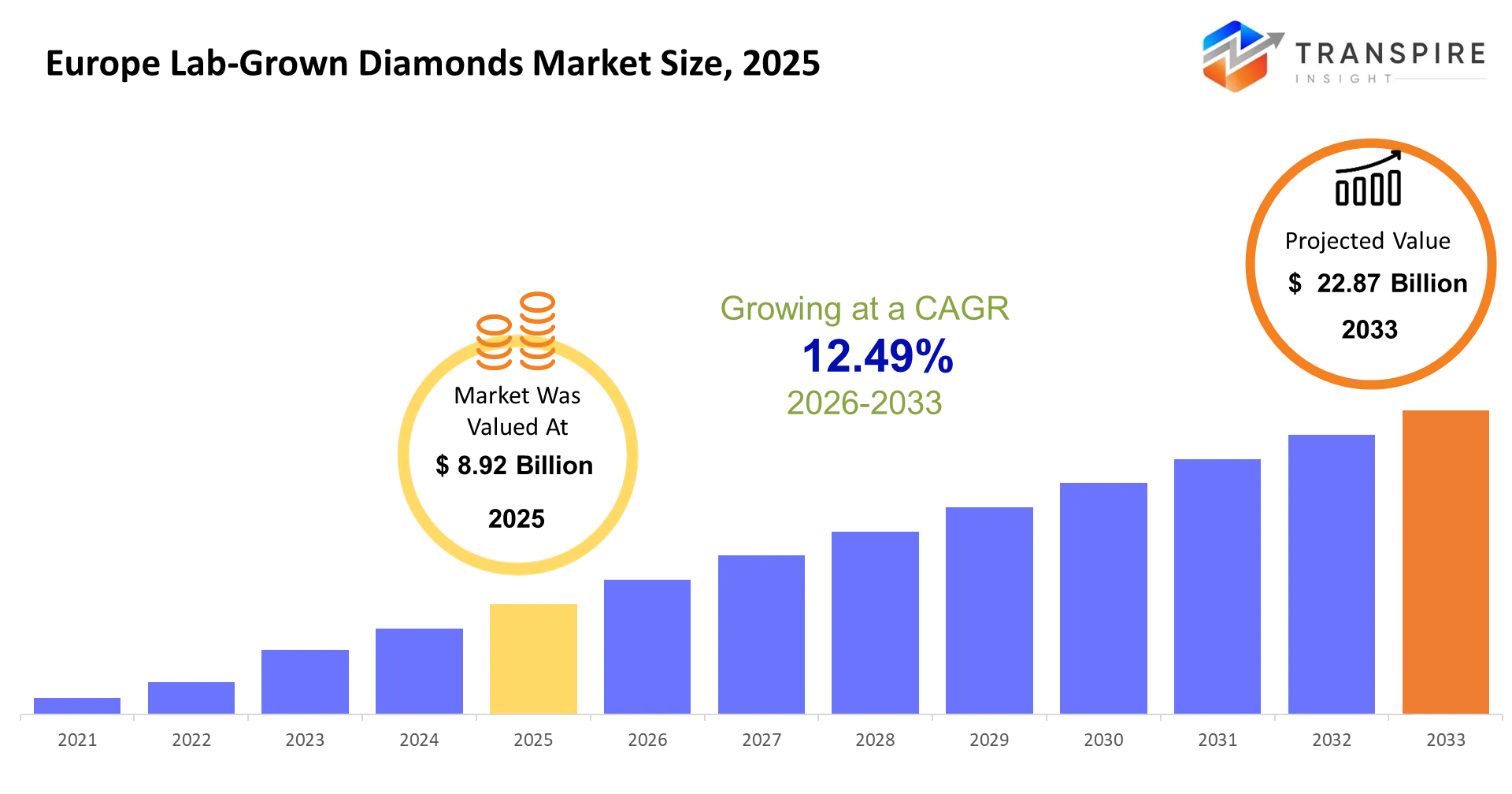
- Europe Lab-Grown Diamonds Market Size 2025: USD 8.92 Billion
- Europe Lab-Grown Diamonds Market Size 2033: USD 22.87 Billion
- Europe Lab-Grown Diamonds Market CAGR: 12.49%
- Europe Lab-Grown Diamonds Market Segments: By Type (CVD Diamonds, HPHT Diamonds, Others); By Application (Jewelry, Industrial Use, Electronics, Others); By End-User (Jewelry Manufacturers, Industrial Sector, Consumers, Others); By Distribution (Online, Retail Stores, Specialty Stores, Others)
To learn more about this report,  Download Free Sample Report
Europe Lab-Grown Diamonds Market Summary
The Europe Lab-Grown Diamonds Market was valued at USD 8.92 Billion in 2025. It is forecast to reach USD 22.87 Billion by 2033. That is a CAGR of 12.49% over the period.
The Europe Lab-Grown Diamonds Market supplies engineered gemstones and industrial-grade synthetic diamonds that replace mined stones in jewelry production and support precision cutting and thermal management and tooling applications. The market functions to enable manufacturers to create diamonds with high quality while maintaining control over their production costs and product traceability and operational performance which remains the same throughout all luxury and industrial supply chains.
During the past 3 to 5 years scientists have observed a fundamental change in manufacturing processes which now use CVD-based systems instead of HPHT-based methods which were previously dominant. The transition increased yield efficiency while decreasing per-carat expenses which then allowed mid-tier and premium jewelry segments throughout Europe to adopt the product more widely. The European Union implemented stricter sustainability reporting regulations which increased the need for materials that could be traced and had minimal environmental impact, which resulted in major retailers needing to change their sourcing methods.
European brands turned to synthetic production methods because supply chain disruptions during 2020 to 2022, which created, global supply chain problems showed how mined diamond imports made them dependent on those diamonds. The disruption forced manufacturers to establish partnerships with local suppliers of lab-grown materials while they directed their resources towards building complete production systems. The market now expands through efficiency improvements and compliance with regulations and decreased risks from supply chain disruptions instead of relying only on increased demand from luxury products.
Key Market Insights
- Western Europe will control 45% of the European Lab-Grown Diamonds Market in 2025 because of its strong luxury retail networks which exist in France and Germany and the UK.
- Eastern Europe becomes the fastest-growing area between 2024 and 2028 because of its developing manufacturing centers and its affordable production system expenses.
- CVD diamonds dominate product categories because they hold more than 60% of the market share which shows that European Lab-Grown Diamonds Market production methods now depend on scalable systems with high-purity output.
- HPHT diamonds hold second-largest share due to sustained industrial demand in cutting, polishing, and specialized engineering applications across Europe.
- Jewelry accounts for 70% of total applications because people buy engagement rings and premium fashion jewelry becomes a replacement for other products.
- The electronics industry has the fastest growth among all segments because thermal conductivity enables high-performance semiconductors and optical devices to operate better.
- Jewelry manufacturers lead end-user demand with integrated sourcing strategies that reduce supply chain costs and improve product traceability.
- The industrial sector now uses advanced technology in precision machining and aerospace tooling which creates stable demand for this technology beyond luxury markets.
- De Beers Group Element Six Pandora Diamond Foundry New Diamond Technology and Lusix are improving their market position through CVD research and retail partnerships.
- The Europe Lab-Grown Diamonds Market will grow through AI production monitoring and blockchain certification and direct-to-consumer digital retail expansion.
What are the Key Drivers, Restraints, and Opportunities in the Europe Lab-Grown Diamonds Market?
Driver:
The Europe Lab-Grown Diamonds Market experiences its most rapid growth because CVD production achieves cost efficiency through its increasing operational scale. The development of plasma reactor technology together with energy efficiency improvements after 2023 has resulted in lower production costs which now match mined diamond prices at reduced rates. The new sourcing practice has resulted in jewelry retailers from France and Germany and the Netherlands to increase their synthetic stone purchases for engagement rings and fashion jewelry in mid-range and premium jewelry markets. The manufacturers who establish complete control over their production processes and selling operations in the retail market experience measurable business growth.
Restraint:
The most persistent barrier exists because Europe operates multiple certification systems together with various methods for verifying product origins. The establishment of stricter rules has not solved the problem of laboratories and supply chain members using different grading systems which creates trust issues for buyers of expensive items. Retailers need to establish extra methods for confirming authenticity which creates a structural problem that affects sales in the luxury market because it raises expenses and extends the time needed for sales. Jewelers who operate in the upper-tier market lose potential revenue because their premium products have restricted pricing which results in lower income from the upper-tier jewelry segment.
Opportunity:
The emergence of AI-based diamond traceability platforms which use blockchain technology for certification purposes presents a major opportunity. The companies in Switzerland and Belgium test their digital provenance tracking system which documents every stage of synthetic diamond production from reactor synthesis until retail sale.The system will enable better institutional and luxury brand adoption through its ability to produce complete sourcing verification which will help European jewelry brands establish their transparent branding.
What Has the Impact of Artificial Intelligence Been on the Europe Lab-Grown Diamonds Market?
The maritime and industrial supply chains of Europe use artificial intelligence and advanced digital systems for their scrubber performance systems and exhaust gas cleaning technology which supports synthetic diamond production inputs and logistics operations. The operators utilize AI-driven control systems to automate scrubber monitoring operations which include water flow adjustments and chemical dosing and pressure level control for emission compliance purposes that require minimal human involvement. Digital twins together with sensor fusion platforms enable continuous equipment health monitoring which enhances operational stability in manufacturing facilities that operate at high energy levels and support CVD diamond production.
Machine learning models are used to predict when machines will fail by detecting early warning signs of failure in pumps and electrodes and filtration units before their actual breakdowns happen. The advanced installations of these systems have successfully achieved a 15 to 25 percent reduction in unplanned downtime while they also enhance energy efficiency through better load balancing. Emissions forecasting tools enable operators to meet European environmental regulations which are becoming stricter by predicting output changes that occur with different production levels thereby resulting in better compliance results.
Artificial intelligence adoption at this ecosystem must overcome a fundamental challenge which prevents its success. Model accuracy decreases when training data remains fragmented across different manufacturers and equipment suppliers because systems must operate in multiple facility setups and different equipment conditions which limits their testing capacity. The organization faces challenges with implementing its complete integration plan because it has identified multiple efficiency advantages.
Key Market Trends
- Since 2023 CVD diamond production has increased its market share to above 60% because European manufacturers chose to enhance production capacity while achieving better quality control instead of using traditional HPHT methods.
- The industry has reduced its use of HPHT methods because production costs became too high and energy expenses turned out to be excessively high for businesses.
- After 2024 young consumers began to purchase lab-grown engagement rings because they wanted ethical diamond sources that cost 30 to 70 percent less than mined diamonds.
- The industrial diamond market has reached a stable point because new applications for precision tools and semiconductor heat management systems have developed while demand for luxury products from mining operations has decreased.
- Since 2025 electronic-grade synthetic diamonds have become more popular because their thermal conductivity improvements today enable high-performance component applications.
- The online diamond market experienced rapid growth after 2023 because customers preferred transparent pricing methods that allowed them to avoid showing physical products in conventional luxury retail spaces.
- The European regulatory system achieved better enforcement in 2025 because it required all markets to disclose CVD and HPHT origin information which helped build consumer trust.
- The period between 2024 and 2026 saw price decreases because China and India created excessive supply levels which compelled European retailers to transform lab-grown diamonds into products that people used for their personal lives instead of their financial investments.
Europe Lab-Grown Diamonds Market Segmentation
By Type:
Diamond production in Europe synthetic diamond supply chain shows uneven growth for CVD diamonds because manufacturers prefer the technology which allows them to scale production while controlling purity standards. HPHT diamonds maintain a strong position in legacy supply networks due to established industrial infrastructure and lower initial production costs. Other emerging methods remain niche because they lack consistent certification standards and face limited commercial adoption.
CVD technology gains momentum from its ability to produce high-clarity stones suitable for jewelry applications which aligns with rising demand for premium lab-grown diamonds in Western European retail channels. HPHT continues to support price-sensitive segments where cost efficiency matters more than optical perfection. The different production methods used by companies create a market divide which separates organizations that focus on innovation from those that seek cost-effective solutions.
The forecast period will result in CVD gaining market strength through enhanced certification frameworks which establish better system transparency across Europe. Hybrid supply chains that serve both industrial and lower-tier jewelry needs will continue to use HPHT technology. Producers who develop CVD systems with scalable operational capacity and consumer traceability methods will achieve better control over product pricing as they meet increasing consumer demands for transparency.
By Application:
Lab-grown diamonds find their primary usage in jewelry because consumers want affordable luxury products. Industrial applications maintain their constant demand because synthetic diamonds provide cutting and grinding and heat resistance capabilities. Electronics and other applications remain limited because semiconductor and niche optical systems have not widely adopted these technologies.
The growth of the jewelry segment happens because consumers increasingly choose ethically sourced gemstones which have prices that remain stable in comparison to mined diamonds. The industrial sector maintains its active demand through its requirements for advanced manufacturing and tooling and precision machining operations. Electronics applications are expected to expand gradually with improvements in thermal conductivity use cases which will shape future diversification strategies for producers and technology developers.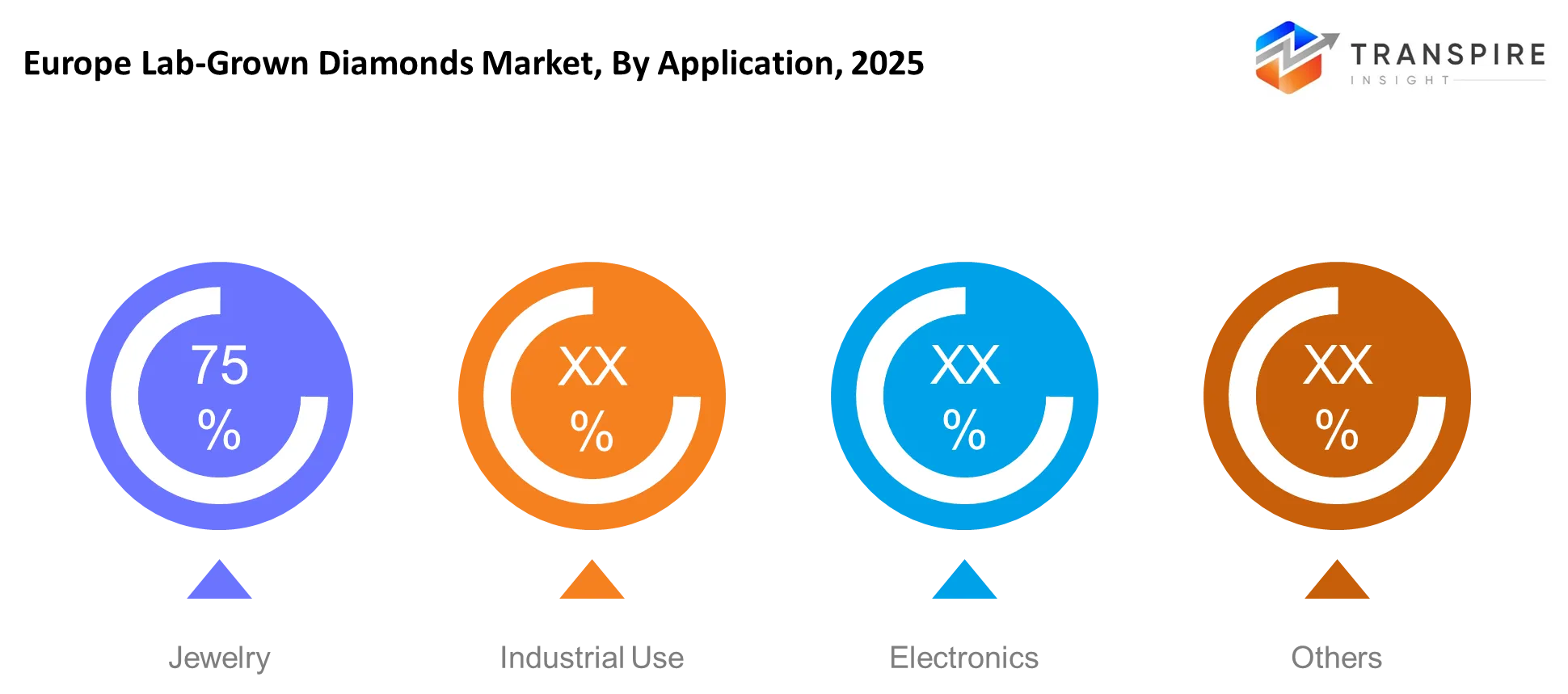
To learn more about this report, Download Free Sample Report
By End-User:
The jewelry manufacturers which produce diamonds represent the primary group which uses diamonds because they require large quantities of diamonds to create rings and ornaments. The industrial sector requires cutting tools and abrasives and precision equipment which results in substantial demand from end users who work in this field. Direct consumer purchases are increasing but remain smaller in scale. The research and specialty applications of other end-users create only minimal demand.
Your business expansion requires vertical integration combined with your increasing retail partnerships to support your jewelry manufacturing operations. The industrial sector shows steady demand because engineering processes require synthetic materials that can withstand extreme conditions. Consumers will begin using products because they can access them through online platforms and brand-driven marketing methods while specialized scientific and optical solutions will help specific user groups.
By Distribution:
Retail stores hold a significant share due to established jewelry showroom networks and customer trust in physical inspection. The growth of online distribution channels occurs because e-commerce markets have expanded and customers now see product prices. Specialty stores maintain a focused presence for premium and customized offerings. The various distribution methods which exist currently now bring only minimal business value to the market.
Online channels are gaining momentum due to digital purchasing behavior and comparative pricing advantages. People continue to trust retail stores because they need to assess high-value items through physical examination. Specialty distribution is expected to grow in premium customization demand, while alternative channels may decline as consolidation increases across the distribution landscape.
What are the Key Use Cases Driving the Europe Lab-Grown Diamonds Market?
The primary application of lab-grown diamonds in Europe exists within bridal and engagement jewelry because consumers prefer affordable luxury products that use ethically sourced gemstones. Couples increasingly choose lab-grown stones because they offer larger carat sizes at lower price points without compromising perceived quality. The strong retail promotion which mainstream jewelry chains practice has established lab-grown diamonds as standard engagement ring options throughout Western Europe.
The fashion and everyday luxury jewelry markets show growth through new use cases which benefit mid-market retail and fast-fashion accessories businesses. Brands who want to reach younger urban markets use lab-grown diamonds for their earrings pendants and stackable rings because these products encourage more frequent customer purchases. Boutique designers who create custom jewelry collections are developing industrial jewelry customization services which use synthetic stones for their made-to-order products.
The emerging use cases of corporate gifting programs and personalized commemorative jewelry exist with digital customization platforms. Some luxury retailers are testing subscription-based jewelry services which permit customers to redesign their jewelry with lab-grown stones. The current applications show early development but they demonstrate upcoming changes which will bring synthetic diamonds into experiential and service-led retail environments.
|
Report Metrics |
Details |
|
Market size value in 2025 |
USD 8.92 Billion |
|
Market size value in 2026 |
USD 10.034 Billion |
|
Revenue forecast in 2033 |
USD 22.87 Billion |
|
Growth rate |
CAGR of 12.49% from 2026 to 2033 |
|
Base year |
2025 |
|
Historical data |
2021 - 2024 |
|
Forecast period |
2026 - 2033 |
|
Report coverage |
Revenue forecast, competitive landscape, growth factors, and trends |
|
Regional scope |
Europe (Germany, United Kingdom, France, Italy, Spain, Rest of Europe) |
|
Key company profiled |
De Beers, Diamond Foundry, WD Lab Grown Diamonds, ALTR Created Diamonds, Clean Origin, Ada Diamonds, Brilliant Earth, Swarovski, Pandora, New Diamond Technology, IIa Technologies, Lusix, Scio Diamond, Pure Grown Diamonds, James Allen |
|
Customization scope |
Free report customization (country, regional & segment scope). Avail customized purchase options to meet your exact research needs. |
|
Report Segmentation |
By Type (CVD Diamonds, HPHT Diamonds, Others); By Application (Jewelry, Industrial Use, Electronics, Others); By End-User (Jewelry Manufacturers, Industrial Sector, Consumers, Others); By Distribution (Online, Retail Stores, Specialty Stores, Others) |
Which Regions are Driving the Europe Lab-Grown Diamonds Market Growth?
The diamond market for lab-grown diamonds in Europe sees its main growth from Western Europe because the region possesses strong luxury retail infrastructure while customers have already accepted sustainable alternatives to mined diamonds. The UK and France and Germany use their extensive jewelry distribution systems together with their developed online shopping capabilities to their advantage. Consumers gain more trust through gemstone disclosure requirements which help both bridal and fashion markets to grow. The branding power combined with retail distribution in this ecosystem creates a system that enables companies to maintain their leadership position in that market.
Southern Europe functions as a stable yet functionally different market since its growth depends on people who love fine jewelry instead of new product development. The family-owned jewelry industry in Italy and Spain maintains constant demand by focusing on craftsmanship and building lasting supplier relationships. The region grows at a slower pace because its markets depend on replacing natural diamonds through traditional jewelry sales instead of following Western Europe's retail development pace. The region maintains a stable economic system which enables it to handle temporary demand changes while generating steady income for international suppliers.
Eastern Europe has become the fastest-growing area because people spend more money and digital shopping lets them discover international luxury fashion trends. The recent upgrades to cross-border e-commerce systems and the increased supply of certified lab-grown diamonds have led to important decreases in access restrictions. Young adults in Poland and Czech Republic and Romania show demand for both affordable luxury products and ethically sourced goods.This momentum suggests strong entry opportunities for new brands and vertically integrated suppliers looking to scale before market preferences fully mature between 2026 and 2033.
Who are the Key Players in the Europe Lab-Grown Diamonds Market and How Do They Compete?
The Europe lab-grown diamonds market continues to exist as a fragmented market because brand positioning and supply chain control now determine competition more than production capacity. The traditional luxury market leaders have ceased to sell synthetic products directly to customers, while new companies and jewelry manufacturers have established vertically integrated business models to meet market demand. Current market conditions still require price sensitivity from customers, but European buyers who focus on sustainability will choose products based on certification authenticity and design-based branding and traceable sourcing narratives.
Pandora has built its strategy around accessible luxury, using widespread retail channels and uniform product design to establish lab-grown diamonds as standard jewelry components in mid-market products. The company achieves its competitive edge through full control of its brand and pricing across all European outlets, which enables it to offer lower prices without diminishing customers' perceived product value. Swarovski Created Diamonds targets high-income customers in the synthetic market by using its history of producing precise crystal products to defend its premium price point, and the company expands its business through flagship store openings in major European markets. Element Six exists as a De Beers Group subsidiary that moved away from consumer jewelry after shutting down Lightbox, and that now develops high-performance synthetic diamonds through its industrial diamond production facilities. Diamond Foundry develops its technological edge through industrial CVD production at its Spanish manufacturing site, and the company gains competitive strength by delivering high-quality diamonds to luxury clients who need complete control of their supply chain.
Company List
- De Beers
- Diamond Foundry
- WD Lab Grown Diamonds
- ALTR Created Diamonds
- Clean Origin
- Ada Diamonds
- Brilliant Earth
- Swarovski
- Pandora
- New Diamond Technology
- IIa Technologies
- Lusix
- Scio Diamond
- Pure Grown Diamonds
- James Allen
Recent Development News
In May 2025, De Beers Group announced intention to close its Lightbox lab-grown diamond jewellery brand. The decision reflects a strategic pivot back to natural diamonds and includes discussions to divest remaining inventory and assets as part of the wind-down process, signaling retreat from consumer-facing synthetic diamonds in Europe-linked luxury supply chains.https://www.jewellerybusiness.com
What Strategic Insights Define the Future of the Europe Lab-Grown Diamonds Market?
The Europe lab-grown diamond market will move from its current early expansion phase toward an eventual maturity period which will rely on consolidation activities during the next five to seven years because consumers start to prefer sustainable products and online luxury shops adopt synthetic diamonds for their mid-range jewelry lines. The market will grow through brand trust and product traceability together with customers finding value between price and product performance. The less obvious danger comes from government regulations which require stricter control over environmental protection and "ethical luxury" declarations because different certification processes will lead to public image damage and legal problems for manufacturers who experience market growth. A new business opportunity exists for blockchain-based tracking systems which offer customized jewelry production that will gain traction in digital retail spaces throughout Northern and Eastern European markets. Market participants need to establish complete supply-chain visibility through their vertical integration processes while obtaining certification through independent partners because this approach will help them maintain profit margins during the upcoming period of product standardization.
Europe Lab-Grown Diamonds Market Report Segmentation
By Type
- CVD Diamonds
- HPHT Diamonds
- Others
By Application
- Jewelry
- Industrial Use
- Electronics
- Others
By End-User
- Jewelry Manufacturers
- Industrial Sector
- Consumers
- Others
By Distribution
- Online
- Retail Stores
- Specialty Stores
- Others
Frequently Asked Questions
Find quick answers to common questions.
The Europe Lab-Grown Diamonds Market size is USD 22.87 Billion in 2033.
Key Segments for the Europe Lab-Grown Diamonds Market are By Type (CVD Diamonds, HPHT Diamonds, Others); By Application (Jewelry, Industrial Use, Electronics, Others); By End-User (Jewelry Manufacturers, Industrial Sector, Consumers, Others); By Distribution (Online, Retail Stores, Specialty Stores, Others).
Major Europe Lab-Grown Diamonds Market Players are De Beers, Diamond Foundry, WD Lab Grown Diamonds, ALTR Created Diamonds, Clean Origin, Ada Diamonds, Brilliant Earth, Swarovski, Pandora, New Diamond Technology, IIa Technologies, Lusix, Scio Diamond, Pure Grown Diamonds, James Allen.
The current Europe Lab-Grown Diamonds Market size is USD 8.92 Billion in 2025.
The Europe Lab-Grown Diamonds Market CAGR is 12.49% from 2026 to 2033.
- De Beers
- Diamond Foundry
- WD Lab Grown Diamonds
- ALTR Created Diamonds
- Clean Origin
- Ada Diamonds
- Brilliant Earth
- Swarovski
- Pandora
- New Diamond Technology
- IIa Technologies
- Lusix
- Scio Diamond
- Pure Grown Diamonds
- James Allen
Recently Published Reports
-
Apr 2026
Bottled Water Market
Bottled Water Market Size, Share & Analysis Report By Product Type (Still Bottled Water, Carbonated Bottled Water, Functional Bottled Water, and Others), By Packaging (PET, Cans, and Others), By Sales Channel (Supermarkets/Hypermarkets, Convenience Stores/Drug Stores, Grocery Stores/Club Stores, Foodservice, and Others) and Geography (North America, Europe, Asia-Pacific, Middle East and Africa, South and Central America), 2021 - 2032
-
Apr 2026
Color Cosmetic Packaging Market
Color Cosmetic Packaging Market Size, Share & Analysis Report By Application (Mascara Packaging, Liquid Packaging, and Liquid Face), By Type (Tubes & Bottles, Pens & Markers, Compacts & Containers, and Droppers & Pumps), and Geography (North America, Europe, Asia-Pacific, Middle East and Africa, South and Central America), 2021 - 2031
-
Apr 2026
External Microphone For Camera Market
External Microphone For Camera Market Size, Share & Analysis Report By Type (Shotgun Microphone, Lavalier Microphone, and Others), By Application (Digital Camera, Professional Video Camera, and Others), and Geography (North America, Europe, Asia-Pacific, Middle East and Africa, South and Central America), 2021 - 2031
-
Apr 2026
Foot Orthotic Insoles Market
Foot Orthotic Insoles Market Size, Share & Analysis Report By Type (Pre-fabricated, and Custom-made), By Material (Thermoplastic, Composite Carbon Fiber, and Others), By Distribution Channel (Drug Stores, Hospitals & Clinics, and Others), and Geography (North America, Europe, Asia-Pacific, Middle East and Africa, South and Central America), 2021 - 2031