
Asia Pacific Early Production Facility Market Size & Forecast:
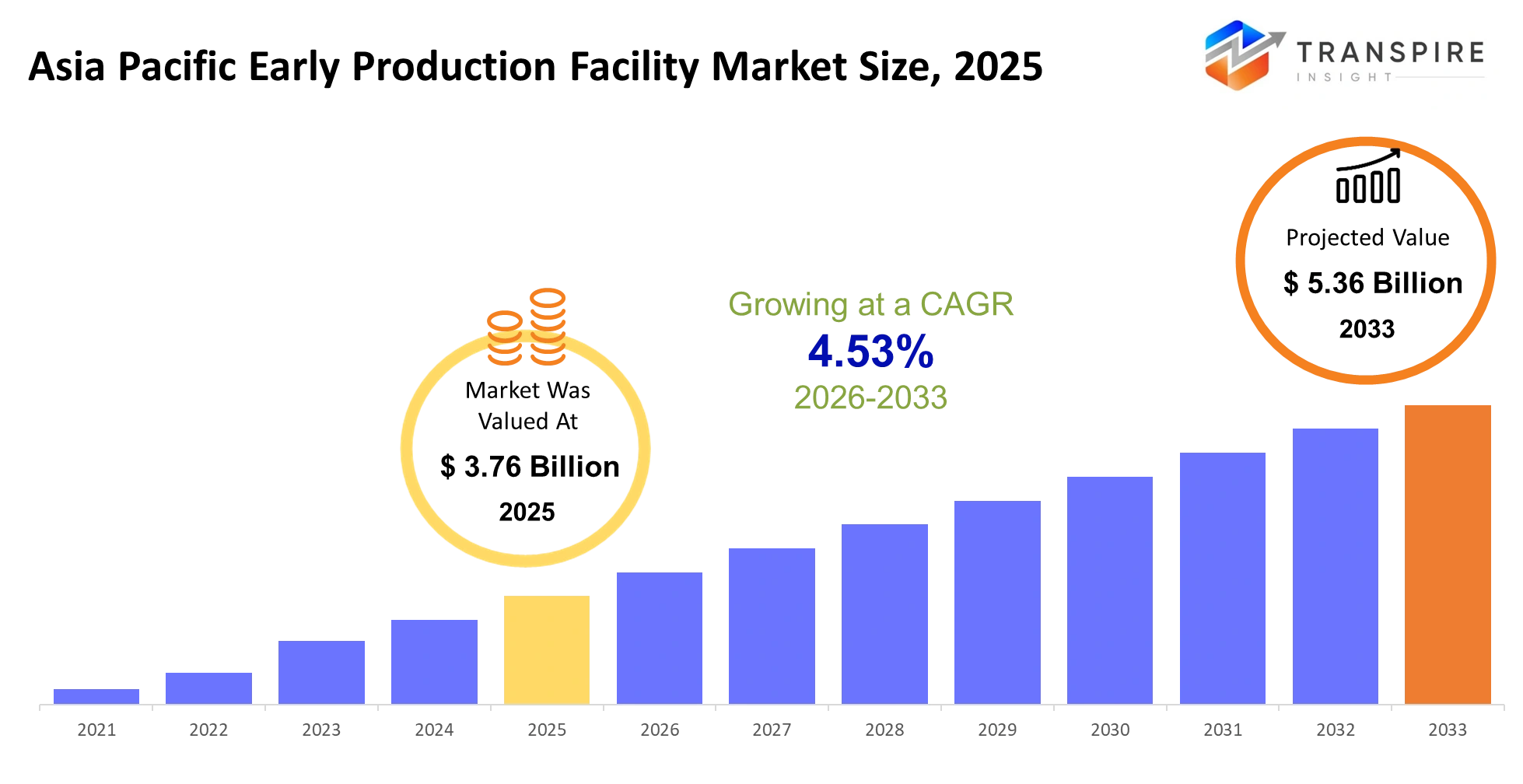
- Asia Pacific Early Production Facility Market Size 2025: USD 3.76 Billion
- Asia Pacific Early Production Facility Market Size 2033: USD 5.36 Billion
- Asia Pacific Early Production Facility Market CAGR: 4.53%
- Asia Pacific Early Production Facility Market Segments: By Type (Onshore EPF, Offshore EPF, Modular EPF, Others); By Application (Oil Extraction, Gas Processing, Field Development, Production Testing, Others); By End-User (Oil & Gas Companies, Energy Firms, Operators, Government, Others); By Component (Separation Units, Storage Units, Processing Units, Others).
To learn more about this report,  Download Free Sample Report
Asia Pacific Early Production Facility Market Summary
The Asia Pacific Early Production Facility Market was valued at USD 3.76 Billion in 2025. It is forecast to reach USD 5.36 Billion by 2033. That is a CAGR of 4.53% over the period.
The Asia Pacific early production facility market provides offshore oil and gas operators with an efficient solution to establish their hydrocarbon production operations before their permanent facilities establish full production capabilities. The modular systems enable companies to test reservoir performance while they achieve cash flow and decrease their uncertainty about developing their entire field operations. The region requires early production facilities because offshore projects demand large capital investments which need extensive time for project approval.
The operators have shifted their market focus toward modular floating production solutions which companies can redeploy because the industry needs to minimize its development risks. The transition gained momentum because the pandemic caused project delays and supply chain issues which forced companies to evaluate their fixed capital investments. The global fuel supply volatility has led governments to develop domestic energy security plans which now require offshore output expansion to occur at a faster rate. The combination of these factors has created an increased need for flexible production systems which generates new revenue streams for engineering contractors and vessel operators and technology providers throughout the area.
Key Market Insights
- The Southeast Asian region controls 38% of the market share in the Asia Pacific Early Production Facility Market which will be active until 2025 because of ongoing offshore redevelopment work.
- The offshore gas monetization activities together with the extensive investments in subsea development projects make Australia the second largest operational market in the region.
- The Indian market will experience its fastest growth until 2032 because of ongoing deepwater exploration efforts and the country's planned expansion of offshore energy production facilities.
- Government-backed energy security initiatives continue accelerating Asia Pacific Early Production Facility Market growth trends across emerging offshore basins.
- The market for Floating Early Production Systems will reach 46% in 2025 because operators prefer to use these systems for quick deployment and offshore asset redeployment.
- The second biggest industry size contribution comes from modular topside processing units because they provide flexible integration capabilities for existing offshore brownfield projects.
- The lease-operated early production facilities establish themselves as the industry sector with the highest growth rate which will continue until 2030 because they require smaller financial investments.
- The Asia Pacific Early Production Facility Market forecast shows strong adoption of compact separation technologies for offshore operational efficiency.
- Offshore oil field appraisal dominates the market with a share of almost 42 percent because of the need for extensive pre-full-field production testing.
- National oil companies account for more than 48 percent of Asia Pacific Early Production Facility Market revenue because they expand their offshore operations through large-scale projects.
What are the Key Drivers, Restraints, and Opportunities in the Asia Pacific Early Production Facility Market?
The Asia Pacific Early Production Facility market reaches its highest growth level because regional oil and gas operators have spent years maintaining capital discipline, which now creates demand for quicker monetization of offshore assets. Operators adopted phased field development strategies after the pandemic caused project delays and global energy supply disruptions to show them the financial dangers of extended development timelines. The industry experienced this transformation because companies faced both increasing offshore development expenses and demands to enhance their project return timelines. Companies can use early production facilities to start generating income before they build permanent infrastructure, which allows them to boost their cash flow while minimizing their financial risks. The company has experienced direct contract increases for modular floating production systems, which has led to faster system implementation in both marginal and deepwater operational areas.
The most significant structural barrier is the high technical complexity involved in integrating early production systems with diverse offshore reservoir conditions.Each project requires custom engineering, regulatory approvals, and compatibility with existing subsea infrastructure. The challenge requires a prolonged solution period because it needs special engineering skills together with extended production times and insufficient local supply chain resources. The result creates operational difficulties for operators who need to wait which results in later project starts, increased project expenses, and lost revenue prospects.
The Southeast Asian offshore basins present an opportunity for significant business expansion through the deployment of redeployable floating early production systems. The governments of Malaysia and Indonesia support the development of their minor abandoned oil fields. The combination of modular processing technology advancements and rising investments in leased floating production assets enables operators to access previously uneconomical reserves through a new commercially viable method.
What Has the Impact of Artificial Intelligence Been on the Asia Pacific Early Production Facility Market?
The management of early production facilities throughout Asia Pacific offshore operations undergoes transformation because artificial intelligence together with advanced digital technologies enhances their automation capabilities and equipment reliability together with processing efficiency. The operators of modular processing units are utilizing AI-driven control platforms to achieve automated control of separator pressure balancing systems and gas compression operations and real-time production optimization processes. The systems use continuous sensor data processing to maintain flow control and output stability through automatic adjustments which prevent unexpected operational disruptions.
The development of predictive maintenance functions receives support from machine learning models which improve their predictive maintenance capabilities. The systems use vibration pattern analysis together with temperature change detection and corrosion assessment and equipment stress measurement to predict equipment failure risks up to three weeks before actual breakdowns happen. Offshore operators who use digital twin technology and predictive analytics platforms have reported maintenance costs dropping between 10 and 18 percent while their operational uptime increased by more than 12 percent. AI-based production forecasting tools help reservoir performance optimization because they predict pressure decline and give operational recommendations which lead to better recovery rates.
Operators use advanced analytics to monitor emissions while optimizing energy efficiency on floating production assets which enables them to enhance their fuel efficiency and achieve better compliance with regulatory requirements. The application of real-time optimization during stable production cycles leads to energy savings between 5 and 8 percent.
The adoption process faces obstacles because of expensive system integration requirements and the restricted availability of offshore connection options. The existing regional platforms, which are becoming outdated, lack essential digital systems that are necessary for their continuous data transmission needs. The historical operating data exists in fragmented form, which decreases model accuracy when testing complex offshore conditions.
Key Market Trends
- The Southeast Asian offshore appraisal sector shifted more than 35 percent of its new projects to modular floating production solutions which emerged after 2022.
- SBM Offshore and BW Offshore developed their redeployable fleet systems because they realized that pandemic project delays created risks which required expensive investment to develop.
- The period from 2021 until 2025 showed increased adoption of lease-and-operate contracting models as independent operators preferred this method to avoid making large initial infrastructure investments.
- The energy supply disruptions during 2022 forced regional regulators to speed up their offshore approval processes which enabled governments to produce domestic hydrocarbons at a quicker pace.
- Since 2023, operators have reported that digital twin technology has reduced their commissioning timelines by almost 15 percent through remote performance simulation usage.
- Standardized modular processing packages have become the preferred choice for buyers since 2024, which results in lower engineering customization expenses while enhancing deployment options for marginal fields.
- The competitive environment changed when Modec and Yinson formed more regional alliances, which enabled them to win extended offshore redevelopment contracts.
- The project pipeline for early production deployment in Southeast Asia now focuses on mature basin redevelopment, which has become the dominant approach since 2023. AI-powered predictive maintenance systems began to operate across offshore production fleets after 2024, which resulted in better equipment availability and fewer required offshore repairs.
- The implementation of supply chain strategies has shifted towards regional sources since 2022, as local fabrication alliances enable businesses to decrease delivery times for offshore modules by up to 20 percent.
Asia Pacific Early Production Facility Market Segmentation
By Type :
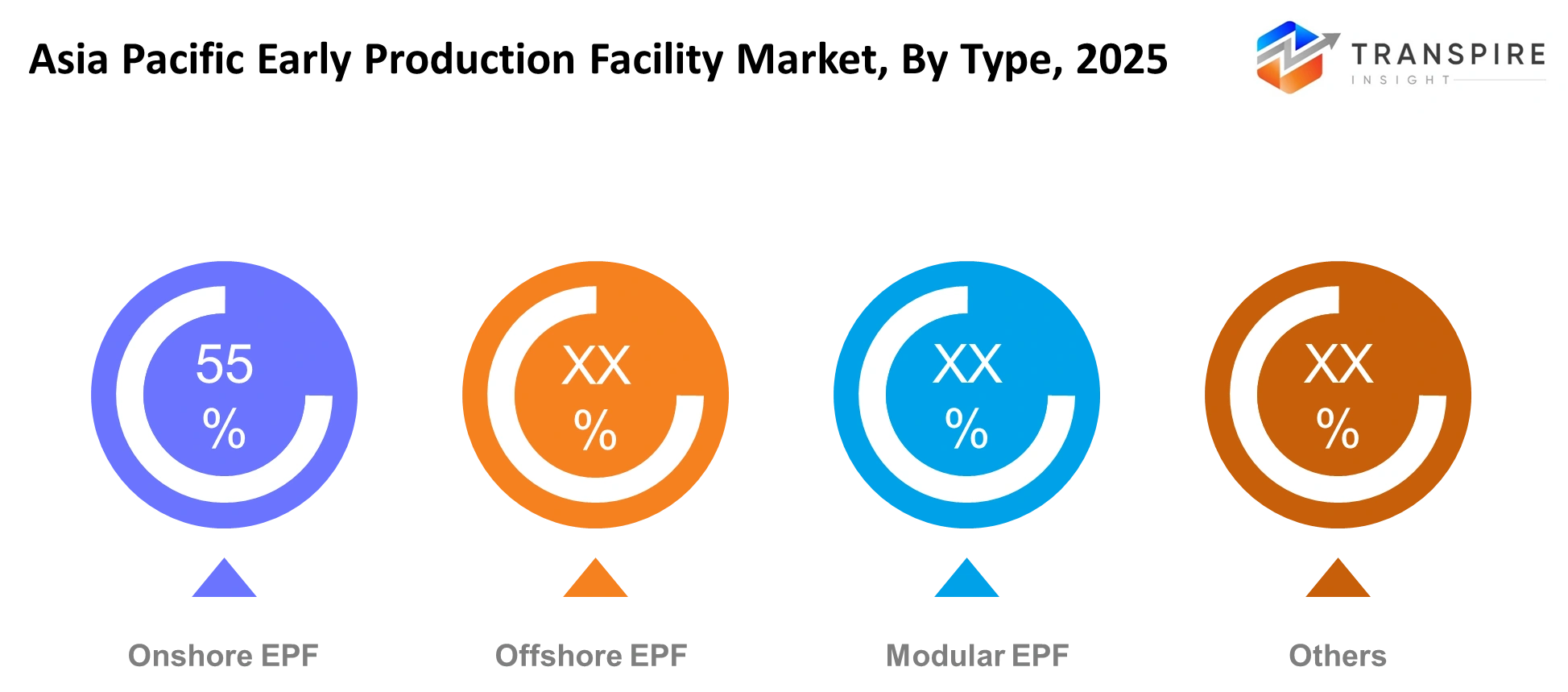
The use of onshore early production facilities enables companies to establish operations in close proximity to oil and gas fields through rapid setup. The systems enable production to proceed at faster rates because they create less complicated transportation requirements. The inland reserves which have pipeline access experience high demand from customers. The early production activities maintain continuous output because operational control becomes simpler and maintenance tasks become easier to execute.
The offshore EPF system operates in marine fields which require higher safety standards for sea-based production. The modular EPF system allows for flexible installation at different locations because it can be easily moved between sites. The system includes hybrid setups which operate according to specific field requirements. These types help improve efficiency in both remote and complex production environments.
To learn more about this report, Download Free Sample Report
By Application :
The oil extraction application system specializes in the initial phase of crude oil extraction from newly discovered oil fields. The EPF systems stabilize production rates while efficiently separating fluids until the complete development process begins. The current stage enables better reservoir assessment which leads to more effective output scheduling. Active energy exploration in areas with increasing power demands maintains strong demand for resources in these regions.
Gas processing involves removing impurities and preparing gas for transport and use. The field development applications enable the establishment of infrastructure which leads to consistent production operations. Production testing helps evaluate performance before large investment decisions. Other applications include support functions across different energy operations, which ensure smoother transition from exploration to full production.
By End-User :
Oil and gas companies remain the main users of EPF systems due to large-scale exploration and production activities. Through early production facilities these companies achieve faster operational startup times while increasing their production capacity from oilfields. Upstream operations receive strong funding which creates constant need for processing systems that can operate efficiently at different locations. Energy Firms, Operators, Government, Others:
Energy firms and operators use EPFs to manage production efficiency and optimize resource output. Government involvement focuses on creating national energy security programs and managing resource-related projects. Other end-users include contractors and service providers supporting field operations. The groups use EPF systems to manage production operations while enhancing resource efficiency during field development.
By Component :
Separation units play a key role in dividing oil, gas, and water from raw production streams. The process enables cleaner production to achieve better effectiveness in following processing activities. The units operate as vital components within early production facilities because they separate well fluids into distinct elements which enables constant production and operational problem reduction.
Storage units hold extracted oil and gas temporarily before transport or further processing. The processing units convert resources into safe products which can be handled and utilized. The components work together to maintain continuous operation of EPF systems. Their efficiency directly impacts production stability, helping maintain smooth flow from extraction to final output stages.
What are the Key Use Cases Driving the Asia Pacific Early Production Facility Market?
The primary application of the Asia Pacific Early Production Facility market operates through offshore evaluations which start hydrocarbon extraction from underdeveloped oil and gas reserves. Operators use these systems to test reservoir function and obtain initial revenue before they build permanent production systems which makes this system their main operational requirement.
National oil companies and mid-sized exploration companies are creating new use cases for redeveloping existing offshore facilities and supporting subsea connections. The operators use modular floating processing systems to extend field life while they continue to extract from existing oil reserves and their base production stays active until major system updates are completed.
The industry is developing new applications which will handle gas production from small offshore fields and provide short-term operational support for offshore carbon capture projects. The applications will become commercially valuable throughout the forecast period because Southeast Asian regulators promote resource development at lower costs and environmentally friendly offshore operations.
|
Report Metrics |
Details |
|
Market size value in 2025 |
USD 3.76 Billion |
|
Market size value in 2026 |
USD 3.93 Billion |
|
Revenue forecast in 2033 |
USD 5.36 Billion |
|
Growth rate |
CAGR of 4.53% from 2026 to 2033 |
|
Base year |
2025 |
|
Historical data |
2021 - 2024 |
|
Forecast period |
2026 - 2033 |
|
Report coverage |
Revenue forecast, competitive landscape, growth factors, and trends |
|
Regional scope |
Asia Pacific (China, India, Japan, South Korea, Australia, Rest of Asia Pacific) |
|
Key company profiled |
Schlumberger, Halliburton, Baker Hughes, TechnipFMC, Saipem, Wood Group, Petrofac, Aker Solutions, NOV, Fluor, McDermott, Worley, Technip Energies, KBR, SNC Lavalin. |
|
Customization scope |
Free report customization (country, regional & segment scope). Avail customized purchase options to meet your exact research needs. |
|
Report Segmentation |
By Type (Onshore EPF, Offshore EPF, Modular EPF, Others); By Application (Oil Extraction, Gas Processing, Field Development, Production Testing, Others); By End-User (Oil & Gas Companies, Energy Firms, Operators, Government, Others); By Component (Separation Units, Storage Units, Processing Units, Others). |
Which Regions are Driving the Asia Pacific Early Production Facility Market Growth?
The Asia Pacific Early Production Facility market exists as the most important market for the Asia Pacific region because Southeast Asia operates as its most important market which depends on mature offshore oil and gas assets and enabling upstream investment regulations and existing offshore fabrication facilities. The governments of Malaysia and Indonesia and Vietnam work to achieve quicker financial returns from their offshore discoveries through their implementation of phased development methods. The regional governments have simplified the licensing process which enables operators to establish temporary production systems for redeveloping their marginal fields. The organization has established its leadership position through a complete network of offshore engineering companies and maritime operators and subsea service businesses and fabrication facilities which enable fast operational start-up and continuous functioning.
Australia stands as the second most significant regional market for the area yet its market operations show major differences when compared to Southeast Asia. The company develops its business through extensive offshore gas projects which have strong financial backing from operators who intend to invest for prolonged periods. The combination of stable regulatory frameworks together with consistent environmental assessment methods enables project developers to create reliable operational schedules. Australia has become a stable income market for high-specification modular production systems which perform best in complex offshore gas operations.
The new offshore exploration policies and deepwater block development investments have made India into the fastest-growing regional market. The government has implemented initiatives to boost domestic hydrocarbon output which resulted in quicker transitions from appraisal to production. The eastern and western coasts now possess better deployment options for modular floating systems because of increased offshore infrastructure development. The market entry period from 2026 until 2033 presents strong investment opportunities because operators will require flexible production systems to extract their new offshore reserves.
Who are the Key Players in the Asia Pacific Early Production Facility Market and How Do They Compete?
The Asia Pacific Early Production Facility market shows competitive dynamics that are mostly controlled by a few specialized offshore production contractors who handle major projects while regional engineering firms pursue smaller modular integration contracts. Businesses compete in the market through their ability to execute technical work and their capacity to move equipment and their skills to complete offshore projects within shorter timeframes than their competitors need. Existing companies in the market protect their existing market position through investments in fleet modernization and digital optimization projects while new market players focus on specialized markets that involve leased modular production systems and brownfield redevelopment assistance.
SBM Offshore competes through engineering sophistication and deep expertise in floating production system integration. The company achieves its competitive edge through its advanced digital asset monitoring platforms which boost uptime while decreasing operating costs for offshore businesses. The company continues expanding through long-term operator partnerships across Southeast Asia, positioning itself strongly in technically demanding deepwater developments. BW Offshore differentiates itself through its ability to convert FPSO systems into reusable products which permit operators to lower their initial investment costs by using their current production facilities to create new field production capabilities.
Modec specializes in developing high-reliability floating production systems which meet the needs of offshore gas-intensive operations especially during times when uninterrupted service is essential. The company benefits from its successful execution of projects throughout Asia which gives it a competitive edge in that region. Yinson uses lease-and-operate service models to expand its business because those models attract independent offshore developers who want flexible production costs. Technip Energies enhances its market position through its development of modular process systems and its complete engineering solutions which simplify the implementation of marginal field projects.
Company List
- Schlumberger
- Halliburton
- Baker Hughes
- TechnipFMC
- Saipem
- Wood Group
- Petrofac
- Aker Solutions
- NOV
- Fluor
- McDermott
- Worley
- Technip Energies
- KBR
- SNC Lavalin
Recent Development News
In March 2026, SBM Offshore was awarded FEED contracts for the Longtail offshore development project. The engineering award supports front-end design for future floating production infrastructure and strengthens technology deployment pathways that influence early production facility project execution across Asia Pacific offshore developments.
Source: https://www.sbmoffshore.com/
"In March 2026, Eni announced final investment decisions for the South Hub and North Hub developments offshore Indonesia. The investment supports deepwater production infrastructure development which includes new subsea systems and FPSO deployment to enhance early-stage field monetization while meeting Asia Pacific early production facility requirements.
Source: https://www.eni.com/
What Strategic Insights Define the Future of the Asia Pacific Early Production Facility Market?
The Asia Pacific Early Production Facility market will experience structural changes during the next five to seven years because flexible service-based deployment models together with redeployable floating production assets and digitally integrated modular processing systems will become the new standard for operations. The offshore operators now use phased development strategies which require less capital because they want to minimize upfront costs while they increase their revenue from smaller reserves which have uncertain technical specifications. The market will transition from companies owning assets to lease-and-operate systems which use performance-based contracts to drive operational success.
The industry faces a hidden danger because market concentration is increasing toward a small group of specialized engineering contractors and fabrication yards. The rise of project complexity will lead to operators losing their power to negotiate because they will become dependent on one or two technical solution providers who control pricing and delivery times. India’s eastern offshore basin now presents an opportunity for business development because the government has introduced new policies and the region has built offshore deepwater facilities which enable modular production systems to operate in the area.
Market participants should direct their investment resources toward developing production modules which meet standardization requirements and operate through digital technology for use across different operational sites. The new system will increase asset usage while reducing the time needed to establish operations, which will enable operators to handle their upcoming offshore discoveries that reach commercial status.
Asia Pacific Early Production Facility Market Report Segmentation
By Type
- Onshore EPF
- Offshore EPF
- Modular EPF
By Application
- Oil Extraction
- Gas Processing
- Field Development
- Production Testing
By End-User
- Oil & Gas Companies
- Energy Firms
- Operators
- Government
By Component
- Separation Units
- Storage Units
- Processing Units
Frequently Asked Questions
Find quick answers to common questions.
The Asia Pacific Early Production Facility Market size is USD 5.36 Billion in 2033.
Key segments for the Asia Pacific Early Production Facility Market are By Type (Onshore EPF, Offshore EPF, Modular EPF, Others); By Application (Oil Extraction, Gas Processing, Field Development, Production Testing, Others); By End-User (Oil & Gas Companies, Energy Firms, Operators, Government, Others); By Component (Separation Units, Storage Units, Processing Units, Others).
Major Asia Pacific Early Production Facility Market players are Schlumberger, Halliburton, Baker Hughes, TechnipFMC, Saipem, Wood Group, Petrofac, Aker Solutions, NOV, Fluor, McDermott, Worley, Technip Energies, KBR, SNC Lavalin.
The Asia Pacific Early Production Facility Market size is USD 3.76 Billion in 2025.
The Asia Pacific Early Production Facility Market CAGR is 4.53% from 2026 to 2033.
- Schlumberger
- Halliburton
- Baker Hughes
- TechnipFMC
- Saipem
- Wood Group
- Petrofac
- Aker Solutions
- NOV
- Fluor
- McDermott
- Worley
- Technip Energies
- KBR
- SNC Lavalin
Recently Published Reports
-
Apr 2026
Active Power Filter Market
Active Power Filter Market Size, Share & Analysis Report By Type (Shunt Active Power Filters, Series Active Power Filter, Hybrid Active Power Filter), By Application (Harmonics Mitigation, Reactive Power Compensation, Voltage Regulation, Power Factor Correction), By Phase (Single Phase, Three Phase), By End-User Industry (Manufacturing, Healthcare, Commercial, Automotive, Oil and Gas, Others), and Geography (North America, Europe, Asia-Pacific, Middle East and Africa, South and Central America), 2021 - 2031
-
Apr 2026
Electrical Transformer Market
Electrical Transformer Market Size, Share & Analysis Report By Core (Closed, Shell, and Berry), By Insulation (Gas, Oil, Solid, Air, and Other), By Phase (Single, and Three), By Rating (100 MVA to 500 MVA, 501 MVA to 800 MVA, and 801 MVA to 1200 MVA), and Geography (North America, Europe, Asia-Pacific, Middle East and Africa, South and Central America), 2021 – 2031
-
Apr 2026
Hydraulic Piston Pumps Market
Hydraulic Piston Pumps Market Size, Share & Analysis Report By Type (Axial Piston Pumps, Radial Piston Pumps), By Operating Pressure (Low Pressure, Medium Pressure, High Pressure), By Application (Construction, Mining, Agriculture, Automotive, Oil & Gas, Industrial Machinery, Others), By End-User (OEMs, Aftermarket), and Geography (North America, Europe, Asia-Pacific, Middle East and Africa, South and Central America), 2021 – 2031
-
Apr 2026
Laboratory Gas Generators Market
Laboratory Gas Generators Market Size, Share & Analysis Report By Product (Nitrogen Gas Generator, Hydrogen Gas Generator, Zero Air Gas Generator, Purge Gas Generator, TOC Gas Generators, Others), By Application (Gas Chromatography, Liquid Chromatography-mass Spectrometry (LC-MS), Gas Analyzers, Others), By End-user (Life Science, Chemical & Petrochemical, Food & Beverage, Others), and Geography (North America, Europe, Asia-Pacific, Middle East and Africa, South and Central America), 2021 – 2031