

Europe Integrated Facility Management Market Size & Forecast:
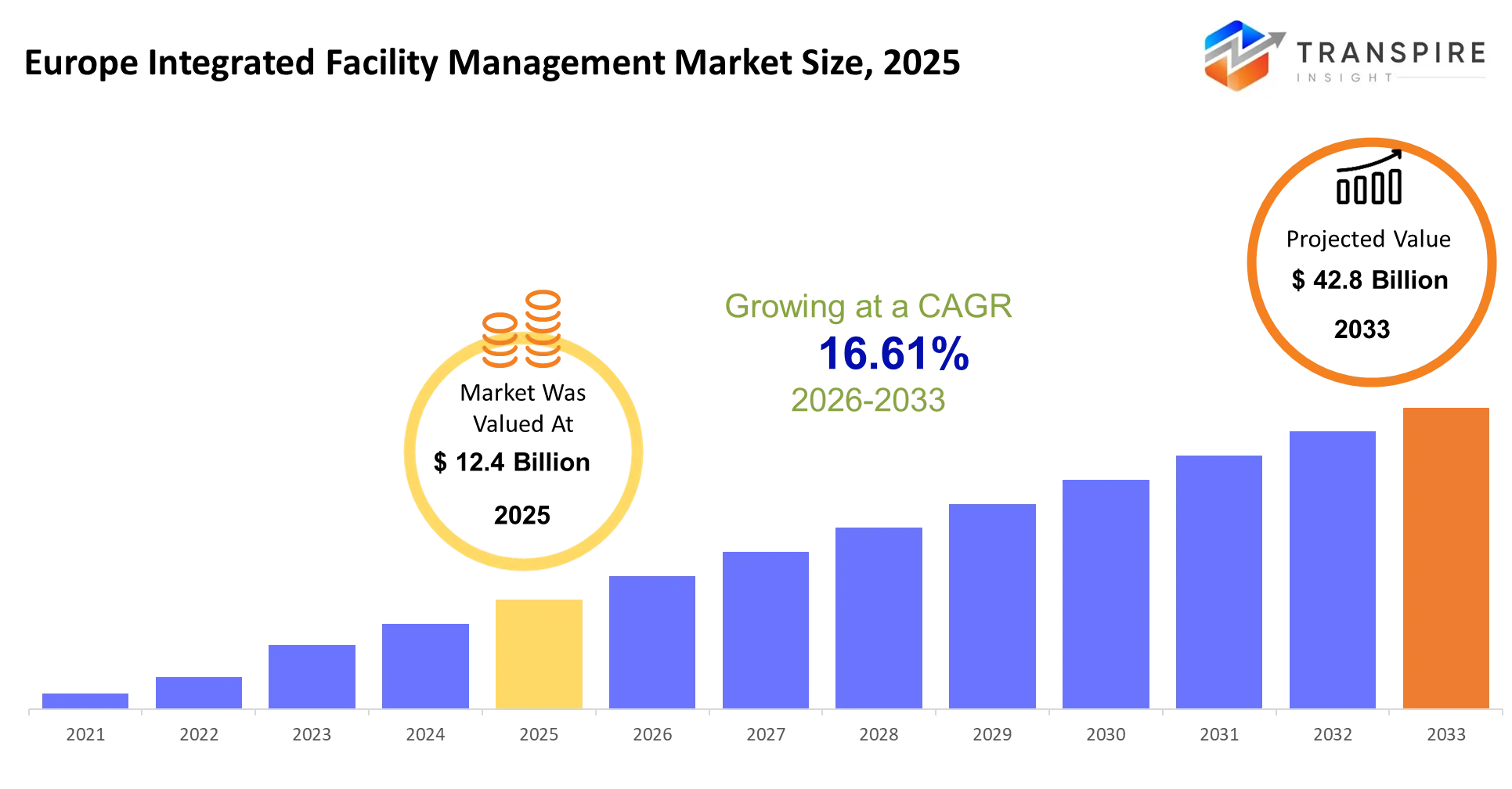
- Europe Integrated Facility Management Market Size 2025: USD 12.4 Billion
- Europe Integrated Facility Management Market Size 2033: USD 42.8 Billion
- Europe Integrated Facility Management Market CAGR: 16.61%
- Europe Integrated Facility Management Market Segments: By Type (Hard Services, Soft Services, Risk Management, Others); By Application (Commercial, Residential, Industrial, Healthcare, Infrastructure, Others); By End-User (Enterprises, Government, Real Estate, Healthcare, Industrial Firms, Others); By Service Model (Outsourced, In-house, Hybrid, Others)
To learn more about this report,  Download Free Sample Report
Europe Integrated Facility Management Market Summary
The Europe Integrated Facility Management Market was valued at USD 12.4 Billion in 2025. It is forecast to reach USD 42.8 Billion by 2033. That is a CAGR of 16.61% over the period.
The European Integrated Facility Management (IFM) system manages operational activities which include cleaning, maintenance work, energy management systems, security measures, and technical functions at industrial facilities, airports, office buildings, and distribution centers. The system provides continuous operational support for complex facilities through its integrated service model which maintains uninterrupted operations while decreasing costs and enhancing compliance for major asset holders.
The market has transitioned during the last three to five years toward digitally integrated service models which use Internet of Things (IoT) devices for operational oversight together with centralized systems to handle maintenance tasks through automated scheduling methods. The industry has shifted its operational framework through the unification of all facility management functions into a single outsourced service agreement which businesses use to enhance their operational efficiency. The COVID-19 pandemic forced organizations to develop new methods for maintaining hygiene standards and conducting remote workforce tracking and employee productivity assessment.
Enterprises have started to adopt integrated facility management (IFM) because they need to control their operational expenses while maintaining business continuity. The extended service contracts will generate continuous income streams which service providers in Europe will benefit from.
Key Market Insights
- The Europe Integrated Facility Management Market in Western Europe maintains its market lead through its 35 to 40 percent share which results from its developed infrastructure and advanced outsourcing capabilities that existed in 2025.
- The Northern European region experiences the fastest growth rate between 2024 and 2030 because sustainability regulations and green building initiatives support its development.
- Large facilities require hard services which constitute approximately 45 percent of total services because they need maintenance engineering and energy management solutions.
- The second largest segment of the market consists of soft services which provide cleaning catering and security services to commercial buildings.
- The integrated digital facility management solutions market experiences its highest growth rate between 2024 and 2030 because businesses adopt IoT and AI and predictive maintenance technologies.
- The Europe Integrated Facility Management Market identifies commercial real estate as its primary application which generates approximately 50 percent of total market share in 2025.
- The industrial facilities field has emerged as a rising application market because of the growing demand for automation and energy efficiency and compliance standards.
- The application areas of smart buildings and green infrastructure projects have reached their highest growth rate because ESG mandates and digital transformation drive their development.
- The end-user market sector dedicates 40 percent of its market share to corporate offices and commercial enterprises because businesses seek cost savings through outsourcing.
- Healthcare facilities represent the primary growth driver for end-user markets because they need to maintain hygiene standards while managing their complex infrastructure systems.
What are the Key Drivers, Restraints, and Opportunities in the Europe Integrated Facility Management Market?
Cost optimization and operational consolidation have become the main drivers for the expansion of the Europe Integrated Facility Management Market which serves large commercial estates. Companies now prefer to unify their facility operations by signing single contracts which enables them to decrease costs while achieving better operational results. The market transition started when European energy costs increased and organizations needed to follow new ESG compliance standards which required them to implement integrated service models that create better visibility while decreasing their need for different vendors. Organizations now enter into longer-term outsourcing contracts which drive contract value increases for their corporate and governmental infrastructure assets.
The market faces its main challenge because different countries experience service delivery problems which result from their workers being spread across multiple locations. Facility management in Europe remains highly localized due to varying labor regulations, union structures, and certification requirements across Germany, France, and Southern Europe. The integrated contract requirements create complex onboarding processes which lead to higher costs for international businesses. The system creates obstacles for providers because it prevents them from implementing their digital systems across different countries which results in missed chances to grow their business in developing territories.
Northern and Western Europe have started to develop smart building ecosystems which create a major business chance for companies operating in the region. Organizations now use their investments in IoT-based infrastructure and digital twin systems to achieve predictive maintenance and real-time asset tracking across all their operations.In Stockholm and Amsterdam commercial hubs of the city, AI-driven facility management platforms have become essential to their operations, which enable them to establish more profitable data-driven service agreements throughout the European Integrated Facility Management Market.
What Has the Impact of Artificial Intelligence Been on the Europe Integrated Facility Management Market?
The European Integrated Facility Management Market experiences transformation through artificial intelligence and digital technologies which establish operational systems that continuously improve their performance by using data-based information. AI-enabled platforms currently operate scrubber performance systems and exhaust gas cleaning technology through operational automation which delivers real-time performance monitoring and automatic control system adjustments to meet EU maritime emission standards. Fleet compliance tracking systems use rule-based automation to decrease manual reporting tasks while maintaining uniform regulatory compliance throughout multiple vessel operations.
The predictive capabilities now serve as essential components for facility management and maritime service delivery systems. Machine learning algorithms analyze sensor data to forecast maintenance needs for critical equipment, predict emissions spikes, and optimize energy or fuel consumption patterns. Multiple European shipping and industrial applications have achieved a 15 to 25 percent reduction in unplanned downtime through predictive maintenance models, which also enhanced fuel efficiency by 5 to 10 percent through optimized operational routing and engine load balancing.
These technologies enhance operational efficiency through asset uptime improvement, maintenance cost reduction, and improved compliance accuracy across European environments which have strict regulatory standards. The high costs of integration and the presence of outdated infrastructure infrastructure prevent worldwide adoption of platforms which require integrated systems to function effectively. The Europe Integrated Facility Management Market faces challenges because operators experience issues with data quality and system compatibility between different vendors, which prevents them from implementing advanced AI facility optimization solutions throughout their operations.
Key Market Trends
- The Eastern European countries developed their outsourcing business through their new commercial infrastructure projects which decreased the Western European countries' power during 2022.
- The two companies ISS A/S and Sodexo introduced AI-powered facility management systems during the post-2023 period to replace their traditional methods which depended on manual labor.
- The energy price increases during 2022 to 2024 period forced companies to merge their multiple vendor agreements into single contracts which included all facilities maintenance services.
- The use of IoT-based building management systems started to replace manual maintenance scheduling in more than 30 percent of newly constructed commercial buildings which opened after 2023.
- The two companies CBRE Group and JLL started buying regional facility management companies from 2023 to 2025 to enhance their ability to provide services across international borders.
- The European corporate real estate market required more carbon-tracking services because ESG regulations which started after 2022 mandated companies to track their carbon emissions.
- The adoption of predictive maintenance systems became popular after 2024 because they decreased equipment failures and enabled facilities to use data for their operational needs.
- The deployment of digital twin technology in smart buildings experienced significant growth across Nordic nations because it enabled better energy management and real-time equipment performance assessment.
- EU cities experienced a drop in soft services outsourcing because integrated contracts which included multiple services became the new standard instead of using separate contracts for cleaning and security work.
- The post-2023 period saw an increase in cloud-based facility management systems which allowed organizations to control their operations from one location while changing how providers and clients interacted with each other through subscription-based services.
Europe Integrated Facility Management Market Segmentation
By Type:
The European Integrated Facility Management Market receives its strongest support through hard services because these services provide essential maintenance solutions for building needs and HVAC system operations and energy system requirements. Large commercial complexes and industrial sites prioritize these services because they directly influence asset longevity and operational continuity. Western Europe currently experiences high demand because its aging infrastructure requires ongoing technical maintenance.
Soft services follow closely because urban commercial properties increasingly outsource cleaning and catering and security functions. The demand for risk management services has increased because organizations now face stronger safety compliance and workplace standard requirements since the start of 2023. Integrated models increasingly combine all service types which leads to decreased vendor distribution.
The market will develop through integrated service bundles that include digital solutions because they offer better value than separate services. Organizations that develop automation systems for maintenance and compliance monitoring will achieve better contract retention results. Investors are likely to prioritize firms capable of cross-service integration rather than niche service specialization.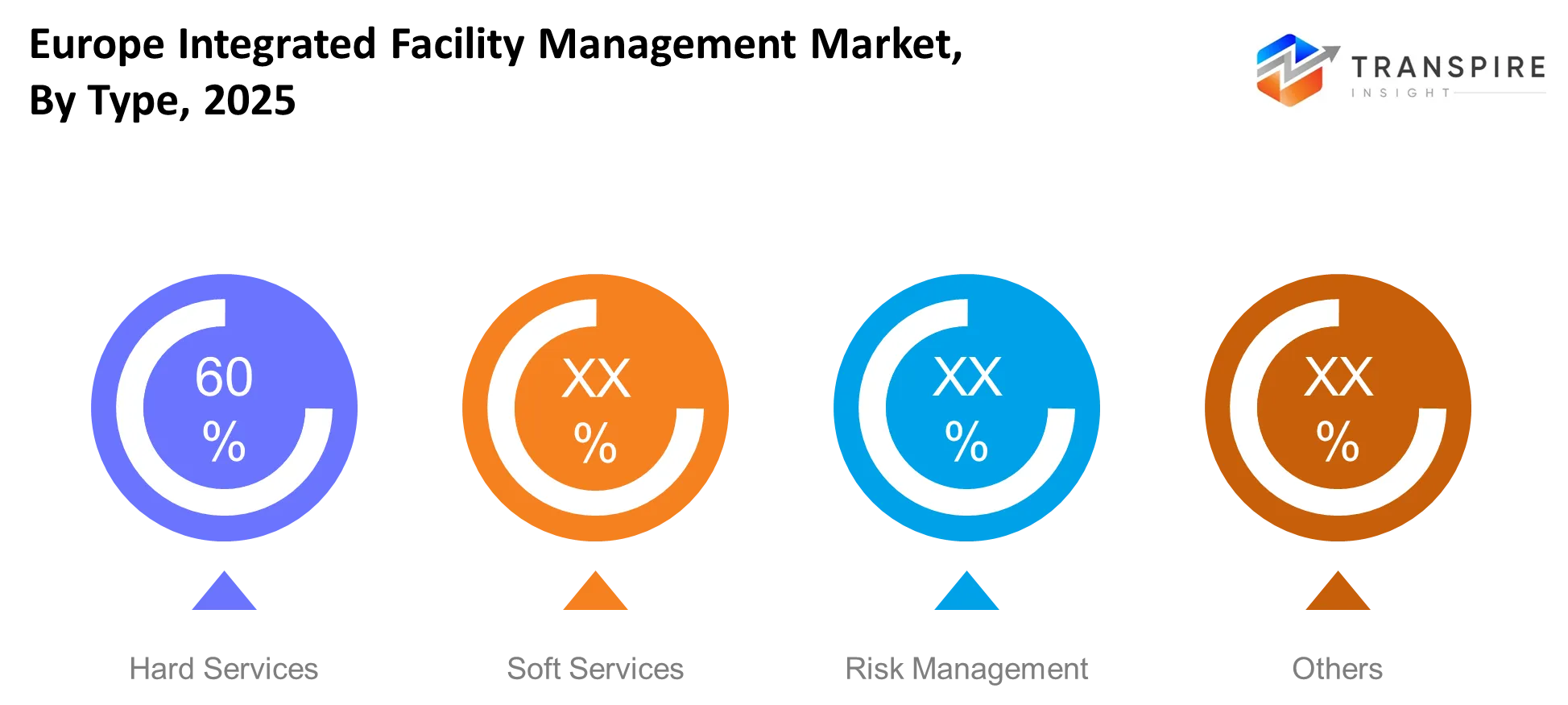
To learn more about this report, Download Free Sample Report
By Application:
The market is divided into six application areas which include commercial, residential, industrial, healthcare, infrastructure and other sectors. The European Integrated Facility Management Market finds its main market in commercial applications because offices and retail centers and corporate campuses outsource their services. The main European cities experience increased demand for centralized building management systems which drive operational cost reductions. Industrial applications follow, supported by manufacturing automation and energy efficiency mandates.
The strong growth of healthcare facilities exists because hospitals need to maintain their operation through continuous service delivery with strict hygiene standards and compliance with regulations. The expansion of public utility infrastructure together with transport hub development drives demand for EU modernization programs. People adopt residential spaces at a slow pace because they face difficulties in assigning property control rights and because they use fewer outsourcing services.
The forecast period shows healthcare and infrastructure segments will grow at a faster rate than commercial usage because of regulatory developments and investment patterns from the public sector. The product developers will develop compliance-heavy service solutions which meet high reliability requirements. The investors will direct their investments toward industries which have consistent demand backed by government support.
By End-User:
The European Integrated Facility Management Market sees enterprises as its main end-user group because corporations delegate their operations to external service providers. Organizations use vendor management systems which centralize their operations to achieve cost savings and better operational efficiency. Real estate firms also hold a significant share due to portfolio-wide facility optimization strategies.
The European Union government bodies have expanded their technology use after they completed infrastructure upgrades and sustainability requirements implementation. The healthcare sector requires more resources because their operational requirements have become stricter and their patient demand has increased. Industrial companies depend on complete service solutions which help them achieve operational efficiency and meet their legal obligations.
Government agencies will become the main market for growth while healthcare facilities will become another market because both public financing and compliance requirements will increase. Enterprises will increasingly adopt performance-based contracts tied to energy savings and uptime metrics. Service providers will need stronger compliance and analytics capabilities to retain institutional clients.
By Service Model:
The Europe Integrated Facility Management Market experiences its highest market share through outsourced models which organizations choose because they provide cost-effective solutions and simpler operational procedures. Large enterprises and commercial property owners outsource multi-service contracts to specialized providers for their capacity to deliver scalable solutions and industry-specific knowledge. In-house models maintain their presence inside critical industries which handle sensitive information but they have lost market share because of increasing labor expenses and compliance requirements.
Organizations in healthcare and critical infrastructure sectors use hybrid models to achieve their desired level of control while accessing external expertise. Digital integration tools enable this shift because they permit businesses to outsource some functions while retaining control over their operations. Mid-sized enterprises are increasing their demand for providers who offer flexible contract structures.
The forecast period will see an expansion of both outsourced and hybrid models because digital platforms enable organizations to manage their services across multiple service levels. Investors will choose to support companies which possess established outsourcing systems and advanced cloud management platforms. Buyers will select service models which provide them with evidence of operational efficiency improvements and compliance with regulatory standards.
What are the Key Use Cases Driving the Europe Integrated Facility Management Market?
The European Integrated Facility Management Market exists for commercial building operations because office complexes and retail centers and corporate campuses need centralized management of their maintenance work and energy systems and security operations. The need for this service exists because energy prices are increasing and multiple tenant buildings require ongoing reliable service delivery.
Healthcare facility management and industrial plant operations are expanding secondary use cases, supported by hospitals requiring strict hygiene compliance and manufacturers focusing on uptime optimization and equipment reliability. Real estate asset managers also adopt integrated services to streamline portfolio-wide cost control and reporting efficiency.
Smart city infrastructure management and data center facility orchestration represent emerging applications that require real-time monitoring and energy optimization and predictive maintenance to function effectively. These use cases are expected to gain momentum as EU digital infrastructure investments and sustainability regulations intensify over the forecast period.
|
Report Metrics |
Details |
|
Market size value in 2025 |
USD 12.4 Billion |
|
Market size value in 2026 |
USD 14.6 Billion |
|
Revenue forecast in 2033 |
USD 42.8 Billion |
|
Growth rate |
CAGR of 16.61% from 2026 to 2033 |
|
Base year |
2025 |
|
Historical data |
2021 - 2024 |
|
Forecast period |
2026 - 2033 |
|
Report coverage |
Revenue forecast, competitive landscape, growth factors, and trends |
|
Regional scope |
Europe (Germany, United Kingdom, France, Italy, Spain, Rest of Europe) |
|
Key company profiled |
CBRE, ISS, Sodexo, Compass Group, Aramark, Mitie, Jones Lang LaSalle, Cushman & Wakefield, EMCOR, OCS Group, G4S, Serco, Veolia, Engie, Apleona |
|
Customization scope |
Free report customization (country, regional & segment scope). Avail customized purchase options to meet your exact research needs. |
|
Report Segmentation |
By Type (Hard Services, Soft Services, Risk Management, Others); By Application (Commercial, Residential, Industrial, Healthcare, Infrastructure, Others); By End-User (Enterprises, Government, Real Estate, Healthcare, Industrial Firms, Others); By Service Model (Outsourced, In-house, Hybrid, Others) |
Which Regions are Driving the Europe Integrated Facility Management Market Growth?
The European Integrated Facility Management Market is primarily dominated by Western Europe because the region possesses established commercial facilities which begun using outsourced facility management systems. The United Kingdom and France together with Germany maintain a strong demand for integrated services because their regulatory authorities enforce stringent energy efficiency standards and workplace safety regulations. The region maintains its leadership position because of its established global service provider network which operates advanced smart building technology and businesses practice extensive outsourcing. The area maintains continuous contract work because its commercial buildings and major business offices create permanent space requirements.
Northern Europe serves as a reliable secondary region through its development patterns which sustainable development policies control rather than its total market size. The countries of Sweden, Denmark, and Finland focus on achieving permanent environmental protection and constructing energy-efficient buildings instead of pursuing immediate business growth. Integrated facility solutions receive increasing demand from public infrastructure projects and healthcare facilities and technology-based office environments. Northern Europe operates through dedicated procurement systems and extended partnership agreements between public and private sectors while Western Europe depends on market volume for its operations. The business environment creates stable revenue streams for service providers which remain intact throughout economic downturns.
The Eastern and Southern European region shows the highest growth rate because countries improve their infrastructure systems while businesses start to adopt outsourcing services. The European Union has supported recent investments in smart city projects and transport centers and energy-efficient public building initiatives, which led to increased use of integrated facility services since 2023.The commercial and industrial asset development in Poland and Spain and Italy is creating a need for centralized management systems. The region provides exceptional growth opportunities for investors and new market entrants because it will establish first-time outsourcing contracts and execute extensive modernization projects from 2026 until 2033.
Who are the Key Players in the Europe Integrated Facility Management Market and How Do They Compete?
The Europe Integrated Facility Management Market operates through a competitive framework which maintains moderate consolidation because multinational companies control significant contract value while local firms provide services in specific areas. Businesses compete today through their ability to implement advanced technology and establish efficient service delivery systems instead of relying solely on their pricing benefits. Organizations maintain their market position through continuous delivery of comprehensive service packages but newcomers who use artificial intelligence technology for maintenance and cloud-based facility management platforms are disrupting these established practices. Organizations now need service providers who can deliver predictive capabilities and energy management solutions along with compliance monitoring services instead of using conventional labor-oriented methods.
ISS A/S achieves its technology-based cost reduction goals through sensor monitoring systems which it installs in its European operations after implementing centralized digital management platforms. The company achieves operational control through its monitoring system which detects all service activities, enabling it to manage its services efficiently at large corporate facilities. Sodexo provides the healthcare and education sectors with integrated workplace experience solutions that combine facility management and employee services, which helps organizations retain their workforce. The company keeps growing through its strategic partnerships with technology companies, which help it build better digital tools for the workplace.
CBRE Group and JLL compete through acquisition-led expansion and integrated real estate service portfolios. CBRE Group strengthens its operations through acquisitions of local facility management companies across Eastern Europe, which enhances its ability to serve various geographic regions and handle different types of contracts. JLL provides smart building solutions and data analytics platforms which help organizations achieve energy efficiency and preventive maintenance through their systems.The two companies make substantial investments on digital twin technologies and cloud asset management systems to achieve long-lasting business contracts throughout the European Integrated Facility Management Market.
Company List
- CBRE
- ISS
- Sodexo
- Compass Group
- Aramark
- Mitie
- Jones Lang LaSalle
- Cushman & Wakefield
- EMCOR
- OCS Group
- G4S
- Serco
- Veolia
- Engie
- Apleona
Recent Development News
In April 2026, ISS A/S announced the acquisition of a majority stake in Livit FM Services AG. The deal strengthens ISS’s presence in Switzerland and expands its integrated facility management capabilities across Central Europe. https://www.issworld.com
In March 2026, Sodexo completed the acquisition of Andersson FM Group. This acquisition enhances Sodexo’s integrated facilities management footprint in the Nordic region, particularly in Sweden and Finland. https://www.sodexo.com
What Strategic Insights Define the Future of the Europe Integrated Facility Management Market?
The Europe Integrated Facility Management Market is structurally moving toward fully digitized and outcome-based service models, driven by accelerating adoption of AI-enabled building systems and tightening EU sustainability mandates. The forthcoming 5 to 7 years will see organizations transitioning from labor-driven contracts toward performance-based contracts which measure value through energy efficiency and uptime and carbon reduction. The implementation of smart building technology and cloud-based facility management systems which connect operational functions across multiple facilities support this development.
The increasing vendor concentration to a small number of global suppliers presents an unrecognized danger which will decrease pricing options and hinder the development of innovative solutions. The extensive dependency on unique digital systems for proprietary platforms will result in mid-sized businesses encountering challenges with system compatibility, which will delay their ability to implement these systems across their operations.
Facility management platforms can now achieve new capabilities through their ability to integrate carbon accounting modules, especially as EU reporting requirements become stricter because of new ESG disclosure regulations. The compliance framework reached its highest maturity level which will enable this development to first establish itself in Germany and the Nordics. Early investments in digital platforms should focus on creating predictive maintenance systems which will track emissions in real time to help organizations build durable business relationships while staying compliant with regulations.
Europe Integrated Facility Management Market Report Segmentation
By Type
- Hard Services
- Soft Services
- Risk Management
- Others
By Application
- Commercial
- Residential
- Industrial
- Healthcare
- Infrastructure
- Others
By End-User
- Enterprises
- Government
- Real Estate
- Healthcare
- Industrial Firms
- Others
By Service Model
- Outsourced
- In-house
- Hybrid
- Others
Frequently Asked Questions
Find quick answers to common questions.
The Europe Integrated Facility Management Market size is USD 42.8 Billion in 2033.
Key Segments for the Europe Integrated Facility Management Market are By Type (Hard Services, Soft Services, Risk Management, Others); By Application (Commercial, Residential, Industrial, Healthcare, Infrastructure, Others); By End-User (Enterprises, Government, Real Estate, Healthcare, Industrial Firms, Others); By Service Model (Outsourced, In-house, Hybrid, Others)
Major Europe Integrated Facility Management Market Players are CBRE, ISS, Sodexo, Compass Group, Aramark, Mitie, Jones Lang LaSalle, Cushman & Wakefield, EMCOR, OCS Group, G4S, Serco, Veolia, Engie, Apleona.
The Current Europe Integrated Facility Management Market size is USD 12.4 Billion in 2025.
The Europe Integrated Facility Management Market CAGR is 16.61% from 2026 to 2033.
- CBRE
- ISS
- Sodexo
- Compass Group
- Aramark
- Mitie
- Jones Lang LaSalle
- Cushman & Wakefield
- EMCOR
- OCS Group
- G4S
- Serco
- Veolia
- Engie
- Apleona
Recently Published Reports
-
Apr 2026
Handling and Lifting Equipment Market
Handling and Lifting Equipment Market Size, Share & Analysis Report By Product (Cranes and Hoists, Forklifts, Conveyor Systems, Aerial Work Platforms, Others), By Application (E-Commerce, Automotive and Railway, Food and Beverages, Aviation, Others), and Geography (North America, Europe, Asia-Pacific, Middle East and Africa, South and Central America), 2021 - 2031
-
Apr 2026
HVAC Equipment Market
HVAC Equipment Market Size, Share & Analysis Report By Heating Equipment Type (Boilers and Furnaces, Heat Pumps, and Unitary Heaters), By Ventilation Equipment (Air Handling Units, Humidifiers and Dehumidifiers, Air Filters, and Fan Coiling Units), By Air Conditioning Equipment (Unitary Air Conditioners, Room Air Conditioners, Packaged Terminal Air Conditioners, and Chillers), By End User (Commercial, Residential, Industrial, and others), and Geography (North America, Europe, Asia-Pacific, Middle East and Africa, South and Central America), 2021 – 2031
-
Apr 2026
Refrigeration Valves Market
Refrigeration Valves Market Size, Share & Analysis Report By Type (Solenoid Valves, Expansion Valves, Check Valves, Service Valves, Others), By Application (Commercial Refrigeration, Industrial Refrigeration, Transport Refrigeration, Residential Refrigeration, Air Conditioning Systems), By End User (Food and Beverage Industry, Pharmaceutical Industry, HVAC Industry, Chemical Industry, Others), and Geography (North America, Europe, Asia-Pacific, Middle East and Africa, South and Central America), 2021 – 2031
-
Apr 2026
E-Commerce Packaging Materials Market
E-Commerce Packaging Materials Market By Material Type (Corrugated Boxes, Paper & Paperboard, Foam & Cushioning Materials, Plastic Packaging, Flexible Packaging, Protective Packaging, Others), By Product(Primary Packaging, Secondary Packaging, Tertiary Packaging), By Packaging Function (Protective Packaging, Branding & Presentation Packaging, Transit & Logistic Packaging, Sustainable Packaging, Tamper Evidence Packaging), By End-User (Retail & Consumer Goods, Electronic Appliances, Food & Beverages, Healthcare & Pharmaceutical, Fashion & Apparel, Home & Furnishing, Others); By Industry Analysis, Size, Share, Growth, Trends, and Forecasts 2021-2033