Europe Internet of Things (IOT) in Healthcare Market Size & Forecast:
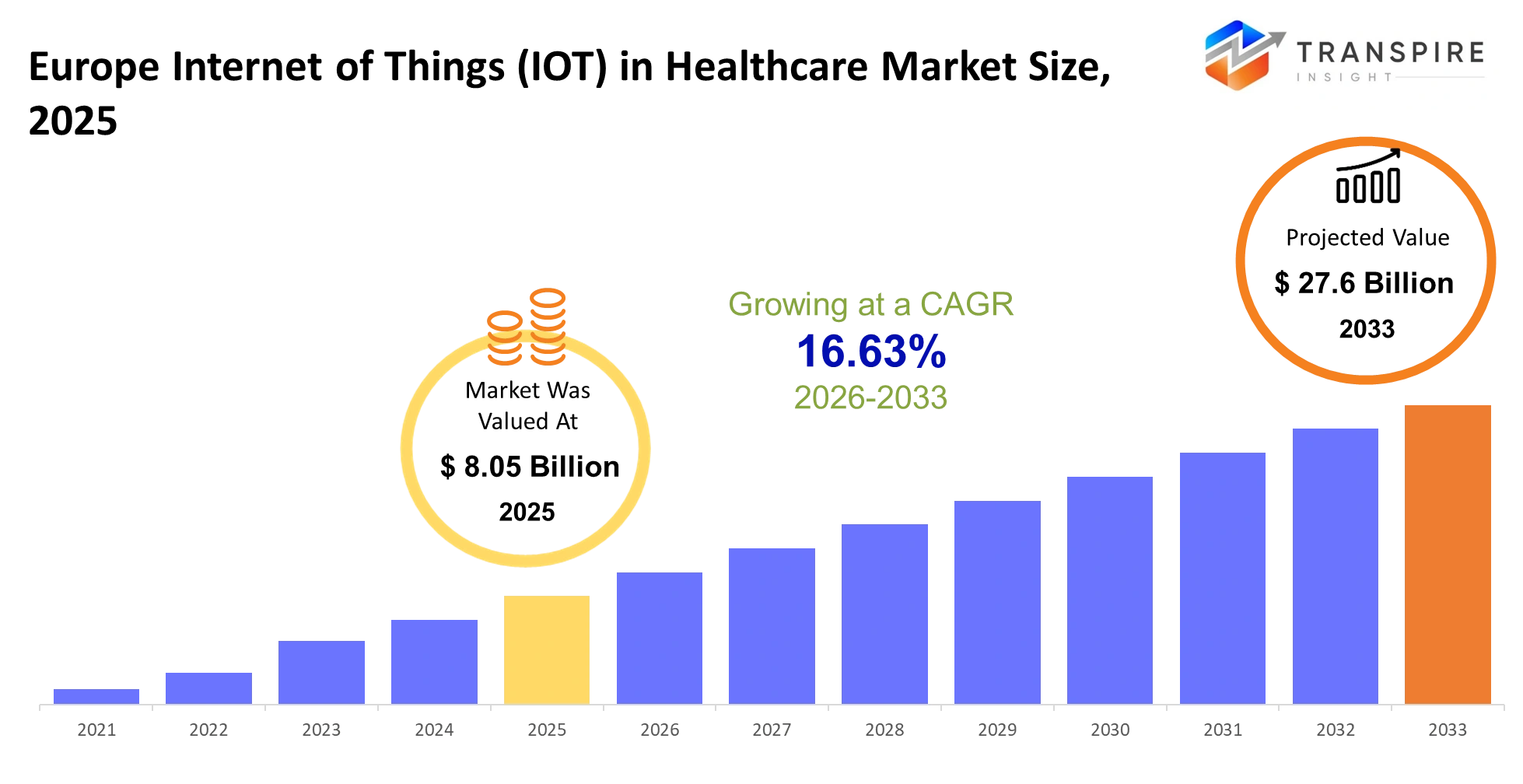
- Europe Internet of Things (IOT) in Healthcare Market Size 2025: USD 8.05 Billion
- Europe Internet of Things (IOT) in Healthcare Market Size 2033: USD 27.6 Billion
- Europe Internet of Things (IOT) in Healthcare Market CAGR: 16.63%
- Europe Internet of Things (IOT) in Healthcare Market Segments: By Type (Devices, Software, Services, Platforms, Others); By Application (Remote Patient Monitoring, Clinical Operations, Asset Tracking, Telemedicine, Wearables, Others); By End-User (Hospitals, Clinics, Healthcare Providers, Research Institutes, Patients, Others); By Deployment (Cloud, On-premise, Hybrid, Others).
To learn more about this report,  Download Free Sample Report
Europe Internet of Things (IOT) in Healthcare Market Summary
The Europe Internet of Things (IOT) in Healthcare Market was valued at USD 8.05 Billion in 2025. It is forecast to reach USD 27.6 Billion by 2033. That is a CAGR of 16.63% over the period.
The Europe Internet of Things (IOT) in Healthcare Market connects hospitals, clinics, and homecare systems through real-time medical data exchange, enabling continuous monitoring of patients and more efficient clinical decision-making. The system enables chronic disease management through its ability to connect multiple medical devices which include wearable sensors and hospital equipment and cloud systems into a single healthcare network.
Healthcare delivery has undergone a significant transformation during the past 3 to 5 years because medical treatment now occurs through home-based and hybrid systems that use connected devices and cloud-based analytics instead of traditional facility-based methods. The COVID-19 pandemic acted as a real-world trigger, forcing rapid adoption of remote patient monitoring and accelerating investment in digital health infrastructure across EU healthcare systems. At the same time, stricter data privacy enforcement under GDPR pushed providers toward secure, interoperable IoT architectures.
The adoption behavior of hospitals changed because hospitals now select scalable IoT platforms as their primary technology choice instead of using individual systems. Organizations start generating more revenue through their subscription-based monitoring services and predictive analytics tools and integrated healthcare ecosystems compared to their previous method of selling devices.
Key Market Insights
- The Europe Internet of Things (IOT) in Healthcare market, which Western Europe controls through its 42% market share for 2025, extends its reach because Germany, France, and the United Kingdom use advanced hospital digitization systems.
- Eastern Europe emerges as the fastest-growing region with projected double-digit CAGR from 2025 to 2032 due to increasing EU-backed healthcare modernization programs.
- The Devices segment leads the Europe Internet of Things (IOT) in Healthcare Market because it controls more than 45% of the market through the widespread use of wearable monitors and connected diagnostic equipment.
- Software platforms represent the second-largest segment, gaining traction through cloud-based patient management systems and integrated clinical dashboards.
- Market growth receives support from three factors which include increasing chronic disease rates and digital health system changes and projected double-digit growth in remote monitoring technology adoption until 2030.
- Services segment is the fastest-growing category between 2024 and 2030, driven by managed healthcare IoT solutions and predictive maintenance offerings.
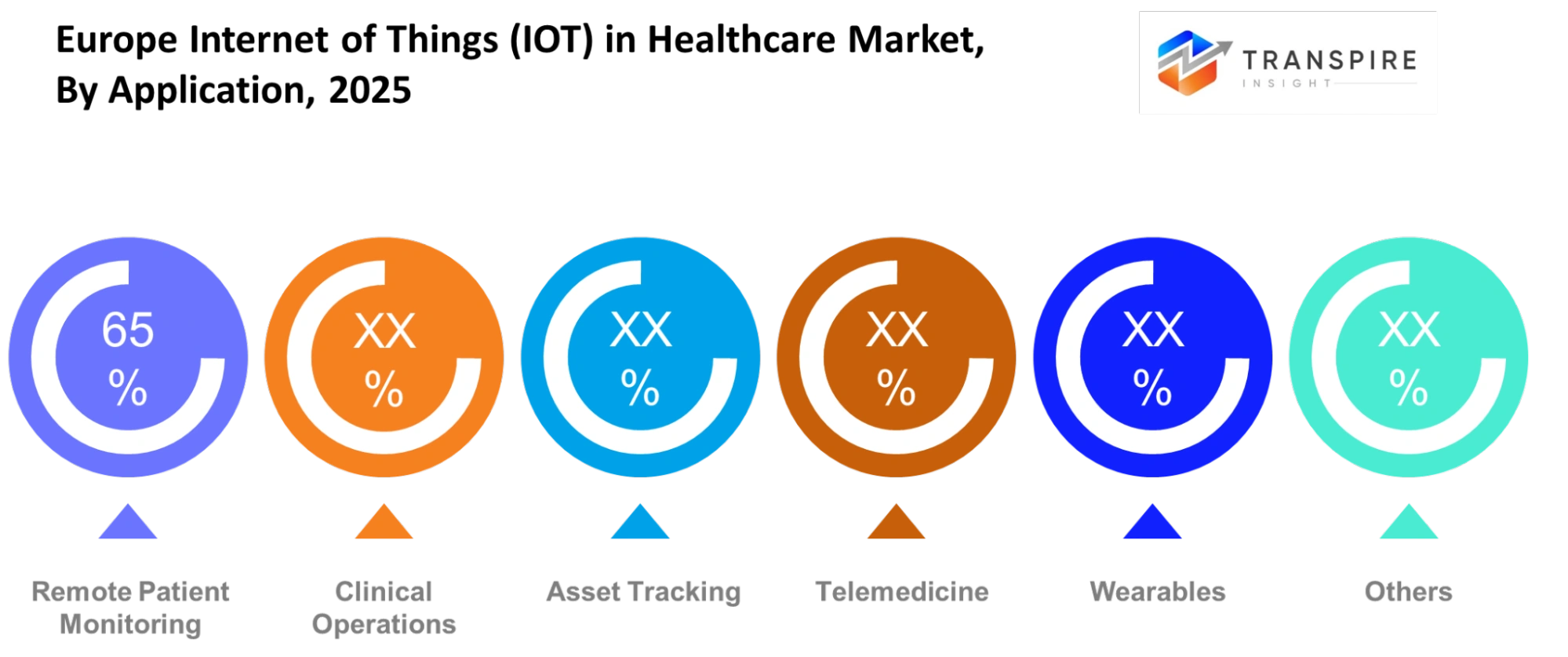
- Remote patient monitoring dominates application share at nearly 38% due to strong demand for chronic disease management and elderly care optimization.
- The hybrid care models, which EU healthcare systems implemented after the 2022 digital transformation policies, have made telemedicine the most rapidly emerging application.
- The hospital sector serves as the primary customer segment because it controls about 50% of the market through its need for extensive infrastructure development and adherence to legal requirements.
- Homecare settings show rapid growth as patient-centric care models and aging population trends reshape demand patterns across Europe.
What are the Key Drivers, Restraints, and Opportunities in the Europe Internet of Things (IOT) in Healthcare Market?
The European Internet of Things (IOT) Health Market exists because remote care delivery methods expanded after both chronic disease rates increased and post-pandemic health system changes. The combination of telehealth reimbursement regulations and EU interoperability standards enables healthcare facilities to implement connected monitoring technology throughout hospitals and homecare settings. The shift from episodic treatment to continuous patient monitoring will create more subscription-based services which will generate recurring revenue through data-driven income streams for device manufacturers and platform providers.
European countries face a major system limitation because their existing healthcare systems operate with two main problems which create interoperability challenges and they use outdated healthcare technology. The high integration costs and long deployment times arise because many hospitals use obsolete electronic health record systems which do not connect with IoT devices. The structural limitation of the system creates barriers that prevent smaller healthcare facilities from using digital technology while it creates potential revenue losses because people want digital solutions. Standardized data architectures do not exist which creates cybersecurity threats that delay purchase decisions.
AI-powered edge computing platforms which provide real-time diagnostics and local data processing capabilities create a major business opportunity for hospitals and their outpatient care networks. The decentralized health data pilot programs in Germany and the Netherlands receive funding which helps them decrease their reliance on centralized cloud data systems. This shift paves the way to quicker clinical decision-making and opens up new streams of revenue for predictive care solutions and advanced analytics providers.
What Has the Impact of Artificial Intelligence Been on the Europe Internet of Things (IOT) in Healthcare Market?
The system uses artificial intelligence to enhance both scrubber performance systems and maritime emission control systems which include healthcare-style monitoring systems. The operators now utilize AI-powered IoT sensors to perform automatic monitoring for exhaust gas cleaning systems which enables them to decrease manual inspection needs and maintain ongoing compliance with IMO emission standards. Digital dashboards integrate data from individual vessels to provide shore teams with the ability to modify operating settings almost instantaneously.
Machine learning models serve as reliable tools for predicting when scrubber units require maintenance because they detect washwater flow anomalies and pressure declines and anticipate corrosion damage which leads to system breakdowns. The predictive tools forecast emissions by establishing links between fuel type and engine load and route conditions which helps fleets enhance their operational planning efficiency. Operators achieve fuel optimization improvements between 5 and 12 percent while detecting faults earlier through automated alerts which results in decreased non-compliance incidents.
AI adoption continues to experience challenges because sensor calibration issues and poor connectivity in open sea environments prevent consistent data collection needed for training real-time models. The high integration expenses required to upgrade existing vessels with new IoT-based emission control technologies will delay complete implementation across smaller ship fleets.
Key Market Trends
- Between 2020 and 2025 hospitals shifted away from using standalone monitoring devices to adopting integrated IoT ecosystems which provided better access to real-time patient data and improved coordination of medical care.
- After 2021 healthcare providers began using remote patient monitoring to manage chronic diseases because they could deliver care through home-based connected systems.
- Organizations began using cloud-based healthcare Internet of Things platforms as their primary deployment method after 2022 because they required systems that provided both scalable analytics and seamless communication between different systems.
- European hospitals used asset tracking solutions more extensively in 2023 because they needed better equipment tracking during equipment shortages while organizations started to use better utilization tracking methods.
- Medical wearable devices evolved from their original design as fitness tracking accessories into approved medical monitoring devices between 2020 and 2024 through the enforcement of tougher testing standards.
- Post-COVID-19 telemedicine systems began to integrate with Internet of Things platforms which led to hybrid consultation systems becoming the basic healthcare model used in urban and semi-urban areas.
- Hospitals began using AI-powered predictive analytics systems at an increasing rate after 2022 which enabled them to shift their medical approach from reactive treatment methods to preventive intervention methods.
- Healthcare providers adopted edge computing solutions because GDPR data privacy rules required them to process sensitive information at local facilities by 2024.
- Healthcare organizations established collaborations with technology companies such as Siemens Healthineers and Philips to speed up the implementation of IoT systems and the creation of interoperability standards.
Europe Internet of Things (IOT) in Healthcare Market Segmentation
By Type:
The classification system divides items into five categories which include Devices Software Services Platforms and Other items. The device category establishes market dominance within the Europe Internet of Things IOT in Healthcare Market because hospitals and homecare networks have implemented connected monitors and wearable sensors and diagnostic equipment. The healthcare sector experiences high procurement volume and frequent replacement cycles because hardware components work together with clinical monitoring systems.
Healthcare providers need real-time physiological data to fulfill rising demand while they must meet regulatory standards which demand continuous monitoring across their hospital systems. The industry adopts edge processing technology because it enables standardization of devices throughout emergency response operations and acute care facilities and senior living facilities.
The future will bring a shift toward software-defined ecosystems because device manufacturers will transition into developing platform systems and subscription service models. Healthcare organizations now prioritize bundled hardware and software solutions because analytics components represent the most valuable assets in their procurement processes.
By Application:
The system classifies items into two categories which include Remote Patient Monitoring and Clinical Operations and Asset Tracking and Telemedicine and Wearables and Other applications. The Remote Patient Monitoring system functions as the primary application in the Europe Internet of Things IOT in Healthcare Market because patients with chronic diseases need ongoing medical supervision for their cardiovascular and diabetes and respiratory health needs. The monitoring systems hospitals and homecare providers use help them decrease patient admissions while they allocate their resources more effectively.
Healthcare networks rapidly implement clinical operations optimization and asset tracking systems to enhance their workflow performance and equipment efficiency and their supply chain operations. European nations experience rising telemedicine usage because of their digital consultation systems which receive backing from public healthcare organizations and insurance reimbursement changes.
Wearable technology for preventive health and AI diagnostic tools create new possibilities for specialized clinics to implement early treatment programs. The rising adoption of consumer medical wearables together with predictive analytics systems shows a strong commitment to long-term use across preventive health and personalized medical treatment systems.
To learn more about this report, Download Free Sample Report
By End-User:
The European Internet of Things (IoT) in Healthcare Market reports that hospitals maintain the largest market share because they possess sophisticated infrastructure and experience high patient volume and utilize extensive systems for remote patient monitoring in their critical care and surgical departments. The two factors of procurement volume and regulatory compliance create continuous requirements which hospital networks must fulfill to maintain their operations.
The operational efficiency improvements which medical clinics and healthcare providers achieve through their expanded service delivery systems lead to better patient outcomes and more precise diagnostic results when they work under budget constraints and staff shortages. The European digital health transformation initiatives enable research institutions to conduct more clinical trials and data-driven medical studies which rely on their digital health transformation initiatives.
The adoption of patient-centered healthcare solutions through home care treatments and patient-based monitoring systems shows continuous growth because of two factors: increasing numbers of elderly people and healthcare systems that use decentralized treatment methods. Healthcare delivery systems will develop distributed care networks which connect medical institutions with community treatment centers and residential patient care.
By Deployment:
The deployment types include Cloud and On-premise and Hybrid and Others. The Cloud deployment method leads the European Internet of Things (IOT)Healthcare market because it provides scalable solutions which reduce costs and enables smooth connection with remote monitoring systems and analytics solutions. The healthcare industry selects cloud-based systems because they enable organizations to access real-time data while managing patients who receive treatment from multiple healthcare facilities.
On-premise deployment maintains operational importance when organizations work with sensitive data which needs strict patient information protection and full compliance with healthcare data security regulations. Hospitals use hybrid deployment systems to create secure networks which provide two main benefits: enhanced security and reduced latency while maintaining system flexibility.
The upcoming years will bring about an increased transition toward hybrid systems which combine cloud-based development with edge processing capacity. The combination of edge computing together with distributed storage systems enhances system resilience while enabling advanced analytics capabilities throughout clinical and operational processes.
What are the Key Use Cases Driving the Europe Internet of Things (IOT) in Healthcare Market?
The main application of Internet of Things technology in European healthcare systems functions as a remote monitoring solution which enables remote patient evaluation of chronic diseases, particularly for patients with cardiovascular issues, diabetes, and respiratory diseases. Healthcare facilities and home healthcare services implement networked medical equipment to lower patient readmission rates while meeting the new EU requirements for healthcare operational efficiency.
Hospitals use adjacent applications for both hospital asset tracking and smart ward management which public hospitals and private hospitals currently implement together with medication adherence solutions that elderly care providers and insurers use to control their long-term treatment expenses.
Healthcare organizations utilize artificial intelligence predictive analytics tools for early disease detection and Internet of Things tele-rehabilitation solutions which represent two new use cases that have emerged. The EU digital health transformation initiatives have established these solutions as operational choices for specialized clinics and rehabilitation facilities.
|
Report Metrics |
Details |
|
Market size value in 2025 |
USD 8.05 Billion |
|
Market size value in 2026 |
USD 9.4 Billion |
|
Revenue forecast in 2033 |
USD 27.6 Billion |
|
Growth rate |
CAGR of 16.63% from 2026 to 2033 |
|
Base year |
2025 |
|
Historical data |
2021 - 2024 |
|
Forecast period |
2026 - 2033 |
|
Report coverage |
Revenue forecast, competitive landscape, growth factors, and trends |
|
Regional scope |
Europe (Germany, United Kingdom, France, Italy, Spain, Rest of Europe) |
|
Key company profiled |
Philips, GE Healthcare, Siemens Healthineers, Medtronic, IBM, Microsoft, Cisco, Oracle, SAP, Honeywell, Qualcomm, Intel, Fitbit, Boston Scientific, Abbott. |
|
Customization scope |
Free report customization (country, regional & segment scope). Avail customized purchase options to meet your exact research needs. |
|
Report Segmentation |
By Type (Devices, Software, Services, Platforms, Others); By Application (Remote Patient Monitoring, Clinical Operations, Asset Tracking, Telemedicine, Wearables, Others); By End-User (Hospitals, Clinics, Healthcare Providers, Research Institutes, Patients, Others); By Deployment (Cloud, On-premise, Hybrid, Others). |
Which Regions are Driving the Europe Internet of Things (IOT) in Healthcare Market Growth?
The European Internet of Things (IOT) Healthcare Market in Western Europe functions as the leading market because of its strong digital health policies and its advanced hospital infrastructure and its early implementation of connected medical systems. The public healthcare funding system together with strict interoperability requirements enables Germany France and the United Kingdom to implement extensive remote monitoring systems and hospital IoT platforms. The ecosystem consists of medical device manufacturers and cloud providers and research institutions which together support ongoing innovation. The combination of high compliance pressure for EU data protection and clinical standards together with EU data protection requirements leads to faster deployment of secure IoT healthcare systems in hospitals and specialty clinics.
The secondary region Northern and Southern Europe maintains stability through continuous healthcare funding and incremental digital technology adoption which avoids major changes in policy. The countries of Italy Spain and Nordic nations plan to modernize their hospitals through long-term development projects which will involve gradual incorporation of connected medical technology. The public healthcare system in this region grows because of continuous improvements to outdated hospital facilities which enable more effective healthcare delivery. The region becomes a dependable source of revenue for IoT solution companies because government-backed universal healthcare systems create foreseeable procurement patterns.
Eastern Europe has emerged as the fastest expanding area because new EU-funded healthcare digitization initiatives and extensive hospital modernization projects have been implemented. The countries of Poland Romania and Czech Republic have increased their use of connected diagnostic systems together with cloud-based patient monitoring systems since 2022.Foreign healthcare investments and rising need for budget-friendly digital health solutions create stronger market momentum. The market demonstrates high growth potential which benefits new businesses and investors who want to establish scalable IoT solutions between 2026 and 2033.
Who are the Key Players in the Europe Internet of Things (IOT) in Healthcare Market and How Do They Compete?
The Europe Internet of Things (IOT) Healthcare Market shows moderate market consolidation because a small number of international technology and medical device companies control most of the market while digital health startups create targeted solutions for specific market segments. The main factors that drive competition in the market come from technological capabilities which include interoperability features and data protection standards and hospital information systems integration abilities. The existing market players maintain their market position through binding long-term agreements with healthcare organizations and their certified regulatory ecosystems, while the new market players develop their AI-powered analytics platforms and affordable cloud-based systems which disrupt the established device-based business models.
Siemens Healthineers uses its imaging system and hospital IoT platform connections to create complete clinical workflow solutions which help the company build its presence in major hospital systems. Philips develops its unique market position through its remote patient monitoring system which enables healthcare professionals to monitor patients in intensive care and home settings, while its recurring revenue model and international healthcare partnerships help sustain business growth. GE HealthCare develops AI-powered diagnostic tools and cloud-based imaging solutions to improve predictive analytics services, which it offers to European hospitals through its existing customer base. Cisco Systems enhances its market position by providing secure network infrastructure solutions that protect internet of things devices in healthcare systems and ensure secure data transmission between various hospital networks. Medtronic establishes a stronger market presence in cardiac and diabetes monitoring devices through its development of clinical-grade wearable systems and remote monitoring technologies which it combines with outpatient treatment frameworks.
Company List
- Philips
- GE Healthcare
- Siemens Healthineers
- Medtronic
- IBM
- Microsoft
- Cisco
- Oracle
- SAP
- Honeywell
- Qualcomm
- Intel
- Fitbit
- Boston Scientific
- Abbott
Recent Development News
In April 2026, Oura Health Oy announced acquisition of Galen AI. The deal integrates AI-driven health data analytics with wearable IoT devices to advance continuous patient monitoring and connected healthcare solutions.
Source: https://www.healthcare.digital
In April 2026, SPIE announced acquisition of BLOCK Group. The acquisition strengthens SPIE’s capabilities in healthcare infrastructure and IoT-enabled cleanroom environments critical for connected medical device manufacturing.
Source: https://www.spie.com
What Strategic Insights Define the Future of the Europe Internet of Things (IOT) in Healthcare Market?
The Europe Internet of Things (IOT) in Healthcare Market is developing into an advanced healthcare network which uses smart technologies to connect its medical systems with artificial intelligence and cloud computing. The upcoming five to seven years will experience growth through the transition from device-based systems to digital healthcare systems which focus on achieving results because EU interoperability requirements become stricter and healthcare systems require better methods to support their elder populations. The new framework will lead providers to adopt complete data management systems instead of using separate IoT systems.
Healthcare networks face a hidden danger because their growing connectivity increases cybersecurity risks which result in larger data breaches that force organizations to implement stricter security measures while delaying their operational activities. Digital maturity gaps between different European healthcare systems create security vulnerabilities which weaken secure systems that should function at their best capacity.
The growth of edge AI-based clinical decision support systems in secondary care hospitals presents a new business opportunity in Eastern European countries which receive financial backing for their hospital modernization efforts. Hospitals require fast diagnostic systems which meet privacy regulations and processing systems which provide real-time data to gain the first market advantage through their combination of both. The market needs organizations to create secure cybersecurity platforms which meet interoperability requirements and can operate in multiple European healthcare systems while complying with upcoming EU digital health regulations.
Europe Internet of Things (IOT) in Healthcare Market Report Segmentation
By Type
- Devices
- Software
- Services
- Platforms
- Others
By Application
- Remote Patient Monitoring
- Clinical Operations
- Asset Tracking
- Telemedicine
- Wearables
- Others
By End-User
- Hospitals
- Clinics
- Healthcare Providers
- Research Institutes
- Patients
- Others
By Deployment
- Cloud
- On-premise
- Hybrid
- Others
Frequently Asked Questions
Find quick answers to common questions.
The Europe Internet of Things (IOT) in Healthcare Market size is USD 27.6 Billion in 2033.
Key segments for the Europe Internet of Things (IOT) in Healthcare Market are By Type (Devices, Software, Services, Platforms, Others); By Application (Remote Patient Monitoring, Clinical Operations, Asset Tracking, Telemedicine, Wearables, Others); By End-User (Hospitals, Clinics, Healthcare Providers, Research Institutes, Patients, Others); By Deployment (Cloud, On-premise, Hybrid, Others).
Major Europe Internet of Things (IOT) in Healthcare Market players are Philips, GE Healthcare, Siemens Healthineers, Medtronic, IBM, Microsoft, Cisco, Oracle, SAP, Honeywell, Qualcomm, Intel, Fitbit, Boston Scientific, Abbott.
The Europe Internet of Things (IOT) in Healthcare Market size is USD 8.05 Billion in 2025.
The Europe Internet of Things (IOT) in Healthcare Market CAGR is 16.63% from 2026 to 2033.
- Philips
- GE Healthcare
- Siemens Healthineers
- Medtronic
- IBM
- Microsoft
- Cisco
- Oracle
- SAP
- Honeywell
- Qualcomm
- Intel
- Fitbit
- Boston Scientific
- Abbott
Recently Published Reports
-
Apr 2026
AI in Diabetic Retinopathy Market
AI in Diabetic Retinopathy Market Size, Share & Analysis Report By Type (Screening AI Systems, Diagnostic AI Systems, and Predictive AI Models), By Application Segment (Hospitals, Ophthalmology Clinics, Diagnostic Centers, and Research and Development), and Geography (North America, Europe, Asia-Pacific, Middle East and Africa, South and Central America), 2021 - 2031
-
Apr 2026
Psychometric Tests Market
Psychometric Tests Market Size, Share & Analysis Report By Type (Personality Tests, Ability/Aptitude Tests, Skill/Knowledge Tests, and Others), By Application (Talent Acquisition and Talent Management), and Geography (North America, Europe, Asia-Pacific, Middle East and Africa, South and Central America), 2021 – 2031
-
Apr 2026
Rare Biological Sample Collection Market
Rare Biological Sample Collection Market Size, Share & Analysis Report By Type (Isolation Kits & Reagent, Blood Collection Tubes, and Others), By Application (Oncology, Transcriptomics, Pharmacogenomics, and Others), and Geography (North America, Europe, Asia-Pacific, Middle East and Africa, South and Central America), 2021 – 2031
-
Apr 2026
Patient Lift Pendant Market
Patient Lift Pendant Market By Product Type (Wired Pendants, Wireless, Programmable), By Operation Type(Manual, Electric), By End-Users (Healthcare Professionals, Patients), By Application (Hospitals, Homecare, Rehabilitation Centers, Others), By Industry Analysis, Size, Share, Growth, Trends, and Forecasts 2021-2033
Our Clients
.jpg)